
On Thursday, March 18 Doctor Izzeldin Abuelaish, a specialist in fetal medicine from Gaza, will give a presentation at Calvin College. Dr. Abuelaish, who has served on the staff of Palestinian and Israeli hospitals for many years, uses his career in healing as a bridge to peace between Palestinians and Israelis.
The Israeli assault on Gaza in January of 2009 was felt directly by Dr. Abuelaish, since Israeli missiles hit his home and killed three of his own daughters. Since then he has moved to Canada, where he is Associate Professor of Medicine at the University of Toronto, from where he continues to work for peace and reconciliation.
The lecture is being sponsored by Calvin’s Middle East Club and Healing Children of Conflict, a local organization committed to assisting children who have been wounded by US military attacks or by foreign militaries that receive the support of the US.
Thursday, March 18
7pm
Calvin College – Science Building, Room 010
An Additional public event will be on Friday, March 19 on the GVSU Allendale Campus, Henry and Padnos building, 103 Loutit Hall. This lecture begins at 11am.
New Online Activist Calendar for Grand Rapids
A new online calendar for activists was recently created. The website says, “The GRAND RAPIDS ACTIVIST CALENDAR is an event calendar and mailing list for left and progressive happenings.
We promote grassroots organizing efforts by creating new and strengthening existing ties in our community through mutual solidarity in our struggles.”
Anyone can register to receive notices about local events at the site or post your own events for left and progressive actions. Thos who put the site together clarify what they mean by left and progressive events:
- We list “progressive” and “left” events.
- We emphasize grassroots organizing.
- We ask that all events submitted are not affiliated with, sponsored by, or promote political parties (ie. Democrat, Republican, Green Party, etc…)
This is a useful and important new online tool for those working on issues of social justice and systemic change locally. We encourage our readers to sign up and submit events.
What Polls tell us about Elections and Election Coverage
On today’s front page of the Grand Rapids Press there appears a story based upon a new poll for the Michigan Governor’s race. Polls are used by news agencies and sometimes paid for by news agencies with the hopes that the poll results will generate news consumers.

However, polls are not very scientific, they tend to reflect a superficial representation of candidates and support the notion that it is all about name recognition. A look at the Press article illustrates for us why polls are problematic.
First, the article states early on that Republican candidates Pete Hoekstra and Rick Snyder were the two front-runners in the GOP race for Governor because Synder has spent a great deal of money on paid political ads and Hoekstra gets free airtime as the Republican head of the House Intelligence Committee.
The Press article then quotes a staff person with Public Sector Consultants who responds to Snyder’s poll numbers, “his numbers are going to go up. The first goal is name recognition. It’s moved his name recognition up from almost zero. Advertising does that for you.” Therefore, polls reflect name recognition based on who is spending money on paid ads.
Second, Michigan Attorney General Mike Cox’s numbers were down in the poll and his campaign said they had issues with the business that conducted the poll claiming it worked for House Speaker Andy Dillon, who is also a candidate for Governor. The Rossman Group denied that they worked for Dillon. However, the Press notes that the Rossman Group had hired Denno-Noor Research to conduct the poll. In looking at a list of who some of their clients have been the agency has worked for Democratic candidates and one of the co-founders has been active in campaigning for Democratic candidates in Michigan. Therefore, polling is often inherently biased because it is hired by or has partisan affiliation.
The remainder on the story just provides other poll data and a few comments from some of the campaign staff. One thing that is missing from this story and is generally missing from poll-driven news coverage is where candidates stand on issues.
Unfortunately, this type of coverage in not likely to change, but we plan to continue to monitor the Governor’s race and other races for the 2010 Election.
Protest Planned for Bush visit June 2 in GR

As many of you already know by now, the Economics Club of Grand Rapids has invited George W. Bush to speak at their annual dinner on June 2nd. We are happy to announce that someone has already started a facebook event inviting people to protest Bush’s visit.
“Join us in the streets for a protest march to Devos Place to let Bush, the elite fools who feel that he is worthy of listening to, and Grand Rapids know that though Bush’s “friends” in Grand Rapids may be powerful, they are sparse, and the great majority of us DON’T approve of lying, thieving, mass murdering, war criminal terrorists feeling safe in our town.”
Media Bites – Mini vans, the new playgrounds
In this week’s Media Bites we take a look at a new commercial promoting Chrysler’s mini-van. The spot shot in Black & White has a nostalgic feeling to it and is attempting to market the van as a playground on 4-wheels. It’s bad enough that kids already don’t get enough outdoor exercise time, now Chrysler wants to market their vehicle as a tool to entertain children.
Press reporting on the Governors race superficial

Yesterday, the Grand Rapids Press ran a very brief article on a report that there were robo calls made in the Grand Rapids area this past weekend critical of Democratic candidate Virg Bernero. The story was superficial and is reflective of the kind of reporting we have seen so far in this Gubernatorial race.
The article states that the robo calls were telling people to contact the AFL-CIO and complain about Bernero. Bernero is being backed by the Michigan AFL-CIO and the article sites the union president Mark Gaffney and his response to the robo calls.
However, instead of just stating he obvious the Press reporter could have tried to verify the claim made in the calls. The robo calls claimed that Bernero didn’t really support workers, but it seems that as Lansing Mayor Bernero did go to bat for UAW workers when GM was in the process of closing more factories in the State’s capitol. In this interview with Fox News Bernero defends workers over Wall Street and puts some of the blame for decreased worker wages on international trade policies.
One More Week: Atomic Bomb Photo Poster Exhibition
Hiroshima-Nagasaki Atomic Bomb Photo Poster Exhibition
2 – 6 p.m. Mon., Weds. and Fri.,
10 a.m. – 4 p.m. Sat.
Noon to 4 p.m. Sun.
Free
Dominican Center at Marywood
2025 East Fulton, Grand Rapids

The Hiroshima-Nagasaki Atomic Bomb Photo Poster Exhibition remains on display at the Dominican Center in Grand Rapids through March 14. Brought here by the Dominican Sisters ~ Grand Rapids, the posters and photographs are on loan from Japan’s Hiroshima Peace Memorial Museum.
 The exhibit begins with a poster that depicts photographs of the actual bombs, developed by the order of President Franklin Roosevelt as part of the “Manhattan Project.” Cut-away diagrams and text that explain the mechanics of Little Boy, the bomb dropped on Hiroshima, and Fat Man, the bomb dropped on Nagasaki. Little boy used uranium 235, Fat Man, plutonium 239. Little boy killed 140,000 people and leveled 76,000 buildings; Fat Man killed 74,000 and leveled 51,000 buildings.

Top: Survivors' art. Bottom: Hiroshima neighborhood before the blast; a 3-year-old boy was riding this tricycle outside of his home when the bomb blast burned him to death; a boy carries his injured brother away from the destruction.
(This brought to this writer’s mind previously classified documents from the era that said one major reason for dropping the bombs was to see how they worked. Targeting a non-white population made the act less objectionable—one US Military propaganda campaign dehumanized Japanese people by calling them lice that needed to be exterminated. Other documents show that the claim made that bombing the cities would save the lives of US troops and Japanese civilians was a false claim made to enlist public support.)
 The next posters reveal the devastation wrought by the weapons. At its epicenter, the blast’s temperature was one million degrees centigrade―on the ground, 3,000 – 4,000 degrees centigrade (5,432 – 7,232 Fahrenheit). Heat rays vaporized people, leaving darkened, body-shaped shadows on the pavement. Next, a shock wave traveling faster than the speed of sound caused winds of up to 1,000 miles an hour, which blew bodies through the air or impaled them with hundreds of tiny shards of glass and metal.
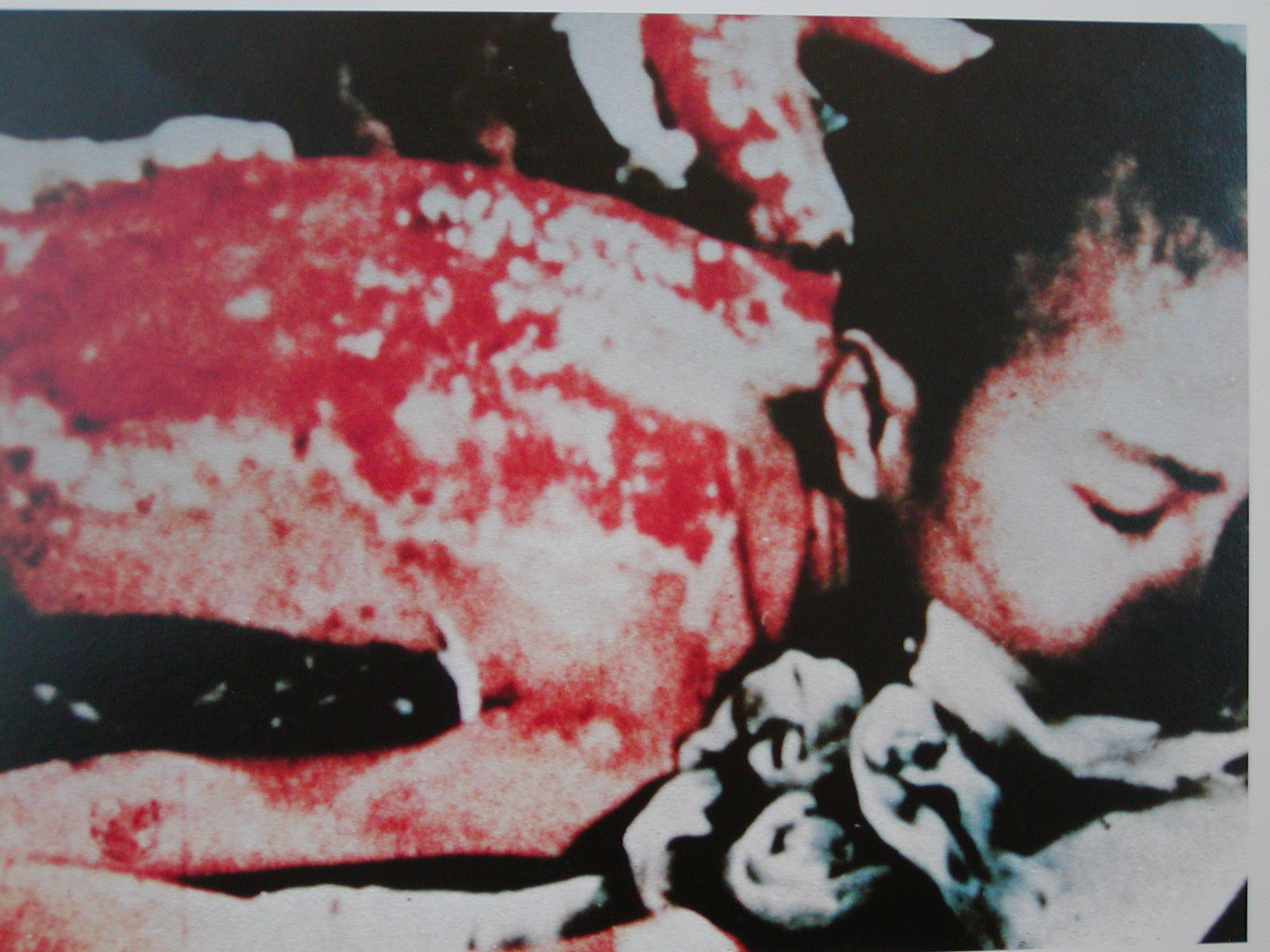
Other victims were scalded by the heat, which burned people crisp down to the bone and major body organs. Even more were trapped in their homes and burned alive by fires, as the heat erupted into a fireball that burnt buildings and homes to the ground throughout an eight square mile area in Hiroshima and a 4.2 square mile area in Nagasaki.
 Thousands who thought they escaped injury died from radiation poison in the coming weeks. Purple bruises spotted their skin and they bled through their eyes, ears and mouths. Those in the womb during the blast were born with microencephaly, which causes developmental delays, or other birth defects. Those who have survived until today live in dire straits today as their parental caregivers have since passed away.

This photo taken in the '70s shows persistent scarring.
Many other survivors, especially scarred young girls, committed suicide in the months and years after the blast. A host of survivors have developed cancers over the years. Those who are alive today never know when they, too, will develop cancer.

The exhibition winds up with posters showing US propaganda at its finest: newspaper accounts the US government providing medical aid and helping orphans.
If you have not yet walked through this important glimpse of US history, GRIID strongly urges you to take a half an hour to do so. The Grand Rapids Dominicans also provide a variety of informational handouts about the bombings and the case for global nuclear disarmament. You can also sign a petition to ban nuclear weapons that will be presented to President Obama.
War Criminal Bush Returning to Grand Rapids
According to MLive, the Economic Club of Grand Rapids has announced that George W. Bush will be the keynote speaker this year at its annual dinner on June 2nd.

Bush has been to Grand Rapids several times since the Supreme Court decided he would be President in 2000. The former President came to Grand Rapids in late January of 2003, the day after his State of the Union address announcing plans to invade Iraq. Bush also came to Grand Rapids just weeks before the 2004 election, in 2005 Bush was the commencement speaker at Calvin College and in April of 2007 Bush spoke to a closed audience at East Grand Rapids High School defending the US occupation of Iraq.
In each of these incidents, hundreds of people came out to protest Bush as a War Criminal. Some of the crimes committed during the Bush Cheney years included the illegal invasions/occupations of Afghanistan & Iraq, indiscriminate bombing and shooting of civilians, forced detention and torture.
There has been an ongoing campaign to prosecute Bush & Cheney for war crimes that was begun by the folks at afterdowningstreet.org, even after Bush left office and the Obama administration has refused to pursue such indictments.
Wouldn’t it be wonderful if people again showed up in big numbers to demand the prosecution of Bush for war crimes? Anyone willing to organize such an action?
March 8 – International Women’s Day
International Women’s Day evolved out of a growing effort amongst women’s and socialist groups to fight for more equality for women at the end of the 19th century and the beginning of the 20th century.
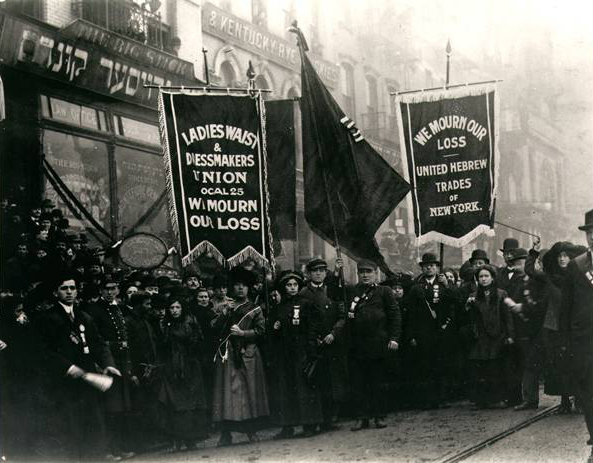
In 1908, 15,000 women marched in New York City demanding shorter work hours, better wages and the right to vote. In 1909, the Socialist Party of America designated February 28 as the first National Women’s Day, which was to be celebrated on the last Sunday of every February.
In 1910, at the Second International Conference for Working Women, there was a proposal to have an international women’s day, where women around the world would press for their demands on the same day. The proposal was not adopted until the following year and International Women’s Day (IWD) was celebrated in several countries around the world. However, something happened just one week later that would galvanize this new international movement.
On March 25, a fire began at the Triangle factory in New York City. It was common practice for factory owners to lock the workers inside until the work day ended and because of that practice 140 women, most Jewish and Italian immigrants, burned to death in that fire. The international women’s movement, labor and socialist movements mobilized around the world to mourn these women and to organize for worker and women’s rights.
For years after the first, the Triangle factory fire became the focus of International Women’s Day and gave birth to the Bread and Roses Campaign. The Bread and Roses Campaign was begun by workers (mostly women) who went on strike at a textile factory in Lawrence, Massachusetts. This strike was organized by the Industrial Workers of the World (IWW) with the slogan, “We want Bread, but we want Roses too!”

In 2010, millions of women and men are celebrating International Women’s Day in almost every country of the world. Over the weekend there were marches and observances in places like London, Toronto, China, and San Jose, California. The United Nations for this year’s IWD has adopted the theme, “Equal rights, equal opportunity: Progress for All!”
The Feminist Peace Network has compiled a great list of statements from women and women’s movements around the world to celebrate International Women’s Day. These statements reflect the urgency of demanding and working for the rights of women everywhere.
One commentator, Judy Rebick says, “In the end, my conclusion is that the inter-locking systems of patriarchy, colonialism and capitalism will maintain the oppression of women. There is only so far we can go without challenging all of them. That’s why I am thrilled to see the women’s movement become more global, more diverse, more radical and more integrated into other movements for social and environmental change. Even if in the short time, we are less effective in making change, in the long term the change will be deeper and broader.”
Let us celebrate the women in our lives – our mothers, our daughters, our grandmothers, our aunts, our cousins, our wives & partners, our co-workers, our neighbors and all the women in the world who deserve equality and justice.
Beauty Mark film at the Bloom Collective 3/12

The Bloom Collective is hosting a screening of the new documentary Beauty Mark: Body Image and the Race for Perfection.
In this courageous, deeply personal new film, Diane Israel examines American culture’s toxic emphasis on thinness, beauty, and physical perfection. Israel, a Boulder-based psychotherapist and former champion tri-athlete, talks candidly about her own struggle with eating disorders and obsessive exercising, fearlessly confronting her own painful past as she tries to come to terms with American culture’s unhealthy fixation on self-destructive ideals of beauty and competitiveness.
There will be a discussion following the film.
Friday, March 12
7pm
Location: 1134 Wealthy
$3 suggested donation
 Grand Rapids Institute for Information Democracy