Students Protest GRPS Policies
About 60-70 students gathered yesterday outside the administrative offices of the Grand Rapids Public Schools to protest two issues the students don’t think are in their best interest.
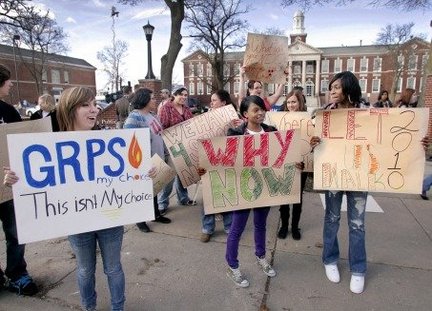
One issue is a proposal to consolidate all four of the GRPS high schools into one large graduation ceremony. The students we talked to said that they want the tradition of walking on stage with their school to get a diploma.
A half hour later, during the GRPS school board meeting, a student liaison to the board asked a question about this proposal to change graduation ceremonies. GRPS Superintendent Taylor said that this was a “rumor” and that he guarantees that students will walk and get a diploma, but he never said that each school will have its own ceremony.
The second issue that the students were protesting was the recent announcement that the school district will offer more online classes. Students told us that this means that some teachers will lose their jobs and they don’t support that. In addition, as Jakayla Holstein, a student at union said, “lots of students can’t concentrate as well with instruction from a computer screen, they need a real live teacher.” Danny Santiago, also a student at Union said that students are already skipping class and he thinks that having fewer teachers and class online will only increase the amount of student absenteeism.
However, if you look at the local news coverage from last night’s protest, most of the major commercial news agencies did not even address this second issue.
The WOOD TV 8 story makes it sound as if the students cause for concern “was rooted in confusion.” In the WZZM 13 story, more time is given to Superintendent Taylor and other school staff that to the students grievances. The WXMI 17 story states that the school district hasn’t come to a decision on the matter school graduation ceremonies.

The only major local commercial news agency to mention that the students were also protesting the issue of online classes was the Grand Rapids Press, which stated that the students were “saying they deserve to be taught by human beings.”
In addition, none of the news agencies bothered to ask the students how they organized this protest and what means they used to get the word out. One of the organizers, Paris Lara, told us that had just found out on Friday about these proposals, so he and others began to call people, text them and used a Facebook page that was created called the Grand Rapids Public Schools Student Union. Several of the students we talked to said they would keep pressuring the GRPS administration until their concerns were heard.
Vampire Movies, DVD Sales & the front page of the GR Press

It is certainly not surprising that the main story on the front page of today’s Grand Rapids Press is devoted to consumerism, since we have noted this in the past. However, a notable difference with today’s article is that it essentially acts as advertisement for local retailer.
The story in question is headlined “Retail revels in ‘New Moon,’” which is about the upcoming sale of the 2nd movie in the Twilight trilogy. The story basically provides a format for representatives of various local retailers to discuss their plans to market DVDs of the much-hyped teen movie. In addition, other sources cited in the story are those from the DVD distribution industry and a fan-based magazine.
However, the most outlandish aspect of the article was the sidebar next to the photo that accompanied the story. The sidebar is essentially a run down of what five area retail stores are planning along with the sales of the Twilight DVD and their hours of operation.
At a minimum the Press should have reserved this article for the “Your Life” section of the paper or better yet it should have just been run as a straight up advertisement. Making this a news story is not only an affront to journalistic standards, but it is an insult directed at the public.
GRIID Classes for Spring 2010
GRIID is pleased to announce that we will be offering two classes this spring beginning the second week of April as part of our ongoing effort to offer popular education opportunities for people in West Michigan.

On Mondays from 6-8pm beginning April 12, we will be offering a class on US Policy in Afghanistan. As the US occupation not only continues but escalates, it is important for people to have solid historical analysis of US policy in Afghanistan since the mid 1970s. We will be using the book Bleeding Afghanistan: Washington, Warlords and the Propaganda of Silence.
The other class is Making Sense of US Foreign Policy. This class explores US foreign policy since WWII and looks at US War, US interventions, plus, military, diplomatic and economic policies as it relates to outside of the US. The text we use for this class is Rogue State: A Guide to the World’s Only Superpower. The US Foreign Policy class will be on Wednesdays from 7 – 9pm beginning April 14.
To sign up for either class contact Jeff Smith jsmith@griid.org or Mike Saunders outobol@gmail.com.
Free Empowered Women’s Health workshop March 20
Empowered Women’s Health
Sat. March 20 10 a.m. – 4 p.m.
The Bloom Collective
1134 Wealthy SE
Info: bloomcollective@gmail.com
www.thebloomcollective.org

Celebrate Spring Equinox in solidarity with sisters! The Bloom Collective hosts a free workshop, Empowered Women’s Health, Sat. March 20, starting at 10 a.m. at 1134 Wealthy SE. The workshop will share information on alternative practices and philosophies around the issues of women’s healthcare as well as provide a safe space for women to share health wisdom with each other.
Such wisdom was the basis for good health in times past, before healthcare became a commodity on the stock market and a product on the pharmacy shelf. The workshop is intentionally free because access to health information, or healthcare for that matter, should not be based on one’s ability to pay.
Sessions include:
- Simple Herbal Remedies for Mothers and Others, a presentation by Chrysta Coronado, local herbalist and women’s health advocate.
- DIY facial and body care recipe exchange.
- De-sanitizing Our Menstrual Health with Rachael Hamilton, a presentation/discussion which will include a DIY pad making activity.
- Women & AIDS: Alive and Well in Kent County, Kelly Knudtson, CleanWorks.
- Expressive Language and Self-esteem with Dance, Painting
and Writing, a participatory session with Zulema Moret, director of Latin American Studies, GVSU.
We’ll have coffee and muffins in the morning and a potluck lunch—please bring a dish to pass. The Bloom Collective will provide vegan dishes. We do have seating available but if you have your own comfortable folding chair, bring it along.
It’s hard these days not to turn on the TV or read a newspaper and come across a news story or an advertisement that proclaims the benefits of green products and green businesses.

These “Green” businesses often use terms like sustainability to present what they are doing for the public. However, a critical look at this issue has not been explored much in the commercial media world, thus making it difficult for people to judge how sustainable these green business practices really are.
A critical examination of corporate appropriation of the concept of sustainability is exactly what author Adrian Parr investigates in her recent book Hijacking Sustainability. “Parr argues that the more popular sustainable development becomes, the more commodified it becomes; the more mainstream culture embraces the sustainability movement’s concern over global warming and poverty, the more “sustainability culture” advances the profit-maximizing values of corporate capitalism.”
We see this over and over again in local news coverage, where businesses make the claim that they are engaging in sustainable practices are not questioned in the news coverage.
For example, on Sunday, the Grand Rapids Press ran a story about a new solar panel grid that the Padnos Iron & Metals Co. have just installed in their Wyoming facility. The very first thing that Padnos President, Jeff Padnos says in the article is, “One of the first rules of sustainability is to make a profit.”
This underscores a fundamental flaw in the corporate sustainability movement, in that their primary motive for installing the solar panels is to make a profit. The article doesn’t talk about the environmentally sustainable benefits of such an undertaking, but how “State property tax breaks and tax credits for alternative energy projects also have a role in giving the panels an estimated payback of eight years.”
The article continues with an emphasis on how this will benefit businesses by stating, “Public policy favoring alternative energy helps manufacturers ramp up for the time when the market favors renewable sources.” So the market has to find renewable energy sources as beneficial in order for it to work? This question is not asked in the story, but presented merely as fact.

More importantly, the article states that Consumers Energy will be buying the excess electricity from Padnos, since State law requires it. Thus, Padnos will make a profit eventually on generating more electricity than they can use. Nowhere does the reporter question why the excess electricity cannot be turned over to the public in order to lower residential energy costs. This is another major flaw of the corporate sustainability movement in that even if renewable energy is created it is still confined to the free market system. Why not have energy that is generated in a renewable fashion be held in the public commons, the same way that parks, forests and rivers are? This would mean a radical shift in public policy, but would ultimately be more sustainable, since having energy generation in the public commons would mean that the public would have a say in how it is produced and consumed.
One last aspect of this Press article that should be explored is why the reporter did not even ask a question about the business practices of Padnos Iron & Metal Co. Is what Padnos does in and of itself sustainable? How much energy do they consume in the metals and iron recycling process? Does the company contribute to environmental contamination? Look at the picture included here of one of the Padnos facilities and ask yourself if there is no environmental contamination occurring. The Press reporter could have contacted the Michigan DEQ to find out if any of the Padnos facilities have committed State violation or are under review.
These are important questions, which journalists must pursue in order for the public to have as much information as possible before being able to determine whether or not businesses can be truly sustainable.
MLive and Forbes List of Richest People
Yesterday, MLive reported that Rich DeVos and Fred Meijer are once again on Forbes annual list of the world’s richest people. Grand Rapids Press reporter Troy Reimink posted the story and in typical fashion just mentions where Meijer and DeVos are on the Forbes list.
What is typical about this kind of reporting in West Michigan is that the reporting does not discuss how these men acquired their wealth and how they spend it. Both men are generally presented as wonderful philanthropists that we should all be grateful for.
However, both Meijer and DeVos have a history of anti-union/anti-worker practices. Meijer also has a track record of intimidating communities over tax and land-use issues when they want to build new stores, as was the case in Traverse City in 2007.
DeVos has a much longer track record of supporting pro-business and far right projects. He is one of the all-time biggest individual donors to the Republican Party and has made significant contributions to groups like Free Congress Foundation, Michigan Right to Life, Focus on the Family and the Family Research Council. DeVos also played a major role in shutting down William James and Thomas Jefferson colleges, which were part of Grand Valley State University and considered too radical for the Billionaire.
The Richest Men in the World
Press reporter Try Reimink also mentioned that the world’s richest man, according to Forbes is now Carlos Slim, a Mexican national. Reimink doesn’t give any information. Carlos Slim was a friend of former Mexican President Carlos Salinas and was the direct beneficiary of the privatization campaign that Salinas oversaw in the late 1980s/early 1990s. Slim was basically handed the national telephone system Tel-Mex and shortyly afterwards increased phone rates for the country. Slim also owns a huge chain of malls throughout Mexico as well.
Reimink mentions that Carlos Slim surpassed Bill Gates, who had been at the top of the list for several years and then ends with this sentence. “Donations to cheer up Gates can be made in care of his foundation.” It is hard to tell if Reimink is just joking by this statement, but either way his article omits anything about what Gates’ foundation is up to.
The Gates Foundation has been at the forefront of promoting the use of genetically modified agriculture in Africa in what some are calling the new Green Revolution. This new Green revolution is also seeing the Gates Foundation fund land grabs in places like Africa for the purpose of benefiting other multinational corporations. However, if one were relying on Grand Rapids Press reporters to provide the kind of analysis that goes beyond headlines, they would be easily disappointed.
New Video on Civilian Deaths in Afghanistan
Brave New Films and Rethink Afghanistan have posted a new video looking at recent civilian deaths in the most recent US/NATO “surge.” The video is also inviting people to join Rethink Afghanistan on Facebook.
US House of Representatives Votes Against Resolution to Withdraw Troops from Afghanistan
On Wednesday, the US House of Representatives had the first debate on the US Occupation of Afghanistan since they passed a resolution in 2001 giving then President Bush authorization to send troops.

Ohio Congressman Dennis Kucinich introduced House Resolution 248, “directing the President, pursuant to section 5(c) of the War Powers Resolution, to remove the United States Armed Forces from Afghanistan.”
The resolution was overwhelmingly defeated with of vote of 356 against the resolution and 65 in favor. Congressman Vern Ehlers voted against the resolution, as did most Michigan Representatives. The only Michigan member of the house who voted for the resolution was Bart Stupak. However, there were three Michigan Congressmen who did not vote; Conyers, Camp and Hoekstra.
During the debate, Rep. Patrick Kennedy noted that there were only 2 members of the US media present in the gallery to hear the debate. Apparently the news that tiger Woods might soon play in a golf tournament was more news worthy.
Kucinich, who has long been a critic of the US occupations of Iraq and Afghanistan stated;
“This debate today, Mr. Speaker, we will have a chance, for the first time, to reflect on our responsibility for troop casualties that are now reaching a thousand, to look at our responsibilities for the costs of the war, which approaches $250 billion; our responsibility for the civilian casualties and the human costs of the war; our responsibility for challenging the corruption that takes place in Afghanistan; our responsibility for having a real understanding of the role of the pipeline in this war; our responsibility for debating the role of counterinsurgency strategies, as opposed to counterterrorism; our responsibility for being able to make a case for the logistics of withdrawal. After eight-and-a-half years, it is time that we have this debate.”
Here is video of the complete statement from Congressman Kucinich.
 Local children’s advocacy group, Stop Targeting Our Kids (STOK), a coalition that operates in solidarity with the national Campaign for a Commercial Free Childhood (CCFC), is deeply concerned that the Disney Corporation has orchestrated CCFC’s ouster from offices it has used for ten years at Judge Baker Children’s Center (JBCC), a Harvard-affiliated children’s mental health center in Boston.
“The Campaign for A Commercial Free Childhood has led the charge against corporations and marketers who place profit ahead of the health and well being of children, families and schools,” says Grand Rapids mom, early childhood advocate and STOK member, Mindy Holohan. “The large membership and targeted activism of the CCFC have given a potent voice to the concerns of a growing body of parents, educators, faith-based leaders and physical and mental health practitioners who provide daily witness to the unhealthy impact of commercialization on the lives of children.”
According to the CCFC, “JBCC severed our affiliation at a time when our work on behalf of children and families was being heralded worldwide. As described in this week’s New York Times, last fall’s successful campaign to get Disney to offer refunds on Baby Einstein videos came at a price. At the height of the media flurry about the refunds, representatives from Disney contacted JBCC, and our relationship with the Center was changed irrevocably. We were pressured to stop talking to the press about Baby Einstein . . . And, for our remaining time under JBCC’s auspices, we were forbidden from conducting any advocacy aimed at a specific corporation or product . . . It is chilling that any corporation, particularly one marketing itself as family friendly, would lean on a children’s mental health center.”
CCFC’s move to new offices was unexpected and expensive. However, the organization is committed to continue advocating for children, even if that means tangling with the big corporations who are willing to ignore children’s mental, emotional and physical well being in the name of profit. Companies  like Disney, Nickelodeon, McDonald’s, Coca-Cola and Scholastic would love to see the CCFC go away. But, the CCFC is more determined than ever to continue advocating for children nationally, as is STOK, right here in West Michigan.
Holohan concluded, “The CCFC’s major successes in holding the Disney Corporation accountable for false claims surrounding the educational benefits of Baby Einstein products and their significant role in the dismantling of BusRadio, a for-profit company that generated revenue from advertising directed specifically at children as they rode buses to and from school, has made the CCFC a more substantial and visible threat to those who invest millions toward the singular goal of targeting children for profit.”
Haiti Post-Earthquake: An Interview with Noam Chomsky
(This was first published in ¡Reclama! magazine.)
Keane Bhatt: Recently you signed a letter to the Guardian protesting the militarization of emergency relief. It criticized a prioritization of security and military control to the detriment of rescue and relief.

Noam Chomsky: I think there was an overemphasis in the early stage on militarization rather than directly providing relief. I don’t think it has any long-term significance…the United States has comparative advantage in military force. It tends to react to anything at first with military force, that’s what it’s good at. And I think they overdid it. There was more military force than was necessary; some of the doctors that were in Haiti, including those from Partners in Health who have been there for a long time, felt that there was an element of racism in believing that Haitians were going to riot and they had to be controlled and so on, but there was very little indication of that; it was very calm and quiet. The emphasis on militarization did probably delay somewhat the provision of relief. I went along with the general thrust of the petition that there was too much militarization.
KB: If this militarization of relief was not intentionally extreme but rather just a default response of the US, is it just serendipity that there is a massive troop presence available to manage the rapidly mounting popular protests post-earthquake? Surprisingly large, politicized group comprised of survivors has already mobilized around demanding Aristide’s return, French reparations instead of charity, and so on.
NC: So far, at least, I don’t know of any employment of the troops to subdue protests. It might come, but I suspect a more urgent concern is the impending disaster of the rainy season, terrible to contemplate.
KB: Regarding relief work, aside from Partners in Health, Al Jazeera noted that the Cuban medical team was the first to set up medical facilities among the debris and constitutes the largest contingent of medical workers in Haiti, something that preceded the earthquake. If their performance in Pakistan [earthquake of 2005] is any indicator, they will probably be the last to leave. Cuba seems to have an exemplary, decades-long conduct in foreign assistance.
NC: Well, the Cubans were already there before the earthquake. They had a couple hundred doctors there. And yes, they sent doctors very quickly; they had medical facilities there very quickly. Venezuela also sent aid quite quickly; Venezuela was also the first country and the only country at any scale to cancel totally the debt. There was considerable debt to Venezuela because of PetroCaribe, and it’s rather striking that Venezuela and Cuba were not invited to the donors’ meeting in Montreal.
Actually the prime minister of Haiti, Bellerive, went out of his way to thank three countries: the Dominican Republic, Cuba and Venezuela for their rapid provision of aid. What Al Jazeera said about Pakistan is quite correct. In that terrible earthquake a couple of years ago, the Cubans were really the only ones who went into the very difficult areas high up in the mountains where it’s very hard to live. They’re the ones who stayed after everyone else left. And none of that gets reported in the United States. But the fact of the matter is, whatever you think about Cuba, its internationalism is pretty dramatic. And the people who’ve been working in Haiti for years have been awestruck by Cuban medical aid as they were in Pakistan, in fact. That’s an old story. I mean, the Cuban contribution to the liberation of Africa is just overwhelming. And you can find that in scholarship, but the public doesn’t know anything about it.
KB: On that point, you’ve talked about how “states are not moral agents. They act in their own interests. And that means the interests of powerful forces within them.” How does the history of exemplary humanitarian work as Cuban state policy relate to that thought?
NC: Well, I think it’s just been a core part of the Cuban revolution to have a very high level of internationalism. I mean, these cases you’ve mentioned are cases in point, but the most extreme case was the liberation of Africa. Take the case of Angola for example, and there are real connections between Cuba and Angola—much of the Cuban population comes from Angola. But South Africa, with US support, after the fall of the Portuguese empire, invaded Angola and Mozambique to establish their own puppet regime there. They were trying to protect Namibia, to protect apartheid, and nobody did much about it; but the Cubans sent forces, and furthermore they sent black soldiers and they defeated a white mercenary army, which not only rescued Angola but it sent a shock throughout the continent—it was a psychic shock—white mercenaries were purported to be invincible, and a black army defeated them and sent them back fleeing into South Africa. Well that gave a real shot in the arm to the liberation movements, and it also was a lesson to the white South Africans that the end is coming. They can’t just hope to subdue the continent on racist grounds. Now, it didn’t end the wars. The South African attacks in Angola and Mozambique continued until the late 1980s, with strong US support. And it was no joke. According to the UN estimates they killed a million and a half people in Angola and Mozambique, nothing slight. Nevertheless, the Cuban intervention had a huge effect, also on other countries of Africa. And one the most striking aspects of it is that they took no credit for it. They wanted credit to be taken by the nationalist movements in Africa. So in fact none of this was even known until an American researcher, Piero Gleijeses unearthed the evidence from the Cuban archives and African sources and published it in scholarly journals and a scholarly book, and it’s just an astonishing story but barely known—one out of a million people has ever heard of it.
KB: You mentioned the Venezuelan debt cancellation. At the same time, the G7 is in the process of eliminating bilateral debt. Why is that?
NC: Well they’re talking about it, yeah. The Venezuelans were first. And they just completely canceled the debt. G7 refused. In the Montreal meeting, they refused to even discuss it. Later, they indicated that they might do something. Maybe they’re embarrassed by the Venezuelan action. But I’m not sure how it’s playing out. As far as the IMF is concerned—the IMF is basically an offshoot of the US Treasury Department—they’ve talked about it but so far they have not agreed, as far as I can discover, to cancel the debt.
KB: Bellerive, Prime Minister of Haiti, thanked the Dominican Republic, Cuba and Venezuela. The DR has been lauded for its relief efforts: providing food, materials and medical care, for example. But at the same time there are reports from the border of Dominican troops forcibly deporting family members of Haitian patients and sometimes even the patients themselves, in Jimaní, for example. What is your take on these contrary developments taking place and is there any historical context that you would like to add?
NC: Well, what the Dominican Republic does is up to Dominicans to decide, but the much more striking thing from my perspective, is that the United States has not brought in any—barely any refugees—even for medical treatment. And that was harshly condemned by the dean of the University of Miami Medical School who thought it was just criminal not to bring Haitians to Miami where there’s marvelous medical facilities while they have to do surgery with, you know, hacksaws in Haiti. And in fact one of the first US reactions to the earthquake was to send in the Coast Guard to ensure that there wouldn’t be any attempt to flee from Haiti. I mean, that’s atrocious. The United States is the richest country in the world, it’s right next door to Haiti. It should be offering every possible means of assistance to Haitians.
Furthermore there’s a little bit of background here. I mean, the earthquake in Haiti was a class-based catastrophe. It didn’t much harm the wealthy elite up in the hills, they were shaken but not destroyed. On the other hand the people who were living in the miserable urban slums, huge numbers of them, they were devastated. Maybe a couple hundred thousand were killed. How come they were living there? They were living there because of—it goes back to the French colonial system—but in the past century, they were living there because of US policies, consistent policies.
KB: You’re talking about the forcible decimation of peasant agriculture in the 1990s?
NC: It started with Woodrow Wilson. When Wilson invaded all of Hispaniola, Haiti and the DR, the Wilson invasion was pretty brutal in both parts of Hispaniola. But it was much worse in Haiti. And the reasons were very clearly stated.
KB: Racism.
NC: Yeah. The State Department said, well, the Dominicans have some European blood so they’re not quite so bad. But the Haitians are pure nigger. So Wilson sent the marines to disband the Haitian parliament because they wouldn’t permit US corporations to buy up Haitian lands. And he forced them to do it. Well, that’s one of the many atrocities and crimes. Just keeping to this, that accelerated the destruction of Haitian agriculture and the flight of people from the countryside to the cities. Now that continued under Reagan. Under Reagan, USAID and the World Bank set up very explicit programs, explicitly designed to destroy Haitian agriculture. They didn’t cover it up. They gave an argument that Haiti shouldn’t have an agricultural system, it should have assembly plants; women working to stitch baseballs in miserable conditions. Well that was another blow to Haitian agriculture, but nevertheless even under Reagan, Haiti was producing most of its own rice when Clinton came along.
When Clinton restored Aristide—Clinton of course supported the military junta, another little hidden story…he strongly supported it in fact. He even allowed the Texaco Oil Company to send oil to the junta in violation of presidential directives; Bush Sr. did so as well—well, he finally allowed the president to return, but on condition that he accept the programs of Marc Bazin, the US candidate that he had defeated in the 1990 election. And that meant a harsh neoliberal program, no import barriers. That means that Haiti has to import rice and other agricultural commodities from the US from US agribusiness, which is getting a huge part of its profits from state subsidies. So you get highly subsidized US agribusiness pouring commodities into Haiti; I mean, Haitian rice farmers are efficient but nobody can compete with that, so that accelerated the flight into the cities. And it wasn’t that they didn’t know it was going to happen. USAID was publishing reports in 1995 saying, yes this is going to destroy Haitian agriculture and that’s a good thing. And you get the flight into the cities and you get food riots in 2008, because they can’t produce their own food. And now you get this class-based catastrophe. After this history—it’s only a tiny piece of it—the United States should be paying massive reparations, not just aid. And France as well. The French role is grotesque.
KB: May I ask, regarding Aristide’s languishing in exile, was he right to go back to Haiti in 1994 in the way that he did, with US troops? Also, was he right to agree, under enormous pressure of course, to the neoliberal reforms laid out in the Paris Accords?
NC: Well, I happened to be in Haiti almost at that time—1993. I was there for a while; this was the peak of the terror. And I’ve been in a lot of awful places in the world. Some of the worst, in fact. But I don’t think I’ve ever seen anything like the misery and the terror that was going on in Haiti under the junta, with Clinton’s backing at that time. And there was a lot of discussion, I talked for example to the late Father Gerard Jean-Juste, one of the most popular figures in Haiti, who the government recently forced out, he was then underground in a church but Haitian friends took me to him. He was very close to large parts of the population. I talked to labor leaders who’d been beaten and tortured but were willing to talk, and to activists and others. And what most of them said is, Father Jean-Juste for example, what he said is, “Look, I don’t want a marine invasion, I think it’s a bad idea. But on the other hand,” he said, “my people, the people in the slums—La Saline, Cite Soleil and so on, they just can’t take it anymore.” He said, “the torture is too awful, the terror is too awful. They’ll accept anything that’ll put an end to it.” And that was the dilemma. I don’t have an answer to that.
KB: Was Aristide wrong to argue against calls (made by some of his more militant supporters) for armed struggle inside Haiti to restore democracy after the 1991 coup?
NC: Not in my opinion. Armed struggle would have led to a horrendous slaughter.
KB: On February 17th, Sarkozy was greeted to street protests by thousands of Haitians holding up images of Aristide, demanding his return, and demanding reparations for what the French extorted in exchange for recognizing Haiti’s independence. At that same address, Preval was shouted down and he withdrew into his jeep. With this kind of sentiment brewing in Haiti right now, do you see Aristide’s return as an important priority, or is it something that might be desirable but not that pressing?
NC: Well, the answer to that question is going to be given in Washington. The United States and France, the two traditional torturers of Haiti, essentially kidnapped Aristide in 2004 after having blocked any international aid to the country under very dubious pretexts, not credible grounds, which of course extremely harmed this fragile economy. There was chaos and the US and France and Canada flew in, kidnapped Aristide—they said they rescued him, they actually kidnapped him—they flew him off to Central Africa, his party Fanmi Lavalas is banned, which probably accounts for the very low turnout in the recent elections, and the United States has been trying to keep Aristide not only from Haiti, but from the entire hemisphere.
KB: By which way is Aristide compelled to remain exiled? How exactly is his persona non grata status in the hemisphere maintained and by whom? What is preventing him from flying into a sympathetic country near Haiti, like Venezuela, for example?
NC: He might be able to go to Venezuela, but if he tried to go to the Dominican Republic, for example, they wouldn’t let him in. And there’s good reason for that. International affairs is very much like the mafia, and the small storekeeper doesn’t offend the Godfather. It’s too dangerous. We can pretend it’s otherwise, but that’s the way it is. There was one country, I think it was Jamaica if I remember correctly, that did allow Aristide in, over serious US pressure and protest. And not a lot of countries are willing to take the risk of offending the United States. It’s a dangerous, violent superpower. I don’t have to tell you, you know the history of the Dominican Republic. I don’t have to tell you about it—that’s the way it works.
KB: Using, as you’ve said, the historical US legacy in the DR, can we turn to recent Dominican history? As this humanitarian aid is provided on behalf of the DR, and it fills in the vacuum left by a weak Haitian state, if we go back to the events leading up to the coup of 2004, it worked under US aegis to actively destabilize Haiti by training the paramilitary rebels, Guy Philippe and Louis Jodel Chamblain…
NC: I know. And providing a base for them.
KB: Is there some kind of a contradiction to provide charity for people who you’ve actually worked to dismantle and destabilize?
NC: Well, you can call it a contradiction if you like, but it’s also a contradiction for Sarkozy and Clinton to appear in Haiti without abject apologies for the terrible crimes that France and the U.S. under Clinton, particularly, have carried out against Haiti. But they don’t do it. The head of Toyota has to go to Congress and apologize for hours because some people were killed by Toyota cars, but does Clinton have to go and apologize for what he did to Haiti? He dealt a death blow. Does Sarkozy have to apologize for the fact that Haiti was France’s richest colony and a source of a lot of France’s wealth and they destroyed the country and then posed an indemnity as a price for liberating themselves, which the country was never able to get out of? A couple of years ago, in 2002 I think, Aristide appealed to France, to Chirac, to pay some remuneration for the huge debt that Haiti had to pay them…
KB: Twenty-one billion dollars…
NC: Yeah, for this huge debt that Haiti had to pay them. And they did set up a commission led by Regis Debray, a former radical. And the commission said that France has no need to give any compensation at all. In other words, first we rob and then destroy them, and then when they ask for a little bit of help, we kick them in the face. It’s not surprising.
KB: Although at the same time there are sources that say that while France put up an indifferent front, it was actually worried about a head of state bringing a legal case with overwhelming documentary evidence for international arbitration.
NC: Well, they really didn’t have to worry, because the way power politics works, the World Court can’t do anything. Look, there’s one country in the world at the moment which has refused to accept World Court decision—that’s the United States. Is anybody going to do anything about it?
KB: You mentioned Clinton, now UN special envoy to Haiti, who intends to woo foreign investors and continue on a low-wage textile focus for Haitian economic development. The lens of neoliberal economist Paul Collier, special adviser to the UN in 2009, dominates the UN perspective of Haiti. An advocate of sweatshop-led growth himself, he’s lavished praise on the much-resented MINUSTAH occupation force there, and has even said that the Dominican Republic “is not engaged in the sort of activities, such as clandestine support for guerrilla groups, that beset many other fragile states.” Can a true humanitarian like Paul Farmer—representing a different development model based on fair wages, public health, strengthening the Haitian state—influence the UN as deputy special envoy?
NC: It’s a hard choice. I don’t blame him for trying. We live in this world, not another one that we’d prefer, and sometimes it’s necessary to follow painful paths if we hope to provide at least a little help for suffering people. Like Father Jean-Juste and the marines.
KB: You’ve talked about how the media created an artificial distinction between the South American ‘Bad Left’ and ‘Good Left,’ omitting Brazil’s important collaboration with Venezuela in the interest of maintaining this view. However, with respect to Haiti, hasn’t Brazil legitimately earned a secure place within the ‘Good Left’? A center-left government of the South has spearheaded the MINUSTAH occupation and has pledged to increase its presence, after taking it over from the imperial architects of the coup (US, France, Canada). What factors made it so vigorous in supporting another deposed president of an equally geopolitically-unimportant country in recent times (Zelaya of Honduras)?
NC: Good questions. I haven’t seen anything useful on Brazil’s decisions on these matters.
KB: Any comments on the US media regarding Haiti following the earthquake? For example, Pat Robertson’s ‘pact with the devil,’ David Brooks’ ‘progress-resistant culture,’ pleas with transnational capital to create more sweatshops (Kirstof), Aristide being a despot and a cheat (Jon Lee Anderson). Even Amy Wilentz has compared Aristide to Duvalier in the New York Times.
NC: It’s been mainly awful, but I haven’t kept a record. The worst part is ignoring our own disgraceful role in helping to create the catastrophe, and consequent refusal to react as any decent person should—with massive reparations, directed to popular organizations. Same with France.
KB: I guess my final question is for the future: there have been a discouraging two decades, from 1990-2010, about the popular mobilization for political change in Haiti, and how to proceed, and I guess now that the Haitian people have struggled so hard through parliamentary democracy for 25 years and have so little to show for it, what are the lessons learned and possible strategies now that they’ve exhausted this parliamentary, democratic approach? Two coups d’etat and thousands tortured and murdered in this process.
NC: The lessons are, unfortunately, that a small weak country that is facing an extremely hostile and very violent superpower will not make much progress unless there’s a strong solidarity movement within the superpower that will restrain its actions. With more support within the United States, I think the Haitian efforts could have succeeded.
And that applies right now. Take the aid that’s coming in. There is aid coming in—we have to show we’re nice people and so on. But the aid ought to be going to Haitian popular organizations. Not to contractors, not to NGOs—to Haitian popular organizations, and they’re the ones that should be deciding what to do with it. Well you know, that’s not the agenda of G7. They don’t want popular organizations; they don’t like popular movements; they don’t like democracy for that matter. What they want is for the rich and powerful to run things. Well, if there was a strong solidarity movement in the United States and the world, it could change that.
 Grand Rapids Institute for Information Democracy