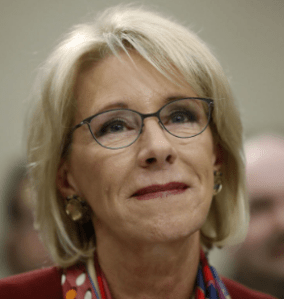
 Last week, Secretary of Education, Betsy DeVos, announced that a new School Safety Commission has been formed.
The announcement from DeVos also stated, “The Commission has been charged with quickly providing meaningful and actionable recommendations to keep students safe at school.”
This new commission has been created, in light of the recent school shootings, but is not limited to just gun violence. If the goal is to keep students safe while attending school, then we can make some assessments based on who has been name to sit on this 4 member commission.
Betsy DeVos
Since Betsy DeVos was put in charge of creating this new Commission on School Safety, she has designated that she would be one of the four members of the commission. Her qualifications in this area are rather vague, plus she has inherited a system that in many ways is not committed to student safety.
For instance, since the 1990s, the Department of Justice funded the “Cops in Schools” program, costing taxpayers $750 million. One of the results of the Cops in Schools program, “has led to the a massive increase in the arrests of students that fundamentally undermines the educational mission of schools, turning them into an extension of the larger carceral state and feeding what has come to be called the school to prison pipeline,” according to Alex Vitale. (The End of Policing)
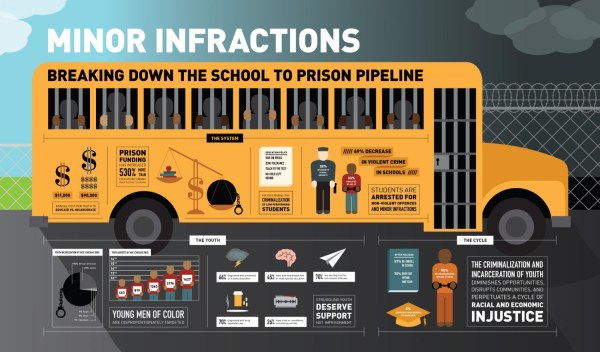
The presence of police in schools has also resulted in more suspensions and detention for students, especially students of color and student from families living in poverty.
This is a system that Betsy DeVos has inherited and she has given no indication that she we de-militarize schools, by removing police officers.
Secondly, Betsy DeVos worked to diminish Title IX policies, thus making it harder for students who have been sexually assaulted on campuses across the country, to get justice.
Third, Betsy DeVos has made no public statements against Immigration & Customs Enforcement (ICE) officials from coming into schools or waiting at school to arrest parents of students who are undocumented.
Attorney General Jeff Sessions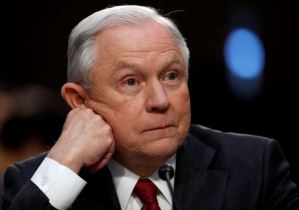
First, according to a recent article on Buzzfeed:
Sessions had earned top grades from the advocacy group over his two decades as a senator, and the director of the NRA’s lobbying arm, Chris Cox, boasted about Sessions’s record in an op-ed last January in USA Today. The firearm advocacy group announced in a press release at the time that it would spend at least $100,000 on commercials to boost him to the top post of the Justice Department.
Second, just after the school shooting in Florida in February, Sessions, while attending a Sheriff’s Convention in Washington, DC, made the following statement:
“I think effective enforcement of our gun laws, focusing on criminals and dangerous people, mentally ill people that have been — where we have the legal ability to do so — can reduce violence in our communities and improve public safety,” Sessions said. “It is not good if we got gun laws that say criminals can’t carry guns and they never get enforced. So we intend to enforce our laws.”
A Think Progress article responded to this statement by saying:
But there are a couple obvious problems with Sessions’ idea. Nikolas Cruz, the 19-year-old allegedly responsible for using an AR-15 semi-automatic rifle to murder 17 people at Marjory Stoneman Douglas High School in Parkland, Florida, bought his military-caliber weapon legally. Cruz also had no criminal record. So it’s hard to see how stronger enforcement of existing gun laws could have prevented the carnage.
Third, Attorney General Jeff Sessions has made it clear that he will begin deporting more undocumented immigrants. This will create more stress, anxiety and fear for students who have parents that are undocumented, since schools will be places that ICE agents will target while immigrant parents pick up their children.
Lastly, Jeff Sessions announced last year in a memo, that he is giving cops permission to continue and expand targeting blacks. This too creates more anxiety, stress and fear for black students if they or their families members will be targeted by law enforcement.
Secretary of Homeland Security Kirstjen Nielsen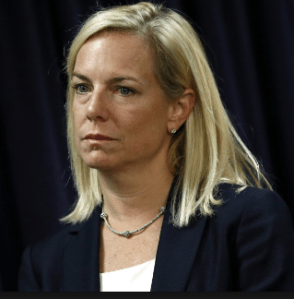
Nielsen is a longtime Homeland Security Department official who served as Kelly’s chief of staff when he was DHS secretary and accompanied him to the White House as his deputy. She also worked at the DHS during the George W. Bush administration and founded a consulting firm focused on risk and security management, according to a Washington Post story last year.
After the Florida school shooting, the Department of Homeland Security announced they were drafting a guide to help schools and law enforcement create Targeted Violence Prevention Plans.
“These plans outline procedures for schools on how to create multidisciplinary threat assessment teams, establish central reporting mechanisms, identify student behaviors of concern, define the threshold for law enforcement intervention, and identify intervention and management strategies for decreasing the risk of a targeted attack,” a Homeland Security news release said.
This announcement doesn’t really sound like this effort will keep students safer, instead it will likely result in profiling students over “behavioral concerns.”
Lastly, upon taking office in December of 2017, Nielsen made it clear where she stands on immigration issues, when she stated:
“The president has made it clear that my number one priority as secretary of Homeland Security is to protect America from all threats,” Nielsen told the Washington Examiner on Friday. “As I discussed this week, making America safe starts with securing our borders, increasing interior immigration enforcement, protecting our communities, and dismantling transnational criminal organizations.”
Like her colleagues on the School Safety Commission, Nielsen is equally committed to rounding up undocumented immigrants, which will created a larger climate of fear for students of immigrant parents.
Secretary of Health and Human Services Alex Azar
Azar comes to the Trump administration as the former president of the U.S. arm of Eli Lilly & Co. Eli Lilly has a history of spending millions of dollars to get candidates elected and to lobby for policies that would be financially beneficial to the pharmaceutical industry.
Azar has no real world experience around public safety issues, let along school safety. However, the head of Health & Human Services has said that he would support the CDC in conducting more extensive research into gun violence.
As you can see, it would be unreasonable for the public to have expectations that this new commission will actually make a difference in school safety. On the contrary, this commission will likely result in firming up the already systemically violent relationship to students, particularly black students and students from immigrant families.
 It is common knowledge that at the state and federal level, candidates need a substantial amount of money of they are going to get elected within the current political system.
In fact, both candidates and incumbents never really stop raising money, for either their own campaign or for other politicians within their party. This definitely the case for Democrats and Republicans.
On top of that, most candidates and incumbents are primarily interested in big donors. You can usually tell by how much their fundraising events cost and where they are located.
The Michigan Campaign Finance Network recently released a new report showing that in 2017, there were 601 fundraisers for state office holders in Michigan. In 2016, there were 439 fundraisers and in 2015, there were 315. Clearly, there has been an increase in the amount of fundraisers being hosted by incumbents or those who are term-limited and seeking higher office.
As you can see from the graphic above, Grand Rapids was the number two destination where these fundraisers were held. The fact that Lansing was the number one location makes complete sense, since incumbents hold fundraisers near their downtown Lansing offices.
We wanted to share with you some of the data on fundraisers that have been hosted by incumbents or those term-limited and seeking higher office from West Michigan.
Democrats
Winnie Brinks for State Senate
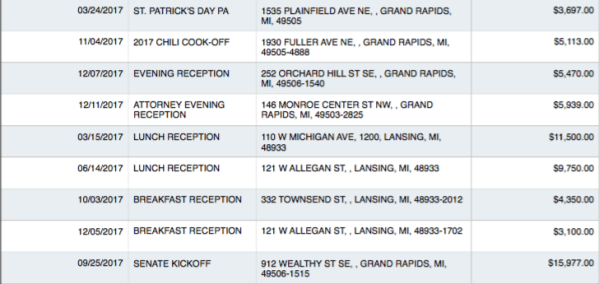
Rep. David LaGrand
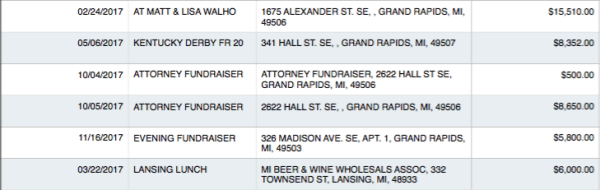
Republicans
Rep. Chris Afendoulis 73rd House District

Rep. Tommy Brann 77th House District

Rep. Julie Calley 87th House District

Daniela Garcia for State Senate

Rep. Steve Johnson 72nd House District

Rep. Jim Lilly 89th House District

Rep. Rob VerHeulen 74th House District

Donor’s Trust, Dark Money and their ties to West Michigan
Donor’s Trust is a non-profit that was created in 1999 and committed to the, “ideals of limited government, personal responsibility, and free enterprise.” It’s sister organization , is called Donors Capital Fund and both of them are made up of members of the Capitalist class to provides big donors an opportunity to hide their money that can influence public policy.
According to SourceWatch, “As a rule, Donors Trust refers clients to Donors Capital Fund if they expect to open donor-advised funds of more than $1,000,000. The twin Donors organizations are advertised as a way for very wealthy people and corporations to remain hidden when “funding sensitive or controversial issues,” creating a lack of accountability.”
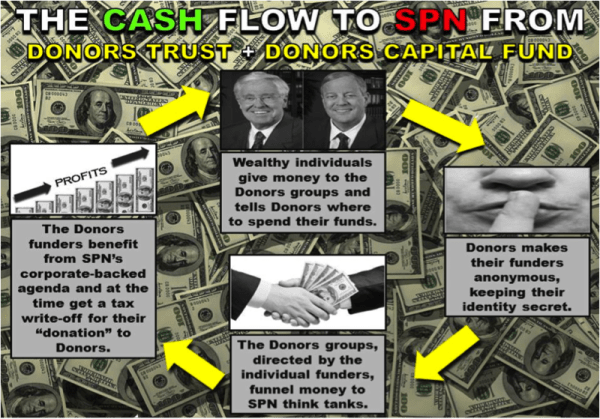
In 2013, we ran a story about how the Richard & Helen DeVos Foundation was a major contributor to the Donor Trust and the Donor Capital Fund. Along with the Koch Brothers and other Wealthy families in the country, the DeVos family channels funds to Donors Trust to help hide some of their funding that might otherwise be scrutinized.
The Center for Media and Democracy just posted a new article about how much money Donors Trust gave out to support right wing groups that are engaged in promoting hate against Islamic groups, undermining unions, denying climate change and a whole litany of organizations that are deeply committed to imposing harsh neoliberal austerity measures on the public.
One such organization that is deeply committed to these neoliberal economic principles, is the Acton Institute for the Study of Religion and Liberty.
 In 2015, based on the 990s from Donors Trust and Donors Capital Fund, the Acton Institute received $1,083,200 to support their work to promote neoliberal capitalist economic policies. When looking at the 990s, the funding from Donors Trust and Donors Capital Fund to groups like the Acton Institute, it always says the money is for “general operations.” Such designation’s are purposely vague, as a means to make it harder to find out what they do with these funds.
Dark Money entities like Donors Trust and Donors Capital Fund help to channel money to other non-profits that can influence public policy, as well as elections – see the info graphic from the Center for Public Responsibility here on the right. The Center for Public Responsibility also has great resources and analysis on the function of Dark Money.
The very fact that the Acton Institute is a major recipient of Donors Trust and Donors Capital Fund monies, is just one more reason that this Grand Rapids institution in should be exposed and resisted.
What one GRPS Principal said to students during the National Walkout in support of Parkland Students
 On March 14, hundreds of thousands of students participated in the National Walkout in support of the Students from Parkland and Against gun violence in schools
Like the rest of the country, the Grand Rapids Public Schools students participated in the walkout.
GRPS Superintendent Teresa Weatherall Neal said they are using the event as a teachable moment focused on school safety and the district’s’ “See It, Say It, Do Something About It-Stop School Violence” theme.
Shortly after the GRPD Superintendent release a statement on what they intended to do, several GRPS students wrote how what the GRPS administration was doing was a hinderance to students. The student response reads in part:
The problems with the district’s endorsement of the walkout are most evident in the letter sent home about the event. The letter contained a short statement of support for the walkout, a rigid plan for each grade level laying out what the students would and would not be allowed to do as part of the demonstration, and a permission slip to be signed by each student’s parent or guardian before they could participate in the action.
Some of those in leadership positions within the GRPS went a step further on the day of the student walkout, which we were alerted to recently by a parent who wishes to remain anonymous. Here is video of what the Principal at North Park Montessori, Robin Sorge, said to the students at that school:
What the Principal at North Park Montessori read to the students on March, was from a posting on a right wing blog site, called Common Sense Evaluation.

The parent who found the statement read by the principal, sent her the following message:
I’m really disappointed in the way you handled the walkout assembly today. My children and husband were also very disappointed. The boys wanted to write a letter to you themselves, but they are too scared to send it because they think they’ll be in trouble if they tell you.
You did not honor children’s voices at all when you dictated the agenda today.
You did not share the microphone so the children could be heard. You held it the entire time.
The letter you read originated from a tea-party website filled with anti-lgbtq messages, conspiracy-theories, anti-immigration sentiments, nationalist rhetoric and pro-NRA messages.
The site even included multiple theories that the Parkland School students were crisis actors, and were hired to promote anti-second amendment messaging.
My husband and I are teaching our children that their voices matter and that they have a right to protest and be heard. We chose Montessori because of the principles of listening to the child, following them and supporting them in their work of becoming engaged members of society.
This assembly did none of those things.
We also wanted to know what you will do with the answers you wrote. Will you share them with any decision-makers at the school? Will anything change to make the children feel safer?
We all appreciated that you wanted us to be nice to each other, but that letter you read, promoting this, also implied that the children in Sandy Hook or Parkland perhaps weren’t nice enough, and that’s why the shooter came in. That being nice will stop bullets. And also that their protests, their raised voices begging to heard, were useless.
I understand why you did what you did from the perspective of someone who wants to control the narrative and maybe protect small children’s ears, but it was very poorly handled.
My kids wanted to walk out of school today with the rest of the nation’s participating children after hearing about honoring the children who were hurt in their school. But they also wanted to hear what you said first in the gym, they respect you. Perhaps consider respecting them next time by letting them have a say in setting the agenda and allowing them to exercise their rights.
You should strongly consider issuing an apology to your students. They were not truly honored today.
I’d also very much appreciate a response as to why you thought it was acceptable to read that dismissive, patronizing and pro-NRA letter in front of the entire school.
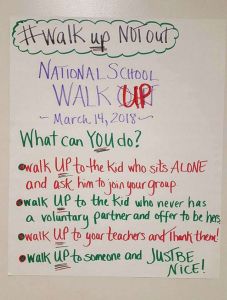 In many ways, the letter that was read from the conservative blog, is very much in line with the viral campaign WalkUpNotOut. This counter-campaign is not only ridiculous, it completely puts the focus on student behavior instead of those coming into schools with guns and shooting people.
What we all learned from the past few weeks, especially from the speeches that students gave on Saturday, it that they know what their lived experience is and that we need to listen to them. Hell, we need to get out of their way and let them determine what they want for themselves.
Incidents, like what happened at North Park Montessori is a clear example of what adults should NOT being doing. If you want to communicate with the Principal from North Park Montessori, Robin Sorge, her e-mail is SorgeR@grps.org. In addition, it might be a good idea to communicate with School Superintendent Neal about this incident. She can be reached at nealt@grps.org.
 Yesterday, MLive ran a story 1 year after Grand Rapids Police officers held 5 black youth at gunpoint, because they “fit the description” of someone who had a gun in their backpack.
The comments from the youth was moving to read. It was also instructive, because they basically said that they Do Not Trust the Cops. This response is completely understandable, because of the trauma these kids experienced being held at gunpoint, but it is also reflective of a larger experience of mistrust between black communities and the police. In fact, this experience that black people has towards law enforcement dates back to the days of slavery, where policing was born in the US.
However, what was more revealing than the mistrust of police by black youth, was the comments from Grand Rapids Police Chief Rahinsky.
Rahinsky said:
- The cops responded appropriately when they held these 5 black youth at gunpoint.
- What cops need to do is play basketball with these kids to try to avoid these situations in the future.
- And, that in a perfect world, he would have more officers.
 In other words, that practice of holding black youth at gunpoint will continue and that they need more cops. Rahinsky also conveniently puts the focus back on “bad” youth when he said, “Unfortunately, we live in a culture where it’s not uncommon to take a handgun off of a child.”
In addition, the head of the GRPD fails to truly address the lack of trust that black people have with cops, almost dismissing this by suggesting that if he had more officers who could play basketball with these kids, things would be all good.
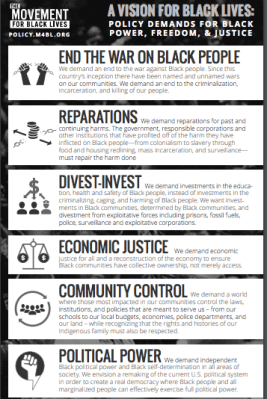
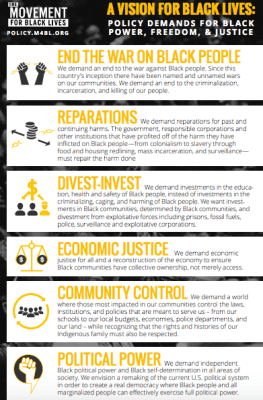
This flies in the face of what black people have been saying for decades about cops, which is in intricate part of the platform of the Movement for Black Lives, reflected here on the right. In Grand Rapids more cops playing basketball with black youth is just another “West Michigan Nice” response.
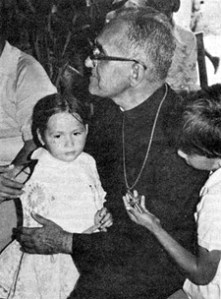 On Saturday, it will be 38 years since Salvadoran Archbishop Oscar Romero was gunned down while saying mass in a small chapel in San Salvador. A Salvadoran soldier who was the graduate of the US Army School of the Americas, it was revealed later, killed Romero.
There has been much written about Romero since his assassination and the factors that led to his eventual death. However, it is important to note that Romero wasn’t always a radical priest or a proponent of Liberation Theology.
Before Romero was chosen as the new Archbishop of El Salvador, he was a quiet and conservative bishop. Romero was even a member of the Opus Dei, a movement within the Catholic Church that began in Spain in the early part of the 20th century and supported the dictatorship of Franco.
However, Romero was a close friend of Fr. Rutillio Grande, a priest in one of El Salvador’s rural communities. Grande was a proponent of Liberation Theology and when he was assassinated for serving the poor and challenging the wealthy oligarchy in El Salvador, Romero began to see the light. This moment of transformation is what Jesuit scholar Jon Sobrino called “Rutillio’s Miracle,” because it was the catalyst that transformed Romero into the Voice of the Voiceless.
Quickly Romero began to not only speak out on behalf of the poor, he began acting in such a way that soon thousands of Salvadorans would come to call him simply “Monsignor.” Romero turned the facilities at the cathedral into a space for people to come for relief, food and medical assistance. Romero also began hearing the stories of countless Salvadorans who told him how their family members were disappeared, tortured and killed.
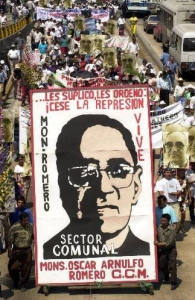 Romero then began to challenge the power structure in El Salvador, mostly through his Sunday sermons and his weekly radio broadcast. Romero understood all to well that the poverty and violence that people endured was because of the unjust economic power that the country’s wealthy possessed.
Romero also understood that the political violence that was terrorizing the country’s poor and working class people was a direct result of US military aid to El Salvador. Five weeks before Romero was assassinated he wrote a letter to then US President Jimmy Carter. He asked Carter that if the US really wanted to support justice in El Salvador that the US should stop sending weapons to his country and that the US should not directly intervene in any way into the political, economic, military or diplomatic affairs of El Salvador.
Noam Chomsky writes in the book Manufacturing Consent, that after Romero sent the letter to Carter, the Carter administration put pressure on the Vatican to try and curb the activities of the archbishop.
Romero also understood that many of the foot soldiers in the Salvadoran military were poor people who had been forced into the army. The day before Romero was assassinated he made a special appeal to the soldiers in El Salvador to not kill their fellow Salvadorans. Romero ended his sermon with these words:
We want the government to seriously consider that reforms mean nothing when they come bathed in so much blood. Therefore, in the name of God, and in the name of this long-suffering people, whose laments rise to heaven every day more tumultuous, I beseech you, I beg you, I command you in the name of God: Cease the repression!
Here is a video with audio of Romero during his last sermon.
Accompanying those in the struggle for justice
According to Staughton Lynd’s book, Accompanying: Pathways to Social Change, Salvadoran Archbishop was the first person to use the term accompaniment. Romero practiced accompaniment in two important ways.
First, the Salvadoran Archbishop practiced accompaniment by speaking out against injustice. Romero did spoke out against the injustice in El Salvador, because that is what the people told him to do.
Shortly after Fr. Rutillio Grande was assassinate in 1977, Romero defied church authorities by hosting a singular mass for Fr. Grande and the two others murdered with him.
In his Third Pastoral Letter as Archbishop, Romero stated, “The most acute form in which violence appears in Latin America, is structural, or institutionalized violence, in which the socioeconomic and political structures operate to the benefit of a minority with the result that the majority of people are deprived of the necessities of life.” This is why in the same pastoral letter, Romero denounces Capitalism.
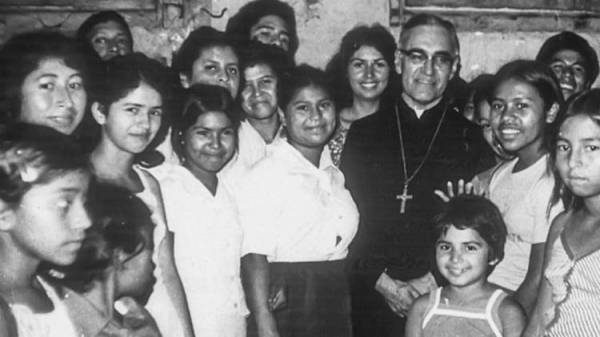
However, the second and most important form of accompaniment that Romero practiced, was walking with the people. Romero made it a point to visit communities all over El Salvador, to listen to them and to learn from them in their struggle.
Eventually, people began coming to the Archdiocese office in wave after wave to talk with Monsenor Romero. In late 1977, Romero turned the church office and courtyard into a place where people could come share their stories, get food and medical attention Romero also used this opportunity to document the disappearances, torture and murder of those who sought out his company. In addition, Romero arraigned for housing for those who had been displaced by the military repression and violence. In many ways, what the Salvadoran Archbishop had done was to offer Sanctuary for the people of El Salvador.
Dr. Paul Farmer, a physician and organizer engaged in accompaniment work in Haiti once wrote a description of what accompaniment work looked like:
“There’s an element of mystery, of openness, in accompaniment. I’ll go with you and support you on your journey wherever it leads. I’ll keep you company and share your fate for a while. And by a while, I don’t mean a little while. Accompaniment is much more about sticking with a task until its deemed completed by the person or people being accompanied, not those doing the accompaniment.”
Monsenor Romero understood this notion of staying with those he was accompanying, sharing their fate, even if that meant death.
Accompaniment in Grand Rapids
 As we wrote on Tuesday, the UCC Church in Wyoming, Michigan, Joy Like a River, is now a sanctuary for undocumented immigrants.
This is a clear form of accompaniment. In fact, Rev. Justo Gonzalez, used that terminology during his address to those present during the Press Conference on Tuesday. Doing sanctuary work is not about helping people, it is about being in solidarity with people who are being targeted by state repression.
 There are other forms of accompaniment being offer in Grand Rapids, such as the work of the GR Rapid Response to ICE project, where people who have been trained attempt to prevent ICE from arresting and detaining immigrants, as well as providing financial, legal, material and emotional support for immigrants impacted by ICE. For those wanting to get involved, like their Facebook page and find out when the next training is.
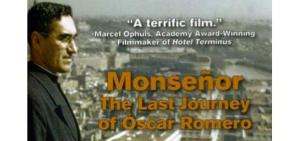
In fact, the GR Rapid Response to ICE group is hosting a screening of a documentary about Monsenor Romero, tonight at Taqueria Rincon. You can get details at this link.
Earlier today, a United Church of Christ, in Wyoming, Michigan declared itself a Sanctuary Church in response to the ongoing repression of immigrants, especially those that are undocumented.
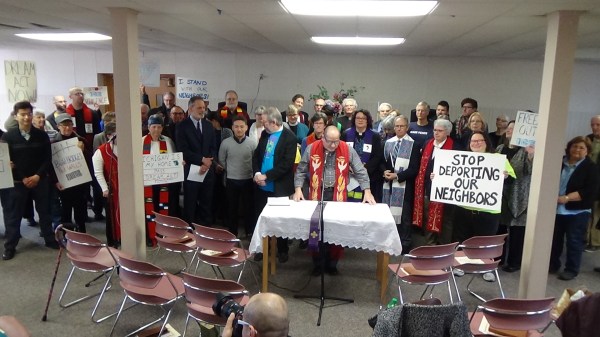
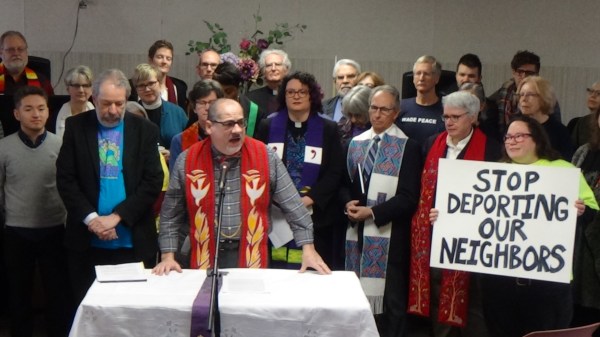
The Rev. Justo Gonzalez stated:
“Immigrants always have been and will be welcome here! The United Church of Christ (UCC) is an Immigrant Welcoming Church. IUC Ministerios Ríos de Agua Viva / Joy Like a River UCC is rooted in Love and Extravagant Welcome for all of God’s Creation. It is with Holy Boldness that we declare ourselves the first and only Sanctuary Church in the Grand Rapids Metropolitan area.
We are clear, no matter who you are or where you have been on life’s journey, you will welcome here. Within this church anyone who needs it will find a warm welcome in a Safe and Sacred Space. We do not care about your immigration status. We care about you. Let it be known that this Community of Faith celebrates diversity, experiences immigrants as a blessing, and will always uplift the dignity and worth of God’s creation.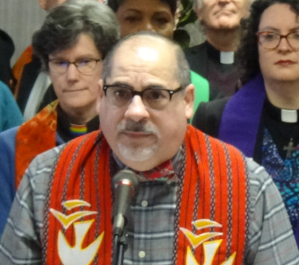
Let it also be known that ICE, Homeland Security and Customs and Border Patrol will not be allowed to enter God’s house. Holy Ground is Sacred. They can choose to break down our doors and forcibly enter but we will NEVER allow them access into this Safe and Sacred Ground known as the Church.
Moreover, the war of Immigrants must end immediately. The Church cannot stand in silence as the Trump Administration unleashes ICE in our neighborhoods, disrupts our communities, profiles Black, Brown and Asian citizens and immigrants. We will not stand for the profiling of our Muslim and other Communities of Faith. A violation on any of us is a violation of all of us.”
Rev. Gonzalez went on to say, “ICE can come to this church, but they cannot enter. If they break the doors down, we will film them taking our brothers and sisters and expose them for for engaging in this type of repression.”
This is the first time that an organization has declared itself a sanctuary in the Grand Rapids area, since the Koinonia House did it in 1986.
Rev. Gonzalez was joined by a whole litany of people during the declaration made today, with several of the people standing with him invited to share a few thoughts about the importance of this work.
Rev. Grey, who is also a UCC Pastor, simply wanted to share some data, which illustrated how urgent this issue is. She stated that since the Trump administration took office, there have been 14,000 administrative arrests in the US of immigrants every month.
Gema Lowe, with Movimiento Cosecha GR, an immigrant led movement, shared the principles of her group by reading a statement, which stated in part that they are fighting for dignity, respect and permanent protection for all immigrants. Lowe also invited everyone in attendance to participate in the 4 day strike they are planning in late April through May 1st. They are asking people not to work, not to shop and to join them for several actions listed below.

There were two DACA students who also spoke during the Sanctuary announcement. Danny Caracheo, said that the US is not only a nation made up of immigrants, but that it is made up of people who are rebels.
The Rev. Colleen Squires, a Unitarian Pastor, said, “We can either build a wall or a longer table. My community choses to build a longer table to welcome everyone to sit at.
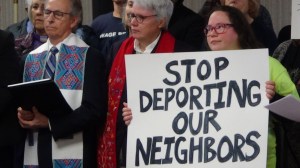 The Reverend Doug Van Doran, Pastor, Plymouth United Church of Christ, states, “Immigrants are our part of our American family. Dreamers are our children. This is their home, the land they know. We need to be certain that this is a land where DREAMS COME TRUE and Justice for Immigrants reigns and not where nightmares are inflicted.”
Richard Kessler, an immigration lawyer who has been practicing for 37 years, said that the current repression against immigrants might be the worst he has ever seen. “The Trump administration has a zero tolerance policy against immigrant. We need to have zero tolerance for ICE repression. We need to have zero tolerance for separating families. We need to have zero tolerance for the racism behind the federal government’s immigration policy.”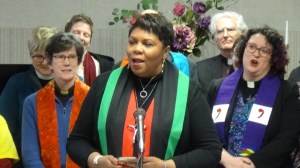
Lastly, Rev. Traci Blackmon, also with the UCC, shared her appreciation for what was happening in Grand Rapids. She shared a beautiful interpretation of the parable of the Good Samaritan during her comments. At the end of her comments she ten said, “There is not a wall so high that we can’t tear down.”
For those who are interested in supporting the new sanctuary church, you can contact Reverend Justo González, II at 716-989-9207, cell or jgonzo2@michucc.org.
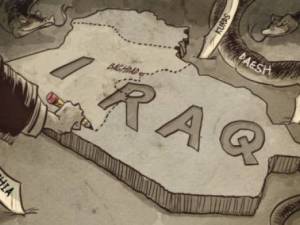 In some ways it is hard to believe that 15 years has already passed, since the US militarily invaded and occupied Iraq. Fifteen years ago there was non-stop coverage of the invasion and occupation, but Iraq has faded from the news cycle for years now and is generally viewed as an outpost for the terrorist organization known as ISIS.
US news media generally fails to provide adequate contextual information about US foreign policy and for most Americans Iraq continues to be framed through whatever the US State Department has to say about it.
Here are fifteen things we think are important to know about the US and Iraq over the past 100 years.
- Iraq was essentially a creation of European Colonialism, with the British drawing the borders and suppressing numerous attempts for Arab and Kurdish self-determination throughout most of the first half of the twentieth century.
- European and US interest in Iraq has always been about oil, especially after WWII, when the US realized that in order to expand it’s global dominance, they needed to secure Iraq’s oil and other oil reserves in the region. This reliance on and control of Middle Eastern oil has been the formal policy of the US since WWII, as is well documented in the film Blood and Oil, featuring historian and author Michael Klare.
- Beginning in the late 1950s, the CIA began to support the Ba’athist Party, in order to destabilize the region enough that would benefit US interests. This support of the Ba’athists, included support for Saddam Hussein.
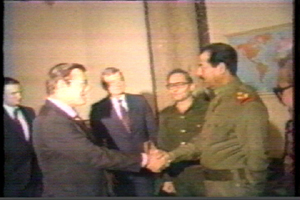
- The US was providing weapons to both Iran and Iraq, during the war between those two countries that lasted for most of the 1980s. The US even supplied Iraq with chemical weapons that were used against Iran and the Kurds. Declassified US documents show that in 1983, Donald Rumsfeld was the Reagan Administration’s connection to supply WMDs to Iraq.
- The US War in the Persian Gulf was an opportunity for the US to flex it’s military muscles at a time when the Soviet Union was imploding (1990-91). The US destroyed much of Iraq’s infrastructure, killed thousands of Iraqis through aerial bombing and used Depleted Uranium in the bombs, which has resulted in death and sickness for Iraqis and US soldiers who fought in that imperialist war.
- After the Gulf War, the US imposed the harshest sanctions on any country ever, resulting in the deaths of at least 500,000 Iraqi children between 1991 and 1998 (during the Clinton Administration). While being interviewed on 60 Minutes, then Secretary of State Madeleine Albright says 500,000 dead Iraqi Children was “worth it.”
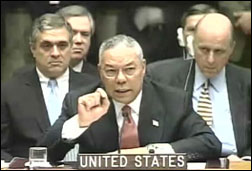
- In the lead up to the 2003 US invasion of Iraq, the US government lied about Iraq’s WMDs. Then Secretary of State Colin Powell has since admitted that the administration lied about this, especially during the Powell’s February 5th, 2003 presentation before the UN Security Council. See declassified documents.
- The US Invasion of Iraq on March 19, 2003 and it’s ongoing occupation resulted in at least 1 million dead Iraqis through 2008, even though that number was usually suppressed in the US media. However, the number is now estimated to be 2.4 million dead Iraqis.
- The US government used the invasion/occupation of Iraq to rewrite the Iraqi Constitution, allowing multination corporations and oil companies free reign to exploit Iraq’s resources. See Naomi Klein’s Shock Doctrine.
- The US Media coverage of the invasion/occupation primarily echoed the government’s position, with little critical inquiry into US policy. The Center for Public Integrity put together a list of 935 lies by the Bush administration about the war. GRIID also created a video and a report about Grand Rapids media coverage of the early months of the US invasion/occupation of Iraq.
- There was a tremendous amount of anti-war organizing against the US invasion/occupation of Iraq from 2002 – 2008. There were numerous groups involved, some more moderate and some more radical. For a great summary of the anti-war organizing see what Media Mouse wrote in 2008. Here is video of an anti-Iraq war protest at the home of Congressman Ehlers.
- The US invasion/occupation of Iraq provided the US to increase it’s military presence in the region and the construction of numerous US military bases in Iraq for geo-political and resource extraction purposes.
 The US invasion/occupation of Iraq saw the largest use of private mercenary forces, like Dyncorp and Blackwater, which was founded by Erik Prince, the brother of US Education Secretary Betsy DeVos. Blackwater won millions of dollars in US contracts for its mercenary efforts in Iraq, which involved the murder of 17 Iraqi civilians. Erik Prince was never indicted for those war crimes.
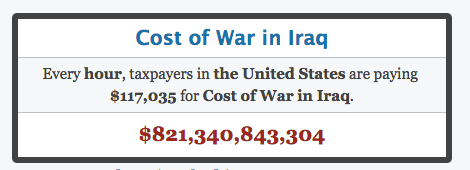
- The cost of the US invasion/occupation of Iraq is ongoing. According to the National Priorities Project, the US invasion/occupation of Iraq has cost over $800 billion to US taxpayers. Imagine what people could do with that amount of money if it went for things like affordable housing, health care, education, etc.
 The current destabilization in Iraq is often laid at the feet of ISIS. However, as longtime journalist Patrick Cockburn, author of the book, The Age of Jihad: Islamic State and the Great War for the Middle East, the US was in many ways responsible for the creation of ISIS. Here is an excellent interview with Cockburn. In addition, the real culprit of Iraq’s destabilization and ongoing violence is rooted in the US military invasion/occupation that has devastated the country. The Bush administration began a Status of Forces Agreement (SOFA) in 2008, which continued under the Obama administration with withdrawal of US troops not completed until the end of 2011. However, the SOFA agreement did not end the use of private military contractors, which has continued in Iraq.
 On Monday, March 12, the day after 60 Minutes aired an interview with Secretary of Education Betsy DeVos, she spoke briefly at the American Enterprise Institute’s annual World Forum.
You can read Betsy’s comments here, which continues what she has been saying over the past year, which is to push for Neoliberal Education School policies.
Now, the American Enterprise Institute is one of the most powerful right-wing think tanks in the US and has been supportive of the larger neoliberal agenda: the transfer of public funds to the private sector, dismissing Climate Change, opposing an increase in the federal minimum wage, supporting US wars abroad and opposing any regulation of the economy.
Betsy DeVos did sit on the board of directors for the American Enterprise Institute, until the end of 2016, but now that she is part of the federal government, her husband, Dick DeVos has taken her seat at the table.
It is rare to actually read comments from the American Enterprise Institute’s World Forum, since the event is private. In fact, most of the people who attend the event are billionaires and millionaires, along with some politicians who embrace the AEI mission.
The event is so private, that the American Enterprise Institute’s own website doesn’t even mention forum and the only access to the forum electronically is by invitation, as is shown at this link.
Whatever one thinks about how the 60 Minutes interview with Betsy DeVos, it is clear that she is going to continue to address audiences that share her world view, the world view of the rich and powerful.

Does Doug DeVos and the West Michigan Policy Forum really want to change the prison system in Michigan?
We have been monitoring the West Michigan Policy Reform (WMPF) group, ever since it came into being in 2008.
 This group is made up of the West Michigan power structure, like the DeVos family, Peter Seechia, John Kennedy, Michael Jandernoa and other CEOs and politicians that have been supporting and lobbying on state policies since they were founded in 2008.
The West Michigan Policy Reform has already been instrumental in pushing through state policy that benefits businesses on taxes, they were a force in making Michigan a Right to Work state, pushing for education policies that expand Charter Schools and last year got legislation passed to eliminate traditional public sector employees and public teacher pensions.
Now the group is taking on what they refer to as Criminal Justice Reform.
Over the past several weeks, the West Michigan Policy Forum has been posting pieces on their Facebook page, pushing what they name as criminal justice reform, with posts about recidivism in Michigan’s prison population, juvenile justice and a letter from Doug DeVos on behalf of the of the WMPF.
DeVos wrote his letter that was published in the Grand Rapids Grand Rapids Business Journal on March 9. DeVos begins his “letter” by stating:
More than a decade ago, law enforcement leaders supported smart criminal justice reform because they recognized that over-incarceration would not make Michigan safer. Despite these improvements, Michigan still incarcerates more people, keeps inmates longer and spends significantly more money on corrections than our neighboring Midwest states. One out of every five taxpayer dollars goes toward corrections — a proportion of Michigan’s general fund budget nearly twice that of the next highest spending state.
So, does this mean that Doug DeVos and the West Michigan Policy Forum are now interesting in dismantling mass incarceration? Hardly.
What DeVos goes on to say in his letter, is to promote specific legislation by Republican Representatives Klint Kesto and Hank Vaupel. DeVos never identifies this legislation, which is House Bill 5234. This legislation does provide county sheriff’s with the ability to provide medical treatment to inmates who are elderly or struggling with mental health issues.
This sounds like a humane thing to do, but why would the West Michigan Policy Forum being championing it? Again, Doug DeVos states:
While there has been discussion of business support of reform to fill jobs, the need for reform is much bigger than any economic impact. To ensure safety, we must keep those who need to be restrained in prison. However, more than 80 percent of Michigan inmates, or more than 32,000 of the current prison population, will be released and re-enter our local communities. For those who have broken the law and have faced appropriate accountability, we have a moral responsibility to create real opportunity for them. We should help them find confidence, meaningful work to support themselves and their families, rebuild lives and contribute to the well-being of our community.
Again, this sounds like a very humane approach, but something seems missing. I believe that this is really about the West Michigan Policy Forum wanting to have access to laborers, as DeVos admits in the above statement. In addition, the message of criminal justice reform also plays well with liberal and progressives.
 However, this seemingly liberal legislative push by the West Michigan Policy Forum is a reform that will benefit business interests, plus it is simply a reform. In other words, there is no indication that the WMPF is now going to take on the issue of mass incarceration by dismantling it.
The West Michigan Policy Forum is NOT going to be advocating for the end of police surveillance of the black and latinx communities, they are NOT going to be calling for an end to bail money, they are NOT going to be calling for the end of the privatization of prisons and prison services, they are NOT going to be calling for the end of criminal history to determine eligibility for housing, education, licenses, voting, loans, employment, and other services and needs, they are NOT going to be calling for an end to ICE raids, they are NOT calling for changes in the condition of jails, prisons, juvenile detention facilities or immigration detention and they are NOT going to be calling for the end of capital punishment.
These ARE the kind of actions that groups like the Movement for Black Lives are calling for across the country, along with other black organizations and immigrant-led movements. This is the kind of platform we need to support and to embrace, NOT the weak, reformist legislation that the West Michigan Policy Forum is pushing.

