115 years ago people resisted the oligarchy in Grand Rapids: The 1911 Furniture Workers Strike
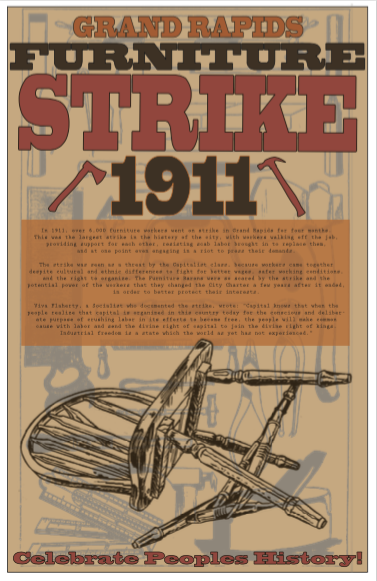 On this day in history roughly 6,000 furniture workers went on strike in Grand Rapids, a strike that sent shockwaves through the furniture industry and put the furniture barons on notice.
This was and continues to be the most significant strike in the history of Grand Rapids, which at the time was considered the furniture capital of the world. I have been researching this historic event over the years and want to offer the following information for those who want to familiarize themselves with this history, learn from it and think about the significance of working class tactics for todays organizing efforts.
First, I highly recommend Jeffrey Kleiman’s book, Strike: How the Furniture Workers Strike of 1911 Changed Grand Rapids. Kleiman’s book is the most detailed account of what happened during the 1911 furniture workers strike, especially from the perspective of workers.
In addition, on the Grand Rapids People’s History site, I have written or republished numerous articles based on my own research over the years as it relates to the 1911 Grand Rapids Furniture workers strike.
Second, there is a two-part article written by Michael Johnston, who is know by many as the unofficial labor historian of Grand Rapids. In Part I of his two-part series, Johnston provides important historical context, a context that led to the massive worker walkout on April 19 of 1911. In Part II, Johnston writes about the role that the IWW (industrial Workers of the World) played in the 1911 strike and how the local power structure and even many of the other unions saw them as a threat.
Third, I also include in this primer on the 1911 furniture workers strike, some articles about other factors that played into the outcome of the strike. First, I look at the role of religion and how Christian Reformed Church members were told not to participate in the strike, while the Catholic Bishop at the time was in full support of the striking workers.
During the strike Bishop Schrembs began to speak out against the injustice being done to the workers.
”I consider the present labor situation in our city as a most deplorable one from every point of view. I would welcome and hasten the day when compulsory arbitration will force men dealing with their fellow men to let fairness and justice come to their own through reasonable methods rather than through the cowering of men’s hearts through the cruel pangs of hunger of their wives and children.”
Bishop Schrembs was also invited to speak at several rallies held by the workers over the 17 weeks of the strike. At one rally in early May at the Ramona Theater in Grand Rapids, where the bishop addressed some 2,500 striking workers, he “praised the workers’ moderation and and restraint, noting that had it not been for the labor unions, we would still have the conditions which shamed men and women one or two generations ago.”
 On August 9, the Christian Reformed Church came out with an official decree that no worker who belonged to the church would be allowed to join a union. Shortly after the strike ended, Bishop Joseph Schrembs was reassigned to the Toledo, Ohio diocese. There is no hard evidence that Schrembs departure was due to his role in supporting striking workers, but the timing of such a decision suggests otherwise.
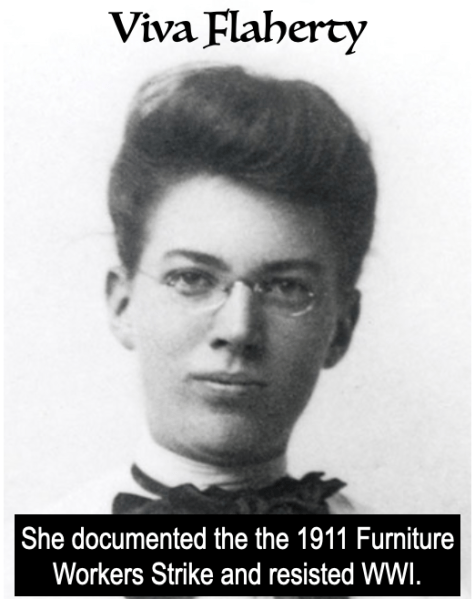
Fourth, there are those who documented the strike at the time. I wrote a piece that contrasted the observations of Viva Flaherty, a socialist, who provides a great reflection on what happened during the 1911 strike, and how one of the Furniture barons (R. W. Irwin) gave his opinion about what took place. Viva Flaherty documented the 1911 strike because she believed that the “people of Grand Rapids are awakened and enlightened and they can be trusted with the whole truth.” Flaherty went on to say, in her introduction to the History of the Grand Rapids Furniture Strike:
“A strike is a public matter, and if the people are to know how another is to be avoided they should know all the inside facts of this one, so that they may know whom to distrust and on whose shoulders rests blame for a nineteen weeks strike.”
Flaherty makes it clear in her version of the story that the strike was able to endure as long as it did because of the seven unions that were involved, with membership of over 4,000 workers in thirty-five shops in Grand Rapids. She also made it clear in the opening observations of her historical account that the Christian Reformed Church would not grant their members the right to be part of the union, since it was not “founded on divine right.”
Fifth, in another article I have written, I note that there were 10,000 workers marching in the Labor Day parade in 1911. Not only was this an impressive number of workers, but it was essentially about 10% of the entire population of Grand Rapids in 1911. Imagine if 10% of working class people took part in a contemporary Labor Day parade, march or direct action.
Sixth, it is important to contrast the living conditions of those in the capitalist class – the Furniture Factory owners – and those who actually created the wealth for these men – the furniture workers. As Kleiman notes in his book:
“Furniture company owners also created a second tier of financial institutions, assuring themselves of a ready supply of money for loans and credit needed for seasonal expansion. The years between 1905 and 1911 saw the chartering of three local banks – City Trust and Savings in 1905, Kent State Bank, which had ties to the Michigan Trust Company, in 1908 and Grand Rapids National City Bank in 1911 – with furniture executives at their command. The manufacturers sitting on the boards of directors and in the executive offices of these new banks represented major local furniture concerns, each employing more than two hundred workers. Through their banking connections, they were able to play a major role in shaping monetary policy to their advantage.”
Lastly, I include an article about the backlash from the 1911 furniture workers strike. The capitalist class was not happy about the 1911 strike, even though they ended up winning. However, those in power are never content with just winning certain battles, they want to prevent future attempts to challenge their power. What the Robber Baron class did was to change the City Charter, which resulted in decreasing the number of city wards to just 3 and eliminating a strong mayor position. The result of this charter change would make it harder for working class people to have real representation on the city commission and to make the mayor a glorified commissioner.
Again, it is important that we come to terms with understanding this local history, reflecting on it and think about what it means for current struggles against the power structure in Grand Rapids. How can working class people organize today? There certainly are labor unions that exist in GR, but none that really stand out and none that wield significant power.
The conditions are ripe for more worker-based organizing, since the wealth gap in this community continues to grow. In recent years I have written about how nearly half the population in Grand Rapids is living paycheck to paycheck, yet this dynamic is rarely reported on.
Another major obstacle to mainstream labor groups is their allegiance to the Democratic Party, which has fundamentally abandoned working class families. Ask yourself, what have unions and workers won with millions in campaign contributions going to the Democratic Party?
Time for a new Labor Movement/Labor Strategy?
Ok, so lets say that organized labor decides to stop funding the Democratic Party and instead focuses on movement building. Union members could still vote for Democrats if they chose, but they could be part of a new labor movement that would not be beholden to political parties and could actually affect change.
First, what if organized labor used the funding that they would have put towards elections and use it for paying people to organize shops and other work places? Not only would this scare the shit out of the capitalist class, it would give more workers an opportunity to be part of a union that actually fought for them. This kind of union organizing should also take place outside of specialized work and organize migrant labor, service sectors, restaurant workers and the unemployed.
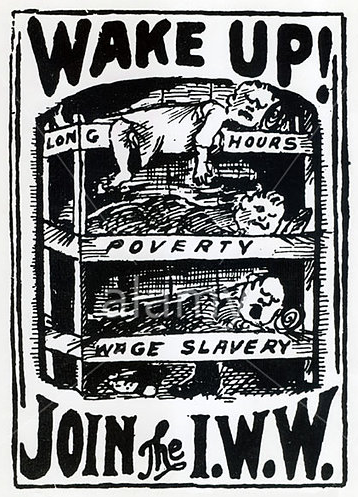 Second, workers could engage in wildcat strikes, walkouts or other forms of direct action that would force companies to the table. In demonstrating their power, workers could negotiate wages, benefits and workplace dynamics that would result in victories. As individual shops and work places win labor battles, these same unions could join other labor struggles and support workers who were fighting get get a union and all the possibilities that come with being organized.
Third, unions could re-direct the money that they were spending for elections and lobbying to provide mutual aid to families that are experiencing poverty, facing foreclosure or any other economic hardships, including the corporate-driven health care costs. Not only would this kind of mutual aid help build relationships with working class people, it could result in an increase in union membership.
Fourth, what is the labor movement began to develop their own independent media. The commercial media will not represent the collective struggles of workers, in large part because they are dependent on advertising dollars from the very entities that exploit workers. We used to have a lively labor press in the US, but so little of that exists now. We need an independent media that tells the stories of the people whom the commercial media ignores. With an independent media, more people will have access to information that the commercial media marginalizes or represses. I’m not talking about just online media, I’m talking about labor-based press, a newspaper that is run by and for workers. Such a tool and other forms of media are weapons we need in the war of propaganda that the capitalist press is winning.
These proposals are not necessarily new, since much of what we have been talking about has been done before, with a great deal of success. However, we do need to do some things differently from what organized labor has done in the past.
Fifth, the worker-led movement needs to also connect to other movements around fighting white supremacy, patriarchy, ablism, homophobia, transphobia and fighting for food justice, immigrant justice and climate justice. Class issues can bring us together, but only if we do not make class the center of all justice struggles.
The new work-led movement needs to be intersectional and transformative and not settle for just fighting against capitalism, but creating new economic systems that are democratic, local and multifaceted. We can take a cue from the wobblies who believed that, “An injury to one is an injury to all.”


Comments are closed.