Betsy DeVos Watch: Deconstructing the 60 minutes Interview
The following interview by 60 Minutes with Education Secretary Betsy DeVos, aired on Sunday, March 11, 2018.
Secretary of Education Betsy DeVos is a devout Christian grandmother from Michigan — who has spent most of her life trying to improve the quality of education for poor kids. So how in the world did she become one of the most hated members of the Trump Cabinet? [How media people frame things is important. Lesley Stahl states as a matter of fact that Betsy DeVos has spent most of her life trying to improve the quality of education for poor kids, yet there is no evidence presented to substantiate this claim.]

She is dedicated to promoting school choice [School choice is code for undermining public education and promoting charter and private schools.] but her critics say she really wants to privatize the public school system that she once called, quote, “a dead end.”
Now, after the school shooting in Parkland, Florida, her portfolio is expanding. Monday, President Trump is expected to appoint her as head of a new commission on school safety charged with developing policies to prevent school violence.
Betsy DeVos visited the school in Florida on Wednesday, but like almost everywhere else she goes, she faced criticism. Some of the students sent out angry tweets: “You came to our school just for publicity and avoided our questions.” “Betsy DeVos came to my school, talked to three people, and pet a dog.” Many of the students are frustrated at the administration for talking about school safety, but not acting.
Betsy DeVos: I give a lot of credit to the students there for really raising their voices, and I think that they are not going to let this moment go by.
Lesley Stahl: They want gun control.
Betsy DeVos: They want a variety of things. They want solutions.
Lesley Stahl: Do you think that teachers should have guns in the classroom?

Betsy DeVos: That should be an option for states and communities to consider. And I hesitate to think of, like, my first-grade teacher, Mrs. Zorhoff, I couldn’t ever imagine her having a gun and being trained in that way. But for those who are– who are capable, this is one solution that can and should be considered. But no one size fits all. Every state and every community is going to address this issue in a different way. [When DeVos and others use the claim that it is up to state and communities to make these decisions, they are really echoing talking points from the American Legislative Exchange Council (ALEC) and the State Policy Network (SPN), both of which are funding by the Koch Brothers.]
Lesley Stahl: Do you see yourself as a leader in this– in this subject? And what kind of ideas will you be promoting?
Betsy DeVos: I have actually asked to head up a task force that will really look at what states are doing. See there are a lot of states that are addressing these issues in very cohesive and coherent ways.
Lesley Stahl: Do you feel a sense of urgency?
Betsy DeVos: Yes.
Lesley Stahl: ‘Cause this sounds like talking. Instead of acting.
Betsy DeVos: No, there is a sense of urgency indeed.
The reason Betsy DeVos wanted to be secretary of education was so she could promote school choice, offering parents options other than traditional public schools – where 90 percent of kids go. She has proposed massive cuts in public education funding and wants to shift billions to alternative players like private, parochial and charter schools. [This is an accurate statement, considering what the budget was in 2018 and what is being proposed for in 2019.]
Betsy DeVos: We have invested billions and billions and billions of dollars from the federal level And we have seen zero results.
Lesley Stahl: But that really isn’t true. Test scores have gone up over the last 25 years. So why do you keep saying nothing’s been accomplished? [Challenging question that should be asked to all politicians.]
Betsy DeVos: Well actually, test scores vis-à-vis the rest of the world have not gone up. And we have continued to be middle of the pack at best. That’s just not acceptable.
Lesley Stahl: No it’s not acceptable. But it’s better than it was. That’s the point. You don’t acknowledge that things have gotten better. You won’t acknowledge that, over the–
Betsy DeVos: But I don’t think they have for too many kids. We’ve stagnated
Lesley Stahl: Okay, so there’s the big argument. So what can be done about that?
Betsy DeVos: What can be done about that is empowering parents to make the choices for their kids. Any family that has the economic means and the power to make choices is doing so for their children. Families that don’t have the power, that can’t decide: “I’m gonna move from this apartment in downtown whatever to the suburb where I think the school is gonna be better for my child” if they don’t have that choice – and they are assigned to that school, they are stuck there. I am fighting for the parents who don’t have those choices. We need all parents to have those choices. [If Secretary DeVos wants all parents to have a choice to move and put their kids in a better school, she should advocate for making the minimum wage $15 an hour, change the tax system to divert more money from the rich and stop supporting the federal government’s massive subsidies to corporations, while reducing public funding for education and other social services. However, advocating for parents in this way is completely counter to the neoliberal economic policies that the US government promotes and that benefits members of the capitalist class, like the DeVos Family.]
Question is: does her solution work? Do choice schools perform better than public schools? Naturally — there are conflicting studies. It’s complicated.
But DeVos spends a lot of time showcasing choice schools like Cold Spring Elementary, a public school in Indianapolis – that was allowed to get rid of the local teachers’ union and create an innovative curriculum.
But when parents choose these options, taxpayer funds follow the child and that means that the public school left behind can end up with less money.
Lesley Stahl: Why take away money from that school that’s not working, to bring them up to a level where they are– that school is working?
Betsy DeVos: Well, we should be funding and investing in students, not in school– school buildings, not in institutions, not in systems.
Lesley Stahl: Okay. But what about the kids who are back at the school that’s not working? What about those kids?
Betsy DeVos: Well, in places where there have been– where there is– a lot of choice that’s been introduced– Florida, for example, the– studies show that when there’s a large number of students that opt to go to a different school or different schools, the traditional public schools actually– the results get better, as well. [No specific study is cited to verify this claim. There are several studies cited in a Center for Media & Democracy piece from 2017, linked here.]
Lesley Stahl: Now, has that happened in Michigan? We’re in Michigan. This is your home state.
Betsy DeVos: Michi–Yes, well, there’s lots of great options and choices for students here.
Lesley Stahl: Have the public schools in Michigan gotten better?
Betsy DeVos: I don’t know. Overall, I– I can’t say overall that they have all gotten better.
Lesley Stahl: The whole state is not doing well.
Betsy DeVos: Well, there are certainly lots of pockets where this– the students are doing well and– [For all the millions of dollars DeVos and her family invested in the Great Lakes Education Project, it has not resulted in public education improving in Michigan.]
Lesley Stahl: No, but your argument that if you take funds away that the schools will get better, is not working in Michigan where you had a huge impact and influence over the direction of the school system here.
Betsy DeVos: I hesitate to talk about all schools in general because schools are made up of individual students attending them. [Avoiding the question.]
Lesley Stahl: The public schools here are doing worse than they did.
Betsy DeVos: Michigan schools need to do better. There is no doubt about it.
Lesley Stahl: Have you seen the really bad schools? Maybe try to figure out what they’re doing?
Betsy DeVos: I have not– I have not– I have not intentionally visited schools that are underperforming. [An important admission.]
Lesley Stahl: Maybe you should.
Betsy DeVos: Maybe I should. Yes.
DeVos is the only Cabinet secretary protected by a squad of U.S. Marshals because she’s gotten death threats. She’s frequently met by protesters who accuse her of pushing an elitist agenda.
She often manages to offend, as when she called historically black colleges and universities “pioneers” of “school choice” – as though they had a choice.
At this commencement speech at Bethune-Cookman University, students booed and turned their backs to her.
Lesley Stahl: Why have you become, people say, the most hated Cabinet secretary?
Betsy DeVos: I’m not so sure exactly how that happened. But I think there are a lot of really powerful forces allied against change. [Again, to evidence presented or naming specific forces allied against change.]
Lesley Stahl: Does it hurt?
Betsy DeVos: Sometimes it does. Sometimes it does. Again, I think– I think–
Lesley Stahl: Do you ever say–
Betsy DeVos: –I’m more misunderstood than anything.
Some of the criticism, she feels, is unfair, especially when it involves her wealth. She faced a hostile question about it during a speech at Harvard last year.
Harvard Question: So you’re a billionaire with lots and lots of investments. And the so-called school choice movement is a way to open the floodgates for corporate interests to make money off the backs of students. How much do you expect your net worth to increase as a result of your policy choices? [For a detailed account of Betsy DeVos’ investments, go to this link.]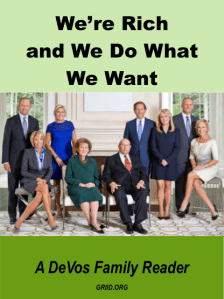
Moderator: You can choose not to answer that secretary.
Among President Trump’s cabinet of moguls and titans, DeVos is the richest: she grew up wealthy and married even wealthier. In their hometown of Grand Rapids, the DeVoses have been exceedingly charitable, their name decorates buildings like the civic center and children’s hospital. [For a more complete critique of the DeVos Family impact in Grand Rapids/West Michigan, see our DeVos Family Reader.]
At her bruising confirmation hearing, she was grilled about her wealth and lack of experience. She’s been an advocate, not an educator.
Lesley Stahl: What happened there?
Betsy DeVos: I’ve not had a root canal, but I can imagine that a root canal might be more pleasant than that was.
Lesley Stahl: So you’ve been on the job now over a year. What have you done that you’re most proud of?
Betsy DeVos: Yeah. We’ve begun looking at and rolling back a lot of the overreach of the federal government in education.
By overreach she means regulations. And like most of President Trump’s cabinet, DeVos is a devoted de-regulator. Part of her job as Secretary of Education is overseeing guidelines that protect the civil rights of students.
Just days after being confirmed, she rescinded a guideline implemented under President Obama that allowed transgender students to use the bathrooms of their choice – sparking even more protests.
She is now considering scrapping the Obama-era “guidance on how to identify, avoid and remedy discriminatory discipline,” which aims to prevent schools from punishing students of color more harshly than their white classmates.
Betsy DeVos: We are studying that rule. We need to ensure that all students have an opportunity to learn in a safe and nurturing environment. And all students means all students. [This statement is in direct conflict with the 2018 federal education budget cuts, which disproportionately impact students of color. The de-regulation around civil rights within education also conflicts with DeVos’ claim to create a safe space for all students.]
 Lesley Stahl: Yeah but let’s say there’s a disruption in the classroom and a bunch of whites kids are disruptive and they get punished, you know, go see the principal, but the black kids are, you know, they call in the cops. I mean, that’s the issue: who and how the kids who disrupt are being punished.
Betsy DeVos: Arguably, all of these issues or all of this issue comes down to individual kids. And–
Lesley Stahl: Well, no. That– it’s not.
Betsy DeVos: –it does come down to individual kids. And–often comes down to– I am committed to making sure that students have the opportunity to learn in an environment that is conducive to their learning. [Here, the Secretary of Education ignores decades of discrimination against African American students within the education system. It’s as if she was saying, “All student lives matter,” which is a ridiculously false notion that makes black student lives invisible. See our post Betsy DeVos and White Savior Politics and see the report, DeVos Watch Year One.]

Lesley Stahl: Do you see this disproportion in discipline for the same infraction as institutional racism?
Betsy DeVos: We’re studying it carefully. And are committed to making sure students have opportunity to learn in safe and nurturing environments. [Again, avoiding the question about institutional racism.]
While this regulation is under review, she has already drawn fire for changing Title IX guidelines on handling sexual assault on college campuses. She’s allowing colleges to require stronger evidence from accusers, and give the accused a greater benefit of the doubt. [See our post, Fake Sympathy from DeVos on MSU victims, while undermining the existing Title IX protections against sexual assault.] 
Lesley Stahl: Are you in any way, do you think, suggesting that the number of false accusations are as high as the number of actual rapes or assaults?
Betsy DeVos: Well, one sexual assault is one too many, and one falsely accused individual is one too many.
Lesley Stahl: Yeah, but are they the same?
Betsy DeVos: I don’t know. I don’t know. But I’m committed to a process that’s fair for everyone involved.
Lesley Stahl: The Me-Too Movement has come along at the same time. This is all feeding into it. We’re not talking about colleges anymore. We’re talking about men in positions of power in industry and government. Have you ever had an issue?
Betsy DeVos: I can recall a number of moments in the past– several decades ago that I think today would just be viewed as unacceptable. Yeah.
It’s been an unlikely journey and balancing act for grandmother Betsy DeVos, from her sheltered life in Michigan – to her life now as a lightning rod in Washington. [Not sure this is a fair comment, since Betsy DeVos has not been sheltered, as she was the head of the GOP in Michigan for years and active in numerous national groups and campaigns to undermine public education around the country. See the article Betsy DeVos’ Holy War.]
If we want Housing Justice, then it must be lead by those impacted by the housing crisis, not by developers, politicians or non-profits
 All across the US, there is a housing crisis. The crisis is complex, but it is not difficult to understand. Gentrification is impacting virtually every city, with “urban renewal” taking the form of white flight. However, unlike the 1950s and 70s, white flight is white people leaving suburban areas to taking over core urban spaces that currently are made up of communities of color.
The gentrification is causing massive displacement and the re-investment of urban spaces, because white people now want to live there. This has caused the housing market to skyrocket in costs, both for those seeking to buy homes and those wanting to rent. Rent costs have doubled in the past 5 – 10 years, depending on which community you live in, making it virtually impossible for people making minimum wage to afford current rent cost. This current housing crisis is particularly felt by single families, particularly black and brown families, which often cannot afford to purchase a home or afford rental fees.
The same housing crisis that is facing communities all across the country, is also happening in Grand Rapids. Grand Rapids has seen the cost of buying a home soar, the cost of rental fees explode and the impacts of gentrification felt in just about every neighborhood in the city. The difference has been in how Grand Rapids is responding to this crisis, as opposed to how many other communities are responding.
Grand Rapids lets developers and non-profits decide
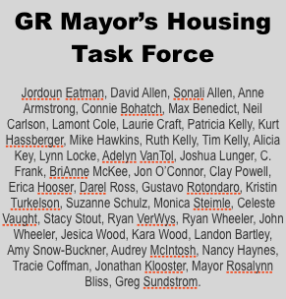 There have been numerous efforts to organize around the housing crisis in Grand Rapids, but the one that has received the most attention, is the Mayor’s housing task force that was developed nearly two years ago.
This task force is made up of city staff, numerous commercial developers, some non-profit housing organizations and social service providers. In other words, there is no one on the Mayor’s housing task force who represents those most impacted from the housing crisis.
This lack of representation from people experiencing the housing crisis, is clearly reflected in the recommendations that the task force came up with, linked here.
Many of these recommendations benefit developers, with either incentives or by allowing development to determine outcomes. Other recommendations have to do with zoning or other government enforcement mechanism. What we don’t find in the recommendations are specific to tenants and their needs, particularly around rental costs and tenant power, which is exactly what has been developing across the country by those most impacted from the current housing crisis.
When tenants and those impacted from the housing crisis decide
The national Homes for All movement, which is led by those most impacted from the housing crisis, engages in a theory of change, which uses strategies and tactics that directly result in challenging the real estate industry, landlords and property management companies.
Every month, tenant unions and other campaigns focuses on housing and land issues across the US, are using direct action to achieve their goals by winning rent freezes, winning rent controls, exposing landlords/property management companies and organizing grassroots power that is led by those most impacted by the housing crisis. You can read about these victories in the Homes for All Press Room section on their website.
The Homes for All organization has lots of great resources available for tenants who want to organize in their community, with reports and fact sheets that can be modified by any community to address the housing crisis.
One recent report put together Homes for All and Right to the City, is entitled, Communities Over Commodities: People-Driven Alternatives to an Unjust Housing System.
This 80 page report, linked here, is full of great strategies and examples of people organizing around housing justice over the past 80 years. The report begins with an introductory section on the current housing crisis, that provides important analysis on how it came about.
However, most of the report provides information and examples of how to De-Commodify Housing. The four areas/strategies for de-commodifying housing are:
- Limited Equity Cooperatives
- Community Land Trusts
- Tenement Syndicates
- Mutual Aid and Housing Cooperatives
Limited equity cooperatives, or LECs, are a model of affordable cooperative housing that exists today in at least 29 states in the United States and in several other countries, including Canada and throughout Europe. In LECs, like with all housing cooperatives, member-residents jointly own their building, have democratic control and bene t socially and economically from living in and owning the cooperative. As a prominent type of affordable housing cooperative in the United States, LECs seek to ensure that the housing remains affordable for the long term.

Community Land Trusts – There are close to 300 CLTs in the United States in rural and urban settings, all of which share the basic objective of providing affordable and stable housing in perpetuity, as well as community investment in upkeep. CLTs began in the United States during the civil rights movement as a means to support the independence and self-determination of Black Americans in the South.

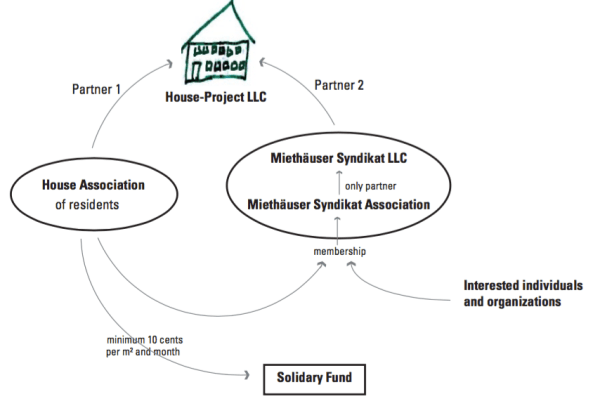
The Tenement Syndicate model is unique in its creation of a “circular model” that uses the limited liability company structure to keep houses afford- able, ensure legal security, and prevent houses from being resold on the speculative market.Today there are 128 house-projects in Germany that typically each have 10 to 20 units, and several initiatives throughout Europe that follow this model. Common to all is a vision of long-term affordability of living and working spaces that are transformed from for-pro t entities into spaces of self-determination, community and collective ownership.
Mutual aid housing cooperatives are founded on the principle that housing is not a market commodity, but rather a communal public asset. They exist in several countries in Latin America, the first such cooperatives having been founded in the late 1960s. Unlike the other three alternative housing models discussed in this report, in mutual aid housing cooperatives, residents participate in build- ing their own houses. Most mutual aid housing cooperatives not only strive to provide affordable housing, but to also foster self-management and political mobilization of the community.

Grand Rapids doesn’t have to follow a failed organizing model
Some people might say that Grand Rapids isn’t Chicago, New York or Minneapolis, when it comes to how people organize. However, Grand Rapids does have a radical history and can continue to be part of radical change, if, and only if, the grassroots movements it builds is made up of those who are being oppressed.
Next month, we celebrate the 107th anniversary of the furniture works strike in Grand Rapids. That strike was lead by workers who were being exploited. Today, movements like Cosecha GR, an immigrant justice movement, is being lead by immigrants and fighting for justice. If we truly want a housing justice movement, then it must be led by those most impacted by the gentrifying housing crisis.
Financial Documents used to entice Amazon to come to Grand Rapids finally released, but 103 pages still missing
 On Wednesday, the Right Place Inc. held a press conference and released 5 pages of financial information about the plan to attract the online sales company, Amazon, to open another headquarters in Grand Rapids.
The 5 pages of financial incentives are linked here, with a summary of the various options and the price tag in the graphic on the right.
It is clear that the financial incentives that the Right Place Inc, Grand Rapids, the Ford International Airport and Wyoming were offering was substantial.
News coverage of the newly released documents was covered by most commercial media outlets, like MLive and WOODTV8, but these news sources primarily focused on the dollar amounts of the proposals pitched to Amazon.
However, an article in MiBiz, does a much better job of asking important questions from the Right Place Inc executive Birgit Klohs.
The MiBiz story states:
 Klohs said the organization’s decision to release the incentive information stemmed from Freedom of Information Act requests news outlets filed with the MEDC.
“This is not how we’re used to it,” Klohs said. “Sharing this kind of information … is extremely rare. And to be quite honest, it’s not in our best interest to share some of this information.”
The MiBiz article also offers additional insight into the issues, by citing a report from the far right Mackinac Center for Public Policy and the Good Jobs First group, which tracks taxpayer subsidies around the country.
This kind of reporting is important in that it does not simply echo the information that the Right Place Inc wanted to share, it asked more pressing questions and provided other perspectives.
However, what is still not know, is why the other 103 pages of the proposal that was submitted last year have not yet been released. If public tax breaks were part of the equation and public land (which was revealed in the document), why has the entire document not made available to the public?
As we reported in January, the massive tax breaks issue is also echoed by Neil deMause, who was interviewed on Fairness & Accuracy in Reporting’s radio show, CounterSpin.
“I think that clearly paid off for Musk and Tesla, to the tune of $1.4 billion. So I’m not really surprised that Jeff Bezos and Amazon are looking at something similar here, and I think, given what we’re seeing from what’s leaking out about some of the bids (which are not public) for Amazon, it looks like they’re going to be looking at some kind of tremendous taxpayer windfall as well.”
deMause goes on to say:
“And, this is what really is driving the bidding war so crazy, what Greg LeRoy talks about, is that you’re seeing these crazy numbers being thrown around, because it’s not like there’s another company down the road that you can say, well, if we don’t get Amazon, we’ll just get the second-best thing to Amazon, because there is no second-best thing to Amazon. It’s Amazon or the highway.”
Sure, there would have been new jobs provided by the company, but Amazon has a track record of having many of their workers needing to rely on Food Stamps, just to get by.
However, the lack of transparency is what is particularly troubling in this case, especially since public funds and public land we part of the deal.
Incumbents, Money and the Michigan Congressional Races
 In electoral politics, money rules. This is the case with the upcoming Congressional races in Michigan, particularly the races in West Michigan. We take a look at the Michigan Senate race and the races in the 2nd and 3rd Congressional Districts, which are just 8 months away.
Senator Debbie Stabenow has $6 million more in campaign funds than her closest competitor, Republican Sandy Pensler, according to recent campaign finance data. Senator Stabenow has raised $11,428,649 and the leading Republican candidate, Sandy Pensler, has raised $5,015,888.
Stabenow, who is the ranking member of the Agricultural Committee, also sits on the Budget Committee, Energy and Natural Resources Committee and the Finance Committee. Committee seats often determine what sectors candidates receive lots of money from during elections.
You can see listed here, the top 20 entities contributing to Stabenow’s re-election campaign.  There are numerous financial entities, like Goldman Sachs, Rock Holdings (a subsidiary of Quicken Loans), Citigroup, BlackRock Inc and the Sterling Group. In the Energy and Natural Resources arena, Stabenow receives money from DTE Energy and CMS Energy. In addition, the Senator from Michigan has received funds from Ag sector companies such as DowDuPont, Monsanto and the Coca Cola Co.
Other notable contributors are Votesane PAC, which is a bipartisan group, which has contributed to more Republicans than Democrats and the Blackstone Group, which is the largest real estate company in the world. The Blackstone Group has been the target of many popular movements and tenant unions around the globe, according to the group Right to the City.
2nd Congressional District
In the 2nd Congressional District, incumbent Rep. Bill Huizenga ($873,441) is way ahead of the his challenger, Democrat Rob Davidson ($139,478).
Huizenga sits on the House Financial Services Committee and is Chairman of the Capital Markets, Securities, and Investment Subcommittee. Therefore, it is no surprise that nearly all of the top 20 contributors in the 2018 Elections are from the financial sector.
3rd Congressional District
Of the three races we are looking at, the 3rd Congressional race has the least amount of money in it. Incumbent Rep. Justin Amash has raised a total of $382,709, with the three Democratic candidates raising a combined $35,000.
 Amash sits on the Committee on Oversight and Government Reform and is part of the Subcommittee on Information Technology and the Subcommittee on National Security. Amash’s campaign contributors are more homegrown, with entities like Michigan Industrial Tools, S. Abraham and Sons, Wolverine Gas & Oil, Autocam Corp, Morning Star Company and the Windquest Group.
However, Amash has also received sizable contributions from the House Freedom Fund, the Senate Conservatives Fund and the Libertarian Think Tank founded by the Koch Brothers, the Cato Institute.
It seems pretty clear that in all three of these races, the incumbents, all of which have far big campaign war chests, will be the likely winner in the November 2018 Election.
A small victory against Settler Colonialism in Kalamazoo: An interview with Ben Williams
 On Tuesday, Kalamazoo City Commissioners voted to remove the Fountain of the Pioneers statue from Bronson Park.
The statue of the Fountain of the Pioneers has attracted attention since a master plan was approved in 2016. The fountain includes a representation of a European settler with a weapon in his hand towering over a Native American.
Yesterday, we interviewed Ben Williams (Potawatomi) about his thoughts on the significance of the vote to remove the statue that contributes to a Settler Colonial narrative.
Women, Influence and the Neoliberal Model
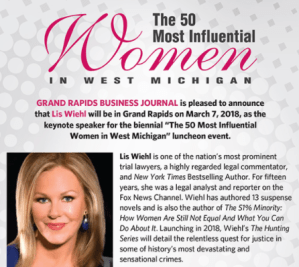 On Wednesday, the Grand Rapids Business Journal will celebrate their annual list of the Most Influential Women in West Michigan.
This celebration, will feature Lis Wiehl, who was a reporter and legal analyst for Fox News for 15 years. The event, which is March 7, is one day before International Women’s Day. Now, I don’t know if this is intentional, but International Women’s Day and the Grand Rapids Business Journal (GRBJ) event have nothing in common, except that it involves women.
International Women’s Day was started based on the exploitative working conditions of women in the garment industry, which resulted in a fire at the Triangle Factory in New York City, on March 25, 1911. One hundred and twenty-three women died that day, which led to an international outcry and the birth of a new movement led by women.
The GRBJ event doesn’t honor working class women, it honors primarily professional women and mostly women who are part of the business class.
The list of 50 women ranges from women in government, to those in business and women in the non-profit sector. There is one woman who is identified as a community asset and advocate and two women who work in the media business.
The list of 50 most influential women made up most of those in business (25) and those in the non-profit sector (17), with those in government tallying 5.
Since the list was created by the Grand Rapids Business Journal, it is no surprise that women in business dominated the list. However, even though there were 17 women listed as being in the non-profit sector, in many ways it is difficult to distinguish at times the difference between businesses and non-profits.
The non-profit sector is structured like a business, with a board of directors and is often staff with professionals who have little or limited experience with the populations they provide services to.
Before people get all bent out of shape, I am not suggesting that none of these women do good work. Doing good work is not the point of the critique here, instead I want to challenge our notion of what it means to be influential in West Michigan.
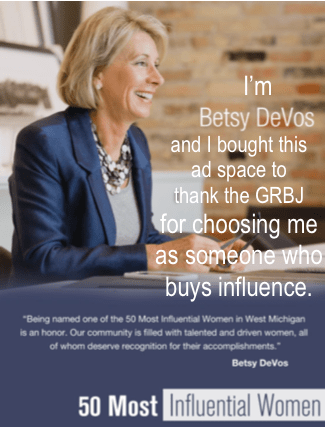 The definition of the word influence is, the capacity to have an effect on the character, development, or behavior of someone or something, or the effect itself. The definition is somewhat vague and does not imply that having influence over people is to the benefit of the community.
Those in government often make decisions that have negative consequences for some people, most often communities of color and working class individuals and families. For instance, the tax structure, police policies, housing and education policies can be extremely detrimental to communities who are the most marginalized, as we have seen in West Michigan, when it comes to policing policies, housing and especially how policing impacts communities of color.
Betsy DeVos clearly has influenced education policy in her first year as Secretary of Education. DeVos has pushed her neoliberal education policy preferences that has favor charter and private schools, cut funding for schools that impact communities of color and changed Title IX policies by allowing men’s rights groups a larger say in campus sexual assault policy, as we have been documenting in section called Betsy DeVos Watch.
In addition, the kind of influence that Mayor Bliss and Commissioner Lenear, both included on the list, has often not faired well for people living in poverty and communities of color. The last year has seen bad decisions or a lack of action on the part of the Grand Rapids City Commission around police violence, immigration status and housing issues that has benefited developers over renters in several neighborhoods.
When we look at how women in business can influence people, here it is also clear that those most vulnerable can be negatively impacted. Women in business can make decisions that perpetuates the wealth gap, impact the environmental justice issues like air quality and food, plus women in business can also make decisions that determine the larger political climate, through contributing to political campaigns, lobbying and what networks or associations they are part of that influences public policy.
Consider Birgit Klohs with the Right Place Inc., one of the 50 Most Influential Women in West MI. The Right Place Inc. tries to attract businesses to set up show in West Michigan, particularly international companies. For instance, the Right Place Inc. has been instrumental in bringing several Israeli military companies to the area, plus Klohs sits of the board of the Michigan Israel Business Bridge, which develops business relationships with Israel and the companies in Michigan.
In addition, the Right Place Inc Board is made up of many of the members of the local power structure, a network of people and businesses that make up the wealthiest in West Michigan, who also make it their business to influence public policy to their benefit.
There are several other business women on the list of 50 most influential, such as bankers, consultants and CEOs of PR firms, which also all tend to serve the interests of those in power.
Then there are all those women who represent non-profits. While many of these non-profits provide necessary services to people who are marginalized, these same non-profits tend to provide those services in a way that keeps the systems of power in place. In other words, all of the services that these non-profits provide, do not address the root causes of poverty, food insecurity, poor public health, racism or patriarchy. Instead these non-profits work within a charity model that focuses on individual opportunity as opposed to dismantling systems of oppression.
Therefore, if we are measuring these women as being the most influential, then what we really mean is that these women are influencing social, political and economic systems which generally do not threaten power. Another way of looking at this list, is that many of these women were chosen for the list of 50 most influential women in West Michigan because their influence serves a larger neoliberal agenda, which means systems of power are not challenged, economic disparities are perpetuated, systemic racism is protected and the transfer of public funds/resources going to the private sector escalates.
If we are determining that these women are the most influential through this neoliberal lens, then yes, they are influential.
Another model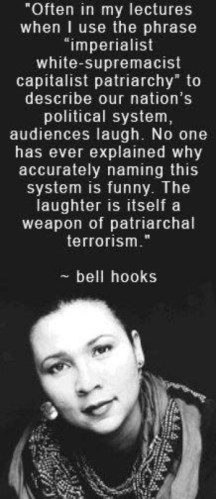
There is another model that runs counter to the neoliberal model. It is based on feminist principles, like mutual aid, where people look out for each other and make sure that any injustice that exists is dismantled. This counter model practices prefigurative politics, which is a feminist principle where groups of people practice relationships that are based on the kind of world we want to live in – horizontal, not hierarchical, autonomous, relational, where justice is practiced and where the most marginal voices are centered.
I can think of lots of women in West Michigan who practice this model, women who do amazing work through grassroots organizing and insurgent cultural practice. There are lots of black and latinx women who are not interested in awards, but in fighting for their communities. These women fight against white supremacy, against male domination and against environmental racism. These amazing women also fight against the violence inflicted on immigrants, police brutality, gentrification, sexual assault and they fight against neoliberal capitalism and philanthro-capitalism.
These amazing women come from a long tradition of women that have fought for collective liberation, women like Harriet Tubman, Sojourner Truth, Fannie Lou Hamer, Diane Nash, Rosa Parks, Ella Baker, Elizabeth Martinez, Angela Davis, Dorothy Day, Audre Lorde and the members of the Combahee River Collective. These women are part of Black Lives Matter and Movimiento Cosecha, they are Indigenous women, women who make up artist collectives, do the work of mutual aid, create safe spaces, do the heavy lifting of emotional labor and community mourning. These are the women I find to be the most human, the most compassionate and the most influential in a world that I want to live in. To all of the amazing women who do not seek recognition, rather justice and collective liberation, I say Thank You!
The difference between Exceptional and Systemic Violence in the campaign on “gun control”
 In the aftermath of the Parkland High School shooting, people are mobilizing around the issue of gun control. There is tremendous energy and passion around coming to terms with the realities of guns in the US. The issue is particularly mobilizing youth and it will no doubt be a major factor in the 2018 elections.
Later this month, there is a planned rally in Grand Rapids called March for Our Lives, on March 24 at Rosa Parks Circle. The events states that people are marching for common sense gun control, but doesn’t offer any information on what that means. Maybe it means a ban on assault rifles or weapons in schools, but at this point it is unclear the direction this “movement” is going in.
One of the problems with the initial reaction to the Parkland School shooting has been its focus on the types of guns used, as opposed to who uses guns and who is trafficking in guns.
There is a great article on It’s Going Down called, Disarm the Cops First: Reflections on Narratives of Exceptional and Systematic Violence after the Parkland Shootings, which provides some important and urgent analysis around the issues of guns in the US.
 The authors of this article name what happened at Parkland School as exceptional violence, referencing the notion that these kinds of mass shootings do not happen very often. The article then points to what they refer to as Systemic Violence and focus on the fact that police departments across the country are involved in the killing of people on a regular basis. Police killings of people is normative, thus it is systemic.
The Washington Post has been tracking fatal police shootings since 2015, the same year that police shootings of black people once again began to be part of a reluctant national conversation. Their database shows that every year since 2015, there have been just shy of 1,000 fatal police shootings of civilians in the US – 995 in 2015, 963 in 2016, 987 in 2017 and already 169 in 2018.
The authors of the article mentioned above, thus make the case that we should disarm the police first, which seems like a sound strategy to this writer.
In addition, people in the US often like to claim tremendous moral authority around the issue of violence, but what is also overlooked, is the fact that the US government is the largest trafficker of weapons around the globe.
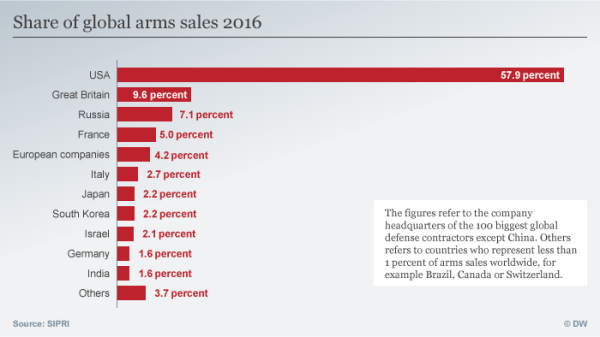 According to recent article on Defense News, “The U.S. State Department has set a new one-year record for clearing weapon sales, with $75.9 billion cleared by the department and announced by the Defense Security Cooperation Agency in fiscal 2017.”
One can see from the graphic above, just how much the US makes in weapons sales globally, compared to other countries.
Thus, any common sense gun control should first include not only a disarming of the police, since they systemically kill civilians, it should also include an end to US weapons sales abroad.
The harsh reality is, and this is what communities of color have always known, both in the US and around the world, that the US has no credibility when it comes to the issue of speaking out against systemic violence. As Dr. King said in his powerful speech Beyond Vietnam, “I knew that I could never again raise my voice against the violence of the oppressed in the ghettos, without having first spoken clearly to the greatest purveyor of violence in the world: my own government.”
Again, these issues are all too familiar in the black community and other communities of color. In fact, the Movement for Black Lives has made it clear in their platform that an end to the war on black people is central to creating racial justice.
Therefore, as move move forward in discussing and taking action around gun violence in the US, we should first look to the black community and other communities of color for direction on how to deal with gun violence. Secondly, any platform or strategy for dealing with gun violence must include action on disarming the police and an end to the US trafficking of guns around the globe. We can ill afford more liberal, knee-jerk reactions when dealing with gun violence in this country. We must develop long-term strategies that deal with systemic violence and not just exceptional violence.
 On Monday, Secretary of Education Betsy DeVos announced that her office would begin a new investigation into Michigan State’s Title IX compliance, in light of the Dr. Larry Nassar revelations.
DeVos stated:
“This new Title IX investigation will look at systemic issues in the University’s handling of sex-based incidents involving Dr. Larry Nassar. Our Office for Civil Rights team will be in East Lansing shortly where they will join the Federal Student Aid team already on site. FSA is currently performing a Clery Act compliance examination regarding MSU’s reporting of crimes committed on campus.”
Considering that Title IX regulations have been weakened under Secretary DeVos, what will this “new” investigation look like and what will it mean for the numerous victims of Dr. Nassar and all of the other cases that were swept under the rug, involving athletes from the MSU football and basketball programs?
We know that Secretary DeVos met with several anti-feminist men’s groups for input on how to move forward on Title IX issues. All of these groups not only deny the current levels of sexual assault on college campuses, they believe that men are too often being blamed for committing sexual assault.
Some of the organizations that Secretary DeVos met with that influenced how she would approach Title IX issues were groups like National Coalition for Men Carolinas, which is a chapter of a national organization. This organization’s website states the following:
Men are easy targets, often staying silent while being publicly attacked by radical feminists and the media. But that is changing. Men are uniting and standing their ground against anti-male hatred and directed discrimination.
Besides their anti-feminist propaganda, one thing that the National Coalition for Men does is publish photos, names, and biographical details of women who have accused men—falsely, the National Coalition for Men insists—of rape. Its members routinely bring lawsuits against women-only networking groups and social events, crying discrimination.
Another group that influenced Secretary DeVos on Title IX policy is Stop Abusive and Violent Environments (Save). SAVE is another anti-feminist organization that believes that campuses are experiencing “rape culture hysteria.”
According to a recent article on Slate.com, “The Southern Poverty Law Center has identified SAVE, which opposes rules that prevent defense attorneys from entering evidence of a survivor’s sexual history in a rape trial, as a planet in the “manosphere” of misogynist online forums. SAVE lobbies against domestic violence protections, claims that the “leading reason” for abuse is “female initiation of partner violence,” and calls falsely accused perpetrators the “true victims of abuse.”
One addition group that met with Betsy DeVos while she was revising Title IX policy was Families Advocating for Campus Equality (FACE). The FACE website is full of videos, commentary and links that make the claim that too many men on college campuses across the US are being falsely accused of sexual assault and rape.
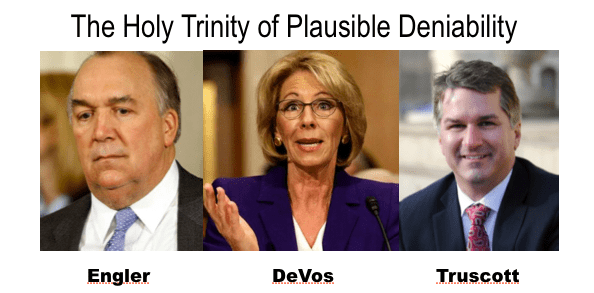
On top of the fact that we find it rather hypocritical for Secretary DeVos to be investigating Title IX compliance at MSU, since her office is influenced by anti-feminist and men’s rights groups, she will be collaborating with former Michigan Governor John Engler.
Engler was the Republican Governor in Michigan when Betsy DeVos was Chair of the Republican Party in Michigan. Plus, as interim President at MSU, Engler has hired John Truscott, his media spokesperson while he was Governor, to handle the PR component of the MSU crisis around the massive amount of sexual assault cases.
Does anyone really believe that with DeVos, Engler and Truscott that there will be much transparency or integrity to the MSU investigations?
A few days ago, the Grand Rapids Police Officers Association posted on their Facebook page the image below, with this message that accompanied the picture:
Thanks to the Brann family for proudly displaying these banners. Their support of law enforcement is second to none and means so much to those that serve and protect.

The Brann Family, which owns Brann’s Steakhouse, hung these banners at one of their restaurant locations, as a show of support for the Grand Rapids Police Department.
Several local organizations and some individuals posted this image and expressed anger and disgust that the Brann family would proudly display such support for the GRPD. This is completely understandable, considering some of the recent actions of the GRPD, specifically as it relates to their treatment of Black youth, last Spring and this past December, specifically the case of 11 year old Honestie Hodges.
The public support provided by Tommy Brann, owner of Brann’s Steakhouse, is also a State Representative. Rep. Brann serves on the State Police subcommittee and last October, voted in favor of the “Blue Lives Matter” legislation, which would make it an even larger crime to target police officers with violence.
In looking at the last few months of the Grand Rapids Police Officers Association Facebook page, it is clear that they not only don’t do well with criticism of their actions, they and their supporters provide all kinds of justifications for pulling guns on Black youth. 
The president of the GRPD union, also made it clear that what the officers involved in the detention of Honestie Hodges did, was completely by the book and just following procedure. Here is a quote from the President of the GRPD union Andy Bingel, as reported by Fox 17, in response to Chief Rahinsky’s comments after viewing the video of the arrest of Honestie Hodges:
“We just need to remember that we’ve got a job to do, and we can’t let this distraction take away from serving the citizens. I don’t expect people outside of law enforcement to understand everything we do. As hard as they might try to understand, they’re not going to, and I think we need to realize that.”
Apparently, Andy Bingel thinks that the public just doesn’t get it and they never will.
In many ways it is easy to find the Brann family’s support of the GRPD disconcerting. However, Brann is not the only one who provides support to the GRPD. Tommy Brann is a Republican State Representative, so many might conclude, “of course he supports the cops.” The reality is that most politicians support the police, regardless of what side of the political aisle they stand on.
In Grand Rapids for instance, Grand Rapids Mayor Bliss, according to Kent County Clerk Campaign Finance records, received $3,000 from the Grand Rapids Police Officers Labor Council PAC, during her 2015 run for mayor.
In the 2017 election for City Commission, Kurt Reppart, who is now one of the 1st Ward City Commissioners, received $1,500 from the Grand Rapids Police Officers Association PAC. In 2016, 1st Ward City Commissioner Jon O’Connor received $1,000 from the Grand Rapids Police Officers Labor Council PAC.
In 2016, Third Ward City Commissioner David Allen, received $1,000 from the Grand Rapids Police Labor Union PAC.
Now, just because these elected officials received funding from the police union or the police association, doesn’t necessarily mean that they are uncritical of the police. However, this writer is unaware of any serious proposals from the Mayor or City Commissioners to hold the police accountable.
 This support for the GRPD goes deeper than elected officials, since many people have expressed support for the police, even lots of people who identify as liberal or progressive. These supporters might not be thrilled with the recent high profile cases of cops targeting Black youth, but the general policy of targeting black and brown neighborhoods is ok with lots of people who identify as liberals.
Alex Vitale, in his important book, The End of Policing, states: Well-trained police following proper procedure are still going to be arresting people for mostly low-level offenses, and the burden will continue to fall primarily on communities of color because that is how the system is designed to operate – not because of the biases or misunderstandings of officers.
It is by design, but many of us accept the dominant narrative that most cops are really about protecting and serving the public. This narrative must be questioned and dismantled.
The Black Panther Movie gives us an opportunity to talk about Colonialism, the African Independence Movement and US Imperialism

This post is primarily for White people. It is for White people who have seen Marvel’s Black Panther movie. Black Panther is an important film for a variety of reasons, many of which have been written about, but it is also an important film because it can help us to expand our radical imagination.
When I say the film can expand our radical imagination, what I mean is that the Black Panther movie can be a mechanism for us, especially for White people, to come to terms with the history of Colonialism in Africa, the African independence movement and the role of US imperialism throughout the continent of Africa.
Colonialism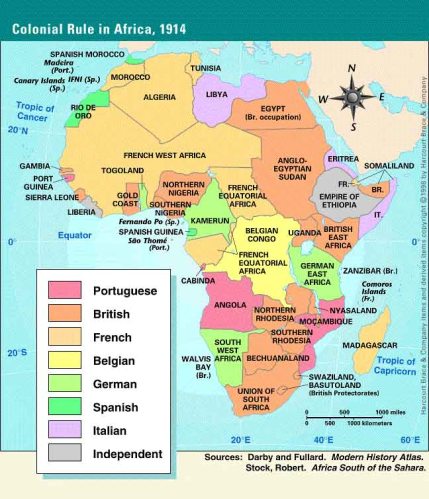
The great African writer Walter Rodney, published in 1973, his powerful book, How Europe Underdeveloped Africa. In Rodney’s book, he lays out an important framework for how European colonialism undermined Africa.
So many of us White people have grown up with images of Africa that were dominated by starving children and those damn religious commercials trying to appeal to our guilt about the awful poverty that existed throughout Africa. What those images and commercials never told us was that African wealth and African resources were being extracted to benefit people living in Italy, France, Belgium, England, Spain, Portugal and Germany, along with the Europeans who were occupying African land as colonizers overseeing this massive resource extraction.
This massive extraction of resources from Africa were in the form of diamonds, oil, cocoa, coffee, wood, animals and of course African labor. The South African Anti-Apartheid movement did a great deal to make us aware of the massive levels of wealth extraction and which companies were profiting from structural racism & apartheid.
Imagine the millions of lives that were lost from colonial violence and exploitation. Imagine how many lives were ruined, how many families were torn apart and how much knowledge and creativity was stolen from African people. Also, it must be said that the massive wealth extraction from Africa and the brutality of European colonialism was all sanctioned by the christian church.
Lastly, just think of the incredible amount of cultural artifacts that were also extracted from Africa, only to end up in European museums without any acknowledgement of the colonial violence perpetrated to steal so much culture from Africa.
African Independence Movement
Like most of the Global South, many Africans grew tired of living under the boot of Colonialism and began to organize independence movements. After WWII, there was tremendous hope that Africa could once again be for Africans.
Anti-Colonial organizing in Africa had begun at the same time that European colonizers began their campaigns of conquest. The anti-colonial movements in Africa often began small, but continued to gain momentum over the centuries. These anti-Colonial movements took many forms, such as the formation of political parties, labor organizing and various manifestations of Pan-African campaigns to unite common struggles.
WWI and WWII greatly weakened many of the European powers and the anti-Colonial movement took advantage of this weakness, particularly after WWII. Anti-Colonial movements were begun in countries like Ghana, Kenya, the Congo, South Africa, Algeria, Namibia, Angola and Nigeria.
We know a great deal about these movements because of the relationship that people in the African American community had with those fighting for justice throughout Africa. Malcolm X had traveled to African in 1959, visiting several countries in an attempt to plan a tour by the head of the Nation of Islam, Elijah Muhammad. Malcolm X later went to Africa in 1964, in two separate trips, where he met with many independence leaders. In fact, Kwame Nkrumah of Ghana, Gamal Abdel Nasser of Egypt, and Ahmed Ben Bella of Algeria had all invited Malcolm X to serve in their governments.
However, some European countries and the United States were not happy about Africans wanting to their own independence. The US in particular was involved in several campaigns to undermine African independence movements, such as the US role in assisting the French battle for control of Algeria, the Congo independence movement and the assassination of Patrice Lumumba, Ghana in 1966, Angola in the 1970s and 80s, putting Mobuto in power in Zaire, destabilizing Libya during the Reagan years, support for the dictatorship in Uganda and the continually siding with the South African government right up until the system of Apartheid could no longer be saved.
The US government spent billions of dollars to destabilize much of Africa, provided arms to dictatorships and refused to support any African independence movement.
US Imperialism in Africa today
The focus on the part of US policy in Africa has been an extension of European Colonialism or as some scholars would say, a form of Neo-Colonialism. Since the end of the Cold War, where Communism was no longer the primary justification for US intervention, you can see a rhetorical shift for US foreign policy, where the justification is now anti-terrorism, radical Islam or even humanitarian intervention.
Since the collapse of the former Soviet Union in the early 1990s, the US has directly intervened militarily (sending troops, missile strikes, sending arms, training, drone attacks) in Africa on the following occasions:
- Somalia 1992 – troops
- Rwanda 1994 – weapons sales
- Sudan 1998 – missile strike
- Congo continuously – weapons sales
- Uganda continuously – weapons sales
- Kenya continuously – weapons sales
- Egypt continuously – weapons sales
- Morocco continuously – weapons sales
- AFRICOM 2007 – Expanding US military bases, training, drone strikes, etc
- Libya 2011 – direct military intervention
One of the most important developments in US Foreign Policy in Africa, is the creation and expansion of AFRICOM, The United States Africa Command. Established in 2007, AFRICOM really took off during the Obama administration and has been involved in expanding the US military footprint throughout Africa. This has meant more US military training of soldiers from African countries and training non-governmental forces who have been instrumental in creating destabilization throughout the region.
Nick Turse, writing for TomDispatch.com has been reporting on AFRICOM for years, with articles like this one from 2014. Turse, also has a book published on the subject of AFRICOM entitled, Tomorrow’s Battlefield: U.S. Proxy Wars and Secret Ops in Africa.
Another person who has been providing important analysis on AFRICOM, is Margaret Kimberley, who writes for Black Agenda Report. She was recently interviewed about AFRICOM. To listen to that interview click here.

This post is just an overview of Colonialism in Africa, the the African Independence Movement and US Imperialism in Africa. There is a whole lot more we need to investigate and come to terms with as White people, who have knowingly or unknowingly been complicit in the colonial and imperialist violence that has been committed and continues to be committed in Africa.
We all have to do the work of learning this history and then providing support and solidarity to the current African movements that are still fighting for liberation. Going to see the Black Panther movie is an important introduction, but it is not enough. White people can’t claim some sort of empathy for Black Africans, just because we saw a movie. We have to come to terms with Colonialism and White Supremacy. Making a Facebook post about going to see the film doesn’t mean much if we don’t work to end US Imperialism in Africa.

