It is interesting how many news sources have reported on Mark Zuckerberg recent visit to Congress to discuss his company’s role in Facebook’s harvesting of data from an estimated 87 million users.
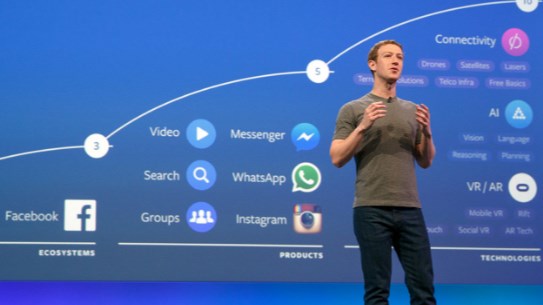
Much of the news media coverage focused on how some members of Congress are not very clear on how social media functions, instead of the reason why Zuckerberg was called in before Congress.
Cambridge Analytica, a British data analytics firm, harvested data from over 87 million Facebookprofiles (up from Facebook’s original count of 50 million) without the users’ consent, according to a report by the London Observer (3/17/18) sourced to a whistleblower who worked at Cambridge Analytica until 2014.
The data collected was then used by Cambridge Analytica to comb through the political preferences of the survey takers and their Facebook friends, without their knowledge, to create individual “psychographic models” that would then allow for entities (like the Trump presidential campaign) to target them with personalized political advertisements and news.
All of this happened with Facebook CEO Mark Zuckerberg’s knowledge.
Then there is Google, which has received almost no coverage of what one of their subsidiaries, Youtube, has been doing with the data mining of children.
A recent complaint was filed with the Federal Trade Commission, pointing out that Youtube has been illegally mining the data from millions of children under the age of 13 for years.
According to the group Campaign for a Commercial-Free Childhood:
Many of YouTube’s most successful channels feature nursery rhyme videos, cartoons, toy ads, and other content designed to capture young children’s attention. YouTube provides how-to guides for creators making videos for kids. Google even runs a program called Google Preferred that lets advertisers pay extra money to get their ads onto the most popular kid-directed channels, like Ryan Toy Review and ChuChuTV Nursery Rhymes & Kids Songs.
In short: Despite the presence of literally millions of child-directed videos, and despite promising advertisers access to kids via YouTube ads, Google pretends that they aren’t responsible for the children on YouTube. Google knows kids are there, and they are not taking steps to protect their privacy. So we are.
The Children’s Online Privacy Protection Act, or COPPA, is the only federal law regulating how to handle kids’ online data, and its demands are relatively straightforward: if you run a site for kids, or if you know kids are using your site, you need to a) tell their parents exactly what kind of personal data you collect, and b) get verifiable parental permission before you gather any information from or about kids. There’s other stuff, too, but those are the basic requirements, and Google doesn’t even try to meet them. Instead, their privacy policy says that YouTube isn’t for children under 13, and that kids shouldn’t use it.
 This is what out of control tech companies and media monopolies look like. Media Consumers are nothing more than a resource that these media conglomerates can make a ton of money from. A more honest assessment of consumers was given by Omnicom Group Senior Ad Executive David Lubars a few years ago, when he said:
“Consumers are like roaches. You spray them and spray them and they become immune after a while. The only answer is to spray them some more.”
As in the case of the Sinclair Broadcasting Group, social media conglomerates like Facebook and Google have tremendous influence in our lives, both in terms of what we know and what we consume.
There is no simple solution to dealing with this overwhelming issue. Some groups advocate regulation, while other push for new kinds of social media sources. The reality is that since the media monopolies are so big, it is hard to operate outside of their reach. Maybe it is time for anti-Trust laws to be applied to these massive companies, to break them up. However, even this seems like a fairly in-effective strategy and maybe what is will take will be revolutionary imagination that will be led by a civil society, which doesn’t see people as consumers to be targeted.
Cops out of uniform can’t stop being cops
 Last night I was invited to speak at a church about the issue of immigration. A small group within the church meets weekly to discuss and hear from people working on a variety of social justice issues.
I spoke briefly about the history of US immigration policy from the founding of the US through the current Trump administration. In addition, I spoke briefly about what Cosecha GR is doing and how they are the real leaders of this issue in West Michigan, since Cosecha GR is immigrant led.
Lastly, I addressed the work of GR Rapid Response to ICE and the realities of state repression in West Michigan that targets immigrants.
The conversation was lively and people seemed to be very interested in the information shared as well as participating in the Rapid Response to ICE work and looking into what it would mean to be a sanctuary church.
Just before the end of the conversation, a white male, roughly 30 years of age, said he wanted to end the conversation on a positive note, specifically about police. At this point he revealed that he was a cop in the Wyoming Police Department. He then went on to say that the Wyoming PD did not ask immigrants what their status is and that the GRPD didn’t do the same. He said they try to get people to trust them and that they are only interested in arresting people who commit crimes. At one point, this police officer said that he understands that immigrants might be afraid of cops, because in their countries the police repression people, unlike here in the US.
 The session was over at that point and people quietly left the building. I thought about what this cop had to say and decided to respond to his claims. There are several points to make, in unpacking what this police officer did and said.
First, I object to his point that he wanted to end the night on a positive note. While we were talking about the level of state violence against the immigrant community, we also discussed all the amazing things that immigrants contribute to this community, their courage and the fact that there is this powerful immigrant-led movement in West Michigan. In fact, most of what we talked about was positive and empowering.
Second, what the police was really saying is that he was uncomfortable with all the discussion about local law enforcement and how immigrants often end up in detention, because if they are processed into the Kent County Jail, the Sheriff’s Department lets ICE know that an immigrant was picked up. Kent County does this because they have a contract with ICE to inform them if immigrants are being held at the Kent County Jail.
 In the police officer’s mind, when cops enforce the law, they are not doing harm to immigrants. However, the reality is that if someone is pulled over for a traffic violation or a tail light that is out, and they are undocumented, they won’t have a drivers license, since the undocumented community can’t get a drivers license. This may not be overt state repression, but it is state repression, since it results in people being separated from their families, put in detention and possibly deported to their country of origin.
Third, the cop made the claim that the Wyoming and GRPD do not ask people of their immigrant status, he was just flat out wrong. In fact, the City of Grand Rapids made it clear last November that the GRPD are excluded from a city police barring employees from asking people their immigrant status.
Fourth, when the police officer made the point about how he understood that people from other countries don’t trust cops, because there they repress people, but that isn’t the case in the US, he was essentially deny that police all across the US are not killing black people, engaged in surveillance of communities of color, arresting and incarcerating black and brown people. How can you say that cops don’t engage in state repression here, when the US has the largest prison population in the world.
Lastly, this police officer did what he was trained to do, which is to try to convince the public that cops are necessary for safety, that they protect and serve the general public. What this police officer was doing was engaging in Copspeak.
According to a new book entitled, Police: A Field Guide, “Copspeak is a language that limits our ability to understand police as anything other than essential, anything other than the guarantor of civilization and the last line of defense against what police call savagery.” The reality is that Copspeak is about pacification, not transformation. Even when they are out of uniform, cops can’t stop policing the rest of us.
 On Monday, we posted an article discussing why boycotting Nestle, in light of their most recent theft of Michigan’s water, would not be enough if we really want to stop what the corporation is doing.
The responses I received from that post were rather instructive and worth discussing here in Part II on the matter of Nestle’s theft of water in Michigan.
One response stated:
I’m not sure what the point is in boycotting Nestle? It’s up to us, the voters, to get rid of lawmakers who made it possible for this to happen. Let’s work to turn Michigan blue again!
In fact, there were several calls to get Governor Synder out and to vote for Democrats. First, Snyder will be out at the end of the year because of term limits. Second, people to seem to have a short memory when it comes to partisan politics, since the Granholm administration also granted massive water extraction rights to the Nestle Corporation’s Ice Mountain bottling plant.
Third, just voting for Democrats does not guarantee that such blatant forms of corporate theft will end. I am not aware of any Democrat running for state office who is taking a strong anti-corporate position. What I have been seeing is that even “progressive” Democrats are talking about business responsibility and businesses being sustainable. There is no sustainable approach to the theft of water by the likes of Nestle. We need to stop them from extracting any more water and making money off of something that should never be a commodity.
In the article posted on Monday, we discussed the importance of using and developing tactics and strategies. Another person suggested that I contact environmental groups and get them on board with using direct action to actually stop Nestle from extracting one more drop of water from Michigan.
On the surface this may sound like a logical thing to do, but there are few environmental groups that have actually come out against Nestle’s extraction of water from Michigan. For example, the largest environmental group in the state, the Michigan Environmental Council, recently said, “Industries that profit from their use of Michigan’s waters should not be the ones to decide whether the amount they use is appropriate.” This is not a definite commitment to opposing corporations like Nestle from extracting water. In the statement they released, they seemed to be more concerned about ending public input. While the public should have a say in this matter, it didn’t seem to make a difference considering that the DEQ received comments from 81,020 people and only 75 supported Nestle’s plan of extraction.
Secondly, most environmental organizations, especially those that are non-profits do not endorse using direct action as a tactic to stop environmental destruction. To advocate for direct action, these environmental groups would probably not be able to apply for grants from foundations and they would likely lose membership of a disproportionately white, economically privileged group of supporters.
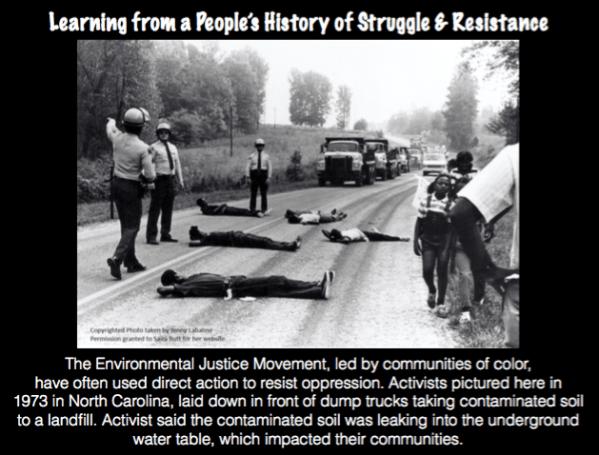
A third major theme from those who responded to the article was the complete lack of understanding of how effective social movement have been in US history. Several responders still wanted to push for voting as the means to create change. One of the main points from Howard Zinn’s, A People’s History of the United States, is that whenever there has been any substantial change in the US, it has come about because of social movements using direct action.
- The Abolitionist Movement used direct action – slave revolts, the Underground Railroad and work stoppages as mechanism to directly impact the profit making imperative of plantations. Armed uprising was also a tactic, which was then used on a large scale by the North, called the Civil War.
- The Labor Movement used direct action – marches, wildcat strikes, work stoppages and industrial sabotage to win better wages, the 8 hour work day, worker safety protections, benefits and pensions. Any labor laws that were passes were the result of the labor movement threatening a massive shut down of capitalism, especially during the administration of FDR. There were literally thousands of strikes happening in the early 1930s.(See Jeremy Brecher’s book, Strike)
- The Civil Rights Movement used direct action – to desegregate the buses, lunch counters, education, ect. with marches, civil disobedience, sit ins, boycotts, and strikes. Whatever civil rights legislation that was passed, was only passed because the Johnson administration was forced to pass those laws by the movement for black freedom.
- The farmworkers movement then and now was not sending their time getting politicians elected, they were using direct action – marches, boycotts, strikes, sit ins, etc – to get better wages and better working conditions. They weren’t appealing to politicians, they were confronting agribusiness.
It has been said by many that electoral politics is the graveyard of social movements. We tend to agree. Let’s be about the business of movement building, not wasting our time and money to get people elected.
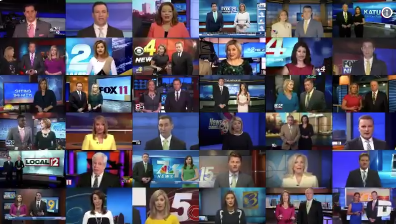 You have all seen it by now. The viral video that shows how numerous TV stations across the US and owned by the Sinclair Broadcasting Group, were all reading from the same script, in Orwellian fashion.
The irony of this viral video is that the script used by the dozens of Sinclair-owned TV stations is suggesting that Fake News is growing and that social media propaganda is at the root of the problem.
While there is certainly a great deal of propaganda circulating in a variety of media platforms, the Sinclair Broadcasting Group does not have any credibility when it comes to criticizing biased news.
The Sinclair Broadcasting Group has made it very clear that they endorse the platform and the policies of the Trump Administration. Last year, it was announced that the company was expanding their media empire by buying out the Tribune Company’s TV stations. We reported on this matter, since there are a few TV stations in the area that were owned by the Tribune Company, namely WXMI 17 in Grand Rapids.
The Sinclair buyout of the Tribune Company was given the green light by the head of the Federal Communication’s Commission (FCC), Ajit Pai. Under the leadership of Pai, we have already seen the undermining of the internet, when the FCC Chairman made the decision to do away with the policy known as Net Neutrality.
However, what has not been discussed in recent news coverage of the Sinclair/Tribune Company buyout, is the fact that this recent example of media consolidation is the direct result of decades of media de-regulation.
Beginning with the Reagan Administration, there has been a constant process of deregulating media ownership policies, which has allowed greater concentration of media ownership in both the entertainment and news industry.
During the Clinton Administration, the radio industry was deregulated, resulting in a massive consolidation of ownership. This consolidation of radio station ownership also transformed the radio landscape by undermining more locally produced programming, accelerating the growth of syndicated shows like Rush Limbaugh and Sean Hannity, decreasing music genres and downsizing staff at local radio stations.
Since the Clinton Administration we have seen additional deregulation in the form of allowing local TV stations to utilize the same video footage, so instead of having numerous TV stations producing independent versions of a particular news story, TV stations are now sharing stock video footage and then using the on air talent to do a voice over of a particular story.
These deregulatory policies have been the direct result of the of the broadcast industry spending millions of dollars to fund political candidates and to lobby elected officials. You can see from this chart that the money coming from the broadcast industry, has been fairly evenly spread between Republicans and Democrats.

This is not the case with every broadcasting corporation, specifically with the Sinclair Broadcasting Group. In a recent article from the Center for Public Integrity, they note that about 80% of their lobbying goes to the GOP, with the Democrats receiving far less.
 While I agree that Sinclair favors the Republican Party, this is not the norm. The Sinclair Broadcasting Group, often referred to as Trump TV, is extremely dangerous. It is dangerous, not just because it is an echo chamber for the current administration, but because it is becoming part of the system of media monopolization.
The consolidation and monopolization of media, particularly news media, should be the enemy of people who want good journalism and an informed citizenry. I understand why people find the Sinclair Broadcasting Group to be dangerous, but we must not lose sight of the fact that this has been the result of a bipartisan effort to deregulate the media, thus creating greater media consolidation. No administration, since the early 1980s has been a champion of independent media, rather every administration since Reagan has engaged in media deregulation. This bipartisan media deregulation gave us the Sinclair Broadcasting Group. Something we can not ignore, nor forget.
Nestle’s Theft of Water: When Boycotts are Not Enough
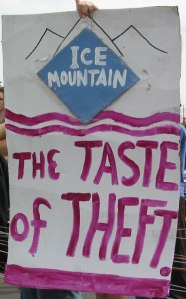 I’m sure there are plenty of people in Michigan who now know that the state has granted the Nestle Corporation the right to extract 200 million gallons of water a year and will only have to pay $200 in exchange.
You read that correctly, Nestle was granted the right to extract 200 million gallons of water a year in Michigan, water that should be left alone, so that the corporate giant can put it in bottles and sell it back to us. For this, Nestle only has to pay the state $200 a year.
This is what corporate power looks like. On top of this, this decision by those in power in Lansing, came on the same day that this same power structure decided that residents in Flint no longer needed to be provided with bottled water.
Many people have no doubt seen various memes calling for a Boycott of Nestle or lists of brand names that the massive multination corporation owns, where in people are also being called upon to boycott these products. Boycotts can be an effective tactic and it certainly is a good mechanism to raise awareness, but boycotting Nestle or just posting images with all their branded products is not enough.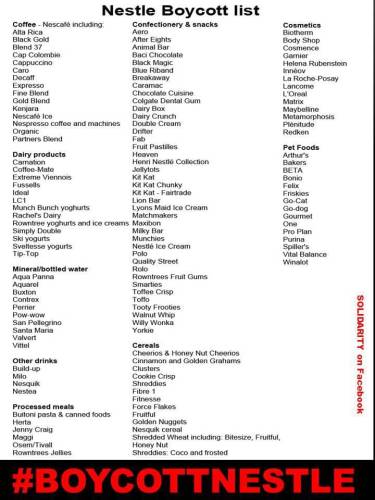
The Nestle Corporation has been the target of boycotts for decades. Beginning in 1977, Nestle was the target of a global boycott because the company was trying to push its baby formula instead of encouraging mothers to breast feed. This boycott involved groups like the International Baby Food Action Network, Save the Children and UNICEF. Nestle was being accused of unethical promotion of their baby formula, particularly to mothers experiencing poverty and in the global south.
Nestle began extracting ground water in Michigan in 2001, when they announced plans to build their Ice Mountain bottled water plant Mecosta County. It has been clear since then that the State of Michigan, through the DEQ, was willing to grant the multinational corporation rights to extract groundwater for their bottled water sales. The courts in Michigan have generally sided with Nestle on this matter, allowing Nestle to continue its theft of water and to expand bottled water production over the years.
The ICE Mountain brand and other Nestle bottled water products have also been the target of a boycott for over a decade, but that boycott has been ineffective to date.
Boycotts are not enough
While I fully support boycotts as a tactic, it is just that, a tactic. Tactics are tools that we use within a specific strategy that movements adopt to obtain certain goals. For example, the United Farm Workers used the Grape Boycott in the mid 1960s as a tactic to win better wages and working conditions for farmworkers. The UFW did win that campaign to a certain extent, but the ongoing struggle of wages and working conditions for farmworkers is still going on today.
If boycotting Nestle products in a tactic, what is the strategy? It depends on which organization you talk to. Some groups want Nestle to pay more for extracting groundwater from Michigan, while others want better regulatory mechanisms in place. However, another strategy could be to actually stop Nestle from continuing to destroy the aquifers in Michigan and not allow them to extract one more drop for their bottled water profits. Some may say that the company will just go somewhere else and do the same thing. While that maybe true, such resistance would send a strong message to Nestle and to the rest of the world about how we can actually stop corporate capitalism and their push to extract water or oil and anything else from our communities.
What a Campaign to Stop Water Extraction in Michigan might look like
First, I think it is important to think about what tactics have been rather ineffective up to this point with corporations like Nestle. I have been reading Facebook posts over the weekend and many people think if they stop buying Ice Mountain or Kit Kats, we can bring the Nestle Corporation to its knees. This will NOT happen with a boycott.
Again, I support boycotting Nestle products, but that is just one tactic that will mostly provide a mechanism for public awareness around what the company is doing in Michigan.
We know that petitions will not work in this case and DEQ public hearings have failed us. Most people who recently weighed in on the Nestle case expressed opposition, but the state still granted the company the right to extract water.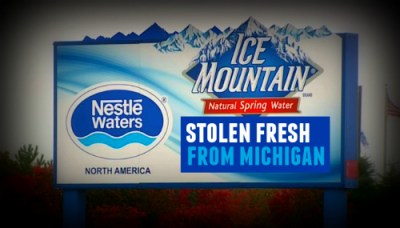
Legal tactics, like lawsuits can also be useful for raising awareness and at times slowing down the extraction process, but it is not enough to stop the extraction of water.
What is needed and what has always worked throughout history is for people to engage in direct action campaigns to actually stop the water extraction from continuing. Without being too specific, we can certainly learn from other historic strategies that have been used in a fight against this corporate giant.
The Abolitionist Movement was not calling for the regulation of slavery or for better working conditions. They were calling for the abolition of slavery. Why can’t we call for the abolition of water as a commodity? Shouldn’t this be the goal? Everyone should have access to clean, drinkable water at no cost. Period!
If we can agree that this goal, then our strategy should be to do whatever is necessary to stop corporations like Nestle from extracting groundwater from Michigan. This could mean a massive march to the Ice Mountain bottling plant, with a commitment from people to blockade the plant and not allow one truck with bottled water to leave the plant for distribution.
If there were enough people, we could just walk on the Ice Mountain bottling facility and shut it down. We could throw the switch, we could cut the power or we could shut the valve that pipes the groundwater into the bottling plant.
All of these forms of direct action are possible and they would actually achieve the goal of stopping Nestle from extracting water from Michigan.
Of course, there would be consequences, since those with power never willingly give up their power. People would be arrested, which means the local and state police would defend Nestle’s extraction of water from Michigan. This alone should tell us something about the function of governments, which is primarily to defend property rights and the system of economic power in our communities. But this is the beauty of direct action, in that it makes plain for all to see how power functions and who has it.
Therefore, we should not delude ourselves into thinking that signing another petition will stop Nestling from extracting water in Michigan, or that attending another DEQ hearing will prevent the theft of water. We should not wait until the “right” elected officials are in office or work to get Nestle to adopt sustainable business practices. No, we need to used direct action on a large scale to actually stop them from extracting the ground water in Michigan.
Let me just end with an excerpt of a speech from great abolitionist Frederick Douglass in 1857:
Let me give you a word of the philosophy of reform. The whole history of the progress of human liberty shows that all concessions yet made to her august claims have been born of earnest struggle. The conflict has been exciting, agitating, all-absorbing, and for the time being, putting all other tumults to silence. It must do this or it does nothing. If there is no struggle there is no progress. Those who profess to favor freedom and yet deprecate agitation are men who want crops without plowing up the ground; they want rain without thunder and lightning. They want the ocean without the awful roar of its many waters.
This struggle may be a moral one, or it may be a physical one, and it may be both moral and physical, but it must be a struggle. Power concedes nothing without a demand. It never did and it never will. Find out just what any people will quietly submit to and you have found out the exact measure of injustice and wrong which will be imposed upon them, and these will continue till they are resisted with either words or blows, or with both. The limits of tyrants are prescribed by the endurance of those whom they oppress. In the light of these ideas, Negroes will be hunted at the North and held and flogged at the South so long as they submit to those devilish outrages and make no resistance, either moral or physical. Men may not get all they pay for in this world, but they must certainly pay for all they get. If we ever get free from the oppressions and wrongs heaped upon us, we must pay for their removal. We must do this by labor, by suffering, by sacrifice, and if needs be, by our lives and the lives of others.
50th Anniversary of Dr. King’s Assassination: The Acton Institute’ uses and abuses of Dr. King Part III
In January, while celebrating the birthday of Dr. Martin Luther King Jr., the Acton Institute took the opportunity to misuse the legacy of Dr. King by saying that he denounced Communism. We made the point that this was both an opportunistic ploy by the right-wing think tank, but it also completely ignored King’s record on economic matters. We made it clear that Dr. King would emphatically reject the neo-liberal capitalist stance of the Acton Institute.
On Wednesday, the Acton Institute once again, misused the legal of Dr. King, specifically by presenting false information and significant omissions about his assassination. In an article entitled, the 5 Facts about the assassination of Martin Luther King Jr., the pro-capitalist think tank completely mis-representing Dr. King’s legacy.
Point # 1 states that it was the second time that someone had attempted to kill Dr. King. This is misleading, since it completely ignores the dozens and dozens of death threats against Dr. King over the years, threats to bomb his home, his church and anytime her traveled by bus or by plane. These numerous other assassination attempts are well documented in Michael Eric Dyson’s book, April 4, 1968: Martin Luther King Jr.’s Death and How it Changed America. The Acton Institute claim also completely ignores the fact that the FBI had also been threatening Dr. King.
Points #2 and #5 say that it was James Earl Ray who murdered Dr. King. This information has been highly contested by numerous investigators, including William Peppers in his book, An Act of State: The Execution of Martin Luther King. In fact, Peppers points out that local law enforcement and even the federal government played a role in the assassination of Dr. King.
In Point #3, the Acton Institute merely states some of the details of where Dr. King was shot, both where he was standing and where the bullet entered his body. There doesn’t seem to be any real value in sharing this “fact,” as it is not terribly relevant.
Point #4 makes a statement about the fact that there were riots and looting all across the country as a reaction to the murder of Dr. King. While this is true, the “fact” does not provide much context and only cites one source on the fact that riots took place all across the country. The Acton fact fails to mention that Dr. King had been saying for years that riots were the language of the unheard:
I contend that the cry of “black power” is, at bottom, a reaction to the reluctance of white power to make the kind of changes necessary to make justice a reality for the Negro. I think that we’ve got to see that a riot is the language of the unheard.
Lastly, there is a complete omission by the Acton Institute writer when it comes to presenting facts about why Dr. King was in Memphis in the first place. The Civil Rights leader was in Memphis to support the sanitation workers who were on strike, demanding better wages, better working conditions and the right to organize a union.
Dr. King stated in a speech he gave in Memphis:
You are demanding that this city will respect the dignity of labor. So often we overlook the work and the significance of those who are not in professional jobs, of those who are not in the so-called big jobs. But let me say to you tonight that whenever you are engaged in work that serves humanity and is for the building of humanity, it has dignity, and it has worth. You are reminding not only Memphis, but you are reminding the nation, that it is a crime for people to live in this rich nation and receive starvation wages.
Just as we stated previously, Dr. King’s position on economic and racial justice would be in complete conflict with what the Acton Institute promotes, which is the virtues of Capitalism.
Cosecha GR continues the legacy of Dr. King with campaign of non-violent Direct Action
Yesterday, members of Movimiento Cosecha GR, held a press conference in downtown Grand Rapids, right in front of the statue of civil rights organizer Rosa Parks.
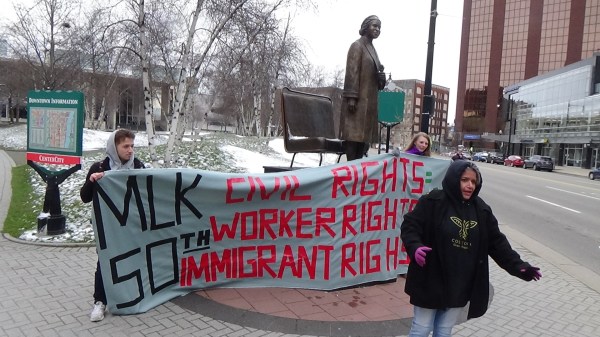
Cosecha GR members Lorena Aguayo-Marquez and Karla Barberi, read a statement (in English and Spanish) about why they were holding a press conference on the 50th anniversary of Dr. Martin Luther King’s assassination.
“On April 3rd, 1968, Dr. Martin Luther King Jr. said his last speech in Memphis, Tennessee as he and other members of the Civil Rights community were there to support sanitation workers who were on strike, demanding better wages and working conditions.
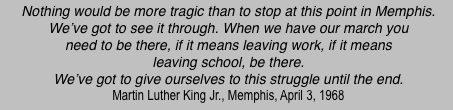
The sanitation workers were paid substandard wages and were not permitted to organize a union. On top of that, the work conditions were horrid, with white supervisors constantly harassing black employees. On that day he said, “Nothing would be more tragic than to stop at this point in Memphis. We’ve got to see it through. When we have our march you need to be there. If it means leaving work, if it means leaving school, be there. We’ve got to give ourselves to this struggle until the end.”
This year today, on April 4, marks the 50th Anniversary of the assassination of Dr. Martin Luther King Jr. Movimiento Cosecha GR wants to honor the legacy of Dr. King, by continuing to promote social justice and non-violent direct action.”
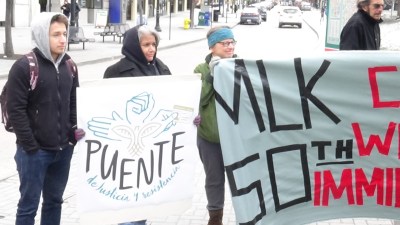 Cosecha GR members also used the press conference to talk about their upcoming campaign to get driver’s licenses for undocumented immigrants, what they are calling Driver’s Licenses for All. Here is what the Cosecha GR members had to say about the Driver’s License campaign:
Driver license increases state revenue through vehicle registration, car insurance, and sales tax. Movimiento Cosecha GR is fighting for driver’s licenses for all in the State of Michigan. Immigrant families are being excluded from access to medical care, work, continued education, places of worship, consumption, and financial security. Not having a driver’s license limits the ability to be an active member of the community, donate organs, and donate blood. Driver’s license for all would provide people with the ability to support themselves and their families. It would promote public safety by ensuring that all drivers are trained and screened. It would increase state revenue through vehicle registration, car insurance and sales tax. Movimiento Cosecha GR is calling for an end to the fear and the oppression that families are being forced to live under that a simple traffic stop by the police could lead to detention, deportation and family separation.
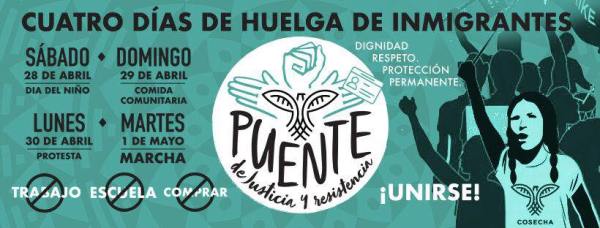
We invite you to participate in the following activities as part of the resistance to the attacks that our immigrant community has been receiving by eliminating DACA, TPS and for many years here in Michigan the Secretary of State has denied DRIVER’S LICENSES to under-documented immigrants.
The activities that Cosecha GR has invited the community to participate in is a four day strike, with activities on each day. For details go to this link.
There were also other people from the community who spoke briefly at the Cosecha GR press conference, including RayLiberator, an immigrant student who talked about the importance of people getting involved in making change, and Rev. Justo Gonzalez, pastor of Ministerios Rios de Agua Viva/Joy Like a River UCC, which announced a few weeks ago that they would be a sanctuary church for undocumented immigrants being targeted by ICE agents. Here is what Rev. Gonzalez had to say at the Press Conference.
The Cosecha GR Press Conference concluded after Lorena Aguayo-Marquez read one more quote from Rev. Martin Luther King Jr.
“You are demonstrating that we can stick together. You are demonstrating that we are all tied in a single garment of destiny, and that if one black person suffers, if one black person is down, we are all down.”

For people who were part of the Civil Rights and Black Freedom Movement between the 1950s and the 1970s, the murder of organizers was all too frequent.
 White Supremacists, which were often part of the law enforcement community, were the ones responsible for the assassination of many of the leaders and organizers within the Civil Rights Movement. They took the lives of people like Medgar Evers, Bobby Hutton, Malcolm X, Fred Hampton and Dr. Martin Luther King Jr.
Today is the 50th Anniversary since they took the life of Dr. King in Memphis Tennessee, while he stood on the balcony of the Lorraine Motel.
Dr. King had been receiving death threats for years and he knew it was just a matter of time before they took his life. People are somewhat familiar with the death threats against Dr. King and other organizers in the South during the Montgomery Bus Boycott and later with the Freedom Rides. However, what is less known, were the threats that Dr. King received in the North, especially after he moved his operation to Chicago. Dr. King often noted that there were larger crowds and more hate-filled verbal assaults on his life in cities in the North than there were in the South.
 When Dr. King was a passenger on a bus or a plan, the departure times were always delayed, because of bomb threats against him, his family and other members of the Southern Christian Leadership Conference. It is hard to quantify the amount of stress that Dr. King had to endure. However, we do know that after Dr. King was assassinated, the medical examiner who preformed the autopsy, reported that he was surprised to see the 39-year old’s heart had the wear and tear of a 60-year old man.
In addition to the white public backlash against Dr. King, the FBI had been monitoring and threatening Dr. Martin Luther King Jr. for several decades. This history of FBI surveillance is well documented in Michael Friedly and David Gallen’s book, Martin Luther King Jr.: The FBI File.
FBI director J. Edgar Hoover, often referred to the Civil Rights leaders as, “that burrhead King” or “the most dangerous Negro in America.” At one point the FBI even sent Dr. King a letter, suggesting that he kill himself, as you can see in this partly redacted letter.
It is no surprise that the FBI saw Dr. King as the “most dangerous man in American,” considering his own evolution. Dr. King was referring less in his speeches about having a Dream, instead he came to the conclusion in his 1967 speech, Which Way It’s Soul Shall Go, to say: I’m sorry to have to say that the vast majority of white Americans are racists, either consciously or unconsciously.
Dr. King realized that demanding an end to racial segregation was not enough. The fiery minister came to see that racial justice was demanded, that the US should pay reparations to black Americans, that economic exploitation was a crime and that the US war in Vietnam was immoral. In fact, Dr. King had come to believe that, “the greatest purveyor of violence in the world today was my own government.”
What Brought Dr. King to Memphis?
One of the strongest criticisms that King had developed in the last few years of his life, was a criticism of poverty, economic exploitation and capitalism. In King’s famous speech, Beyond Vietnam, he provides his own commentary on the story of the Good Samaritan, see here on the right. Restructuring the edifice that produces beggars means we need to change the economic system.
In addition to King’s increasing critique of capitalism, King was in the midst of working on the last campaign he was organizing, the Poor People’s Campaign. Dr. King and the other organizers of this campaign were planning on using direct action in the nation’s capital, by having a tent city, where poor people from all over the country would be occupying land in Washington, DC to not only draw attention to the issue of poverty, but also to demand the promissory note that King spoke often about, which is just another way of saying reparations.
Considering Dr. King’s increased focus on economic justice and the Poor People’s Campaign, it’s no surprise that he would support the black sanitation workers in Memphis.
Michael Honey’s well research book, Going Down Jericho Road: The Memphis Strike, Martin Luther King’s Last Campaign, provides critical insight into King’s support for the striking sanitation workers. Honey provides detailed background material on the black population in Memphis and how that community was plagued by poverty and white supremacy.
The sanitation workers were paid substandard wages and were not permitted to organize a union. On top of that, the work conditions were horrid, with white supervisors constantly harassing black employees.
On top of the general climate of exploitation, the black sanitation workers were often forced to seek refuge inside the garbage trucks, just to get out of the rain. On February 1st, 1968, while some of the workers were inside the garbage truck, the compactor malfunctioned and killed Echol Cole and Robert Walker, crushing them. On February 11, 700 sanitation workers attended a meeting and decided to go on strike. A week later the NAACP passed a resolution supporting the strike, as did King’s organization, the Southern Christian Leadership Conference (SCLC).
Dr. King arrived on March 18 and that same day gave a speech, where he told the crowd, “You are demonstrating that we can stick together. You are demonstrating that we are all tied in a single garment of destiny, and that if one black person suffers, if one black person is down, we are all down.” At that same speech, King not only endorsed the striking workers, he joined others in supporting a city-wide work stoppage on March 28th.
The March 28th city-wide work stoppage also included 22,000 students who boycotted going to school. These students, along with the sanitation workers and people from all over the city marched to demand justice for the dead workers, for the right to organize a union and for better wages and working conditions.
However, the march was disrupted by violence and a 16 year old was shot and killed by Memphis police. Police also followed marchers to a local church, entered the church, released tear gas inside the sanctuary, and clubbed people as they lay on the floor to get fresh air.
The next day, the Mayor of Memphis, Henry Loeb, a Democrat, called for Marshal Law and had 4,000 National Guard Troops brought in to the city.
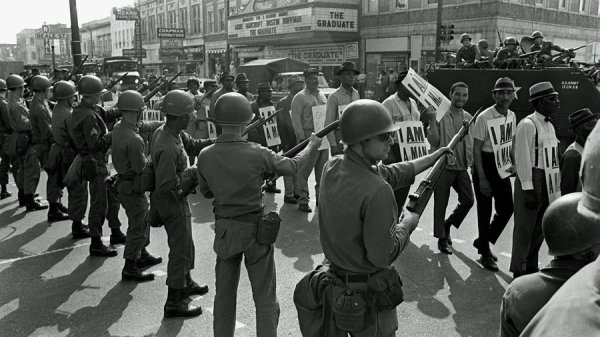
In response, striking workers and Dr. King decided to organize another march. Dr. King came back to Memphis on April 3 and delivered what would be his last speech that evening at Bishop Charles Mason Temple.
The next day, while Dr. King, and those with him, were getting ready to go to dinner, he was shot while standing on the balcony of the Lorraine Motel.
Who Killed Dr. King?
For years the US government presented conclusive information that lone gunman James Earl Ray had shot and killed Dr. Martin Luther King Jr. We were always led to believe that this individual racist had taken the life of Dr. King in a fit of rage over what the man had stood for.
 Considering how much Dr. King, and those closest to him, were being monitored by the FBI and local law enforcement, how is it possible for a lone gunman to have shot and killed Dr. King in such a public setting as outside hi motel room? The police were constantly nearby and the motel had been checked by local police for bombs the day before his assassination. Something didn’t seem right.
Along comes William Peppers, a lawyer, who decided to look at this case in greater detail. Peppers interviewed dozens of people who were there in Memphis that day and was able to gain access to lots of documentation and reports on what local law enforcement and the National Guard were doing at the time of Dr. King’s assassination.
After years of research and investigation, William Peppers published a book in 2003 entitled, An Act of State: The Execution of Martin Luther King. In this book, the author provides a detailed analysis, along with evidence that 1) either the government was directly involved in the assassination of Dr. King, or 2) the government turned a blind eye to what had happened on April 4, 1968.
What Pepper’s argues is that at a minimum, the US government had turned a blind eye to the assassination of Dr. King. However, what seems more plausible, is that law enforcement agencies and the National Guard had collaborated to participate in and allow the assassination of Dr. King.
How People Reacted to King’s Death?
There were demonstrations and riots all across the US in the aftermath of Dr. King’s assassination, with dozens of cities reporting that people were taking out their rage on white-owned businesses.

In Washington, DC, Stokely Carmichael and SNCC were going around the city demanding that businesses close for the day out of respect to the black community. However, the crowd of protestors grew larger by the minute and eventually people were smashing windows and taking items from stores. The National Guard was called in to suppress the uprising.
The scenario repeated itself in cities all across the country, in places like New York, Chicago, Baltimore and Detroit. Michigan Governor George Romney had called in the National Guard to stop people from protesting, much like he had done the previous July during the uprising in July of 1967 in both Detroit and Grand Rapids.
How did Grand Rapids Respond to the Death of Dr. King?
On April 5, the Grand Rapids Press put the assassination of Dr. King on the front page.

However, most of the Press coverage framed the reaction to the death of Dr. King in a negative way. The GR Press did interview people from the community to get reactions.
It states, in an article from the Grand Rapids People’s History Project:
Reggie Gatling, referred to as a black power militant, said, “Members of the black community had a meeting last night and decided we would not give out a public statement that would be reflective of feelings. We’re in mourning for Dr. King, but to say anything further would only give comfort, or possibly discomfort, to white racists.”
What is instructive about Grand Rapids, is how the White Power Structure responded. Again, we refer to the Grand Rapids People’s History Project:
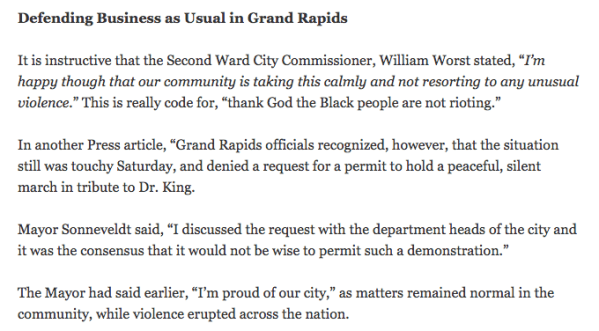
It is vitally important that we continue to morn the assassination of Dr. Martin Luther King Jr. In addition, we must not forget this history. We must not forget that Dr. King was in Memphis to be in solidarity with sanitation workers who were striking. We must not forget that Dr. King was working on the Poor People’s Campaign, which was a direct action campaign designed to gain reparations for the black community and poor people in general. And we must not forget that the US government was spying on Dr. King, making threats against him and most likely involved with his assassination.
To honor Dr. King’s Legacy, we should practice the same kind of justice and love in our actions and campaigns today. Anything less would be dishonorable.
 On Saturday, the Business Leaders for Michigan (BLM) bought ad space on MLive to promote their “new” plan for Michigan’s economy.
The reality is, that this is not a new plan and it is not really about boosting the economy of Michigan. In fact, there is no such thing as a state economy. States don’t have an economy, just like countries and cities don’t have an economy. What we have is Capitalism, which is an economic system that doesn’t recognize borders, is based on constant growth, exploitation of natural resources & human labor, along with increased profits for those who already have tremendous wealth.
All one has to do is look at who makes up the Business Leaders for Michigan, which can be found near the end of the 32-page economic plan they have devised.
The Chairman of this group is none other than Blake Krueger, the CEO of Wolverine Worldwide. Wolverine Worldwide has clearly demonstrated that profits are more important than ecological sustainability and human health, now that the world knows how they have deliberately polluted large areas of northeast Kent County, putting thousands of people’s lives at risk.
 In addition to the Wolverine Worldwide CEO, there are representatives from GM, Chase Bank, DTE Energy, Dow Chemical, Whirlpool, Ford, Consumers Energy, Google and the CEO of Quicken Loans, Dan Gilbert. Gilbert, who also owns the Cleveland Cavaliers, has become Detroit’s equivalent to the DeVos Family. In a recent issue of the Jacobin Magazine, there is a solid article entitled, Opportunity Detroit:
In the national folklore, it is Gilbert — Detroit’s “superhero,” according to the Atlantic — who helped Detroit escape its downward spiral by investing billions in the real estate market when other capitalists scorned it. He now owns at least ninety-five buildings in Detroit and wields immense influence over the city’s future. Even many of his critics admit that he’s had a positive impact. Sure, they say, he owns a huge chunk of downtown and enjoys incredible power over the local economy. But what would Detroit look like without him?
This is a false premise. The choice isn’t between billionaire-led investment and the destitution of the city. On the contrary: the revival spearheaded by people like Gilbert is made possible by, and depends upon, the poverty and dispossession of working-class Detroiters.
There is also substantial representation on the BLM, from names that we are very familiar with here in West Michigan. People like Doug DeVos, Steve Van Andel, Mark Bissell, Michael Jandernoa, John Kennedy, Matthew Hayworth and Hank Meijer. If you are familiar with our writing here at GRIID, you know we refer to these people are members of the West Michigan Power Structure. These white men (not surprising that they are men and white) are the wealthiest in the area, the are involved in groups like the West Michigan Policy Forum and they all contribute a ton of money to political candidates, in order to influence public policy that expands their wealth.
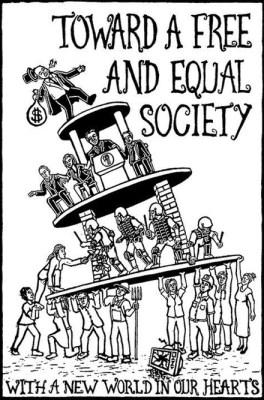
This plan to “improve Michigan’s economy,” uses phrases that are meant to sound creative, but in reality, it is meant to just continue the same old capitalist model that benefits a few at the expense of the majority.
The Plan – Decoded
The plan laid out by the Business Leaders for Michigan uses language that is somewhat vague and often deceptive. Here is a look at several of the major themes the group of rich, white men are promoting.
- Stronger Job Growth – at first appearance this might seem like more jobs for people, but in reality it means creating a better business climate. A better business climate means lower taxes for businesses and the business class, greater public subsidies and less government regulation.
- Improving Fiscal Management – is simply code for getting government to privatize more. One example the BLM cites is the recent legislation in Michigan which ended public sector employee pensions and shifting people’s retirement to the whim of the speculative market.
- Competitive Tax Environment – is code for reducing taxes for businesses, especially larger businesses. It also means re-directing more public money into private hands.
- Talent Pipeline at Risk – is code for we need to improve education to that these business leaders have a larger pool of future workers to chose from and who have the skills they need to insure greater profits for the businesses they own.
- Automotive Past Can Build a Stronger Future – is code for GM and Ford wanting to continue to push the same old tired car culture on the rest of the world, instead of developing an efficient mass transit system that would decrease the use of fossil fuels.
- Strategic Assets for Growth – is code for how to push certain industries and exploit more of the natural world, which they refer to as Natural Resources. In a Capitalist world, trees, water, soil, etc. are commodities for making profits.
- Innovation Boosts Entrepreneurism – is code for pushing venture capitalism and competition. In other words, capitalists don’t believe in sharing knowledge and collective liberation, they believe in survival of the richest.
The rest of the report continues with more details on how to compete, invest and growth Michigan’s economy. Here is a chart that lays out their strategy:

Towards the end of “The Plan,” there is this statement in larger letters:
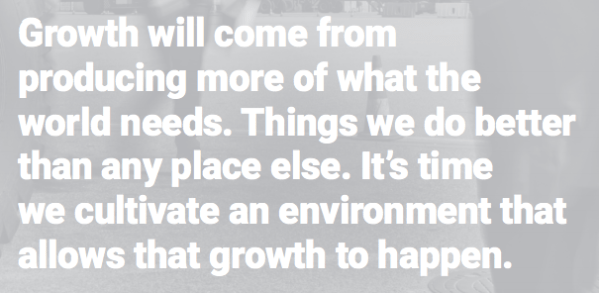
Based on the people and the companies that make up the Business Leaders for Michigan group, producing more of what the world needs would mean:
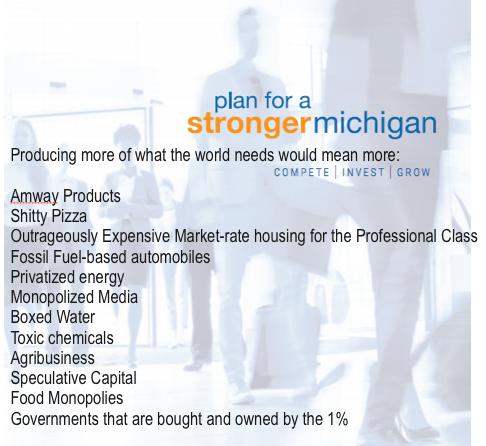
Let’s be honest. This IS the kind of world that the Business Leaders for Michigan want. It will not benefit most of us. It will not give land back to Indigenous communities. It certainly won’t benefit black and latino  communities. It will not benefit most immigrants. It will not promote environmental justice. It will not end poverty. It will not end mass incarceration. It will not end police violence.
This economic plan that the wealthiest has for us must be resisted. We can resist it with radical imagination, with cooperation, with mutual aid, with reparations, with love and with justice. We can imagine a better world, a different world and a world based on collective liberation. Another World is Possible.
GRPD’s Youth Interaction Policy provides no real evidence that they will not continue to hold youth at gunpoint in the future
 Just over a week ago, we posted an article in response an MLive story, about the 1 year anniversary of when Grand Rapids police officers held 5 black youth at gunpoint.
The article cites Police Chief Rahinsky as saying that the police responded appropriately in this instance, that he would love to have more officers hired and that the GRPD needs to spend more time with youth, doing things like playing basketball.
In that same MLive story, written on March 22nd, the police department announced that they would be releasing a “youth police” document, in response to several high profile cases involving the GRPD holding black youth at gunpoint. You can read the 2 page document at this link.
The Youth Interactions Policy is rather vague. It also frames the issue primarily around youth who are suspects. This notion that youth are suspects is exactly what people were so upset by in the community, both in the case of the 5 black youth held at gunpoint a year ago and the 11 year old Black girl held at gunpoint and handcuffed last December. In both of these cases, the youth were not suspects, they just happened to either fit the profile of other suspects or they were in the wrong place at the wrong time.
However, most of the 2-page document deals with youth suspects. Under the section General Procedures, there are 5 points made. Only the 5th point talks about what to do if the youth in question is not a suspect and what to do with them. At this point the document includes 3 ways in which Grand Rapids Police Officers are supposed to deal with youth that are no longer determined to be suspects.

Even these operational procedures, which are to be applied if the youth in question is no longer a suspect, uses language that still views the youth and or the parents as problematic. How many families from communities of color have had difficult and unpleasant experiences with Child Protective Services? If the youth are not suspects, why should an officer be assigned to them?
According to a story on WXMI 17, the cost of the updated training curriculum that is specific to youth interaction, is costing the City of Grand Rapids $9,995.
The Youth Interaction Document doesn’t seem like it will prevent the GRPD from holding youth in Grand Rapids at gunpoint. In fact, the document provides little evidence that the GRPD will be making much of an effort to NOT further traumatize youth, particularly youth of color.
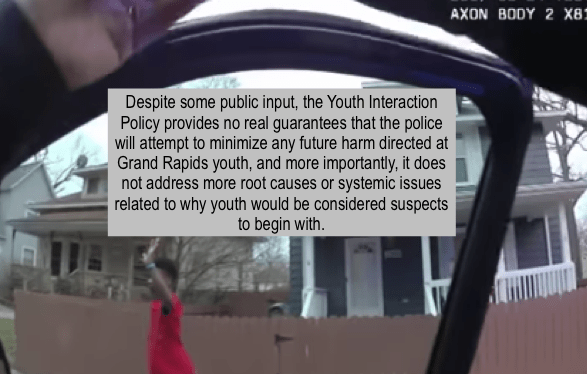
This document was crafted with input from a Task Force, made up of members of the GRPD and community members, listed here at this link from the City. However, despite some public input, the Youth Interaction Policy provides no real guarantees that the police will attempt to minimize any future harm directed at Grand Rapids youth, and more importantly, it does not address more root causes or systemic issues related to why youth would be considered suspects to begin with.