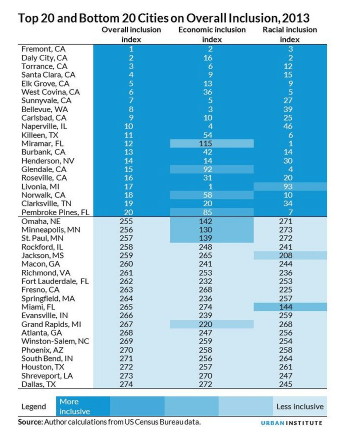
 Last week, the online site Colorlines, post a story about a new study looking at how US cities with populations of 100,000 or more has dealt with the recovery since the 2007-2008 economic recession.
Colorlines writes:
The Great Recession of 2008 forced many cities to rebuild their economies. But in many places, the recovery has been uneven, with some cities enacting policies that increase equity across racial and ethnic groups, while others widened the gaps between the haves and the have nots. A new study from nonprofit research organization Urban Institute explores which cities prioritized inclusion in their struggle for economic growth.
The study done by the Urban Institute, Inclusive Recovery in US Cities, was released just weeks ago. Their research looks at both economic inclusion and racial inclusion:
Our overall inclusion index combines the economic inclusion and racial inclusion indices for a composite view of inclusion in a city, but the two are also analyzed separately. We distinguish between economic inclusion and racial inclusion because it is common for cities to experience economic growth while leaving certain groups behind: this is especially true for communities of color, given the longstanding history of race-based discrimination and segregation in this country (Greene, Austin Turner, and Gourevitch 2017; Kijakazi et al. 2016). We pay special attention to those cases in which economic inclusion and racial inclusion diverge, as these examples may offer important insights into whether achieving inclusion is contingent on the deliberate use of targeted policy actions that address group-based discrimination or structural barriers.
This last sentence is important, since it acknowledges targeted policy actions and group-based discrimination or structural barriers.
Grand Rapids, based on the study conducted by the Urban Institute, shows that:
In 2013, Grand Rapids ranked 267 out of 274 cities on overall inclusion, 220 on economic inclusion, and 268 on racial inclusion. From 2000 to 2013, Grand Rapids’s economic health rank decreased from 149 to 211. The city also became less inclusive, falling from 222 to 267 in the overall inclusion rankings.
Here are some graphs from the study, which looks at home Grand Rapids compares to the national trend.

At this point, some might argue that this data is based on 2013, and that since then Grand Rapids has significantly changed. I would agree that GR has changed during the past 5 years, but we have to ask ourselves who has been benefitting from that change.
As we have reported in the past, the wealth gap is larger in Grand Rapids than in any other city in Michigan. In addition, the economic development has been concentrated in certain areas of the city and has primarily benefitted those who already have economic and racial privilege. One only need to look at what is happening in downtown Grand Rapids, the near westside, especially on Bridge St, plus other areas like the Wealthy St. corridor to see who the primary beneficiaries are. Many of the same development companies have been the beneficiaries, the same wealthy families and a disproportionate number of white, urban professionals are benefitting.
I would suggest that given the trend, Grand Rapids might even been worse on the economic and racial inclusion front than it was in 2013.
Lastly, it is worth noting that when Grand Rapids ends up being on the top lists for things that are “feel good,” local entities like the Chamber of Commerce, The Right Place Inc or Experience GR are quick to use these lists to market the city. None of these organizations mention this new study and are not likely to, since it ultimately exposes the realities of neoliberal economic policies and the ongoing embrace of white supremacy.

It’s not the KKK invading Grand Rapids this weekend, it’s a group more dangerous: The American Legislative Exchange Council
The American Legislative Exchange Council, also known as ALEC, will be having their 2018 Spring Task Force Summit in Grand Rapids all day long, this Friday, April 27.

The ALEC event will be held at the Amway Grand Plaza and is a private event for members only. This is not surprising, as ALEC does not want journalists or any one else to expose what new policies they are crafting that will promote their neo-liberal economic agenda.
ALEC, of course, is the creation of the Koch Brothers, and is designed to implement policies that promote privatization, greater corporate control, plus undermine unions and attack public education.
The Center for Media & Democracy (CMD) has done more to expose the efforts of ALEC over the years and they are the ones who discovered that ALEC will be in Grand Rapids this weekend.
In an article by David Armiak and Mary Bottari, the co-author’s write:
There is no word yet on whether Secretary of Education Betsy DeVos, a Michigander married to Amway heir Richard DeVos, will be joining the gathering at the swank four-star hotel as ALEC legislators and corporate lobbyists vote on cookie-cutter bills behind closed doors. ALEC has long embraced DeVos and her school privatization agenda, even though the failure of the charter school system she helped create in Michigan has been the topic of devastating reports in the New York Times and 60 Minutes. Further education privatization is on the agenda in Grand Rapids along with measures to please fossil fuel companies, marijuana companies, and more.
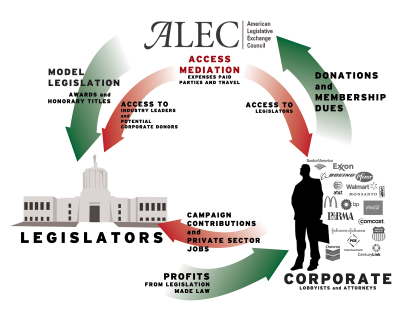 The agenda for the ALEC gathering in Grand Rapids can be found at this link, which includes discussion and the crafting of policy relates to economic development, pension reform, education and workforce development, energy and the environment, to name just a few.
ALEC operates across the nation and has state policy chair persons who work for the state legislature. In Michigan, the state chairs are Rep. Mike Webber and Senator Michael Green. Green has been the recipient of large sums of DeVos money and Webber has been the recipient of another member of the West Michigan power elite, John Kennedy.
Michigan organizations, such as the Acton Institute and the Mackinac Center for Public Policy, are part of the network of ALEC supported right-wing think tanks. In 2015, Grand Rapids was host to the State Policy Network’s (SPN) annual gathering, but the Acton Institute and the Mackinac Center were effectively the hosts for that SPN function. I had planned to attend that gathering in 2015 and was even registered, but when I checked in they denied me entrance to the conference.
On Friday, in Grand Rapids, a national right-wing organization will meet to create proposals that will give more power to corporations, attack public education, promote greater privatization of government and craft energy policy that will continue to benefit the oil and gas industry as we all suffer the consequences of climate change. How can we allow this kind of gathering to take place in this city, especially knowing that they seek to use wealth to influence public policy that gives private power greater control over our lives?
ICE is kidnapping members of our community: ICE Out Now Press Conference in Grand Rapids
 Just after noon today, about 25 people gathered in front of the Grand Rapids office of Immigration and Customs Enforcement (ICE).
The Press Conference was called by Movimiento Cosecha GR and the GR Rapid Response to ICE project, since there has been an increase in ICE activity, including arrests and intimidation.
When I arrived for the press conference, there were two ICE agents wearing bullet proof vests and standing next to white Homeland Security vehicles. One of the ICE agents told us that “they were there to make sure that everyone was safe.” This is what those who critique law enforcement strategy as the management strategy, where cops try to manage what community groups do, always presenting a “we are here to help” posture.
After most people had arrived for the Press Conference, there also appeared members of the GRPD, although they just circled the block a few times to see what was happening.
Part of the reason that this press conference was organized, was due to the fact that ICE activity has increased, but also because the immigrant community has been communicating with Cosecha GR about the concerns they have and wanting to feel safe at ICE event. Gema Lowe, with Cosecha GR, made it clear that the reality is that it is safer for immigrants to participate in Cosecha GR activities, because together they are stronger than any attempt to repress people. She also used language that is usually heard outside of the US, with terms like kidnapping, forced disappearance, along with the idea that those in detention have to pay a ransom in order to get out. Here is a brief video with Gema Lowe speaking to those who came to the press conference.
 In addition, Martin, an immigrant who spoke, told those in attendance that he and his family left their country because they believed that they could leave fear behind them, only to then find out that they are also living in fear in the US because the government has failed to adopt just immigration policies. Martin, also encouraged people to come to the May 1st march being hosted by Cosecha GR.
The next speaker was Amy Carpenter, with the GR Rapid Response to ICE project. Amy read a statement in support of immigrants and a pledge from allies that they would do whatever they could to stop ICE from separating families and to support those who have been impacted from ICE arrests. Amy also let people know that the GR Rapid Response to ICE group has a network they can mobilize to try to stop ICE from taking immigrants and to offer a variety of other kinds of support. She stated that if ICE comes to your door, call 211 in Kent County and we will respond as quickly as possible to ICE oppression.
Al Heystek, a pastor with the UCC spoke about the physical and emotional pain that ICE causes when they arrest people and “make children have to witness a parent or another family member be taken away.” Heystek also spoke about the importance of the need for the faith community stand with immigrants and to offer support however they can.

Lastly, Richard Kessler, an immigration attorney spoke about how the current administration might be the worst administration in regards to immigration policy. Kessler said that the current policy is both racist and xenophobic, plus that many of the arrests that ICE make are in violation of the rights of immigrants, regardless if they are documented or not. The immigration lawyer also encouraged people to come to the May 1st march, which would send a loud message that people will fight these unjust policies and that we can win justice for all immigrants.
Movimiento Cosecha GR is an immigrant-led movement, which has been organizing in Grand Rapids for more than a year.
Cosecha GR is fighting for Dignity, Respect and Permanent Protection for all immigrants. This immigrant-led movement has been using direct action strategies, such as boycotts, marches, civil disobedience and strikes.

They have four days of action coming up, between April 28th and May 1st.
- April 28: 11am-2pm Join us at DÍA DEL NIÑO at Cesar Chavez School, 1205 Grandville Ave SW, Grand Rapids, MI 49503.
- April 29: 2pm-5pm Come and share a COMMUNITY MEAL potluck style at San Juan Diego Academy 1650 Godfrey Ave. SW, Wyoming, Mi 49509
- April 30: 11am-1pm We will conduct an action for our DRIVING LICENSE FOR ALL campaign at Rogers Plaza, 972 28th Street SW, Wyoming, MI.
- May 1: 12 pm A huge march for International Workers Day that will start from Roosevelt Park at Chicago Drive & Clyde Park to Downtown Grand Rapids.
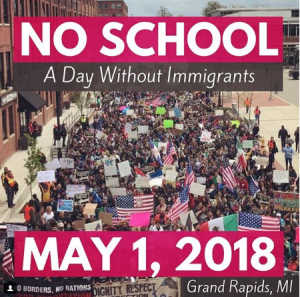
Cosecha GR is calling for a 4-day strike, for people to not send their children to school and to not purchase anything during these four days. If you have to purchase anything, Cosecha GR is encouraging people to makes purchases at minority owned businesses. For more details on the four days of action, please go to their Facebook link https://www.facebook.com/events/606122836408011/.
In addition, these four days of action will also be part of movement’s kickoff of their campaign to get driver’s license for all. “Immigrant workers need to drive to their workplaces without the risk of being arrested because of no license or expired license. That is why, as part of our movement, to win respect and dignity, we are launching a statewide campaign to win DRIVERS LICENSES FOR ALL as we continue fighting for permanent protection.”
Lastly, we also interviewed Karla Barberi, one of the Cosecha GR organizers about these upcoming actions.

 Last Wednesday, Secretary of Education, Betsy DeVos, announced the confirmation of Carlos G. Muñiz as the Education Department’s General Counsel. In a statement that DeVos released, she said:
“We are pleased to finally have Carlos on the team. After a protracted confirmation process, Carlos can at last get to work on behalf of our nation’s students. He has dedicated his career to upholding the law, and his insight and expertise will be invaluable as we work to advance educational opportunities for all students.“
As a lawyer, Muniz is currently a partner with McGuireWoods LLP and a senior vice president in the National & Multistate Strategies group of McGuireWoods Consulting LLC. Muniz previously worked as Florida Attorney General Pam Bondi’s chief of staff for three years, between 2011 and 2014. During his time in that capacity, Muniz represented Florida State University in a lawsuit brought by a student who accused the former quarterback Jameis Winston of raping her in 2012. That case was settled with the accuser for $950,000, but the Office of Civil Rights opened an investigation after it was discovered that the university barely investigated the rape case.
In addition, Carlos Muniz helped to defend the Florida Attorney General’s decision to sit out legal action against Trump University, a controversial real estate seminar owned by Donald Trump.
As General Council to the Department of Education, Muniz will decide which school legal battles to pursue. The Department of Education has already come under fire, because Secretary Betsy DeVos has already said that she will limit the amount of civil rights cases her department will hear. DeVos has also made it clear that Title IX cases will be treated differently, since she has chosen to bring in several Men’s Rights groups who claim that there are plenty of cases on college campuses where women are falsely accusing men of rape.
Betsy DeVos has also diminished the Department of Education’s role in defending the rights of LGBT students, students with disabilities and students of color. Bringing in Muniz, is just one more confirmation of the Department of Education’s lack of commitment to civil rights issues within education.
Lastly, Muniz is part of the Federalist Society for Law and Public Policy Studies, a conservative Libertarian group, which receives funding from numerous large right wing foundations, supports the American Legislative Exchange Council (ALEC) and is a member of the State Policy Network. Both ALEC and the State Policy Network work at the state level to push a right wing agenda, which includes the privatization of education, which Betsy DeVos supports.
MLive, Experts and what would be good for Michigan
On Saturday, MLive ran a story about the economic outlook in Michigan, with the usual framing around job growth, unemployment rates and wages.
The article relies on what they refer to as experts for their analysis and then proceed to list 8 moves that would mean significant economic and job growth for the state.
As we stated in a previous post, “States don’t have an economy, just like countries and cities don’t have an economy. What we have is Capitalism, which is an economic system that doesn’t recognize borders, is based on constant growth, exploitation of natural resources & human labor, along with increased profits for those who already have tremendous wealth.”
However, since MLive continues to talk about the economy of Michigan, it’s still important to look at the 8 ideas, based on expert input, that would be good for Michigan.
Michigan needs more people with four-year college degrees. This idea presents the notion that with a 4 year degree, you have more people with talent and that will attract businesses. The MLive report then cites Gov. Snyder’s Marshall Plan, which is nothing more than a business-centric proposal to bring more people from the professional class to the state. This Marshall Plan is really rather frightening and it seems to have received very little news coverage and what coverage there has been is uncritical of said plan.
What major omission in the idea that Michigan needs more people with a 4 year degree, is the issue of student debt. We have a whole generation of students that have tens of thousands of dollars of debt. When people are living with large amounts of debt, society will suffer.

The state needs good-paying jobs, not just jobs. While we would agree with this second point in principle, the MLive article never defines what good-paying jobs would be. There is a national $15 an hour minimum wage movement, but even that movement is also not just calling for better wages, but the need to have good benefits and a just pension. Benefits and pensions are not even discussed in the “good-paying jobs” idea. Moreover, the MLive writer takes at face value that these “good-paying” jobs would be for new professional talent and not for people in the service sector. This means that people who clean the rooms at the Amway Grand, bus tables at restaurants, pick the food at area farms, are not included in this “good-paying jobs” mantra.
Michigan needs to increase school funding. While more funds for public education are critical, the MLive writer never uses the term “public” when referring to education. The MLive article does state that Michigan schools are not performing well, but doesn’t offer any analysis of why this is the case. There is no discussion of Secretary of Education Betsy DeVos’s role in public education funding, plus the article continues to talk about education in terms of job training instead of education that would create critical thinking students.
Upskilling Michigan workers needs to be an ongoing effort. This idea again refer’s to Gov. Snyder’s Marshall Plan. In this instance, it is about training, “the state’s residents for the high-skill, high-demand jobs the workplace needs.” In other words, businesses want to dictate what people should be trained in, as opposed to people having a say in what they want to do and how the economic system should function.
The state’s best urban environments need to grow and thrive. The argument here is that companies need concentrated talent and apparently they can’t find that in small communities. Therefore, cities like Detroit and Grand Rapids need to grow. This idea is not based on fact and it even comes with a certain level of contempt for those who live in small communities and rural areas. This idea also fails to acknowledge that if people with talent move to cities, it will mean the decline of small communities and rural areas, which suffer high rates of poverty.
Michigan should look at policy to improve jobs. While having sound policy to improve jobs might make sense, it has not be a reality for decades in Michigan. We could talk about the negative impact that NAFTA had on the manufacturing sector, but more recently we can look at the state policy that made Michigan a Right to Work state, the attacks on public sector unions, forcing people who previously had good pensions to now rely on the stock market for retirement and the elimination of business taxes in the state. These policy decisions in the past couple of decades are exactly what groups like the West Michigan Policy Forum are advocating for.
Altering the sales tax structure would boost revenue. Working people are already over taxed. Instead, why not advocate for bringing the business tax back and re-structuring the tax system to put a larger burden on those with tremendous wealth to pay more in taxes. This is not likely to happen, since those with tremendous wealth are the ones who essentially buy public policy.
Michigan could better leverage its universities and innovation. Again, there is no assessment of the fact that public universities have continued to receive less public money in recent decades, relying instead on wealthy donors who push their own agendas.
Essentially, this MLive article, like most articles on the economy, fail to discuss the wealth gap and how the capitalist class often dictates public policy on matters related to the economy and education.
These eight ideas are not new, not are they going to challenge systems of power in Michigan. Until civil society becomes more organized in mass movements and until workers decide to take back their power, the future of Michigan will not change, no matter who makes up the state legislature in Lansing.
Boxed Water, Greenwashing and the DeVos Family support for racist water policies in Michigan
More and more corporations are trying to present themselves as caring about the environment. These corporations use slick advertising campaigns and try to deceive us into thinking that we can consume our way out of the environmental crisis we have made.
Greenwashing is a term that eco-activists have used for several decades now, in an attempt to expose the hypocrisy of capitalism. Green Capitalism is especially visible around the time that we celebrate earth day. In fact, corporations have pretty much hijacked earth day, by trying to convince us that they too care about the planet. Nothing could be further from the truth, since what drives capitalism is labor exploitation, profits and exponential growth……none of which is sustainable.
A great example of greenwashing in the West Michigan-based product known as Boxed Water. Boxed Water markets themselves as a product that is Better For Our Planet. The company’s main argument is that buying water in plastic bottles is bad for the planet, so buy water in a box, which is completely recyclable.
While I would agree that buying bottled water is highly problematic, buying water in a box is just as deceptive.
First, water is essential to life. It should not be a commodity, but something that all life has access to. Second, the energy spent manufacturing the boxes, putting water into the boxes, shipping it and marketing the product could all go away if we just stuck to drinking water from a tap.
Third, for those who argue that tap water is not safe, then we should put our energies into fixing the water delivery system that comes from a municipal water infrastructure to homes, schools, hospitals, etc.
Fourth, Boxed Water, by their own admission, uses water from Lake Michigan, via their Holland plant. The company also has another facility in Utah.
Fifth, Boxed Water does use a filtration process, claiming that their water is more pure. Ok, so why don’t they apply this filtration process to all municipal water systems, so that we can all drink healthier water? Ah, but then the company could not make a profit…..and therein lies the problem. Well, at least one of the problems.
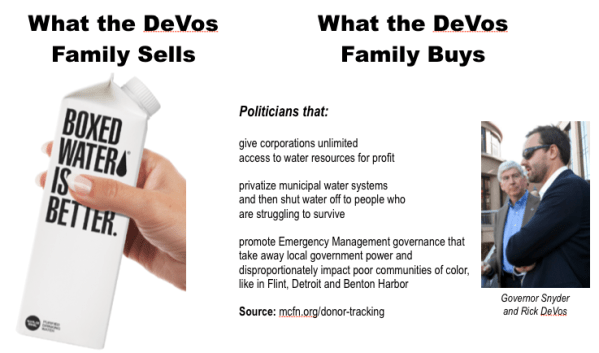
I’m sure that most people are well aware that Boxed Water is just one of the companies that is part of the Windquest Group. The Windquest Group is part of the DeVos Family empire and is specifically part of what Dick & Betsy DeVos own, along with Melissa DeVos and Rick DeVos.

Part of the irony of the DeVos Family owning Boxed Water, is that they are major contributors to Govenor Rick Snyder and many other state politicians that have supported the recent decision to grant the Nestle Corporation rights to steal more water from Michigan for their Ice Mountain bottled water brand. These same politicians have also engaged in the criminal acts being committed in Flint, where residents of that city STILL do not have access to clean, drinkable water.
The Flint water disaster is a direct result of having an emergency management system, which essentially takes power away from local communities and puts it in the hands of people that the state government choses.
This downsizing and privatizing of local government is also one of the main goals of the DeVos Family, both through their direct campaign contributions and through groups like the Chamber of Commerce and the West Michigan Policy Forum, which makes the privatization of government services their goal.
Another example of the DeVos effect on water is the Emergency Management system in Detroit, which has privatized some of the water services and made it a priority to shut water off to thousands of homes of mostly African Americans.
Like Flint, the Detroit water crisis is a deeply racist policy by design. Now, which politicians are responsible for these policies……….the very same politicians whom the DeVos Family has so zealously supported.
 The annual event known as Earth Day, will be celebrated this coming Sunday, April 22nd. Earth Day began in 1970, as greater consciousness was being raised about the how humans were impacting the environment.
Many people were influenced by Rachel Carson’s monumental book, Silent Spring, which was published in 1962. In her book, Carson exposed the harmful impact that pesticides and other commercial chemical use was having on wildlife and our ecosystems.
Building on the popular movements of the 1950s and 1960s, like the Civil Rights Movement, the Anti-war Movement, the Farmworker Movement and the Feminist Movement, the modern day Environmental movement was born.
What the first Earth Day organizers emphasized was the need to directly confront polluters and force the federal government to adopt some regulations. After all, it was the first Earth Day that forced the Nixon administration to create the Environmental Protection Agency (EPA). Of course there was also the message of personal responsibility that came with the first Earth Day celebrations, but this was not the focus.
As a response to the growing scrutiny of environmental polluters, the business sector responded by creating a campaign called, Keep America Beautiful. The centerpiece of this campaign became moving attention away from industrial waste and pollution to personalized trash known as litter. The Keep America Campaign even came up with the label “litterbug,” a term which is used even today to describe individuals we all should look down upon. The campaign worked beautifully and by the second Earth Day celebration these corporate entities financed the creation of a powerful TV ad using a Native America actor Iron Eyes Cody. The Native man is seen at numerous places – in the woods, along the beach – and everywhere he goes there is trash. Again the emphasis was on individual behavior and not so much on industry.
The First Earth Day in Grand Rapids
Earth Day activities were planned across the country on April 22, 1970. Grand Rapids was also included in those communities that celebrated Earth Day.
Based on articles from the Grand Rapids Press, there were three separate activities that received attention in Grand Rapids.

In the afternoon, there was an event with song and signs on the Calder Plaza, with the featured speaker being Rep. Guy VanderJagt, a Republican from Cadillac. The comments by VanderJagt, as reported in the Grand Rapids Press, spoke of the urgency to take action. However, the representative from Cadillac framed the environmental urgency in terms of how much people would be willing to pay in taxes to get clean air and clean water.
There was also a large community event, with an estimated 1,500 people in attendance at the Civic Auditorium in the evening. The event featured images on the big screen, musicians and speakers.
Senator Philip Hart got the biggest applause from the audience, according to the Press. Hart spoke about not separating humanity from nature and that the “drive to save the environment” will outlast recent crusades such as those of civil rights and the war on poverty.
At one point the image of Vice President Spiro Agnew appeared on the screen, which received a lot of boos from the audience. Representative Gerald Ford spoke, and he too received boos, shouted comments about the war in Vietnam and sometimes loud stamping of feet.
 Ford’s comments, according to the GR Press, were limited to personal sacrifices, consumer dollars and taxes. Ford also suggested we “reduce pollution from the internal combustion engine.” He claimed that President Nixon, along with the private sector, would be creating a “virtually pollution-free automobile within five years.”
There were a whole list of other speakers, including representatives from business, the faith community and non-profits.
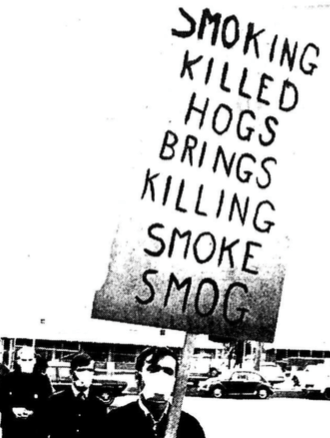
The other major activity that people took part in on Earth Day in Grand Rapids in 1970, was a protest organized by students from the Grand Rapids Junior College.
Students chose to protest at a meat factory, because of the pollution the business was emitting as a result of how the company cured the meat. The factory had been the target of complaints from neighbors for years because of the pollution.
The owner of the business was cited as saying that he was in the process of addressing the air pollution, but didn’t know what kind of timetable there would be to address the issue.
This last action, organized by students, is more reflective of the kinds of actions people were taking across the country, which focused attention on corporate pollution or structural pollution. In fact, in its early years, Earth Day actions were either to engage in collective projects that would promote ecological integrity or to confront those most responsible for environmental destruction, the corporate/industrial sectors.
 Being evicted is an awful thing for anyone to experience. It is humiliating. Eviction can be the result of poverty and it can be a cause of poverty. Eviction is also a form of structural violence, which can take a tremendous toll on individuals and families alike.
A new project called Eviction Lab, a project through Princeton University, provides us with some great tools to understand the eviction crisis in the United States, something that is part of the larger affordable housing crisis.
According to Eviction Lab:
Today, most poor renting families spend at least half of their income on housing costs, with one in four of those families spending over 70 percent of their income just on rent and utilities. Incomes for Americans of modest means have flatlined while housing costs have soared. Only one in four families who qualifies for affordable housing programs gets any kind of help. Under those conditions, it has become harder for low-income families to keep up with rent and utility costs, and a growing number are living one misstep or emergency away from eviction.
The most current data provided by Eviction Lab is for 2016. During 2016, there were 34,016 evictions throughout the state of Michigan, which translates to 92.94 evictions per day. In Grand Rapids, the number of eviction in 2016 totaled 611, which means that 1.67 evictions happened every day.

Now, data doesn’t give us the whole picture, since we don’t know how many people these 611 evictions in Grand Rapids impacted in 2016. The data also does not adequately communicate the harm and humiliation that those being evicted must endure.
First, evictions are often posted on your door and/or are sent to you via the mail that you have to appear in court.
People being evicted must show up for this court hearing, which might be listed as appearing before a judge at 9:00am, but in reality, possibly dozens of other people have received similar eviction notices and they are all waiting to go before a judge. This means that people might have to wait hours.
 Landlords and property management companies often send their lawyers to the court hearing, which means that they don’t even know the person who is being evicted. People being evicted have to defend themselves in front of a judge, who generally sides with those issuing the eviction notice. Renters might be “offered” some conditions in order to have the eviction notice dropped, but these conditions are also often humiliating.
People who are at most risk of being evicted are low-income women, especially poor women of color. Also, individuals and families who are the victims of domestic violence, are also at high risk of being evicted.
So, people being evicted are disproportionately women of color who are experiencing poverty. They have to find transportation to get to the court hearing and no doubt bring their children because they can’t afford day care. Then these people who are being evicted, must sit through a dozen or more eviction proceedings and witness the humiliation that several other people are going through, before being subjected to this process themselves.
What is to be done?
In most cases people are evicted and then fall further into poverty, since they now have a record of being evicted, which often results in making it difficult to find future housing. Therefore, evictions often result in perpetuating poverty and social marginalization.
Last year, the Steelcase Foundation and the Grand Rapids Community Foundation, together contributed $300,000 towards an eviction prevention project. This project is a partnership between the 61st District Court, the Michigan Department of Health and Human Services (DHHS) and the Salvation Army.
This project will pay for a full-time DHHS staff person to work with people who are at risk of eviction. The goal is to negotiate an agreement between landlords and tenants before they come to court and avoid an eviction on their official court records.
This project is an important safety net, but it doesn’t offer any longterm solutions.
 What people have done in other cities is to form Tenant Unions to fight against no cause evictions, to negotiate a rent freeze or rent control with individual landlords and property management companies.Tenant Unions can provide important support to individual renters by offering solidarity and resources to collectively fight exploitation by landlords and property management companies.
However, even this is not enough. People need to make a livable wage/livable income, which means that fighting poverty is also fighting an unjust economic system that does not support millions of people who are facing eviction. These same people are also experiencing food insecurity, have limited access to affordable health care and other basic necessities. In other words, there needs to be major systemic and structural changes. Dr. King called for that very restructuring of society, when he said:
“We have moved from the era of civil rights to the era of human rights,, an era where we are called upon to raise certain basic questions about the whole society. We have been in a reform movement… But after Selma and the voting rights bill, we moved into a new era, which must be the era of revolution. We must recognize that we can’t solve our problem now until there is a radical redistribution of economic and political power… this means a revolution of values and other things. We must see now that the evils of racism, economic exploitation and militarism are all tied together… you can’t really get rid of one without getting rid of the others… the whole structure of American life must be changed. America is a hypocritical nation and [we] must put [our] own house in order.” Dr. King, report to his staff – 1967
We just commemorated the 50th anniversary of Dr. Martin Luther King Jr.’s assassination. Let us make his call to embrace revolutionary values in order to restructure this society.
Let me begin by saying that the US military assault on Syria this past Friday was nothing short of criminal. In fact, such an attack violated international law, in part because of the failure of the US to get approval from the United Nations Security Council, but more importantly because of the death and destruction it caused.
There has been plenty of outrage on social media since the latest example of US imperialism, with lots of people claiming that this was an example of the Trump administration wagging the dog. This is certainly not the first time that a US president has engaged in a military strike against another country, especially when a sitting president is in the midst of a domestic scandal. Bill Clinton did the same thing in 1998, when his administration bombed Sudan, targeting a pharmaceutical plant, which resulted in the premature deaths of thousands of Sudanese, since the pharmaceutical plant was the only one in Sudan producing critical medicines.
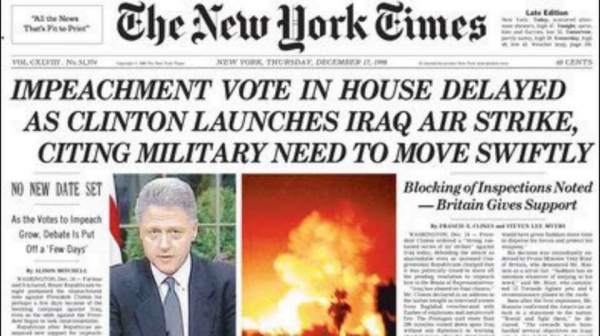
More importantly, the notion that this was a wag the dog tactic on the part of the Trump administration is just to simplistic a response to a very complex matter. What we will do here is to look at a brief history of US policy towards Syria, a geo-political analysis, the issue of WMDs in context, the US media response and other US military industrial complex factors that are always part of the equation with US imperialism.
US Foreign Policy and Syria
Syria, like the rest of the Middle East, is a creation of European Colonialism. The French imposed colonial rule over Syria, until 1946, when Syria gained independence.
The US took particular interest in Syria after WWII, primarily as the US dependence of Middle Eastern oil became the central determining factor in the region.
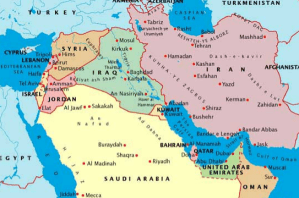 The CIA initiated a coup in Syria in 1949, which was one of nearly 20 coups that would destabilize Syria for the next two decades. For the US, the Syrian power structure was too autonomous, was deeply sympathetic to the Palestinian cause and not supportive enough of the plans to run pipelines through their country for US oil extraction.
Syria was also run by the Baathist Party, which the US generally did not support. Besides CIA coup attempts, the US was financing and arming Islamic groups in order to destabilize Syria, primarily a branch of the Muslim Brotherhood, according to Devil’s Game: How the United States Helped Unleash Fundamentalist Islam, by Robert Dreyfuss.
Syria was also often in conflict with Israel, a conflict that came to head over the control of the Golan Heights, which Israel militarily took during the 1967 war. The US was claiming at the time that both Syria and Egypt were under the influence of the Soviet Union, although that argument was often a justification for undermining Syrian autonomy.
Another coup took place in 1970, which brought to power Hafez-al Assad. Assad became one of the most brutal dictators in the region, but that did not stop the US from developing a close relationship with Assad.
In 1976, Assad invaded Lebanon, with approval from the US, specifically Henry Kissinger, who was the point person for President Gerald Ford. Syria’s invasion on Lebanon was to counter the PLO effort to influence Lebanon, since so many Palestinian refugees were living in Lebanon.
Syria was a big supporter of the US war on Iraq in 1991, known as the Gulf War. The US rewarded that support with $2 billion channeled through the Saudi Kingdom. Hafez-al-Assad died of a heart attack in 2000, but was replaced by his son, Bashar, who still rules Syria today.
After 9/11, the US continued a close relationship with the Assad regime, but Syria was also on a US State Department short list of countries that sponsored terrorism. It was in 2002, that the US named Syria, along with Iraq, Iran and North Korea, as the “Axis of Evil.”
In the Spring of 2011, inspired by the other Arab uprisings, a Syrian pro-reform movement was initiated. However, the pro-Democracy groups were followed by armed rebels, who don’t always have the same goals.
The Obama administration had uniformly opposed the Arab Spring and in Syria, his administration engaged in bombing campaigns on more than one occasion, supposedly in response to the Russian support of Assad. US foreign policy expert Noam Chomsky made the observation the number of casualties more than tripled after the US and British air strikes. (see Who Rules the World? 2016) You can also see from this map that more US bombs were dropped on Syria, than any other country in 2016.

The US/British bombings, combined with the civil war in Syria, has resulted in the creation of over a million refugees fleeing the country.
This brings us to the present, which should make it clear that the most recent air strike by President Trump, is consistent with decades of US foreign policy towards Syria.
On Friday, 80 members of Congress sent a letter to President Trump stating that, “engaging our military in Syria … without prior congressional authorization would violate the separation of powers that is clearly delineated in the Constitution.” Rep. Justin Amash was one of those who signed on to the bi-partisan statement, but it is ultimately an empty action, since Congress will not do anything other than make statements.
On the matter of the claims that Syria has Weapons of Mass Destruction (WMDs), we may never know. United Nations inspectors had come to Syria the same day as the airstrike, leading one to think that the air strike was a way to ultimately foil the UN investigation on the claim that Syria had WMDs.
US Media uniformity on the air strikes on Syria
Here we defer to the national media watchdog group, Fairness & Accuracy in Reporting, which posted the following:
 The curators of American public opinion at the three most influential broadsheets in the United States have decided that dissent from the build-up to new airstrikes on Syria is not really an opinion worth hearing. Of 16 columns leveling an opinion about “fresh” airstrikes on the Syrian regime in the coming days, only two—both in the Washington Post (4/12/18, 4/12/18)—opposed the airstrikes. No New York Times or Wall Street Journalopinion piece came out against a renewed attack on Syria.
Ten expressly supported the airstrikes (three in the Times, five in the Post and two in the Journal), two did so by implication (both in the Times, both lamenting the US “doing nothing” in Syria), two were ambiguous and two were opposed to the airstrikes. A complete list of the columns can be reviewed here.
This is slightly less unanimous than the level of support Trump’s airstrikes on Syrian air bases received from the media last year, when only one out of 47 editorial boards failed to back the escalation (FAIR.org, 4/11/17).
On the issue of launching airstrikes against the Assad government, robust debate is nonexistent. Major publications take the bulk of the premises for war for granted—namely the US’s legal and moral right to wage it—and simply parse over the details (FAIR.org, 4/12/18). The Washington Post editorial board (4/9/18), unsatisfied with what they view as token airstrikes, calls for Trump to not just launch “a few cruise missiles,” but for a “concerted strategy” of open-ended “US military initiatives.” This, of course, includes additional permanent military bases scattered throughout Syria.
Military strikes on Syria is good business for Weapons Manufacturers
 66 Tomahawk missiles were used and 19 JASSM-ER. The Tomahawk missile are manufactured by the Raytheon Company and the JASSM-ER weapons are made by Lockheed Martin. The Ratheyon Corporation has contributed over $24 million to politicians since 1990, with a slight edge to Republicans.
Lockheed Martin has contributed over $37 million since 1990, with Republicans receiving nearly twice as much as the Democrats. However, it is clear that both of these weapons manufacturers are committed to bipartisan support.
As we stated at the beginning, the Trump administration’s missile attack against Syria is criminal, but we need to see it as a longstanding imperialist policy in the Middle East.

