 There are numerous things that we have all learned about ourselves during the COVID-19 pandemic and there are lots of things we have learned about our community.
One thing that seems to be overwhelmingly clear, is that we cannot go back to the way things were before this crisis. In fact, the current crisis has revealed to us that the existing systems of power and oppression in Grand Rapids have not only exacerbated the crisis, but they created the long standing conditions that have led to so much suffering in this community.
The conditions I am referring to are the profound levels of poverty that so many families live in, especially black, latinx and native families. Add to the fact that thousands more in Grand Rapids are now unemployed and you have a major economic crisis. The government “stimulus” checks are not getting to people fast enough, plus there are lots of other families, namely immigrant families, who are not even eligible to receive them.
However, at the same time that thousands of people are struggling to survive in Grand Rapids, those who have economic and political power and using the crisis to push and expand their own agenda. We have been reporting on what groups like the West Michigan Policy Forum are doing to not only get back to normal, but to use this crisis to push for further policy changes that will benefit the business class. In addition, many of the same people who serve as part of the Grand Rapids Power Structure, those who are billionaires and millionaires, are benefiting from this crisis, because of tax breaks that were built into the Cares Act. This small group of people are profiting off the crisis, while thousands in Grand Rapids are left wondering if they can pay rent, pay their utilities or feed their families.
Then there is the issue of what the system is referring to as “essential workers” during this crisis. Essential workers are generally the people on the front lines of the health care industry, like nurses, doctors, direct care staff, hospital kitchen staff, hospice workers, etc. But essential workers also includes those who are part of the food system, migrant workers, fast food workers and grocery store workers, all of which do not make a livable wage in this system. The current crisis also reveals that these workers were always essential, but the system of capitalism doesn’t value the work they do.
Other conditions we could identify are the housing crisis in Grand Rapids, police violence and the prison industrial complex and the homophobic/transphobic systems that exists in Grand Rapids.
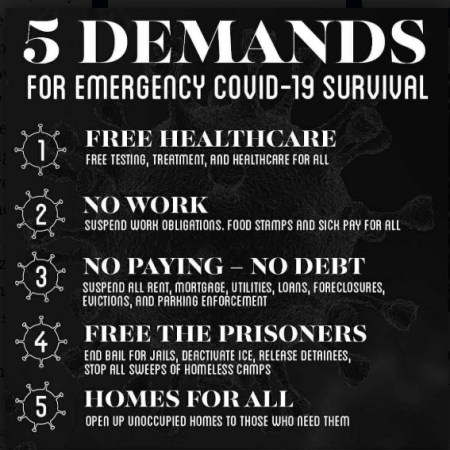 These systems of power and oppression in Grand Rapids are nothing new, but if we are interested in not just surviving the COVID-19 crisis, but thriving afterwards, then we need to collectively organize for the things we want. Already there are powerful examples of grassroots responses to the COVID-19 crisis, like the Grand Rapids Area Mutual Aid Network, the La Lucha Fund, No Rent Michigan. Together We Are Safe and Movimiento Cosecha GR. Hundreds of volunteers and practicing Mutual Aid to make sure that the families who are the most vulnerable right now are getting some of their needs met.
However, unless we dismantle the systems of power and oppression that have created the conditions for the current crisis, then there will always be a crisis. People living in poverty is a crisis. People living with pain or dying from preventable diseases or conditions is a crisis. People living on the streets is a crisis. People suffering under white supremacy and settler colonialism is a crisis. People living under patriarchy and heterosexism is a crisis. Climate change is a crisis.
The Grand Rapids Power Structure is not sitting around during this crisis, just waiting for things to get back to normal. They are strategizing and planning to figure out ways to benefit from this crisis and to shore up the power they have. We need to strategize, to plan, to organize and radically imagine that another world is possible.
In the coming weeks, we will post pieces that look at what is possible. We will look at ways to get to a just food system, a just housing system, how to get to climate justice, workers justice and a just health care system. Another World is Possible!!!!
Betsy DeVos makes statement about how US History is taught
 On Thursday, US Secretary of Education, Betsy DeVos, released a statement on the National Assessment of Educational Progress (NAEP) 2018 Civics, Geography, and U.S. History Assessments for 8th Graders:
“America’s antiquated approach to education is creating a generation of future leaders who will not have a foundational understanding of what makes this country exceptional. We cannot continue to excuse this problem away. Instead, we need to fundamentally rethink education in America. It is the only way our nation’s students will be in a position to lead our nation and the world.
The results are stark and inexcusable. A quarter or more of America’s 8th graders are what NAEP defines as ‘below basic’ in U.S. history, civics and geography. In the real world, this means students don’t know what the Lincoln-Douglas debates were about, nor can they discuss the significance of the Bill of Rights, or point out basic locations on a map. And only 15% of them have a reasonable knowledge of U.S. history. All Americans should take a moment to think about the concerning implications for the future of our country.”
While I agree that the way US history is taught in American schools is deeply troubling, what Betsy DeVos thinks is important about US history and what should be taught about US history are vastly different.
Betsy DeVos’ father-in-law, Richard DeVos Sr., had a view of US history, one that has been taught for a long time. The co-founder of Amway, in his book Believe, when talking about freedom and the founding of the US, says:
“that call of freedom went forth from a rugged wilderness, and Europe and Asia and Africa sent their sons of adventure to hew out a new society in a land of forests and savages.”
Is this what Betsy DeVos means by a foundational understanding of what makes this country exceptional? The statement above by Richard DeVos is reflective of one of the foundational aspects of US history, namely the genocide of Indigenous people. The other major foundational aspect of US history is the enslavement of African people, the very same people who created a great deal of the wealth in the US, but did not benefit from their labor.
Indeed, based on the lived experience of Betsy DeVos, growing up as part of the Prince family and then marrying into the DeVos family, the US Secretary of Education would see US history through the lens of someone who is deeply privileged. Betsy DeVos no doubt views US history as something that the capitalist class built, a history that believes the US was founded on Christian principles, and one that is governed by White Supremacy.
US History has primarily been taught through the view of the historical victors, as Howard Zinn used to say. US history is always about the powerful, those with great wealth and very much centered on wars and US global dominance.
This type of US history began to be challenged at the university level in the 1960s, with the introduction of women’s studies and ethnic studies, particularly black studies. Unfortunately, what is being taught at the university level hasn’t always trickled down to the K-12 level. There are some amazing US history teachers across the country, but they are in a minority. Some of these US history teachers have been influenced by Zinn’s, A People’s History of the United States or the resources offered through groups like Rethinking Schools.
The group Grand Rapids for Education Justice has heard from the black, latinx and Anishinaabe communities that they want to see their communities’ history taught and not just the dominant. white version of history.
US Secretary of Education, Betsy DeVos, is right to point out the antiquated way in which US history is taught. However, we cannot and should not allow people like her to determine how US history is taught, nor what version of US History.
“I’m worried that students will take their obedient place in society and look to become successful cogs in the wheel — let the wheel spin them around as it wants without taking a look at what they’re doing. I’m concerned that students not become passive acceptors of the official doctrine that’s handed down to them from the White House, the media, textbooks, teachers and preachers.” Howard Zinn
West Michigan CEOs who are pushing to open their businesses
 Last week, the West Michigan Policy Forum (WMPF) hosted an online forum with CEOs talking about how to get Michigan businesses up and running.
This discussion from the WMPF happened the day before Gov. Whitmer announced another extension of the stay-at-home, with the extension going til May 15. However, there will be some relaxation of the previous order, allowing some sectors to open, particularly the lawn and garden industry, greenhouses, boating and golf courses.
The WMPF event involved Amway President Doug DeVos as the moderator, with several CEOs offering information on their respective businesses, along with a few other voices in the mix.
The hour-long forum was recorded and you can watch the video on the WMPF Facebook page, at this link.
In his opening comments, DeVos made the point that, “we are very alined with what Sen. Shirkey’s plan is.” We wrote about Senator Mike Shirkey’s plan on Tuesday.
Another important thing that Doug DeVos mentioned had to do with regulations that have slowed the business community down for years, and that “once we come back from this crisis, maybe some of those could be changed or eliminated.” Such a statement comes as no surprise, since the West Michigan Policy Forum has more than a decade of working to change state policy in ways that benefits their interests. Deregulation would be the next logical step for this group.
The CEOs and other executives that took part in the online forum were:
- Mike VanGessel, the CEO of Rockford Construction,
- Bill Dobbins, Caster Concepts
- Brian Cooper, ELCo Enterprises, Inc.
- Kelly Presta Sturgis Molded Products
- Kurk Wilks, Mann + Hummel
- Matthew Haworth, Chairman of Haworth
- Ron Geisman, Lomar Machine & Tool
- Steve London, Bekum America
- Birgid Klohs, CEO of the Right Place Inc.
- John Hendrickson, C=H Solutions
- Jennifer Owens, Lakeshore Advantage
- Jase Bolger, WMPF advisor
- Mike Hill, Coldbrook Insurance
- Johnny Brann Jr., Brann’s Restaurants,
Several of these businesses are in West Michigan, specifically in Grand Rapids. It is interesting that there has been a significant increase in COVID-19 cases in the Grand Rapids area, just within the last week. Therefore, while the business community in West Michigan continues to push for “re-opening” the state’s economy, they are ignoring the fact that COVID-19 cases are up in Grand Rapids. Having more people go back to work will most likely put more people are risk of contracting the coronavirus. Thus, these business leaders are taking a very similar position as those who protested in Lansing on April 15, a position that says, “profits before people.”
 Yesterday, several dozen people protested outside of the Governor’s mansion in Lansing, calling on Gov. Whitmer to re-open Michigan’s economy.
The person credited with organizing the demonstration is Brandon Hall. Hall was quoted in the news source, Up North Live as saying:
“Gretchen Whitmer is tyranny, this is like a third world country. It’s like V for Vendetta and Idiocracy hooked up and they produced this baby that is 2020.”
Brandon Hall is originally from Grand Haven and was sentenced to 30 days in jail in 2012 for election fraud. Hall is the editor of a blog called West Michigan Politics, which ironically has as its banner on Facebook an image of Richard DeVos Sr.
Brandon Hall said that Nick Somberg, a lawyer, also helped to organize the protest. Somberg, is also with the group Michigan United for Liberty, which brought a lawsuit against Governor Whitmer a few days ago.
Michigan United for Liberty is a fairly new entity that has a number of people on their “team” who have previous experience with campaign organizing and other conservative efforts. Michigan United for Liberty is claiming that Facebook has blocked their anti-government protest events on the social media platform, but that is not preventing them from promoting several upcoming actions.
On April 30th, Michigan United for Liberty is hosting another protest at the State Capitol in Lansing. According to their announcement, Governor Whitmer’s, “executive orders are direct violations of our constitutional rights and are infringing upon our basic freedoms.” The protest on April 30 is also sponsored by the Michigan Conservative Union, a group that has been around since 1975 and includes former State Rep. Dave Agema. The other group involved in the April 30th protest is Libertarian Party of Michigan.
Then on May 1st, Michigan United for Liberty is organizing a MayDay to PayDay action. This action is a call to business owners to start back up again, regardless of what the Michigan Governor has to say. The MayDay to PayDay action says:
Calling all small business owners! Are you fed up? Ready to re-open and start making an income again?
Michigan United for Liberty believes ALL jobs are essential and we want to help you re-open! Unite with us as we band together to make this a reality!
Join us in our stand for freedom by committing to re-opening your business on May 1st!
Clearly, the groups involved in the April 15 protest at the Lansing State Capitol, the protest at the Governor’s mansion and the upcoming protests have generated a fair amount of interest from the public. It would be a mistake to be dismissive of these groups, as Ben Burgis stated in a recent article in the Jacobin Magazine.
Many on the Right have cheered on the protesters. Centrists have mostly just rolled their eyes. The Left needs a better response. While the lockdowns are necessary, it’s unacceptable to ask everyone to continue paying their bills without far more robust government assistance. We should offer genuine solutions to legitimate economic worries even as we acknowledge that much of what was said and advocated at the protest was irresponsible and absurd.
In addition, I think it is not a matter of simply giving blind support to Gov. Whitmer. I agree with the stay-at-home orders, since we need to flatten the curve. However, people are hurting and we need some short-term and long-term ways of addressing the fact that millions of people are struggling around having basic needs met. We need to pressure the State Government and Gov. Whitmer to make sure that people are being taken care of. We need a rent freeze, an end to evictions, and to release people from prisons, jails and detention centers. We need to demand that health care workers, agricultural workers, those working in grocery stores and fast food restaurants, along with all other essential workers – who do essential work – get real, substantive hazard pay.
Some conservative groups are saying, We’re suing that woman from Michigan, while liberals are saying, We support that woman from Michigan. Such simplistic slogans are meaningless if we don’t have clear-headed strategies and plans to make sure that people have the resources to make sure they can stay safe, have access to food, housing and the health care we all need.
 There has been some additional attention around the power and politics of the DeVos family, even in commercial media.
Gov. Whitmer made the claim that Betsy DeVos was financially contributing to the Michigan Freedom Fund, one of the organizations behind the protest held on April 15, calling into question the governor’s stay-at-home policy.
In addition, there has been some focus on the DeVos funding of the Mackinac Center for Public Policy and how the DeVos family, along with other millionaires and billionaires in the country will be getting massive tax breaks, as part of the Cares Act.
If you just can’t get enough about the power, influence and history of the DeVos family, then we invite you to check out our 536 page document, We’re Rich and We Do What We Want: A DeVos Family Reader.
The document includes:
- Introduction to their Religious and Political Ideology
- Early Critiques of DeVos/Amway
- DeVos Family, Elections and Money
- DeVos Family and West MI Politics
- DeVos Family Foundations
- West MI Media and the DeVos Family
- ArtPrize
- Betsy DeVos Watch
- Additional Resources
In these pages you can read about the cumulative impact that the most powerful family in West Michigan has had on Grand Rapids politics, State politics and Federal politics. You can read about how Amway workers tried to form a union in the early 1980s, how the DeVos family transformed GVSU, how much money they have spent on buying elections, the impact of their foundations, and how they so often get a free pass from the commercial media.
We believe the DeVos Family Reader is a great resource for those who want to understand how power functions and just how much influence this family has across the state.
Help pressure the City of Grand Rapids to provide support for immigrant workers during the current crisis
 A few weeks back, we posted an article that pointed out how some cities are providing financial support to immigrant workers during the current pandemic. That article talked about my interaction with Grand Rapids City Commissioners about their willingness to offer the same kind of support.
Now there is a new call to action around the same issue, coming from the group GR Rapid Response to ICE.
In their Action Alert, they state:
Immigrant workers are on the front line of this pandemic. Many continue to work in dangerous conditions because they have no choice–they do not receive unemployment, will not receive a relief/stimulus check from the federal government, and still need to support themselves and their families. We are calling on the City of Grand Rapids to immediately start providing COVID-19 pandemic relief to all immigrant members of the community–regardless of status or documentation–including payments for rent, food, utilities, and any other benefits the city is providing to the rest of the community.
The Action Alert then invites people to send a message to Grand Rapids City officials, by going to this link.
It’s a simple action, but an important one, especially if the City of Grand Rapids hears from enough people, thus making them commit to providing critical support to immigrant workers and their families during the crisis. Please send the message and share it with your networks on social media.
 Towards the end of last week, both Senator Mike Shirkey and Rep. Lee Chatfield, continued to push Gov. Whitmer on the need to re-open the economy in Michigan.
Last Monday, we reported on how Shirkey and Chatfield had expressed “frustration” with Gov. Whitmer over the extended stay-in-place order, that current goes on into the end of the month. We reported that Shirkey and Chatfield both were taking the position that re-opening the economy was more important than preventing people from contracting the COVID-19 virus and possibly dying.
Now Sen. Shirkey and Rep. Chatfield are continuing to push to let businesses re-open, this time with the support of powerful allies and with a “plan.”
Senator Mike Shirkey was doing a Q & A with the Jackson County Chamber of Commerce on Friday, plus the Michigan Chamber of Commerce posted their own news, with a headline that read, Senate Republicans and Whitmer Increase Focus on Economic Reopening. In that Michigan Chamber post, it stated:
The Michigan Chamber is encouraged by the Senate’s action and currently analyzing their proposal. The Senate’s proposal, referred to as Open Michigan Safely, is summarized as “relying on measurable data points to serve as indicators of decreased risk. The proposal is structured in phases that outline conditions in the state, suggest safe business operations, and propose levels of citizen activity.”
On April 15, the Michigan Chamber of Commerce released a a set of guidelines for policymakers to create clear and consistent expectations for employers. These guidelines were crafted with the help of the Mackinac Center for Public Policy, which we also reported on last month, with their policy wish list during the crisis and their new partnership with the Great Lakes Education Project and the Michigan Freedom Fund. The guidelines that the Michigan Chamber and the Mackinac Center have released are rather basic, but also very vague. It is important to remember that the Mackinac Center was the main driving force behind Michigan’s Right to Work policy, plus they have a long history of undermining public sector unions and public education.
Meanwhile, the Senate Republican caucus has released their own set of guidelines, which is described in 5 phases. One thing that I find troubling about their plan is the lack of testing. The Senate Republican Caucus does mention testing, but only as something people could do. There is no plan for statewide testing and there is no clear plan for what to do if there another outbreak across the state. Also, it would seem that this commitment to re-open businesses doesn’t fully take into account the seriousness of the human loss of life across the country and across the state. In addition, there is no known cure for COVID-19, which seems like that should be a larger priority than businesses opening back up again.
Closer to home, the West Michigan Policy Forum (WMPF), which was created in 2008 to provide the business community with an opportunity to push their own state policies agenda, has affirmed the push by Senator Mike Shirkey and the Senate Republican Caucus. The WMPF stated on their Facebook page on April 16:
The principles offered by Senator Mike Shirkey today smartly allows for a regional and phased approach to safely reopening businesses and protecting employees as they go back to work. We must reject the false choice between work and safety, so these outlined principles rightly empower workers, protect customers and increase economic security. We applaud Senator Shirkey’s welcoming approach to further input by medical experts. We urge the governor, lawmakers and business leaders to further refine the appropriate and sensible proposal by Senator Shirkey to coalesce around one plan to protect both lives and livelihoods and provide a safe pathway to restart our economy.
The WMPF, then posted yesterday, a link to a Detroit News article, where West Michigan Policy Forum chair John Kennedy was interviewed. In that interview, Kennedy talks about how his business, Autocam, has continued to operate during the COVID-19 crisis and what precautions they are taking. However, Kennedy primarily responds to the plan that Sen. Mike Shirkey is pushing. One thing that Shirkey believes, and Kennedy agrees with, is that roughly 75% of businesses could re-open if they followed certain protocols. One thing that was not revealed in this interview with John Kennedy, is that Kennedy is the number one campaign contributor to Sen. Mike Shirkey since 2011.
Again, it seems to this writer that there is still so much that we do not know about the virus, then add to that the lack of systemic testing and the fact that no cure has yet been developed, which leaves us very vulnerable to many people contracting and dying from the coronavirus. We know that the business community has a great deal of leverage with state policy makers, since they have been major campaign contributors and are always at the top of entities engaged in lobbying. The question for those of us who identify more with civil society is, should we have as much say as the capitalist class? Maybe we need to organize in such a way as to have more say than the capitalist class.
The 600 Millionaires living in Kent County will receive on average $1.7 million because of the COVID-19 Relief Policy
“The class which has the power to rob upon a large scale has also the power to control the government and legalize their robbery.” —Eugene V. Debs
Several news sources, including the Washington Post, have been reporting that:
 More than 80 percent of the benefits of a tax change tucked into the coronavirus relief package Congress passed last month will go to those who earn more than $1 million annually, according to a report by a nonpartisan congressional body expected to be released Tuesday.
This information is based on the research done by group known as the Joint Committee on Taxation (JCT), a nonpartisan Congressional body.
Forbes reported that the 43,000 millionaires and billionaires in the US will get on average $1.7 million because of the Cares Act.
While wealthy Americans are not eligible for the comparatively measly $1,200 stimulus checks that are now being disbursed to many Americans, they are on pace to do even better. 43,000 taxpayers, who earn more than $1 million annually, are each set to receive a $1.7 million windfall, on average, thanks to a provision buried in the Coronavirus Aid, Relief, and Economic Security (CARES) Act.
If there are 43,000 millionaires (some being billionaires) in the US and each of them will receive an average of $1.7 million because of the Cares Act, that would mean that the wealthiest people in the US will collectively receive $73,100,000,000, which is $73 billion and change. That is a massive amount of money, almost too big to comprehend, and it is going to the wealthiest people in the US because that is how the tax structure is set up through policy.
 If we were to think about this on a local level, what would this mean? According to the most recent data (2019), there are 600 millionaires in Kent County. If they each receive on average $1.7 million because of the Cares Act, that equals a total of $1,020,000,000 coming to those 600 millionaires collectively. This means that people like Doug DeVos, John Kennedy, Michael Jandernoa, Peter Secchia, Steven Van Andel, those that make up the Grand Rapids Power Structure, will be benefitting from the Cares Act, just for being disgustingly rich.
Now, image for a moment, how $1,020,000,000 could benefit the individuals and families who are no longer working in Kent County because of COVID-19. Imagine how much this money could be used to pay people’s rent or mortgages in Kent County. Imagine how this money could be used to provide testing to every resident in Kent County. Imagine how this money could feed all those who are food insecure in Kent County. The crisis isn’t just COVID-19, the crisis is capitalism and the capitalists who push policies to the politicians they have bought, policies which the capitalists benefit from.
The Acton Institute provides the ideological framework for the kinds of responses we saw in Lansing on Wednesday
 As someone who has been monitoring the work of the Acton Institute since its founding in the early 1990s, I continue to want to impress upon people the importance of coming to terms with the mission and message of this right wing Think Tank.
The Acton Institute, and particularly their founder, Rev. Robert Sirico, have continued to push their “free market” mantra, even in the face of the COVID-19 pandemic. We last wrote about the Acton Institute’s free market fanaticism in a post from April 5, Acton Institute Founder wants a Tax Holiday for businesses, while an Acton writer tells the Governor that golf courses should stay open.
The most recent example of free market fanaticism coming from the Acton Institute, can he seen in an interview done by the Eternal Word Television Network (EWTN), speaking with Acton Institute’s founder and President, Rev. Sirico. The EWTN is a right-wing Catholic media entity.
Listen to the kind of language that Sirico uses in this interview.
Notice how Rev. Sirico uses language like “central government,” specifically referring to Michigan. Rev. Sirico then goes on to claim that when we have a strong economy, we have healthier people. Such a claim completely ignores the realities of the long-standing health care crisis in the US, specifically because it is a health care system driven by the pharmaceutical and insurance industries. Rev. Sirico also pushes the idea of a “Tax Holiday,” which essentially means more massive tax breaks for the private sector.
It is important that we recognize that the ideological framework that Rev. Sirico and the Acton Institute are promoting, are being manifested in the proposals from politicians in Michigan and the demonstration that we saw in Lansing on Wednesday. The knee-jerk reactions that the far right is having to the Stay-in-place orders in Michigan, are directly linked to the free market fanaticism of the Acton Institute, along with their belief that Capitalism and Christianity make wonderful bedfellows.
The 1911 Furniture Workers Strike, labor militancy and radical imagination after COVID-19
 On April 19, it will be the 109th anniversary of the 1911 Grand Rapids Furniture Workers Strike. On that day in 1911, thousands of furniture workers went on strike, with demands for better wages, safer working conditions, an 8 hour work day, and the right to form a union.
The strike lasted for several months before it ended and while the 1911 Grand Rapids Furniture Workers Strike didn’t win every demand, it did demonstrate the power of organized direct action.
However, there are several lessons we can learn from the 1911 strike, lessons that we can build on. The COVID-19 pandemic has exposed the banality of Capitalism and we need to not allow things to go back to normal. We can’t be happy with just getting rid of Trump, instead we need to develop and employe a radical imagination about what can of a world we really want to live in.
The first lesson we can learn from the 1911 Furniture Workers Strike is the power of solidarity. Not only did thousands of workers go on strike, they took care of each other, provided support and mutual aid to make sure that people’s daily needs were met.
A second lesson was the importance of creating a narrative about what took place during the 1911 strike, particularly from the perspective of the working class. Viva Flaherty, a socialist, created a powerful narrative about what happened during the 1911 strike, which was in stark contrast to the narrative created by one of the furniture barons R.W. Irwin. For a look at the contrasting narratives, go to this link.
A third lesson is that workers during the strike were not afraid to engage in militant tactics. When the furniture barons brought in scab workers, those on strike attempted to prevent them from entering the factories, even by throwing bricks at them. If you look at the 1911 strike monument in downtown Grand Rapids, you can see that the woman in the monument had bricks at her feet, just under her dress. We have to be willing to defend ourselves and our livelihoods and not allow those in power to try to crush us.
A fourth lesson we can take away from the 1911 strike is how the strike exposed the class warfare that the furniture barons engaged in against the workers. This class warfare was not just reflected in the tactics used to break the strike, but it was made apparent by the massive wealth gap between the workers and the furniture barons.
A fifth lesson from the 1911 strike is that those with economic and political power were five steps ahead of the labor movement. The system of power in Grand Rapids changed the political structure of the city, by changing the ward system, in order to consolidate power.
Expanding on the Lessons of the 1911 Grand Rapids Furniture Workers Strike
It is not enough to just learn from history, but to critically engage history and create a new vision for how to move forward. Those in power are certainly thinking about how to do things different once the COVID-19 crisis is over, which means that we must also strategize and radically imagine a different world.
First, we need to reclaim the radicalism of organized labor. The labor movement has such a rich history of fighting back in this country, from the early days of the Knights of Labor, to the Wobblies and the CIO. Hell, even the UAW started as a more radical union and did not shy away from engaging in direct action through the wildcat strikes that forced the auto industry to accept their demands, beginning with the 1936-37 Flint factory occupations. We need to utilize the tactics of strikes, walkouts, workplace occupations, boycotts and even a general strike, which are all actions that give us real power. These kinds of actions are being utilized right now and we cannot stop using them even after the pandemic.
Second, we need to redirect financial resources toward organizing where we are. For decades the labor movement has been pumping millions of dollars into electoral politics instead of organizing in the workplace and building capacity amongst workers to have the skills to do radical politics. Workplace democracy is arguably more important than voting in a system of representative democracy. We need to create thousands of workplace organizers so that anyone of us can take action when it is needed, instead of just waiting for the next election cycle to see change.
Third, we need to stop thinking about elections as the main strategy. Virtually every major struggle we can think of in this country – end of slavery, women’s rights, worker rights, civil rights, environmental justice and LGBTQ rights – did not come about from elections, they came about through direct action and struggle. Elections have to be seen as simply a tactic in the larger strategy and in a radically different way. We know how to turn people out for actions and to vote. Doing so does not require a ton of money, since most election money is spent on electronic advertising.
But before we turn people out to vote, we need to think differently about voting. If we have stronger coalitions of grassroots groups, we can create a collective platform that candidates must endorse before they get our support. This way they can’t get the pro-choice vote without the pro-LGBTQ vote, or the Climate justice vote without an Anti-Racist vote. Think of it this way, we don’t endorse candidates, they endorse/embrace our collective platform. We have to stop giving away our votes without demanding anything. Candidates need fight to get our votes.
Fourth, we need to have a broader, more radical vision beyond the workplace. What we saw during the Sanders campaign from the grassroots was a call for Medicare for All, Housing Justice, Climate Justice, immigrant justice, an end to White Supremacy, an end to state violence and the prison industrial complex, food justice and food sovereignty, an end to homophobia, transphobia, ablism and misogynistic patriarchy. We need to smash the system of Capitalism and build a movement of movements!
 Fifth, we need to practice Mutual aid and Solidarity. It is amazing how many people are rising up taking care of each other during the COVID-19 pandemic. Everything we need is already in our community. We know how to do this work and we can continue to practice new ways of taking care of each other outside of what bell hooks calls the white supremacist, capitalist, patriarchy.
Lastly, we need to create new and radical ways of living. This one might be the hardest for us to think about, since most of us don’t know of any other way of organizing society. However, there are lots of examples from neighborhoods to villages and even cities. These forms of cooperative systems of living can be learned from indigenous communities, worker-run collectives, anarchist struggles and even religious communities like the Quakers and other liberation movements.
This is not just a pipe dream, but a real possibility that we need to serious investigate in our struggles for greater justice. These new ways of living with each other also might not be enough, especially considering the urgency we face through climate change. If humanity is to have a future, we have to radically rethink how we are going to both resist the current systems of oppression and how to form new and liberating systems based on justice, cooperation and revolutionary love.
Returning to normal is not an option!

