History of US Immigration Policy: Summary of GRIID Class week #4 – Why people leave their countries to come to the US
For anyone who could not join the class tonight or who couldn’t find time to be part of this class, I want to share a summary of what was discussed. I also want to provide links and resources for anyone who wants to do their own investigation on the history of US immigration policy.
As with each of the 8 weeks of this class we will rely on the Popular Education resource I created and update regularly. The Popular Education resource provides an important overview of this history, along with a list of books and online resources that can help us with developing a robust analysis of the history of US immigration policy and how to frame it.
In week #1 we relied heavily on the book, No One is Illegal: Fighting Racism and State Violence on the US/Mexican border, which look at the way that Mexicans, Chinese, Japanese, Jewish and even German immigrants have been treated since the mid-1800s.
In week #2 we the responded to the question about why so many immigrants were coming, especially those who were risking their lives to enter the US/Mexican border at unsanctioned border points.
For week #3 I focused heavily on the anti-immigrant narrative or the xenophobic narrative(s) about immigrants that politicians and US news media companies use when talking about undocumented immigrants.
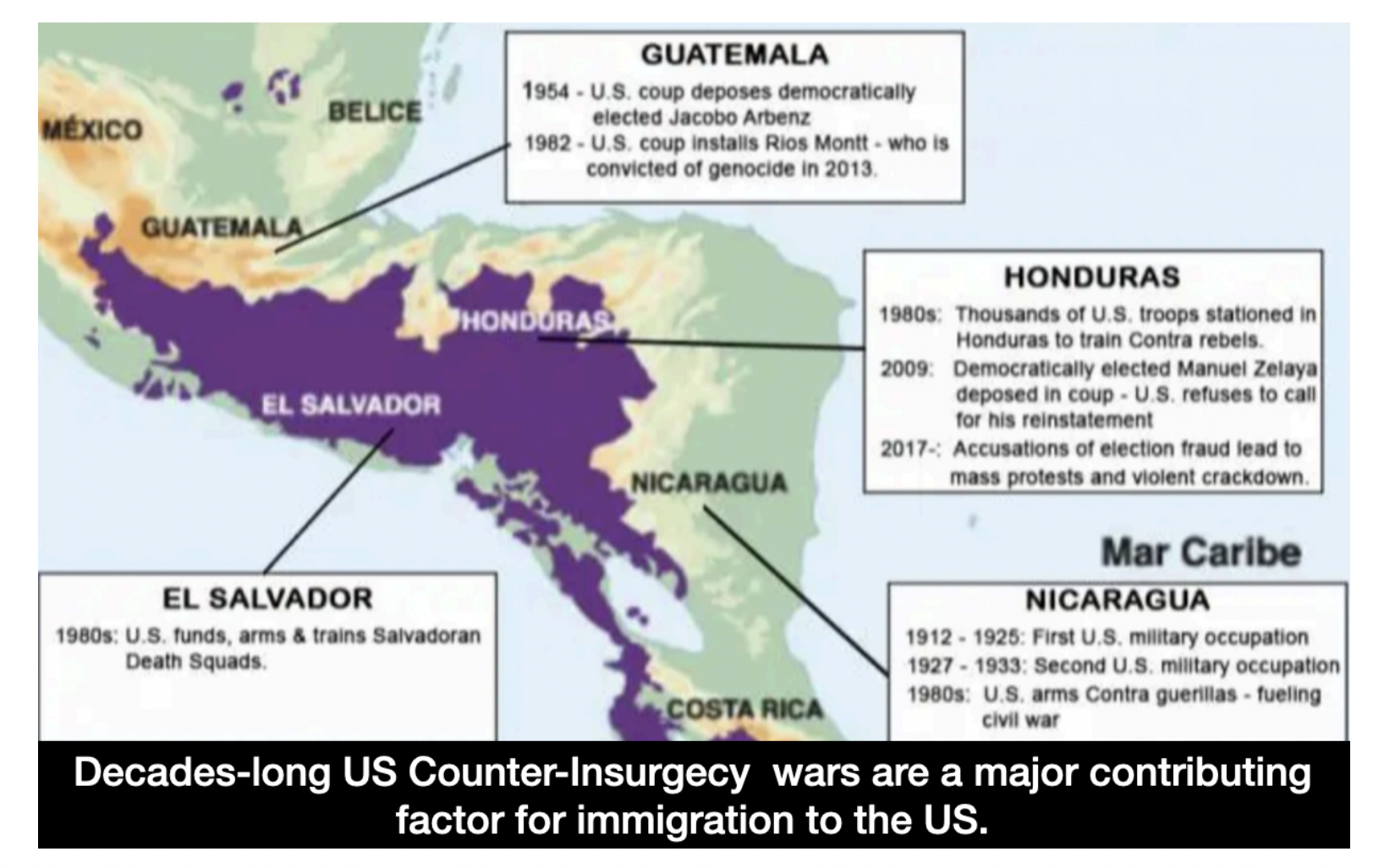
For week #4 we talked about why people are taking the risk of coming to the US without documentation and what the root causes of displacement are.
We all read an overview article on the history of US interventions in Central America and discussed the motives of the US government for their support of US corporate interests and regional control of Central America. We then did a more detailed account of the US History with Guatemala.
History of US relations with Guatemala
The US government has always had an interest in the rest of the Americas to the south, including Mexico, Central and South America, along with the Caribbean countries. In fact, the Monroe Doctrine adopted in the early part of the 19th century was essentially a policy that said that all of Latin America was the back yard of the US and only the US has a right to what happens in that part of the Americas.
During much of the first half of the 19th century the US was also pressing Latin American countries to maintain a slave system, since the US would also benefit from it, especially after Haiti rose up and defeated the French colonizers and ended slavery. The book, This Vast Southern Empire: Slaveholders at the Helm of American Foreign Policy, documents this dynamic in detail.
However, a major driving force for US interest in Latin America was economic interests. With Guatemala it was coffee, then bananas. The US-based United Fruit Company quickly bought own a great deal of land in Guatemala, quite often the best land. Various Guatemalan leaders from the late 19th century into the 20th century were happy to support United Fruit’s exploitation of the land and the workers of Guatemala. In fact, by the 1930s people were referring to the United Fruit Company as El Pulpo, the octopus, because the company had its tentacles in everything.
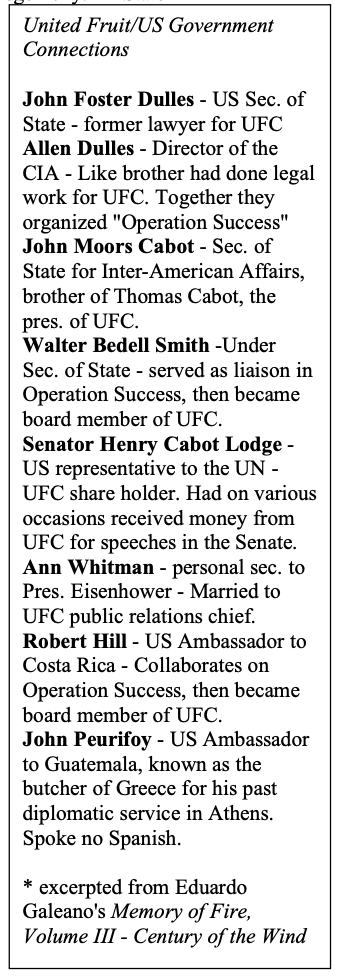 However, Guatemalans became increasingly frustrated with being exploited, so in 1944 then they ended the dictatorship of Jorge Ubico (who was a fan of the Nazis) and elected a progressive government that made significant reforms, especially land reforms. The United Fruit Company was so enraged by these policies that the sough assistance from the US government to overthrow the Guatemalan government. In 1954 the CIA organized a coup and Guatemala and put in place another military dictator, since the interest of the United Fruit Company was more important than the people of Guatemala, You can see from the graphic here on the right how integrated the United Fruit Company was in the US government.
During the Cold War Guatemala acted as a proxy for the US, even allowing for US military to use Guatemala as a base for the Bay of Pigs invasion of Cuba in 1961. Beginning in the 1970s, there was a growing insurgency movement throughout Central American and many Guatemalans began to support an armed uprising. Various Guatemalan administrations, beginning in the mid-1970s engaged in massive repression of the civilian population, disappearing tens of thousands, displacing 200,000 and murdering over 100,000, in what Amnesty International referred to as a genocidal campaign during the regime of Rios Montt. Throughout all of this the US was providing millions in weapons sales, training and advisors to the Guatemalan military. (See Aviva Chomsky’s book, Central America’s Forgotten History: Revolution, Violence, and the Roots of Immigration)
Eventually, there was a ceasefire in 1995, followed by internationally observed elections. However, root causes of the conflict were not resolved nor did the military reduce their numbers or end their repressive tactics. Guatemalans are still uncovering clandestine mass graves, plus those seeking justice are being targeted by the Guatemalan authorities.
As soon as the peace accords were signed there were efforts around exposing those responsible for the deaths, disappearance, torture and displacement of hundreds of thousands of Guatemalans. The Guatemalan Catholic Church spent two years interviewing people and in 1998 published a human rights report titled Guatemala: Nunca más (Guatemala: Never Again). This report was built around previous work done by Guatemalan human rights groups, which were targeted by government death squads, groups like Grupo de Apoyo Mutuo (GAM). We know this happened, since the US-based group the National Security Archives gained access to Guatemalan military documents, such as the Death Squad Dossier.
Two days after the Catholic Church’s report Nunca Mas was released, the Bishop who was overseeing this project, Bishop Gerardi, was assassinated. A few years after this assassination it was discovered that a Guatemalan military officer, Colonel Byron Disrael Lima Estrada, orchestrated Gerardi’s assassination. Colonel Byron Disrael Lima Estrada also received extensive training at the US Army School of the Americas, based at Fort Benning, Georgia.
In 2006, Guatemala, along with the rest of Central America, adopted a so-called trade agreement with the US, known as the Central American Free Trade Agreement (CAFTA). CAFTA provided easier access for multinational corporations to exploit Guatemalan resources and labor. According to a report entitled, CAFTA’s Tragic Legacy in Central America: Failed Trade Policy That Drove Millions From Their Homes, “from 2005 to 2014, the number of undocumented immigrants from El Salvador, Honduras and Guatemala living in the United States increased 49 percent, 122 percent and 73 percent, respectively.”
The Guatemalan currency has become increasingly devalued over the past several decades and the influence of US and other multinational corporations has been devastating for a large percentage of the Guatemalan population, which has forced thousands of them to flee the country and come to the US to earn a living and be able to support their families.
This is exactly why Mario David Coronado Juarez came to the US. Mario was unable to obtain a visa from his own government, primarily because it is too expensive for most people to afford. Due to limited economic opportunities Mario took the risk to come to the US in order to support his family.
Combined with over a century of US military and economic intervention in Guatemala, using violence and exploitation of land and workers, you can see why people like Mario make the difficult choice to do whatever they can to support their families. Guatemalans like Mario fled state terrorism and exploitation that the US funded only to end up being the target of state violence in the US. This is a reality for most undocumented immigrants and we need to come to terms with this reality if we ever want to have a truly just immigration policy.


Comments are closed.