Indigenous People’s Day: No one is illegal on stolen land, end ICE abductions in Grand Rapids
It is imperative that we come to terms with the past in order to confront what is happening right now. We can’t hide from it and we can’t minimize it, but this country was founded on the genocide of Indigenous people and the enslavement of African people.
These two dynamics are not some ancient notion, they are intertwined with the very fabric of what this country has become and what it continues to do. I don’t want to minimize local indigenous history. In fact, I encourage people to do their own research on the history of the Anishinaabek people. You can read chapter one of my book, A People’s History of Grand Rapids, which provides an overview of how Grand Rapids was founded on Settler Colonialism.
For this year’s Indigenous People’s Day I want to talk about how the majority of people that are being abducted by ICE in Grand Rapids and throughout Kent County are Indigenous people. I am talking about people from Mexico, Guatemala, and other parts of Central American and the Caribbean, many of whom are Indigenous. In fact, the shift from Columbus Day to Indigenous People’s Day didn’t start in this country, it started with the resistance by Indigenous people throughout the Americas.
In October of 1991, people from some 60 different indigenous groups, Blacks, and members of popular organizations met in Xelaju (Quetzaltenango), Guatemala at the Second Continental Encounter. At this gathering they discussed their continuing struggles as well as all the Quincentenary hype and babble. For these folks Columbus did not discover the Americas, nor was it an encounter. For Native people it was, simply put, an invasion followed by genocide and a continual colonization of their people. As Juan Vasquez says, “The Conquest has not yet ended.“
The 500 years of resistance movement has existed in one form or another for the past 500 years. However, since the early 1990s Indigenous people have been meeting and organizing throughout the Americas and reclaiming history in order to reclaim the present.
There are many ways to honor Indigenous People’s Day, but one way we can do it this year is to first acknowledge that most of the people that ICE is abducting in this city are Indigenous people. In Grand Rapids, a majority of Mexican and Central Americans that Immigration and Customs Enforcement (ICE) are abducting are Indigenous people. For many of them their first language is now Spanish, it is Mam, Quiche, Q’anjobal or one of the dozens of Mayan dialects that are still spoken in Mesoamerica.
You’ve seen these people, hell you have probably shopped in one of their tienda’s (stores). We eat the food they prepare in restaurants and we eat the food that they pick from local farms. Indigenous people from mesoamerica clean our hotel rooms, do construction work, do landscape work and they are being abducted by ICE in Grand Rapids.
Mario David Coronado Juarez was from Guatemala, specifically from the state of San Marcos. Mario was indigenous and spoke a Mayan dialect. Mario died because of ICE terrorism. Most of the people who came to the vigil for Mario just days after his death were Indigenous people.
Shortly after Mario died ICE abducted four of his cousins, all of which were also Indigenous. Mario’s family contact Cosecha and GR Rapid Response to ICE and people tried to prevent Mario’s cousins from being sent to the ICE detention facility in Baldwin, Michigan.
One of the many lessons that I learned while doing solidarity work in Guatemala and Chiapas, Mexico was that Indigenous people have been fight conquest for 500 years. Whether we are talking about the conquest led by Columbus or he conquest led by US Imperialism we have to understand that this is what indigenous people throughout the Americas have been dealing with for now more than five centuries.
500 years of conquest seems rather overwhelming, but what the people of mesoamerica have taught me is that they have been resisting conquest for 500 years. I learned this lesson from a 17 year old in one of the Zapatista communities in 1997.
The indigenous people of La Realidad were preparing for a New Year’s eve celebration and this 17 year old created a visual depiction of his people’s history. His history lesson was rather comprehensive and he talked about the various forms of conquest over the past 500 years. However, the thing he emphasized the most was the fact that his people are still here after 500 years of conquest, precisely because they have resisted.
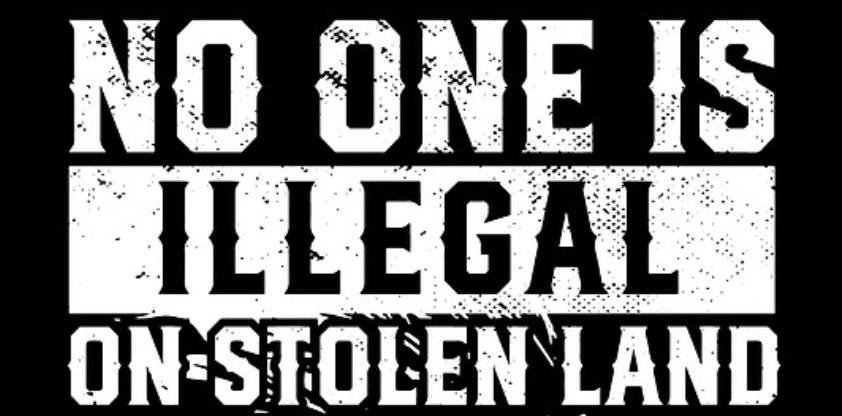
In the immigrant justice movement we often say, “no one is illegal on stolen land.” We say this because the land of what is now called West Michigan once belonged to Indigenous people, to the Anishinaabek. We should also acknowledge that US policy has displaced people of mesoamerica, often because of state terrorism. Those same people are now being terrorized by ICE, by the state, right here in Grand Rapids. If you want to honor Indigenous People’s Day you can also be part of the resistance work right here by contacting Movimiento Cosecha and GR Rapid Response to ICE.


Comments are closed.