 Earlier this week, GRIID was interviewed for the podcast Mutual Aid on Lockdown, which has been centering the importance of practicing mutual aid during the COVID-19 crisis.
However, the person who hosts the show thought it would be good to talk about how disaster capitalism is currently functioning in Michigan and specifically in Grand Rapids. During the interview we talk about:
- the Grand Rapids Power Structure
- the DeVos family and the Kent County Relief Fund
- who is really benefiting from the federal stimulus money
- statewide organizations that are pushing for Michigan’s economy to “re-open”
- the protests in Lansing against Gov. Whitmer’s Stay-at-Home order
- and how the COVID-19 crisis has created lots of political openings for people to radically re-imagine how we can move forward and not be content with getting back to normal.
You can listen to the interview by going to this link. The interview is just over an hour long.
Graphic credit – Brett Colley
 Michigan Gov. Whitmer now has several lawsuits leveled against her by people and organizations that are not in favor of the Stay-at-Home order. Senate Majority Leader Mike Shirkey and House Speaker Lee Chatfield submitted a lawsuit on Wednesday, which we just wrote about. In addition, a group of Christians have also submitted a lawsuit against Michigan’s Governor.
Earlier this week, several Christian churches, some pastors and a Christian law firm began a lawsuit against Gov. Whitmer, because they believe she is violating their right to religious assembly.
The Great Lakes Justice Center filed the lawsuit on behalf of the following plaintiffs:
Word of Faith Christian Center Church, a Southfield nonprofit that operates other churches and Bible training centers; Word of Faith Christian Center Church Bishop Keith Butler; Michigan Association of Christian Schools Director Timothy Schmig; Sturgis-based Whole Life Church; Whole Life Chirch Pastor Chuck Vizthum; and Northern Michigan Baptist Bible Church Pastor Stanley Chatfield III, who also served as am Emmett County Republican delegate in 2018.
These are the plaintiff’s listed, as was reported by MLive. Unfortunately, there were several important omissions from the MLive story.
First, there is no mention that the Great Lakes Justice Center, which filed the lawsuit, has a long history of defending religious groups that actively discriminate against the LGBTQ community. A Lansing-based news source, City Pulse, reported on one example and the ACLU has documented other cases against the Great Lakes Justice Center. The Great Lakes Justice Center is part of group Salt & Light Global, which was founded by William Wagner. Salt & Light Global embraces a far right political and religious worldview. The “Resources” section on their homepage is a who’s who of far right religious groups, including the Federalist Society, Hillsdale College, Wall Builders, the Discovery Institute and the Acton Institute.
The other major omission in the MLive article is the fact that the pastor of the Northern Michigan Baptists Church, pastor Chatfield, is actually the father of Michigan House Speaker Lee Chatfield. Rep. Lee Chatfield also filed a lawsuit against Gov. Whitmer, along with Senate Majority Leader Mike Shirkey.
These omissions from the MLive story are not marginal. The public has a right to know these basic facts about groups like the Great Lakes Justice Center and the churches that have filled a lawsuit that alleges the Governor is violating their right to religious assembly.
 On Wednesday, it was announced that Senate Majority Leader Mike Shirkey and House Speaker Lee Chatfield are suing Michigan Gov. Gretchen Whitmer over her “abuse of power” with the Stay-at-Home orders.
MLive reported on the lawsuit, stating:
The debate boils down to the interpretation of two Michigan emergency powers laws, from 1945 and 1976.
The 1945 law allows a governor to extend a state of emergency indefinitely, while the 1976 law limits it to 28 days without further approval from the House and Senate.
To view the actual language of the lawsuit, click on this link.
However, one thing that was omitted from the news coverage about the lawsuit, is who have been the dominant campaign contributors to both Senator Mike Shirkey and Rep. Lee Chatfield.
According to data provided by the Michigan Campaign Finance Network, the top 5 campaign contributors to Senator Mike Shirkey are:
1. John Kennedy and family, Autocam Corporation, $200,000
2. Mike Shirkey, $145,010
3. DeVos family, Amway, $71,000
4. Michigan Bankers Association, $53,250
5. Cotton Family, Meridian Health, $50,000
Both John Kennedy and the DeVos family are members of the Grand Rapids Power Structure. Besides the Michigan Bankers Association the other contributor is the Cotton Family, which ranks in the top 20 for campaign contributions in Michigan in recent years.
The top 5 campaign contributors to Rep. Lee Chatfield are:
1. Republican State Leadership Committee, Washington D.C., $250,000
2. Ron and Eileen Weiser, McKinley, $113,000
3. Lee Chatfield, $78,000
4. DeVos family, Amway, Windquest, $67,500
5. Michigan Values Leadership Fund, Tom Leonard, $62,500
The DeVos family is the only member of the Grand Rapids Power Structure contributing to Rep. Lee Chatfield, but the amount provided, $67,500, is a bit misleading. The number one contributor to Rep. Lee Chatfield has been the Republican Senate Leadership Committee. According to Opensecrets.org, the DeVos family, through the company they co-founded Amway, had contributed $599,075 to the Republican Senate Leadership Committee in 2016 and $392,000 in 2018. Now, we don’t know how much of the money from the Republican Senate Leadership Committee that went to Chatfield was from the DeVos family, but the point is that the DeVos family’s political contributions to Rep. Lee Chatfield exceeds $67,500 and would likely make them the top contributor to the Speaker of the House in Michigan.
Thus, it seems clear that the two GOP members of the Michigan legislature that have filed a lawsuit against Gov. Whitmer, have been both been bankrolled by members of the Grand Rapids Power Structure – the DeVos family and John Kennedy.
Why we can’t go back to the way things were in Grand Rapids: Part II – Re-imagining a new food system
 Last week, we posted an initial article about Grand Rapids can’t go back to normal after the COVID 19 crisis. We made the argument that the inequities that existed before the crisis which amplified with the crisis, but they would continue to exist long after COVID 19, unless we begin to radically re-image another way of organizing ourselves.
In Part II, we want to focus on food, the current food system and why we need to radically re-imagine a new food system in this community. Food insecurity has been amplified during the current crisis, with thousands of people in the Grand Rapids area not being able to access food or struggling to access food. There has been inspiring efforts to make sure that people are getting access to food, like food pantries changing how they distribute food, to people volunteering to bring food to families, to various groups making sure that children who relied on school meals could still get the food they needed. A great deal of food triage has been happening, work that is very important, but it does not address the larger issue of food insecurity in the Grand Rapids area.
Another thing we have seen in the past 6 weeks is, with the closing of restaurants and other sectors in society, many farmers have been forced to dump or destroy the food they have produced, because they could not get rid of it. This dynamic exposed the major flaws in the food supply chain. Essentially, the food supply chain is based on seeing food as a commodity, rather than seeing food as a human necessity.
Lastly, there has been a great deal of interest on social media about the interest of people to learn gardening skills, even calls for people to grow victory gardens. As a long-time gardener, I completely support people’s desire want to grow more of their own food, but individual responses will not be adequate and we need to come up with solutions that will be collective solutions, since virtually no one I am aware of can take care of all of the own food needs.
So, when the COVID 19 crisis is over, which doesn’t seem to be anytime soon, we will still need to address major flaws in the current food system. In fact, it is arguable that we need an entirely new food system, a system that is not driven by the profit motive, a system that exploits agricultural workers, a system that values and promotes highly processed food over fresh food and a food system that relies on fossil fuel-based transportation and food traveling thousands of miles while it is consumed.
So what might a radically re-imagined food system look like in the Grand Rapids area? Here, we offer 10 ideas about how to move in that direction.
- We do need more people to question the existing food system and learn food growing and food preserving skills. More people growing and preserving food is an important step, but it is only a first step and not the end goal.
- We need large, fully functional farmers markets in a sectors of the Grand Rapids area, which will make it easier for more people to access fresh food that is in their neighborhood.
- We need to guarantee that people have access to land to grow food, particularly to grow food collectively. I support people turing their lawns into spaces of food production, but this is often a privileged response, since many people do not have lawns. Vacant lots, church property, green space that exists at commercial facilities, all need to be made available for people to collectively grow food.
- Right now, a great deal of food that is grown in West Michigan, does not stay in West Michigan. Many of the area farms grow mono-crops, like corn and apples, which are either used for animal feed (in the case of corn) or the food is sent abroad to be used in the creation of highly processed foods. Current, the food system is not bio-regional and this also means that the average food item grown will travel 1,000 miles before it is consumed. This is not sustainable, nor should it be desirable. More farmers would use a CSA model (Community Supported Agriculture), but this requires that thousands more need to join a CSA.
- Food waste is built in to the current food system. Food that goes bad before it gets to consumers is expected and used as a write-off in the current food system. Then there is the amount of food that grocery stores throw away because it has expired and all the food that is thrown away by restaurants and other institutions that prepare thousands of pounds of food every day. So much food ends up in a landfill, food that could be used to meet the nutritional needs of so many people.
- We need to rethink how we access food and move beyond supporting the large grocery chains, moving to other food distribution models. We need more food coops, food buying clubs, more CSAs and more neighborhood-based farmers markets. 75% of the food sold in Grocery store chains is highly processed foods that we don’t need, and if fact, the highly processed foods is what has led to a major health crisis, especially for those experiencing poverty.
- The Slaughterhouse industry has also now being exposed to its brutal and dysfunctional nature. For years we have know that a meat-centric diet in the current food system is a major contributor to climate change. Moving forward we need to come to terms with the fact we need to significantly reduce animal consumption to truly have a just and sustainable food system.
- Right now it is apparent that agricultural workers/migrant workers are “essential workers.” However, agricultural workers/migrant workers have always been essential to the current food system, despite the fact that they are exploited on a massive scale. Food worker demands should be met, which includes a livable wage, safe working conditions, just housing conditions and the elimination of the threat of ICE arrest, detention and deportation, since many workers in the food system are undocumented. Farmworker unions should be a priority.
- Farmworker labor improvements are a good first step, but it would still not do much to challenge the existing food system. We need massive land reform, which includes a longstanding tradition, particularly in the Global South, where those who work the land should own the land.
- We also need to challenge the massive subsidization of the current food system, also known as the Farm Bill. Billions of dollars of taxpayer money is used to support a dysfunctional, exploitative and unjust food system.
 Instead of ending the Farm Bill, maybe we need to radically re-imagine a new Farm Bill that would redistribute the billions going to support the agribusiness sector and redistribute that money to fund all of the other ideas listed above.
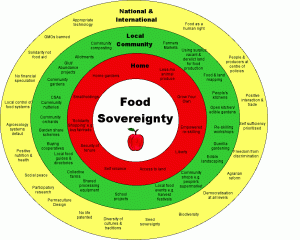
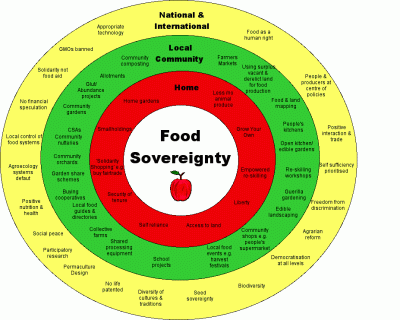
These 10 ideas are just the beginning of what a radically re-imagined food system might look like, but it is just that, a beginning. We need to have a collective conversation about how to move forward from here and take advantage of the opportunities that the COVID-19 crisis is providing us, in order to radically re-imagine a just food system. Ultimately, we need to practice food sovereignty, which essentially means that every community would have a direct say in the kind of food system we want. Let’s embrace the ideas that groups like Via Campesina have been giving us (the idea of food sovereignty originated with Via Campesina) and collectively practice the radically re-imagine new food system we want!
Another ICE Detention Facility is being proposed in Ionia by Immigration Centers of America
 Within the last week, there have been articles from MLive and the Ionia Sentinel-Standard, about another proposal from Immigration Centers of America (ICA) to build an ICE detention facility in the Ionia area.
In October of 2018, ICA first proposed an ICE detention facility, using an old Ionia prison facility. However, after there was significant grassroots opposition across the state, specifically from the group No Detention Centers in Michigan, Gov. Whitmer denied ICA a permit to use state land.
Now, ICA is proposing to build a brand new ICE detention facility that could house up to 600 ICE detainees. The current proposal would use land that ICA would purchase from Jeffrey and Gloria Badder, land that is south of downtown Ionia and north of the Ionia County Airport.
According to MLive, ICE officials sent a letter to Ionia County officials, “seeking input on an environmental assessment for the site.” GRIID sent a request to the Ionia County Clerk, requesting a copy of this letter and is waiting a response.
According to the Ionia Sentinel-Standard, there are at least three of the seven Ionia County Commissioners that have given verbal approval of the new private ICE detention center in Ionia. The three commissioners who support the proposal are Jack Shattuck, Georgia Sharp and Scott Wirtz. All three of these commissioners are Republicans, as are all seven members of the Ionia County Board.
Commissioner Shattuck was quoted as saying, “I think it would be a huge asset for the county and community having that kind of opportunity made available.” The County Board Chairman, David Hodges was quoted as saying about the proposal, a downside would potentially be losing guards from the Ionia County Jail, but added “a little competition’s not a bad thing for the county.” They will be voting on the ICA proposal on Tuesday, May 12.
MLive also reported that ICA has John Truscott as their spokesperson on this proposal. Truscott is the former Press Secretary for Michigan Gov. John Engler, who co-founded the PR Firm of Truscott Rossman. Truscott Rossman got a contract in 2017 with the City of Grand Rapids and Engler hired Truscott in 2018 to do deal with MSU’s communications issues during the Larry Nassar sexual assault cases.
For those interested in being involved in organized resistance to detention centers in Michigan, GRIID encourages you to like the FB page for No Detention Centers in Michigan.
 The Acton Institute for the Study of Religion and Liberty has defended all sorts of conservative positions, both religious and political.
It’s founder, Rev. Robert Sirico, is a pompous man who spends a great deal of his time in the company of the capitalist class. Sirico was the priest that Erik Prince asked to preside over his second marriage.
I’m never surprised anymore about who or what the Acton Institute acts as an apologist for. However, in a recent Acton Institute column, I was somewhat surprised by the fact that they were complaining about a show that is currently running on the online streaming service Hulu.
The show that the Acton Institute took issue with is the show Mrs. America, a show about the battle between pro-ERA activists and the conservative icon, Phyliss Schlafly. The article, which appeared on the Acton Institute’s website was entitled, ‘Mrs. America’: How Hollywood rewrites history. The article was written by Caroline Roberts. Roberts produces Acton’s weekly podcast called, Acton Line.
The article by Roberts takes issue with how Phyliss Schlafly is portrayed, but also with what she stood for and the women who worked with her. Personally, I’m not terribly invested in the Hulu show, although I did watch a few episodes. What I am more interested in, is the fact that the Acton Institute writer was defending a woman who was not only an anti-feminist, but someone who was a racist, anti-abortionist who hated the LGBT community.
Phyliss Schlafly was deeply committed to the Republican Party and became a party delegate in 1956, until just before she died. Schlafly was part of the ultra-right part of the GOP, the same crowd that pushed to get Barry Goldwater on the ticket in the 1960s. Schlafly actually believed that the Republican Party was controlled by an elaborate conspiracy of bankers and financiers who were assisting a global communist conquest.
In the 1990s, Schlafly founded the Republican National Coalition for Life (NCL) in 1990 for the purpose of electing a majority of pro-life delegates in as many states as possible.
However, Phyliss Schlafly’s most notable contribution was her commitment to ending the Equal Rights Amendment. Schlafly detested feminism and embraced what she believed to be was a biblical belief that men are the head of the household and that women should obey their husbands.
Arch-conservative beer manufacturer, Joseph Coors, funded Schlafly during her anti-ERA work. Schlafly once said, “The ERA mentality is the source of today’s social evils – hostility toward women, preborn babies, men, family church, state and God.” In fact, Schlafly believed that feminists were really just lesbians who had a much larger agenda. According to Chip Berlet, in his book, Eyes Right: Challenging the Right Wing Backlash:
“Schlafly made heavy use of the accusation of lesbianism in her early 1980s attacks on Equal Rights Amendment organizers. She argued that the ERA would promote gay rights, leading, for example, to the legitimization of same sex marriage, the protection of gay and lesbian rights in the military, the protection of persons with AIDS, and the voiding of sodomy laws.”
The organization that Schlafly founded, the Eagle Forum, not only organized against the ERA, but against any kind of rights for the LGBTQ community, against women’s reproductive rights, and she was opposed to immigration reform. In fact, Schlafly was most clearly a racist, as has been well documented on the site Right Wing Watch. In one article, published in May of 2016, Schlafly was calling on Christian leaders to stop push for immigration reform and to rally behind then presidential candidate Donald Trump.
Phyliss Schlafly did not live to see Donald Trump elected, but the last book she published was entitled, The Conservative Case for Donald Trump. In many ways, one could argue that Phyliss Schlafly was as much to blame as anybody else for Donald Trump’s ascendency to the White House.
So, the Acton Institute writer has decided that the Hulu show about Phyliss Schlafly is not an honest depiction and then spends an entire article acting as an apologist for the woman who fought tooth and nail to prevent gender equity, a woman who hated the LGBTQ community, who didn’t believe that women had reproductive rights and told Christian leaders to get behind Donald Trump. I don’t think any hollywood depiction of Phyliss Schlafly would do justice to the hateful and harmful work that “Mrs. America” engaged in for more than 60 years.
New resource on COVID-19 for Kent County and what it reveals: Structural Racism and White Supremacy
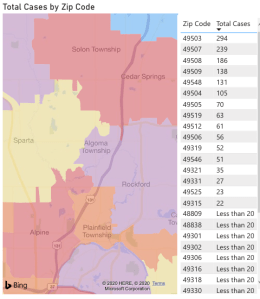 On Friday, the Kent County Health Department began tracking cases of COVID-19 for the Kent county, with the number of deaths, the racial breakdown of cases, age demographics, by gender and zip code.
MLive reported on the new COVID-19 resources on Friday, but only included information on COVID-19 cases by zip code. This limited reporting is not only unfortunate, it is a weak form of journalism that doesn’t ask larger and more urgent questions about which populations appear to be more at risk.
Looking at the racial breakdown of COVID-19 cases is instructive for Kent County. According to the 2010 Census data, the percentage of African Americans living in Kent County was 10.5 %, compared to 82.3% White. However, in looking at the racial breakdown of COVID-19 cases, 22.1% of White people have contracted COVID-19, compared to 18.6% of African Americans. While the number of White people living in Kent County is roughly 8 times greater than African Americans, they are nearly equal in contracting COVID-19. This means that African Americans are between 7 or 8 times more likely to contract COVID-19 than White people are.
This data on COVID-19 for Kent County, based on race is a clear indication of structural racism and White Supremacy. In addition, the zip codes that have the highest number of cases are 49503, with 294 reported cases, and 49507, with 239 cases. The 49503 zip code has the highest percentage of African Americans than any other zip code in Kent County and 49507 is one of the highest for African Americans.
In Detroit, the structural racism in COVID-19 cases is even more disturbing, as Mark Fancher writes in Black Black Agenda Report, and the same dynamic is taking place in New York, according to the Center for Public Integrity.
None of this data, from around the US or right here in Kent County should be surprising, unless you are white and are in denial about the systemic function of White Supremacy. The data should be disturbing and should cause outrage over the fact that proportionately more African Americans in this community will die than White people. As was the case before COVID-19, we have to dismantle the system of White Supremacy in the Grand Rapids area.
 Yesterday, nearly 100 vehicles were part of a “caravan for dignity,” that brought attention to critical issues facings the undocumented immigrant community in Grand Rapids.
This was the fourth consecutive year that Movimiento Cosecha GR has organized a May 1st action to demand dignity, respect and permanent protection for all 11 million undocumented immigrants living in the US.
It was difficult to say exactly how many people were part of the action yesterday, since most people were in cars and practicing social distancing. There were crowd safety people on foot and on bicycle, but there would easily have been over 100 people, since most of the vehicles I saw had multiple people inside. The amount of people that took a public stand in the face of the COVID-19 crisis was impressive, but unfortunately both WOOD TV 8 and WZZM 13 stated that there were “dozens of protesters.” Just looking at some of the images that came from yesterday’s action, with long lines of vehicles, confirms that it was more than dozens of protesters.
Movimiento Cosecha GR was once again demanding driver’s licenses for all, but they also emphasized the fact that immigrant workers are essential workers, particularly migrant workers. Migrant workers do the back breaking work in the fields that puts food on all of our tables, work that is so essential, that without them the food system would collapse. Another important point that Movimiento Cosecha GR made yesterday was that the 11 million undocumented immigrants in the US are not eligible for any of the COVID-19 relief funds coming from the federal government, thus causing even extra hardship for the immigrant families that are already terrorized by law enforcement.
 The Grand Rapids Police Department (GRPD) once again had an excessive amount of police presence during the non-violent immigrant-led caravan. There were police in marked cruisers, unmarked cars, on foot and on bicycles. In the pictures that MLive took of yesterday’s action, every time the GRPD was shown in the photos, the caption always read, “Members of the Grand Rapids Police Department discuss safety with protesters.” The notion that the GRPD was there for safety reasons is patently false. The GRPD has demonstrated over the part four years, that whenever there is a Movimiento Cosecha GR action, particularly a May 1st action, that they are NOT there for the safety of the immigrant community. The GRPD shows up in large numbers for the following reasons:
- To intimidate and harass those involved in Movimiento Cosecha GR actions.
- To engage in surveillance of the organizers and allies who are fighting for immigrant justice, which means collective data and images on certain activists.
- To ensure that business as usual is maintained, which means the GRPD does not want any disruption or interruption of the functioning of commerce and government. Why else did the GRPD have large city-owned trucks and police cruisers blocking the on ramp and off ramps along US 131 and i96 yesterday?
Apart from what members of Movimiento Cosecha GR have witnessed over the last four years from the GRPD, there is also plenty of evidence to support the three reasons cited above, especially since we were able to obtain some 250 pages in a Freedom of Information Act (FOIA) request late last year.
However, despite the efforts of the GRPD to limit the collective power of the immigrant justice movement in Grand Rapids, the movement once again demonstrated their resiliency, their commitment and their determination to win dignity, respect and permanent protection for all 11 million undocumented immigrants in the US. Hasta La Huelga!


 Two weeks ago, we posted an article about a COVID-19 relief fund that the DeVos-funded AmplifyGR organization had announced. We noted in that article that the relief project was in partnership with the Family Independence Initiative and the Koch brothers created group, Stand Together.
In that initial announcement from AmplifyGR, they stated:
A generous group of Kent County residents have partnered with a nonprofit called the Family Independence Initiative (FII) to create a fund for families that are experiencing financial hardship because of COVID-19.
Well, we now know that the “generous group of Kent County residents,” is actually referring to members of the DeVos family. The project is called the Kent County Relief Fund and the funding has come from 4 different DeVos family foundations – the Dick & Betsy DeVos Foundation, the Doug & Maria DeVos Foundation, the Dan and Pamela DeVos Foundation and the CDV5 Foundation.
Now, it’s not just the funding that the DeVos family is providing, the address for the Kent County Relief Fund is 48 Fountain St. NW, Grand Rapids, which is the address for the Doug & Maria DeVos Foundation.
As of a few days ago, the Kent County Relief Fund post an update stating that the fund had given away all of its available resources. People still apply, but they will be put on a waiting list. The update also noted that the Kent County Relief Fund has given $1,679,000, which seems like a lot of money. However, considering the wealth of the DeVos family, this is like contributing $20 for most of us. In fact, as we reported 10 days ago, the DeVos family members, and all other millionaires and billionaires in Kent County, will get on average $1.7 million (each) in a tax break as part of the Care Act. Therefore, between the four DeVos foundations that have providing the funding for the Kent County Relief Fund, they would collectively be receiving $6.8 million in tax breaks for doing nothing. It seems to be that the DeVos foundations should provide another $5 million to the relief fund, since they got these funds from an unjust tax policy that was crafted by the same politicians that the DeVos family funds through campaign contributions.
There are also several other important things to point out about the Kent County Relief Fund.
First, the application process for the Kent County Relief Fund has very similar conditions that we see in other charity-based assistance. People have to present some form of government issued ID and provide tax returns or a recent pay stub. This kind of scrutiny carries with it the same shame-based conditions that those experiencing poverty too often experience.
Second, the community partner list provided on the Kent County Relief Fund’s website is very instructive. These nonprofit supporters and partners are not just random entities, rather they were deliberately selected since virtually all of these groups have some major DeVos connection.
 This means that of the 23 partners working with the Kent County Relief Fund, 20 of them have a direct connection to the DeVos family. The only nonprofits partners that do not have a direct DeVos family connection are Dwelling Place, River City Scholars Charter Academy (part of the National Heritage Academies – J.C. Huizenga) and Michigan Works.
The fact that the majority of nonprofit partners working with the DeVos-created Kent County Relief Fund should tell us something. First, the DeVos family is very strategic and does not like working with entities that they cannot control. Second, most of these groups are Christian in orientation, which is what the DeVos family prefers. Third, the nonprofits are not known for challenging systems of power and oppression in Grand Rapids, which means they do not exist to fight the structural or root causes of the problems of the people they serve.
Lastly, while I am glad for the families that have received the $500 funds provided by the Kent County Relief Fund, but make no mistake about it, this project is designed only as a form of charity. More importantly, the very people that the Kent County Relief Fund has provided money to, are the same families who have been negatively affected by the policies that were created by the politicians that the DeVos family has funded over the decades, policies which have benefited the millionaire/billionaire class and punished poor families, especially families of color.

