Betsy DeVos Watch: Department of Education affirms its commitment to supporting religious education with public money
 In early July, we posted an article about what the Supreme Court ruling in the Espinoza v. Montana Department of Revenue, which essentially rules that public money can be used for faith-based education, and what it could mean moving forward with Betsy DeVos as the Secretary of Education.
Last week, Betsy DeVos affirmed her department’s commitment to making sure that faith-based education programs and schools will benefit from this administration. DeVos stated:
This Administration will continue to protect the religious liberty and First Amendment rights of every student, teacher and educational institution across the country. Too many misinterpret the ‘separation of church and state’ as an invitation for government to separate people from their faith. In reality, the First Amendment doesn’t exist to protect us from religion. It exists to protect religion from government. Today’s guidance reaffirms our commitment to protecting our first liberty and ensuring that discriminatory restrictions on access to federal grant funding are no longer tolerated.
Such a proclamation from the Secretary of Education makes it pretty clear where she stands on this matter. The danger with this Supreme Court ruling was reflected in a recent ACLU position, which states:
The court’s ruling could effectively mean that, when states offer school vouchers or similar funding involving indirect aid — such as Montana’s tax credit scholarship program — they now must extend the aid to religious schools, too. This is despite the fact that millions more in government funds will be diverted from public schools as a result, and taxpayer dollars will be used to support religious indoctrination and training for future religious leaders and adherents. This also means that the government will fund discrimination against minority-faith and LGBTQ students and job applicants, as well as students and prospective employees with disabilities, whom many religious schools refuse to admit or hire. Indeed, earlier this year, the court heard arguments in two cases that could expand the ability of religious schools — the very same ones that often receive voucher funding — to discriminate in hiring and firing based on any ground the schools want, including race and ethnicity.
In her recent affirmation of Department of Education support for faith-based education, DeVos included a list of guidelines her department will use to guide faith-based educational systems. Those guidelines include:
• Affirms that religious organizations are equally eligible to participate in ED-administered programs as their secular counterparts
• Affirms that financial award decisions are made based on merit, not based on an organization’s religion, religious belief, or the lack thereof
• States that religious organizations receiving federal financial assistance under a Department program must comply with program-specific legislation and regulations, but clarifies that these organizations may continue to carry out their missions and maintain their religious character. However, direct federal financial assistance may not be used for religious worship, religious instruction, or proselytization
• Reminds states that they may not use discriminatory Blaine Amendments to deny faith-based organizations contracts or grants, as this violates Department regulations against discrimination on the basis of an organization’s religious character or affiliation
• Affirms that students and/or borrowers seeking to participate in Department loan programs and beneficiaries seeking to participate in Department social service programs will not be penalized or singled out for disadvantages on the basis of religion
• Clarifies the role of the Department’s Center for Faith and Opportunity Initiatives (CFOI) as a Department office that collaborates with faith and community leaders to maximize participation of religious organizations in Department programs while eliminating barriers in the grantmaking or regulatory process to safeguard religious liberty
These guidelines are highly problematic and it will be interesting to see if this ruling will increase the amount of faith-based educational programs/schools applying for public money. In addition, when we say faith-based educational systems, we really mean Christian, since we all know that Betsy DeVos and the DeVos/Prince families have a deep commitment to ultra-Conservative Christian values. This issue of using public money for faith-based schools and educational programs is not getting the attention it should be, but make no mistake about it that groups like the Great Lakes Education Project, are working hard to make sure that the candidates they are endorsing in Michigan (all of the GLEP-endorsed candidates won their primary in Michigan), will be committed to channeling public money to religious schools.
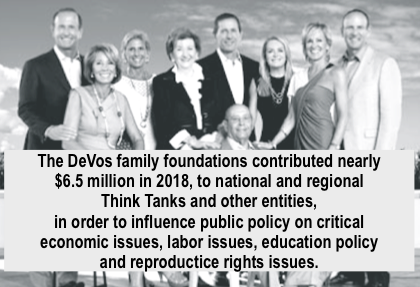 We were recently able to access the 2018 990 documents from the various DeVos family foundations, through GuideStar.org. These foundations include, the Richard & Helen DeVos Foundation, the Dick & Betsy DeVos Foundation, the Doug & Maria DeVos Foundation, the Dan & Pamela DeVos Foundation and the CDV5 Foundation.
We have been tracking the DeVos family foundations for years, since it provides useful information on how the family strategically uses their money to influence the world around us. It is important to recognize that when people generally think of philanthropy, they think of money going from those with tremendous wealth to non-profits who provide needed services in the community. While there is some truth to this, what we will demonstrate in this series of articles, is that the DeVos family uses their foundation money to primarily wage ideological and class warfare.
In Part I of this series, we looked at how the DeVos family foundation funded and influenced educational institutions in West Michigan and across the US. In Part II, we looked at how the DeVos family foundations funded far right Christian organizations, and in today’s post we want to take a look at how these same foundation have funded Think Tanks and other groups that influence public policy, along with organizations that practice far right and Neoliberal policies.
American Enterprise Institute – $1,500,000 – AEI is one of the most influential Think Tanks in Washington, DC. The American Enterprise Institute has a long history of opposing an increase in the minimum wage, business regulation, being critical of Climate Change, supported the US invasion/occupation of Iraq, with strong ties to the Koch Brothers and Donor’s Trust.
Mackinac Center for Public Policy – $1,000,000 – The Mackinac Center is the most influential Think Tank in Michigan and has been working with the DeVos family for decades. The Mackinac Center was instrumental in getting Right to Work passed in Michigan, along with pushing privatization policies, anti-union policies and a whole host of prop-business policies. The Mackinac Center has also been aggressively pushing disaster capitalism policies during the COVID 19 pandemic.
George W. Bush Foundation – $2,000,000 – The DeVos family has always had close ties with the Bush family. The George W. Bush Foundation funds pro-capitalist projects across the US and around the world. The foundation’s foreign policy projects compliments US imperialism, particularly the economic aspects of US imperialism, such as supporting CAFTA in Central American and other Neoliberal economic practices in countries that the US has militarily occupied in recent decades.
Acton Institute for the Study of Religion and Liberty – $228,500 – The DeVos family has long supporter the Acton Institute, with funding and with family members serving on the Board of Directors. The Acton Institute promotes the idea that Capitalism and Christianity are good bedfellows, but they also take a strong stance against the LGBTQ community, have supported attacks on unions, promotes xenophobia and has been very critical of the Black Lives Matter Movement.
Alliance for School Choice – $700,000 – The Alliance for School Choice has long received support from the DeVos family, since they advocate for the privatization of education and promote policies that undermine public education.
Talent 2025 Inc – $716,000 – Talent 2025 is a Grand Rapids-based entity that works with the business class to find inroads within the education system to recruit and promote the idea that education is fundamentally about developing talent for the business world. https://griid.org/tag/talent-2025/
National Review Institute – $150,000 – The NRI was founded by William F. Buckley to promote the benefits of Capitalism, particularly the way that the United States brand of capitalism.
Pregnancy Resource Center – $300,000 – The Pregnancy Resource Center is an anti-Choice organization that is based in Grand Rapids and provides “alternatives” to abortion.
Right to Life Michigan Educational Foundation – $125,000 – The RTL foundation is also an anti-choice organization that attempts to influence public opinion on reproductive rights and they lobby Michigan legislators to take an anti-Choice position.
Collectively, in just 2018, the DeVos family contributed roughly $6.5 million to these think tanks and public policy influencing entities to push and promote their brand of class warfare and ideologically far right policies. In Part IV of this series, we will look at the DeVos family created non-profits and what role they play in furthering the family’s legacy.
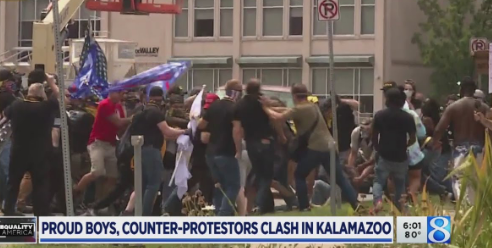 Most major Michigan news outlets reported on what happened in Kalamazoo on Saturday, with the Proud Boys violence. However, most news outlets also chose to frame the violence as equally distributed by the right and the left, or with no clear source of the violence with headlines like the one from MLive, Rally turns violent as Proud Boys met by counter-protesters in downtown Kalamazoo.
The problem with this reporting is that it is only reactive. It was known for at least a week that the Proud Boys would be coming to Kalamazoo to spew their White Supremacist propaganda, yet the news media didn’t really make an effort to report on who the Proud Boys are, what their ideology is and what their history of violence has been. Several of the news outlets that reported on this did mention that the Southern Poverty Law Center has identified the Proud Boys as a Hate Group, but this reference is vague and frankly, a lazy form of journalism. Sure, most news sources provided a link to the Southern Poverty law Center information on the Proud Boys, but they should have included at least an except within the coverage.
An additional source on the Proud Boys comes from Emily Gorcenski, writing for another group that monitors the far right, the Political Research Associates:
The Proud Boys, launched in 2016, had managed to stand apart from many of the other groups that attended and organized the fatal Unite the Right rally in Charlottesville, Virginia. Compared to the White supremacists they sometimes marched alongside, the Proud Boys—self-declared “Western chauvinists” whose core ethos is that they won’t “apologize for creating the modern world”4—enjoy comfortable proximity to the conservative mainstream. Existing almost entirely to antagonize left-wing and Democratic opposition, they effectively serve as the Republican Party’s militant arm.
I would also recommend the recent book, Proud Boys and the White Ethnostate: How the Alt-Right Is Warping the American Imagination by Alexandra Mina Stern, as a good source on unpacking who the Proud Boys are.
So, since the Proud Boys have a history of violence against marginalized communities, to not report on them ahead of the rally on Saturday, not only does a dis-service to the community of Kalamazoo, it makes the news media complicit in the White Supremacist violence.
One independent news source, Community Voices, did report ahead of time on the Proud Boys coming to Kalamazoo, with information about their planned rally and information to assist people in identifying far right White Supremacist groups.
However, most of the commercial news media ran headlines like:
Rally turns violent as Proud Boys met by counter-protesters in downtown Kalamazoo
Proud Boys, counter-protesters clash in Kalamazoo
Far right Proud Boys group clashes with counter-protesters in Kalamazoo
Violence erupts at Kalamazoo rally and counter-protest
Proud Boys, counter-protesters clash in downtown Kalamazoo
Far-right group, counter-protesters clash in Kalamazoo
You can see from each of these headlines that the news media frames the violence as stemming from all parties, without really acknowledging the fact that a far right White Supremacist groups came to Kalamazoo with the specific purpose to intimidate people, do real harm to people and to spread their propaganda.
The articles themselves don’t provide much insight into what happened and both the print and broadcast news included lots of short videos of interactions between Proud Boys and “counter-protesters.”
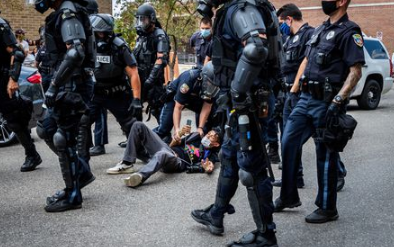 There was a fair amount of social media commentary from people who were there and were there specifically to force the Proud Boys to leave. One person commented:
“The police SPECIFICALLY PROTECTED the proud boys, CLEARED SPACE for them to leave, and then began ARRESTING Black counter protestors as well as the Media outlet reporting in this video. State police/Portage police/and Kalamazoo police are all complicit.”
Several other activists confirmed this observation about how the police seemed to be providing cover for the Proud Boys, which led to activists showing up outside the police station in a separate demonstration, as was reported on by WZZM 13.
Furthermore, the City of Kalamazoo, which included the Police Chief, held a press conference on Sunday, which was reported on by MLive, with the headline, Police chief says Proud Boys completed their mission by causing chaos in downtown Kalamazoo.
What is instructive about the Sunday Press conference by the Kalamazoo Police Chief was that they admitted that they knew that the Proud Boys were coming as early as July, that they had “a plan in place” and that the Police Chief said they, “had officers in an unmarked vehicle on scene and that the department was using aerial surveillance and deployed law enforcement officials immediately upon the initial clash occurring a half-hour earlier than expected.”
What is equally instructive is the fact that while there were 111 police officers present, they did not really prevent any violence, yet arrested 9 people, NONE of which were members of the Proud Boys.
It would be very interesting to submit a Freedom of Information Act (FOIA) to see exactly what the police knew and why none of the Proud Boys were arrested.
The fact that the police presence was massive and it resulted in no arrests of Proud Boys is consistent with what we have seen all across the US when White Supremacists come to communities and are met by resisters like antifa. In fact, a very similar situation happened in Kalamazoo in 2007, when White Supremacists came to Kalamazoo and were outnumber by anti-racist activists three to one. As someone who was involved in that action, the police not only created free speech spaces for the White Supremacists, they always faced those were were there to confront the White Supremacists and not the White Supremacists themselves, as was reported on by the indy news source Media Mouse.
Students for Trump Rally in Grand Rapids, will feature Charlie Kirk, known racist and founder of Turning Point USA
 On Saturday, there will be a Students for Trump rally at Rosa Parks Circle in Grand Rapids. Let that sink in for a moment…..a pro-Trump rally at Rosa Parks Circle.
The event is being hosted by the group Students for Trump, which is part of the the organization known as Turning Point USA.
Turning Point USA was founded by Charlie Kirk, and according to their own website:
Since its founding, Turning Point USA has embarked on a mission to build the most organized, active, and powerful conservative grassroots activist network on high school and college campuses across the country. With a presence on over 2,000 campuses, Turning Point USA is the largest and fastest-growing youth organization in America.
According to SourceWatch.org, Turning Point USA has ties to the Koch Brothers, the fossil fuel industry and the Trump family.
However, the most over aspect of Turning Point USA and its founder, Charlie Kirk, is there use of racist propaganda and its relationship to White Supremacists groups across the country.
The Southern Poverty Law Center, in one article, documents several examples of Turning Point USA leaders making racist comments:
TPUSA’s flirtation with racists and racism is well documented. In a December 2017 expose in The New Yorker, reporter Jane Mayer was provided screenshots of a text message from TPUSA’s (now former) national field director, Crystal Clanton, that read, “i hate black people. Like f— them all… I hate blacks. End of story.”
Kirk himself has been criticized for his anti-immigrant and anti-Muslim tweets, and he habitually tweets out racist dog-whistles with statements like, “It would take 40 years worth of blacks killed by cops to equal the number of black [sic] killed by other blacks in one year.”
In an article for Newsweek, TPUSA founder Charlie Kirk rails against Black Lives Matter and their unfounded use of rioting in response to the police murder of George Floyd.
In another public talk, Kirk said that there is no such thing as systemic racism in police departments. In fact, Kirk says, “cops are more likely to be shot by Black people,” as stated in this video.
In this brief exchange, Kirk talks about why he likes Immigration and Customs Enforcement and in yet another video Kirk defends building the Wall along the the US/Mexican border. In both instances Kirk uses false information.
These are the kind of comments one can expect to hear from Kirk, when he addresses people at the Students for Trump Rally in Grand Rapids on Sunday.
Lastly, it is worth noting, that according to the Turning Point USA Chapter Map, there are TPUSA chapters at Forest Hills Eastern High School, Forest Hills Northern High School, GVSU, Hope College and West Ottawa High School.
Setting the parameters for input by controlling the narrative: The GRPD Strategic Plan Survey
 On Tuesday, the Grand Rapids Police Chief presented a draft of the new GRPD Strategic Plan. MLive reported on this dynamic, with the headline, Grand Rapids leaders praise police department’s strategic plan.
The article offers no insight into the GRPD’s Strategic Plan, something we did a few days ago.
What the article does do is to provide simplistic quotes from a few City Commissioners, without any real assessment of what they really think about the GRPD Strategic Plan and how it differs from previous plans, if at all.
The MLive story also provides a link for to the City’s website, where people can take a survey, by going to this link https://www.grandrapidsmi.gov/Government/Departments/Police-Department/Police-Strategic-Plan-Feedback-Form.
The survey begins with these words:
The Grand Rapids Police Department is here to serve you. We’re committed to ensuring all people feel safe and are safe at all times throughout our community. Through compassion, empathy and courage, we are driven to meet the public safety needs of our community. Our vision is to become the safest mid-sized city and most trusted police department in the United States.
We can’t do this without your support. Please take a moment to review our draft strategic plan and provide feedback. Your input is a valued part of this process. The questions on the following page are meant to provide guidance as you review the plan. We look forward to hearing from you.
How could anyone who actually pays attention believe any of what the GRPD is saying in this introduction to the survey? All the warm fuzzies in the world can’t undo the tremendous harm that the GRPD has done to individuals and families in this community, particularly the Black community.
In addition, the survey is carefully crafted to do two things. First, the survey wants you to respond to very specific and limiting questions, which means they want to control the parameters of what can be discussed. Secondly, the GRPD survey wants to dictate the narrative, by using language that is designed to elicit certain responses without allowing people to fully articulate their experiences of the GRPD.
I took the survey and what follows are the questions that are asked, along with my responses.
GRPD – The three main goals of the Grand Rapids Police Department’s strategic plan are Safety, Innovation and Engagement. How are these goals important to you?
These goals are not important to me, as they are just another version of the way that the GRPD does policing in this community, which has done tremendous harm to black and latinx communities. Does the Chief mean that Black people who feel the fear and dangers of White Supremacy and White Supremacist institutions will be safe? Does the Chief mean that those who identify as Queer or Trans should feel safe and never have to worry about homophobia and transphobia, or the spiritual violence that permeates Grand Rapids? Does the Chief mean that undocumented immigrants will feel safe with the GRPD’s Strategic Plan, never having to worry about ICE agents coming to kidnap them? Does the Chief mean that families who are facing eviction from rental properties, since they can’t afford the outrageous costs of housing, since they work in low wage jobs?
GRPD – What do you think the Grand Rapids Police Department needs to do better to effectively communicate and engage with you?
This is the wrong question to be asking. The GRPD should be under community control. If they want to communicate more effectively, then there needs to be complete transparency, which would happen under community control. According to the Movement for Black Lives, “Direct democratic community control of local, state, and federal law enforcement agencies, ensuring that communities most harmed by destructive policing have the power to hire and fire officers, determine disciplinary action, control budgets and policies, and subpoena relevant agency information.”
GRPD – After reviewing the strategic plan, what are your top three observations or suggestions?
1. The GRPD Strategic Plan does not address any systemic problems associated with policing in Grand Rapids.
2. It further legitimizes the function of the GRPD, since the public has NO say in the Strategic Plan, and
3. It doesn’t address Defunding the GRPD, which over 6,000 people have demanded in the past 8 weeks alone.
GRPD – Are there other action items you want to see included in the plan?
A plan to Defund the GRPD, have real community control over the GRPD budget and to re-direct existing funding for the GRPD to the Black community, where they would have control over the re-directed funding.
GRPD – We’ve also launched the Police Metric Dashboard. This provides up-to-date progress on various police metrics related to:
• Accountability
• Budget
• Community Engagement
• Crime Statistics
• Criminal Charge Statistics
• Staffing
What additional information do you want included in this dashboard?
A complete list of all weapons that the GRPD is in possession of, a list of private companies they purchase from and complete transparency on what military weaponry the GRPD is using from US military surplus.
I don’t expect that the Chief of Police will take seriously my comments, based on how he has dealt with the public to this point, especially those that have challenged him on how the GRPD functions in this community.
However, if you want to take the survey, you have until August 25th to do so.
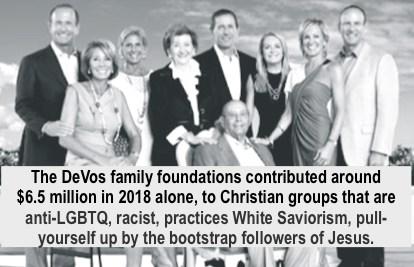 We were recently able to access the 2018 990 documents from the various DeVos family foundations, through GuideStar.org. These foundations include, the Richard & Helen DeVos Foundation, the Dick & Betsy DeVos Foundation, the Doug & Maria DeVos Foundation, the Dan & Pamela DeVos Foundation and the CDV5 Foundation.
We have been tracking the DeVos family foundations for years, since it provides useful information on how the family strategically uses their money to influence the world around us. It is important to recognize that when people generally think of philanthropy, they think of money going from those with tremendous wealth to non-profits who provide needed services in the community. While there is some truth to this, what we will demonstrate in this series of articles, is that the DeVos family uses their foundation money to primarily wage ideological and class warfare.
However, before we get to the data from the 2018 990 documents from the various DeVos family foundations, it is important to note that this family spends more money to directly influence public policy, based on the funding they provide to candidates and various Republican Party entities, as documented by the Michigan Campaign Finance Network (MCFN). Between 1999 and 2018, the DeVos family provided at least $93 million in contributions to political candidates and Republican PACs. However, this amount of money does not include Dark Money, such as the group known as Donor’s Trust. According to one source, the DeVos family has contributed $6.5 million to Donor’s Trust, which funds a variety of right wing entities throughout the country.
We argue, that the money the DeVos family foundations contribute ultimately compliments the direct political contributions they make. In Part II of this series, we look at the contributions the DeVos family foundations made for 2018 to Christian groups that would easily be considered part of the Christian Right – anti-LGBTQ, racist, practices White Saviorism, pull-yourself up by the bootstrap followers of Jesus.
Christian Leadership Institute – $837,000 – this group has as some of its content partners Focus on the Family and Foundation for Economic Education.
International Aid – $100,000 – Has a history of collaborating with dictatorships around the world, particularly those working with the US government. Oliver North wrote in his autobiography about his relationship to International Aid.
Luis Palau Association – $900,000 – Luis Palau and his activities have been reported in dozens of article in Christianity Today during the past 40 years. During that time Palau was in Somoza’s Nicaragua, where, unlike the community of Solentiname, a Nicaraguan Christian based community under persecution, he was welcome with open arms. In 1977, Palau was greeted and accompanied on his crusade by Colombian president Alfonso Michelsen, not particularly known for being a human rights advocate. Also in the 70’s Palau visited Bolivia with the help of an organization known as Food For the Hungry (FFH). According to Sara Diamond’s book Spiritual Warfare, FFH “argues that poverty is rooted in individuals’ belief systems and by extension, in cultures supposedly conducive to underdevelopment and poverty.” (Diamond pg 226) The founder of FFH, Larry Ward, was also with Palau on that trip. Ward, a former overseas director of World Vision “was known to have a close relationship with South Vietnamese and US military leaders.” In 1982, Palau brought his crusade to Paraguay, under the brutal dictatorship of Alfredo Stoessner. According to recently released documents there was massive execution of civilians during Stoessner’s reign. (see Covert Action Quarterly, Fall 1994). Stroessner’s government gave Palau his approval to distribute 100,000 bibles and study courses to children nationwide. Luis Palau was also a close friend and supporter of the Guatemalan dictator Rios Montt, who engaged in genocidal policies during his 18 months as President.
Partners Worldwide – $1,975,000 – this group believes that the only way to fight poverty is to make everyone an entrepreneur. Partners Worldwide embraces Capitalism to fight the affect of Capitalism, specifically poverty.
Campus Crusade for Christ – $10,000 – founded by Bill Bright, CCC was a campus-based Christian group that during the 1960s and 70s, was opposed to the anti-war, Civil Rights, LGBTQ and Feminist students groups that flourished around the country. The Southern Poverty Law Center refers to CCC as a Hate group.
Evangelism Explosion – $215,000 – founded by Dr. James Kennedy, former pastor of Coral Ridge Presbyterian Church and a longtime supporter of anti-LGBTQ campaigns. Over the years, Kennedy emphasized anti-gay rhetoric, particularly in his TV ministry. He recommended as “essential” the virulent work of R.J. Rushdoony, who believed practicing gays should be executed.
Prison Fellowship Ministries – $1,550,000 – founded by former Nixon staffer Chuck Colsen, who went to prison for Watergate. PFM is biased towards only working with those in prison who identify as Christian, plus they do nothing to challenge the Prison Industrial Complex.
Willow Creek Association – $1,000,000 – Is a Christian Ministry that has lost some credibility in recent years, because of the sex scandal that their leadership has been accused of. More importantly, Willow Creek hosts annual conferences that feature politically conservative and far right speakers from around the world.
Life International Inc. – $50,000 – an anti-Choice Christian group that works outside of the US.
One could also add to this list the millions that the DeVos family has contributed to the Christian Reformed Church in America, which has its own history of promoting Settler Colonialism, White Supremacy, anti-feminist, anti-union and anti-LGBTQ messages.
In Part III, we will look at the Think Tanks and related groups that received funding from the DeVos family foundations in 2018.
GRPD Strategic Plan: Placates those unaffected by police violence, insults the rest of us
 On Friday, the GRPD released a draft of their strategic plan. This news was announced on the City’s website, with the headline, GRPD’s strategic plan will transform policing in Grand Rapids.
A PDF version of the strategic plan is 18 pages long and the draft of the new GRPD Strategic Plan for for 2021 – 2023. The Strategic Plan begins with a Letter from Chief Payne, which states early on:
Your safety is our highest priority and, with this document as our guide, we will work together to ensure all people feel safe and are safe in this city.
Such a statement from Chief Payne is simply not true. Part of the problem might be with how Chief Payne defines what it means for people to feel safe. Does the Chief mean that Black people who feel the fear and dangers of White Supremacy and White Supremacist institutions will be safe? Does the Chief mean that those who identify as Queer or Trans should feel safe and never have to worry about homophobia and transphobia, or the spiritual violence that permeates Grand Rapids? Does the Chief mean that undocumented immigrants will feel safe with the GRPD’s Strategic Plan, never having to worry about ICE agents coming to kidnap them? Does the Chief mean that families who are facing eviction from rental properties, since they can’t afford the outrageous costs of housing, since they work in low wage jobs?
Chief Payne and the GRPD have no real idea what it means to really feel safe for thousands of people in Grand Rapids. What Chief Payne means by safety is really when people comply and submit to oppression and exploitation, especially if people do not disrupt business as usual and challenge the very systems of power and oppression that keeps people from feeling safe.
On pages 3 – 4, there is a timeline that begins in 2015 and brings us to the present, following a narrative that the GRPD wants us all to believe. The timeline completely omits any of the harm that the GRPD has committed against the Black community, against immigrants, against families in poverty, against queer and trans people or against those who have resisted oppression. The timeline does include May 30th from this year, uses the language Civil Unrest and Demonstration and includes a picture of Chief Payne kneeling during a Black Lives Matter protest (shown above). This narrative says nothing about the GRPD beating people, firing weapons into crowds, arresting people for curfew violations or spying, monitoring and intimidating people who have opposed police violence.
Page 5 includes a graphic that includes “stakeholders, with exclusively law enforcement agencies and city officials in 9 of the 10 categories. Under the category of community, the GRPD lists all the ways they have “engaged” the community with programs like Speed of Trust, Coffee with Cops or the Citizen Police Academy – all of which are designed to manage public dissent in ways that the cops can control.
On page 6 of the Strategic Plan, it lists the top 10 community feedback items. However, most of this “feedback” was based on comments from programs that the GRPD or the City had complete control of. The only unfiltered feedback was from the June and July town halls and commission meetings, where people flooded the meetings with calls to Defund the GRPD. And lets not forget that this happened all digitally, since these meetings took place during the pandemic, where people could not physically demonstrate their outrage, like what we have seen at City Commission meetings in recent years.
Page 7 lists the values of the GRPD, which is laughable and infuriating at the same time. Does the GRPD really believe any of this shit?

Much of the rest of the document lays out how the GRPD will implement their strategic plan, which is essentially a regurgitation of previous plans – community policing and beat cops. There is a section called “Innovation”, which is where the GRPD plans to “partner” with mental health workers and other social service agencies, which we have previously critiqued.
Page 13 has a section on police use of technology, such as unmanned ariel systems and drones. The GRPD planned to hold “community” sessions on this technology back in the Spring of 2020, but then the pandemic hit and those meetings were cancelled.
A great deal more could be said about the GRPD’s new and improved strategic plan, but the reality is that the GRPD is only making mild adjustments to the way they do policing. There is no evidence that the GRPD or the City of Grand Rapids is taking any of the calls for Defunding the GRPD and the redirecting of those funds to the Black community, as a serious and urgent call from the community. This Strategic Plan from the GRPD is at best designed to placate sectors of the public that still believes in the benevolence of the police, but to those on the ground fighting against power and oppression, this document is insulting.
 We were recently able to access the 2018 990 documents from the various DeVos family foundations, through GuideStar.org. These foundations include, the Richard & Helen DeVos Foundation, the Dick & Betsy DeVos Foundation, the Doug & Maria DeVos Foundation, the Dan & Pamela DeVos Foundation and the CDV5 Foundation.
We have been tracking the DeVos family foundations for years, since it provides useful information on how the family strategically uses their money to influence the world around us. It is important to recognize that when people generally think of philanthropy, they think of money going from those with tremendous wealth to non-profits who provide needed services in the community. While there is some truth to this, what we will demonstrate in this series of articles, is that the DeVos family uses their foundation money to primarily wage ideological and class warfare.
However, before we get to the data from the 2018 990 documents from the various DeVos family foundations, it is important to note that this family spends more money to directly influence public policy, based on the funding they provide to candidates and various Republican Party entities, as documented by the Michigan Campaign Finance Network (MCFN). Between 1999 and 2018, the DeVos family provided at least $93 million in contributions to political candidates and Republican PACs. However, this amount of money does not include Dark Money, such as the group known as Donor’s Trust. According to one source, the DeVos family has contributed $6.5 million to Donor’s Trust, which funds a variety of right wing entities throughout the country.
We argue, that the money the DeVos family foundations contribute ultimately compliments the direct political contributions they make. In Part I of this series, we look at the contributions the DeVos family foundations made for 2018 to educational entities and what that means.
The DeVos family is not shy about their Christian values, which is reflected in the amount of funding they provide to Christian Schools from their 2018 contributions:
- King’s College $33.500,000
- Rehoboth Christian School $2,836,000
- Potter’s House Christian School $2,175,000
- Western Theological Seminary $1,950,000
- Lee University $1,250,000
- Grand Rapids Christian Schools $1,220,000
- Cornerstone University $1,160,000
- Aquinas College $1,097,500
- Trinity Christian College Association $1,000,000
- Calvin Theological Seminary $443,000
- Zuni Christian Mission School $300,000
- Calvin College $125,000
It’s instructive to note that King’s College is a Catholic College, which also has a major business school component. Potter’s House has been a pet project of Dick & Betsy DeVos for many years and Rehoboth and Zuni are both mission schools specifically for indigenous people to educate them in the “one true God” – which is one form of White Saviorism and Cultural Genocide.
The DeVos family foundations also contribute significantly to public schools, such as:
- GVSU $4,983,000
- Northwood University $3,320,000
- MSU $2,700,000
- Grand Rapids Community College Foundation $2,623,000
- Ferris State $537,500
- Grand Rapids Students Advance Foundation $477,500
- Grand Rapids Public Schools $211,200
In the case of GVSU, Northwood and GRCC, there are buildings named after DeVos family members. The GR Student Advancement Foundation is the foundation for the GRPS, so the combined total is close to $700,000 for 2018 alone. The DeVos family foundations have been the largest contributor to the GRPS for several years, as we reported on in 2019. The DeVos family has been instrumental is getting more business-oriented curriculum into the GRPS system and they have been the main force behind Christian-centered programs like Believe to Become and the DeVos Urban Leadership Institute.
It is no surprise that GVSU is first on the list of contributions to secular schools from the DeVos family. The DeVos family has been very influential in the school’s history, with several members of the family serving on the Board of Trustees. It is also well known that the DeVos family influenced the school’s shift from being a more liberal-arts oriented school, with William James and Thomas Jefferson Colleges, to a more business-centered school. It is also well documented that the DeVos family blocked GVSU’s push to have domestic partner benefits for faculty and staff. In 1994, when faculty and staff at GVSU were meeting with then President Lubbers over the university’s willingness to offer domestic partner benefits, word got out that this was going to happen. At the time GVSU was raising money for a proposed health education building on Michigan St and Peter Cook and Rich DeVos had pledged millions. Once DeVos and Cook found out about the proposal by GVSU to offer domestic partner benefits, they threatened to withdraw their financial support if the university would support a domestic partner benefits policy. GVSU acquiesced to the wish of DeVos and Cook. For further reading on Rich DeVos and GVSU check out What’s in a Name: A Popular Guide to Wealth & Influence at GVSU.
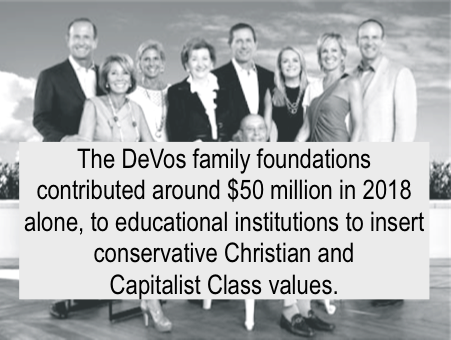
These DeVos foundation contributions to schools and colleges are strategic, both to promote conservative Christian values within faith-based schools and to influence public schools to take a more pro-capitalist position, as well as to infiltrate these institutions with conservative Christian beliefs. These two principles – conservative Christian and Capitalist Class values – are also what drives the DeVos family contributions to political candidates for local and federal offices. This is essentially the two-pronged strategy of the DeVos family, both in the political and philanthropic arenas.
White Lies Matter: Director of the Kaufman Interfaith Institute defends racist monuments
 I was contacted the other day by someone involved with GVSU concerning the Civil War monument in Allendale, Michigan.
The person who contacted me included a recent column by the Director of the Kaufman Interfaith Institute. The column by Doug Kindschi is fraught with all sorts of inaccurate information and problematic analysis,
This is not the first time that the Kaufman Interfaith Institute has taken a problematic position on critical issues of the day. In September of 2016, they co-hosted a forum on Israel/Palestine, but both speakers were really biased in favor of the State of Israel. On this issue, the Kaufman Interfaith Institute has always sided with Israel and will not take a position on Israel’s Apartheid policies.
Doug Kindschi’s column, entitled, Response and Reflection on Monuments, takes the position that all monuments are important, as they are part of the nation’s history. Kindschi provides examples of other war monuments in Grand Rapids, then shifts to monuments that have primarily been erected through a project that Peter Secchia created.
Kindschi mentions the Chief Noonday statue and says that Noonday “welcomed the early settlers to the area.” The narrative on the statue that accompanies the Noonday statue also perpetuates a Settler Colonial narrative, which we have written about on the Grand Rapids People’s History Project site.
Kindschi then goes on to mention the statue of Bishop Baraga, “an early Christian figure in the City’s history. This overly simplistic statement about Baraga fails to mention the role he played in Settler Colonialism in Michigan. Kindschi also includes in his list Arthur Vandenberg, and attributes to the former Senator that he played a role in the creation of the United Nations. It is true that Vandenberg played a role in the development of the UN, but he also was instrumental in the Marshal Plan and the creation of NATO, which were all critical aspects in the expansion of US imperialism after WWII.
The Director of the Kaufman Interfaith Institute then cites a college classmate who was appointed to the American Battle Monuments Commission by both the Clinton and Obama administrations, saying in part:
The same can be said of what has been built on our National Mall, America’s “village green.” Washington and Jefferson owned slaves. Yet, one led the nation in establishing our country as a republic and democracy; and the other authored the words “all men are created equal,” which would eventually lead to the freeing of the slaves. These men were not perfect but the underlying principles for which they stood were enduring and gave us the country we now have.
If we think we can erase American history or change social behavior by removing monuments and memorials — we are going down a dead-end. Martin Luther King kept his eye on what would help African Americans during his time and that was the Civil Rights Act. He didn’t waste a lot of time trying to tear down Confederate monuments.
And, fittingly, when a subsequent generation decided to remember King, they didn’t tear down the Jefferson Memorial. They built a memorial to King, straight across the tidal basin from Jefferson where the two could look each other in the eye, each with his own words engraved in stone about what freedom and liberty should mean for the citizens of this country.
That is the way to deal with Memorials — build new ones to show how the country can grow, change and embrace equality under the law for all of its citizens.
There are several things that are wrong with this commentary. First, the writer acknowledges that Washington and Jefferson were slave owners, but then minimizes that horror by saying they were not perfect. What we need to come to terms with is the fact that Washington and Jefferson were some of the architects of the founding policies of this county – genocide of indigenous people and the enslavement of people forcibly brought from Africa. It’s not just a question that these men own slaved, but that they founded a country based on genocide and slavery.
Second, using a portion of the legacy of Dr. King is a bullshit argument. We have to look at the totality of Dr. King’s legacy and there is nothing to suggest that Dr. King would not have supported the tearing down of monuments that celebrate White Supremacy. It is true that King and the Southern Christian Leadership Conference made it possible to get Civil Rights legislation passed, but Dr. King acknowledged himself that it wasn’t enough and that Civil Rights legislation was inadequate, since it did nothing to deal with dismantling the economic system which produced millions of poor people.
Kindschi then concludes his column by stating, “I appreciate the sentiments expressed by Kidder and certainly hope that whatever the disposition of such statues and monuments, that it be handled not by angry mob violence, but by careful consideration by the appropriate representatives from our communities.”
People who are protesting everything from racist monuments to police violence have every right to be angry, but calling those protesting a mob is nothing more than borrowing from the narrative of those in power. And who exactly are the “appropriate representatives from our communities?” Sounds a lot like respectability politics to me. Only professionals or those with degrees should have a say on the matter of monuments, which is to say people like Doug Kindschi. My advice to Mr. Kindschi is that he better get out of the way of the people involved in the current Black Lives Matter movement, who, like the late John Lewis, said:
“To those who have said, “Be patient and wait,” we must say that “patience” is a dirty and nasty word. We cannot be patient, we do not want to be free gradually. We want our freedom, and we want it now. We cannot depend on any political party, for both the Democrats and the Republicans have betrayed the basic principles of the Declaration of Independence.”
No Police in Schools: GRPD out of the GRPS Campaign begins
 Alex Vitale, in his important book, The End of Policing, states:
While the origins of school resource officers (SROs) can be traced back to the 1950s, there was a dramatic change in their number and focus in the 1990s, thanks in large part to the Justice Department’s “Cops in Schools” program, which gave out $750 million to hire 6,500 new school-based police.
Police and policing in schools, particularly in urban schools has been a major source of contention for some time, primarily because policing in urban schools has been a major component of the school to prison pipeline. Like community policing, school administrators will tell you that having cops in schools is about safety, but the reality is that it is just another form of control and punishment, particularly directed at Black and latinx students.
However, with the current national conversation about policing, there is an opportunity to do away with part of the school to prison pipeline, getting cops out of schools completely. New legislation in both the Senate and the House have been introduced to get police officers out of schools permanently. This legislation is called the Counseling Not Criminalization in Schools Act.
However, as with any legislation, local communities do not have to wait for federal legislation to be passed. The group Grand Rapids for Education Justice (GREJ) has just announced a new campaign to get cops out of the GRPS. Part of the reasoning from GREJ was the direct result of the used of public school buses to transport members of the GRPD in early June, cops who were in downtown Grand Rapids to suppress the resistance to police violence.
Another major reason for the GREJ to demand that the GRPS end any and all relationships with the GRPD, is because the GRPD was named as a partner in an upcoming program for 2020-2021 called the Academy of Public Safety Services, which will be held at the Ottawa Hills High School location. The Academy of Public Safety Services would introduce students to policing as a career, where the GRPD would have direct access to students. Not much else is known about this program, as the GRPS has not provided many details on this academy.
The GREJ has initiated an Action Alert and called it the GRPD out of the GRPS. Here is the text of that Action Alert:
We are demanding that the Grand Rapids Public Schools discontinue any relationship they have with the Grand Rapids Police Department (GRPD). We know that the GRPD has officers come in to GRPS schools and that the district approved a plan to have an Academy of Public Safety Services in Ottawa Hills HS for the 2020-2021 school year, which would involve the GRPD presenting to students about careers in policing.
The GRPS should end any current relationships they have with the GRPD, along with not entering into any relationship with the GRPD in the future. We are making these demands in solidarity with the larger Black Lives Matter movement, which is also calling for a defunding of police. The GRPD has a long history of violence against the Black community and since there are a disproportionately large number of Black students in the GRPS system, we believe that demanding an end to any relationship with the GRPD is what solidarity looks like. GRPD Out of the GRPS! Black Lives Matter!
To add your name to this campaign to get and keep the GRPD out of the Grand Rapids Public Schools, go to this link https://actionnetwork.org/letters/grpd-out-of-grand-rapids-public-schools?source=direct_link&, then share the link on social media and help get the word out.

