Cosecha’s direct action on Friday confronts business as usual politics and West Michigan Nice
“We do not need allies more devoted to order than to justice. I hear a lot of talk these days about our direct action talk alienating former friends. I would rather feel they are bringing to the surface latent prejudices that are already there. If our direct action programs alienate our friends … they never were really our friends.” Dr. Martin Luther King Jr.
It has been rather instructive to see all of the responses on social media after the Cosecha action at Long Road Distillers last Friday.
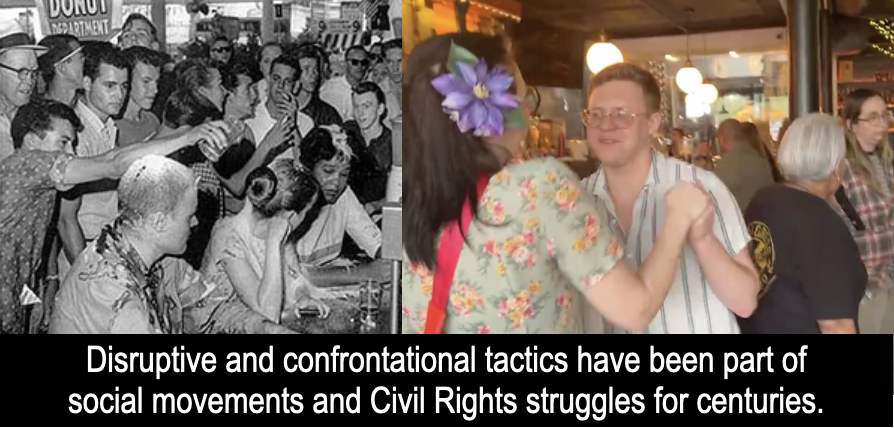
There have been reactions from conservatives, MAGA fanatics, and those who embrace a white supremacist and pro-ICE ideology. These reactions have all been predictable and expected.
The reactions I find most instructive are those that are coming from liberals and so-called progressives. These responses have been littered with phrases like “this is not the way to protest”, “going into the business to disrupt was disrespectable” or “if you want to protest, do it outside.”
Engaging in disruptive tactics has long been part of social movements. Here are just a few examples:
- Black people who were enslaved didn’t protest, they would burn the plantation owner’s home, sometimes kill the white people in charge of those who were enslaved or simply fled the plantation in an act of self-liberation. Those who freed themselves didn’t go to the local city council to plead their case, nor did they seek help from the sheriff. In fact, the local laws and the local sheriff supported slavery and even sent men to catch those who had freed themselves.
- Workers have used the tactic of occupying the business they worked at to demand better wages, working conditions or the right to form a union affecting the ability of the business to make money. The 1936-37 Flint Wildcat Strike is a great example, which taught other workers to use the same tactic, even here in Grand Rapids.
- During the Civil Rights Movement people would disrupt businesses through boycotts (like the Montgomery Bus boycott) or by disrupting businesses by engaging in lunch counter sit-ins to protest segregation.
- Anti-War movements have also engaged in boycotts or occupied businesses that were profiting from war.
- The South African Anti-Apartheid movement also disrupted businesses that were profiting off of the apartheid system in South African. Those involved also boycotting business and disrupting businesses as I have documented locally.
- Environmental Justice movements have also occupied businesses and disrupted their ability to make a profit, like in the case of groups like GreenPeace, the Sunrise Movement, Extinction Rebellion and Rainforest Action Network.
Therefore, the Cosecha action Friday at Long Road Distillers is using a tactic that movements all around the world have used for the past 2 centuries.
However, there are plenty of people who would not be convinced by the fact that disruption is a standard tactic for social change. Some people might argue that the Cosecha action disrupted the patrons who were at Long Road Distillers. However, what we know is that not one customer left during the action, and many of the patrons took flyers from people taking part in the action. People didn’t leave until the own showed up and started yelling at people and tell them to get the fuck out.
Other people might say that the Cosecha action only alienated people from their cause. Again, there was no evidence that this was the case for the people who were present during the action. The white supremacists and pro-ICE people on social media were never going to be an ally to this movement, plus there were plenty of people who either wrote favorable comments or hit the like button in support.
What Movimiento Cosecha actions often do are to polarize people, which is to get them to think about an issue and then choose a side. With polarization you can get people to think about something that they have not really thought much about before. In addition, you often can get people to not only agree with you, but get them to decide to be involved in the movement. If they are already involved in the movement, a polarizing action might get then to decide to become more involved and even be willing to take risks for the movement.
This is exactly what happened with the Cosecha action at Long Road Distillers. The action used a disruptive tactic at a business that is part owned by Mayor LaGrand to potentially impact his ability to make money, especially since he has not agreed to adopt the demands from Cosecha. People were also potentially polarized during the action, along with the polarization that has happen during in person conversations and because of the information shared on social media.
Now, not everyone has to agree with Cosecha’s use of Direct Action tactics. However, just because you don’t agree with them, people shouldn’t be undermining the important work that Cosecha does. I don’t find hold signs as a terrible effective form of resistance, but I will never tell people to not do it. The same should apply with Direct Action tactics. Cosecha’s goal is to fight for immigrant justice and to abolish ICE. If you support these goals, even if you don’t agree with all of the tactics, please stop discrediting those doing this work.
I agree with Dr. Martin Luther King Jr. when he said, “If our direct action programs alienate our friends … they never were really our friends.” Hasta La Huelga!


Comments are closed.