A Primary Election Day reflection for Kent County
By the time that most of you have read this post, you will have already voted in the August 4 Primary Election. In the midst of a pandemic, I am guessing that many of you have voted absentee and sent in your voting choices weeks ago, which is fine as this post is not meant to persuade you how to vote. This post is intended to raise questions about the state of electoral politics in Kent County and its relationship to social movements and some of the critical issues our community is faced with.

We have learned a great deal about ourselves over the past few months, beginning with the reality that we are in the midst of a global pandemic. The pandemic has further exposed the vast inequities in our society and the lack of radical imagination of our elected officials. At the same time, the pandemic has caused more people to question fundamental aspects of our society, leading many to reject the idea that they want things to get back to “normal.” Going back to normal means that we still have a community that is built on White Supremacy, a massive wealth gap, structural violence, mass incarceration, gentrification, food insecurity and a health care system based on profits.
As the primary election grew closer, most of these issues I named have become even more prominent, especially since the May 30th uprising that began in Grand Rapids. White Supremacy and policing in Kent County has been put under the microscope, resulting in a great deal of organizing and resistance and White Supremacy and all of its manifestations in this area.
At the same time, people running for office, whether as incumbents or challengers, have been very silent on these critical issues, whether they are running for Congress, state seats or county commissioner. I have looked at candidate websites and Facebook pages and have rarely found public positions from candidates on the issues White Supremacy/systemic racism, mass incarceration, the current health care crisis, the massive wealth gap in Kent County, unemployment or the housing crisis and the thousands of area residents who are facing possible eviction. These are not marginal issues, but they are the issues that thousands of families in Kent County are facing every day.
One would think that candidates for political office would be sensitive to this reality, yet I have found very little public information about where candidates stand on these critical issues. Most of those running for office have been silent on the issues I have identified above.
At the same time there has been a great deal of social media endorsing numerous candidates running for office in this community. People have used all sorts of platitudes to describe these candidates and their commitment to this community, yet I can help but wonder what they hell this really means. Virtually all the candidates that are on the Primary ballot or will be on the November ballot, do NOT have a position on issues like White Supremacy, policing, mass incarceration, immigration justice, eviction, unemployment or the massive wealth gap in Kent County. Some might say that these are not issues that elected officials would be dealing with or would have little influence on. Such a response in my experience has taught me that this is bullshit.
For example, two years ago, most people in Kent County were completely unaware of the fact that the Kent County Sheriff’s Department had a contract with Immigration and Customs Enforcement (ICE), a contract that County Officials voted on. When Movimiento Cosecha GR and GR Rapid Response to ICE had 200 people show up to a Kent County Commission meeting to demand an end to the ICE contract, they were met with contempt and a whole range of excuses.
All of the Republican members of the Kent County Commission left the meeting and said that those protesting were disrespectful. Democrats on the County Commission, most of which stayed, did nothing to assist the campaign to End the Contract. In fact, Democrats on the commission either remained silent on the matter, engaged in gaslighting of immigrant organizers or offered the excuse that they had no power to End the Contract with ICE.
Those involved in demanding the end to the ICE contract were not deterred and continued to press their demands, with disruptions at more Kent County Commission meetings, protesting at the Commission Chair’s home, doing lots of education of the issue, holding marches, creating online petitions and actions at the Kent County Jail. In fact, after a little more than a year of direct action to End the ICE Contract, ICE officials decided to terminate the contract they had with Kent County in late August of 2019. What this all means is that elected county officials did nothing to end the contract with ICE. What ended the contract with ICE, was direct action and the involvement of thousands of people demanding immigrant justice.
Elected officials can claim that they have no power to affect change, but that does not absolve them from taking a public stance in support of social movements that are demanding structural changes.
So, regardless of who you voted for in the primary election, ask yourself this……..Will these candidates really do anything to further the vision of Black Lives Matter? Will these candidates make it so that thousands of families who are facing eviction in Kent County lift a finger to stop the evictions? Will these candidates publicly support Medicare for All? Will these candidates endorse and fight for the demand from Movimiento Cosecha GR to win Driver’s Licenses for All in Michigan? Will these candidates in Kent County call for a Defunding of the GRPD? Will these candidates fight to end the massive wealth gap in this community? The answer to these questions are right in front of us.
When will we stop centering cop voices: Confronting the White Liberal view of Policing
 We are a little more than 2 months removed from the May 30th uprising in Grand Rapids, where thousands of people descended on the downtown area to protest against the police murder of George Floyd.
During the past two months there have been ongoing protests, marches and vigils in support of the Black Lives Matter movement. There has also been a significant campaign, involving numerous groups, to Defund the GRPD. None of this pressure seems to be going away anytime soon and institutions are feeling tremendous pressure to deal with institutional racism and White Supremacy.
Amidst all of this, the GRPD and the Grand Rapids Police Officer’s Association (cop union) has pushed back against any significant calls for reform, accountability and for departmental defunding. So why provide the police in the Greater Grand Rapids area a forum to continue to push back against community demands? Why do groups always feel the need to center the voices of law enforcement?
This is exactly what a group that supposedly works on police/community relations is doing on Monday night, as they host a forum that will center cop voices. The group known as ALPACT – Advocates and Leaders for Police and Community Trust – is hosting an online event on Monday, from 6:00 – 7:30pm, where six law enforcement agency heads will be provided yet another opportunity to present their take on the current political climate. The forum is entitled “Behind every mask their is a story,” which is a very misleading title, since this forum will not be centering public voices, but the voices of those who are attempting to suppress any and all public resistance to police violence, particularly police violence against the Black community.
The panel will be moderated by someone with ALPACT and the GVSU Police. The panel includes six law enforcement agencies leaders, including GRPD Chief Payne, someone from the Michigan State Police, the Kentwood Police Department, the Kent County Sheriff, the Wyoming Police Department and the Grandville Police Department.
Now, this is a 90-minute forum that will feature six cops who get to “share their stories.” Why? Why is this moment, with everything that has been taking place around the country and in Grand Rapids, why provide yet another forum for cops to tell us what to think?
According to the ALPACT Facebook page, it says this about the group:
GGR ALPACT examines issues affecting police and community relations and ensure equitable enforcement of laws to build trust.
This description of the organization is essentially the White liberal view of the relationship between the police and the public. In this version, we are to believe that the police exist to protect and serve the public, that they are a force for good, even if at times they make mistakes or we find out that there are a few bad apples in police departments.
This view of the police is part of the problem. First, it completely ignores the history of policing in the United States and the reasons why police departments were created. According to the book, Our Enemies in Blue: Police and Power in America, by Kristian Williams, policing in the US was always about power. In the South, policing began as a function of “slaves patrols,” where armed men were tasked with hunting down and capturing those who were enslaved, and bringing them back to whichever plantation they escaped from. In the North, policing was created at the same time that political machines were developing and the police departments acts as tools for those political machines. Overtime, police departments have been used to manage populations and to suppress dissent.
Second, the White Liberal view of policing is problematic because it ignores the fact that police departments are designed as a system of oppression. As Alex Vitale, author of the book, The End of Policing, states in the chapter entitled, The Police Are Not Here to Protect You:
The problem is not police training, police diversity, or police methods. The problem is the dramatic and unprecedented expansion and intensity of policing in the last forty years, a fundamental shift in the role of police in society. The problem is policing itself.
Well-trained police following proper procedure are still going to be arresting people for mostly low-level offenses, and the burden will continue to fall primarily on communities of color because that is how the system is designed to operate – not because of the biases or misunderstandings of officers.
A Third reason why the White Liberal view of policing is problematic is that it wants to believe that if we just sit down and talk to cops we will have a better understanding of how they do their jobs and we will be able to assist them in preventing crime. While this may be true on a superficial level, where community members provide information to cops to prevent petty crimes, it fails to understand the power dynamics that exist. Policing is about protecting systems of power, which are also primarily systems of oppression. For example, if a Property Management Company, which charges outrageous rental fees, is confronted by a tenant or a tenant union, who do you think the police will protect? Institutions can exploit and oppress people all they want and when people engage in organized resistance, the police are always there to protect those with power and those who are exploiting and oppressing people.
Think about the deliberate harm that Wolverine Worldwide has caused to thousands of people and their health. If you were to deliberate poison or attempt to poison someone and the police were around, you would be arrested and maybe even beaten in the process for doing so. However, a corporation can poison thousands of people and the police will not be arresting them or beating them in the process. Sure, corporations like Wolverine might have to pay fines, but these are legal inconveniences that are nothing like what Black communities face on a daily basis.
Lastly, the White Liberal view of policing in this community is problematic, because it says that trusting the police is more important that solving systemic problems. Doing the work of trying to get the public to trust the police is a false solution, not only because it ignores the real function of policing, it also demonstrates that the White Liberal view of policing is about the normalization of the oppression of Black people.
For those who are fighting against police violence, those wanting to Defund the Police and those who embrace an abolitionist view of policing, we have to come to terms with the fact that the White Liberal view of policing is the dominant perspective on policing. Therefore, resisting police oppression will inevitable lead to resisting White Liberalism.
To join to zoom call for the ALPACT forum go to https://us02web.zoom.us/…/tZctcuysqDsjG9Cdv_b0BXVLyJLQjc0GY.
Front running GOP candidates for Congress are both backed by members of the Grand Rapids Power Structure
 Based upon the most recent data from the Center for Political Responsibility, there two leading GOP candidates running for the seat that is being vacated by Justin Amash and both of these candidates are being financed by families and companies that are part of the Grand Rapids Power Structure.
Peter Meijer and Lynn Afendoulis are the two leading COP candidates for the 3rd Congressional seat that is up for grabs and on the August 4th Primary Election ballot.
The DeVos family is the main backer of Peter Meijer, both with individual family members contributions, plus RDV Corporation and the Amway Corporation. Other members of the Grand Rapids Power Structure that have contributed to Meijer are the Meijer Corporation, the Secchia family’s company Sibsco LLC, Bissell, Gordon Foods and the Van Andel Institute.
 Lynn Afendoulis hasn’t raised nearly as much as Peter Meijer in her bid for the 3rd Congressional seat, but she also has received campaign contributions from individuals and companies that are part of the Grand Rapids Power Structure. Among those that have contributed are Autocam (John Kennedy), UFP Industries (Peter Secchia), National Association of Realtors, Varnum Law, the Huizenga Group (J.C. Huizenga) and Wolverine Oil & Gas.
There are three other GOP candidates listed as running for the 3rd Congressional seat, but only Tom Norton has any campaign finance information as of the last filing date. Elections are not exclusively won by the amount of money that a candidate raises, but in most cases, those with the biggest war chest are often the winners.
Between Meijer and Afendoulis, whoever wins the Primary race next week, will then run against Hillary Scholten in the November election. It is likely that the wealthiest families and largest companies in West Michigan will back whoever wins between Meijer and Afendoulis. If either of those two candidates win, they will most certainly be beholden to the corporations and and families that make up the Grand Rapids Power Structure. The next time you thin that the philanthropy of DeVos, Meijer, Secchia, Kennedy and Huizenga families are benign, remember that they finance candidates who adopt policies that do tremendous harm to Black and latinx communities, working class people, immigrants and other socially marginalized communities.
Grand Rapids is using bureaucratic management to further marginalize the Defund the GRPD campaign
 Last week, the City of Grand Rapids made the announcement that the GRPD will be presenting to the City Commission on August 11th, regarding their new strategic plan.
The local news media has reported a great deal on what Chief Payne thinks about police budget cuts, along with what City Manager Mark Washington has to say on the matter. In the City’s announcement from last week, Washington provided his talking points about the police budget and why he opposes Defunding the GRPD. Here are those talking points from Washington:
- The City’s FY2021 approved budget was $22 million less than FY2020 due to the economic impacts of COVID-19.
- The general fund portion of the police department’s budget was reduced by $1.1 million – the largest department budget reduction. This resulted in a decreased FY2021 general fund police budget compared to FY2020.
- The $1.1 million reduction made during the budget process and the additional $403,000 cut made earlier this month total $1.53 million and equates to 63% of the department’s overtime budget, or roughly 15 officers.
- This adjustment, along with the fact the 327-person police department staff is lower than the millennium high of 369, is an indication of staffing divestment despite the city’s population growth.
- Since personnel accounts for more than 80% of the police department’s budget, further reductions likely would result in layoffs. Personnel changes must be carefully determined.
- The end is not known for the economic recession as a result of COVID-19 or the pandemic itself. It is not wise to make drastic changes without a clear picture of expected revenue and expenditures.
The first point is pretty meaningless, since it just states the obvious. Of course COVID-19 has impacted City revenues, just like thousands of residents of Grand Rapids have been affected by the pandemic and continue to be affected.
Points 2 and 3 are basically saying the same thing and even though the amount of money to the GRPD has been reduced, it has nothing to do with Defunding the GRPD. Defunding the GRPD, not only is calling for a reduction of the police department’s budget, but that the money that would have gone to the police, be re-directed to the Black community in ways that they determine.
Point 4 from the City Manager is misleading, since the number of police should not be tied to the population of the city, but to the issue of how the police are responding to crime. Also, based on an independent investigation conducted last year, the GRPD spend most of their time responding to minor community conflicts. The study done by Hillard Heintze LLC, determined that 70% of calls to the GRPD are non-emergency. In addition, one of the recommendations from the study was that the police did not need to hire more officers and in fact, they could have non-police personnel respond to most of the non-emergency calls.
Point 5 is legitimate, since there would be a reduction in police personnel if the City were to take seriously the community calls for Defunding the GRPD. Layoffs happen all the time and the City Manager should know that literally thousands of Grand Rapidians have lost a job in recent months due to the COVID-19 crisis.
The last point from City Manager Washington not only brings us back to the COVID-19 induced economic crisis, but it misses the point about reducing the GRPD’s budget, especially if thousands of community members are calling for Defunding the GRPD.
Besides our responses to the City Manager’s talking points, there are other issues at play around the GRPD’s budget and larger issues around community safety and accountability.
First, as we have noted in a recent article, the GRPD and City officials have been attempting to radically alter the narrative around police violence and the demands from the community. However, the Defund the GRPD movement is not buying into the attempts of the GRPD and City officials to control the narrative about what has happened in the city since the May 30th protest. Protests and other forms of resistance are continuing in Grand Rapids, forms of resistance that have their own narratives.
Second, the GRPD has recently been attempting to justify their opposition to Defunding, based on recent gun homicides. However, the GRPD has not demonstrated that they would have been able to do anything to prevent these homicides. In addition, the ongoing calls from the GRPD to add more cops because of increased crime is a misleading narrative. Grand Rapids has not seen a rise in crime statistically for several years. The last time the City of Grand Rapids deceived the public around crime, they passed a ballot initiative in 1995, which solidified into the City Charter that the GRPD would receive at least a third of the City’s budget.
Lastly, it is important to note that what the City Manager, Chief Payne and other City officials are doing, is engaging in bureaucratic management. Those with power in local government are planning on 1) dragging these issues out with the hope that people will forget or get distracted with something else; 2) that they know what is best for us, so they get to make the decisions, regardless of what the public has been saying; and 3) the City is banking on the fact that all the so-called reforms they plan to adopt around policing, will be enough to pacify people into accepting their plan. If there is ongoing resistance to the police reforms, the City will simply referred to any ongoing call for Defunding the GRPD as an extreme position that is being promoted by people who the City will attempt to further marginalize.
The attempted marginalization of the Defund the GRPD campaign is the very definition of domestic counterinsurgency, which is most often a form of psychological and ideological warfare.
GRPS plans to start the school year with distance learning, but lots of questions remain about how this will all work
With the Trump administration, primarily through Secretary of Education Betsy DeVos, pushing for schools to open for the upcoming school year, the Grand Rapids Public Schools announced it will begin the 2020-2021 school year. However, the district announced that it would begin the school year online, at least for the first marking period, which goes until October 21st, based on the statement they released.
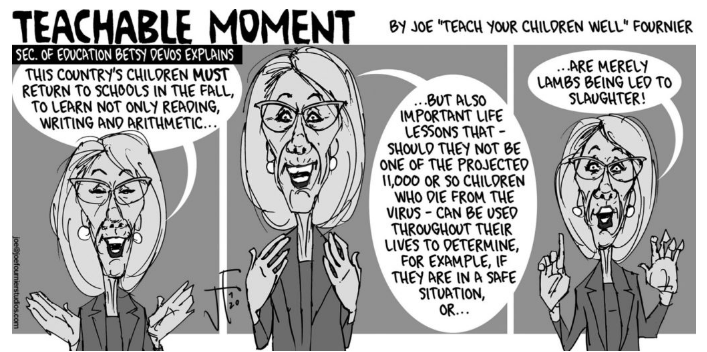
While it is encouraging that the GRPS will not be putting the health and safety of students and teachers at risk for the beginning of the school year, such an announcement raises all kinds of questions. The GRPS did host a Q&A for news media on Monday as well, which you can view at this link, but that virtual Press Conference still left numerous questions unanswered.
Some of the larger questions are:
- How will parents and students who a subjected to poverty navigate the additional demands of children being home while they go to work. Lots of low wages jobs require employees to work on site and not from home? This includes childcare costs, healthy food for students, etc. Billionaires are profiting from the pandemic, while politicians provide grossly inadequate relief to families.
- We know that the schools in the district that are underperforming, utilize non-union, substitute teachers. Will this continue and how will it impact the quality of education that students are receiving?
- What criteria will the district use to determine if and when students and teachers can return to the classroom, especially since there still is no cure for COVID-19 and grossly inadequate testing available?
- Since the district will begin with distance learning, will access be free to homes with students and will there be adequate language support for students who are not fluent in English?
- What kinds of support systems will there be for teachers, who will now be tasked with online education, and what will the classroom sizes be?
- Will teacher unions demonstrate their collective power during this crisis or will they go along to get along. Eric Blanc, author of Red State Revolt: The Teachers’ Strike Wave and Working-Class Politics, has an excellent article about what teachers and teacher union could do in response to schools re-opening.
- The GRPS has stated that the will use Seesaw and Schoology as the two online educational platforms. Both of these entities are private corporations, which means they are driven by profits. Will the GRPS actively engage in the educational content used with both of these platforms? Will teachers have any say in online content? Will the district invest in creating (with teachers) their own online content for the future.
These are just some of the important questions we should all be asking ourselves as the school year approaches, but we know that there are many, many more. With the push to “re-open the economy,” we have seen spikes in COVID-19 cases and deaths. Do we run the same risks when pushing students, parents and teachers with the re-opening of schools. How many and whose lives are expendable in the current crisis?
Important questions can be asked at the virtual town hall meeting on August 5 from 5:30 p.m. to 7:00 p.m, hosted by the GRPS.
Grand Rapids Police Officers Association endorses the most far right candidate running for the 3rd Congressional District
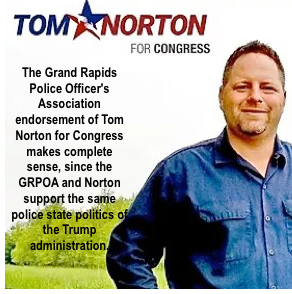 Late last night, the Grand Rapids Police Officers Association, the union that represents those who work for the GRPD, posted an endorsement for the far-right Congressional candidate Tom Norton.
The brief post on the GRPOA Facebook page states:
The GRPOA proudly endorses Tom Norton and his bid to represent the people of Michigan in Washington. Tom is one of the most down to earth guys you will ever meet. He will be a true representative for the people and will never forget the real reason he is in Washington. Join us in casting a vote for Tom.
This should come as no surprise to people who follow the GRPOA, since Norton has been a staunch defender and apologist for cops across the US, especially since the police lynching of George Floyd. Norton also co-hosted a rally in support of the GRPD in late June, which we also reported on.
There is no evidence, based on the current data at the Michigan Secretary of State’s Campaign Finance page, that the GRPOA contributed to Norton’s campaign, but those filings only include what has been contributed up until mid-July of 2020.
However, the more important point is that the Grand Rapids Police Officer’s Association has endorsed a candidate that is the most pro-Trump of all the GOP candidates running for the 3rd Congressional District. Norton’s website doesn’t present a great deal of information on his political stances, but his Facebook page makes it clear where Norton stands on many issues. Norton is pro-police and he supports ICE and their terror tactics against immigrants. Norton is anti-Choice, homophobic and anti-Trans. Many of Norton’s videos demonize antifa, while supporting the “patriots” who have protested against Gov. Whitmer during the COVID-19 crisis.
We know that the GRPOA has been against the immigrant justice movement in Grand Rapids and has openly called for the arrest of members of Movimiento Cosecha GR, plus they have publicly defended the actions of Captain VanderKooi, who contact ICE in the Jilmar Ramos-Gomez case. The GRPOA has demonstrated their commitment to reactionary politics and their support for defending the status quo. Therefore, the police union’s endorsement of Tom Norton for Congress makes complete sense, since the GRPOA and Norton support the same police state politics of the Trump administration.
 On Thursday, the Police Officers Association of Michigan (POAM) released a statement about why they are endorsing Donald Trump for re-election. The statement reads:
The men and women of the Police Officers Association of Michigan are proud to endorse the re-election of Donald J. Trump as President of the United States. Unlike most elections, where political opponents share many opinions and goals, this presidential election presents two very different candidates.
President Trump restored the sharing of surplus military equipment and tools to our members. This has saved lives. His opponent currently, and while vice president, opposed this. President Trump has announced that he would veto HB7120 which would limit qualified immunity for police officers. His opponent supports this bill. President Trump opposes any form of “defunding” or “re-imaging” police. His opponent has made this his goal. President Trump considers the United States an “exceptional country” while his opponent promises to “transform” the country.
President Trump never fails to recognize our homeland’s security personnel at home and abroad. He supports the police while the previous administration preferred to insult them or to find them guilty without due process. Our officers are under attack and are being told to “stand down.” At a time when civic leaders are choosing to tolerate televised felonies because a group of people is “offended,” we need real leadership. The Police Officers Association of Michigan and its members support the re-election of President Trump.
The endorsement of Trump from the POAM is instructive, since it acknowledges some major issues that is receiving significant public attention, such as:
- Surplus Military equipment that local police department use
- Qualified Immunity for police
- Defunding police departments
In addition, with the endorsement of Trump, the POAM shows their contempt for people who are protesting and dismantling symbols of White Supremacy, like statues. The POAM endorsement takes issue with this by say, “ At a time when civic leaders are choosing to tolerate televised felonies because a group of people is “offended,” we need real leadership.” Lets be clear that what the Police Officers Association of Michigan says people in this statement, they mean Black people and when they say “offended,” we should take that as nothing more than their contempt towards Black people who take issue with statues that honor White Supremacists or police behavior that is rooted in White Supremacy.
This endorsement by the POAM should make it clear that not only are police unions reactionary, they take offense at being scrutinized by the public. This endorsement should also signal to the public that police unions are far right entities and should be treated as such.
We have written about the response from the Grand Rapids Police Officers Association on the issue of defunding the police and this endorsement letter demonstrates that larger unions across the state also object to calls for defunding or simply greater accountability.
The Police Officers Association of Michigan has dozens of police departments across the state included in their association. The GRPD is independent, but there are several West Michigan police agencies that are listed as part of the POAM, such as the East Grand Rapids Public Safety Officers Association, Grand Valley State University Command Officers Association, Grand Valley State University Public Safety Officers Association, Ionia City Public Safety Officers Association, Ionia County Command Officers Association, Ionia County Command Officers Association (Non-312), Ionia County Corrections Officers Association, Ionia County Deputy Sheriffs Association, Kent County Courts Union Association, Kent County Law Enforcement Officers Association, Walker Command Officers Association, Walker Police Officers Association and the Zeeland Police Officers Association.
This list of West Michigan police departments, which are members of the POAM, also endorse the re-election of Donald Trump, which means they not only oppose defunding, the oppose any real kind of community accountability and they endorse the recent decision by the Trump administration to use federal officers to arrests people who are part of the larger Black Lives Matter movement that has erupted since the police lynching of George Floyd in late May.
Lastly, it should be noted that the Police Officers Association of Michigan also contributes to Michigan candidates, which is documented in a recent article by the Michigan Campaign Finance Network.
Betsy DeVos sends an additional $85 million of public money to private schools in the nation’s capital
 There has been a fair amount of pushback from educators and parents across the country, with the increase of funds being allocated from the Department of Education. At the behest of Secretary of Education Betsy DeVos, millions of taxpayer money has been allocated to private schools.
Several states, including Michigan, have filed lawsuits against the Department of Education for using public money for private education. The NAACP also announced recently that they too would be filing a lawsuit against the Secretary of Education, citing this reason:
“In a moment of crisis — when public school districts are called upon to educate their students in unprecedented circumstances, to protect their students and staff from disease, and to feed families who have been plunged into poverty, all with decimated state and local revenues — it is unconscionable for Defendants to siphon away the CARES Act’s desperately needed funds for the benefit of more affluent private-school students.”
At about the exact same time that the NAACP had filed their lawsuit, it was announced by the Secretary of Education, that an additional $85 million in public money would be going to private schools in Washington, DC. This announcement came on July 22nd, with the headline, Trump Administration Announces $85 Million to Support Disadvantaged Students in Nation’s Capital Attending K-12 Private Schools of Their Choice.
What is even more interesting is that Betsy DeVos’s office announced that the $85 million would not be going directly to private schools, but would be managed by an organization called Serving Our Children. This particular, where the federal government provides public money to private schools in DC, began in 2004 from legislation that was crafted by the Heritage Foundation, plus it was the first time that federal funds were allocated to private schools.
Just two years before this program was instituted in Washington, DC, the husband of Betsy DeVos, Dick DeVos, gave a speech at the Heritage Foundation. In that speech DeVos lays out a strategy for attacking and undermining public education. Here is a video clip of that speech:
This program in DC is called the D.C. Opportunity Scholarship Program (DCOSP), but it is essentially a school voucher program, where public money goes to private schools, which is exactly what Dick and Betsy DeVos had been attempting to implement in Michigan, with an unsuccessful ballot initiative in 2000.
There have been numerous entities that have evaluated the D.C. Opportunity Scholarship Program and most of those evaluations are not favorable. According to an article at the Center for American Progress:
In the spring of 2017, the Institute of Education Sciences (IES), the independent research arm of the Education Department, published a study that found that D.C. students who used a voucher scored 0.12 standard deviations lower in math than students who were not offered a voucher and remained in a public school.35 The evaluation assessed the outcomes of students from the 2012, 2013, and 2014 lotteries. This 0.12 score drop is the equivalent of an average student in the 50th percentile dropping to the 45th percentile after participating in the D.C. voucher program for one year.36 According to the IES study, participating in the D.C. voucher program had no statistically significant effect on reading achievement.37
It is deeply troubling that the Trump administration, through the efforts of Betsy DeVos, have been pushing for an increase in public funding for private education. Many of these private schools are also faith-based, which calls into question the so-called separation between Church & State. What is equally problematic about this trend is that there is not enough opposition from teacher unions or other groups, which should be making this fight for public education a priority.
Most Democrats, including Michigan Senator’s Peters and Stabenow, voted against a reduction in US military spending
“A nation that continues year after year to spend more money on military defense than on programs of social uplift is approaching spiritual death.” Dr. Martin Luther King Jr.
Earlier this week, 139 Democrats in the House voted against an amendment to the US Military Budget, which would have reduced military spending by 10%. Then on Wednesday, the majority of Senate Democrats also voted against the amendment that was introduced by Bernie Sanders.
The amendment would have reduced the US military budget by a mere 10% and redirect that money into jobs, education, health care, and housing in communities in the United States in which the poverty rate is not less than 25 percent.
The Senate vote was 77 against the amendment and 23 in favor. Both Michigan Senators Debbie Stabenow and Gary Peters voted against the amendment, which would have redirected $74 Billion to meet critical needs of the most impoverished communities across the US.
In a recent report by the National Priorities Project, which examines the 2020 US Military Budget, shows a continued increase in US military spending, in the midst of the COVID-19 crisis and widening wealth gap in the US. The study also shows that the US military budget is so large that it is more than the next 10 largest military budgets combined, as can be seen in this graphic.

Therefore, the question should be asked, why are the Democrats voting for an increase in US military spending and against an amendment that would reduced military spending and direct that money to support the poorest communities? Despite public perceptions, the Democratic Party has been equally committed to US imperialism abroad and to the Military Industrial Complex. The Center for Responsive Politics provides data that shows that the US Defense Industry contributes a substantial amount of money to the Democratic Party, only slightly less than to their Republican counterparts.
Then there is the issue of how military weaponry is manufactured, with private weapons companies in virtually every Congressional District across the country, thus making it difficult for most candidates to go against reduced military spending, so as not to alienate the private defense sector.
As for Senators Stabenow and Peters, we have reported (in 2018 and 2019) on their motivations for ongoing support for US military spending.
Voting for increased US military spending and against proposals to reduce such spending signifies that the Democratic Party is not progressive on one of the most important issues of our time, even if the majority of those who identify as Democrats would support a reduction in US military spending.
What is problematic about the recent announcement from Grand Rapids to have mental health workers collaborate with the GRPD?
 On July 20th, the City of Grand Rapids, specifically the City Manager, made an announcement of it’s, “intent to expand mental health partnerships as part of the City’s ongoing efforts to improve public safety outcomes.”
The local news media reported on this announcement, but essentially just re-posted the City’s Media Release, without bothering to ask important questions about what this announcement means.
There was lots of buzz on social media and several non-profits have chimed in on the announcement, singing the City’s praises. Again, no real engagement and no hard questions being asked about what this will all mean.
It is important that we acknowledge that this announcement comes in the midst of a major community push to Defund the GRPD, with Commissioner Lenear stating during the July 21st City Commission meeting that nearly 6,000 community members have engaged the city on the matter of Defunding the GRPD. One could see this as a public relations move or by some as a positive outcome because of all of the public pressure.
City Manager Mark Washington acknowledges in the announcement that the traditional response – sending cops – is not the most effective. Not only is what Washington said an understatement, it ignores the fact that communities have been calling for a social services response model for decades.
So, what is problematic about this recent announcement from the City? First, and this is more of a procedural issue, but why does Chief Payne get to decide whether or not, “an expanded co-response model with a mental health or behavioral health professional could work.” The police are tasked with enforcement, but should not be creating policy or deciding whether or not to implement policy.
Second, the City’s announcement lists a number of types of calls where a mental health professional could be applicable; Disorderly intoxication, Drug overdose, Intoxicated person, Mental health crisis, Suicide crisis, Mental health transport, Disorderly youth/juvenile, Panhandling and Neighborhood dispute. One could argue that most of these types of calls could be handled exclusively by social service or mental health professionals. In fact, in a 2019 study done by Hillard Heintze LLC, as reported by MLive, determined that:
“Across the GRPD, officers are not tasked in alignment with a strategic vision, which results in inefficient use as officers are tasked based on demand inflows, rather than a guided strategic vision that outlines how and when resources are allocated,” the study reads.
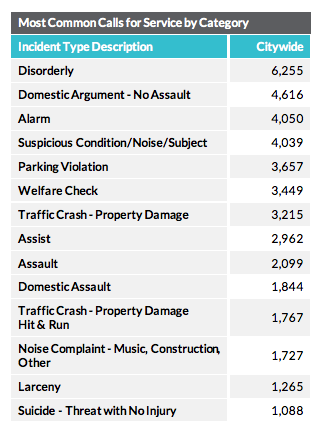 The study done by Hillard Heintze LLC, also determined that 70% of calls to the GRPD are non-emergency calls. You can see here on the right, the breakdown of types of calls that the GRPD responds to. With 70% being non-emergency, wouldn’t it follow that conflicts or complaints could be dealt with, without the need of police officers.
Third, according to Alex Vitale (author of the book, The End of Policing) hundreds of people with mental illness are killed by cops on an annual basis. Police do not have the capacity to make a mental health diagnosis and statistically, when police respond to concerns about someone with mental health issues, too often it results in the person being arrested. According to the National Alliance on Mental Illness (NAMI), 2 million people with mental health issues are jailed every year and that the number two cause of death in jails and prisons is suicide. NAMI estimates that 83% of those incarcerated with mental health issues don’t have access to the treatments they need. Vitale believes that what is happening with police responding to these types of calls, is the criminalization of mental illness. Having police present with mental health professionals only escalates potential harm.
Fourth, having cops present with or partnering with mental health professional ultimately lends greater legitimacy to police departments and their bloated budgets. If the public was encouraged to call 311 instead of 911, police involvement would be reduced and the public would see that most conflicts can be resolved through non-violent means, whether that means that friends, neighbors or community professionals take initiative to provide the support that people need in a crisis or when there is a conflict. This is the exact kind of outcome that the Grand Rapids-based group Together We Are Safe has been advocating for over a year now, by distributing a document entitled, Before Calling the Police, Ask Yourself.
Lastly, if there was more equity in our community, where people had sufficient income, affordable housing, good health care and the ability to enjoy life, then there would be less of a justification for the GRPD. Grand Rapids City officials are always talking about equity, yet thousands of people in this city are suffering from poverty, systemic racism, high rent costs, lack of adequate health care and tremendous stress and pressure to make ends meet.
Having the GRPD partner with mental health professionals is a false solution. Working towards greater equity and dismantling structural violence would not only reduce the need for cops, it would drastically improve the quality of life for people in this community. However, despite the rhetoric, Grand Rapids City officials do little to dismantle structural violence. The City’s resistance to community calls to reduce the funding of the GRPD sends a strong message to residents that the City is committed to maintaining a system of power and inequality.

