Over the next few weeks, we will be posting information and links to candidate websites and/or social media pages so that people can see what their policy positions are and what they say they will do if elected.
So far we have looked at the candidates and their policy platform information for the 3rd Congressional race and the State Senate races. Today, we will look at the State Representative races.
We do this in part, since we cannot rely on the dominant commercial news media to provide this information or any robust analysis of the policy platforms of those running for office.
In late July we will also be posting information on campaign financing for these same candidates, so that people have as much information as possible about candidates before the August Primary and the November 2022 Election.
Now, personally I identify politically as an anarchist, so I don’t put much stock in representative democracy or the electoral process. However, I do think it is important for people to think critically about the political/electoral process that currently exists.
In today’s post, we look at State Representative races in the West Michigan area. As a State Representative, these candidates will be voting on a wide range of critical issues, such as, funding for the prison industrial complex, the public education budget, environmental justice issues – like Line 5, affordable housing, supporting a living wage, rent control, housing evictions, police funding, subsidies for corporations, water quality, water diversion rights, immigration issues like Driver’s Licenses for All, nuclear power, renewable energy sources, mass transit, tax policies, adoption, child care, racial discrimination, regulating the real estate industry, diverting public money towards private education, labor union support, cooperation with Immigration and Customs Enforcement, regulation of pesticide use, mining issues, climate change policies, gun control, gentrification and structural racism.
As an anarchist, I believe that my aspirations and the desire to work towards Collective Liberation is rarely reflected in the electoral/representative democracy process. Where are the candidates who are publicly anti-capitalist and anti-racist? Where are the candidates that oppose the homophobic and transphobic policies and practices in this country and in this community? Where are the candidates that are anti-colonialist, who believe that Indigenous sovereignty and land should be a priority? Where are the candidates that are committed to reparations for Black people? Where are the candidates who believe that housing, income, education and health care are fundamental rights? Where are the candidates who are committed to resisting the current climate crisis and oppose things like the Enbridge Line 3 and Line 5? Where are the candidates that want to deal with root causes of problems, instead false solutions perpetuated by charitable groups and the Non-Profit Industrial Complex? Where are the candidates that not only support labor unions but actively work to support workers to create workplace democracy? Where are the candidates who support reproductive justice? We all deserve a better world and we need to support politics the dismantles systems of power and oppression.
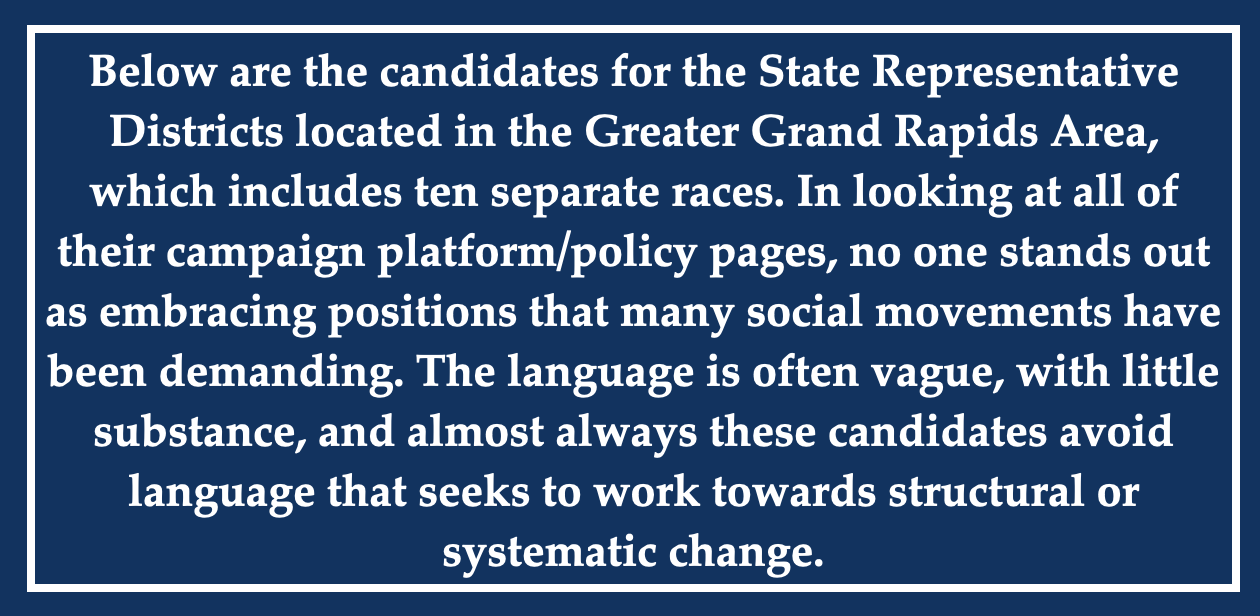
Below are the candidates for the State Representative Districts located in the Greater Grand Rapids Area, which includes ten separate races. In looking at all of their campaign platform/policy pages, no one stands out as embracing positions that many social movements have been demanding. The language is often vague, with little substance, and almost always these candidates avoid language that seeks to work towards structural or systematic change.
State Representative 78th District
Leah Groves D
No online platform
Christine Barnes R
https://www.barnesforstate.com/
https://www.facebook.com/TheRealChristineBarnes
Ben Geiger R
Gina Johnsen R
https://www.facebook.com/Gina4StateRep
https://www.youtube.com/c/TheGistofItWithGina
State Representative 79th District
Kimberly Y. Kennedy-Barrington D
https://www.drkim4statehouse.com/
https://www.facebook.com/drkim4statehouse
Ryan Gallogly R
https://www.ryangallogly.com/issues
https://www.facebook.com/RyanGalloglyForStateRepresentative/
Jeremiah Keeler R
https://votekeeler.com/issues.html
https://www.facebook.com/keelerforstaterep
Angela Rigas R
https://www.facebook.com/AngelaRigas4MI
State Representative 80th District
Lily Cheng-Schulting D
https://www.lilyformichigan.com/platform
https://www.facebook.com/lilyformichigan
Phil Skaggs D
https://www.facebook.com/philskaggs
Jeffrey Johnson R
State Representative 81st District
Rachel Hood D
https://www.hoodforthehouse.com/values
https://www.facebook.com/hoodforthehouse
Lynn Afendoulis R
https://www.lynnafendoulis.com/
https://www.facebook.com/LynnAfendoulisForMichigan/
State Representative 82nd District
Salim Mohammed Al-Shatel D
https://www.salimal-shatel.com/
https://www.facebook.com/salim.alshatel
Kristian Grant D
https://electkristiangrant.com/
https://www.facebook.com/KristianGrantforStateRep
Robert Womack D
https://www.facebook.com/robertswomack
William Alexander R
https://www.alexander2022.com/
https://www.facebook.com/MichiganCongress
Ryan Malinoski R
https://www.malinoskiformichigan.com/
State Representative 83rd District
John Fitzgerald D
https://www.facebook.com/JohnForMI
Jose Flores D
https://joseflores4staterep.com/
https://www.facebook.com/jose4staterep
Lisa DeKryger R
https://www.lisadekryger4michigan.com/
https://www.facebook.com/LisaDekryger4Michigan
State Representative 84th District
Carol Glanville D
https://www.facebook.com/cglanville4house
Mike Milanowski Jr. R
https://www.votemikemilanowski.com/home
https://www.facebook.com/MikeFor84th
Justin Noordhoek R
https://www.trustinjustin4rep.com/home
Robert Regan R
https://www.facebook.com/regan4michigan
John Wetzel R
https://www.wetzel4michigan.com/
https://www.facebook.com/CandidateDistrict84/
State Representative 89th District
Sharon McConnon D
https://www.facebook.com/Sharon-McConnon-For-State-Representative-89th-District-104614108926122
Luke Meerman R
https://www.facebook.com/MeermanForStateRep
State Representative 90th District
Meagan Hintz D
No online platform
Kathy Clark R
No online platform
Bryan Posthumus R
https://www.posthumusformichigan.com/
State Representative 91st District
Tammy L. DeVries R
No online platform
Frank J. LaFata D
https://www.facebook.com/votefrankjlafata
Pat Outman R
As painful as it may be, it is critical that we know what the enemy is saying about the US Supreme Court’s decision to overturn Roe v Wade. I use the term enemy, since anyone who willingly choses to impose their misogynistic, racist, classist, ablest, heteronormative values on the rest of us, is an enemy.
In the case of groups that identify as Pro-Life, who wish to control people’s bodies, calling them the enemy is appropriate. They wish to do harm to people, and not just in a legal sense. Here is what the National Right to Life Coalition had to say recently about their wishlist on how the end of Roe v Wade will be enforced:
The model legislation also makes clear that the route to enforcement should be vigilantism, following the lead of Texas’s vile Senate Bill 8. The law permits anyone to file a civil suit against any person who could be deemed to “abet” an abortion — potentially including an Uber driver who takes someone to an abortion appointment, or a therapist or pastor who has counseled a person on ending a pregnancy. The plaintiff need have no personal connection to the abortion seeker or fetus at all. The Texas law incentivizes anti-abortion crusaders to act as bounty hunters, promising $10,000 to those who bring successful suits against abortions performed in violation of the law.
 Closer to home, here in Michigan, there has been lots of reactions from the Far Right after the US Supreme Court decision last week, effectively ending nearly 50 years of Roe v Wade.
The student group Protect Life Michigan wrote on June 25th – Good morning to our post-Roe nation! Human rights are for all human beings—including the unborn—therefore we rejoice that the Supreme Court has overruled Roe v. Wade! 🎉 Yes, they included this fucking party emoji. In addition, there was this gem of a statement, you can see here on the right. Jesus take the wheel!
The Michigan Right to Life released a longer statement, which read in part:
We urge the public and pro-abortion activists to accept this decision without violence and retaliation. The overturning of Roe v. Wade was made possible by working with the legal system and following laws. We know that one day Michigan’s 1931 abortion law will be enforced again, and the unborn will be protected against ableism, sexism, and racism. We will continue to peacefully work towards this through the legal system.
The Michigan Right to Life statement on the end of Roe v Wade, included the graphic below.

Continuing on the theme of the “violence from pro-abortion activists, David Maluchnik, the vice president of communications for the Michigan Catholic Conference, was quoted as saying:
“Federal authorities have indicated to organizations across the state that there could be disruptions or other activity that is either violent in nature or efforts to vandalize property to maintain awareness that there’s the possibility for disruptions or violence or vandalism.”
It is instructive to note that Federal authorities did not make it a regular practice to send warnings to community-based clinics about potential violence from the Right to Life crowd, particularly in the 1980s and 90s, when attacks against clinics that provided abortions.
The DeVos-created and DeVos funded group, the Michigan Freedom Fund, wrote last week:
Even before the Supreme Court’s decision, violent extremists launched attacks on pregnancy centers, Right to Life offices and innocent bystanders. And Gretchen Whitmer continues to instruct her supporters to “fight like hell.”
Personally, I wish we had a political leader in Michigan who would actually call for Direct Action against organizations that are seeking to control and punish those who want to have an abortion. This is currently not the case. When people like Whitmer say, Fight Like Hell, they mean only if it is legal and within the current electoral framework.
Then there are groups like The Ridge Covenant Church, which used to be on 3 Mile Rd in Walker, but have since moved to Kent City. The pastor of this church begins his weekly video message entitled, Overturning Roe, with these words:
Not only have we allowed the systematic slaughter of the unborn, but we have publicly funded it. While at the same time of having the audacity to claim we are the valiant defenders of human rights and women’s rights. Human beings are so precious, that they ought never to be enslaved by another. But, if one inconveniences you, in response to your own actions, then you should be able to violently rip them into pieces.
Lastly, the more highbrow religious group, the Acton Institute for the Study of Religion and Liberty, had three white men pontificating these sentiments on their podcast:
Why has most of the reaction been about the policy implications flowing from the decision and not what the Supreme Court actually wrote and held in Dobbs? What does that say about civics education in America right now?
Condescending much?
Again, as painful as it is to read or listen to these words, we have to understand our enemy, in order to combat their sadistic values. Also it is critically important that we come to terms with the fact that these groups are not on the fringe of the Far Right, they are well respected, well funded groups that have significant influence in this state.
The Ferguson Effect, handling protesters and other fallacies at the GRPD Press Conference on Friday
On Friday, Grand Rapids Police Chief held a Press Conference to talk about an “officer involved shooting”, which took place earlier that morning. Chief Winstrom claimed that a GRPD officer, who was in his cruiser, was shot at by someone in a car.
Like the case involving the murder of Patrick Lyoya, the Michigan State Police is now conducting an investigation.
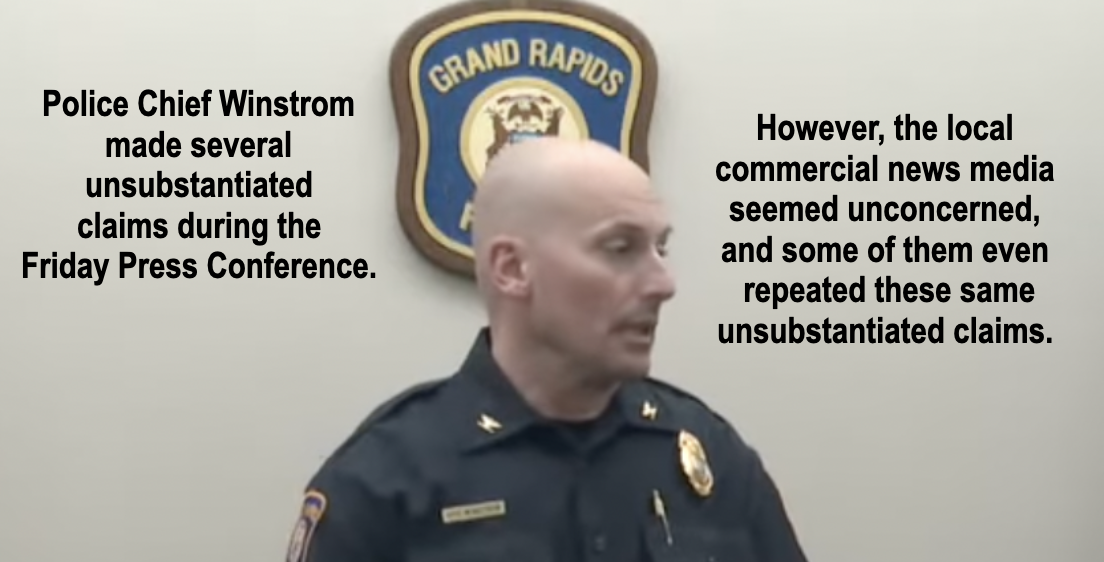
A 15 minutes video of the Press Conference can be viewed online. Much of the Press Conference had to do with specifics about the shooting, but what I want to focus on is some of the question that were asked by the local news media and the responses from Chief Winstrom.
At around 2:40 into the video, a local reporter asked the question whether or not the shooter was targeting the GRPD cruiser. Winstrom’s response was that he felt that was probably the case, since the GRPD cruiser was not an unmarked vehicle. However, this is all speculation, since there is no evidence of motive as of yet.
At 7:10 into the video, another reporter asked whether this shooting might have been retaliation for the Christopher Schurr (now an ex-cop) shot and killed Patrick Lyoya. Winstrom responded by saying, that was his concern, and they he goes on to use the phrase, the “Ferguson Effect.” Winstrom then refers to the Michael Brown incident – he was also shot and killed by a cop in Ferguson, Missouri – and claims that there is a correlation between police killings of Black people and an increase in violent crime. Winstrom say this happened after the police murder of George Floyd, with “record levels of violent crime.” Winstrom then says this, was his concern after the April 4 police shooting of Patrick Lyoya – again referred to as the “April 4th incident.” Throughout all of this commentary by Chief Winstrom, he offers no evidence that there is a clear correlation between police murdering Black people and an increase in violent crime.
The phrase “Ferguson Effect”, was coined by Heather MacDonald, which Chief Wonstrom named during the Press Conference. What Winstrom didn’t mention is the fact that Heather MacDonald is a senior fellow at the right-wing Manhattan Institute. The use of the phrase, the “Ferguson Effect” was looked at in an article by the media watchdog group, Fairness in Accuracy & Reporting in June of 2015. The article states:
The point of the “Ferguson effect,” though, is not to be accurate. It is instead to distract us from the growing evidence about the magnitude and extent of police use of lethal violence in the United States—as powerfully documented just this week by the Guardian and the Washington Post—and to besmirch the #BlackLivesMatter movement.
It’s a strategy that Republican presidential candidate Barry Goldwater inaugurated in his campaign in 1964, almost single-handedly turning crime into a political weapon against the civil rights movement.
This is exactly what Chief Winstrom was doing, which the local media seemed to be eating up. WOODTV8 repeated the Ferguson Effect claim in their coverage on Friday.
In addition, the national recognized organization, The Sentencing Project, which looks at racial disparities in crime and sentencing, has written several articles and conducted several studies that debunks the who Ferguson Effect theory. One article in particularly, concludes, In the absence of credible and comprehensive evidence, sounding alarm bells over a “Ferguson effect” or any other putative cause will not help.
At 8:30 into the video, Chief Winstrom states that he thinks that “the criminal element feels emboldened” after the GRPD killing of Patrick Lyoya, since there is a lot of scrutiny of the police and the police tend to “back off” a bit from their work. Again, Winstrom offers no concrete evidence to this claim and no reporter asks for any data to support such a claim.
At 10:45 into the video, another reporter shifts the conversation to the Supreme Court’s ruling to dismantle Roe v. Wade and whether or not the GRPD is prepared to deal with protests. Winstrom says they have been having discussions about this, but that, “we (the GRPD) are very good at handling protests.” As we, and so many others, have noted over the past two years, when the GRPD says they are good at handling protests, they mean they have spent a great deal of energy doing surveillance of protest organizers, suppressing dissent, targeting protest organizers and arresting organizers on bogus or trumped up charges, as they did with two Black organizers during the protest against the Supreme Court ruling on Roe v Wade, Friday evening.
The GRPD Press Conference ended with a few words from Brandon Davis, who had nothing to add to Chief Winstrom’s comments, other than to say that he was praying that the GRPD officer who was shot at on Friday morning was ok.
Former US Education Secretary, Betsy DeVos, has a book out. The book is entitled, Hostages No More: The Fight for Education Freedom and the Future of the American Child.
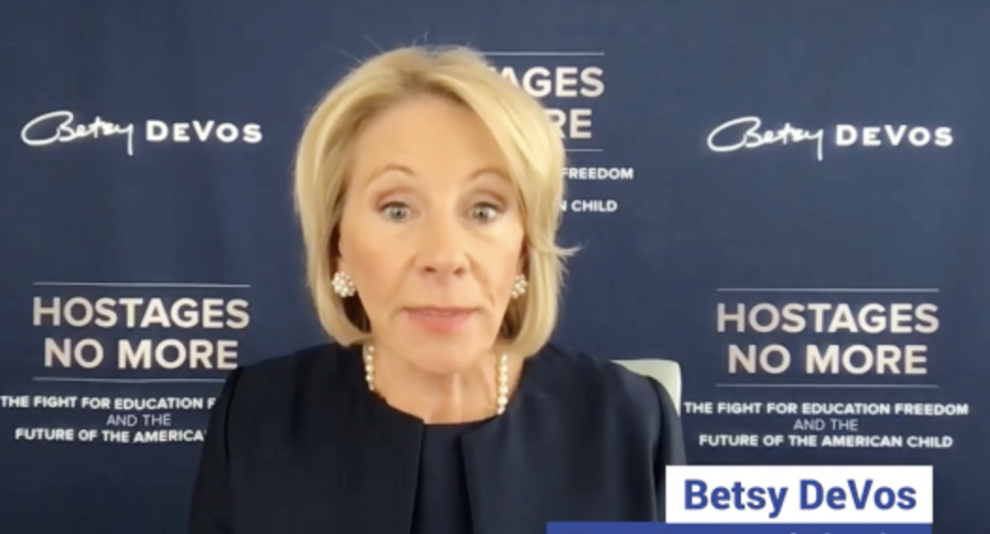
Just a few days ago, the far right Think Tank, the Grand Rapids-based Acton Institute, interviewed DeVos about her new book. The interview is worth listening to, even though the Acton podcast host couldn’t contain himself with his glee in interviewing Betsy. I say it’s worth listening to, since I believe that those of us who oppose the likes of Betsy DeVos, need to familiarize ourselves with the arguments and ideological principles that she embraces. If people just plainly reject something, without understanding it, that is not only intellectually inadequate, their rejection might also be based on faulty assumptions, which often leads to faulty responses.
After listening to the interview that the Acton Institute conducted with Betsy DeVos and after reading much of her new book, here are some of my overall responses.
First, DeVos believes that the US public education system is in deep trouble. I agree. The system of public education in the US is deeply dysfunctional and quite often perpetuates harm. I know this from my own experience of going through the K-12 public school system, along with my own critical reading of its history and the work that I have done with groups like Grand Rapids for Education Justice (GREJ). While working with GREJ, we determined that there is a two-tiered school system within the Grand Rapids Public Schools, where a smaller number of students get preferential treatment, while the bulk of GRPS students have limited resources, so much so that the GRPS is content to just graduate them, but not provide them with the necessary tools to be fully human and to fully participate in this society. The difference between groups that want to improve public education and people like Betsy DeVos, is that she wants to fundamentally alter public education, if not dismantle it. In fact, much of the two tiered system with the GRPS, is in part due to the influence that Betsy DeVos and other members of her family have had in that system, particularly the former Superintendent. Also, see our 3 part series entitled, Betsy DeVos and the Covert Privatization of Grand Rapids Public Schools.
Second, Betsy DeVos regularly uses – in her book and during her 30-year commitment to undermining public education – buzzwords and phrases that are often unsubstantiated. For instance, DeVos will say that the biggest roadblock to education reforms are the teacher unions. This primarily is driven by the fact that DeVos and other members of the Capitalist Class despise organized labor. In fact, teacher unions are one of the only reasons why public schools have not already been dismantled in the US. Other phrases that Betsy uses regularly are “government runs schools,” that the “public school curriculum teaches students to hate the country,” and that public education offers no “school choice.” DeVos then uses personal stories to support such claims, stories that are nice and all, but never back up with hard data. In addition, the phrases she uses, to the extent that they are even remotely true, are due to the fact that she and the anti-Public Education network she has helped to create over the past few decades, has been somewhat effective in their efforts.
Third, in the Acton Interview and further explored in her book, DeVos takes aim at certain issues around public education that she uses to attack them. The pandemic has been a great opportunity to attack public schools and teacher’s unions, in part because of how school systems dealt with school closings and masking policies. DeVos claims that parents have become more involved in their children’s schools, which is true, but DeVos fails to mention that this attack of public education has been primarily orchestrated by certain groups that are also part of the anti-Public Education network across the US. For example, parents in Kent County came to school board meetings and government meetings to rage against the system, but this didn’t happen in a vacuum.
Fourth, the claim that public school curriculum teaches US students to hate the country, is not only ridiculous, it is unfounded. Betsy DeVos claims that the US Constitution is unique and that American Democracy is the best form of government on the planet. To the degree that teachers get students to critically assess such claims and to look at US history through a critical lens, is not teaching students to hate the US, it is teaching students important critical thinking skills. A Betsy DeVos funded and created entity, known as the Michigan Freedom Fund, has railed against Critical Race Theory over the past years, as has the anti-Public Education Network across the country. In addition, while Betsy DeVos claims to celebrate the US Constitution, she and her family have been providing millions in funding to the National Constitution Center, which her brother Doug DeVos is a board member of. The National Constitution Center has its own version of celebrating the US Constitution, one that ultimately protects power, especially from an increasingly organized public.

Fifth, the former US Secretary of Education spends a whole chapter in her book talking about an idea she created years ago, which she re-packaged while in the Trump Administration, known as Education Freedom Scholarship. This was essentially code for school vouchers, but DeVos and the people around her were smart enough to re-brand it using the word freedom. DeVos announced this program in March of 2019, and has continued to push for it around the country, but particularly in Michigan. The revised language for the campaign to use public money for private and charter schools, is called Let MI Kids Learn. To date, it is yet to be determined if this effort will get enough signatures to put it on the November 2022 Ballot.
Lastly, Betsy DeVos claims to be a proponent of free speech, particularly on college campuses. However, her idea of protecting free speech is driven by her desire to protect the speech of those she agrees with, which is primarily those who side with power. However, Betsy DeVos’s claim that she support freedom of speech on college campuses, hold no water, especially when looks at what she said at a speech she gave at Hiilsdale College in October of 2020. DeVos spoke about the evils of socialism, stating:
Too many today—especially among our rising generation—don’t seem to understand the dangers of such a view. They somehow have come to believe that socialism is the cure, not the deadly disease it really is. Tragically, it’s because no one has taught them differently. And worse, some have been indoctrinated to believe not in themselves, but in government.
Betsy then goes on to say:
So, the unholy mob thinks our economies need redistributing. It thinks our Constitution needs rewriting. It thinks our families need restructuring. One prominent group was explicit about its desire to “disrupt the Western-prescribed nuclear family structure.” That’s taken right from the old Marxist playbook. It admits the goal is to “[do] away with private property and [educate] children on a communal basis, and in this way [remove] the two bases of traditional marriage.”
DeVos was a bit more candid about her views, considering this was a Hillsdale College audience, but also because she knew that the Trump Administration was on the verge of being defeated in the November 2020 Election.
A day after the attempted coup by Trump supporters in 2021, Betsy DeVos formerly resigned from her position as Secretary of Education. We wrote about her letter of resignation, and stated in part:
The fact that DeVos is trying to distance herself from what happened at the US Capitol on Wednesday is also a desperate attempt to deflect the fact that the DeVos family spent millions in the last four years to elect Republicans, many of which have encouraged the White Nationalist who attempted the coup, plus they contributed to Trump’s re-election in 2020.
Lastly, it is worth saying that Betsy’s resignation is just another attempt by those who have benefited from Trumpism to try to save face. The reality is that the resignation of Betsy DeVos was a cowardly act, in a long line of cowardly acts that she and the rest of the Capitalist Class have been committing for a very long time.
In the end, Betsy DeVos will be using her book tour as another opportunity to mobilize people to join her in the fight against Public Education, just as she has done for the past 30 years. As I have said before, I have nothing but contempt for the likes of Betsy DeVos and her family, but it would be a serious mistake on our part to dismiss her as some sort of a nutcase. The DeVos family is indeed ruthless, but they are not stupid.
Last week, the Senate Armed Services Committee voted 23 – 3, to add an additional $45 Billion to the US military budget. The Biden Administration originally requested an increase from the 2022 US Military budget, which was $782 Billion, but the Democratic White House asked for $813 Billion.

The Senate Armed Services Committee’s vote to add more makes the US Military’s Budget an astronomically bloated budget, especially considering that millions of people living in the US are struggling to just survive.
One of the members of the Senate Armed Services Committee is Gary Peters from Michigan. Peters, like his predecessor Carl Levin, also voted consistently for a bloated US Military budget, a budget which is larger than the next 14 country’s Military budgets, COMBINED.
William Hartung, a senior research fellow at the Quincy Institute for Responsible Statecraft, and the author of numerous books on US military spending, stated recently:
“The administration’s proposal is already higher than spending at the peaks of the Korean and Vietnam Wars and over $100 billion more than at the height of the Cold War,” Hartung said in a statement. “Throwing more money at the Pentagon will not make us safer — it will just divert funds from addressing other urgent challenges like pandemics and climate change that put millions of Americans at risk.”
Additionally, Robert Weissman, president of Public Citizen, released the following statement:
“The Senate Armed Services Committee’s choice to defy both the president and public opinion and flood the Pentagon with more money is outrageous. Time and again, Congress funnels billions in additional funds to costly weapons programs, war, and defense contractors, while claiming that human needs would ‘cost too much.’ Most Americans oppose efforts to rocket-launch military spending towards a trillion dollars per year. Lawmakers should reject this and champion human-centered spending instead.”
The National Priorities Project has been tracking the cost of war and US Militarism for several decades now, with real-time counters that boggle the mind. In addition, they look at concrete trade-offs, to demonstrate how the US Military budget could be spent on human needs in this country. You can look at those trade-offs nationally, at the State level or the City level. Based on the 2022 US Military Budget, $370.66 Million leaves Grand Rapids for the US Military budget in tax dollars. Imagine what that kind of money could be used for, especially for the thousands of families that are struggling to pay rent, eat well, have good health coverage, etc.
On the day that the Senate Armed Services Committee voted to increase the US Military budget, Senator Peters released a statement, where he bragged about getting more funding for military bases in Michigan, and massive taxpayer subsidies for private military contractors in the state.
This is what we get when we continue to vote for people like Gary Peters. This is what voting for the lesser of evils looks like. Senator Peters is proposing to increase an already bloated US Military budget, while millions of people in this country can’t afford to survive. Senator Peters wants to increase a massive military budget while the world is burning. How do people justify this this sort of banality?
Once again the Grand Rapids commercial news media presents a narrative that favors the ex-GRPD cop who killed Patrick Lyoya
Yesterday, the lawyers who are representing the cop who killed Patrick Lyoya, were in court for a preliminary hearing, as a result of the Kent County Prosecutor’s decision two weeks ago to charge Christopher Schurr with second-degree murder.
However, the news reporting on the court hearing grossly framed the cop who killed Patrick Lyoya in a positive light to a degree that will make it difficult for any juror to find the former-GRPD cop guilty of murder.
Faulting the victim
The MLive article from yesterday, states:
Lyoya was face down, trying to get up, when the officer shot him in the back of his head. They had fought for control of the officer’s Taser.
This is a distortion of the events that took place. Most reasonable people, upon viewing the videos, would not describe what happened in such a way. Later in the MLive article it repeats the claim that, “The two fought for control of the officer’s Taser.” This claim is followed yet another negative framing, where it states:
Tests showed that Lyoya had a blood-alcohol level of 0.29 percent, over three times the level a motorist is presumed intoxicated.
The MLive article then continues to present a narrative about the victim, a narrative which suggests Patrick was at fault.
WZZM 13 also presented a narrative that made it sound like Schurr was just protecting himself, with this sentence:
Lyoya got out of his vehicle to speak with Schurr. After a brief physical struggle, Lyoya was shot in the back of the head and killed.
WZZM 13 also posted an interview with Schurr’s lawyer. There were two things instructive about this interview. First, a reporter (even though we can’t see the person who made the statement) made a statement, saying that the media has been presenting a one-sided view so far. This is absolutely not true, as we have not in numerous deconstructions of the local news, such as a WOODTV8 story from May 2nd, a May 17 story, and an MLive article that presents Schurr in a positive light.
A second point from the channel 13 interview with the lawyer representing Schurr is that he went out of his way to say that he hopes this doesn’t turn into a side show outside the court. This was a backhanded way of marginalizing the Justice4Patrick movement. The lawyer goes on to say the courts will likely not tolerate any sort of “interruptions” or “outbursts” from people.
Providing a platform for the killer cop’s family
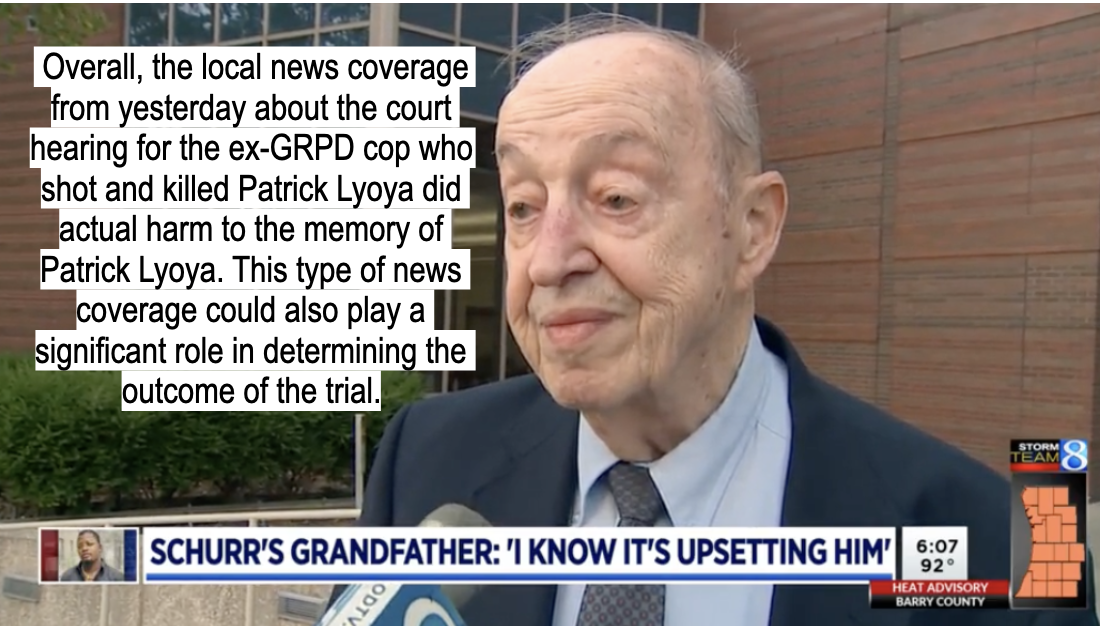
However, maybe the most ridiculous story from the local news was from WOODTV8. The piece that channel 8 broadcast last night begins with the two newsreaders saying that this is the first time the public gets to hear from the family of Christopher Schurr. In fact, most of the 2 minute and 12 second story is mostly about Schurr’s family, featuring commentary from his grandfather, with softball questions from the reporter, in an attempt to humanize the ex-cop who shot Patrick Lyoya in the back of the head, while he was face down on the ground. The channel 8 reporter even asked Schurr’s grandfather about how it was to spent father’s day with his son and grandson. Instead of focusing on the court hearing, WOODTV8 felt that it was more important to communicate the feelings of a family member of the ex-cop who murdered Patrick Lyoya.
WXMI 17 did the best job of reporting on the hearing, with minimal commentary, no strongly biased narrative, plus they post video of the entire court hearing, thus allowing people to make up their own minds about what happened in the courtroom.
Overall, the local news coverage from yesterday about the court hearing for the ex-GRPD cop who shot and killed Patrick Lyoya did actual harm to the memory of Patrick Lyoya. This type of news coverage could also play a significant role in determining the outcome of the trial.
Over the next few weeks, we will be posting information and links to candidate websites and/or social media pages so that people can see what their policy positions are and what they say they will do if elected.
We will be posting this information specifically for candidates running for office in West Michigan, candidates at the Congressional level, state level and in Kent County. We do this in part, since we cannot rely on the dominant commercial news media to provide this information or any robust analysis of the policy platforms of those running for office.
In late July we will also be posting information on campaign financing for these same candidates, so that people have as much information as possible about candidates before the August Primary and the November 2022 Election.
Now, personally I identify politically as an anarchist, so I don’t put much stock in representative democracy or the electoral process. However, I do think it is important for people to think critically about the political/electoral process that currently exists.
In today’s post, we look at State Senate races in the West Michigan area. As a State Senator, these candidates will be voting on a wide range of critical issues, such as, funding for the prison industrial complex, public education budget, environmental justice issues, like Line 5, affordable housing, supporting a living wage, rent control, eviction, police funding, subsidies for corporations, water quality, water diversion rights, immigration issues like Driver’s Licenses for All, nuclear power, renewable energy sources, mass transit, tax policies, adoption, child care, racial discrimination, regulating the real estate industry, diverting public money towards private education, labor union support, cooperation with Immigration and Customs Enforcement, regulation of pesticide use, mining issues, climate change policies, gun control, gentrification and structural racism.
As an anarchist, I believe that my aspirations and the desire to work towards Collective Liberation is rarely reflected in the electoral/representative democracy process. Where are the candidates who are publicly anti-capitalist and anti-racist? Where are the candidates that oppose the homophobic and transphobic policies and practices in this country and in this community? Where are the candidates that are anti-colonialist, who believe that Indigenous sovereignty and land should be a priority? Where are the candidates that are committed to reparations for Black people? Where are the candidates who believe that housing, income, education and health care are fundamental rights? Where are the candidates who are committed to resisting the current climate crisis and oppose things like the Enbridge Line 3 and Line 5? Where are the candidates that want to deal with root causes of problems, instead false solutions perpetuated by charitable groups and the Non-Profit Industrial Complex? Where are the candidates that not only support labor unions but actively work to support workers to create workplace democracy? Where are the candidates who support reproductive justice? We all deserve a better world and we need to support politics the dismantles systems of power and oppression.
Listed below are the candidates for the State Senate Districts located in the Greater Grand Rapids Area. In looking at all of their campaign platform/policy pages, no one stands out as embracing positions that many social movements have been demanding for years.
State Senate 18th District
Kai Degraaf D
No online platform
Thomas Albert R
http://www.votealbert.com/platform-2
https://www.facebook.com/votealbert
Ryan Mancinelli R
No online platform
State Senate 20th District
Kim Jorgensen Gane D
https://www.facebook.com/kimjorgensengane
Kaleb M. Hudson R
https://m.facebook.com/people/Kaleb-Hudson-for-district-20-State-Senate/100078865028135/
Austin Kreutz R
Aric Nesbitt R
https://www.votenesbitt.com/issues/
https://www.facebook.com/aricnesbitt
State Senate 29th District
Winnie Brinks D
https://winniebrinks.com/84-2/
https://www.facebook.com/WinnieBrinksforSenate
Tommy Brann R
https://brannforsenate.com/issues.html
https://www.facebook.com/TommyBrannforMI
State Senate 30th District
David LaGrand D
https://www.davidlagrand.com/priorities
https://www.facebook.com/davidlagrand
Keith Hinkle R
https://www.facebook.com/profile.php?id=100080641306251
Mark Huizenga R
https://www.facebook.com/votehuizenga/
State Senate 33rd District
Mark Bignell D
https://www.bigmarkforsenate.com/
https://www.facebook.com/BigMarkForSenate
Rick Outman R
New Public Safety Committee member, has also been a participant in the GRPD-created program, Clergy on Patrol
The agenda packet for the Committee on Appointments, which met today, states that the City Commission adopted a resolution to appoint Willie Gholston to the Public Safety Committee.
Willie Gholston is the pastor at First Community AME Church in Grand Rapids and has been a participant in the GRPD created program called Clergy on Patrol. In fact, the Clergy on Patrol page features a quote from Willie Gholston, saying:
“The Clergy on Patrol program provides an opportunity to enhance public safety initiatives as a means of accountability, partnership, and service to help make Grand Rapids Michigan one of the safest cities in the Midwest. We believe that by working together the spiritual and the secular worlds can build a collaborative effort to cause harmony and peace that we haven’t witnessed in a while.”

The Clergy on Patrol page states – Clergy on Patrol is a partnership between the Grand Rapids Police Department (GRPD) and local clergy of different congregations and faith traditions to help build trust and positive interactions between the police and the neighborhood they serve.
GRIID wrote about Clergy on Patrol when it first began last year. We have a much different take on what the function of this project is. We wrote at that time:
For those who have been involved in monitoring and resisting US militarism abroad, the language that the GRPD is using to recruit faith leaders is the exact same kind of language that the US Army and CIA were using in manuals to train foreign soldiers in counterinsurgency. This may sound extreme to equate the GRPD’s recruitment of faith leaders to techniques that have been used in counterinsurgency, but to dismiss such a claim would be naive.
The GRPD sees the public, particularly members of the public who are opposing business as usual policies, as insurgents, as people who are a potential threat to order. In the Public Safety Committee meeting mentioned above, Chief Payne stated that he had reached out to the group Justice for Black Lives (JFBL) about getting a permit for their rally/march to City Hall. Chief Payne stated that groups like JFBL need to get permits if they want to do things in a lawful and orderly fashion. In other words, the GRPD wants to be notified, and therefore, have has much control as possible for when there is any demonstration, protest or act of resistance that challenges business as usual.
This is why it is important for us to think about how dangerous it is for faith leaders to be part of the Clergy on Patrol program. We have to come to terms with what the bigger picture is for such programs, which are ultimately about inserting law enforcement – which is state violence – into neighborhoods and through community-based groups. In fact, the more they are inserted into our communities, into our schools, and places of worship, the result would be and increase in surveillance, the expansion of mass incarceration expands and increased justification for state violence.
Six weeks ago, we noted in one of the GRIID posts that a members of the Capitalist Class had just been appointed to the Public Safety Committee. Adding Rev. Gholston, who has already built a relationship with the GRPD through a program they created, should be cause for concern about who sits on the Public Safety Committee and what that means for the future of police accountability and for the possibility of models of public safety that do not rely on violence workers, or what most of us know them as, cops.
 Earlier this year, GRIID wrote a piece about a new podcast that is hosted by one of our local billionaires, Doug DeVos.
In that article about the podcast hosted by Doug DeVos, we wrote:
The Believe! Podcast from Doug DeVos has so far featured people who are aligned with his religious views, other members of the Capitalist Class and those who defend the far right ideological values that are the very embodiment of the DeVos family. So, instead of blindly believing anything that people like Doug DeVos have to say, lets adopt solid critical thinking skills, skills which will allow us to see through the lies those in power want us to BeLIEve!
We continue to monitor the show’s content and the guests that DeVos invites. One guest caught our attention, so we thought is was important to write about what Dr. Larry Arnn, the President of Hillsdale College had to say. The main theme of the interview between Doug DeVos and the Hillsdale College President was, Why Should Students Love America?
The President of Hillsdale College engages in what most scholars refer to as American Exceptionalism. American Exceptionalism is the idea that the US as a country is unique and special and should be seen as a model for the rest of the world. This sentiment is reflected in the conversation between Dr. Arnn and Doug DeVos, since neither of them mention anything about the US genocidal policies directed at the First Nation’s people that lived here way before the Europeans invaded these lands.
The Hillsdale President does acknowledge slavery, but just in passing. Interestingly enough, Dr. Arnn then spends a great deal of time talking negatively about the 1619 Project, stating:
You know, the New York Times has done that frightful 1619 Project. And they claim that the movement of the founding of America from the colonies forward was in the direction of perpetuating slavery.
The President of Hillsdale College then cites Gordon Wood as the leading US Historian, so as to contradict the claims made by the 1619 Project. This theme is not really explored by DeVos or his guest, since both are not interested in a serious exploration of the more honest history that the 1619 Project explores, particularly as it related to the centuries long practice of systemic racism in the US and how it has impacted the Black community in particular.
While DeVos and his guest make backhanded comments about Critical Race Theory, they fail to mention that Hillsdale College has developed their own curriculum to counter the 1619 Project. The Hillsdale project is called The Hillsdale 1776 Curriculum, which is a very sanitized and whitewashed version of US history.
What we can learn from this episode of the podcast from Doug DeVos, is that he endorses and celebrates a view of US history that denies, ignores and minimizes the deeply racist history of the US, a history that continues til today. This is significant in two ways. First, Doug DeVos is the head of the Amway Corporation and he has contributed millions to the Republican Party and GOP candidates that promote and push for public policy to deny public education teachers to teach Critical Race Theory.
Second, the Doug & Maria DeVos Foundation provides millions in funding to projects in Grand Rapids, like AmplifyGR. AmplifyGR operates in a predominantly Black neighborhood, which begs the question, does Doug DeVos’s belief about US history, particularly the history of racism, influence how his foundation contributions are used? If Doug DeVos vehemently disagrees with Critical Race Theory and the 1619 Project, shouldn’t the residents of the Boston Square Neighborhood be made aware of his views on racism?
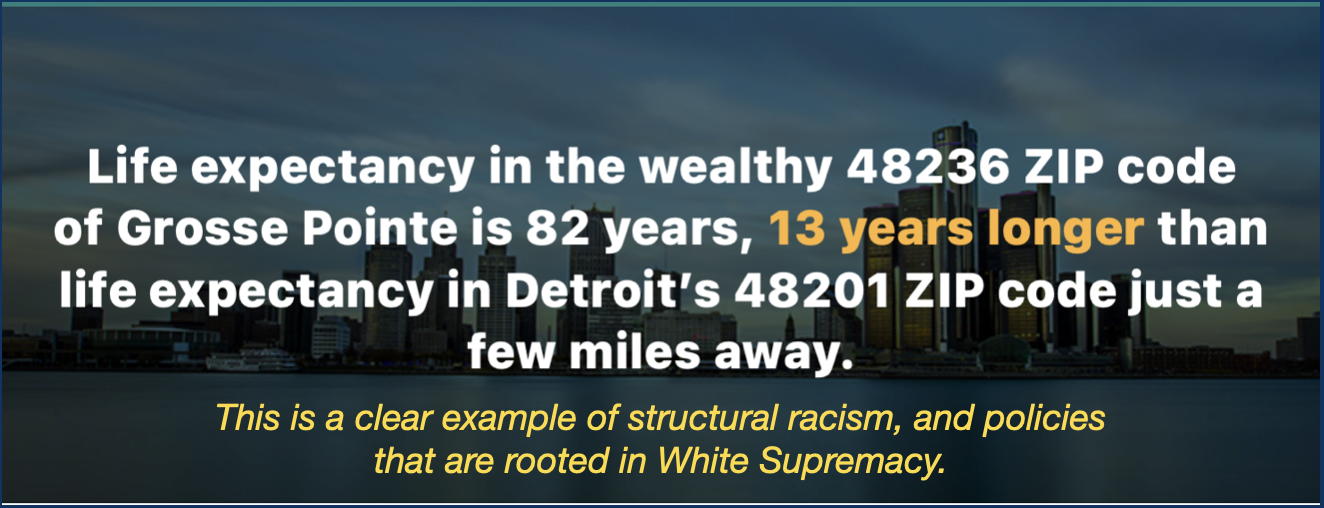
Last week Tuesday, MLive posted a story with the headline, 43% of Michiganders can barely afford necessities, says task force offering solutions. Let that sink in for a moment. Nearly half of the people living in Michigan say they care barely afford what they need.
The MLive article begins by saying:
A group tasked with helping Michigan combat poverty has come up with 29 policy recommendations aimed do just that.
The Michigan Poverty Task Force examined the policy gaps that cause some residents to endure health inequities resulting from non-medical factors. Its 2022 report, released Tuesday, June 14, highlights the problems resulting in disparities, and offers solutions for the state to consider.
Later, in the MLive article, the reporter provides some numbers on what the federal poverty level is for a single person and a family of four. “In 2022, the federal poverty line is $13,590 in annual earnings for a single adult, or $27,750 for a family of four. By those metrics, an estimated 1.4 million residents are living in poverty, including about 20% of the state’s children.”
All of this data is very sobering, but the reporter does not ask the question as to why so many people in Michigan are living in poverty.
Task Force Recommendations
The Michigan Poverty Task Force report can be found at this link, which includes more data and the 29 recommendations the group came up with.
The 29 recommendations are based on five main focus areas:
- income and social protection
- housing, basic amenities and the environment
- early childhood development
- social inclusion and nondiscrimination
- access to affordable health services of decent quality
In reading the recommendations, it occurred to this writer that these recommendations were created by people who have never directly experienced poverty. Don’t get me wrong, the recommendations are not bad, but they do very little to address systemic or structural problems. Let’s look at one example from each of the five focus areas, to illustrate my point.
On the matter of income and social protection, one recommendation is – Increase investments in a universal benefit application so Michigan residents can apply for resources in one place. Again, this is not a bad idea, since it makes it easier for people to access various social services through one portal. However, in this section on income, there is no discussion about the urgent need for people to make a living wage. What if individuals were making a minimum wage of $25 an hour. How would that impact the lives of workers and their families? There is also no discussion, nor recommendation to address the wealth gap in Michigan.
The second focus area listed in the recommendations, is housing, basic amenities and the environment. One recommendation is, to Create Statewide Rental Housing Partnership Trust. This recommendation is essentially designed to support landlords who have taken on “risky” tenants. What is more alarming is that there was no recommendation suggesting that housing is a human right or what the minimum income is for families to afford rental costs in Michigan. According to the Living Wage Calculator, a family of four – 2 adults and 2 children – would need to earn $35.94 an hour to afford the average rent costs in Michigan.
The third focus area the Poverty Task Force includes is early childhood development. One of their recommendations is, increase rural childcare options for families. Again, not a bad idea, but this recommendation never addresses income levels or the need for families to make a living wage, in order to even afford childcare costs.
A fourth area included in the recommendations is, social inclusion and nondiscrimination. There are only two recommendations in this section, one of which is to improve water quality and affordability. This recommendation is instructive, since it does not acknowledge the harsh realties that so many families in the state are facing when it comes to level of contaminated water that families (disproportionately BIPOC families) are facing. Flint is not even mentioned or acknowledged in this recommendation.
The fifth focus area included in the Poverty Task Force report is listed as, access to affordable health services of decent quality. One recommendation is coextend coverage to “children of qualified immigrants.” This essentially means they want to provide more access to immigrant children, as long as they are documented. What about the thousands of families who live and work in Michigan every year, mostly in the agricultural sector, who are undocumented?
Reading through the 29 recommendations of the Michigan Poverty Task Force was like an exercise in, “how to make minor tweaks to the economic system of Capitalism, without threatening its core value of profits over people.” Again, the recommendations are not bad, but they not only fail to address the root causes of systemic poverty, they end up perpetuating an economic system that is designed to create poverty.

