Last month we reported that the US Senate Armed Services Committee, which includes Michigan Senator Gary Peters, voted to increased the US Military Budget by an additional $45 Billion, making it the largest US Military Budget in history.
Last week, the group Public Citizen released a new report entitled, Military-Industrial Complex Campaign Checks Help Explain Bloated Pentagon Budget. This report begins by saying:
Every year, the defense industry donates millions of dollars to the campaigns of members of Congress, creating pressure on the legislative branch to fund specific weapons systems, maintain an extremely high Pentagon budget, and add ever more military spending. This upwards pressure is a constant, no matter what figure is requested by the president for the Pentagon, even though nearly 50% of the current Pentagon budget already goes to private contractors each year.
Members of the House and Senate Armed Services Committees are especially targeted by defense contractors. These committee members determine the amount of money authorized for the Pentagon when the committee marks up the annual Pentagon policy bill, the National Defense Authorization Act.

The report from Public Citizen makes it clear that there is a direct correlation between the campaign contributions made by weapons manufacturers and which members of Congress consistently vote for increases in US military spending.
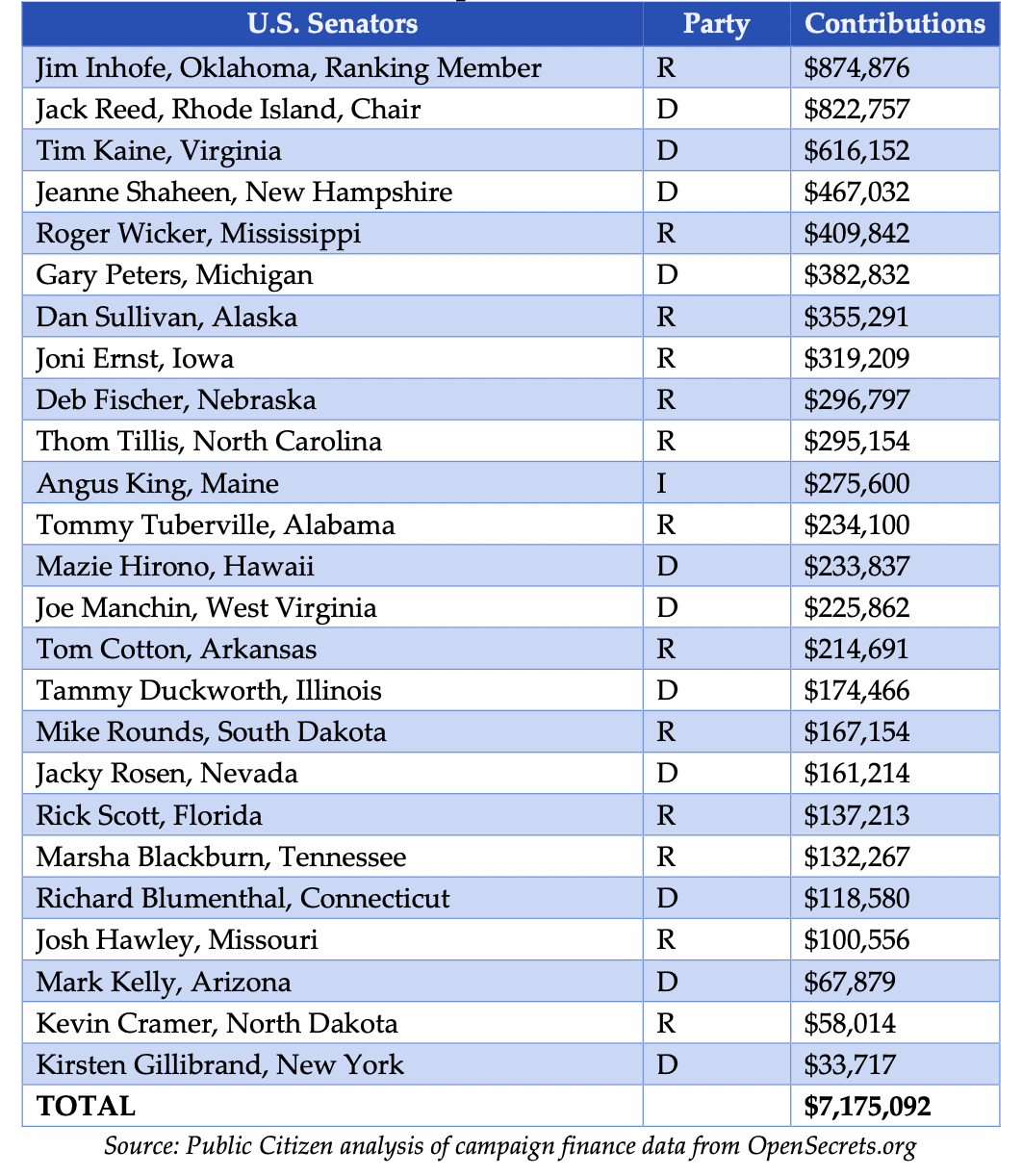
The information included in this new report demonstrates that this is a bipartisan project, with both Democrats and Republicans receiving large sums of campaign funds from weapons makers, as can be seen in the graphic above.
This bipartisan dynamic is strongest within the House and Senate Armed Services Committees, although the Senate Armed Services Committee receives a great deal more of campaign funding from the Military Industrial Complex than the House Armed Services Committee.
In addition, the report breaks down the amount that each member of both the House and Senate Foreign Services Committee members have received from weapons manufacturers, just within the current election cycle (2022). You can see from the chart below that Michigan Senator Gary Peters, who voted for the $45 Billion additional military budget funds, is the 6th highest recipient of campaign contributions from US weapons manufacturers.
As we noted in the previous post from last month about the increased funding for the US Military Budget, Senator Peters even bragged about how this money will help Michigan’s weapons manufacturers. Such bravado is particularly insulting when we look at how many Michiganders are struggling to survive economically, along with the fact that increased US military spending is essentially a big fuck you to any notion of Climate Justice.
GRPD funding sources, police collaborators and the institutionalization of violence workers in Grand Rapids
 At yesterday’s Fiscal Committee and later during the Grand Rapids City Commission meeting, there were numerous GRPD funding items that were approved, as you can see from the July 12 Fiscal Committee Agenda packet.
There are a total of 17 items on the Fiscal Committee Agenda for July 12, with nearly half of them involving the Grand Rapids Police Department. While the issue of GRPD funding was the focus of much debate leading up to the 2023 Grand Rapids City Budget approval, we tend to lose focus on police funding for the rest of the year. Some of these funding items are not large sums of money, but the point of looking at these funding items is that the GRPD is woven in to so many aspects of Grand Rapids society, including specific partnerships with community entities, often without public knowledge. Lastly, it is important that we re-name what police officers are in contemporary America. We prefer to identify cops as violence workers, which is a term that David Correia and Tyler Wall use in their important book, Violent Order: Essays on the Nature of Police.
The first item from the Fiscal Committee agenda that involves the GRPD is item #2, involving $84,000 contract for the Boys & Girls Clubs of Grand Rapids Youth Commonwealth. The GRPD has had a long standing relationship with the Boys & Girls Clubs of Grand Rapids Youth Commonwealth, and is in charge of their Drive for Success Program. The question we should ask ourselves is why is the GRPD involved in a program to teach youth how to drive? Isn’t this a service that could be done by an entity that is not involved in population management and the hyper-policing of BIPOC and poor communities? The irony is, that a disproportionate number of youth who attend the Boys & Girls Clubs are BIPOC youth, which means they will be more likely to be stopped by the GRPD when they are old enough to drive, based on all the recent traffic stop reports.
The second item from the Fiscal Committee agenda that involves the GRPD is a $60,000 contact going to the GRPD to provide “services” to the Children’s Assessment Center, d.b.a. the Children’s Advocacy Center of Kent County. The GRPD, “Detective Bureau provides ongoing expert multidisciplinary investigations of complaints regarding sexual abuse of children.” Again, is it appropriate to have violence workers be involved in investigating sexual abuse of children?
The third item from the Fiscal Committee agenda that involves the GRPD is a contract for $28,750 for TacLogix, Inc. to provide three train-the-trainer training sessions over a two-day period for the GRPD. This training will accelerate the progress of change and will be in addition to the $150,000 allocated for community informed training in the OPA budget, according to the narrative provided in the Fiscal Committee packet. There is no explanation of what TacLogix, Inc. does and who they are. TacLogix does a variety of trainings, which you can find here, and their team is mostly made up of people who have worked in law enforcement at the federal, state and local level. This means that the trainings for the GRPD offered by TacLogix are insular, since it is cops talking to cops, which offers very little opportunity to fundamentally alter or question the function of policing in Grand Rapids.
The fourth item from the Fiscal Committee agenda that involves the GRPD is a $92,200 contract with GVSU Police Academy for new GRPD recruits. The GVSU Police Academy website says their faculty are law enforcement experts, with years of law enforcement experience. Of course, the description does include details of what this expertise is, but more importantly its people who have been violence workers training a new generation of violence workers.
The fifth item from the Fiscal Committee agenda involves policing, but not directly the GRPD. The City has a contract for $65,000 with four Uptown business districts: Eastown, East Hills, East Fulton, and Wealthy Street. Part of that contract is to remove flyers or “handbills” from the area – often political or community-based in nature, along with the removal of graffiti. These are both forms of censorship, with flyers/handbill removal being a low cost way for people to share information on the street level with the public. Graffiti is also often an expressive/artistic form meant to communicate ideas or feelings about the state of the world. What really is the difference between street graffiti and commissioned art work or murals that Grand Rapids seems so fond of?
The sixth item from the Fiscal Committee agenda involves policing or the GRPD is a Salary Ordinance for Employees represented by the Grand Rapids Police Officers Association, specifically Crime Scene Technician/Latent Print Examiner/Police Intern Unit. Crime Scene Technicians, Latent Print Examiners and Police Interns will all be receiving an increase in wages/salary, based on a contractual agreement between the City of Grand Rapids and the Grand Rapids Police Officer’s Association. This agreement went into effect on July 1st of 2022 for an increase in wages/salary, which will again be increased on July 1st of 2023. The Crime Scene Technicians and Latent Print Examiners salaries range from $57,000 to $81,000 a year in 2022 and will then go up to $58,000 to $83,000 in 2023. Do you think these same salary increases are happening for the City employees? Also, what does this say about how we value violence workers in this society over care workers?
The seventh item from the Fiscal Committee agenda involves policing or the GRPD is the Bid List Resolution, which involves numerous items. One specific item is for bicycles for the GRPD, specifically Volcanic bikes. The City had a contract with Freewheeler Inc. for the not-to-exceed amount of $35,179 for 20 bicycles. Freewheeler Inc is facing supply chain issues, so the GRPD will be looking for other bids for 20 bicycles that will cost the public no more than $36,000. This means that the GRPD will spend $1800 on each of the 20 bikes they plan to purchase.
The last item that includes information from the Fiscal Committee packet regarding violence workers, aka the GRPD, is under the heading, Travel & Funds Report through May 2022. In this section there are itemized public funds to various City Departments and next to the section that says police, it reads:
- Contract Serv-Training $112,461.40
- Professional Development $11,871.25
- Conferences & Travel $190,301.33
- Local Business Expense $694.95
- Food-Beverage $12,502.64
Again, these numbers don’t add up to large amounts, especially considering how large the GRPD total budget is. However, it makes you wonder what kind of Professional Development these violence workers are receiving, how many conferences they attend and what is the benefit to the community, along a fair amount of money for food and beverages. Is the public paying for break room food, vending machines, meals, pizza and donut orders? How about some god damn transparency for once!
As you can see from all the items that were in Fiscal Committee packet, since approved by the Grand Rapids City Commission, there are numerous funding streams for the GRPD, which only perpetuates the institutionalization of this system of oppression and their violence workers known as police officers.
Grand Rapids Chamber of Commerce letter is a great example of who and what gets prioritized in community safety
The agenda packet for Tuesday’s Grand Rapids City Commission meeting, included a letter (on page 52) from Joshua Lunger, the Vice President for Government Affairs for the Grand Rapids Chamber of Commerce.
The letter begins with the Chamber representative clearly wanting to frame the downtown business concerns as urgent.
“The Grand Rapids Chamber shares many of the values and priorities set by the City’s Strategic Plan, including goals for economic prosperity and a safe community. Unfortunately, as many of you are hearing, the high rate of shootings, violent crimes, trespassing, harassment and many other unacceptable actions continue to harm businesses and their employees in downtown, neighborhood business districts and other critical commercial corridors.”
The letter then goes on to list 13 separate incidents in the downtown area, involving some theft, but mostly incidents where there was public defecation, people shouting and causing a disturbance, someone using drugs in a business restroom, public masturbation, and a “camp” that was set up in a wooded area near a business.
Many of these incidents did not require the GRPD to be present, as there are numerous other services, organizations and entities that can deal with many of the conflicts or issues mentioned in this letter. Having heavily armed violence workers, as known as cops, show up to deal with issues of are community mental health, substance abuse, people who are houseless, are not only unnecessary, they often make the problems worse by escalating the conflict. We encourage people to read the report, Cops Don’t Stop Violence, co-produced by the Community Resource Hub and Interrupting Criminalization.
The GR Chamber letter does acknowledge the additional resources allocated by the City for Mental Health and the HOT Team, but those effort almost always include the GRPD to accompany mental health or social workers. Having police accompany those who have training and lots of experience with mental health, substance abuse and housing issues, simply creates a more hostile, intense or traumatic environment for people who are struggling.
The GR Chamber letter ends with the following paragraph:
That being said, it takes a long time to build a reputation as a clean, safe city and only a short time to lose it. We know there is not an easy fix or we’d already have done it, but I feel compelled to share it with you and increase awareness of the serious nature of what people are experiencing. The general feedback I get from many is that problems are getting worse and they don’t expect this to change. I look forward to further discussions and working with you and all stakeholders to promote the vibrant, safe environment that everyone in our community deserves.
These comments from the GR Chamber representative illustrates some clear contradictions. First, they say want a safe environmental for everyone, yet there are literally thousands of individual and families that are struggling with the cost of rent, food insecurity, unjust wages, and the structural racism that exists in this city. People can never be safe if they don’t have their basic needs met.
Second, the GR Chamber of Commerce has consistently opposed raising the minimum wage and does not support a living wage. The Chamber also supports rental property associations and housing developers, which dictate the cost of housing in this community, which excludes a significant percentage of the population. Over a decade ago, the GR Chamber gave birth to the group, the West Michigan Policy Forum (which is now an autonomous group) which is made up of the Grand Rapids Power Structure and has pushed legislation that benefits their interests, which are the same interests as the GR Chamber of Commerce – eliminating business taxes, privatizing the public sector, opposing labor unions, using public money for private sector-led development projects, etc. All of these things listed here make it impossible for thousands of people in Grand Rapids to have their basic needs met, thus contradicting the notion that the GR Chamber wants everyone to feel safe.
Third, the GR Chamber of Commerce has leverage with City officials, since several members of the current City Commission has received campaign contributions from the GR Chamber or prominent members of the local chamber. These contributions not only buys the GR Chamber and its prominent members access to politicians, it usually translates into action on the issues most urgent to them, such as creating spaces for people to purchase and consume.
Lastly, it is hard not to recognize that the GR Chamber primarily represents the professional and business class to the exclusion of working class people and large sectors of the BIPOC community which has to deal with the harsh realities of racial capitalism. I would argue that the Grand Rapids Chamber of Commerce, with their primary commitment to free market capitalism, has actually helped to create the social and economic conditions that result in people being homeless, struggling with substance abuse or mental health issues, along with perpetuating Structural Racism, all of which has come back to hit the GR Chamber right in the face. The people that the GR Chamber of Commerce are complaining about in their letter to the Grand Rapids City Commission are in many ways are the collateral damage create by the free market capitalism that the GR Chamber and its members push on the rest of us.
The GRPD was monitoring the Civil Disobedience Training in Grand Rapids on Sunday, attempting to undermine it
 On Sunday afternoon, I was co-facilitating a workshop on Civil Disobedience in Grand Rapids.
The training was designed to provide skill sharing to those who attended on the purpose of Civil Disobedience and how it can be used as an effective form of Direct Action to push for social change within any movement for collective liberation.
This particular training was primarily for allies who are involved in or want to be involved in the Justice4Patrick Movement. The GRPD has been targeting Black organizers, so if allies can be trained in direct action tactics, it can take some of the heat off of Black organizers who are at greater risk of State Violence in Grand Rapids.
There had been a Facebook event for the training for the past three weeks, but Friday, the location host of the training received a voicemail from the GRPD. Here is a transcription of that voicemail:
“This is Captain Terry Dixon of the Grand Rapids Police Department. Hey, just giving you a call in reference to your event, taking place on Sunday regarding civil unrest. Just have a few questions about it and if there was anything that law enforcement can do to come along side that in anyway. My telephone number is 616-456-4489. Have a blessed day.”
There are several things worth mentioning in regard to this message from the GRPD, which I will address here. First, the fact that the cop referred to the event as “civil unrest” is either willful ignorance – since the event page clearly stated this was a Civil Disobedience Training – or it was a feeble attempt to reframe the intent of the training from civil disobedience to civil unrest.
Second, the phone call from the GRPD Captain is a clear sign of the fact that they are monitoring the activities of grassroots dissident groups and movements, particularly those that are making demands for radical social transformation.
Third, the monitoring and surveillance by the GRPD of dissident groups is nothing new in Grand Rapids. Since the 1980s, I have been directly aware of this dynamic, where the GRPD is either monitoring dissident activity or has sought to infiltrate it. In the 1980s, while being involved in the Central American Solidarity and Sanctuary Movement, the GRPD was constantly monitoring our activity, both our literature (there was not internet then) and our public acts of resistance, which often involved Civil Disobedience. During the US invasion and military occupation of Iraq, we were able to submit a Freedom of Information Act(FOIA) to see what the GRPD was doing in response to anti-war organizing, which involved monitoring, surveillance and infiltration.
In 2018, during an action organized by Movimiento Cosecha GR and GR Rapid Response to ICE, the GRPD did nothing to stop or pursue someone who have driven their car into protesters, significantly injuring one. A few weeks later, Movimiento Cosecha GR held a Press Conference about that action. While setting up for the Press Conference, two GRPD officers showed up asking if we needed any assistance. Organizers with Cosecha told them to leave, which they promptly did. After the Press Conference the GRPD was waiting in the parking lot and corralled one of the news reporters so they could give their version of what took place during the action where the cops allowed a motorist to run into protesters.
One last example, if from another FOIA request having to do with the lead up to and the day of the May 1st, 2019 march that Movimiento Cosecha GR had been organizing since 2017. From that FOIA, you can see that the GRPD was threatening to use chemical agents and other non-lethal munitions on the mostly immigrant population that showed up that day.
Fourth, the voicemail from the GRPD is not only an act of intimidation, it is an act of State Violence. The intent of the GRPD cop’s call to the training host was to send a message that they are watching, monitoring and will likely have a presence at or near the training that day, possibly even attempting to infiltrate the skill sharing event.
Lastly, the fact that the GRPD left a voice mail, based on a Facebook event post – and possibly the monitoring of communication between the groups involved – provides further evidence that the GRPD serves to protect the interests of the systems of power and oppression that run Grand Rapids. Any threat to those systems, whether it is a march, a training or various forms of direct action, will not be tolerated. The GRPD, like all police departments, are not primarily interested in preventing crime, they are interested in suppressing acts of dissent, which threaten business as usual in Grand Rapids.
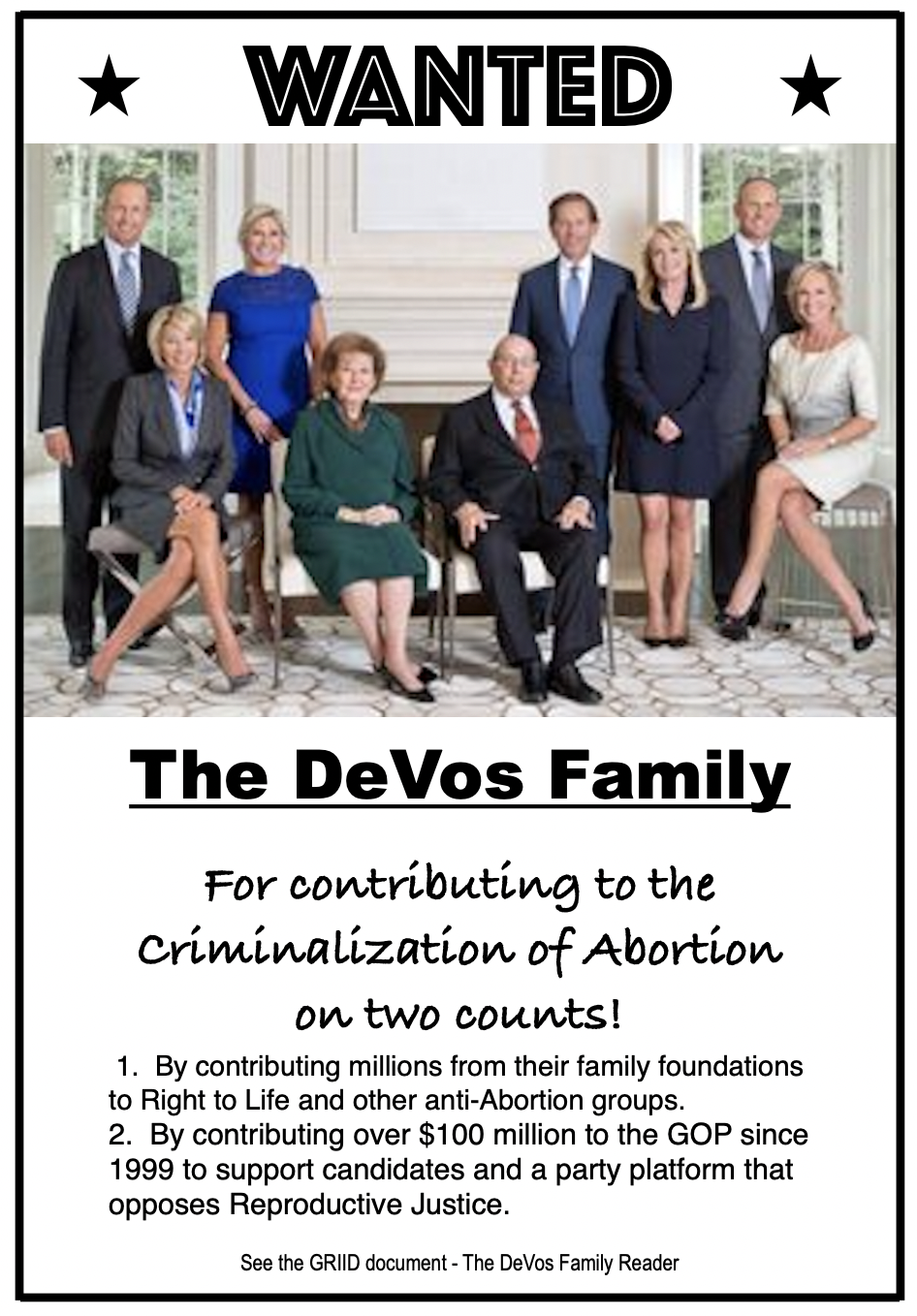 This is the first in a series of WANTED posters, looking at individuals, families and organizations in West Michigan that have contributed significantly to the criminalization of abortion and the undermining of reproductive justice.
The DeVos family has probably done more than any single family in West Michigan to contribute to the criminalization of abortion. The DeVos family undermines the efforts of reproductive justice through their money and political influence.
First, the DeVos family funds the anti-abortion movement through their foundations – the Richard & Helen DeVos Foundation, the Dick & Betsy DeVos Foundation, the Doug & Maria DeVos Foundation, the Dan & Pamella DeVos Foundation and the CDV5 Foundation. The DeVos family has been consistently the largest funder of the anti-abortion movement from West Michigan, which not only has included funding to groups like Right to Life, it means funding “pregnancy resource centers,” and other groups like Focus on the Family, the Family Research Council, the Acton Institute, the Alliance Defending Freedom, the Council for National Policy, the Federalist Society, Hiilsdale College, and many other groups that include opposition to abortion as part of their work/mission. To see the history of their foundation contributions, you can download our document, a DeVos Family Reader.
Second, the DeVos family has provided millions of dollars to political candidates and to the Republican Party, which has consistently opposed abortion and have weakened women’s access to abortion at the state level for the past four decades. According to the Michigan Campaign Finance Network, between 1999 and 2016, the DeVos family contributed $81 Million to the Republican Party. In 2018, the DeVos family contributed $11 million, leading up to the 2018 Election and in 2020, GRIID documented that they contributed $12.7 million in the 2020 Election. This means that the DeVos family has contributed a little over $100 million since 1999 to Republican candidates, all of whom are endorsed by Right to Life and are staunchly committed to opposing abortion.
We encourage you to share this poster and consider directing some of your rage at the recent US Supreme Court ruling to overturn Roe v Wade towards the DeVos family. We know where they live and where their headquarters are located in downtown Grand Rapids.
Over the next few weeks, we will be posting information and links to candidate websites and/or social media pages so that people can see what their policy positions are and what they say they will do if elected.
So far we have looked at the candidates and their policy platform information for the 3rd Congressional race, the State Senate races, and the State Representative races. Today, we will look at those running for seats on the Kent County Commission.
We do this in part, since we cannot rely on the dominant commercial news media to provide this information or any robust analysis of the policy platforms of those running for office.
In late July we will also be posting information on campaign financing for these same candidates, so that people have as much information as possible about candidates before the August Primary and the November 2022 Election.
Now, personally I identify politically as an anarchist, so I don’t put much stock in representative democracy or the electoral process. However, I do think it is important for people to think critically about the political/electoral process that currently exists.
In today’s post, we look at Kent County Commission races. As a Kent County Commissioner, these candidates will be voting/deciding on a wide range of critical issues, such as, funding for the Kent County Jail, which has a disproportionate number of Black and Latinx inmates. Then there is the Kent County Sheriff’s Department, which continues to cooperate with Immigration and Customs Enforcement, by notifying ICE and holding undocumented immigrants until ICE decides what to do with them. Kent County Commissioners could also take a position in support of undocumented immigrants who want to obtain a driver’s license, since they are currently prohibited from doing so. Kent County Commissioners will also decide on important issues like affordable housing in this area and not contribute to the gentrification of neighborhoods. Kent County could promote the idea that everyone should make a livable wage, which is roughly $20 an hour for a single person to afford the basics in this area. Kent County Commissioners will make important ecological decisions, around how to effectively deal with PFSA’s that are in the water and soil in Kent County because of corporate malfeasance, along with a more robust policy to deal with corporate polluters, the protection of the Grand River, and preventing the use of chemical fertilizers, which will impact the main water supplies in the area. Kent County has yet to offer concrete policy decisions on the matter of structural racism in this area, even though they have been presented with a proposal to adopt a Racism is a Public Health issue framework.
As an anarchist, I believe that my aspirations and the desire to work towards Collective Liberation is rarely reflected in the electoral/representative democracy process. Where are the candidates who are publicly anti-capitalist and anti-racist? Where are the candidates that oppose the homophobic and transphobic policies and practices in this country and in this community? Where are the candidates that are anti-colonialist, who believe that Indigenous sovereignty and land should be a priority? Where are the candidates that are committed to reparations for Black people? Where are the candidates who believe that housing, income, education and health care are fundamental rights? Where are the candidates who are committed to resisting the current climate crisis and oppose things like the Enbridge Line 3 and Line 5? Where are the candidates that want to deal with root causes of problems, instead false solutions perpetuated by charitable groups and the Non-Profit Industrial Complex? Where are the candidates that not only support labor unions but actively work to support workers to create workplace democracy? Where are the candidates who support reproductive justice? We all deserve a better world and we need to support politics that dismantles systems of power and oppression, not perpetuate them.
Below are the candidates for the 21 different Kent County Commission seats. In looking at all of their campaign platform/policy pages, no one stands out as embracing positions that many social movements have been demanding, although a few candidates do mention some of those demands, without providing solutions or commitments. The language for many of the candidate platforms are often vague, and almost always the candidates avoid language that seeks to work towards structural or systematic change. There are also 9 Democratic Candidates and 6 Republican candidates which had no online platform information.
Kent County Commission District 1
Jerry Berta D
No online platform
Ben Green R
https://www.votebengreene.com/
https://www.facebook.com/BenGreeneMI
Mark Jordan R
https://www.facebook.com/BenGreeneMI
Kent County Commission District 2
Rebecca Diffin D
No online platform
Thomas Antor R
No online platform
Kent County Commission District 3
Janalee Keegstra D
No online platform
Mark Laws R
No online platform
Jennifer Merchant R
https://www.facebook.com/profile.php?id=100080382173562
Kent County Commission District 4
Judy Wood D
No online platform
Katie DeBoer R
https://www.facebook.com/katie4kent
Diane Jones R
https://www.dianejonesforcommissioner.com/
https://www.facebook.com/dianejones2014
Kent County Commission District 5
Vanessa Lee D
https://www.facebook.com/Vanessa-Lee-for-Kent-County-Commission-106779902041903
Stefanie Boone R
https://www.facebook.com/booneforkcc/
Dave Hildenbrand R
https://www.davehildenbrand.com/
https://www.facebook.com/MIDaveHildenbrand
Kent County Commission District 6
Nicholas H. Vander Veen D
No online platform
Stan Stek R
https://www.facebook.com/StanStek/
Kent County Commission District 7
Sue Merrell D
https://electsuemerrell.blogspot.com/
https://www.facebook.com/Nov8.2022
Stan Ponstein R
https://www.facebook.com/profile.php?id=100063712706170
Kent County Commission District 8
Jennie Chatman D
No online platform
Dan Burrill R
https://www.danburrillforkent.com/
https://www.facebook.com/danburrillforkent
Kent County Commission District 9
Chip LaFleur D
No online platform
Matt Kallman R
Kent County Commission District 10
Julie Humphreys D
https://www.facebook.com/kentcommissiondistrict10
Emily Post Brieve R
https://www.facebook.com/CommissionerBrieve/
Bill Hirsch R
https://www.facebook.com/BillForKCC
Kent County Commission District 11
John Considine D
No online platform
AJ Hoff R
https://www.facebook.com/profile.php?id=100082071813687
Lindsey Thiel R
https://www.facebook.com/CommissionerLindseyThiel/
Kent County Commission District 12
Monica Sparks D
https://www.facebook.com/MonicaSparks4KCC/
Adam R. Palasek R
No online platform
Lee White R
https://www.leewhiteforcommissioner.com/
Kent County Commission District 13
Michelle McCloud D
https://www.facebook.com/mccloudkcc13
Tom McKelvey R
https://www.mckelvey4commissioner.com/
https://www.facebook.com/ElectTomMcKelvey/
Nick Prill R
https://www.facebook.com/Nick4Kent/
Kent County Commission District 14
Carol Hennessy D
https://www.facebook.com/CommissionerCarolHennessy
Jerri Schmidt R
https://www.jerrischmidtforkentcounty.com/
Kent County Commission District 15
Lisa S. Oliver-King D
Brian Boersema R
No online platform
Kent County Commission District 16
Melissa LaGrand D
https://www.melissalagrand.com/
https://www.facebook.com/VoteMelissaLaGrand
Jim Talen D
https://www.facebook.com/profile.php?id=100080597371234
John Brooks Twist R
No online platform
Kent County Commission District 17
Tony Baker D
https://www.facebook.com/CTETonyBaker/
Victor Williams D
https://votevictorwilliams.com/
https://www.facebook.com/votevictorwilliams
Jason Gillikin R
No online platform
Kent County Commission District 18
Stephen Wooden D
https://www.stephenwooden.com/
https://www.facebook.com/votewooden
Tim Allen R
Josie Kornev R
https://www.facebook.com/josieforkent
Kent County Commission District 19
Dave Bulkowski D
https://davebulkowski.squarespace.com/
https://www.facebook.com/davebulkowski
Kris Pachla D
https://www.facebook.com/krispachla
Jeremiah Bannister R
No online platform
Samuel R. Carstens R
https://www.carstensforcommissioner.com/
Kent County Commission District 20
Ivan Diaz D
https://www.facebook.com/people/Ivan-Diaz-for-Kent-County-Commissioner/100078727971393/?ref=py_c
Elisa Rodriguez R
No online platform
Kent County Commission District 21
Charles Howe D
No online platform
Alan Bolter R
https://www.facebook.com/votebolter
Walter Bujak R
The 2023 State Budget is receiving bipartisan support, with several issues being highlighted by Gov. Whitmer and other State Legislators.
One are in particular that will receive millions more in public money is the Michigan State Police Department.
In a statement released by State Senator Mark Huizenga, he highlighted funding for police and corrections, stating:
“…..and funding to train and hire 170 state police troopers and train 800 corrections officers.”
State Representative David LaGrand, also had positive words for the 2023 State Budget funding for policing in Michigan:
“I am very glad to support the budget we passed today. I’m especially proud to see that several of my priorities are part of the final budget, including funding for public safety. We’ve included grants for community policing….”
The 2023 Michigan Budget includes the following for policing. After each funding allocation, GRIID provides some commentary.
- $9.2 million to support a Trooper Recruit School (general fund) anticipated to graduate 50 new troopers in addition to the 120 troopers that are anticipated to be hired and trained using existing attrition savings. This investment allows the department to increase enlisted strength to nearly 2,200 while continuing to increase the diversity of uniformed personnel. GRIID Comments: More funding to recruit more cops does not translate into safer communities. Over and over again, the public is mislead into believing this major fallacy of more police, safer communities. See the report, Cops Don’t Stop Violence.
- $3.7 million to improve Data Collection during Traffic Stops (general fund) through the development of new tracking and documentation systems including a benchmarking dashboard and increasing data collected during traffic stops to allow for easier review and analysis of traffic stops made by the State Police. These improvements will build upon the recommendations of the recent Michigan State University Traffic Stop Study. GRIID Comments: Last year, the Michigan State Police had conducted a traffic stop study, which concluded there was racial disparity by their department. Despite this, the public will provide more money to tell us what we already know about policing, traffic stops and racial profiling.
- $3 million to expand Training and Professional Development (general fund) to provide training on cultural competency, implicit bias, and decision-making to expand positive interactions between department members, minority groups, and the diverse communities that the department serves. GRIID Comments: There are numerous studies demonstrating that racial sensitivity and cultural competency training for police departments are ineffective. As Alex Vitale, author of The End of Policing states, “Diversity and multicultural training is not a new idea, nor is it terribly effective. Most officers have already been through some form of diversity training and tend to describe it as politically motived, feel-good programming divorced from the realities of street policing. Researchers have found no impact on problems like racial disparities in traffic stops or marijuana arrests; both implicit and explicit bias remain, even after targeted and intensive training. This is not necessarily because officers remain committed to their racial biases, though this can be true, 19 but because institutional pressures remain intact.”
- $1.8 million to establish a Victim Services Program (general fund) that will support 14 full-time Victim Advocates across the state. These positions will serve to support victims’ needs early in their interactions with the criminal justice system while also building partnerships with community organizations in support of victim advocacy. GRIID Comments: There should be funding for victims of crime, but it should not go to the Michigan State Police. Funding for crime victims should go through the Department of Social Services.
- $1.1 million to increase the department’s capacity to Prevent, Detect, and Investigate Cybercrimes (general fund). This investment will support statewide investigatory assistance and digital forensic examinations to further the department’s position as a leader in areas of cyber security, computer crimes, and digital evidence. GRIID Comments: Cyber crimes prevention, detection and investigation should also not be done by the Michigan State Police. Such categories are nothing more than justifications for police departments to receive more funding.
- $1 million for Trooper Recruitment (general fund) to broaden the racial, ethnic, and gender makeup of the department to make it more representative of the communities it serves. This investment will support digital marketing campaigns, recruiting events, and improved public relations to assist the department in achieving its recruiting goals for enlisted positions. GRIID Comments: Recruiting and hiring more cops based on gender, race and ethnicity will NOT address the deep seated lack of trust between the police and the public. Do you think it matters that having a Black cop arrest you, beat you or shoot you is any better than a white cop doing the same?
This comes to about $20 million, which is on top of the massive amount of money the Michigan State Police receives as part of their standard operating budget each year. Have we learned nothing in the past few years? More and more of the public are demanding defending of police departments and the re-allocation of those funds to go towards community needs such as housing, health care, food security and education. The 2023 Michigan Budget demonstrates once again that more money for cops is a bipartisan project.
Skill sharing and Direct Action: Civil Disobedience Training set for Sunday, July 10 in Grand Rapids
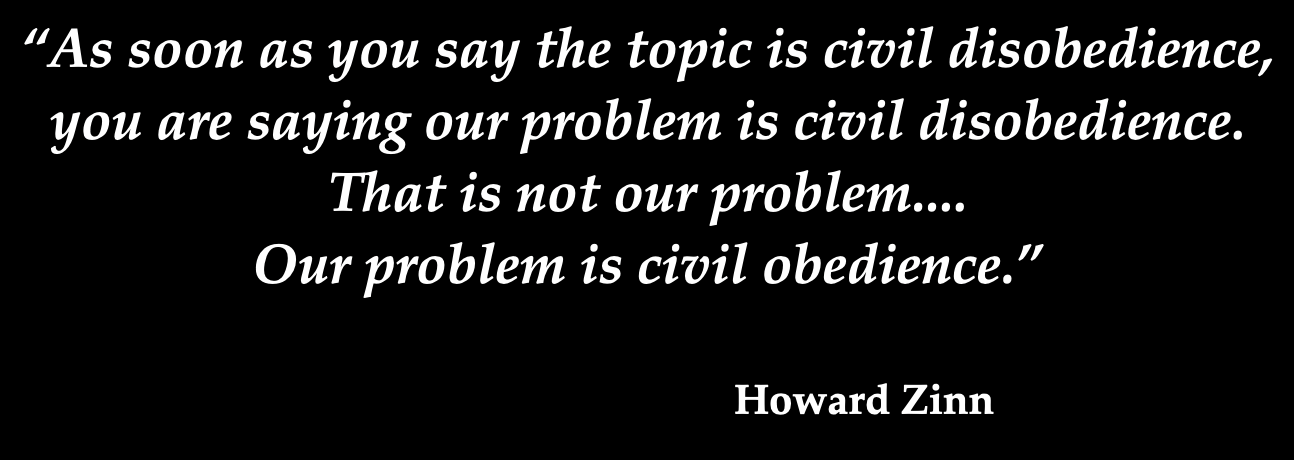
The late, great radical historical, Howard Zinn, once wrote:
As soon as you say the topic is civil disobedience, you are saying our problem is civil disobedience. That is not our problem…. Our problem is civil obedience. Our problem is the numbers of people all over the world who have obeyed the dictates of the leaders of their government and have gone to war, and millions have been killed because of this obedience. And our problem is that scene in All Quiet on the Western Front where the schoolboys march off dutifully in a line to war. Our problem is that people are obedient all over the world, in the face of poverty and starvation and stupidity, and war and cruelty. Our problem is that people are obedient while the jails are full of petty thieves, and all the while the grand thieves are running the country.
Zinn was not writing these words as some theoretical reflection, he was writing them in the context of the way that the system was dealing with members of the Black Freedom Struggle, along with those resisting US Imperialism in Vietnam. Zinn also wrote these words just after he arrested in November of 1970, where is was protesting at a US Military base, attempting to stop a load of soldiers who were being sent to Vietnam.
Civil Disobedience has been a centuries old tactic, used by political dissidents and other revolutionaries who were committed to Direct Action as a primary strategy for social change. People resisting wars have used it for over a century in the US. Black activists and white allies used it during the 1950s – 1970s part of the Black Freedom Struggle. Some example from then were – Rosa Parks refusing to move to the back of the bus, the lunch counter protests, the freedom rides, and marches that were not sanctioned by the authorities.
Civil disobedience has been used by the group ACT Up, the Environmental Justice Movement, the Central American Solidarity Movement, the South African Anti-Apartheid Movement, the Disability Justice Movement, and so many more.
The power of civil disobedience is the intention defiance of the law, to not only amplify the issue that people are protesting, but to disrupt the business as usual approach to protesting.
On Sunday, there is a Civil Disobedience training being offered in Grand Rapids, which you can sign up for by going to this link. The training will include role playing, Civil Disobedience 101, jail solidarity, courtroom solidarity and media messaging.
This particular training is for allies who can leverage their privilege in the Justice4Patrick Movement that is currently happening in Grand Rapids. Those who participate in the training might be asked by Black leadership to use the skills learned for an action. BIPOC people are also welcome to participate, but the intention is to get more allies committed to this kind of Direct Action, in part, as a way to take some of the pressure off of Black organizers that are being targeted by the GRPD.
The training lasts two hours, but you need to register for the training by sending an e-mail to sjeff987@gmail.com.
Lastly, the training is intended to be a safe space, so no cops, no cop sympathizers, no racists and no other forms of oppressive behavior will be tolerated. If you plan to attend this training, you will need to either know people who are already part of this movement or bring documentation/evidence that you are connected to those in the movement.
Latest Amway announcement on ending operations in Russia is all about the loss of markets
 In March, we posted our response to Amway’s announcement that they were temporarily suspending operations in Russia and Ukraine because of the Russian invasion
In that post from earlier this year we stated:
So, Amway does their best to avoid demonstrating any real solidarity with the Ukrainian people, nor do they empathize with the harsh realities that civilians are facing in Ukraine because of the Russian invasion. What Amway does do, is to constantly promote themselves and their capitalist values. In the end, the Amway corporation is not pausing operations because of human rights, they are only pausing operations because it would be an embarrassment to continue doing business in Russia. If Russia and Ukraine negotiate a peace settlement, you can bet that Amway will be back in Russia, attempting to create more little capitalists, regardless of the repressive political realities under the Putin regime.
Three and a half months later, the Ada-based global marketing giant has made another announcement about finally ending their operations in Russia. Here is their full statement:
Earlier this week, we shared with our employees and Amway Business Owners (ABOs) that Amway’s global Board of Directors has made the decision to cease operations in Russia. This follows our announcement on March 14th, 2022, on the suspension of product imports.
This is the first time in Amway’s 63-year history that we have left a market. What makes this such a heartbreaking decision is our enduring belief in offering an economic opportunity, meant for everyone. After exploring all possible options, we have reached a point where economic, technological, organizational, and operational circumstances have made it impossible for us to operate in Russia.
Beginning July 1, we will be thoughtfully and responsibly winding down our operations there. We are focused on providing support to those impacted by this decision; and on treating all with openness, dignity, and respect while meeting our contractual and statutory obligations.
Amway employees and ABOs in Russia have been a part of our family for 17 years and we are endlessly grateful to them for their dedication and for inspiring us with their entrepreneurial spirit.
This latest announcement is worth deconstructing, something that local media sources like MLive will not do.
First, like in their March 2022 announcement, Amway makes it all about them. In their brief statement, Amway uses their own name four times. In addition, Amway center’s their business owners in Russia.
Second, the pyramid scheme company further’s their narcissism by saying, “This is the first time in Amway’s 63-year history that we have left a market. What makes this such a heartbreaking decision is our enduring belief in offering an economic opportunity, meant for everyone.”
Third, never does the Amway announcement discuss the difficulties that the Russian invasion of Ukraine – which continues to divert public money for militarism rather than human needs – has caused regular Russia people, whom they claim to champion. There is also no statement of solidarity with the Russian or Ukrainian people, both of whom are suffering from the violence of the invasion and the economic consequences of that invasion. No, we are sad because we are missing out on pushing our products in a market!
This latest Amway announcement is rather instructive, especially since it exposes the core of the Amway business ethos, which is nothing more than the ethos of Capitalism. It all comes down to expanding markets and profit margins, without even a hint of humanity or solidarity for the people of two countries that will be impacted by the Russian invasion of Ukraine, nor the role that the US and NATO are playing to expand their area of influence. Maybe Amway can recoup their profit loses in Russia by become the official sponsor of the US military and their NATO allies. Soap and vitamins for everyone!
The US Supreme Court ruling against Roe v Wade has brought calls for a July 4th boycott, which centers whiteness
 The US Supreme Court’s decision to terminate Roe v Wade has been devastating news for people around the country.
Protests have erupted in numerous cities and communities throughout the nation, with the expected police repression. People are angry, and rightfully so. The end of Roe v Wade will impact anyone wanting to have an abortion, but it will particularly impact those who are forced to live with economic insecurity, along with BIPOC, queer and Trans communities, all of which will disproportionately be impacted by the criminalization of abortion.
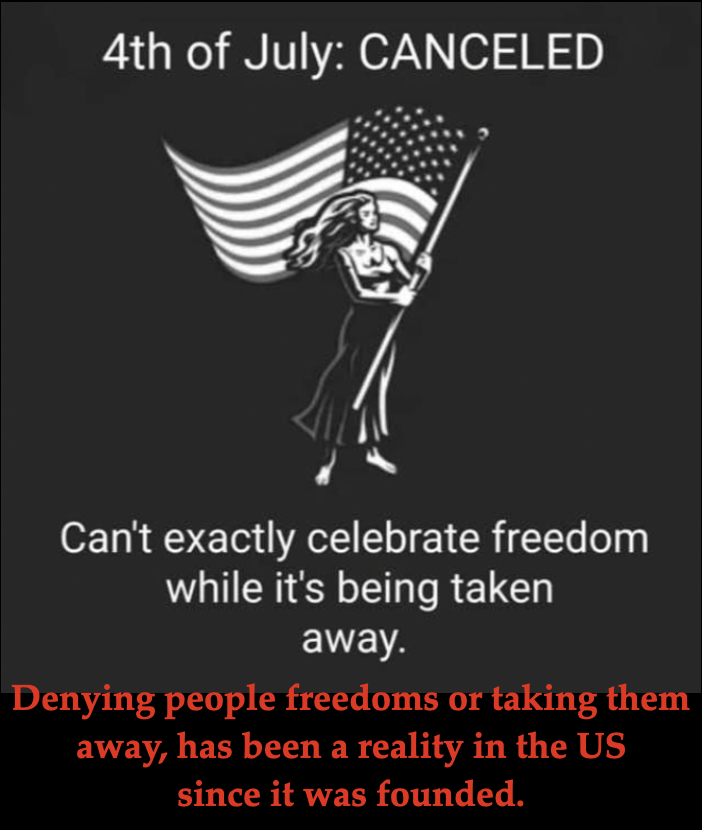
Within the past week, there have been calls coming mostly from white women to boycott the Fourth of July. There have been memes circulating on social media, like the ones displayed below.
Again, I get the anger and I get the motive to boycott July 4th. However, this sentiment demonstrates a great deal with what is wrong with how we understand history in this country, and how white privilege is once again being displayed in the calls for a Fourth of July boycott.
The Fourth of July holiday is designed to get people to passively accept the premise that the US fought and won independence and freedom from the British, wherein the residents of the newly created nation would experience liberty and justice for all.
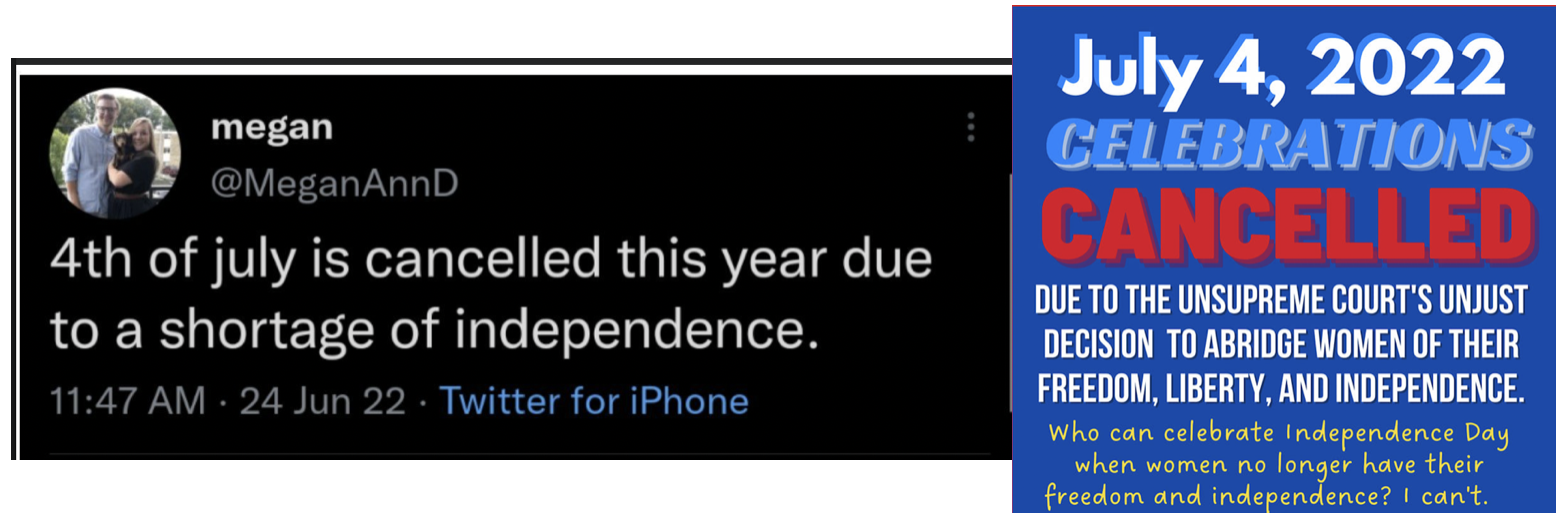
This all sounds nice and makes for great propaganda, but it completely ignores the history of oppression and exclusion that has plagued the US since it was founded. For those pissed off about the Roe v Wade decision, and calling for a Fourth of July boycott, demonstrates not only the level of their white privilege, it demonstrates their ignorance and complicity in crimes this country has committed against so many people. What follows is a brief list of why the Fourth of July could and should always be boycotted:
- The US has engaged in genocidal policies against Indigenous people/nations on this continent since the founding of the US. White Settler Colonialism has been the primary driving force, which has included the outright slaughter of Indigenous people, the forced removal from their lands, the repeated violation of treaties, forcibly removing Indigenous children from their communities and putting them in so-called “Boarding Schools,” and the denial of Indigenous people to celebrate their own spiritual traditions for most of the past 250 years. For an excellent resource, see Roxanne Dunbar Ortiz’s book, An Indigenous Peoples’ History of the United States.
- If people haven’t read it, they should read Frederick Doughlass’ famous 1852 speech, entitled, “What, to the Slave, is the Fourth of July?” Douglass calls out the realities of slavery and denounces the blind celebration of July 4th, by saying, “What, to the American slave, is your Fourth of July? I answer: a day that reveals to him, more than all other days in the year, the gross injustice and cruelly to which he is the constant victim. To him, your celebration is a sham; your boasted liberty, an unholy license; your national greatness, swelling vanity; your sounds of rejoicing are empty and heartless; your denunciations of tyrants, brass fronted impudence; your shouts of liberty and equality, hollow mockery; your prayers and hymns, your sermons and thanksgivings, with all your religious parade, and solemnity, are, to him, mere bombast, fraud, deception, impiety, and hypocrisy—a thin veil to cover up crimes which would disgrace a nation of savages. There is not a nation on the earth guilty of practices, more shocking and bloody, than are the people of these United States, at this very hour.”
- While Chattel Slavery was outlawed by the end of the Civil War, the US legal and economic systems made sure that Black people were still denied freedom and independence. The 13th Amendment essentially made slavery legal again, a theme which is explored in AvaDuVernay’s 2016 award winning documentary, 13th. In addition, the history of lynching, red-lining, legal segregation, the War on Drugs, mass incarceration, gentrification and the ongoing efforts to dismantled legal gains made by the Black Freedom Struggle/Civil Rights Movement, ultimately demonstrates that Black people have never been afforded the same freedom as white people in this country.
- The history of US immigration policy has excluded millions of people from coming to and be accepted into US society. From the Chinese Exclusion Act in the late 19th Century, the refusal of the FDR Administration to welcome thousands of Jews fleeing Nazi Germany, to the brutal treatment of people fleeing poverty, political oppression and climate catastrophe from Latin America since the 1960s, the US has consistently excluded millions of immigrants seeking asylum and safety. See our popular education tool, History of US Immigration Policy.
- The US has a bloody history towards working class people, which has always been directed by the Capitalist Class, with assistance from the state and the state’s main enforcement mechanism, the police. From the earliest efforts to win labor struggles in the early part of the 19th Century, the harsh repression of radical union organizing in the late 19th Century through the 1930s, and the ongoing Capitalist Class’s war against working people, evidenced by the efforts against Amazon and Starbucks workers, most people living in this country have never experienced economic freedom or independence. See Kim Kelly’s book, Fight Like Hell: The Untold History of American Labor.
- The US has consistently marginalized and repressed people who are part of the LGBTQ community, those who are gender non-conforming; religious minorities, especially Muslims, those in the disability community, anti-war dissidents, radical environmentalists and so many other communities that the systems of power in this country have never accepted and have often brutalized.
In addition, to the white privileged calls to boycott the Fourth of July, many white-centered organizations and white individuals have been using additional memes to reflect their anger towards the current US Supreme Court Justices, where they refer to them as the American Taliban, even changing the images of the 6 Supreme Court Justices that voted against Roe v Wade to look like members of the Taliban.
In a recent post on Dissident Voice, Tom Wheeler writes: Using phrases like “American Taliban” or invoking the term “sharia law” to attack the ruling of Christians on the court is all the rage after the recent Roe v. Wade decision. Once again, we have people—primarily liberal white people—engaging in racist, Islamophobic tropes. Muslim activists, scholars, and researchers have repeatedly pointed out this racism and Islamophobia for years, apparently to no avail. This needs to stop. Islam isn’t the problem. It’s Christianity. The six judges who voted to overturn Roe v. Wade aren’t Muslim. They’re Christian. The oppression in America is home-grown Christianity. It’s as American as apple pie.
Wheeler goes on to cite professor Nazia Kazi at Stockton University, who points out, “it reflects this assumption that Muslim women are uniquely oppressed and that American or western women are remarkably liberated. From both the American common sense public imagination, right on up to the seats of power, there’s this impulse to externalize that which actually is endemic to the US itself.”
What this all comes down to is the failure of white liberals to fully understand or acknowledge the real history of the US, along with the fact that too many white liberals don’t really give a damn about other people’s struggles for freedom and liberation. Calling for a boycott on the 4th of July because of the recent US Supreme Court ruling, is a reflection of the fact that too many white people knowingly or unknowingly embrace the values of White Supremacy.

