This week we have been posting a series of articles on the 55th anniversary of the riot/uprising in Grand Rapids, which took place from July 25th through the 27th in 1967. Most of the content for these articles is from pervious postings on the Grand Rapids People’s History Project site, in the Civil Rights/Black Freedom Struggle section. I am interested in this history for several reasons, but mostly because of what we can learn from the past and how it can impact the present and the future.
In Part I, we looked at the Grand Rapids Press coverage of the 1967 riot in Grand Rapids. In Part II, we looked at the coverage from WOOD TV8. Part III was a look at the imagery of the 1967 riot in what we are calling Cops, Property and the White Gaze. In Part IV, we looked at a report the City of Grand Rapids produced just after the 1967 riot, called Anatomy of a Riot. In today’s post, which is the last in the series, we look at MLive reporting on the 50th anniversary of the 1967riot, along with what has happened since.
 In 2017, on the 50th anniversary of the 1967 riot in Grand Rapids, this is what we wrote:
Over the past few days, MLive has been running a series of articles about the 1967 riot in Grand Rapids. Next week is the 50th anniversary of the 3 day riot that took place and MLive has been posting several stories, lots of photos and video about the 1967 riot.
There have been some positive aspects of what MLive reporters have done in this series, especially the interviews with members of the African American community that witnessed the 67 riot or those who have researched it.
However, there are also many problems with the MLive series on the 1967 riot. We want to address what is problematic about the coverage and why their reporting perpetuates a tremendous amount of misinformation about what took place in July of 1967.
No Ownership on the part of the GR Press and its role in the reporting in 1967
It is vitally important for us to think about the events 50 years ago in Grand Rapids, to come to terms with its significance, and how the dominant narratives around the 67 riot impact us today.
The Grand Rapids People’s History Project has assembled all the articles and the editorials from the Grand Rapids Press during the 3-day riot in 1967. The articles are in order of appearance between July 25 and July 27.
One thing that is apparent in the Press headlines is how the riot is framed. The riot is framed as violence and the response from the City of Grand Rapids is presented as keeping the peace. This is to be expected, since the dominant narratives about riots affirms the idea that riots are an attack on the social order of the day.
However, as Dr. King so eloquently put it, riots are the “language of the unheard.” In addition, riots are a response to the structural and daily violence imposed by the systems of capitalism and white supremacy on communities of color. Structural violence is the daily oppression that communities of color experience in the form of poverty, lack of adequate housing, poor health care, lack of educational opportunities and environmental racism.
MLive and the continuance of the dominant, white supremacist narrative
Fifty years later and the major daily news source in Grand Rapids is continuing to perpetuate the dominate narrative, which is to say a white supremacist narrative.
The first article in the series is entitled, Grand Rapids 67 riot: when anger, oppression erupted into ‘chaos.’ There are dozens of accompanying photos that solidify the dominant narrative, showing white cops arresting or detaining black suspects.
Several of the African Americans interview for this MLive article do offer some insight into the conditions that the black community were subjected to, but the MLive article also sought to convey the message that things are better now. Things are better now based on what Mayor Bliss is doing with the racial equity initiative, what the Chief of Police is doing with community relations, what data the City Manager has looked at and what an employee of Start Garden has to say about bringing economic development to communities of color. The MLive writer does not investigate any of the claims made by those who believe that things are better now and there is no evidence to support such a claim.
In addition, there is a video that MLive put together, which through the use of archival photos and text essentially affirms what was said in the article. There is some acknowledgement that inequality exists, but that city leaders are “now addressing issues of racial inequity head-on.” Again, no evidence is provided to show how racial inequity is being addressed in concrete terms.
A second article in the series is made up of interviews with five African Americans and two white people who were living in Grand Rapids at the time. I can appreciate the attempt to make these voices public, but there is little historical context to what was shared by these seven people.
A third article in the MLive series looks at how Division Avenue in Grand Rapids has never recovered from the 1967 riot. A variety of people are interviewed, historians, business people and the Grand Rapids Chief of Police. There is some acknowledgement of white flight and disinvestment in the southeast part of Grand Rapids, but there is no acknowledgement of the current gentrification that is happening in and around the area most impacted by the riot in 67. Instead, employees of DeVos-owned entity Start Garden, “are focused on redeveloping Grand Rapids at the micro level by helping small businesses and startups.”
A fourth article in the series makes the claim that the city is doing what it can to address racial inequity. The MLive article gives voice to Police Chief Rahinsky, City Manager Greg Sundstrom and Grand Rapids Mayor Rosalynn Bliss. Of the three, Sundstrom is more honest about the challenges, saying that he didn’t think the problems from 1967 are getting any better today. However, both Rahinsky and Bliss make the claim that the city is addressing these problems and is making headway.
What is problematic about Chief Rahnisky’s claims that the City has been aggressive in finding solutions since the 2014 shooting of Michael Brown in Ferguson, Missouri, is that many in the African American community don’t believe that the city has really done anything to address inequity. In fact, as many in the African American community have been pointing out, the city leadership and the police department continue to downplay the urgency surrounding the numerous and recent incidents of violence by the GRPD.
In addition, the city has failed to take serious the black community’s word on racial profiling by the GRPD, especially motorists. This became evident recently, since the city paid thousands to conduct a traffic study, wherein the results were a confirmation of what the black community has been saying for years.
The current affordable housing crisis and the growing gap between the rich and the poor in Grand Rapids are also evidence that the city is not any closer to achieving racial and economic equity in the past 50 years. The movement by white people back to the urban core areas of Grand Rapids and the re-investment to those areas not only makes rent higher for thousands, it displaces communities of color at a disproportionately high rate.
The City of Grand Rapids needs to take seriously the platform of the Movement for Black Lives, which has laid out an ambitious and just vision for how to achieve justice, which are laid out here. However, I don’t think people should expect the city to embrace such a vision. What will likely happen is what has always happened is for African Americans to take matters into their own hands and challenge this system of white supremacy and managerial racism in Grand Rapids. How they chose to do it is another matter, but it seems that the current state of emergency might call for another uprising, like in 1967.
The 2020 Uprising in Grand Rapids
No one could have predicted that the police murder of George Floyd would have sparked a national uprising against the oppressive way that policing in done in this country. The uprising not only mobilized millions, it brought with it a deeper analysis of the Prison Industrial Complex, an analysis that came out of the work that Black writers and organizers had been doing for decades, which was rooted in an abolitionist perspective. With this abolitionist framework, the Movement for Black Lives was also calling for the Defunding of the Police across the country.
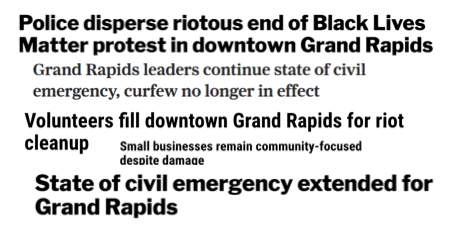
The Grand Rapids commercial news media again, demonstrated their allegiance to centers of power and systems of oppression, by relying primarily on the voices of City officials and business owners in downtown Grand Rapids. GRIID conducted a 5 day study of the local news coverage just after the May 30th uprising, which we wrote about on June 5th.
The sources cited from each commercial news source, also indicates which voices were centered in the coverage of the protests and government response over the 5 day study period. Government and police voices are the most dominant, with business and clean up voices combined taking up the next most space, with protesters being the least important. In addition, the protester voices that did appear in the commercial news sources we documented, were voices that were primarily after the uprising/riot took place, always with the news media framing these protest voices as “peaceful” and almost completely avoiding the larger structural issue of White Supremacy. What should have been an opportunity to amplify black voices, resulted in the same voices that are always centered – state voice, business voices and cop voices.
Internalizing the values of the System
This brings us to the larger issue of how these news stories were collectively framed. Media framing is often described as the angle or perspective from which a news story is told. While news is often thought to be objective and value free this is rarely if ever the case. In fact, what media researchers have been saying for decades is that commercial news sources tend to internalize the over-arching values of the dominant culture and the larger systems of society, which are fundamentally systems of oppression.
This means that the coverage of what took place in Grand Rapids since last Saturday, was framed through the dominant social, cultural and political values. For example, protesting can only be viewed through the lens of peaceful or non-confrontational, when in fact a great deal of public dissent and protest has been very confrontational throughout US history and often operates outside of the legal framework – civil disobedience, insurrection, uprisings, strikes and occupations are all part of how people have protested/dissented. Therefore, to create the good/bad protester framework in just dishonest.
Another major value that the commercial news media has internalized, is the fact that they rarely recognize structural violence or structural looting. Every day in Grand Rapids, black people are are subjected to poverty, police harassment/intimidation, limited resources, limited choices, redlining and gentrification, yet these issues are rarely acknowledged. Therefore, when people rise up and demonstrate their collective anger and pain, the commercial news media sees vandalism and disrespect for the law, when in fact what is often happening is a collective response to the the oppression of White Supremacy, Capitalism and State violence. The City of Grand Rapids brings the National Guard in to “restore order,” when in fact the order they are restoring is racial injustice, a massive wealth gap, despair and whiteness.
Looking at these news stories collectively affirms our analysis and demonstrates that the commercial news media in Grand Rapids plays a major role in how the dominant culture views West Michigan. We need to come to terms with the fact that are growing number of people, especially black people, who are tired of living under the boot of West Michigan Nice.
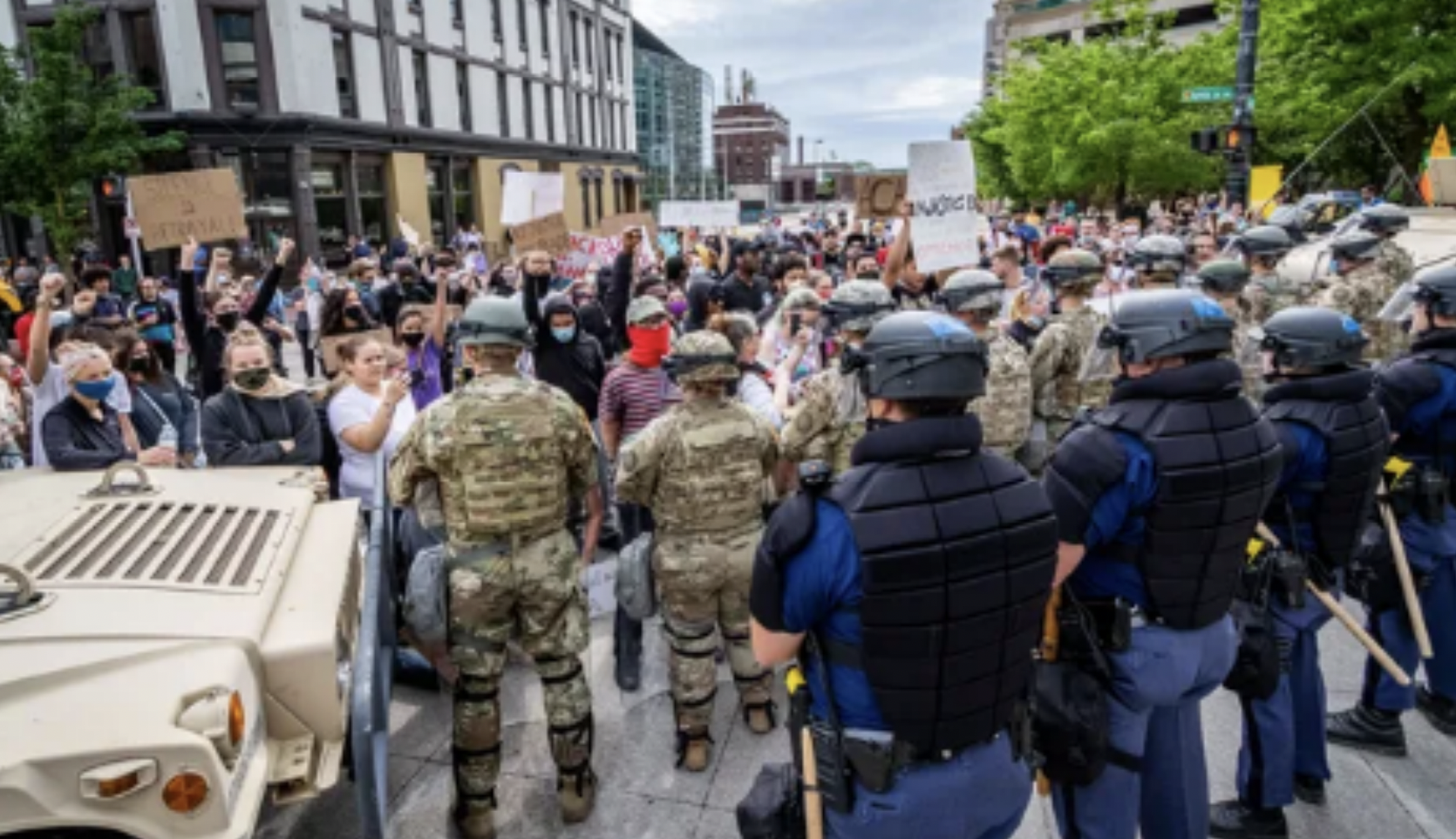
Lastly, we need to honestly think about how the trial of former GRPD cop Christopher Schurr will play out, especially if he is found not guilty of murdering Patrick Lyoya. Once again, the economic conditions of thousands in Grand Rapids, with the ongoing impact of the pandemic and the structural racism that plagues Grand Rapids are the kinds of conditions that could lead to another riot/uprising, especially if Schurr is found not guilty in the murder of Patrick Lyoya. We cannot, and should not, expect the commercial news media in Grand Rapids to provide honest and in depth reporting should another riot occur. In fact, what should be apparent to those involved in the Justice4Patrick Movement, is that we need to create and promote our own narrative and not allow systems of power and oppression to dictate what is happening right now in Grand Rapids. This should be one of the most important lessons we can learn from the 1967 riot in Grand Rapids.
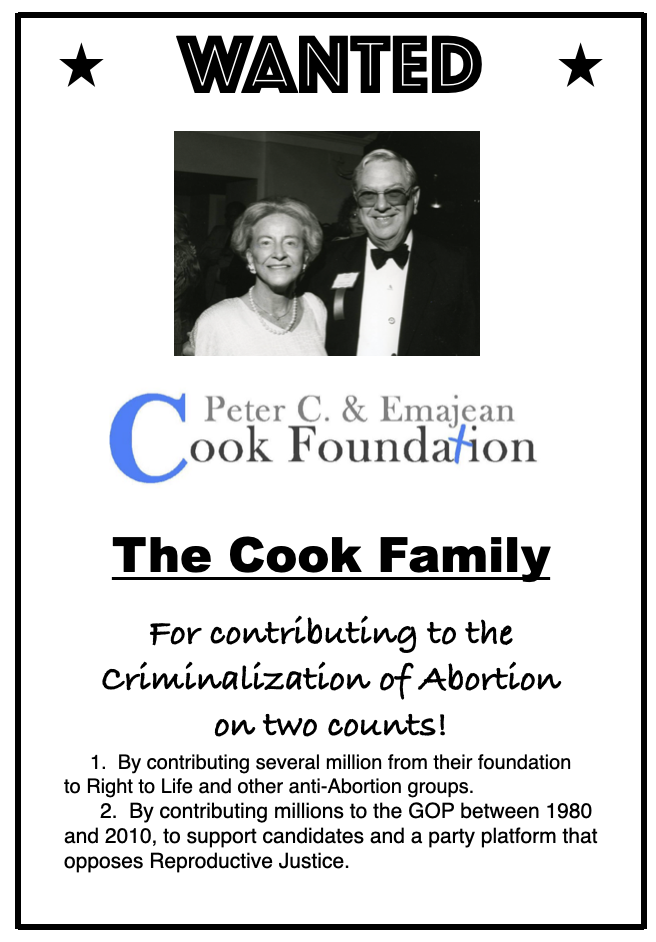 This is the second in a series of WANTED posters, looking at individuals, families and organizations in West Michigan that have contributed significantly to the criminalization of abortion and the undermining of reproductive justice.
Peter Cook, now deceased, was the former President of Great Lakes Mazda in Grand Rapids, as well as being the former Director of Michigan National Bank. While Cook never reached the same level of wealth that his contemporary Rich DeVos did, Cook was a multi-millionaire.
Cook had a long history of being part of the far right, from the Council for National Policy to the anti-public education group TEACH Michigan, Gospel Films, Campus Crusade for Christ, the Mackinac Center, and the Acton Institute.
Then there are the groups that Cook contributed to that played a significant role in pushing an anti-abortion agenda, groups such as Michigan Family Forum, Focus on the Family, the Family Research Council, and Right to Life Michigan. His funding of these organizations eventually led to the US Supreme Court’s overturning of Roe v Wade, thus criminalizing abortion.
Like the DeVos family, Peter Cook funded an anti-abortion agenda both through his foundation, the Peter and Emajean Cook Foundation and through his campaign contributions over the years to GOP candidates and incumbents.
We encourage you to share this poster and consider directing some of your rage at the recent US Supreme Court ruling to overturn Roe v Wade towards the Cook Family Foundation, since both Peter Cook and his wife are no longer living.
Sources used:
The Religious Right in Michigan Politics, by Russ Bellant, 1996.
 This week we will be posting a series of articles on the 55th anniversary of the riot/uprising in Grand Rapids, which took place from July 25th through the 27th in 1967. Most of the content for these articles is from pervious postings on the Grand Rapids People’s History Project site, in the Civil Rights/Black Freedom Struggle section. I am interested in this history for several reasons, but mostly because of what we can learn from the past and how it can impact the present and the future.
In Part I, we looked at the Grand Rapids Press coverage of the 1967 riot in Grand Rapids. In Part II, we looked at the coverage from WOOD TV8. Part III was a look at the imagery of the 1967 riot in what we are calling Cops, Property and the White Gaze. Today, we want to look at a report the City of Grand Rapids produced just after the 1967 riot, which they called Anatomy of a Riot.
It’s been 55 years since hundreds from the black community rose up in a three day riot against racial injustice in Grand Rapids.
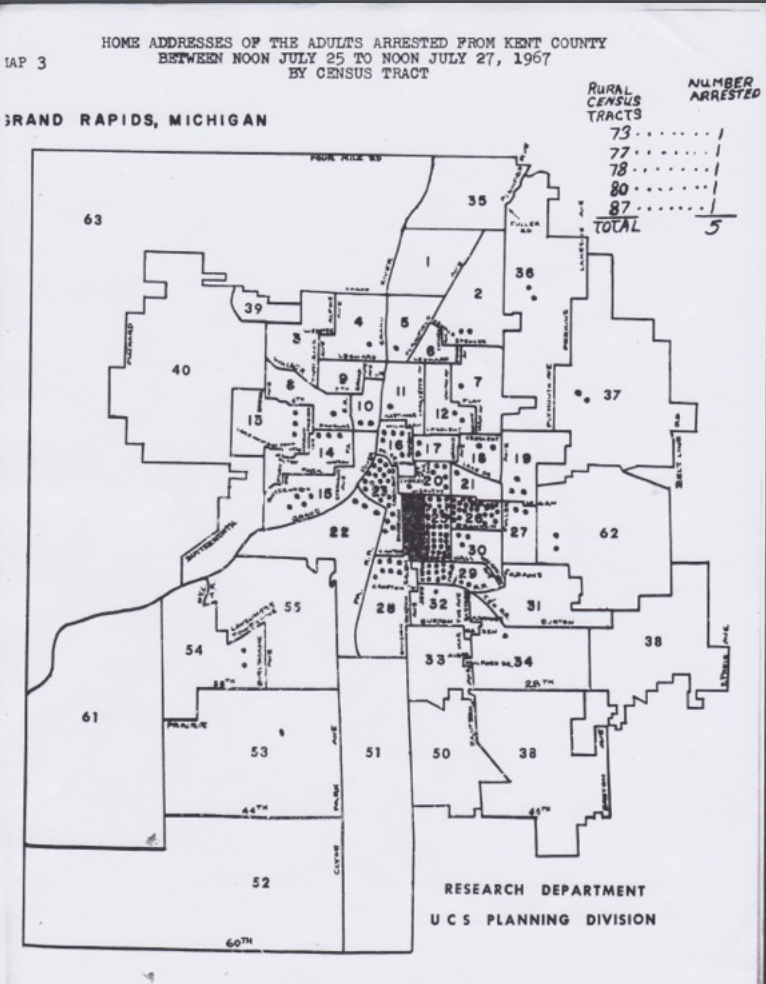
In 1967, there were 44 cities that experienced a racial uprising, including Grand Rapids. Like all across the country, the black community in Grand Rapids suffered from high levels of poverty, unemployment, limited educational opportunities, poor housing and little political power. On July 25th, Grand Rapids police pulled over a car with several black youth, and in front of several witnesses, used “excessive” force against those same black youth.
This was the spark that ignited an entire community’s rage over decades of institutional racism and exploitation. Some in the black community smashed windows of white owned businesses, while others set fire to abandoned or rundown buildings owned by white absentee landlords. An estimated 320 arrests were made during the three days that rioting took place, with most of the arrests involving members of the black community.
However, there were several white people who were arrested, according to a report published just months after the 1967 riot, entitled, Anatomy of a Riot. According to the report, published by the Grand Rapids Planning Department, most of the white people that were arrested, was because of weapons charges. Apparently, there were several white residents who wanted to use the riot as an opportunity to shoot black people. The report notes that some of the white people arrested were armed because they “wanted to protect their property.”
There were even a few groups (the report refers to them as gangs) of white people who roamed the streets on foot and in cars, particularly from the west side of Grand Rapids. The Grand Rapids Police Department even received calls from white people wanting to “volunteer as vigilantes.”
It’s Their Behavior, not the System
In the last section of the Anatomy of a Riot report, they make some recommendations about what could be done to prevent future responses like the 1967 riot.
Income – The report states that there is a need to provide full employment to people in the black community, so they they can take care of themselves. The report doesn’t say anything about wages, just employment, as if any job will suffice. The report also acknowledges that there are few black owned businesses and no black run financial institutions. Looking at the economic reality for blacks in Grand Rapids today, not much has changed, based on a report acknowledging that Grand Rapids is one of the worst cities for blacks to live in.
Housing – The report acknowledges that more black people should be provided the opportunity to own their own homes. However, the report also states, “At the same time, to stop deterioration, the prices of ghetto property have to be determined by the supply and demand of the open market.” Ironically, the same mentality exists today, which is why a disproportionate number of African Americans are being priced out of the housing market in Grand Rapids.
However, the report does suggest that local government needs to better serve the black community. The report states:
“The residents of the inner city must feel that the local government is their government. This is best shown when their problems and suggestions are considered as seriously as those of others in the community. A reputation for being concerned and doing everything possible for the inner city will go a long way toward the opinion that, unlike most American cities, the government of Grand Rapids considers these people first class citizens.”
In this whole section of the report, the section on recommendations, is completely devoid of any systemic analysis. In addition, institutionalized racism and White Supremacy are completely omitted from this part of the report, which is to say that those that prepared the report believe that while society can do better, the problems facing the black community comes down to its behavior.
So it has been nearly a half a century since the 1967 riot in Grand Rapids. So, what lessons can we learn from how the dominant culture responded to this racial uprising that took place 55 years ago?
First, not much has changed in terms of the quality of life for the black community in Grand Rapids. Almost every indicator in terms of quality of life has not changes much. Whether it is income levels, employment, housing, health care or incarceration rates, the black community continues to be disproportionately impacted in a negative way in each of these areas.
Second, the news media and public opinion continue to reflect White Supremacist values. The problems in the black community, we are told, are the fault of the black community. Things like institutionalized racism don’t really exist, we just need more diverse representation in our organizations, in government and corporate board rooms. However, the real lesson to be learned is that white people and white dominated power structures are resistant to change. The 1967 Riot says more about white people and our unwillingness to come to terms with White Supremacy.
Lastly, black anger and black rage are not allowed. As in the 1967 riot, black people today are constantly being told to be patient and to work to change things through proper channels. Join a non-profit, vote or start your own business, but stop blaming it all on racism are the mantras of today. Dr. Martin Luther King Jr. would disagree with this sentiment and had his own important take on what a riot really is, when he said – “It is not enough for me to stand before you tonight and condemn riots. It would be morally irresponsible for me to do that without, at the same time, condemning the contingent, intolerable conditions that exist in our society. These conditions are the things that cause individuals to feel that they have no other alternative than to engage in violent rebellions to get attention. And I must say tonight that a riot is the language of the unheard.”
In June, the Coalition for Community Owned Safety began collecting signatures on a petition they are circulating that would, amend the Grand Rapids City Charter to replace certain mandatory budget appropriations in subsection (f) and, instead, require the City to appropriate no less than 9.8% of the General Operating Fund for affordable housing, mental and physical health, environmental sustainability, police accountability, and economic growth of communities with disproportionately high gun violence, unemployment, and child poverty. For the complete language of the petition campaign, go to this link.
This campaign to change the Grand Rapids City Charter would change the language from the 1995 campaign which institutionalized a minimum of 32% of the City’s budget to go to the GRPD. That campaign was utilizing the fear mongering campaign that was passed in 1994 at the federal level, known as the Crime Bill, which also institutionalized more funding for policing, even though violent crime was in decline.
Ever since the May 31st, 2020 Uprising in Grand Rapids, there have been calls to Defund the GRPD. In July of 2020, some City Commissioners proposed to reduce the GRPD funding to the 32% minimum per the 1995 City Charter change, but the City Manager and City Attorney stepped in to prevent such a vote from happening. This call continue, but was escalated after the GRPD murder of Patrick Lyoya in April of 2022.
The Coalition for Community Owned Safety, which involves the ACLU of Michigan, Urban Core Collective, NAACP of Greater Grand Rapids, and LINC UP. Shortly after they began their campaign to collective signatures to amend the City Charter, there have been at least two organized efforts that we know of to oppose thing campaign.

The first organized campaign was started in February of 2022, called SafeGR.org People living on the westside of Grand Rapids were receiving political mailers calling on people to oppose the petition campaign to amend the City Charter. The SafeGR.org campaign has very little information on their webpage. There is a contact page, a PO Box listing and this brief text:
Our great city is home to a diverse group of people. We come from all walks of life, economic backgrounds, and places all over the world. We deserve a city and neighborhoods that are safe, welcoming, and prosperous.
I have not been able to find out any information about this group, after looking through numerous channels and I did send them a message asking for more information, but received no response.
The other organized effort to oppose the petition campaign by the Coalition for Community Owned Safety, is purely an online effort I have seen on Facebook for the past several weeks by the group known as Mighty Michigan. According to the group’s website it states:
Mighty Michigan is dedicated to building a freer, more prosperous Michigan. As you know, entrenched politicians and special interests have controlled Michigan’s government for too long – and we’re working to change that.
The same page says, “Mighty Michigan is sponsored by the nonprofit American Culture Project, a national leader in research and civic engagement in the Midwest and throughout the country.” The American Culture Project comes off as a non-partisan, non-profit groups that claims to empathize with regular people. They also have campaign in Florida, Ohio and Michigan.
However, according to SourceWatch:
“The American Culture Project (ACP) is a 501(c)(4) right-wing nonprofit officially registered as the Americans for Government Accountability. According to a fundraising proposal obtained by The Washington Post, ACP was created “to address the right’s gap of cultural influence” and plans on “building a permanent, growing community focused infrastructure to take back the commanding heights of culture that determines electoral outcomes.”
In addition, according to an article in the Anchorage Daily News:
Undisclosed on the Facebook page is the nonprofit’s partisan goal. Arise Ohio and similar sites aimed at other politically pivotal states are part of a novel strategy by a little-known Republican-aligned group to make today’s GOP more palatable to moderate voters before the 2022 midterms by reshaping the “cultural narrative” on hot-button issues. That goal, laid out in a private fundraising appeal sent last month to a Republican donor and reviewed by The Washington Post, relies on building new online communities that can be tapped at election time, with a focus on winning back Congress in 2022.
In regards to Mighty Michigan/American Cultural Project opposition to the Grand Rapids petition campaign to amend the City Charter, they say:
The proposal uses a sleight of hand to avoid spelling out its goal of defunding the police. This is because the new 9.8% spending requirement on other priorities leaves no alternative but to slash law enforcement spending. Simply put, if this ballot proposal were to pass, it would mean a reduced public safety presence in Grand Rapids neighborhoods.
This campaign seeks to use the language of Defunding the Police as a fear tactic, just like the GOP and the Democratic Parties have been doing since this became a rallying cry from the Movement for Black Lives, which has an excellent toolkit on how to do a Defund the Police campaign in your community.
 The Facebook ads from Mighty Michigan not only urges people to oppose the Coalition for Community Owned Safety petition drive, they invite people to send messages to Grand Rapids City Officials, with their own petition campaign, as you can see here on the right. This petition can be signed by anyone no matter where they live, but it also has no legal weight, unlike the petition campaign to Amend the Grand Rapids City Charter that the Coalition for Community Owned Safety is circulating. In fact, the Grand Rapids Police Officers Association, which is the GRPD union, linked the Mighty Michigan campaign on their Facebook page on July 17, along with limiting who could comment on the post, which seems to be a relatively new tactic on their part.
At GRIID, we highly encourage people to sign to Coalition for Community Owned Safety petition, which you can access from the coalition groups – CLU of Michigan, Urban Core Collective, NAACP of Greater Grand Rapids, and LINC UP. You can also help circulate the petition by getting copies at any of the offices of the coalition groups.
We also think it is important to be aware of and understand that there are at least two organized efforts to oppose this grassroots effort. As with any organized opposition, we must always ask ourselves, what is it that they find so threatening about the Coalition for Community Owned Safety petition and what is motivating their opposition. Based on the Mighty Michigan/American Cultural Project, their motivation is both political and partisan, plus their tactic is to use fear and misinformation.
This week we will be posting a series of articles on the 55th anniversary of the riot/uprising in Grand Rapids, which took place from July 25th through the 27th in 1967. Most of the content for these articles is from pervious postings on the Grand Rapids People’s History Project site, in the Civil Rights/Black Freedom Struggle section. I am interested in this history for several reasons, but mostly because of what we can learn from the past and how it can impact the present and the future.
In Part I, we looked at the Grand Rapids Press coverage of the 1967 riot in Grand Rapids. In Part II, we looked at the coverage from WOOD TV8. Today, we want to look at the imagery of the 1967 riot in what we are calling Cops, Property and the White Gaze.
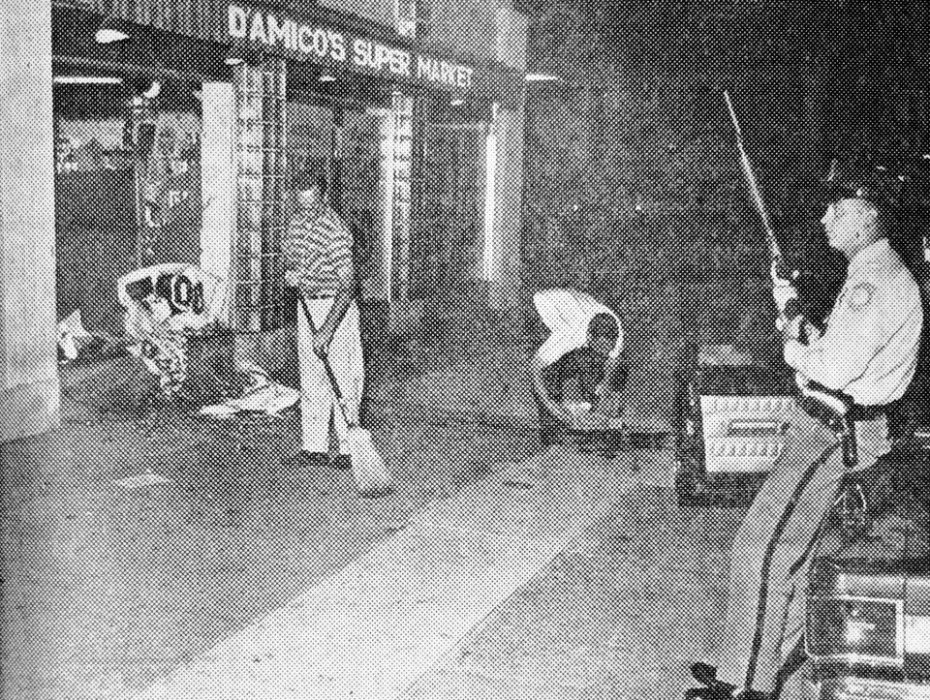 In today’s post, we wanted to share a selection of photos from the Grand Rapids Press that were taken in late July of 1967 during the three days of the Black uprising in Grand Rapids. The photos are instructive, since most of them deal with White owned property, police protection of White owned property or Grand Rapids cops policing the Black community.
These photos could collectively be identified as utilizing what some social theorists refer to as the White Gaze. The White Gaze, “is described as looking at the world through the eyes of a white person who has undertones of, or is blatant in, their racism,” as is defined by George Yancy, Professor of Philosophy at Duquesne University.
The photos definitely reflect the White Gaze, not just because they were taken by a white photographer, but because they reflect visually constructed reality as presented through a white lens.
The first photo (seen above) is from S. Division in Grand Rapids, where we see white business owners/workers outside of D”Amico’s Super Market cleaning up after windows had been broken. This image also includes the presence of a white cop with a rifle held in such a way as to make it clear who he is there to protect.
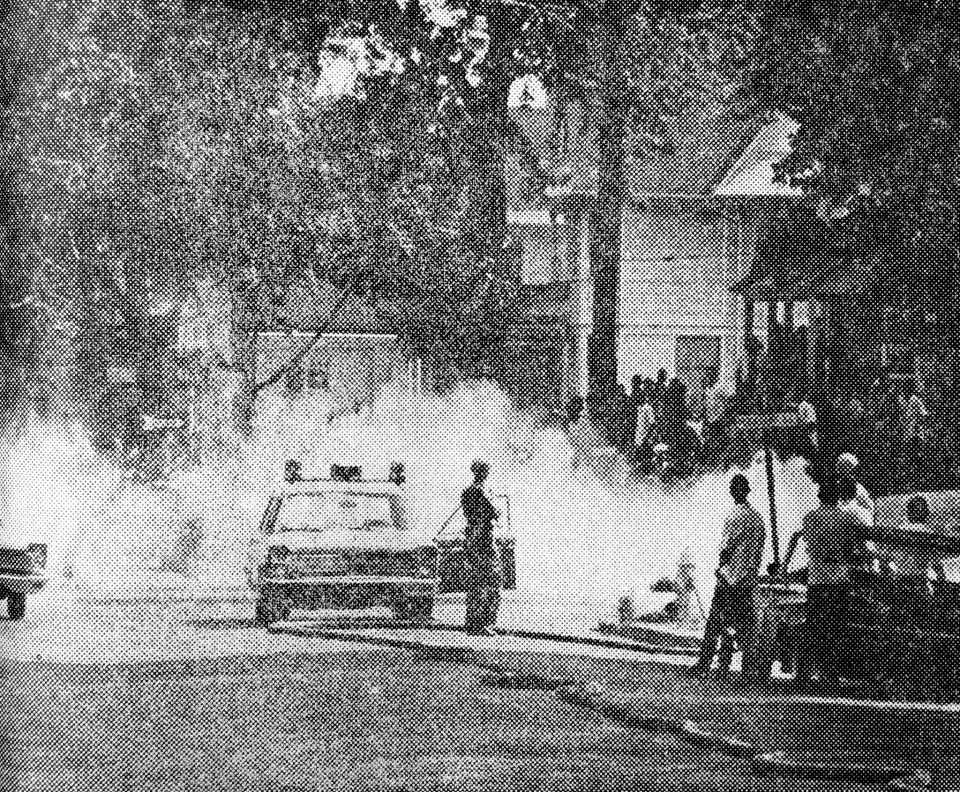
The next photo (seen below) is an image of Grand Rapids cops using tear gas in a predominantly Black neighborhood near the corner of Jefferson and Pleasant SE. The tear gas was used to disperse a crowd of people who had gathered.
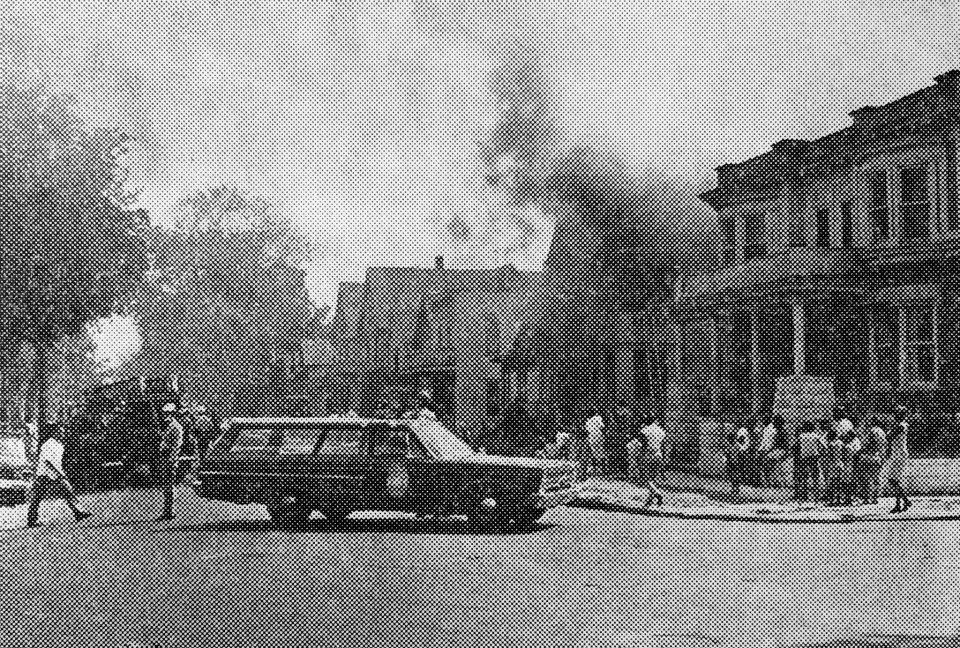
The third photo in this selection (seen below) shows a house on Jefferson near Buckley SE that was on fire. Neighbors who lived in that area during the 1967 uprising told this writer that houses were often targeted, because they belonged to white absentee landlords. The house that is on fire was torn down and that lot on Jefferson is still vacant to this day.
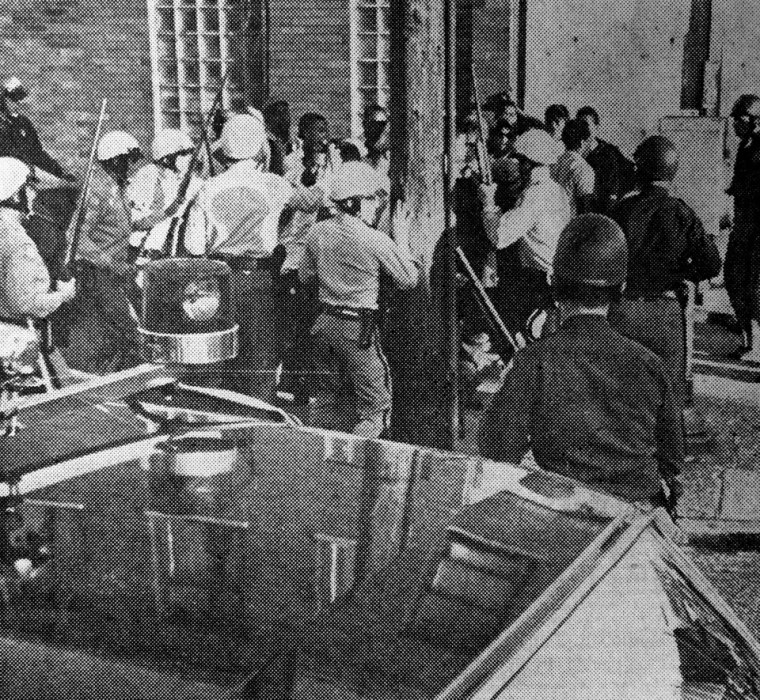 The next photo (to the right) shows Grand Rapids cops cornering Black people near the corner of Wealthy and Division. Despite the fact that this was predominantly a Black neighborhood, Black people were not permitted to freely move about, especially during the three days of rioting in 1967.
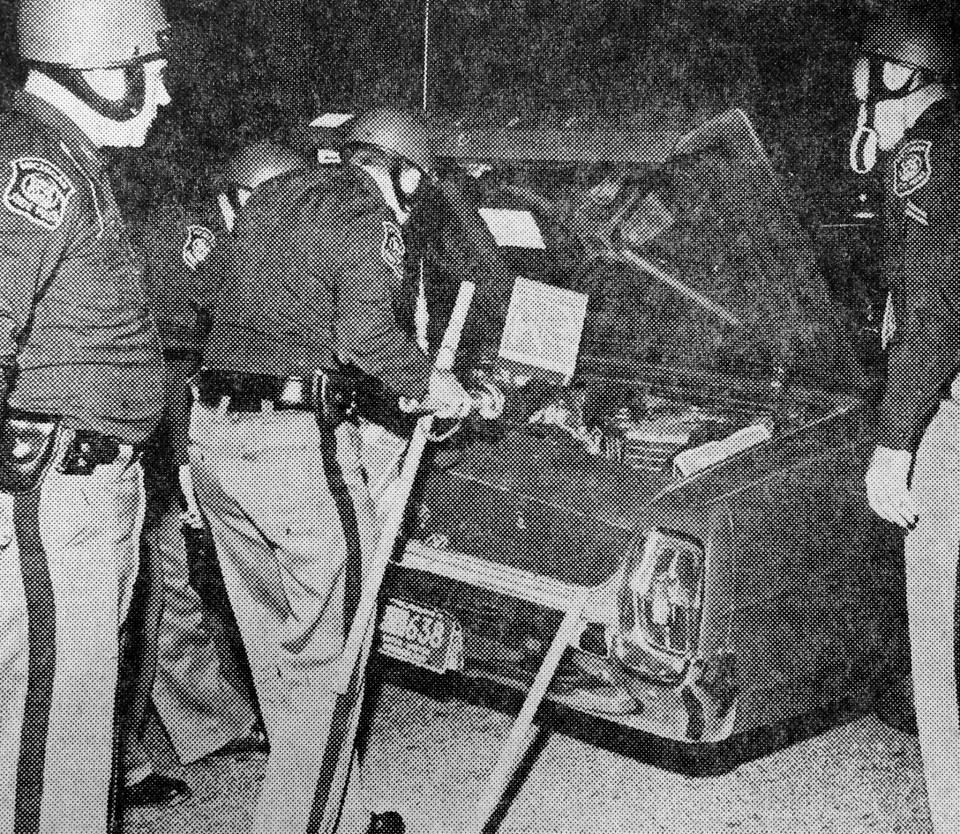
This fifth photo (see below) from the selection shows Grand Rapids cops going through the trunk of someone’s car. People coming in and out of the neighborhood that they lived in during those three days of rebellion in 1967, were subjected to constant surveillance and harassment by the cops.
The last photo seen here below is of a Grand Rapids Police Officer, who “poses” with people along Division Avenue during the uprising of 1967. This image is particularly telling as it represents the arrogance of White Supremacy, with a White cop posing amidst Black people who were confronted by the brutality of this system.

Again, these images from the Grand Rapids Press, were primarily consumed by a white readership, which is why it is important to reflect on the power of the white gaze.
In Part IV, we will look at the City of Grand Rapids report that came out after the 1967 riot, entitled, Anatomy of a Riot.
On Monday, MLive reported that Downtown Grand Rapids Inc. (DGRI) is looking to expand their boundaries in order to capture more tax money for development.
The MLive article states:
Tim Kelly, president and CEO of Downtown Grand Rapids Inc., said his organization is exploring whether to expand the DDA’s tax collecting boundaries to include the area around 201 Market Ave. SW, the site of a proposed 12,000 seat amphitheater and other potential development.
Later on, the article clarifies that there will be additional development projects such as apartments, retail space, parks and trails.
In addition, the MLive provides readers with this bit of information:
The DDA doesn’t collect tax revenue from the site now because it’s owned by the city of Grand Rapids.
However, by adding the property to the DDA’s tax capture plan, the DDA could begin collecting revenue from the site should it one day come on to the tax rolls.
If the property wasn’t added to the DDA but went on the tax rolls, property tax revenue from the site would go to the the city of Grand Rapids, Kent County, Grand Rapids Community College, and The Rapid.
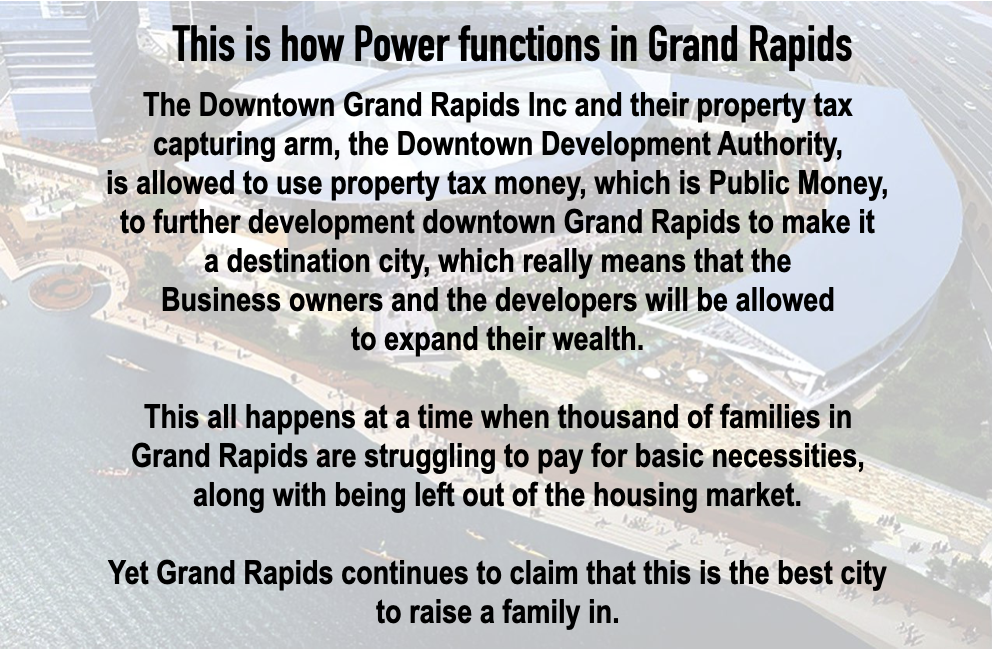
This last sentence should raise eyebrows and concerns from anyone who is interested in seeking any kind of equity, since as the article makes clear, the Downtown Development Authority (DDA) uses the property tax revenue from the downtown area and they get to decide how that money is use, which is always to further development plans in downtown Grand Rapids.
Now, maybe people have been aware of this fact, that the DGRI, through the use of the DDA, are able to capture property tax revenue and use it solely for the benefit of the downtown. The DDA website affirms this by saying:
The Downtown Development Authority (DDA) is a funding tool Downtown Grand Rapids Inc. administers to help catalyze public and private investment in Grand Rapids urban core. Funds go to help expedite private development projects, put underutilized property back to productive use, build streets and public infrastructure, as well as maintain and expand parks and other public amenities.
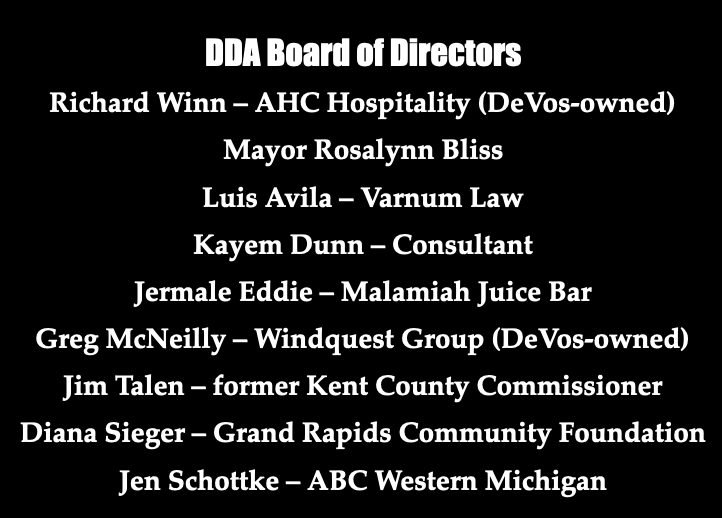 This means that a 9 member board of the Downtown Development Authority, a group of people that are appointed and NOT elected, get to make these decisions about property tax money. On top of that the DDA Board is made up of the Mayor of Grand Rapids, former Kent County Commissioner Jim Talen, the President of the Grand Rapids Community Foundation, a corporate lawyer and 5 business representatives, two of which work for the DeVos family – Greg McNeilly and Richard Winn.
This also isn’t the first time that the DGRI/DDA boundaries have expanded, such as in 2016, when they proposed to expand an additional 200 acres.
Unfortunately, this issue is completely off the radar for most people, people who are just trying to figure out how to pay the bills with all the increases in gas, food and housing costs. And this is exactly why people should be aware, concerned and organized to oppose the DDA expansion. We need to demand that the DGRI/DDA not be allowed to expand and should give up their ability to capture property tax revenue that they then have control over.
If the City of Grand Rapids and the people of Grand Rapids want property tax money, which is PUBLIC MONEY, to be used for affordable housing, to lower the cost of mass transit or to provide economic relief to the thousands of families in this community that are struggling to survive, then that is exactly what this public money should be used for. The members of the Grand Rapids Power Structure and other wealthy elites can actually practice free market capitalism and pay for their own damn development projects without using public money. They will just have to wait for people to spend money at their establishments to make the money back that they invested in, just like everybody else. This is a great example of how participatory budgeting could be applied to meet the need of the most vulnerable in this city.
This week we will be posting a series of articles on the 55th anniversary of the riot/uprising in Grand Rapids, which took place from July 25th through the 27th in 1967. Most of the content for these articles is from pervious postings on the Grand Rapids People’s History Project site, in the Civil Rights/Black Freedom Struggle section. I am interested in this history for several reasons, but mostly because of what we can learn from the past and how it can impact the present and the future.
In Part I, we looked at the Grand Rapids Press coverage of the 1967 riot in Grand Rapids. Today in Part II, we want to look at the coverage from WOOD TV8.
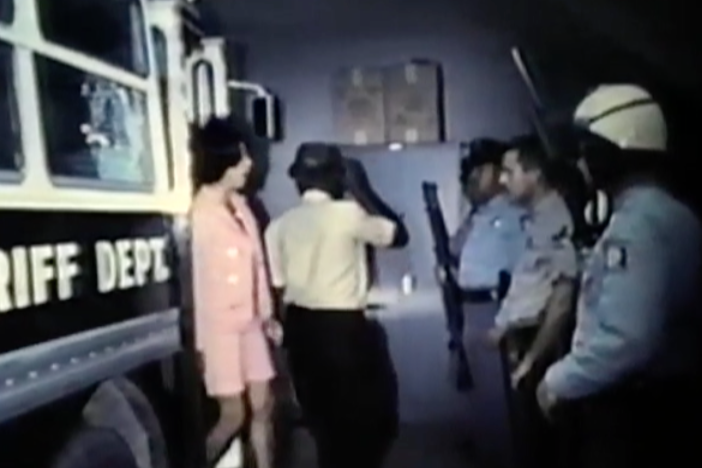
Today, we are posting footage from channel 8 that includes at the beginning a story done by reporters in Detroit during the 1967 riot in the Motor City, followed by footage with no commentary, an interview with the Grand Rapids Chief of Police and an interview with a Grand Rapids Business owner, whose store was attacked during the riot. The footage seems to go back to Detroit briefly, with the channel 8 reporter commenting, then followed again by footage in Grand Rapids without any commentary.
There is some footage of people who had been arrested, but no one who was arrested and no one from the Black community was interviewed about what started the three day riot nor what conditions the Black community were living under prior to the riot in late July of 1967. The video footage lasts a total of 11 minutes and 8 seconds and is a good indication of how the riot was reported on by commercial media at the time. The transcript for the channel 8 coverage is after the video.
The first clip with sound is with the Grand Rapids Police Chief in 1967. He reads the following statement:
Chief of Police – Speaking on behalf of Mayor Sonnevelt and City Manager Nabers, we are proposing to establish a prohibited area near the southeast end, in the districted bounded on the east by Madison, on the south by Cottage Grove, on the west by the expressway and on the north by Wealthy.
We ask all people and we particularly place emphasis on all people, to please refrain from going into the area with the limits I have just described. In addition, we are also closing the exit ramps, I repeat, only the exit ramps on the 131 expressway, Burton St on the south and Pearl St on the north. So, for the benefit of those motorists bound north or south on 131, do not plan on getting off on any exits from Pearl on the north to Burton on the south.
Reporter – Chief have you heard any word about any National Guards troops coming into town?
Chief of Police – I have just been advised by operations in East Lansing that there is one battalion of National Guardsmen that has been released and will be available in Lansing. However, I was also reminded that in addition to our request, they have similar requests in Pontiac, Flint and from Lansing, so we are going to cut this pie four ways.
 Reporter – How long will you keep the particular area sealed off?
Chief of Police – Until such time that we feel that conditions are such that can be opened for general usage.
Reporter – How many officers will you have out there tonight?
Chief of Police – We will have an excessive, we would like to think, an excessive amount of police out there tonight.
Next story, also an interview with the Grand Rapids Chief of Police.
Reporter – But you have requested National Guard Troops?
Chief of Police – Yes, very definitely. The City Manager and I have both talked to the Governor’s office and they are attempted to send to us National Guardsmen to take care of the some of the needs.

This brief interview with Grand Rapids Chief of Police is followed by some brief footage of property destruction in Grand Rapids (image above) and then cuts to an interview with a business owned identified as Mr. Chester.
Reporter – Mr. Chester, what happened here last night?
Business owner – We had all of our windows of our front office broken in, rocks thrown threw them, everyone of them destroyed. And then in the back of our plant they had a fire started, but fortunately there was no damage to speak of.
Reporter – Do you have any estimate as to the damage that was caused?
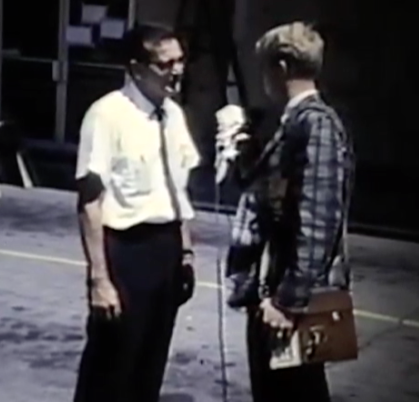 Business owner – Not yet, but is can be anywhere…..there were 9 panes and each of these panes can cost over a $100.
Reporter – What is your reaction to this whole disturbance last night?
Business owner – Sickening, needless to say and very disappointing.
Reporter – What are your plans now? Will you remain open?
Business owner – We plan on remaining open and doing business as usual.
Reporter – What happens if they come back tonight and do some looting tonight?
Business owner – We’ll do our best to be back in operation tomorrow morning.
There is about another minute of footage with no sound, footage of property destruction and police presence, like this image of cops in front of the Firestone garage on Wealthy St and LaGrave.
One thing that we can learn from this news coverage from WOOD TV8, is that they decided to center the voices of white politicians and white businesses owners, with no commentary from the affected Black community. This is a dynamic that permeates Grand Rapids-based news outlets even through today.
In Part III, we will look at images from the 1967 riot, what we are calling Cops, property and the White Gaze.
Last week, the U.S. Secretary of Transportation Pete Buttigieg held a press conference at the Gerald R. Ford International Airport to announce, “an $8.68 million federal grant that will help fund Gerald R. Ford International Airport’s concourse expansion,” according to MLive.

The MLive article went on with the following comments from Buttigieg:
“As part of the terminal gate expansion project here, this grant is going to help to fund eight new passenger boarding bridges so that this airport is able to handle more travelers and so that they can walk or roll more comfortably from their gate to their plane. It’s going to make traveling better. It’s going to allow Grand Rapids to accommodate that increasing passenger growth and support the economic opportunity that is emerging across West Michigan.”
Ok, so let me get this straight. Buttigieg was in town last week to announce that $8.68 million in public money was going to be used to expand the Kent County Airport, which somehow “supports economic opportunity.” After reading the rest of the MLive article I could not find anything to substantiate the claim that the airport expansion will support economic opportunity for people living in West Michigan. Not surprising, the Kent County Airport Authority makes the same claim in their mission statement:
Our mission is to create an exceptional travel experience for our passengers, and growth and prosperity for all of West Michigan.
The question still remains, how will airport expansion economically benefit people and create prosperity for all of West Michigan? The reality is that airport growth does not provide economic growth nor prosperity for everyone living in West Michigan, but it does provide economic opportunities to the business class in West Michigan.
Let’s face it, while regular people use the airport for visiting family or for going on vacations, the primary use of any and all commercial airports are by the business class. This sector of society, which always is the primary beneficiary in a Capitalist economic system, uses air travel as a means to meet with other members of the business class to find ways to make more profits and the use more public money that will benefit the private sector. If you look at who sits on the Airport Authority Board of Directors, you can see how the business community and their interests are represented.
Air travel, airports and Climate Injustice
Then there is the issue of the environmental and climate impact of air travel. The Environmental and Energy Study Institute recently wrote:
Between 1970 and 2019 in the United States, engine and design technology advances, improvements in air traffic operations, denser seat configurations, and higher passenger loads together reduced the energy intensity of air travel, expressed as British Thermal Units (BTUs) per passenger mile, by 77 percent. In the last two decades, carbon dioxide (CO2) emissions from commercial aviation worldwide grew at a slower pace than the growth of the industry, but emissions from aviation have accelerated in recent years as increasing commercial air traffic continued to raise the industry’s contribution to global emissions. According to the International Council on Clean Transportation (ICCT), global CO2 from commercial aviation was 707 million tons in 2013. In 2019 that value reached 920 million tons, having increased approximately 30 percent in six years. The United States, with the world’s largest commercial air traffic system, accounted for 202.5 million tons (23.5 percent) of the 2017 global CO2 total. EPA reports that commercial airplanes and large business jets contribute 10 percent of U.S. transportation emissions, and account for three percent of the nation’s total greenhouse gas production.
Globally, aviation produced 2.4 percent of total CO2 emissions in 2018. While this may seem like a relatively small amount, consider that if global commercial aviation were a country in the national CO2 emissions standings, the industry would rank number six in the world between Japan and Germany.
If we are serious about fight Climate Change and promoting Climate Justice, then celebrating the expansion of the Kent County International Airport is antithetical to Climate Justice.
In addition to rejecting and exposing the notion that airport expansion and increased air travel will bring propensity to all of us, we need to come to terms with the fact that the US Airline Industry is a highly subsidized industry. The airline industry also is a major campaign contributing sector, according to The Center for Responsible Politics, which also does its own share of lobbying to Congress. Such lobby has paid off in recent years, resulting in the airline industry receiving a $54 Billion bailout during the global pandemic in 2021.
Unfortunately, the commercial news media won’t be discussing these issues, they just provide us with celebratory news coverage and lots of pictures of people who represent the ruling class, which are the same people who will primarily be benefiting from the Kent County Airport expansion.
This week we will be posting a series of articles on the 55th anniversary of the riot/uprising in Grand Rapids, which took place from July 25th through the 27th in 1967. Most of the content for these articles is from pervious postings on the Grand Rapids People’s History Project site, in the Civil Rights/Black Freedom Struggle section. I am interested in this history for several reasons, but mostly because of what we can learn from the past and how it can impact the present and the future.

Fifty-Five years ago hundreds of people participated in what the news media referred to as a race riot in Grand Rapids.
On July 25th, 1967, Grand Rapids police officers arrested several Black youth, when they pulled them over believing they were in a stolen vehicle. One source says that the officers may have used excessive force in dealing with the Black youth, according to an eyewitness account.
News reports on the first day of the uprising never mention the police abuse. Instead the headlines read that, “gangs threaten a riot” and “S. Division beset by young mob.” In fact, most of the Grand Rapids Press coverage focused on the property damage and police arrests, but never on the motives of those who took action.
The first editorial on July 26 at least acknowledges that people in Grand Rapids may have acted in part due to the riot that began on July 25th in Detroit. However, the Press editorial then uses harsh words to condemn those who participated in the Grand Rapids uprising.
The editorial says that, “The great majority in the Negro Community is law-abiding.” This statement alone reflects contempt for anyone who acts outside officially sanctioned behavior.
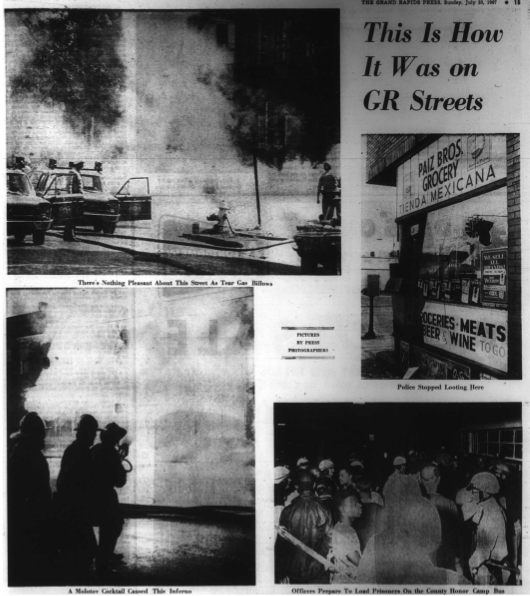 The editorial goes on to say that, “the lawless behavior of a few Negro citizens has made a mockery of civil rights and that everything that has been done up to this point to improve the Negro’s social and economic standing has been a waste of time, money and effort.” It is as if the civil rights movement consisted of what the White government did for Black people, as if the Freedom Struggle didn’t really exist.
Lastly, the editorial says, “there must be no compromising with the forces of disorder.” The Press editorial writer makes his bias known by saying that anyone arrested should be treated as a criminal and nothing else.
The Grand Rapids Police, along with other area cops and the Michigan State Police made it a point to arrest anyone they could get their hands on who was either engaged in actions they deemed unlawful, even those who violated the curfew that was put in effect on the evening of the 25th.
According to a report put out by the Grand Rapids City Planning Department, there were a total of 320 arrests made over a two-day period. The report, Anatomy of a Riot, stated that 49% of those who were arrested had a prior arrest record, thus the implication that those involved were prone to “criminal behavior.”
The area where the uprising occurred was 131 to the west, Hall street to the south, Wealthy to the north and Lafayette to the east.
Besides the data contained within the report, Anatomy of a Riot spent a great deal of time making pronouncements about living conditions of the Black community, but in a contemptuous way. The report acknowledges high unemployment rates and that many of the households are led by females. “These are families without an adult male to give support, love and guidance to the children.”
What the report does not really address, nor the news coverage, was the legitimate grievances of many of those who took action between July 25 and July 27.
It is important to note that this uprising in Grand Rapids was not an isolated incident. In 1967, there were 40 “riots” across the US and numerous since 1965, including Watts and the uprisings in 1968 after the assassination of Dr. King. However, because the bulk of the uprisings took place in 1967, the federal government did commission a study to investigate the cause(s) of the “riots.”
The report, known as the Kerner Report, does acknowledge the grievances of those who rose up. The report identifies three levels of intensity, each with their own list of grievances:
First Level of Intensity:
1. Police practices
2. Unemployment and underemployment
3. Inadequate housing
Second Level of Intensity:
1. Inadequate education
2. Poor recreational facilities and programs
3. Ineffectiveness of the political structure and grievance mechanisms
Third Level of Intensity:
1. Disrespectful white attitudes
2. Discriminatory administration of justice
3. Inadequacy of federal programs
4. Inadequacy of municipal services
5. Discriminatory consumer and credit practices
6. Inadequate welfare programs
As was mentioned before, most of the news coverage focused on what the GR Press often referred to as lawless behavior, such as property destruction and looting as is evidenced by the photos they printed.
 However, it should be noted that most of the fires that were set were of vacant or deteriorated buildings that were owned by White people. One could certainly argue that these buildings were targeted as a means of protesting against the constant exploitation of the Black community by White landlords. A former pastor in the neighborhood where the uprising took place told this writer that there were several houses and an old barn near his church on Buckley street that were set on fire and that these were buildings clearly targeted because of how the landlord treated the Black tenants.
Another interesting aspect of the 1967 uprising in Grand Rapids, was the role played by a group of Black Youth who were part of what was called Operation Task Force. This was a program operating out of the old Sheldon Complex, made up of mostly Black high school student athletes who were tasked with walking the neighborhoods and talking to people to get a sense of what people’s needs were.
When the uprising began, these students in the Task Force were asked to help “calm down” the Black youth who were enraged. Ironically, some of these students were physically assaulted by police officers who did not known that the students were actually cooperating with them. Several GR Press articles were printed over the two-day period about the task force, with one headline reading. “Negro Youths calm crowd.”
On July 27, the Grand Rapids Press ran an interesting story, one that reflected the dominant culture’s fear about urban Blacks. The July 27 story was based on calls the Press writer made to people in communities near Grand Rapids, communities that were almost exclusively White.
A woman from Ionia said, “We heard they were coming here on Tuesday. We all had our guns ready if we had to.” Another White woman in Lowell was quoted as saying, “I think it is terrible. They are destroying their own property – hurting their own cause.” A resident of Saranac stated, “It is a terrible thing to say, too, but authorities should open fire on them, do something drastic to wake them up.” A man from Holland agreed with serious force being used against those rioting. He stated, “The troops should have orders to stop them anyway necessary.”
These statements clearly demonstrate the entrenched White Supremacist attitudes of the day. According to the Anatomy of a Riot report, there were calls from people on the west side of Grand Rapids who wanted to “volunteer as vigilantes” during the uprising. In fact, the report notes that some White people were arrested during the uprising, because they were in violation of the firearms ban that was put in place.
In the aftermath of the 1967 uprising in Grand Rapids there were calls for increased funding for urban youth programs and some concerns about housing conditions, especially of the properties owned by White absentee landlords. Years later there was a new condo project built in the heart of where the uprising took place, between Jefferson and Lafayette, but within a year they built a brick wall around that development to keep out undesirables.

Today, the Sheldon Complex is gone, replace by a government social services facility and the newly gentrified area around the Wealthy/Division area. These new development projects have forced Black and Latinx people experiencing poverty out of the neighborhood, which is one tactic in minimizing the possibility of any future uprisings.
In Part II, we will look at some of the TV coverage of the 1967 riot in Grand Rapids.
Commissioner O’Connor’s fake apology, civility and Business as usual Politics in Grand Rapids
On Friday, three days after First Ward Commissioner Jon O’Connor shouted at protesters and walked out during public comment, he released a statement he claims is an apology.
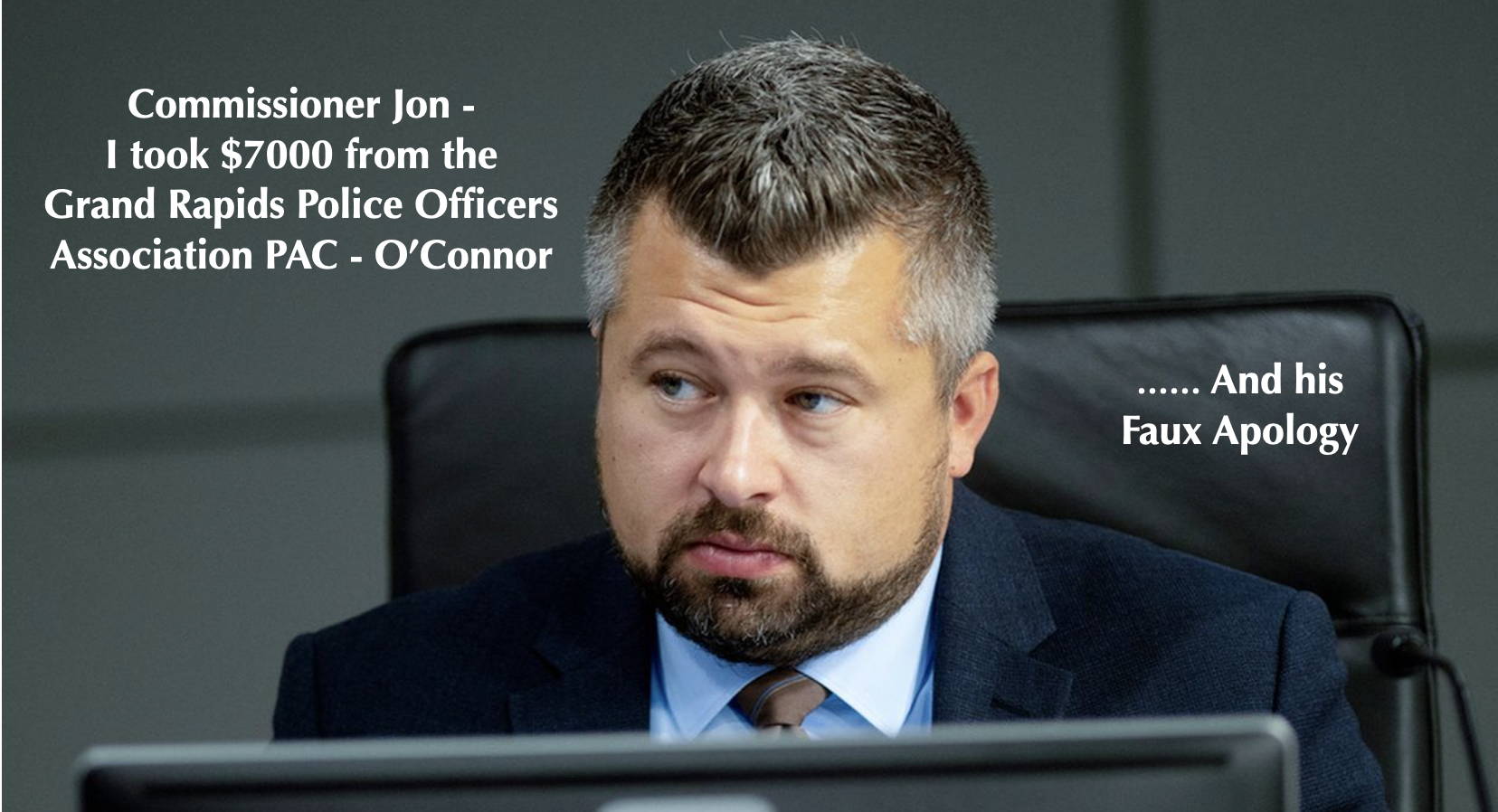
Here is that statement from Grand Rapids City Commissioner O’Connor:
“I want to apologize to my constituents and the entire city for my outburst and use of inappropriate language at Tuesday evening’s city commission meeting. Like so many others in our community, I am frustrated and unfortunately, I let my emotions get the better of me.
Over the past several months I, along with my colleagues on the commission, have remained relatively quiet at the dais as well as in our public commentary for a variety of reasons. While we all share concerns about what has taken place in our community, the actions of a small activist group have diminished the ability to conduct the business of the city and have created an environment within the commission chambers where any opposing point of view is interrupted, shouted down, or chastised. I have a responsibility to listen to all those who choose to attend and make public comments, regardless of my personal beliefs about what they are saying. The current situation continues to stifle civic engagement and intimidates individuals from participating in the local government process.
This group of individuals and their supporters have crossed a line, making it difficult to seek compromise and pursue positive outcomes for the community. They have come to my home, where my family sleeps, in an attempt to intimidate me, defacing my residence in the middle of the night. These intimidation tactics toward myself and my colleagues are unacceptable and we should not stand for such actions, now or in the future.
I remain committed to working for positive outcomes for Grand Rapids. This is an amazing community with a history of working together in a respectful manner, making hard decisions, and producing results for residents. This is the work I will continue to focus on with my colleagues on the City Commission. Our city, our state and our country have become increasingly polarized and unwilling to seek compromise with civility. In Grand Rapids, however, we must rise above. I am dedicated to this work and invite others to join in a positive and proactive discourse for a better future for all.”
– Jon O’Connor, Grand Rapids First Ward City Commissioner
There are numerous things to say in response to O’Connor’s “apology,” so I will lay them out here:
First, O’Connor says he apologizes for his “inappropriate language” during the City Commission meeting last Tuesday, claiming his emotions got the best of him. This part of the statement is designed to acknowledge that saying the word “fuck” was not ok, only because the Mayor has already been cracking down on public who use these kind of words during public comment. O’Connor, therefore, has to refer to his outburst as “inappropriate language” in order to justify the standard that the Mayor has already set for the public. However, we all know that O’Connor, like most people, when he is not publicly acting as a City Commissioner will let the expletives fly, and using derogatory descriptors directed at organizers and those resisting the GRPD murder of Patrick Lyoya.
Second, not only does O’Connor refuse to call what Christopher Schurr did to Patrick Lyoya murder, he quaintly says, “While we all share concerns about what has taken place in our community.” The Commissioner, like so many City officials, just can’t bring it upon themselves to say that the GRPD murdered Patrick Lyoya.
Third, O’Connor uses his fake apology to say exactly what he wanted to say, which was to directly blame those protesting the GRPD murder of Patrick Lyoya and resisting the repressive policing practices of the GRPD used against Black organizers. O’Connor claims that it is his responsibility to listen to all voices, but we all know that he rarely looks at those who are speaking during public comment, is often doing something else while people are speaking their truth and at times will make faces, which only demonstrates his contempt of the public.
Fourth, the First Ward City Commissioner then says that, “this group of individuals and their supporters have crossed a line.” When O’Connor says that people have crossed the line, he means that people have the audacity to question not just the GRPD, but they way the politics is done in this city. Crossing the line means that more and more people are challenging the business as usual way in which GR politics has played out for too long. O’Connor affirms the crossing the line dynamic, because – Holy Shit – people have come to his home to protest. Oh No! O’Connor fails to see that he and other City Officials are being confronted where the live, because we have come to the realization that City Commission meetings are a joke, they are anti-democratic and they will suck the life out of you if you follow their rules. We all know that Grand Rapids City Commissioners make the real decision during the Meeting of the Whole, which is why everything that gets approved during the evening meetings is nothing more than a formality. Public Comment period is also a formality they are legally obligated to have, but such forms of “civic engagement” are shallow and often demeaning.
Fifth, Commissioner O’Connor really ends up using his so-called apology as an opportunity to center himself and other city officials who feel “intimidated” by the actions of protesters. O’Connor’s faux apology is nothing more than his ridiculous attempt to claim victimhood, then to assert his real intent which was to threaten those protesting with further repression by saying, “we should not stand for such actions, now or in the future.”
Sixth, the First Ward Commissioner then wraps up his fake apology with claims of “a history of working together in a respectful manner” because people “have become increasingly polarized and unwilling to seek compromise with civility.” The appeals to civility are always about respectability politics, but the calls for civility are also part a long standing tradition of systemic racism and White Supremacy within the US.
I highly recommend that people read Alex Zamalin’s book, Against Civility: The Hidden Racism in Our Obsession With Civility. Early on in the book, Zamalin states:
Civility is exalted in the language of slaveholders, segregationists, Lynch mobs, and eugenicists. It is also enshrined in the language of free marketeers and preachers of fiscal responsibility. And, surprisingly, it is elevated in the language of well-intentioned liberals, self-described moderates, and devout progressives. All of them traffic in ideas about public etiquette to declare what counts as good citizenship and what doesn’t. From slavery to Jim Crow, to black ghettoization, to mass incarceration, to police brutality, the idea of civility has been enlisted to treat black suffering with apathy or to maintain an unjust status quo. Worse, it has been a tool for silencing dissent, repressing political participation, enforcing economic inequality, and justifying violence upon people of color.
People with privilege, people with power, and people who work within systems of oppression often will use the notion that those who are dissenting need to be civil, as if that has always been the way you get things accomplished. Remember when the White Christian Pastors wrote to Dr. King while he sat in a jail. The White Clergy were counseling Dr. King to not ask too much or engage in confrontational direct action, which Dr. King ignored by committing civil disobedience. The author of Against Civility, makes the point that throughout history:
Civility hasn’t been the organizing principle of the most successful anti-racist thinkers and movements who have sought to dismantle US racism. They discovered, over and over again, that real political change happens through direct struggle, without obligation to decorum or propriety.
This certainly has been true of the 200 year long Black Freedom Struggle in the US, from slave rebellions, to anti-lynching campaign, resisting Jim Crow policies, the Birmingham Bus boycott, the luncheon counter sit-ins, the Freedom Rides, SNCC, the Poor People’s Campaign, the Black Panther Party for Self Defense, the League for Revolutionary Black Workers, and the Movement for Black Lives. The people who were part of these movements, who were part of the Black Freedom Struggle, were what the author of Against Civility calls, civic radicals. The difference between civility and civic radicalism is this:
A politics based in civility makes agreement among participants the prerequisite for political thought, whereas civic radicalism begins with the goal of liberation for all, regardless of who disagrees.
Civic radicalism seems to be what the Justice4Patrick movement and the broader Defund the GRPD goals are rooted in, since they are more interested in collective liberation, rather than compromises that lead us back to business as usual politics.
In the end, we should all thank Commissioner O’Connor for his faux apology, since it exemplifies the very ethos that governs Grand Rapids City officials – deflecting and avoidance of dealing with systemic issues. The First Ward Commission provided us with insight into what those in power think, what they talk about behind closed doors and how they view the current Justice4Patrick Movement. As always, we must not be seduced or fooled by the narratives that emanate for local power structures.

