According to the Grand Rapids Police Officer’s Association, it is a waste of tax payer money for a Black person to seek justice in this city
On Friday, it was reported that the GRPD cop Gregory Bauer, was was found not guilty of discharging his firearm, while confronting someone he believed to be a suspect in a stolen car.
Daevionne Smith, a Black man, was getting out of his car, when the GRPD cop stopped him, then fired his gun, which hit a house. The GRPD cop claims he tripped, which is what caused him to fire his gun. This all happened in December of 2021.
In February of 2022, Daevionne Smith, who had agreed to do an interview with FOX 17, was driving with a carload of people, when arriving to do the channel 17 interview. FOX 17 reported:
“I’m in fear for my life every day. Every day I walk outside the house and I don’t know if it’s somebody on the side of the house waiting for me again. Like, I’m scared. I’ve actually hired a security team to transport me from place to place.”
In late April, Daevionne Smith then filed a lawsuit against the Grand Rapids Police Department and the city of Grand Rapids after an officer accidentally fired his gun. He says the incident has caused him emotional distress, according to a story on WOOD TV 8.
During the court proceedings to determine if the GRPD cop who fired the shot was guilty of negligence, Daevionne Smith was not allowed to speak, nor offer testimony. The Judge said, his testimony would “distract the jury.” In response, Daevionne Smith was quoted as saying:
“This is one of the first times I’ve ever felt so powerless, to sit back and actually watch this go on and not able to do nothing about it. Y’all made me feel like I don’t matter. My life don’t matter. Everything that I went through and I’m still continuously going through doesn’t matter.”
Cop Union Response to the verdict
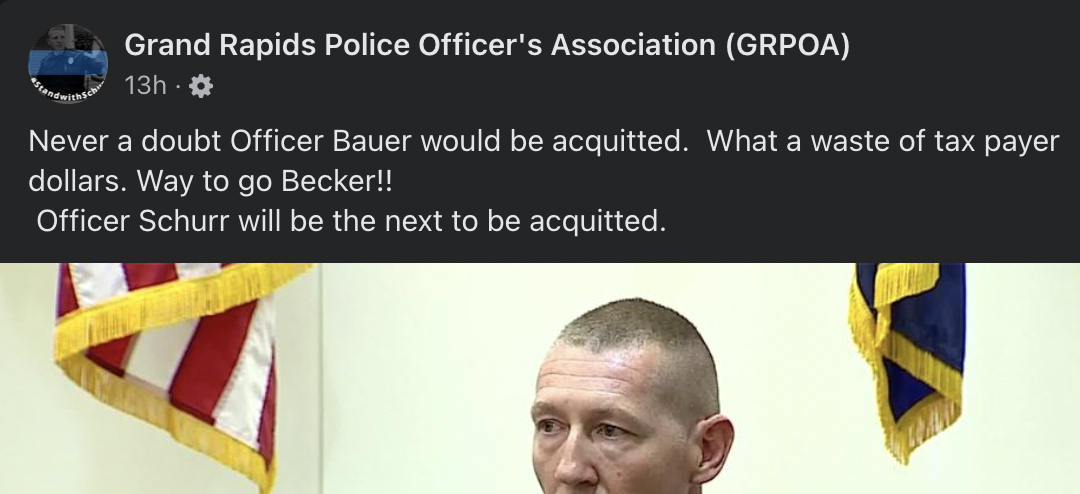
The Grand Rapids Police Officer’s Association (GRPOA) didn’t waste any time responding to the verdict. They posted a link to the WOOD TV 8 story, but provided their own narrative at the top, which read:
Never a doubt Officer Bauer would be acquitted. What a waste of tax payer dollars. Way to go Becker!! Officer Schurr will be the next to be acquitted.
Even though the statement from the GRPOA was brief, it said a great deal.
First, by saying that there was never a doubt that the cop who forearmed his weapon while confronting Daevionne Smith, would be acquitted, demonstrates, 1) a certain level of arrogance that cops are never in the wrong, and 2) an understanding that the laws involving cops in this society, almost always protect cops or give them the benefit of the doubt.
Second, the cop union claims that the trial was a waste of tax payer dollars. This statement is basically saying that someone who is seeking justice for the harm they have endured, is a waste of tax payer dollars. Seeking justice for a Black man, who has been traumatized from the GRPD cop firing his weapon and has repeatedly stated that he fears for his life is not a waste of public money. The fact that the GRPD union thinks it is a waste of public money, shows their ignorance and their complete disregard for the well being of Daevionne Smith.
Third, the Grand Rapids Police Officer’s Association ends their statement by asserting that the former GRPD cop Christopher Schurr will be the next cop to be acquitted, despite the fact that he shot and killed Patrick Lyoya, after Lyoya had been stopped because his car plates had expired. Again, the GRPOA demonstrates their arrogance, but also their belief that the cop who shot Patrick Lyoya in the back of the head will be acquitted because the law is in Schurr’s favor, especially around use of force laws in Michigan.
Lastly, it is worth noting that the same lawyer who got the GRPD cop who fired his weapon while confronting Daevionne Smith, is the same lawyer who is part of the defense team for Christopher Schuur, Mark Dodge. In June, the legal team representing Schuur released the following statement:
We were disappointed to learn that Officer Schurr has been charged with murder by the Kent County Prosecutor. Officer Schurr is a decorated member of law enforcement who has dedicated his career to helping others and protecting the citizens of Grand Rapids. The evidence in this case will show that the death of Patrick Lyoya was not murder but an unfortunate tragedy, resulting from a highly volatile situation. Mr. Lyoya continually refused to obey lawful commands and ultimately disarmed a police officer. Mr. Lyoya gained full control of a police officer’s weapon while resisting arrest, placing Officer Schurr in fear of great bodily harm or death. We are confident that after a jury hears all of the evidence, Officer Schurr will be exonerated.
Such a statement is not only consistent with what the Grand Rapids Police Officer’s Association believes, it is reflected in comments from white people in this city, which we documented during the August 23rd City Commission meeting public comments. Daevionne Smith is right to feel like his life doesn’t matter. The City of Grand Rapids and the GRPD continues to affirm that reality, especially when it comes to Black residents in this city.
More Cops won’t keep us safe: Biden announces even more funding for cops, despite national movement calling for defunding the police
 On Tuesday, while speaking in Pennsylvania, President Joe Biden laid out his Safer America Plan, which includes $37 Billion in funding for policing and a commitment to add an additional 100,000 more cops across the nation.
Biden’s comments were similar to what he said during the 2022 State of the Union address, when he said:
You know, I call it the Safer America Plan, and both your members of Congress voted for it. It’s based on a simple notion: When it comes to public safety in this nation, the answer is not “defund the police,” it’s “fund the police.”
Such statements from Biden should not come as a surprise, as he campaigned in 2020 with the intention of increasing funding for cops. In addition, we need to remember that when Biden was the Vice President and a Senator he has always supported policing, and the Senator was instrumental in passing the 1994 Crime Bill, which not only increased police funding, it led to what Michelle Alexander calls Mass Incarceration.
Over the past few weeks, we have written that the Democratic Party is equally committed to supporting and defending policing in this country, despite the calls from millions to defund the police. Biden’s speech on Tuesday affirmed his administration’s commitment to expanding the police, even though there is plenty of evidence that more cops does not translate into safer communities, nor less crime.
Take for instance the 2021 report from Interrupting Criminalization, Cop’s Don’t Stop Violence: Combating Narratives Used to Defend Police Instead of Defunding Them. The report states in its introduction:
Police are facing one of the greatest crises of legitimacy in a generation. In the wake of the largest uprisings in U.S. history, sparked by police violence, bloated police budgets, and the deadly impacts of a failure to invest in community health and safety laid bare by the pandemic, pro-police forces are on the defensive. So they are reaching for one of their most reliable weapons — fear.
This is nothing new — cops and policymakers have always used fearmongering to push “law and order” agendas and pour more and more money into police departments. Now, with police budgets under scrutiny by campaigns to defund the police and refund our communities all across the country, lawmakers and the media are once again recycling old talking points about increasing violence and crime, claiming that campaigns to defund police are responsible.
The Cops Don’t Stop Violence report is well researched and full of data, that is presented in a very readable fashion. The report concludes with the following statement:
It’s time to recognize that decades of pouring more money, resources, and legitimacy into policing in an effort to increase safety have failed — because policing is functioning as it is intended to: to contain, control, and criminalize Black and Brown communities rather than to prevent and reduce violence. It’s time to invest in meeting community needs and building non-police community safety strategies. It’s time to invest in just recovery.
 While Biden’s commitment to providing more funding for cops and increasing the sheer number of police across the county is somewhat disheartening, it is expected that those committed to protecting power and privilege would continue to maintain a system of repression and State violence, policing. What has been happening in Grand Rapids over the past several years, is no different.
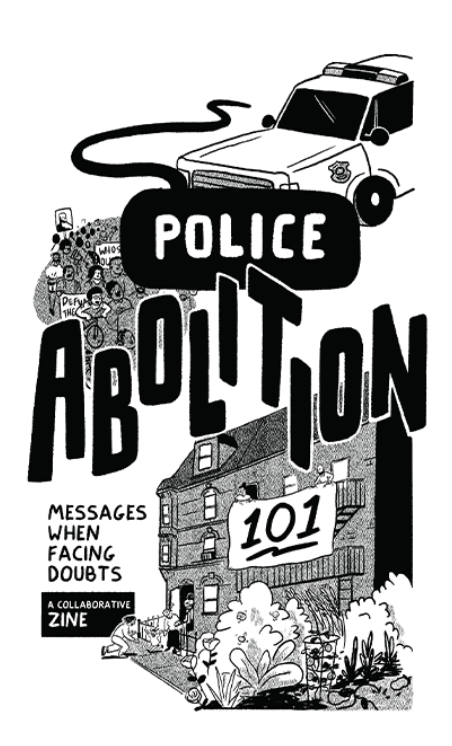
We know we have our work cut out for us, just as all abolitionists have experienced of the centuries. We need to continue to resist and to radically imagine a world that is not subservient to capital, and a system that is rooted in White Supremacy. We need to continue to educate ourselves and use resources that can be used as tools of popular education. For example, I encourage people to read and share this fabulous zine, Police Abolition 101, which you can download here. The more we can share these tools, self-educate, resist State violence, and create real conditions for community safety, then we can work to defund and abolish the GRPD.
Our latest update to the DeVos Family Reader: Monitoring the most powerful family in West Michigan
 In Howard Zinn’s monumental book, A People’s History of the United States, he constantly juxtaposes the amazing things that people did to fight for liberation and the people behind the systems of oppression that social movements were fighting against.
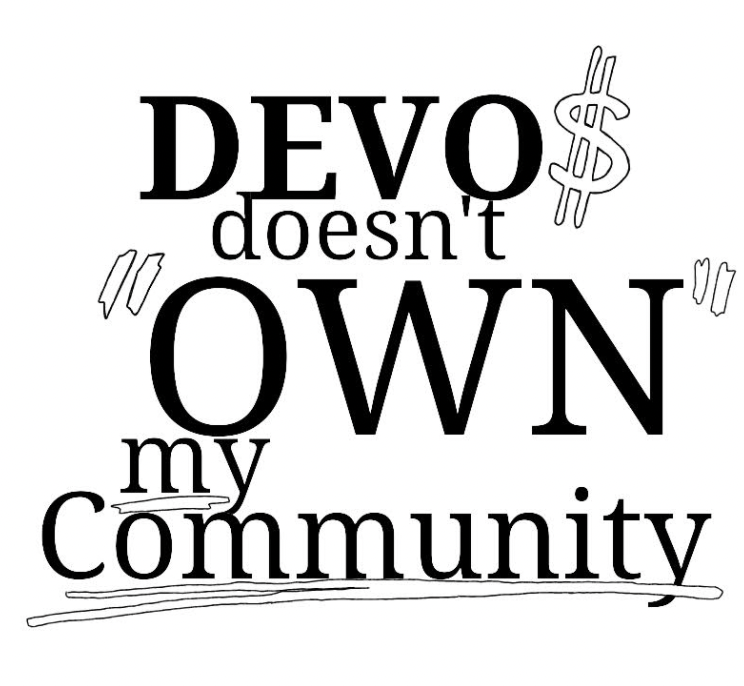
This is exactly why I have spent years monitoring, investigating and critiquing the DeVos Family. They are the most recognizable and powerful manifestation of the systems of power and oppression in West Michigan. Now, I know there are plenty of people who share the belief that without the DeVos Family, Grand Rapids wouldn’t be where it is today. I fully agree with that belief, but for reasons that are the exact opposite of those who hold the most powerful family in West Michigan in high regard.
Three times a year we try to update our DeVos Family Reader, a collection of articles that looks at the family’s history, the influence on election & public policy, their foundations, how they are reported on in the news media, ArtPrize and the section entitled Betsy DeVos Watch.
This updated version of the DeVos Family Reader includes information and analysis on a variety of topics, since our last update, which was 4 months ago. There a total of 10 separate articles we posted having to directly with the DeVos family. The first post in mid-May was an article about the anti-Abortion Cartel in West Michigan, which has at the top of it the DeVos family. This article looks at the level of funding, both to political candidates and through their foundation, the DeVos family has contributed that essentially has led to the criminalization of abortion. In July, we posted another article with some of the same information, but it was also the beginning of a Wanted Poster series we began, looking at the families and organizations that have funded the criminalization of abortion.
A second article, which was post in the 3rd week of May, was written because of the pressure being put on the Kent County Prosecutor to recuse himself in the Patrick Lyoya case, since he took money from the Grand Rapids Area Police Officer’s Association. The GRIID article was pointing out that during the County Prosecutor’s time in office, he has received 23 time more campaign money from the DeVos family, than the cop union.
In June, we posted four articles about the DeVos family, with the first focusing on the role they are playing the proposed outdoor amphitheater project, which will be located in the southwest part of downtown along the Grand River. The article centers on how much public money is being used without any public input.
Another article in June looks at one the guests that Doug DeVos had on his podcast show, called Believe, while another article looked at an interview that Betsy DeVos did on the Acton Institute’s radio show, which focused on her recently released book.
There was one final post in June about the DeVos family, which was a critique of the Amway Corporation’s decision to pull all of their operations out of Russia.
 In early August, right around the time of the Michigan Primary Election, we posted two stories on the DeVos family’s role in campaign financing. One article centered on the fact that the DeVos family, along with other members of the Grand Rapids Power Structure, dominated campaign contributions to candidates from West Michigan in the primary. The second post was about the fact that the DeVos family was the single largest campaign contributor to the GOP gubernatorial candidate Tudor Dixon, who won the GOP primary and will face Gov. Whitmer in November.
The last article we posted in our updated version of the DeVos Family Reader, was a mid-August piece looking at the upcoming art spectacle in Grand Rapids known as ArtPrize. We have written a great deal about ArtPrize over the years, but this year decided to ask the question, How do we justify ArtPrize with all the horrible shit the DeVos family does?
With these new additions to the DeVos Family Reader, we are now up to 681 pages of information and analysis on the most powerful family in West Michigan.
Two weeks ago, I read an excellent piece posted on the Jacobin website, entitled, Bigger Police Budgets Could Be Used for Abortion Crackdowns. The article is essentially arguing that the Democratic Party’s decision to support more funding for cops and abortion rights is inherently problematic. Once anti-abortion laws are put into place in many states, police departments will be called upon to enforce anti-abortion laws, thus targeting the very people that the Democrats claim they want to defend.

In thinking about the clash between being pro-police and pro-abortion, I came across a new brief published by the group Interrupting Criminalization, Abortion Decriminalization is Part of the Larger Struggle Against Policing and Criminalization. This important publication begins with the following overview:
The expanding surveillance and criminalization of mutual aid, self-managed care, and bodily autonomy, and the growing attempts to criminalize pregnant people, parents, and health care providers have far-reaching ramifications beyond abortion criminalization that require us to join together to collectively resist!
Hundreds of restrictive bills have been proposed, many passed, including the Texas law (SB8) that not only bans abortion after six weeks, but deputizes civilians to police each other’s reproductive decisions. Such laws are just the latest examples in a long history of criminalizing bodily autonomy, especially for Black, Indigenous, migrant, disabled, queer, and trans people, and people with low incomes who will experience the harshest impacts of anti-abortion legislation.
This important brief gets us to look at how the movement to defund policing and the movement to defend access to abortion intersect. In fact, these issues intersect in two ways. First, both issues deal with the carceral system of criminalization and policing. Second, both defunding police and defending abortion access disproportionately impact BIPOC communities, migrant communities, disabled communities, and trans and queer communities.
The Interrupting Criminalization document then goes on to say:
Organizers and advocates sometimes fail to consider the criminalization
of abortion and reproductive care within larger campaigns against the violence of policing and criminalization. Similarly, organizers sometimes exceptionalize expanding restrictions on abortion and reproductive care as a new or unique type of criminalization, rather than understanding them as a part of a larger web.
It is important to broaden and deepen our collective analysis of the culture of punishment that makes such criminalizing legislation possible, following the lead of Black and Indigenous women, women of color, and trans reproductive justice activists who have made critical connections between multiple movements. Solidarity among anti-criminalization and reproductive justice organizers is essential to dismantle the culture of carcerality and control, and to prevent more laws targeting people existing at precarious intersections of race, gender, sexuality, disability, class and migration. Communities organizing for gender justice, migrant justice, economic and racial justice, sex workers’ rights, disability justice, and other movements for liberation should view abortion criminalization as a site of shared struggle.
Imagine what it would look like for those involved in the fight to defund the GRPD and those fighting to demand that abortion should be legal and accessible to all? How would this alliance impact the work of each movement, and how would it make these movements stronger if they saw the benefit of collaborating to combat policing in all of its manifestations?

Lastly, the Interrupting Criminalization publication provides three overarching strategies to resist the criminalization of reproductive autonomy:
- Amplify and lift up the history, framing and demands of the Reproductive Justice (RJ) movement, and an intersectional framework that extends beyond “choice.”
- Divest from mechanisms and sites that criminalize reproductive autonomy; Invest in affirming care, bodily autonomy and reproductive justice.
- Destigmatize abortion.
Criminalization of abortion providers, abortion seekers, and their communities does nothing to prevent unplanned pregnancy. Organizing for full decriminalization is the only way forward, while we continue the grassroots work to build and strengthen our capacity for mutual aid and communities of care. Another World is Possible!
Michigan Freedom Fund campaign seeking to associate Gov Whitmer with the Defund the Police Movement is false and misleading
Two weeks ago I wrote a piece about how there is a public perception that the Democratic Party is in favor of defunding the police. This reality is simply not true, despite the far right’s attempt to label the Democrats as being anti-police.
A recent example of this kind of misinformation, can be found on the August 26th from the DeVos-created, pro-GOP blog, Michigan Freedom Fund. The Michigan Freedom Fund post creates a false narrative, both with video and written content that is simply dishonest.

The video created by Michigan Freedom Fund attempts to make the claim that it is Gov. Whitmer’s fault that Michigan cities are seeing a rise in crime. The video uses a montage of news clips from various Michigan-based TV stations, a few graphics and audio of Whitmer saying over and over, “I’m riding with Biden.” The video is sophomoric and is a longstanding tactic used to blame politicians for violent crime.
The written commentary that the Michigan Freedom Fund (MFF) uses isn’t much better, but it’s worth looking at in greater detail. Here is what the MFF blog post says:
Governor Whitmer supports the “spirit” of defunding the police. The Whitmer-Biden inflation has exhausted law enforcement budgets and taken police off the streets, and lockdowns like the ones Whitmer implemented here in Michigan led to a spike in violent crime. But with your help, we can stand up to the Whitmer-Biden agenda, and make Michigan safe again!
First, the claim that Governor Whitmer supports the spirit of defunding the police is completely out of context. The source for such a claim is the far right news source, Breitbart. However, a basic function of journalism is to question what politicians say and them compare it to the actual policies they have adopted. In this case, even if Gov. Whitmer agrees with the “spirit of defunding the police,” her actions are completely the opposite.
Last December, the Michigan House of Representatives passed a nearly unanimous bill that would provide an additional $300 Million for policing, legislation that was supported by Gov. Whitmer. In fact, two months before the legislation was passed, Gov. Whitmer’s office released their own Media Statement fully endorsing an additional $32 Million for policing in Michigan. In addition, if Gov. Whitmer is so opposed to funding the police, why has she been the recipient of $3,000 in police union funding?
Second, the Michigan Freedom Fund blog post makes the claim that Whitmer/Biden inflation has depleted police budgets and taken cops off the streets. The source used for this claim is a Fox News story that only references one Sheriff in Isabella County who says that the cost of gas has hurt their department’s budget. Now, I can’t speak to every community across the state, but in Grand Rapids, the City Council voted to increase the GRPD budget and at the most recent Public Safety Committee presentation the Grand Rapids Chief of Police made it clear that they just had several new recruits complete their training, along with more new recruits that will be started their training in the coming months.
Third, the Michigan Freedom Fund blog post claims that Gov. Whitmer’s decision to lockdown the state in 2020, led to a spike in violent crime. Again, the source used is Fox News, which says nothing about an increase in violent crime in Michigan. In fact, the Fox News story only references New York, California and Chicago as examples of where crime has spiked.
Lastly, it is important to talk about the purpose of this Michigan Freedom Fund piece, especially since its primary purpose is to get their supporters to equate Gov. Whitmer with not only the rise in crime here in Michigan, but to equate her with the defund the police movement. This effort by the DeVos-created organization has been effective, since most GOP supporters embrace the “Back the Blue” mantra. It doesn’t matter that the claims are false, only that it paints the Democrats as soft on crime and undermining the cops. Equally important is the fact that the Democrats have not questioned or responded to misinformation campaigns like this one from MFF. The Michigan Democratic Party could challenge the claims found in the MFF smear campaign, especially since the claims are false and that the Democratic Party does support policing, even the increase in policing funding. However, it is my suspicion that the Democrats are choosing to not contest the Michigan Freedom Fund misinformation, because they still want to appeal to the Black Lives Matter supporters and other more progressive and radical voters whom they will need in the November Election, regardless of the fact that Democrats are equally committed to supporting the police, as has been demonstrated by their policies to increase funding for police departments across the country and in Michigan.
Grand Rapids is facing a housing crisis. Few people would deny this fact. Grand Rapids City Officials are well aware of this fact and are doing what they think is needed to address to problem.

On August 18, the City of Grand Rapids posted the following under the news section of their website:
Over the past decade, more than 100 Grand Rapidians have volunteered their time serving on groups such as the Great Housing Strategies and the Housing Advisory Committee. Each initiative prompted revisions to City policies and ordinances that promoted creation and access to all levels of housing, but primarily affordable housing.
Despite advancements to remove barriers and make housing development easier in Grand Rapids, the demand for housing is outpacing development.
Housing remains a key focus of the City – something that’s imbedded in its strategic plan. In July 2020, the City commissioned a study that showed nearly 9,000 housing units — apartments, condos, single-family homes — were needed by 2025 to meet demand and avoid displacing residents. Progress is being made toward that goal – 1,045 new housing units have been added since that time, with more than 1,000 additional units reserved for low- to moderate-income residents currently planned and in various stages of pre-development. In the wake of the pandemic, developers are struggling to meet demand due to labor shortages, high material costs, rising land acquisition costs and inflation.
In addition, there is also a 50-page report entitled, Redefining the Path Home: System Building for Housing Stability in Kent County, which was produced in 2020 and has some good data on the current housing crisis. This report came out of a group of people working to create that document and was facilitated through KConnect. The housing sector of KConnect states:
We are a committed network of community stakeholders creating a more comprehensive housing system driven by community data that prioritizes equitable housing access in Kent County.
Our community-based approach focuses on The Path to Housing Stability that moves from “No-Housing” to “Housed by Choice” and aims to develop an equitable housing system for all people in Kent County.
This brief statement from KConnect uses the term “stakeholder,” a term which has always confused me at some level. But is we want to see what stakeholder means to the Housing Kent people, here are the names of the Board of Trustees:
- Tasha Blackman – President and CEO of Cherry Health
- Rosalynn Bliss – Mayor of Grand Rapids
- Michael Bohnsack – President Bohnsack and Associates
- Eric Brown – President and CEO Urban League of West MI
- Lynn Ferrel – Program Director Frey Foundation
- Raquel Guzman – Partner Avanti Law
- Brad Kessel – President and CEO Independent Bank
- Josh Lunger – Senior Director of Government Affairs Grand Rapids Chamber of Commerce
- Pamela Parriott – Director of Philanthropy DeVos Family Foundations
- Al Vanderberg – Kent County Administrator
- Mark Washington – City Manager/City of Grand Rapids
In addition, there was a group of community partners who developed the 50 – page report we mentioned earlier, which we can read on page 4 of the report.
In looking at the Board of Trustees for Housing Kent and the community partners group, it is very apparent that most of those listed are people who operate within systems of power – government representatives, business owners, Non-Profit Directors, Law Firms, etc. What you do not see listed are people who represent those directly affected by the current housing crisis – people who can’t afford to buy a home, those who are renters, those facing eviction, those living in homeless shelters and the unhoused.
This isn’t a new dynamic, where those making the decisions or creating a strategic plan about an issue are not made up of those most affected by the issue being addressed. In the 1980s, I was part of the Homelessness Task Force, which was part of the work being done by the Grand Rapids Area Center for Ecumenism (GRACE). Now, in the 1980s, I was living at Koinonia House, which was a community house that practiced radical hospitality. We had two rooms in our house, which were used for hospitality for those who were unhoused, had fled domestic violence or were refugees. Between 1984 and 1998, we offered hospitality to over 300 people who were in need of temporary housing, until they could find something more permanent. Sometimes people just needed a few days to figure out what to do and sometimes people needed 6 months to find housing stability. Doing radical hospitality work, certainly sensitized me to those who were experiencing a housing crisis, especially the unhoused. If there was anything I learned from that experience, it was that those who are most affected by a housing crisis need to be the primary people making decisions or coming up with ideas about how to achieve housing justice.
The entire history of social movements is predicated on the fact that they are led by those most affected. The Abolitionist Movements was led that those who were formerly enslaved, the labor movement was led by workers, the LGBTQ movement was led by those in the LGBTQ community, and the immigrant justice movement is being led by immigrants. Therefore, the current housing crisis should be led by those that are the most affected – people who can’t afford to buy a home, those who are renters, those facing eviction, those living in homeless shelters and the unhoused.
Unfortunately, this is not happening. So, what if the City of Grand Rapids and the Housing Kent would provide the space for those most affected to meet, plus they would need to provide transportation, refreshments and a stipend, since those most affected are struggling to survive. Now, I don’t expect that this is what will happen, since this would be a significant paradigm shift for those working in systems of power, even though it is possible. What we do know is the most effective housing justice efforts across the US are led by those most affected. Take for example the national movement known as Homes for All. Homes for All, which is part of the Right to the City Movement, is rooted in the belief that, “housing is a human right and that every person deserves a safe, affordable and permanent home.” This national movement is led by those most affected from the current housing crisis.
Therefore, since the strategic plans that the City of Grand Rapids and Housing Kent have developed to address the current housing crisis do not center those most affected and are not led by those most affected, their plans will likely fail, or at best they will continue to perpetuate the same inequities. This has to change.
However, there is another glaring problem with the strategic plans of the City of Grand Rapids and Housing Kent, which is an economic justice problem. One critical problem for those who are seeking to buy a house or rent in this area, is that people do nor make a living wage. If the goal if for people to have housing stability, housing that is affordable, whether we are talking about owning a home or renting, then people need to make a living wage.

The current housing market in Kent County is through the roof, which makes home ownership extremely difficult, unless you have a household income that is comparable with the cost of housing. In the graphic above, which was produced by the National Low Income Housing Coalition, you can see that people in the Grand Rapids/Wyoming area need to earn a minimum of $20.02 to afford the average cost of rent. Now, we know that there are literally thousand of individuals and families who are not earning $20 an hour, and thus cannot afford to pay rent. Yes, there are rental assistance programs, but they are all temporary. In both the City of Grand Rapids and Housing Kent’s strategic plans, there is no mention of the need for people to earn a Living Wage, which ultimately means that their strategic plans will once again fail.
From my own reading of history, those is positions of power rarely ever make decisions to do things like make housing a human right, unless of coursed they are forced to do so by grassroots social movements. If we are being honest with ourselves, the only way we can get out of the current housing crisis is to have a housing justice movement that is led by those there are most affected and to guarantee that everyone living in Kent County earns a livable wage.
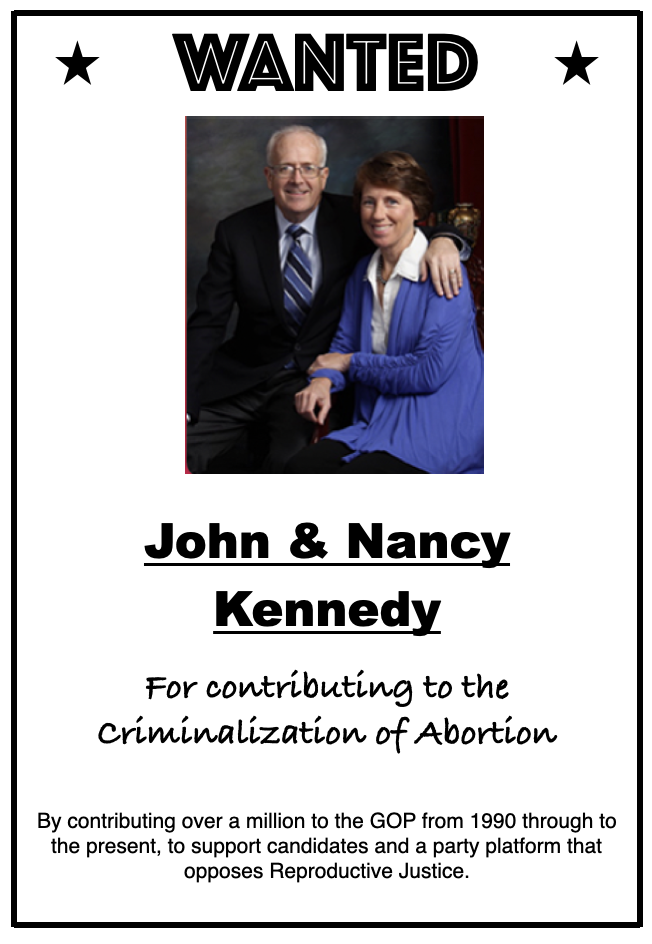 This is the fourth in a series of WANTED posters, looking at individuals, families and organizations in West Michigan that have contributed significantly to the criminalization of abortion and the undermining of reproductive justice.
John Kennedy is the CEO of Autocam, here in West Michigan. We have identified Kennedy as a member of the Grand Rapids Power Structure, in part because of his wealth, but also because of his politics and his involvement with groups like the West MI Policy Forum, the Acton Institute, the Right Place Inc. and the GR Chamber of Commerce.
John Kennedy, and his wife Nancy, have been major contributors to the Republican Party, specifically to candidates from West Michigan who have been elected to state office and have pushed neoliberal economic policy and a far right social agenda, like restricting and working to eliminate reproductive justice for individuals wanting to have an abortion.
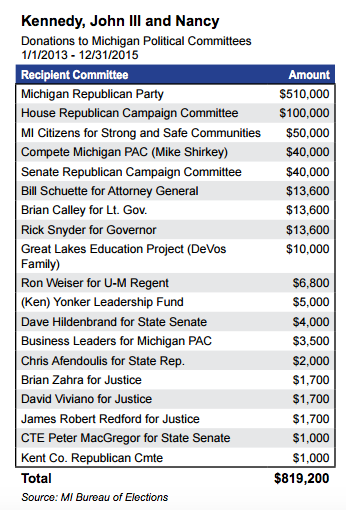 The graphic on the right here shows where he spent his money to support politicians and influence public policy in Michigan between 2013 – 2015. In 2016, John Kennedy contributed $589,700 to state races, in the 2017 – 2018 election cycle, as well as the current election cycle.
The Autocam CEO has been a vocal opponent of reproductive rights and was outspoken against the Affordable Care Act. Kennedy was quoted in an MLive article as saying:
“This law requires me to violate my beliefs by paying for controversial products that cause abortions, and it does nothing to improve access or eliminate cost for essential medications like insulin and heart medication.”
In 2012, Kennedy was invited by the far right Think Tank, the Acton Institute, to speak on his “religious” objections to providing birth control and other reproductive justice resources that were part of the Affordable Care Act.
We encourage you to share this poster and consider directing some of your rage at the recent US Supreme Court ruling to overturn Roe v Wade towards John & Nancy Kennedy.
Sources used:
Free Speech, Hate Speech and the attempt by the Grand Rapids City Government to silence dissent
What kind of a world do we live in when people are threatened with arrest at a Grand Rapids City Commission meeting for using swear words, but someone can say, because he didn’t obey the GRPD cop, Patrick Lyoya deserved to be shot in the back of the head?
This was the main question I was left with after Tuesday’s Grand Rapids City Commission Meeting. During public comment, there were several white 1st Ward residents who all spoke against defunding the GRPD, saying things like “we need more funding for the GRPD” and “they keep us safe.” Then, another white dude from the 1st Ward said, that Patrick Lyoya got what he deserved because he refused to obey the cop who ended up shooting him.
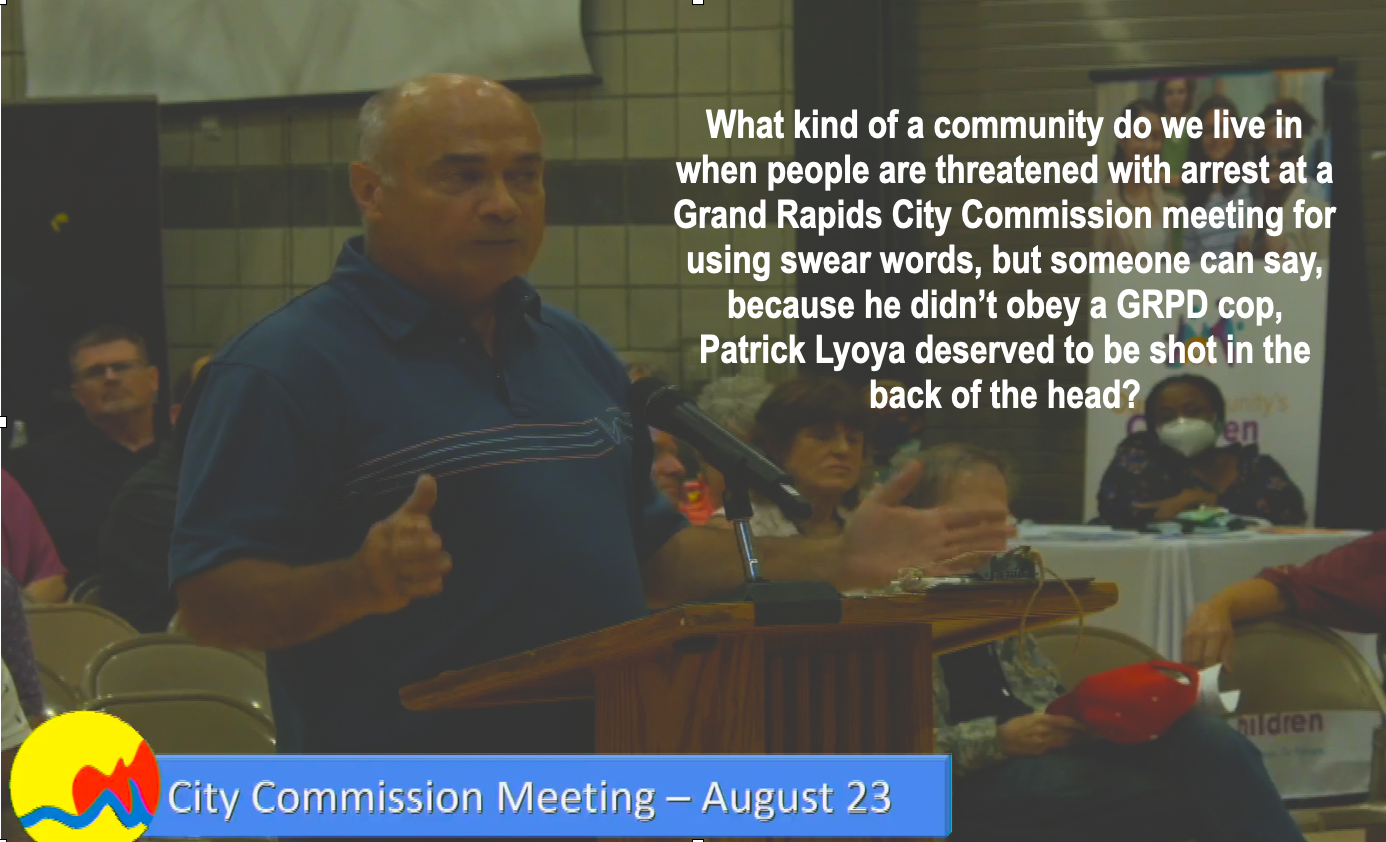
Right after this white guy said that Patrick Lyoya deserved what he got, several people who are part of the Justice4Patrick Movement sat in shock, while some booed and others tried to call this white guy out for his hate speech. At no point did Mayor Bliss chastise or counsel the white guy to reframe from using that kind of language, but the GR Mayor did tell those who are part of the Justice4Patrick Movement that they need to respect the white guy’s right to speak. You can watch/listen to what went down at the 1:54:00 mark at Tuesday City Commission meeting.
I tried to think about what would prompt this white guy to say such a thing, that an unarmed Black man, got what he deserved, a bullet to the back of the head. Certainly, part of why he said it, was because he, like most white people, feel a sense of entitlement. Another part of me had to acknowledge that this white dude knew there would be no consequences for making such a hateful comment, which means we live in a deeply White Supremacist culture. In addition, his comments about Patrick Lyoya in particular, but all of his comments, demonstrated both a lack of empathy and a willful ignorance of the history of the Black Freedom Struggle.
For me, this white guy’s comment demonstrated no empathy for what happened to Patrick Lyoya. Would this same white guy say those hateful things to the parents of Patrick Lyoya or to Patrick’s children? Does this white guy not know how much the murder of Patrick Lyoya has impacted the Congolese Community, the Black community, and other immigrant communities? Does this white guy not realize that saying the hurtful things that he said is traumatic and will likely re-traumatize members of the Black community?
Earlier, I named the comment from this white guy as hate speech. I’m not referring to the legal definition of hate speech, rather I am referring to the harm that his hate speech would cause people. This is likely why several people verbally reacted to his comments about Patrick Lyoya getting what he deserved. People were clearly bothered by his comments, but they were also harmed by his comments. This white guy’s comments were ultimately saying that Black Lives do NOT Matter, that they are trivial and disposable, especially if you do not follow the orders of a cop.
This white guy’s comments also reflected his willful ignorance about the history of the Black Freedom Struggle. This white guy, not only made hateful/harmful comments about Patrick Lyoya, he also said that people who didn’t follow the rules at City Commission meetings should be arrested, plus those who march in the street without a permit should be arrested. The very history of the Black Freedom Struggle IS a history of disobedience, of disruption and defiance. The Montgomery Bus Boycott, the lunch counter sit-ins, the Freedom Riders, SNCC, the countless marches organized by the Southern Christian Leadership Conference, CORE, and other Black organizations, land occupations, refusing the draft, the Deacons for Defense, the Black Panther Party for Self Defense, and on and on, were all engaged in disruption, disobedience and failure to obey authority, because those authorities and those laws protected and defended Structural Racism and White Supremacy.
Lastly, the very fact that the Grand Rapids City Commission, the Mayor, the City Attorney and the City Manager were silent when this white guy made harmful/hateful comments, not only reflects their complicity, it normalized White entitlement. It speaks volumes that at no time did any Grand Rapids City Official address these hateful/harm comments from this particular white man. Their collective silence over the comment that Patrick Lyoya got what he deserved, should signify to all of us who are fighting for justice that Grand Rapids City Officials value rules and procedures more than they do the lives of Black people in this city.
Learning a People’s History, living a People’s History, writing a People’s History: Reflecting on the Legacy of Howard Zinn in Grand Rapids
“We need Howard Zinn now more than ever. Not for the sake of romance or to construct another hero in history. We need his insights, his politics, and his commitment to the struggle for a better world.” —Keeanga-Yamahtta Taylor, from her foreword to You Can’t be Neutral on a Moving Train: A Personal History
The late radical historian Howard Zinn, would have turned 100 today. Therefore, it seems like a perfect time to not only honor the legacy of Zinn, but to reflect on the importance of continuing his work by practicing a People’s History.
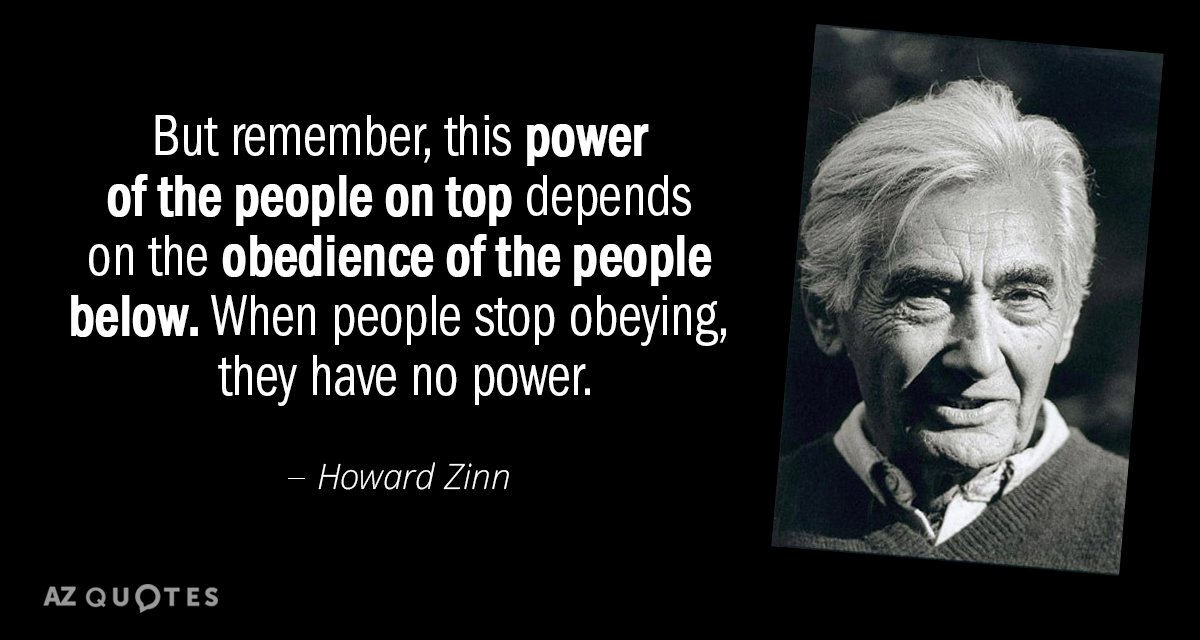
After WWII, Howard Zinn took advantage of the GI Bill and went to college and getting a degree in education. Zinn soon became a professor of US history. After years of searching for a primary text that presented history from below, from the perspective of those most marginalized, Zinn was unable to come across such a book. One day, Zinn recalls, his wife said to him, “you are just going to have to write the book yourself.”
Years later, Zinn ended up publishing A People’s History of the United States. Zinn’s book soon became a bestseller and has been reprinted several times over the decades. More importantly, A People’s History of the United States, has inspired a whole litany of new books that uses a People’s History as a framework. There are books a a People’s History of the Revolutionary War, the Civil War, the Vietnam War, a Queer People’s History, a People’s History of the Disabilities Community, an Environmental People’s history, even a People’s History of Sports.
Thirty years ago, I began teaching a class on the History of US Social Movements, using as a primary text, Zinn’s, A People’s History of the United States, which you can download. It has been one of my favorite classes to teach, both because of how it is such an epiphany for those who take the class, plus it allows me an opportunity to explore new ways to present this information. Here are posts from the 8 week class on the History of US Social Movements:
Week #1 – The Abolitionist Movement
Week #2 – The Black Freedom Struggle/Civil Rights Movement
Week #3 – The US Labor Movement
Week #4 – The Anti-Vietnam War Movement
Week #5 – How Social Movements get co-opted
Week #6 – The Anti-Apartheid Movement in Grand Rapids
Week #7 – The Immigrant Justice Movement in Grand Rapids
Week #8 – Building a framework for Social Movements and Radical Imagination
Honoring Howard Zinn
In January of 2010, Zinn passed away. While at breakfast with friends, we were talking about what a loss it was. Then my friend Tom says to me, “You should do A People’s History of Grand Rapids.” From that moment on, I began doing the Grand Rapids People’s History Project, which has included an online site of archival materials and articles, a feature length documentary we did in 2011, A People’s History of the LGBTQ Community in Grand Rapids, and a forthcoming book, slated for January of 2023, A People’s History of Grand Rapids.
Learning from Zinn’s model of a people’s history has radically altered my life and the lives of millions more. Once you go down the road of a people’s history, which is ultimately a subversive challenge to “history from above” or what some call “official history,” there is no turning back. We have all been subjected to the official history version of US history in K – 12 schools, even in the colleges and universities we have attended.
One additional benefit from learning and practicing a People’s History is that it helps you to re-orient how things are happening right now. This is why since 2009, I have seen the work of GRIID as a way to document the systems of power and oppression in Grand Rapids, along with the social movements that have been challenging that power.
Thank you Howard Zinn, for changing my life, for inspiring me, for leading me down the path of documenting radical history in Grand Rapids, and for challenging me to practice radical imagination! Happy 100th Birthday to you, Howard Zinn!
Postscript:
There are lots of organizations celebrating and honoring the life of Howard Zinn today. Haymarket Books is offering a free download of Howard’s writing, in a book entitled, A Life of Activism: Howard Zinn in His Own Words – Selected Writings for the Centennial.
One last great resource is the online site, the Zinn Education Project.
The awful response I received from Sen. Peters about the GRPD murder of Patrick Lyoya
 Two weeks ago, GRIID posted an article about how none of the Democratic Party candidates from West Michigan, who will participate in the November 2022 elections, is advocating that the GRPD or any law enforcement agency be defunded.
The Republicans are constantly claiming that the Democratic Party supports defunding, but this just isn’t the case. Even Democrats that are safely holding office for several more years, like Senator Gary Peters, are unwilling to support the Movement for Black Lives, which has been calling for the defunding of the police since 2020.
There have been numerous online petitions and efforts to communicate to elected officials since the GRPD shot and killed Patrick Lyoya on April 4th. The most recent effort to send messages came in June, right around the same time that the Kent County Prosecutor announced that he was charging former-GRPD office Christopher Schurr with second degree murder. The June online petition that went through change.org, had a list of demands and it was sent to City & County Commissioners, State elected officials from West Michigan, the 3rd Congressional Representative and the 2 Michigan Senators. On Friday, some 6 weeks after the message was sent to Senator Gary Peters, he responded with the following message:
Thank you for contacting me about the shooting of Patrick Lyoya. I appreciate you taking the time to express your views. Hearing directly from Michiganders like you helps inform me of the issues that matter to our state. I’m so grateful for your input.
On Monday, April 4, 2022, Patrick Lyoya was shot to death by a Grand Rapids police officer attempting to arrest him after a traffic stop. While the officer was charged with second-degree murder, nothing can bring back Patrick Lyoya or take away the pain and trauma experienced by his family.
Too many Americans, especially African Americans, are dying senselessly. We must come together to address systemic issues in order to change these unjust circumstances. Additionally, we must make needed reforms to policing, support our law enforcement officers—who serve every day—and build trust between them and the communities they are sworn to protect. I have supported commonsense bills to improve police training and hold officers accountable for their actions. I am a cosponsor of the Police Training and Independent Review Act, which would incentivize states to enact laws requiring the independent investigation and prosecution of the use of deadly force by law enforcement officers. I am also a cosponsor of the Excessive Force Prevention Act, which would prohibit the use of chokeholds under federal civil rights law. We must provide law enforcement with the necessary training.
While I’m very disappointed negotiations on criminal justice and policing legislation in the Senate broke down, I’m continuing to press for a bipartisan path forward on needed reforms. That is why I introduced the bipartisan Strong Communities Act, which advanced out of the Senate Judiciary Committee and now moves to the full Senate. My bill addresses both the issue of attracting diverse recruits to enter our law enforcement agencies as well as the lack of funding at the local level. By increasing the recruitment of public safety officers through their own communities, we can help building stronger, lasting relationships. This legislation would provide federal grants for local law enforcement recruits and officers who agree to serve in a law enforcement agency in their communities. Please be assured I remain committed to working with my colleagues to pass meaningful reforms.
Deconstructing Senator Peters’ response
The first 2 short paragraphs are the obligatory response to the message that came from the Justice4Patrick Movement. Senator Peters is sorry about what happened to Patrick Lyoya, but the Michigan Senator makes sure that he doesn’t say exactly how the GRPD cop killed Patrick Lyoya – Patrick was face down on the ground and the GRPD cop was sitting on top of Patrick, then shot him in the back of the head, execution style.
Senator Peters then spends the rest of his written response talking about legislation he introduced in 2020, the Strong Communities Act, which actually provides more funding for policing, even money to recruit more people to become cops across the country.
This legislation that Senator Peters talks about in his letter does two main things. First, it further legitimizes the notion of community policing as a positive way of doing policing. However, as Alex Vitale, author of The End of Policing notes:
The research shows that community policing does not empower communities in meaningful ways. It expands police power, but does nothing to reduce the burden of overpricing on people of color and the poor.
The second thing that this legislation does is offer financial incentives to recruit news cops and then have them live in the neighborhood they serve for at least 4 years. Police reform groups have long advocated that police officers should live in the communities that they serve. The group Communities United Against Police Brutality, has this response to such a proposal:
“Throughout our research, we have never encountered a shred of evidence that requiring or incentivizing police officers to live in the communities in which they work has any positive effect on the quality of policing,”
A third and final argument for why Senator Peters’ Strong Communities Act is deeply troubling, is the fact that it has received the endorsement from the largest and oldest police organization in the US, the National Fraternal Order of Police.
The National Fraternal Order of Police has a long history of supporting police departments across the US that have a particularly brutal history, has a leadership that is all white, spends millions on lobbying Congress and endorsed Donald Trump in 2016.
For those who want to see systemic change around policing, they cannot be seduced by language of community policing and the notion that cops who live in the communities where they work will make a difference. It just doesn’t matter to people who are harassed, arrested, tasered or beaten by cops, that they live in the same neighborhood as the people they are oppressing.
We all should see this written response to the community-based demands (Senator Peters never addressed any of the demands) in the aftermath of the GRPD killing of Patrick Lyoya as another example how the Democratic Party is equally committed to defending police departments around the country. And while the Democrats don’t use the GOP’s sophomoric slogan, Back the Blue, their legislative proposals are essentially the same, with calls for more funding for police departments and recruiting of new cops. Considering what we have seen in recent years from Senator Peters, I don’t know how else to describe him, other than by calling him a Police Apologist.
 Grand Rapids Institute for Information Democracy