Road to Copenhagen Part 3: US Climate Legislation & Lobbyists
With just two weeks before the International Climate Summit in Copenhagen we thought it would be useful to look at current US legislation as it relates to Climate Change. We have already discussed in this series Global Warming and Public Opinion and the growing international opposition leading up to Copenhagen.
With the announcement last week that there will be no international agreements decided on in Copenhagen, the US Senate now has some time to massage their version of the Climate Change legislation passed by the House in June of this year.

Called the American Clean Energy and Security Act of 2009, the Waxman-Markey bill was fought hard by the energy industry. According to a report by the Center for Public Integrity, “More than 460 new businesses and interest groups jumped into lobbying Congress on global warming in the weeks before the House neared its historic vote on climate change legislation.” You can see from the chart above that there was a spike in the amount of lobbying just prior to the bill’s passing.
It is true that that the energy industry fought hard to defeat this legislation and according to the Center for Responsible Politics those who voted against the bill received on average about twice as much money compared to those who voted for the bill.
While the Obama administration and some of the beltway environmental groups hailed this vote as a victory, many people and organizations believed that the Waxman-Markey bill was too weak and made too many concessions to industry. Greenpeace fought against the legislation and stated, “The Waxman-Markey bill sets emission reduction targets far lower than science demands, then undermines even those targets with massive offsets. The giveaways and preferences in the bill will actually spur a new generation of nuclear and coal-fired power plants to the detriment of real energy solutions.”
Friends of the Earth had a much stronger critique of the House bill on Climate Change. “Vital authority for the EPA is stripped, but 2 billion additional tons of pollution are authorized every year, forever. Residential consumer protection incredibly is entrusted to the mercy of utility companies. Exempting a hundred new coal plants and paying billions to Old King Coal leaves him, indeed, a very merry old soul. This bill is 85% different from what President Obama proposed months ago.”

George Monbiot, author of the important book Heat: How to Stop the Planet From Burning, provides some of the best critique of the Waxman-Markey bill we have seen. Monbiot addresses the weak proposed carbon emissions cuts:
“The cuts it proposes are much lower than those being pursued in the UK or in most other developed nations. Like the UK’s climate change act (pdf) the US bill calls for an 80% cut by 2050, but in this case the baseline is 2005, not 1990. Between 1990 and 2005, US carbon dioxide emissions from fossil fuels rose from 5.8 to 7bn tonnes.
The cut proposed by 2020 is just 17%, which means that most of the reduction will take place towards the end of the period. What this means is much greater cumulative emissions, which is the only measure that counts. Worse still, it is riddled with so many loopholes and concessions that the bill’s measures might not offset the emissions from the paper it’s printed on.”
Some of the concessions he identifies are to the biofuels industry, with promises not to investigate its wider environmental impact, concessions to agribusiness and of course the biggest concession being the Cap & Trade provisions. Environmental writer and activist Brian Tokar recently wrote that,
“The much-touted cap-and-trade provision of the bill accounts for about a 1 percent reduction by 2020, according to the Center for Biological Diversity’s analysis, with the remainder coming from regular, old-fashioned performance standards for smaller pollution sources, including automobiles, and from a controversial USAID effort to reduce deforestation in poorer countries. For comparison, most wealthy countries agreed over a decade ago in Kyoto to reduce their emissions by 2012 to 6-8 percent below 1990 levels.”
Cap & Trade is of course a market-based solution, which is supposed to provide “economic incentives” for polluting industries to reduce their pollution output. However, in reality, Cap & Trade policies will only exacerbate the problem and further create a gap between rich and poor nations in terms of the actual impact of climate change.
The Senate version of Climate Change legislation is not expected to break from the weak and concessionary policies of the Waxman-Markey bill. In August some 300 grassroots and environmental groups did send a letter to Senator Boxer laying out a vision for a meaningful Climate Change bill, but there is no evidence that the Boxer-Kerry version will embrace these demands.
The Press Promotes Agribusiness Front Group
Yesterday the Grand Rapids Press published a story in the Business section of the paper entitled, “Learn about farming, enter to win groceries.”
The article begins by stating, “Michigan’s farmers have a story to tell. And they are offering you a chance at $5,000 in free groceries if you are willing to listen. A coalition of agricultural industry groups launched a Web site this week, farmersfeedus.org/mi, offering visitors a chance to register to win one of three $5,000 grocery giveaways if they take the time to view any of 10 farmer profiles.”

The story goes on to quote the owner of a “poultry ranch” in Saranac telling readers, “We want to give people a little glimpse into where their food comes from.” Seems well intentioned, until you dig a little deeper.
Towards the end of the story we find out who is behind this campaign and the $5,000 sweepstakes. “The sweepstakes is organized by the Center for Food Integrity, a nonprofit established to build trust in the U.S. food system.”
According to the Center for Media and Democracy, the Center for Food Integrity (CFI) is a food industry funded front group. Founded in 2007, CFI’s creation was set to coincide with the release of a film version of Eric Schlosser’s book Fast Food Nation, since the book and the film challenged some fundamental aspects of the agribusiness in the US.
If you look at the website for the Center for Food Integrity you notice that the member groups are state and federal industry associations like the American Farm Bureau Federation, the Michigan Ag Council and the National Pork Board. Other members of CFI include the international animal agriculture giant Novus and Monsanto, one of the worst companies in the world in terms of food control and genetic modification.
Unfortunately, the Press article did not explore who was behind the $5,000 grocery giveaway. Instead, the Press accepted at face value the information provided to them by CFI and even posted two of the “local farmer” videos with the online version of the story. You can see in the video below that this “egg farmer” runs an industrial sized operation that is highly automated and produced most of their eggs for “the food service industry.”
Readers of the Press should not be deceived by this attempt to present agribusiness as “local” and we should see the grocery sweepstakes as no different than the contest that McDonalds offers every so often.
Say No to the Latest Media Merger
This history of media consolidation has been disastrous for the American public, particularly since the 1980’s when media deregulation became the norm. Every administration since Ronald Reagan has helped facilitate this consolidation by passing legislation friendly to media conglomerates and those conglomerates have returned the favor by making substantial donations to political parties/candidates as is evidenced by the amount of money donated during the 2008 Election cycle.

Now the federal government is confronted with another proposed media merger. The cable giant Comcast and the NBC network are now talking merger. The national media reform group Free Press is asking people to oppose this merger on the grounds that it will:
- Give Comcast unprecedented control over what you can watch and how you can watch it.
- With less competition, Comcast will jack up prices even more. If you don’t have Comcast at home, you could end up paying more to get NBC shows.
- Comcast will have an incentive to promote NBC shows over local or independent programming, making it even harder to find alternative voices on cable.
Free Press is asking you to take action by sending a message to Washington that You Oppose This Merger!
The Sarah Palin Media Spectacle Comes to Grand Rapids
Grand Rapids has yet again been cemented in the mind of the nation as a GOP stronghold, conservative to its core, by the arrival last night of former Alaska Governor Sarah Palin.
Kicking off her tour for her tell-all memoir “Going Rogue”, she was greeted by hundreds of adoring fans at Woodland Mall, many of whom had waited all day for her.

The line of people, filled with as many men as women, young as old, snaked around the mall entrance to Barnes & Noble and outside into the chilly, drizzly November night. Many in the crowd wore Palin memorabilia, including stickers reading “Palin Power” with a moose and the Liberty Bell or t-shirts claiming “Thanks Sarah–We Still Love You!”.
To pass the time the three diehard Palin fans who camped out at the mall the night before — Nichole Perrine, Laura Lomik, and Lucy Vismostad — periodically started chants of “Sarah, Sarah!”. Everyone would join in, and the chant reverberated through the festive holiday halls of the mall.
Everyone was eagerly awaiting Palin, but we in the media were disappointed, yet not surprised, to learn that Palin would not be doing any interviews and perhaps wouldn’t even address the crowd gathered outside, who were busily scanning the parking lots for her tour bus.
If Palin wanted to travel inconspicuously, her tour bus definitely was not the way to go. As the bus pulled up to the gathering, plastered onto either side of the vehicle was a massive portrait of Sarah the folksy outdoors woman, amidst the mountains of Alaska and the words “Going Rogue: An American Life”. Palin has never been about doing things quietly.
She surprised the crowd by coming off the bus holding her youngest son, Trig, and grabbing the microphone on the platform set up for her as country music blared through the speakers. Thanking everyone for showing up, Palin then begin to say how much she was glad to be back in Michigan, comparing it to Alaska: “Alaska and Michigan, so much in common, with the huntin’ and the fishin’ and the hockey moms. And just the hard working patriotic Americans that are here.”
Palin had some not so underhanded digs to make towards the media in her short speech, saying she was glad people could read “[her] words unfiltered from the media”.
This tension between the “liberal media elite” and the “real America” was one of the underlying messages last night. Many of her supporters spoke out against the media’s portrayal of Palin and how they contort her words and image. These very supporters eagerly spoke their message to the “liberal media elite” they despise and which is giving Palin ample coverage for her book tour.
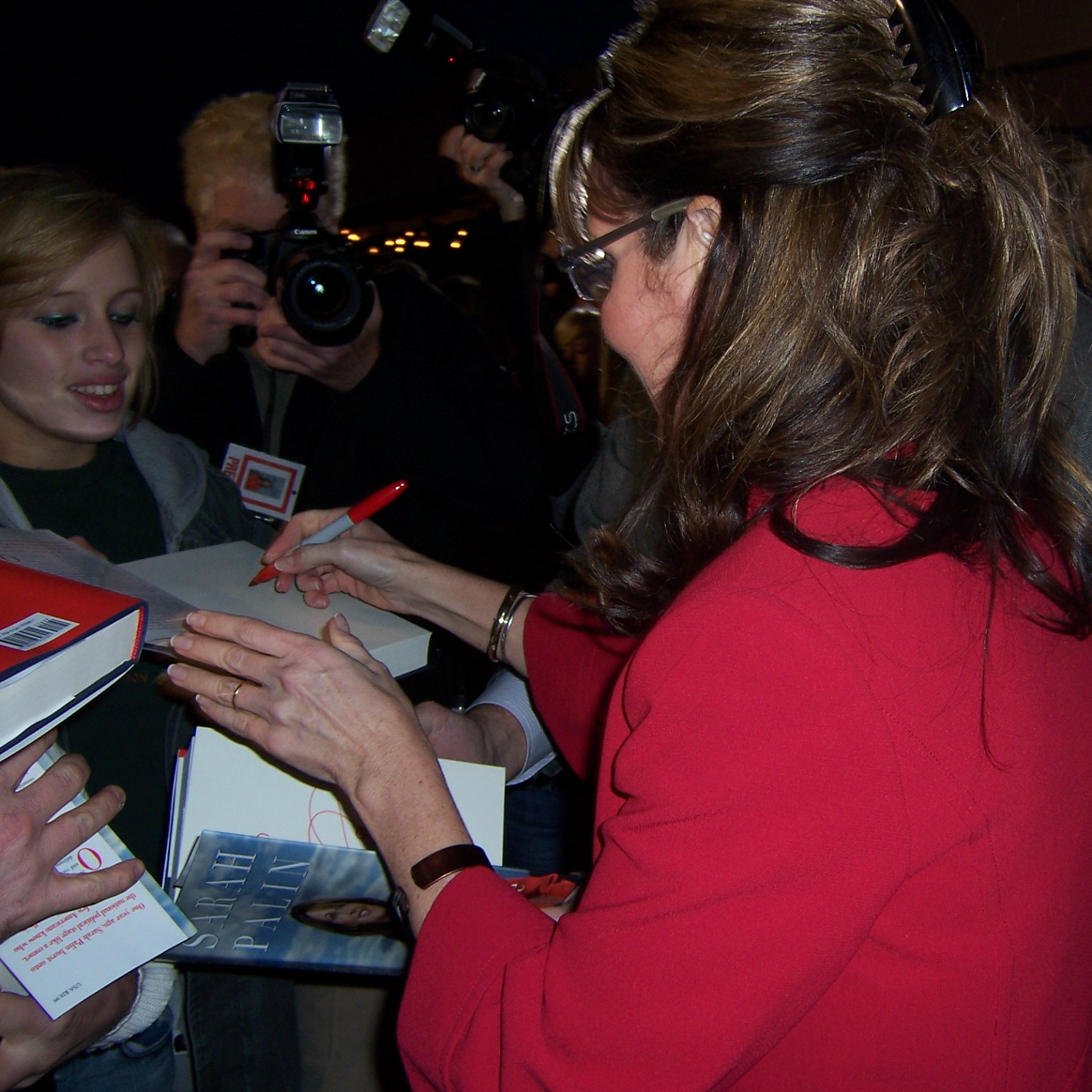
After her short speech, she greeted fans in the crowd, who were intermingled with media clamoring for a word with Palin. This was as close as the media was allowed, as Palin was whisked away into Barnes & Noble to begin signing books. Her security guards kept her well protected from the media, which Palin often looks at with disdain, especially after her disastrous interview with Katie Couric during the election campaign.
Much criticism of Palin’s book has been raised, but that didn’t stop her fans from gushing out Palin praise.
Teenager Madeline Hamilton waited in line since noon but was unable to get a wristband to get her into the signing. But that didn’t diminish her love of Palin:
“She’s my hero, she’s my mentor…I love her, she’s great, she’s American. She symbolizes everything I’d love to be. She’s everything I wish I could be and hope to be when I’m older.”
Jo Lamanski drove all the way from the Michigan-Ohio border to see Palin so her daughters could witness ‘Palin Power’:
“We are firm believers that she’s an awesome role model for women, that she is a strong, smart, beautiful woman who is a great mother and didn’t put her career on hold to be a mom and proved that you can do both. You don’t have to give up your family to be a successful career woman, you don’t have to sacrifice your career to be a great mom. And to me that’s an important lesson for my girls to learn.”
At the end of the night, with the crowds dispersing in revelry and the cameras and lights of the media all packed up, Grand Rapids has yet again experienced life in the political spotlight. But what the spotlight has revealed to the nation, and the world, is for us Grand Rapidians something that doesn’t look right in the light.
Edward McClelland of Salon.com had this to say about West Michigan:
Sarah Palin seemed to have an affinity with Greater Grand Rapids that she may not find anywhere else on her 31-city tour. West Michigan fits both sides of the Palin persona — the antiabortion creationist and the moose-skinning hockey mom. It’s a northern exclave of the Bible Belt, with one of the highest churchgoing rates in the nation. But unlike the rest of the Bible Belt, it’s a place of deep snowfalls, ice rinks and bars with more Ski-Doos than pickups parked outside on a January night.
Many other news outlets commented on Grand Rapids and West Michigan being a conservative stronghold.
The notion that is being spread in much of the media that Grand Rapids is purely a GOP epicenter is dishonest, especially when one considers that a majority of Grand Rapids voted for Barak Obama and Jennifer Granholm in recent elections. If Sarah Palin was so popular in Grand Rapids why did she do so poorly in last years Presidential race in this supposed GOP epicenter?
Statewide Group Targets Consumers Energy CEO
Today in Grand Rapids 15 people gathered in front of the Consumers Energy offices in Wyoming, Michigan to kick-off a new campaign targeting David Joos, CEO of Consumers Energy. The Press Conference was one of many throughout the state, where consumers, activists and environmental organization came together to say no to more coal plants that are proposed in Michigan.

Representatives from the Sierra Club, Clean Water Action, Michigan Citizen Action & a Consumers Energy ratepayer spoke to a variety of reasons for opposing more coal plants in the state of Michigan. One of the reasons for coal plant opposition was the negative impact of coal, from both the mining and burning of coal.
Another issue that was addressed was the possibility for Michigan to generate its own renewable energy. Erin Knott with Michigan Citizen Action sited a recent study by the Natural Resources Defense Council, which supports the idea that Michigan can meet its energy needs through a combination of renewable sources. Some of the finds from this study are:
- Energy efficiency programs could save Michigan $3 billion in electricity costs over the next 20 years.
- Michigan’s previous energy plan, written in 2007, is out of date, with unrealistic projections of future electrical demand, limited implementation of energy efficiency and renewable energy, and reliance on outdated 20th century coal technologies.
- Clean renewable energy is less expensive, cleaner, faster, more economically robust, and creates more jobs in Michigan than a 20th century plan based on new but obsolete large power plants driven by fossil fuels.
Lee Sprague with the Sierra Club ended the Press Conference by encouraging people to sign the online petition that Clean Energy Now is circulating that tells Consumers Energy CEO David Joos to put an end to coal plants in Michigan and to invest in Green Jobs and clean energy.
Below is a video of the Press Conference in its entirety.
New GR Press Editor Speaks to the Progressive Women’s Alliance
Starting last July, Paul Keep has been the editor for the Grand Rapids Press, replacing long-time editor Mike Lloyd. Wednesday night Keep spoke at a forum hosted by the Progressive Women’s Alliance.
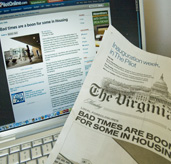
Keep began his talk by reading some comments from readers about Sarah Palin’s visit to Grand Rapids, with one of them being from a someone who referred to the GR Press as “liberal,” a comment that drew laughter from the crowd of about 75 people who came to hear the new Press editor speak.
The speaker talked about the reasons that newspapers are financially challenged in the US. Keep said that one of the big things that have happened at newspapers across the country was lay-offs. However, the editor said that the Press did not lay people off, rather they offer employees a buyout. Another change that is evident at the Press has been the reduction in the size of the paper.
Keep said there were three main reasons for these changes at the only daily newspaper in Grand Rapids. First, he said, the national economy’s recession has meant that Sunday inserts are cut or reduced to fewer weeks, since national companies were spending less on advertising. Second, since Michigan’s economy was also hurting regional businesses like Art Van’s and Meijer were also reducing their advertising revenue.
At this point Keep wanted to make it clear to the audience that 75% of the revenue that the Press generated was from advertising and since advertising revenue was down they had to make changes. The third, and last reason for the changes was the role that the Internet was playing. More people are getting their news content online and less likely to read newsprint. Keep did say that the Internet has been a positive aspect for the paper in some ways since it allows their reporters to do more with video and audio. However, fewer people are paying for ad space in the classified section, so again it seems that all three reasons for the changes at the Press were based on a decline in advertising revenue.
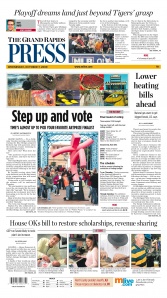
Keep then wanted to reassure the audience that the news side of things will stay the same and that the Press “will do whatever it can to provide good news, with an emphasis on local.” He said that national and international news changes so much, so what they print in the morning is old news by the time that people receive their paper, which is why local reporting is important.
The editor mentioned that the Grand Rapids Press was part of the Booth Newspaper chain and that it was a family business. While it is true that the Press is part of the Booth newspaper chain, Booth is just a subsidiary of a much larger media conglomerate known as Advance Publications, which owns dozens of newspapers across the country, magazines and some broadcast media. So it seemed a bit dishonest to present the Press as owned by “a family business.”
Keep went on to say that the Booth Newspapers have made changes in the past year across the state, but he didn’t mention that the consolidation of the Booth papers meant that the Grand Rapids office would been doing the design and copy editing for all the Booth papers. The Press editor did say that the Booth chain was doing some experimenting right now with their papers and he provided three examples for the audience.
First, reducing the size of the paper in Grand Rapids is one experiment. They reduced the amount of national and international news and also moved it to the back of section A opposite the editorial page. A second experiment is what happened in Ann Arbor where the decision was to shut down the print paper and go to an online presence. They did start up a different print publication that is only printed on Thursdays and Sundays. The Third experiment is with the papers in Flint, Saginaw and Bay City, which are share some content, national news and local sports. They cut out 4 days of publication, leaving Thursday, Friday and Sunday as the days people would get newspapers. Keep said they are waiting to see which of the three experiments works best.
The Press editor concluded by saying, “We are a profit making company, so we need to make more than our expenses. Since it is a big retail time, it is also an important time for the papers.” Apparently ad revenues are big this time of the year for the paper. Keep also said that he thinks that journalism is going to be fine and that newspapers will be fine, based on the fact that people will always want local information.
There was a question and answer period after the talk but most of the questions continued to deal with issues like readership, advertising and competition with the Internet. There was one question about the editorial process used in deciding which candidates to support and Keep said there are four of their staff, which makes that decision.
Someone also asked about the GR Press relationship to the Rapidian. Keep said that they have had conversations with them, but frankly he hasn’t followed the site much in recent weeks.
Another person asked about process for deciding local stories versus wire service stories in the religion section of the paper. Keep said that that depends on what is happening locally, how many reporters they have available and whether or not the wire story has interesting content.
GRIID did ask Keep about their claim to have a commitment to local news. We asked him about our recent study that concluded that the Press gave way more coverage to ArtPrize than they did to local elections this fall. Keep responded by saying that they want to focus more on local elections and then said they plan on doing monthly election issue themes leading up to the 2010 Governor’s race. Apparently, his definition of local is different than ours.
Corporate Front Group Presents on Climate Change
The Consumer Energy Alliance (CEA) hosted an event today in Grand Rapids that was billed as “A Business Primer on Federal Climate Change and Energy Legislation.” About 30 people gathered to listen to Tom Mullikin, who the CEA refers to as an “environmental attorney.”
Mullikin began his talk with what he called background on the issue of Climate Change. He said that the issue is usually framed by the two most polar opposite ends – the far right, which denies global warming and the far left, which says we need to reduce global carbon emissions by 83%. I understand how denying global warming is a polarizing perspective, but to say that an 83% reduction of carbon emissions is far left perspective, dismisses the leading scientific body, the Intergovernmental Panel on Climate Change (IPCC), which agrees that there needs to be about an 80% reduction in carbon emissions by 2050.

Next Mullikin talked about the “bad precedent that was set at Kyoto.” The speaker said that the language of Kyoto framed the debate of global warming between developed nations and developing nations in such a way as to exempt developing nations from any responsibility for global warming. Mullikin thinks that countries like China and Brazil are more responsible for carbon emissions than the US or the European Union. What he failed to address is that while China produces a significant amount of carbon emissions, the US proportionately generates more since we have a significantly smaller population.
Mullikin showed the audience lots of graphs and charts to support his main points, all of which downplayed US responsibility for global warming. Some of the main points he made were:
- Human activity on generates about 5% of Green House Gases (GHG)
- The US is only responsible for 17.9% of GHG
- US manufacturing is 3 times more energy efficient than in Asia
Mullikin told the story of when he was in Minnesota as part of an effort to bring a new steel plant to that state. He said that environmentalists were opposed to it because of all the carbon emissions generated, but countered by saying that the same steel plant in China would generate more carbon emissions in China because there was less regulation.
In fact, Mullikin seems to direct most of his criticism towards China, but offered no context. When I asked him about manufacturing jobs moving to China and the causes he said it had to do with “currency manipulation,” ignoring trade policy and minimizing the profit motive of large corporations to find a cheaper wage market.
Mullikin concluded his presentation by saying that if the Waxman-Markey legislation is adopted, Michigan will lose 90,800 jobs. Mullikin did not explore the content of the Waxman-Makey bill and his source for the data on Michigan job loss was a study by the National Association of Manufacturers (NAM).
Using sources like NAM, which represents business interests, was typical of most of the sources he cited. Other sources were Energy Matters MidWest, another business-centered group, Secure Our Fuels (part of CEA) and the American Petroleum Institute, which represents Big Oil.

In fact, when looking at the website for the Consumer Energy Alliance, it becomes clear that they don’t represent a non-profit, non-partisan perspective, rather a very pro-corporate alliance. The organization’s affiliates is a who’s who of energy companies, business associations and conservative Think Tanks. If anything the Consumer Energy Alliance should be seen as an astroturf organization that was created and funded by a corporate alliance in order to promote that agenda.
Mulliken said throughout his presentation that the audience shouldn’t take his word for the data he was offering. This was good advice, since most of what he presented was at best biased, but more accurately deceptive, since there was no honest commentary about how the Consumer Energy Alliance came to be and whom it represents.
Media Bites – Product Placement and Viral Marketing
This week’s Media Bites takes a look at how advertising continues to infiltrate all kinds of media. We first look at the use of Product Placement in films like Zombieland and X-Men Wolverine. We also look at a recent attempt by the Captain Morgan brand to pay NFL football players to strike the Captain Morgan pose during games. This technique is what the industry calls viral marketing, which is effective when the public starts to mimic what the use of the brand.
Heartwell fills in for Mayor Daley at Econ Club event
Mayor George Heartwell spoke Monday afternoon on short notice to the Grand Rapids Economics Club. The scheduled speaker was to be Mayor Richard Daley of Chicago. Daley was forced to cancel at the last minute due to the apparent suicide of Michael Scott, President of the Chicago School Board. Heartwell used the opportunity to make a speech full of plenty of nice quotes about where he would like to see Grand Rapids in the future, but did not seem to have much substance to actually back it up.
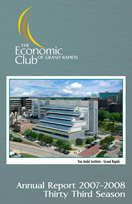
Calling Grand Rapids “a little Chicago” and stating that the city is “making a transformation from manufacturing to a knowledge based economy”, the mayor put great emphasis on the city’s attempts to retain young professionals. The same sentiment was recently put forward by Frey Foundation President Milt Rohwer in the Grand Rapids Business Journal.
According to Heartwell, this young talent will be “lured to Grand Rapids by things like Founders Brewing Company and Metallica concerts”, but had few words on what jobs might be here for these people.
He also spoke briefly about Grand Rapids Public Schools, stating that on a recent tour of a few of them, he found “the learning environment different from that of popular mythology” and that “students were engaged and discipline was not an issue.”
While only once at the beginning mentioning that the city is facing a “budget deficit of $28 million”, and not bringing up at all the recent decision to lay off 125 city workers, the mayor talked about grandiose plans to bring about more public transportation and bike paths.
As the mayor wrapped up his talk with the quote, “I am so damn proud of Grand Rapids,” he was given a standing ovation by the crowd of around 500, most of which represent the area’s economic elite.
Journalism as Advertising: The GR Press & Black Friday
On Monday the Grand Rapids Press ran as the lead front-page story an article about local retailers “leaking” their Black Friday Deals to the public. The headline of this story read, “Black Friday buildup begins.”

Both Meijer and Target spokespersons are quoted in this article about why they have decided to release their sale items early. The Meijer spokesperson said, “The indicators are saying retail sales in general will be flat for the season. We’re basically trying to amp up the game.”
In many ways you could argue that this story is nothing more than a glorified ad for both Meijer and Target stores. There doesn’t seem to be any journalistic value, since there are no other sources cited, sources, which might be talking about the current economic troubles or comments from working people who have limited resources for holiday shopping.
Instead, the Press story includes the website Gottadeal.com, which is essentially an advertising site. One wonders why the only daily newspaper in Grand Rapids would be compelled to report such a story, let alone make it the lead article. Considering that in the 16-page section of the November 16 edition of the Press there were already 5 ½ pages of advertising, there is no need to use limited space to “amp” up sales for big retailers.
 Grand Rapids Institute for Information Democracy