Road to Copenhagen Part 2: Climate Rage
Yesterday it was announced by world leaders that there would be no clear goals determined at the International Climate Summit next month in Copenhagen, Denmark.
According to the Reuters story “negotiations have been bogged down, with developing nations accusing the rich world of failing to set themselves deep enough 2020 goals for curbing greenhouse gas emissions.” The article also suggests that the delay might give the US Senate time to pass its version of Climate Change legislation, which we will analyze later this week.

This delay by world leaders will no doubt fuel the growing Climate Rage that Naomi Klein just wrote about in an article for Rolling Stone Magazine. This idea of Climate Rage is reflecting in a growing international movement, particularly in developing nations, to confront the rich nations of the world (G8 nations), who have been the primary generators of carbon emissions.
Movements within the developing world are even now calling for Climate Debt, which is the idea that “rich countries should pay reparations to poor countries for the climate crisis.” A Bolivian delegate Angelica Navarro better articulated this idea of Climate Debt at a recent UN gathering. Navarro said, “Millions of people – in small islands, least-developed countries, landlocked countries as well as vulnerable communities in Brazil, India and China, and all around the world – are suffering from the effects of a problem to which they did not contribute.”
Klein has also been suggesting that we can expect the kind of direct action and public resistance at Copenhagen that the world has seen since Seattle.
“There is certainly a Seattle quality to the Copenhagen mobilization: the huge range of groups that will be there; the diverse tactics that will be on display; and the developing-country governments ready to bring activist demands into the summit. But Copenhagen is not merely a Seattle do-over. It feels, instead, as though the progressive tectonic plates are shifting, creating a movement that builds on the strengths of an earlier era but also learns from its mistakes.”
We plan to report on this resistance and critique the commercial media’s coverage of Copenhagen, since there is no indication that the mainstream news media will report on the real motives and actions of the thousands of people on the streets.
For some good discussion on Climate Change and Climate Rage, watch this 2 Part interview with Naomi Klein on Ring of Fire Radio.
Local Screening of documentary on Children & Commercialism
The local child advocacy group STOK – Stop Targeting Our Kids – is hosting a public screening of the documentary Consuming Kids: The Commercialization of Childhood.
Produced by the Media Education Foundation, the documentary “throws desperately needed light on the practices of a relentless multi-billion dollar marketing machine that now sells kids and their parents everything from junk food and violent video games to bogus educational products and the family car. Drawing on the insights of health care professionals, children’s advocates, and industry insiders, the film focuses on the explosive growth of child marketing in the wake of deregulation, showing how youth marketers have used the latest advances in psychology, anthropology, and neuroscience to transform American children into one of the most powerful and profitable consumer demographics in the world.”
When: Thursday, November 19 at 7pm
Where: Wyoming Park United Methodist Church, 2244 Porter SW in Wyoming, MI
For more information contact STOK at stokaction@gmail.com.
Interview with Dennis Banks
We had a chance to interview Dennis Banks, co-founder of the American Indian Movement (AIM), while he was in town participating in the Great Lakes History Conference. We talked with Dennis about the US Policy of removing Native children from their communities, what led to the creation of AIM, the 1973 occupation and current Native struggles across the country. The interview is in 4 parts.
The Business Class and Talent Production
One way to understand the business class is to read the business press. Quite often the reporting is more honest in the sense that they are more up front about what they are doing since their audience is primarily the business community.
In the most recent issue of the Grand Rapids Business Journal there was a short interview with Frey Foundation President Milt Rohwer. Rohwer was asked what he thinks needs to happen in order for Michigan’s economy to thrive. Rohwer thinks that people need to support “education to generate the high-quality talent needed for the economies and jobs of the future.”

Rohwer goes on to say, “To me it’s really an issue of understanding the globally competitive nature of the economy and the extent to which prosperity is related to jobs that require a very high degree of skill and education.”
In the Business Journal interview Rohwer says that he is trying to improve education in Michigan, particularly education that would create economic talent. Rowher does this work through mainly through an organization called Michigan Future Inc. According to the website, “Michigan Future, Inc. is a non-partisan, non-profit organization. Our mission is to be a source of new ideas on how Michigan can succeed as a world class community in a knowledge-driven economy.”
Education, through the lens of Rohwer and Michigan Future Inc., is really about creating future talent for the business community throughout the state. This is reflected in who sits on the board of Michigan Future Inc. Some of the notable board members are from DTE Energy, the Detroit Chamber of Commerce, Crain’s Detroit Business and the New Economy Initiative. In addition, Michigan Future Inc. has people from the Detroit Public Schools, the business law firm of Jaffe, Raitt, Heuer & Weiss, and several Michigan Foundations, including the Frey Foundation.
In the interview Milt Rohwer affirms this notion of education serving the interests of the business class when he states, “I’m hopeful employers will make their voice known in terms of their needs for very well trained people coming out of higher education and K-12 school systems.”
People will argue that this is a good thing if it provides people with good paying jobs, but what is usually not included in this discussion is that only a small percentage of people will get high paying jobs, even though taxpayers subsidize the public education system that provides the “talent” for these businesses. In this sense the business community only sees our educational system merely as a mechanism to groom new and talented employees that will help create the profits they seek to remain “competitive in the global economy.”
Lou Dobbs forced off CNN because of anti-hate campaign
Last month we encouraged people to participate in a national campaign against the racist and anti-immigrant positions of CNN commentator Lou Dobbs.
The Basta Dobbs campaign exposed the vicious and hateful commentary that long time CNN commentator Lou Dobbs has been known for through an online petition campaign and a short video they produced that was widely distributed.

The Basta Dobbs campaign yesterday released a statement upon hearing the decision by CNN to release the long-time anchor from their network.
“Our contention all along was that Lou Dobbs – who has a long record of spreading lies and conspiracy theories about immigrants and Latinos – does not belong on the ‘Most Trusted Name in News,’” said Roberto Lovato, co-founder of Presente.org, a national online advocacy organization coordinating the BastaDobbs.com campaign in conjunction with more than 40 local and regional Latino organizations from across the country. “We are thrilled that Dobbs no longer has this legitimate platform from which to incite fear and hate.”
This victory not only demonstrates that this kind of hate speech will not be tolerated by many in this country, it also sends a message to the anti-immigration and White Nationalist movements that those who support immigration are organized.
Bissell Protest is small, but sends a strong message

Yesterday a small group of people gathered outside the Bissell offices on Walker NW in Grand Rapids to protest the company’s complicity in the firing of 70 workers from one of their warehouses outside of Chicago last week.
When protestors arrived Bissell had 2 security guards at the entrance to the facility asking people if they had “business with Bissell.” The guards had a vehicle and communication devices to relay information to others inside the building.
Within 2 minutes of arriving protestors were also met by Walker City police who instructed them on where they could stand and that any violation beyond the “allowable” activities he described would result in arrest. The police officer came and went several times during the 90-minute protest.

Protestors held a variety of signs and were seen by roughly 100 Bissell employees upon their departure. There were also several hundred motorists who passed by during the protest and some of them displayed support by giving a thumbs up or honking their horns.
Even though there were just a few people at the protest, it clearly sent a strong message to the Bissell Corporation based on their security presence and their notification of local law enforcement.
It is not known at this point what actions will take place in the future, but we will continue to follow this story and keep you up to date.
Here are some comments by some of those who came to the demonstration:
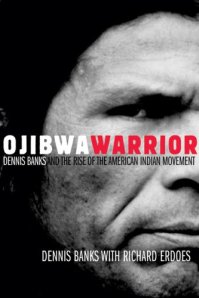
Indian Activist and AIM co-founder, Dennis Banks, Speaks to Overflow Crowd at GVSU
The six Native American drummers pounding out the traditional rhythm on one drum spanned several generations, one was a young girl, perhaps seven or eight years old. Part of President Obama’s speech commemorating National Native American Heritage Month was read aloud, “Native American voices have echoed through the mountains, valleys, and plains of our country for thousands of years, and it is now our time to listen.”

Like the message of the drums, the message Dennis Banks delivered will resound for generations to come. The Indian is strong—and that strength will continue the fight for justice in this land that was so unjustly taken from them.
Banks is one of the founders of the American Indian Movement, AIM. Grand Valley State University’s Loosemore auditorium was “standing room only” by the time the presentation began with a segment from the PBS television series, We Shall Remain. The segment revealed how, between 1878 and 1940, more than 100,000 Indian children were kidnapped from their families and forced to live at boarding schools. Dennis Banks, given name Nowa Comig, was forcibly torn from his mother and family at age five and taken to the Pipestone Boarding School.
“It was a social experiment to change the Indian child’s thinking, to destroy the Indian culture within the native child,” Banks said. “It was a bad experiment with a heavy toll. It failed, but we’re still here.”
Banks described the brutality that reigned within the schools. Upon arrival, children’s traditional braids were cut off; they were sprayed, naked, with DDT; then issued “white man’s” clothes and names. Beatings were common, especially for runaways, with other children enlisted to join in with sticks, clubs and brooms.
“There was deep pain when I witnessed the brutality,” Banks said. I screamed along with them,” Banks said.
The deeper pain was the disconnect Banks experienced with his mother and family—a disconnect which he was never able to overcome.
Much of the conversation Tuesday night told the rest of Banks’ life story: his successful stint in the Air Force; his many incarcerations; his times as a day laborer in the slums of Minneapolis, where Paddy wagons were sent to the bars on Friday nights and filled with Indians who would be forced, like slaves, to clean the streets and football stadium.

Wounded Knee 1973
Another segment of the PBS series was shown, this one documenting how in 1973 Dennis Banks and members of the American Indian Movement mounted an armed occupation of Wounded Knee, South Dakota, the site of the U.S. Calvary’s horrific massacre of 250 men, women and children in 1890. During AIM’s 1973 occupation, the Indians called for a review of treaties, restoration of the lands legally theirs and the removal of Dick Wilson, the corrupt tribal chairman of Pine Ridge reservation, known for violence and extortion. During Tuesday night’s event, not enough attention was spent on the US policy of Indian Removal or the specifics of the 1973 Occupation of Wounded Knee.
Event moderator, Levi Rickert, asked Banks if he thought AIM’s actions at Wounded Knee were too violent. Banks paused, took a breath and answered, “There comes a time when you’re up against a wall, taking beatings, and you’re just not going to take it any more.”
When an audience member asked what the Indian’s next fight would be, Banks answered “Water rights. We’re going to have to assert our water rights . . . in the west, Minnesota, the Midwest… we own a lot of water but states argue that the water belongs to them.”
Banks went on to discuss how Indians’ fishing rights and control of oil on reservation lands has been likewise subverted by state and federal government. Banks concluded the evening by saying that, even though ignored by the doctrines of Manifest Destiny and Christianity, and subjected to U.S. brutality for the past 233 years, “Native people have had an impact on this continent for thousands of years.”
As the drummers came back on stage to close the event with ceremony, accompanied by Native singers, Banks joined the circle.
As Obama said, “ . . . it is now our time to listen.”
The question is, will we?
Media Bites – Nike & Urban Youth
This week’s Media Bites takes a look at a new Nike commercial that is promoting their line of skateboard shoes. The spot is attempting to position Nike as a company in touch with edgy, urban youth, even youth that defy authority. The commercial also features the music of Ice Cube and P. Rod with the song “Today was a good day.” Nike can appropriate all the urban dissident culture it wants to, but in the end Nike is only interested in selling their high priced shoes.
Speaker talks with students about Plan Mexico
This morning students at Grand Valley State University had the opportunity to listen to a presentation by Carlos Euceda. Carlos works with the Mexico Solidarity Network (MSN) based in Chicago and is on tour in the Midwest to share information on the work of his organization and provide an analysis of what is called Plan Mexico.
Carlos began with an overview of the work that MSN does and how it began. MSN was founded as a response to a massacre in Acteal, Chiapas in 1997. Tom Hansen, the founder of MSN, was investigating these actions and because of that he was deported from Mexico. In response to this people organized in the US to support human rights in Mexico and MSN was born.
Out of this effort an education program began with students from the US going to Mexico to learn first hand about the situation. MSN has projects in partnership with the Zapatista communities in Chiapas, with displaced people in Mexico City, in Oaxaca, and in Juarez where there has been a femicidal campaign against women.
Plan Merida/Plan Mexico
The main focus of Carlos’ presentation was on Plan Merida, or what is called in the US Plan Mexico. He said that this plan is really an extension of NAFTA, Plan Puebla Panama and Plan Colombia, in that Plan Mexico is the most recent policy designed to gain greater access to the natural resources of the country.
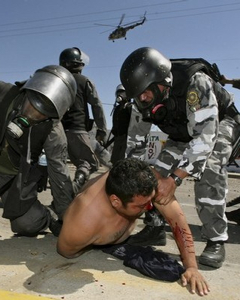
Carlos said that Plan Mexico is framed as a response to the growing drug problem in Mexico, but that is just a pretext for the militarization of the country. The US has increased the amount of weapons it has sent to Mexico under this plan in recent years, but Carlos also made the point that the narco-traffickers are also getting most of their weapons from the US.
However, according to the MSN speaker the real reason for the increased militarization of Mexico has been to criminalize any public opposition to the exploitation of resources. This policy has primarily targeted indigenous communities, which also happen to be people who live in very resource and bi0-diverse parts of what is called MesoAmerica – Southern, Guatemala and Belize.
So, the problem for governments and corporations is that this territory is populated by millions of indigenous people, which makes it difficult for these economic forces to easily extract resources. Since the indigenous people will not leave, the only way to gain access to the natural resources is to engage in low-intensity warfare, according to Carlos.
Carlos said that the Obama administration has continued the Bush policies of focusing on the narco-traffickers publicly, when in reality it is about the militarization of Mexican society. The MSN speaker said that the jails in Mexico are filled with human rights activists who have been resisting these policies. He also said that the para-military forces are growing in southern Mexico and that there are 9,000 Mexican soldiers along the US border in Juarez. However, Carlos emphasized that this militarization provides a cover for the exploitation of Mexico’s resources.
There has been tremendous resistance to these policies, according to Carlos. One example he gave took place in Atenco, Mexico where the government wanted to build an international airport. However the resistance is more effect if there is international solidarity. Carlos encouraged people to get involved with the work of the Mexico Solidarity Network, by hosting speakers, providing financial support or going on a delegation and being an observer in the areas of conflict. “Solidarity is key,” he said, “and it is our obligation as US citizens to counter-act the policies of the US government which has escalated the repression.”
For additional information on Plan Mexico, check out this segment on Democracy Now from last year.
Bissell’s Dirty Secret: Workers Protest Bissell Warehouse in Response to Mass Firing
Two weeks ago workers from Chicago spoke in Grand Rapids about a factory occupation that happened last December. During that presentation they mentioned a new organizing campaign amongst warehouse workers in and around the Chicago area, since over 50% of merchandize that the US imports is distributed through Chicago.

We recently received word from the labor organizers in Chicago about the unjust action taken against workers at a Bissell warehouse just outside of Chicago.
Employees at the Bissell warehouse near Joliet, arrived to work at 6am today only to be informed they were all fired, but not before they trained their replacements.
Workers were fired en masse after filing legal complaints and charges last week over the many violations of state and federal law in the warehouse. On Thursday October 29th workers notified management that they had formed a union.
“This company has no respect for our rights. We will fight to force Bissell and Maersk to follow the law and treat workers with dignity,” said Anthony Bailey a forklift driver at the Bissell facility. “I will not accept losing my job because I stood up for my rights.”
The warehouse has been using an unregistered temporary employment agency that had systematically violated many state and federal laws, including paying some workers less than minimum wage.
Workers also cited racial discrimination, unpaid wages and threats of retaliation for bringing these issues to management’s attention.
The Bissell warehouse, managed by Maersk Logistics, opened in January 2009 and is part of the expanding distribution industry in Chicago’s suburbs. It supplies Bissell vacuum cleaners to big box retailers including Walmart and Target.
Today in Grand Rapids, 5 people in solidarity with the fired warehouse workers delivered a letter to the CEO of Bissell to express their opposition with the treatment of workers. The letter read in part:

As you should know, it is illegal to retaliate against employees for filing complaints under federal and state laws. These workers have lost their jobs after exposing unlawful practices at your warehouse and in fact may have been retaliated against for exercising their legal rights. As members of the Grand Rapids community, we hold Bissell accountable for worker abuse and sweatshop conditions in your supply chain. We urge you to retain all of the workers, many of whom have worked at your facility since it opened in January.
The Bissell CEO refused to meet with people from the community, but they were told an assistant would meet with them. After a 5-minute wait someone did come down to talk with the group and listen to their objections to the treatment of workers in the Bissell warehouse. The person said that they would give the letter to the CEO, but could not answer any of the questions asked, because he was just “a security guard” for the company. So, not only would the CEO refuse to speak to people, the secretarial staff deceived the community members by sending a security guard to speak with them.
Organized Protest
However, the efforts to pressure Bissell have just begun and the community members present, in conjunction with the Chicago labor organizers, are calling for a protest at the Bissell facilities located at 2345 Walker NW in Grand Rapids.
This Wednesday, November 11 beginning at 4pm, people will gather with signs in solidarity with the workers who were fired from the Bissell warehouse outside of Chicago. Please help us spread the word and consider joining the protest.
 Grand Rapids Institute for Information Democracy