(This article is reposted from Black Agenda Report.)
“African Americans are tumbling out of the nation’s economic orbit, wealth-wise, on a trajectory that can never achieve parity with whites.”
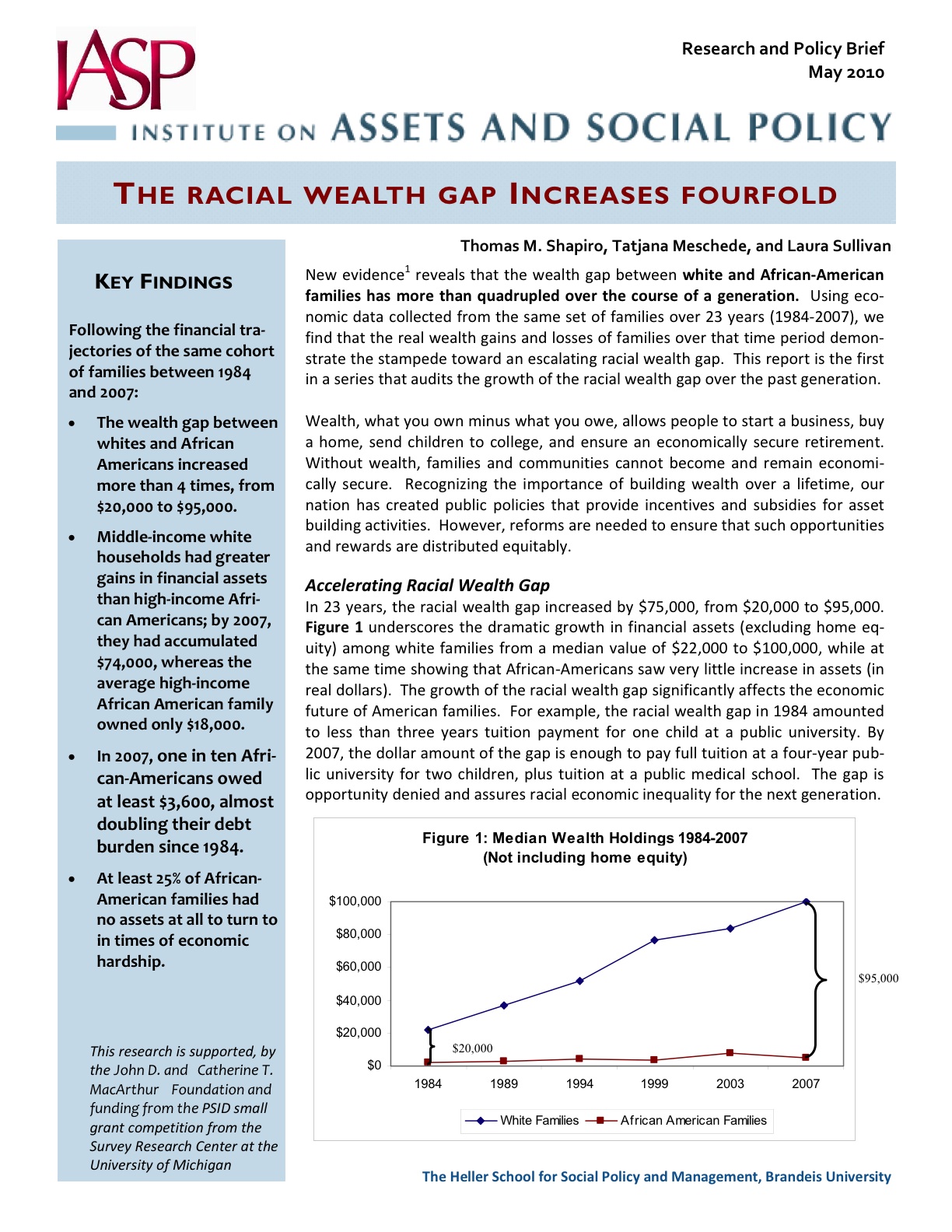
The gap between Black and white household wealth quadrupled from 1984 to 2007, totally discrediting the conventional wisdom that the U.S. is slowly and fitfully moving towards racial equality, or some rough economic parity between the races. Like most American myths, it’s the direct opposite of the truth. When measured over decades, Blacks are being propelled economically downward relative to whites at quickening speed, according to a new study by Brandeis University.
The gap between Black and white households ballooned during the 23-year study period, as white families went from a median of about $22,000 in wealth to $100,000 – a gain of $78,000. In the same period, Black household wealth inched up from a base of $2,000 per family to only $5,000. The sweat and toil of an entire generation had netted Black families only $3,000 additional dollars, while white families emerged from the period with a net worth of 100 grand that can be used to send a couple of kids to college, make investments, help out other family members, or contribute to the larger (white) community. The typical Black family has no such options.
Viewed another way, the median white family was 11 times richer than the median Black family in 1984 ($2,000 vs. $22,000). By 2007, the white household had become 20 times richer than its Black counterpart($5,000 vs. $100,000).
Any way one measures it, the numbers show African Americans are tumbling out of the nation’s economic orbit, wealth-wise, on a trajectory that can never achieve parity with whites. I repeat: never.
“By 2007, the white household had become 20 times richer than its Black counterpart.”
On the campaign trail in 2007, Barack Obama flippantly declared that African Americans had “already come 90 percent of the way” to equality, with only 10 percent more to go. Whatever the future president was thinking, it wasn’t economics. The meter of progress is running backwards on Black America, toward greater inequality and relative poverty. Everything else you’ve heard is propaganda.
The Brandeis study, conducted by the university’s Institute on Assets and Social Policy, showed that upper income Blacks fell even farther behind their white peers than lower income Blacks. During the survey period, higher income Blacks saw their wealth drop from $25,000 to just $18,000, while their white counterparts wealth soared to $240,000.
Black folks have been integrated long enough to know that the white family didn’t get richer by a quarter million dollars because they were smarter than the Black family. Privilege, especially cumulative privilege over generations, works wonders, like compound interest only better. Whites are both collectively privileged and capable of bestowing an endless stream of privileges on each other, while Blacks are deliberately positioned outside of the stream, and are preyed upon as a group by powerful (white) financial forces that profit from the wealth differential.
“Upper income Blacks fell even farther behind their white peers than lower income Blacks.”
The Brandies report recognizes the “powerful role of persistent discrimination in housing, credit and labor markets” – that is, the institutionally racist crimes of finance capital. Had the survey continued past 2007, the carnage of the Great Recession would have revealed even more dramatically the incredibly shrinking nature of Black wealth in the current era.
Enemies of all colors and sly servants of the rich will use the news of the evaporation of African American wealth to heap blame on Black “culture.” This “shaming” strategy is designed to keep Blacks looking inward for the source of their woes, and to simultaneously despair of finding salvation in our own capacity for group agency. Meanwhile, the Lords of Capital devour us like piranhas – quicker than they do whites, who are padded with the fat of relative privilege – $95,000 worth of it, the racial wealth spread of 23 years.
Although Black parity with whites has never been on the horizon, impatient whites have insisted since 1969 or thereabouts that “it’s time” African Americans were made to “stand or fall” on their own, minus all the imagined assistance Blacks have supposedly received from phantom federal and state agencies. After all, say the anxious whites, how long is society (meaning themselves) supposed to pay for the slavery and segregation of the past? Most white folks – and President Obama – believe, or pretend to believe, that whatever legitimate grievances Blacks might harbor against the United States stem from circumstances deep in the past. The only question is, when will Blacks finally “get over it?”
“Blacks are preyed upon as a group by powerful (white) financial forces that profit from the wealth differential.”

The Brandies study shows that the racial wealth gap, although historically rooted in slavery and Jim Crow oppressions, has grown dramatically under post-civil rights era conditions. The gap is not simply a legacy of some ancient American apartheid, but a product of the recent past and of the present. This is a different paradigm, entirely, in which past racial wrongs are compounded by additional layers of institutionalized anti-Black behavior in the 1980s, 90s and in the 21st century –wounds so harmful they set African Americans on a backward course in terms of wealth accumulation.
In 2004, United for a Fair Economy came out with the first of its annual “State of the Dream ” reports. Readers were shocked out of complacency by data that showed Blacks would not reach wealth parity with whites until the year 2099. It was surely a bummer to realize that no one then alive would see the “promised land” of evenly matched Black and white median household wealth. But at least the study indicated that “we, as a people” would eventually get there, as someone famous once predicted. There are no such condolences in the Brandies data. At the rate Blacks have been falling behind in wealth since the mid-80s, the Black and white median paths will diverge ever farther, never to connect under this system of economic and political rule. Blacks cannot shop or invest or save or borrow our way to a just society. Social justice and true human equality can only be achieved through our collective political action in opposition to the current order – by any means necessary, as another famous man once urged.
The Michigan Organizing Project (MOP) announced today that they are organizing a rally in Kalamazoo on June 7, while President Obama gives the commencement address to an area high school.

MOP wants to pressure the President to follow through with campaign promises on a comprehensive immigration reform at the federal level. In a message sent out MOP states, “This is a tremendous opportunity to show local and even national media how much the people of West Michigan care about comprehensive immigration reform.”
MOP is also organizing buses from Grand Rapids to Kalamazoo, buses that will be leaving from La Nueva Esperanza United Methodist Church (100 Burton St SE, Grand Rapids, 49507) at 5:15pm on Monday, June 7th.
The local organization is also asking for a $10 donation to cover their costs and for people to reserve a seat ahead of time by sending an E-mail to Jordon Bruxvoort jordan.bruxvoort@gmail.com. If you are unable to attend by would like to sponsor anyone else to attend the rally you can also make a donation to MOP by June 4. Their office is located at 250 Brown St SE in Grand Rapids.
MOP has been one of the main groups locally advocating for comprehensive immigration reform over the past few years. Organizers say that they expect a large turnout from the Hispanic community since some of the Spanish language radio stations will be aggressively promoting this opportunity.
According to the Center for Responsive Politics, $15,824,832 has been spent to fund Congressional races across the state, with a little over half of that going to Democrats.

The candidates receiving the largest amounts so far are Democrats Gary Peters ($1,962,516) and Mark Schauer ($1,817,673). The top Republican recipient is Dave Camp at $1,370,192.
In West Michigan the money raised for the 2nd and 3rd Congressional races are not nearly as high and the money seems to be spread out between numerous candidates.
In the 2nd Congressional race Jay Riemersma (R) leads all candidates having raised $526,000 as of the last financial report deadline, follwed by Willian Cooper (R) ($225,721), Bill Huizenga (R) ($200,269), Wayne Kuipers (R) ($112,590), John Reichardt (R) ($35,974), Fred Johnson (D) ($25,703), Nicolette McClure (D) ($13,280), Jeff Wincel (R) ($11,885) and Chris Larson (R) & Edward Ted Schendel (R), which have both raised no money.
In the 3rd Congressional race Justin Amash (R) leads all candidates in fundraising with $116,063, followed by Pat Miles (D) ($107,230), Steve Heacock (R) ($88,187), Bill Hardiman (R) ($54,087) and Robert Overbeek (R) ($2,549). Louise E. Johnson (R), Michael Van Kleeck (R) and Paul Mayhue (D) all have not raised any money as of the last financial reporting deadline.
The top donor to Michigan Congressional races so far is the UAW ($800,500), followed by ActBlue, Weyerhaeuser Co., Centra Inc., DTE Energy, Ford Motor Co., and Dow Chemical. West Michigan donors are Autocam Corp. ($111,000), Bridge Street Capital ($109,000), Amway ($108,050), and Windquest Group ($100,900). Amway and the Windquest Group are essentially the same since the DeVos family is involved in both.
While it is hard to determine for sure exactly how this money will influence the Congressional races, it is likely that big money will determine the outcome of most of these races. It would also be good to pay attention to how money from specific entities will influence the political platform of individual candidates as the races develop.
Comcasteroid Heading Right for Earth
(This Media Alert is a re-posting from Stop Big Media.)

Comcast is like an asteroid on a collision course with earth, and time is running out to stop the company from taking over NBC Universal and destroying our media system. We have one month to tell the Federal Communications Commission why it should stop the Comcast merger (and save the planet? Perhaps!).
Comcast is notorious for overpriced cable service, overpaid executives, attacks on Net Neutrality and terrible customer service. Now, it wants to take over NBC Universal and expand its already massive media empire. If we don’t take action, we’re going to get hit with higher bills and fewer choices both on- and offline.
The impact will be felt by everyone. We need to avert a Comcast disaster by telling the FCC to stop the merger.
Thanks to the public outcry, the FCC is paying attention. The agency just appointed an outside investigator to review the merger and opened a month-long public comment period so we can register our objections to this disastrous deal. If the deal goes through, Comcast will be able to control what we watch and how we watch it, absorbing dozens of cable networks, a movie studio, 27 television stations, and influence over 200 NBC affiliates.
It would be the biggest media takeover in a generation. Our cable and Internet bills could skyrocket. Sites like Hulu and popular TV programming could get locked behind a paywall.
The fact is, Comcast has a terrible record on just about everything:
- It fires workers who try to join unions
- It was voted worst company in America by readers of the Consumerist
- It engages in vicious price gouging
- It was caught red-handed blocking Internet traffic
CEO Brian Roberts was rated one of the five most overpaid CEOs in America. The video below explains just how bad this Comcast-NBC deal is, and why the FCC needs to stop it. But let’s be real. This isn’t some Hollywood movie. This is our media system, and if we don’t act now, it will be struck by a merger of epic proportions. With your help, we can stop it.
OSHA Says BP Has “Systemic Safety Problem”
(This article is re-posted from the Center for Public Intergrity.)

Two refineries owned by oil giant BP account for 97 percent of all flagrant violations found in the refining industry by government safety inspectors over the past three years, a Center for Public Integrity analysis shows. Most of BP’s citations were classified as “egregious willful” by the Occupational Safety and Health Administration and reflect alleged violations of a rule designed to prevent catastrophic events at refineries.
BP is battling a massive oil well spill in the Gulf of Mexico after an April 20 platform blast that killed 11 workers. But the firm has been under intense OSHA scrutiny since its refinery in Texas City, Texas, exploded in March 2005, killing 15 workers. While continuing its probe in Texas City, OSHA launched a nationwide refinery inspection program in June 2007 in response to a series of fires, explosions and chemical releases throughout the industry.
Refinery inspection data obtained by the Center under the Freedom of Information Act for OSHA’s nationwide program and for the parallel Texas City inspection show that BP received a total of 862 citations between June 2007 and February 2010 for alleged violations at its refineries in Texas City and Toledo, Ohio.

Of those, 760 were classified as “egregious willful” and 69 were classified as “willful.” Thirty of the BP citations were deemed “serious” and three were unclassified. Virtually all of the citations were for alleged violations of OSHA’s process safety management standard, a sweeping rule governing everything from storage of flammable liquids to emergency shutdown systems. BP accounted for 829 of the 851 willful violations among all refiners cited by OSHA during the period analyzed by the Center.
Top OSHA officials told the Center in an interview that BP was cited for more egregious willful violations than other refiners because it failed to correct the types of problems that led to the 2005 Texas City accident even after OSHA pointed them out. In Toledo, problems were corrected in one part of the refinery but went unaddressed in another. Jordan Barab, deputy assistant secretary of labor for occupational safety and health, said it was clear that BP “didn’t go nearly far enough” to correct deficiencies after the 2005 blast.
“The only thing you can conclude is that BP has a serious, systemic safety problem in their company,” Barab said.
The head of OSHA, David Michaels, said the safety problems aren’t limited to BP. “We are very concerned about the commitment of the refining industry to worker health and safety,” he said.
BP officials did not respond to requests for comment about the OSHA data.
According to the company’s website, “BP’s commitment to safety begins at the most senior levels of our organization—with robust systems to implement, audit, report on and improve our performance.
“Creating a safe and healthy working environment is essential for our success. Since 1999, injury rates and spills have reduced by approximately 75 percent,” the BP website says.
BP FACES $90 MILLION IN FINES
BP, which calls itself the country’s largest oil and gas producer, operates five U.S. refineries that collectively process about 1.5 million barrels of crude oil per day. Last October, OSHA proposed a record $87 million fine against the Texas City refinery. The agency proposed a fine of $3 million against the Toledo refinery in March. BP is contesting both penalties.
Separately, BP’s Cherry Point refinery in Blaine, Wash., was cited by state regulators for 13 serious violations earlier this month. Penalties totaling $69,200 have been proposed. These citations are not included in data analyzed by the Center.
No other oil company inspected by OSHA since June 2007 was even close to BP in the number of citations issued. Sunoco Inc. was cited for 127 alleged violations, eight of which were willful. ConocoPhillips Co. was cited for 119, four of which were willful, and Citgo Petroleum Corp. for 101, two of which were willful.
OSHA defines a willful violation as one “committed with plain indifference to or intentional disregard for employee safety and health.” An egregious willful violation is considered so severe that it can result in a penalty each time a violation occurs, rather than a single penalty for all violations of a regulation. A serious violation is described as one creating a “substantial probability” of death or serious injury. OSHA can refer cases involving worker deaths and wanton disregard for safety rules to the Justice Department for criminal prosecution.
Under the nationwide program, OSHA has finished inspecting, or is in the process of inspecting, 55 refineries under federal OSHA jurisdiction, with 12 left to inspect. Another 23 U.S. refineries are exempted because they participate in a voluntary program for employers that have agreed to adopt safety rules stricter than what OSHA requires. Some inspections were performed by regulators in states such as Washington and California, which have their own worker safety programs. There are 55 refineries in these states.
In a letter to refinery managers last year, OSHA’s enforcement director, Richard Fairfax, wrote that in the previous 15 years, the refining industry had recorded “more fatal or catastrophic incidents related to the release of highly hazardous chemicals … than any other industry sector covered by the [process safety management] standard.” OSHA inspectors, Fairfax wrote, were finding “many of the same problems repeatedly.”
A TROUBLED INDUSTRY
After the BP refinery in Texas City blew up on March 23, 2005, the U.S. Chemical Safety Board, an independent federal agency, concluded that the disaster was caused by “organizational and safety deficiencies at all levels of the BP Corporation. Warning signs of a possible disaster were present for several years, but company officials did not intervene effectively to prevent it.”

Several other major incidents – including a pipe failure that caused $30 million in damage – occurred at the same BP refinery just months after the explosion, the safety board found. An investigative panel chaired by former Secretary of State James Baker also documented management lapses and questionable cost-cutting at BP. But the Baker panel’s report added: “We are under no illusion that deficiencies in process safety culture, management, or corporate oversight are limited to BP.”
Indeed, on April 2 of this year, a fire at the Tesoro Corp. refinery in Anacortes, Washington, killed seven workers. The cause of that accident has not been determined.
But Bill Hoyle, former manager of investigations for the safety board and chief investigator of the 2005 BP disaster, said it provides further evidence that the industry is cutting corners.“The industry across the board has process safety problems. Fires and explosions and fatalities are continuing unabated. Texas City should have served as a wake-up call, but they didn’t wake up,” Hoyle told the Center.
Now a safety consultant for the United Steelworkers, which represents about 30,000 refinery employees, Hoyle said the OSHA inspection program is “a flash in the pan which looks at only a tiny percentage of each refinery – one or two process units.” He questioned its effectiveness, noting that the Tesoro refinery in Anacortes was cited in October 2008 for 17 serious process safety management violations, 14 of which were dropped after the company negotiated with the Washington State Department of Labor & Industries. A proposed penalty of $85,700 was reduced to $12,250.
Refineries are inherently dangerous places. In the course of turning crude oil into gasoline, diesel, propane and other products, workers come in close contact with extremely flammable and toxic materials. These materials are under high temperatures and pressures, creating fire and explosion hazards. OSHA’s process safety management standard requires refinery and chemical plant operators to have systems in place to identify and mitigate these hazards.
Kim Nibarger, a health and safety specialist with the Steelworkers, happened to be in Anacortes when the Tesoro refinery caught fire last month. Six of the seven workers killed belonged to the union. “I was almost sick to my stomach,” Nibarger said. “I thought, ‘When is it going to stop? What’s it going to take for this industry to wake up?’”
In his view, many of the problems in the industry can be traced to growing intervals between refinery “turnarounds,” when equipment is taken offline for cleaning, repair or replacement. Not long ago, Nibarger said, turnarounds were scheduled every two to three years. Now, as oil companies try to cut costs, it’s every three to five years.
Gregory Scott, executive vice president of the National Petrochemical & Refiners Association, defended the industry. “Safety is the highest priority at our member plants,” he told the Center.
Scott said the industry is developing uniform standards to improve process safety management at refineries. “Clearly, we’re taking the steps to implement process safety metrics,” he said. “Chastising the industry for not doing it earlier may or may not be accurate.”
But OSHA’s Barab said the refining industry group continues to treat calamities like those in Texas City and Anacortes as isolated incidents. Refiners also point misleadingly to their industry’s relatively low “recordable” illness and injury rates, which he says are not reliable predictors of catastrophic incidents. Federal law requires employers to record and report all occupational deaths, injuries, and illnesses.
“BP had a very low recordable injury and illness rate before they blew up the [Texas City] plant,” Barab said. If the industry persists in using such rates as a measure of overall safety, he said, “It’s hard to take their commitment seriously.”

The national organization Campaign for a Commercial Free Childhood recently announced the winner of their annual Toys Oppressive And Destructive to Young Children (TOADY) Award. The advocacy group monitors toys and children targeted media to identify harmful messages in this hyper-commercial world. What follows is part of a statement the organization released after the vote for this year’s most egregious toy.
“Nickelodeon’s decision to exploit its reputation as a family-friendly company by linking to the games directly from its popular websites for young children earned AddictingGames.com the award for worst of the worst. TOADY voters were aghast that Nick allows children such easy access to the horrific content on AddictingGames.com, including the Perry the Sneak series, where gamers take the role of a peeping Tom trying to catch revealing glimpses of naked women showering–and successful voyeurs are rewarded by getting in bed with their prey; Stick Dude Killing Arena, the object of which is to “Train to Kill Until You Die”; and Kitty Cannon, where players can “make Fluffy bloody” by shooting a kitten out of a cannon onto a row of metal spikes.
The fact that the games are free, making them accessible to any child with Internet access, was another reason voters frequently gave for why AddictingGames.com got their TOADY vote.

Since December, more than 4,000 parents have written to Nickelodeon to demand that the children’s media empire remove the links to AddictingGames.com from Nick.com, NickJr.com and Neopets.com. But Nickelodeon refuses to grant parents even this simple courtesy, suggesting that keeping children’s eyes glued to advertiser-supported screens by providing edgy content is much more important to Nick than honoring parents’ trust. (One advertiser for Perry the Sneak 2 is Lunchables, Kraft’s popular brand of packaged lunches for young children.) If you haven’t done so already, you can demand that Nickelodeon stop promoting AddictingGames.com on its websites for young children by clicking here.”
New Study looks at GR Press Religion Section
A group of Calvin College students, in conjunction with GRIID, decided on a project that would look the religion section of the Grand Rapids Press for the entire year of 2009.

The Press religion section only runs on Saturdays and the students decide this would be a valuable investigation. The students wanted to look at how the Grand Rapids Press discusses religion in the paper.
Here is a summary of their findings:
- Coverage was more prominent with establish movements vs. new religious movements
- The focus of much of the coverage was conflict driven
- There was also a fair amount of coverage of politics and its relationship to religion.
The study looked at a total of 438 articles from the Saturday religion section of the Press during 2009. They looked at article written by Press writers as well as wire service stories.
The students measured the stories based on the various religious traditions, themes and attitudes. Not surprisingly the majority of stories were based on the Christian tradition, with the bulk of those made up of the Catholic and Christian Reformed traditions.
The study also looked at sources (who was quoted in the articles), based on position in those religious traditions and their gender. Race was not included since it was difficult to determine the racial makeup of sources. When faith leaders were sourced in the stories it was overwhelmingly male, but when the stories source faith members the majority were women.
You can read the entire report by going to this link.
$33 Billion More for Afghan War
This video interview is with David Swanson, the founder of War is a Crime, and from the Real News Network.
2nd Congressional race ads and the GR Press
Yesterday the Grand Rapids Press posted an article that takes a look at a new political ad by 2nd Congressional candidate and political newcomer Jay Riemersma. The posting has the ad embedded, but provides little analysis of either the ad or Riemersma’s political platform.

The Press reporter begins by telling us that Riemersma’s ad has been running on the Fox News channel from Traverse City to Grand Rapids. However, the story then switches to reactions from Riemersma’s GOP opponents.
Candidate Bill Cooper points out that Riemersma has been using a fundraising consultant group, Base Connect, but the reporter never bothers to tell readers anything about this group. According to their website, Base Connect “is a creative agency for conservative candidates running at the national level. They boast a list of conservative candidates and organizations in their client list. Among the groups are Veterans for Victory, a pro-war/pro-defense PAC; the National Center for Policy Research, which got it’s start support Reagan’s policies in Afghanistan and Central America in the 1980s; and the Liberty Committee, which works to reduce the size of government.
The rest of the Press article on Riemersma has a reaction from another candidate for the 2nd Congressional seat, Bill Huizenga and a short excerpt from Riemersma’s ad. The Press reporter offers no analysis of the ad or information about Riemersma’s platform as a candidate.
In the ad Riemersma says he wants to be known for cutting taxes, being Pro-Life and for Conservative Values, stopping Washington from reckless spending and that he is pro-gun. Any with any ad it is hard to know what he means by cutting taxes. Does this mean he favors cutting taxes for working people, the rich or corporations? According to Riemersma’s website he is in favor of cutting corporate taxes.
On the matter of “reckless Washington spending” Riemersma offers no details on his website, so it is hard to know if he is against the Wall Street bailout or any other government program, because he never identifies the reckless spending. One area of reckless spending would not be the military budget, since Riemersma is pro-military. He quotes the great historian Ronald Reagan who says, “History teaches that wars begin when governments believe the price of aggression is cheap.” Interesting comment, especially since the Reagan administration supported numerous wars around the world with the largest military budget on the planet.
Unfortunately, this kind of analysis is not provided by the reporters at the GR Press. They believe that just having reaction from political opponents is sufficient and more interesting than actually providing solid information on candidates and their platforms.
Musician Elvis Costello cancels concert in Israel in support of Palestine Solidarity Campaign
(This article is a re-posting from the Palestine Solidarity Campaign.)

Elvis Costello has announced on his website that ‘after considerable contemplation that I have lately arrived at the decision that I must withdraw from the two performances scheduled in Israel on the 30th of June and the 1st of July.’
He continued: ‘there are occasions when merely having your name added to a concert schedule may be interpreted as a political act that resonates more than anything that might be sung and it may be assumed that one has no mind for the suffering of the innocent.’
Elvis Costello’s decision to cancel his concerts in Israel was taken just days after the announcement that Gil Scott-Heron was also cancelling his performance there.
Sarah Colborne, Director of Campaigns and Operations at Palestine Solidarity Campaign, said ‘we are increasingly seeing artists taking a stand against allowing themselves to be used by the Israeli state to normalize their occupation and apartheid policies against Palestinians.

Principled artists understood it was unacceptable to play under the Apartheid South African regime in Sun City. Principled artists and performers are holding firm to such principles in the 21st century, taking a clear stand for peace and justice, and not performing under a regime in Israel which is engaged in an illegal occupation and denies Palestinians their basic human rights.
We urged Elvis Costello to respect the Palestinian call for boycott, divestment and sanctions on Israel, and our members and supporters also deluged him expressing their concerns. We are very pleased that Elvis Costello has taken such a stand.’
Elvis Costello signed off his announcement ‘with the hope for peace and understanding’. Elvis Costello’s decision not to perform in Israel brings us closer to that peace, understanding and justice which is so desperately needed.

