Media Alert: A double standard at the GR Press

Over the past week the Grand Rapids Press has run three separate stories on whether or not Rob Bliss was going to cancel an event originally scheduled for May 1st.
Bliss, who has organized numerous corporate and city endorsed events in downtown Grand Rapids, was hoping to have a Founding Day Parade to celebrate the founding of Grand Rapids. Weather reports said that rain was likely for May 1st and Bliss eventually cancelled the event, which led to one of the Press stories on this non-event.
The Grand Rapids Chapter of the IWW did not cancel their event, which included numerous local organizations, an event that attracted roughly 200 people despite the weather. However, the only new entitle to show up was the Grand Valley Labor News.
Why did the Press feel compelled to print three stories about an event, which never happened and yet ignore an event that involved a broad range of community groups?
We encourage you to contact the GR Press Editor Paul Keep by e-mailing him at pkeep@grpress.com and ask him why the Press ignored the IWW May Day event yet printed 3 stories on a Rob Bliss event that never happed.
IWW Reclaims May Day in Grand Rapids
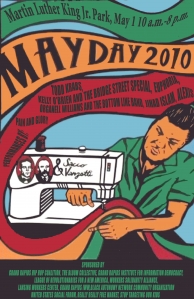
Yesterday, about 200 people came to a May Day event at Martin Luther King Park, hosted by the Grand Rapids Chapter of the IWW. Reclaiming the original day when working people gathered together to build solidarity and community, the IWW invited a variety of organizations to come and talk about their work, enjoy some food and live music throughout the day.
There were representatives from Stop Targeting Our Kids (STOK), the Bloom Collective, a new socialist student group at GVSU, Our Kitchen Table, an anti-foreclosure group and the West Michigan Coalition for Comprehensive Immigration Reform.
In addition to the speakers there were children’s activities, a community potluck, information tables and the Really Really Free Market. All of this combined provided an atmosphere of solidarity and a chance for people to build community.
The IWW also passed out a document reflecting their core beliefs and current position on issues of importance to working people and their families. The document read:
- We believe that that this economic system of exploitation, capitalism, where profits are valued more than people, is inherently unjust. The IWW wants to replace Capitalism with an economic model where everyone’s needs are met. We envision a society where workers take possession of the means of production, abolish the wage system, and live in harmony with the Earth.
- We believe that all workers have the right to organize. The IWW has a history of organizing everyone in the working class, even students and the unemployed. In Grand Rapids we have organized Starbucks workers and are planning a new organizing campaign of bar and restaurant workers.
- We believe that until Capitalism is replaced with a better economic system that all workers have a right to a livable wage. Right now in the US according to United for a Fair Economy, the average CEO makes 344 times more than the average worker. CEOs are not more valuable than workers and we will work with anyone on a campaign for a livable wage ordinance for Grand Rapids and Kent County.
- We believe that the US government has misused taxpayers’ money by bailing out Wall Street, which has done nothing more than reward institutions engaged in criminal behavior. Hundreds of thousands of people are losing their homes to foreclosure and unemployment and while underemployment affects millions, the rich are rewarded. The IWW condemns both the bailout and the so-called federal economic stimulus. Imagine what would have happened if the money the government gave to Wall Street Bankers went to the American public to pay off all our mortgages and to pay workers a livable wage. That would have been a real economic stimulus!
- We believe, like Dr. Martin Luther King Jr., that a nation that spends more on war than it does on the well being of its citizens is deplorable. As of today, the US has spent $989 Billion of taxpayers’ money on the wars in Iraq and Afghanistan, $518 million from Grand Rapids alone. The IWW condemns these wars and the use of the working class to fund and fight them.
- We believe that no human being is “illegal”. We are firmly opposed to SB 1070 in Arizona, which disenfranchises and criminalizes a whole race of people. As a union formed by immigrants we stand in solidarity with all immigrants. Liberal “free trade” policies like NAFTA and CAFTA create a race to the bottom at the expense of ALL workers.
The following video is with IWW organizer Cole Dorsey:

According to the Holland Sentinel, Blackwater founder Erick Prince has requested a media blackout for his luncheon address on Wednesday in Holland.
The Tulip Time Festival luncheon has always been open to the media, but Prince requested the blackout mostly likely to avoid further scrutiny by the news media. A spokesperson for the Associated Press still plans on reporting since they bought tickets for the event, an event that has sold out.
It is also reported that a group of Holland residents are planning on protesting Prince’s talk and will be gathering outside of the Hope College Fieldhouse at 10:30am, an hour before the founder of the private mercenary group will speak.
Amway eliminates more West Michigan jobs
Yesterday it was reported in the Grand Rapids Press that Amway will be eliminating 100 jobs from one of its Ada-based warehouse facilities. The announcement was made via a Media Release, which stated that this decision was necessary for the company to remain competitive and that the jobs would be moved to Asia because that is where more of their product is sold.
The Press story does mention the 100 jobs to be eliminated locally, but fails to mention that 150 jobs are also being cut from an Amway facility in California. The Press cites Amway spokesperson Zeiger who states that the job elimination is “part of a project we’re calling strategic operating model.” Interesting business speak for job elimination.
However, the most interesting comment from Zeiger was, “The moves we’re making are designed to support our being a competitive West Michigan-based employer for the longest time imaginable.” Unfortunately for Press readers, the reporter never bothers to ask how eliminating 100 jobs makes Amway a competitive West Michigan-based employer. If one of the main functions of an employer that touts itself as based in West Michigan is to provide employment, how does eliminating jobs benefit this community?
The Press does acknowledge that the company also recently sent 93 West Michigan jobs to Costa Rica, but then follows this acknowledgement with more comments from Zeiger about how the new job elimination is a strategic move. Zeiger tries to compare the difference to what Amway is doing and what GM has done, but the statement is somewhat convoluted. Unfortunately, the Press reporter fails to question these comments, instead they print them as fact.
The Amway Media Release says that the company made $8.4 billion dollars in 2009. The Press reporter could have at least inquired as to how with such large profits the company is unable to keep jobs in West Michigan.
Questioning the Triple Bottom Line: Observations of the Local First Sustainable Business Conference
(Christy Mello contributed to this article)

Local First hosted an all day conference at Aquinas College this past Wednesday, and those able to pay the registration cost of $75 were welcome to attend. The majority of people in attendance were mostly people in business attire and there on behalf of their businesses. Vendors aligned the parameter of the main conference room and the majority of the booths showcased their services to aid businesses. These services included payroll accounting, wealth management, data backup, printer supplies, and banking, just to name a few.
Local First is a non-profit group who creates a network of businesses who pay membership dues to receive the Local First logo and become part of this network. This is a powerful marketing strategy for businesses in order to aid in promoting their services or products.
At this conference, people learned effective business practices, which appeal to people’s need to make humanitarian purchasing choices when they believe a business’s products are “local,” “sustainable,” or helping the “environment.” The morning keynote speakers as well as workshops through out the day utilized these terms that convey positive imagery.
Nevertheless, people asked questions indicating their confusion over what is meant by the “local” in Local First. According to one of the keynote speakers, it turns out that they define local as any business located in Kent County including businesses owned by stakeholders outside of Kent County. This was a transparent admission by Local First, and the conference was evidently devoted to economic development strategies. For example, Local First has done a study indicating that if one out of ten dollars are spent locally, this would create 1600 new jobs. Although, which non-local groups invest money in to these efforts and how much money still leaves the area? One should also ask what type of jobs would be created and available to whom.

It is important to ask critical questions around whether or not these often misleading discursive terms are being put into practice and to what degree. Businesses tap into people’s concerns over these issues with the use of this ideological language that diverts one’s attention from the fact that they may have or support destructive environmental practices. Many examples were apparent at this conference.
For example, the first keynote speaker was with the local software company known as Atomic Object. Some of the clients that Atomic Object works with are Priority One Health, Whirlpool, Amway and even the World Bank. One would have to ask how these companies practices sustainability, particularly in regards to environmental practices and how they treat their employees.
How is it that a company like Amway, which is based on a pyramid system can be considered sustainable? Amway has also been eliminating local jobs and sending them to China and Costa Rica in recent years, something which seems to conflict with part of the triple bottom line – how we treat people part. The Whirlpool Corporations has also been sending jobs abroad for years and the World Bank has funded projects that have displaced millions of people over the years.
When talking about the increased interest in local food it was interesting that Meijer was cited as a local food business. Meijer did start in West Michigan, but it is hard to see how a company which sells a majority of products not from the area, can still be considered local. One could argue that most of the food items that Meijer sells is not healthy for human consumption nor environmental sustainability.
However, there were examples such as a bakery in Ann Arbor that composts, buys and butchers grass fed cows, buys their food locally, and etc. Examples such as these, presumably, makes one feel that Local First’s primary objective is to choose businesses whose triple bottom line focuses more on the social and environmental rather that the economic component.
However, one should question the percentage that businesses utilize these components or if they do to a minimal degree as an advertisement for their products or services. Furthermore, Local First’s study revealed that a denser square footage of businesses increases profits. These businesses are flourishing in the Wealthy Street Business District, for example with several new restaurants in the past 12 months. Although maybe not intentionally, these development and revitalization efforts have been pushing out small business owners and further gentrifying this area of the city.
In one breakout session we attended on social capital, the presenter gave an example of a business in Michigan, which purchased hand-sewn goods from Nicaragua. The products were made by a worker run, women’s cooperative, which allowed the Michigan business to buy these products at a fairly low price and then sell them as Fair Trade items. What seemed to make this a “success” story was the fact that there was a worker run women’s cooperative, an economic model that was not discussed or encouraged by any of the presenters throughout the day.
In fact, this made us think about why with all the emphasis on food these days there were no formal food cooperatives in Grand Rapids like there were in the past. Grand Rapids used to have two food co-ops, one is Eastown and one on the Westside. Is it because traditional food co-ops are not privately held businesses?
At the end of the day we were left with more questions than answers about how Local First promotes sustainability with the businesses that are members of the non-profit organization. There was limited discussion about concrete and measureable practices that promoted the human and environmental aspects of the triple bottom line, with most of the focus being on how to make a profit if your business is “green” and getting people to buy “green” products.
Pete Hoekstra on Arizona’s anti-immigration law
We recently posted a story about whether or not what Arizona has recently done regarding its immigration policy could happen in Michigan. At the time, none of the Michigan gubernatorial candidates had responded to the Arizona law, but now we have a video comment from Pete Hoekstra, which was posted on MLive.com.
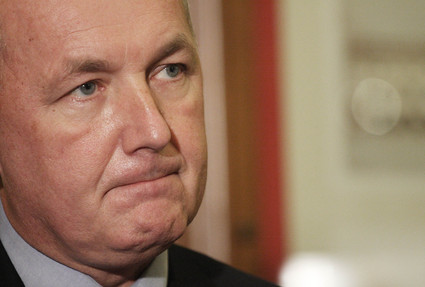
Here is a transcription of the response from Hoekstra:
Question: What about Arizona’s immigration law, can you see something like that in Michigan as states rights?
Hoekstra: Well, I think what you are seeing in Arizona, and as you talk about these issues, this is the great thing about when you stand up for the 10th Amendment and state’s rights. Arizona has a very very different problem and very different circumstances than what Michigan has. To say that we are going to take the Arizona law and put it in place in Michigan may or may not work. It probably won’t work because our issue and our problems are very different from Arizona’s.
Question: The thing about the Arizona law is that it is state’s right trumping individual rights, right of search and seizure.
Hoekstra: Well, again, let’s see exactly how this law is going to be implemented in Arizona. There is a lot of rhetoric flying around on both sides of the issue. Again, it’s the beauty of state’s rights. Let’s see if it works in Arizona or there are problems. We will have the opportunity to see that over the coming months. There will be constitutional challenges. Let’s see if they work. And after Arizona moves forward other states can learn from it and hopefully improve or deal with it. Hopefully with this issue, the federal government will do what it is supposed to do – secure the borders. That is the responsibility of the federal government. They haven’t done it.
ACLU to Obama: ‘Entire World is Not a War Zone’
(This article is re-posted from Common Dreams.)
The American Civil Liberties Union has sent a strongly-worded letter to President Barack Obama, asking him to end an alleged program that allows ‘targeted killings’ of terror suspects outside of war zones.

In the letter (PDF), the civil liberties group argues that the alleged program — which, according to news reports, is now targeting at least one US citizen — is unlawful and unconstitutional, and could set a dangerous precedent leading to foreign governments killing people on US soil.
“The program that you have reportedly authorized appears to envision the use of lethal force not just on the battlefield in Iraq, Afghanistan, or even the Pakistani border regions, but anywhere in the world, including against individuals who may not constitute lawful targets,” ACLU Executive Director Anthony Romero stated in the letter.
“The entire world is not a war zone, and wartime tactics that may be permitted on the battlefields in Afghanistan and Iraq cannot be deployed anywhere in the world where a terrorism suspect happens to be located.”
Romero’s letter came the same day as a House foreign affairs subcommittee convened to probe the legal issues surrounding the use of targeted killings. It also comes in the wake of a series of news reports suggesting the US’s use of targeted killings has expanded significantly in recent months.
In February, Director of National Intelligence Dennis Blair announced that the United States may target its own citizens abroad for death if it believes they are associated with terrorist groups.
“We take direct action against terrorists in the intelligence community,” Blair told the House Intelligence Committee. He said US counter-terrorism officials may try to kill American citizens embroiled in extremist groups overseas with “specific permission” from higher up.
If “we think that direct action will involve killing an American, we get specific permission to do that,” Blair said.
Earlier this month, news reports indicated that Muslim cleric Anwar al-Awlaki, an American citizen, was added to the CIA’s list of alleged terrorists the US has targeted to kill.
Al-Awlaki was born in New Mexico and served for years as an imam in the United States. He has not been charged with a crime, but was linked by US officials to Maj. Nidal Malik Hasan, the psychiatrist alleged to have killed 13 at an Army base in Fort Hood, as well as Nigerian Umar Farouk Abdulmutallab, the so-called “Christmas day” bomber who attempted to detonate a jetliner en route to Detroit.
“Such a program of long-premeditated and bureaucratized killing is plainly not limited to targeting genuinely imminent threats,” Romero wrote in his letter. “Any such program is far more sweeping than the law allows and raises grave constitutional and human rights concerns.”
Romero argued that the alleged program could set a dangerous precedent for other nations, which could result in foreign governments killing US citizens on home soil.
The program you have reportedly endorsed is not simply illegal but also unwise, because how our country responds to the threat of terrorism will in large measure determine the rules that govern every nation’s conduct in similar contexts. If the United States claims the authority to use lethal force against suspected enemies of the U.S. anywhere in the world – using unmanned drones or other means – then other countries will regard that conduct as justified. The prospect of foreign governments hunting and killing their enemies within our borders or those of our allies is abhorrent.
The ACLU is not alone in attacking the program as unlawful. Constitutional law professor Jonathan Turley said in February that the program raises serious questions.
“This is something that President Bush developed,” Turley explained. “We actually saw the Bush administration kill an American citizen named Kamal Derwish in 2002 with a Predator strike. … The Obama administration, once again, seems to be morphing into the Bush administration.”
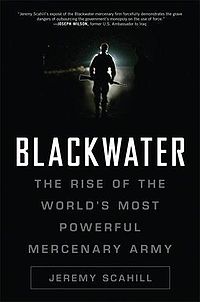
After hearing that the Tulip Time Festival in Holland had invited Blackwater founder Erik Prince to speak at the annual event, local organizers in Holland decided they needed to do something to counter the message of the Holland native.
Prince is speaking during the day, so organizers will host a public event with Jeremy Scahill, author of the book Blackwater: The Rise of the World’s Most Powerful Mercenary Army. Scahill will be speaking at the Holland 7 theater, located at 500 Waverly Road in Holland. The event is May 5th, begins at 7:30pm and is free and open to the public.
(This article is re-posted from CounterPunch.)
Tuesday’s hearings of the Permanent Subcommittee on Investigations laid the groundwork for future criminal prosecutions of Goldman Sachs Chief Executive Lloyd Blankfein and his chief lieutenants whose reckless and self-serving actions helped to precipitate the financial crisis. Committee chairman Senator Carl Levin (a former prosecutor) adroitly managed the proceedings in a way that narrowed their scope and focused on four main areas of concern. Through persistent questioning, which bordered on hectoring, Levin was able to prove his central thesis:

1. That Goldman puts its own interests before those of its clients.
2. That Goldman knowingly misled it clients and sold them “crap” that it was betting against.
3. That Goldman made billions trading securities that pumped up the housing bubble.
4. That Goldman made money trading securities that triggered a market crash and led to the deepest recession in 80 years.
The hearings lasted for 8 hours and included interviews with seven Goldman executives. Every senator had the opportunity to make a statement and question the Goldman employees. But the day belonged to Carl Levin. Levin was well-prepared, articulate and relentless. He had a game-plan and he stuck to it. He peppered Goldman’s Blankfein with question after question like a prosecuting attorney cross-examining a witness. He never let up and never veered off topic. He knew what he wanted to achieve and he succeeded. Here’s a clip from his opening statement:
“The evidence shows that Goldman repeatedly put its own interests and profits ahead of the interests of its clients and our communities…..It profited by taking advantage of its clients’ reasonable expectation that it would not sell products that it didn’t want to succeed….
Goldman’s actions demonstrate that it often saw its clients not as valuable customers, but as objects for its own profit….Goldman documents make clear that in 2007 it was betting heavily against the housing market while it was selling investments in that market to its clients. It sold those clients high-risk mortgage-backed securities and CDOs that it wanted to get off its books in transactions that created a conflict of interest between Goldman’s bottom line and its clients’ interests.” (Senator Carl Levin’s opening statement for the Permanent Subcommittee on Investigations)
Levin’s entire statement is worth reading, but these two paragraphs distill his plan for exposing Goldman. He was determined to “go small” and repeat the same points over and over again. And it worked. From a purely strategic point of view, Levin’s battleplan was flawless. The Goldman execs never knew what hit them. They swaggered into the chamber thinking they’d breeze through the hearings and have a few laughs over cocktails afterwards, and left with their heads in their hands. They were outmatched and outmaneuvered.
Senator Carl Levin:
“These findings are deeply troubling. They show a Wall Street culture that, while it may once have focused on serving clients and promoting commerce, is now all too often simply self-serving. The ultimate harm here is not just to clients poorly served by their investment bank. It’s to all of us. The toxic mortgages and related instruments that these firms injected into our financial system have done incalculable harm to people who had never heard of a mortgage-backed security or a CDO, and who have no defenses against the harm such exotic Wall Street creations can cause….
These facts end the pretense that Goldman’s actions were part of its efforts to operate as a mere “market-maker,” bringing buyers and sellers together. These short positions didn’t represent customer service or necessary hedges against risks that Goldman incurred as it made a market for customers. They represented major bets that the mortgage securities market – a market Goldman helped create – was in for a major decline. Goldman continues to deny that it shorted the mortgage market for profit, despite the evidence…
The firm cannot successfully continue to portray itself as working on behalf of its clients if it was selling mortgage related products to those clients while it was betting its own money against those same products or the mortgage market as a whole. The scope of this conflict is reflected in an internal company email sent on May 17, 2007, discussing the collapse of two mortgage-related instruments, tied to WaMu-issued mortgages, that Goldman helped assemble and sell. The “bad news,” a Goldman employee says, is that the firm lost $2.5 million on the collapse. But the “good news,” he reports, is that the company had bet that the securities would collapse, and made $5 million on that bet. They lost money on the mortgage related products they still held, and of course the clients they sold these products to lost big time. But Goldman Sachs also made out big time in its bet against its own products and its own clients.” (Sen. Carl Levin)
Levin had all the facts at his fingertips and put them to good use. Goldman’s execs were on their heels from the start and never really regained their footing. Even worse, the hearings showed that Goldman cannot be trusted. Their reputation is in ruins. Levin proved that if Goldman has junk in its portfolio, it won’t hesitate to dump it on its clients and then pass around high-fives at the prop-desk. Here’s a typical exchange between Levin and the former head of Goldman’s mortgage department, Dan Sparks:
SEN. CARL LEVIN: June 22 is the date of this e-mail. “Boy, that Timberwolf was one shitty deal.” How much of that “shitty deal” did you sell to your clients after June 22, 2007?
DAN SPARKS: Mr. Chairman, I don’t know the answer to that. But the price would have reflected levels that they wanted to invest…
SEN. CARL LEVIN: Oh, of course.
DAN SPARKS: … at that time.
SEN. CARL LEVIN: But you didn’t tell them you thought it was a shitty deal.
DAN SPARKS: Well, I didn’t say that.
SEN. CARL LEVIN: Who did? Your people, internally. You knew it was a shitty deal, and that’s what your…
DAN SPARKS: I think the context, the message that I took from the e-mail from Mr. Montag, was that my performance on that deal wasn’t good.
SEN. CARL LEVIN: How about the fact that you sold hundreds of millions of that deal after your people knew it was a shitty deal? Does that bother you at all; you sold the customers something?
DAN SPARKS: I don’t recall selling hundreds of millions of that deal after that.
Levin was just as tough on Blankfein, reiterating the same question over and over again: “Is there not a conflict when you sell something to somebody, and then you bet against that same security, and you don’t disclose that to the person you’re selling it to? Do you see a problem?”
At first, Blankfein acted like he’d never considered the question before, as if “putting himself in his client’s shoes” was something that never even entered his mind. His look of utter bewilderment was revealing. Then he launched into the excuses, the evasions, and the elaborate, long-winded ruminations that one expects from schoolboys and hucksters. But Levin never gave and inch. He kept pushing until Blankfein finally gave up and responded.
“No,” he stammered, “In the context of market-making that’s not a conflict.”
Blankfein’s answer was a triumph for Levin, and he knew it. To the millions of people watching the sequence on TV, Blankfein’s denial was as good as an admission of guilt. It showed that Wall Street kingpins don’t share the same morals as everyone else. In fact, Blankfein seemed genuinely confused that morality would even be an issue. After all, it wasn’t for him. Levin covered some old ground, pointing to Goldman’s dealings with Washington Mutual’s Long Beach unit which was a “conveyor belt” for garbage subprimes which frequently blew up just months after they were issued. It’s clear that Goldman knew the mortgages were junk that were “polluting the financial system”, but that made no difference. Goldman feels that it’s responsible to its shareholders alone, not the people who bailed it out.
All in all, it was a bad day for the holding company that’s come to embody everything that’s wrong with Wall Street. Goldman entered the hearings as the most successful financial institution in the country, and left with its reputation in tatters and its future uncertain. Its CEO came across as shifty and jesuitical while his executives seemed arrogant and uncooperative. At no point during the hearings did any of the Goldman throng look at ease with themselves or their answers. They remained rigid and sullen throughout. On top of that, they were unable to defend themselves against the main charge, that they don’t mind sticking it to their clients if it means a bigger slice of the pie for themselves.
The truth is, the Golden boys were handled quite capably by an elderly statesman who took them to the woodshed and gave them a good hiding. Levin’s stunning performance is likely to draw attention to the upcoming SEC proceedings and, hopefully, build momentum for more subpoenas, indictments, arrests, and long prison sentences.
Could Arizona Come to Michigan?
Last week, Governor Jan Brewer of Arizona signed legislation into law that effectively makes racial profiling legal in her state. The Arizona Senate Bill 1070 will allow police to stop anyone if they have a “reasonable suspicion” that the person is not in this country legally. The intent of the law is to spread a wide net to identify and arrest undocumented immigrants. It goes into effect this summer.

If one person in a car doesn’t have the correct documents, everyone in the car can be arrested. People can be arrested for “harboring” an undocumented worker, even if that worker is a member of their own family. The parents of an undocumented immigrant can be hauled off to jail for visiting in the home of their son or daughter.
And workers who do have the correct ID can be arrested for simply not carrying their papers at all times. Any Latino/a living in Arizona will have zero margin for error about forgetting their papers when taking a walk around the neighborhood.
Recently GRIID cross-posted an article that includes information about groups attempting to ensure this law will not stand—as it should not. But now that the governor has signed it into law, it may take months, if not years, to challenge it. In the meantime, the law will stand.
And with the Michigan Tea Party loudly demanding “militarized borders” and various gubernatorial candidates here in Michigan pandering to this audience, it begs the question—could something like SB 1070 happen here?
First, remember that we also have what could be represented as an “unsecured” or permeable border. Traffic moves between the U.S. and Canada with relative ease. Car traffic is monitored; private boat traffic operates mainly on a trust system. It’s the perfect alarmist vehicle to make the case for harsher immigration laws.
Next, as an example, take a look at the most likely Republican candidate for the run for governor: Pete Hoekstra. As a U.S. Representative, Hoekstra has a well-documented voting record. It’s clear what kind of stance on immigrants he would bring to the governor’s office through these examples:
•He voted on legislation requiring hospitals to turn in undocumented immigrants who came in for emergency treatment. The law would have also arranged for transportation of immigrants without papers back to their native countries for treatment—in effect, a new deportation law packaged into the bill.
•He voted for building a $7 billion fence along the U.S.-Mexican border. He also voted for more security personnel and surveillance.
•He voted to allow vigilante Minutemen to operate in secrecy, without informing the Mexican government about the placement of armed volunteers along the U.S.-Mexican border.
•He’s attempted twice to get legislation through Congress making English the sole official language of the U.S. Both times, he co-sponsored the bills.
Pete Hoekstra has been endorsed by the USBC, a group that says its work is “to seal our borders against drugs, disease, illegal migration and terrorism and…to preserve our nation’s language, culture and heritage for the next generations.”
Hoekstra has also been given a 100% approval rating from the Federation for American Immigration Reform (FAIR). FAIR has been identified as a hate group by the Southern Poverty Law Center.
You won’t find a word of any of this on Hoekstra’s official campaign site. Other candidates are equally silent on immigration. The pistol-packing Mike Bouchard doesn’t even list it as an issue on his site, where taxes and crime fighting are emphasized. Andy Dillon speaks mainly to education and jobs. Virgil Bernero’s focus seems to be, as it has been for some time, on strengthening unions and protecting workers’ rights. Rick Snyder’s issues section only outlines his 10-point plan for restoring Michigan’s economy. Mike Cox is spending both his Tea Party time and website promotion on his effort to overturn the new federal health care reform in his role as Attorney General.
Each of these candidates is going to present himself in a filtered light that will attract the maximum number of voters. Their own PR is not going to offer hard-line statements that can be used against them in the media.
Clearly, we’re not going to get the depth of information we need from the Press or other local news sources in West Michigan for this election. So it’s up to each individual voter to get educated on every issue that these candidates will address as governor. That includes, at this crucial point in our history, a solid understanding of their views on immigration. We don’t want to end up with a Jan Brewer wannabe in the Governor’s Mansion and racist Arizona-style legislation in Michigan.
 Grand Rapids Institute for Information Democracy