Last night, Jeremy Scahill, investigative journalist and author of the book Blackwater: The Rise of the World’s Most Powerful Mercenary Army, spoke in Holland to over 200 people. Scahill’s talk was just hours after Erik Prince spoke at the Tulip Time Festival luncheon.

Scahill began by saying that the message that Prince gives for the public is different than what he gives to private, conservative groups like the one at U of M, which was taped and sent to the Nation magazine, the publication Scahill writes for.
Much of what Scahill said in his talk is in the analysis he wrote about a few days ago for the Nation, which is worth reading in its entirety. One point that the journalist emphasized throughout the night was that using private mercenary forces means there is no accountability for the politicians who don’t want to be held accountable.
Scahill wasn’t just referring to Bush & Cheney, but to the current members of Congress and the Obama administration. In fact, Scahill said that under President Obama, private military contractors have increased in Afghanistan, from 70,000 a year ago to 104,000 today.
The Blackwater author also said that Prince uses people who have worked in the intelligence community – the CIA, FBI and DEA. Blackwater provides body guards for US Ambassador to Afghanistan Karl Eikenberry and to other US diplomats when traveling to Afghanistan. This means that members of Congress, when visiting Afghanistan on a fact finding mission, the same Congress which has been investigating Blackwater, is guarded by that private mercenary group when in Afghanistan.
Scahill says that when the FBI investigated the Iraq killings from 2007, in which Blackwater was accused of killing innocent Iraqi civilians, the FBI agents were going to be guarded by Blackwater personnel. Blackwater controls four forward operating bases in Afghanistan, according to Scahill and even bragged that they have the closest base to Pakistan. Blackwater was responsible for making the biggest drug bust ever in Afghanistan and they called in air strikes from NATO. Scahill asks the rhetorical question – “how can a private company call in air strikes from NATO?”
Scahill mentioned that during Prince’s talk at the Tulip Time Festival that the Blackwater CEO said that no one has died who was being protected by Blackwater security people. The author said that there were 8 CIA agents killed in Afghanistan recently who were under the protection of Blackwater.
Then Scahill tells the story about an Iraqi, Mohammad Kanani. Kanani welcomed US troops in 2003 when they arrived in Baghdad and was a supporter of the US occupation. In 2007 he took his son near downtown Baghdad one day where they came to a stop at an intersection. Gunfire opened and people were killed, and Kanani’s car was shot and his son was hit. The Iraqi man got out of his car to go to the other side and saw his son’s limp body. “My son, my son, they’ve killed my son,” he cried out. His brain had been shot out. The people that shot Ali Kanani that day were Blackwater mercenaries. This story that Scahill was recounting was Nisour Square shootings, where 17 Iraqi civilians were killed by Blackwater personnel. Scahill said we never hear the details of these killings, because the media in this country does not really care about the lives of innocent people that US soldiers and mercenaries take in these wars.

Scahill went on to say that they originally offered Mohammad hey $10,000 in compensation for the loss of his son. Originally said no, but later he said yes and gave half of the money to the US military to pay for a soldiers’ funeral. The US courts let the Blackwater personnel responsible for the killings go free. Mohammad Kanani said that the only thing he wanted was a public apology from Erik Prince, because Prince had said during the Congressional hearings that he believes that some Iraqis kill themselves so that they can collect money from the US government. Mohammad was so outraged by this statement that he demanded an apology, but Prince said that his company does not make apologies.
There is one legal case still open from the Nisour Square killings being held in North Carolina. Scahill said that recently Blackwater asked US Attorney General Eric Holder to step in and take responsibility for the deaths. He Private mercenary company even said they should be tried in Afghanistan under Sharia law since that is the legal system there.
What about the four Blackwater emplyees who were killed in Falluja? All of them were decorated veterans put in a ridiculously dangerous situation. The families wanted to know what happened that day. Blackwater stonewalled them. Blackwater executives told them they would have to sue the company to get the information, which they did. In turn, Blackwater sued the families for violating the contract that the men had signed.
Scahill concluded his remarks by saying that we could talk until we are blue in the face, but the problem is not just Blackwater, it is a thirst for militarism and US imperial wars. He said that there is a push to privatize all aspects of our country – education, health care, etc and until we address that and the incredible power that corporations wield in this country, we will not solve the problem of companies like Blackwater.
This comment was the most important thing that Scahill said all night, but it was not a statement that people wanted to address during the Q&A. Most of the questions were specific to Blackwater and Prince and not the larger power structure that Scahill exposed.
Lastly, I think it is worth pointing out that at the Price talk yesterday there were dozens of news reporters in attendance. For the Scahill lecture I only saw a reporter from the GR Press and the Holland Sentinel. The Press article was very short and had virtually none of the analysis Scahill provided in his talk. The Holland Sentinel had not posted a story on their website by the time we posted this story.
The Holland Tulip Time Festival officially kicked off today with a luncheon attended by roughly 800 people. An event that was originally closed to media, the Tulip Time Festival Committee changed their mind and allows news agencies to attend the luncheon to hear the founder of Blackwater, Erik Prince.
GRIID was at first scrutinized by the media liaison and then questioned by the Holland Police Department, only eventually to be “cleared” as a legitimate news entity.
Prince spoke for no more than 30 minutes and gave a somewhat dispassionate, pre-written speech. He spoke about his family roots and growing up in Holland, but emphasized how his family made it through tough times without any government assistance.
This theme of “self-sufficiency” was spread throughout Prince’s speech and he took every opportunity to criticize what he called big government that is rife with bureaucracy. At one point Prince quoted Ronald Reagan who said once that the most frightening words were, “I’m the government and I’m here to help.”
Prince also talked about American values and what made this country great – liberty, entrepreneurship and hard work. He said that what makes this country great was embodied by something that happened in 1969, the year that he was born, the Apollo mission. He contrasted this with another event in that same year that reflected what he saw as something that has attacked the moral fiber of this country – Woodstock.
Prince spoke briefly about his decision to join the military, eventually becoming a Navy Seal. He said, “It was the best job I ever had.” After Prince left the military he eventually got the idea to start Blackwater. Prince says he was inspired to create the internationally known private mercenary group because of what he saw as a lack of action from the US during the Rwandan genocide.

Prince responded to what he called his critics by saying that the US was founded on the help of private military contractors and that what Blackwater does was consistent with what has always existed in America.
The former Navy Seal said his company was contracted by the US Government after the USS Cole was attacked in 2000. Ever since then, according to Prince, his company has not received one cent from any grant money or other US tax money. The fact is, that every time the US government gives contracts to Blackwater, they do so with public taxpayer money.
Prince said that his company was called upon 40,000 times to protect diplomats and reconstruction contractors in Iraq and that not one of them was ever injured. However, Prince failed to mention the civilians that his private soldiers killed in Iraq and the role that Blackwater has played in a targeted assassination campaign involving the CIA in the Af-Pak War.
Prince beamed with pride when he said that Blackwater continues to train “security personnel” from countries like Egypt and Pakistan. He also boasted of the amount of cargo that Blackwater has brought to US troops in Afghanistan. Again, Prince failed to mention that his company was caught stealing US weapons in Afghanistan through one of its contracting partners Paravant.
Prince also talked about Blackwater’s role after the devastating effects of Hurricane Katrina. Prince said they provide some relief work early on in New Orleans, but eventually was hired by private companies to do security work, companies like Wal-Mart.
Holland’s native son did not miss an opportunity to trash the US government, especially now that it “just wants to spends its way out of trouble.” Prince said that US taxpayers are saddled with debt and that there seems to be more “class war going on.” He also said that the lack of free market principles hinders our country’s ability to compete with India and China.
Prince concluded his remarks by reflecting on what makes this country great – liberty and the free market. This may have been the most honest thing he said during his speech, especially since Blackwater has made money from militarism.
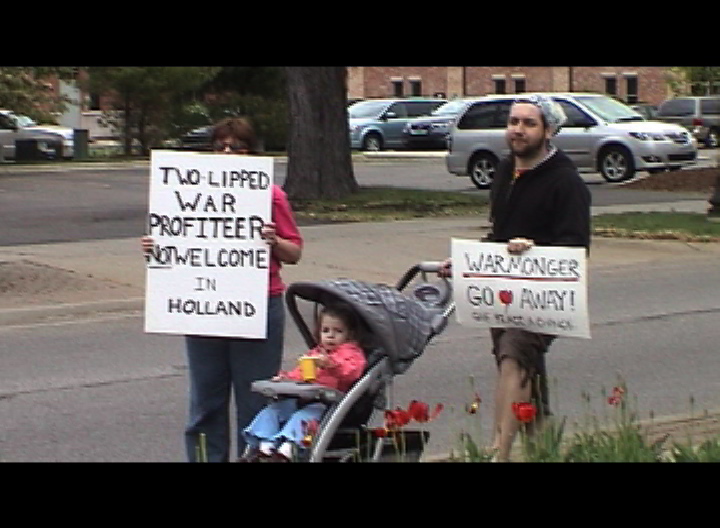
The luncheon crowd gave Prince a standing ovation, but not everyone there today supported the Holland native. Outside of the Hope College Fieldhouse about 75 gathered to protest Prince’s visit. We had a chance to interview some of those who came out to express their disgust with the Tulip Time Festival’s decision to invite the war-profiteer.
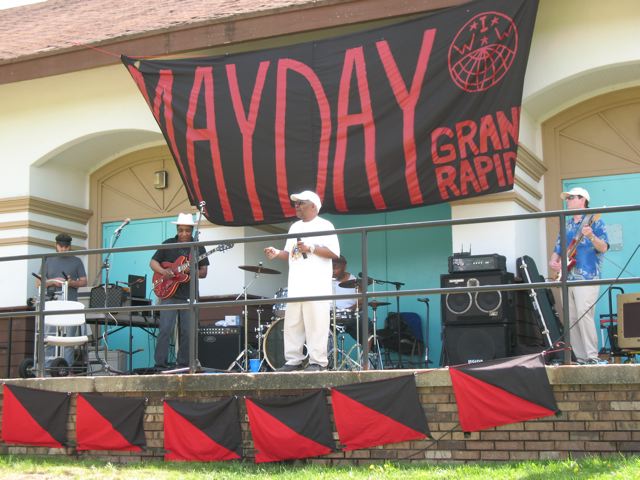
When the IWW May Day 2010 event, sponsored by a number of local groups and successful in every sense of the word, was not covered by the Grand Rapids Press, I decided to find out why. I wrote a letter to Paul Keep, editor: “On May Day, over 200 residents of Grand Rapids gathered in Martin Luther King Park for an event sponsored by several local and area groups. There were bands, a neighborhood potluck, events for children, and information booths. The Press was alerted in advance about this event, and yet there was no coverage of it in the paper.
“Leading up to May Day, the Press published three different articles about Rob Bliss—would he or wouldn’t he cancel his May Day event downtown? What was the weather going to be like? Would Rob decide to go forward or back down? That’s a lot of coverage for something that didn’t happen.
“On Sunday, you stated in your column that you felt that the Press needed to be the go-to place for people to learn about events and opinions in the community. You also stated you wanted to encourage community participation.
“Please explain to me the wisdom of ignoring an event that many local people worked on and which actually did go forward with a significant community turnout, while giving triple coverage to an event that didn’t even occur. I’d especially like to know if the Press’s political slant had anything to do with your decision not to mention the Martin Luther Park event.”
Paul Keep wrote back promptly, courteously, and in surprising detail. But I found what he didn’t say was as interesting as what he did. He started out by assuming I was one of the organizers of the event (I wasn’t), and assured me that the paper did in fact get word about it: “I asked our metro editor, who is in charge of making the decisions on what we cover locally, about this and he reported that we did indeed receive the advance notice of the May Day event at Martin Luther King Park.”
Then Keep went on to list all of the events that were covered—and weren’t—on May Day: “As you know from reading the paper, our reporters covered a number of other things going on in town on Saturday, including the first day of the statewide smoking ban, GVSU’s graduation, the first day of census takers hitting the street, a Grandville apartment fire and a regional high school technology fair (more than 800 projects). Our photographers shot pictures to go with all of these stories plus the Tulip Time opening, the Latin festival and Right to Life Bike & Hike Fest (although the latter photos did not run, for space reasons). We were unable to get to the event you mentioned and also the Grace Hunger Walk, because of the limitations of staff and space resources. And, of course, we had sports reporters covering a number of local stories and they used some of our staff photographer time as well.”
He added, “It was an unusual weekend, too, in that a number of our sports reporters and photographers were in Las Vegas covering the Saturday night fight of GR-native Floyd Mayweather.”
Keep’s conclusion? “I can assure you that politics did not play any role at all in our selection of stories to cover. The editorial page, where opinion is encouraged, does not make the coverage decisions for our newsroom. Your event sounds perfectly worthy of coverage, we just ran out of people to cover things.”
And that left me with an interesting handful of statements to study. First, note that Keep did not even address the advance coverage given to the Rob Bliss May Day event that never took place. In a newspaper of limited resources, that level of attention still seems like a strange decision.
And I know that Keep isn’t kidding when he says that he ran out of people to cover events. The Press laid off 65 employees in January, and that was after large-scale cuts to wages and benefits in 2009. In July last year, the Press lost a number of long-time reporters and columnists, some of whom apparently have since decided to work for the paper freelance. The fulltime staff can best be described as skeletal for the amount of work it has to handle.
With that in mind, I was left to dissect what had and hadn’t been found “worthy” enough to receive a reporter and/or photographer assigned to it. Tulip Time always gets plenty of press, and so do school events, so the technology fair coverage made sense. I was glad to see that the Press chose to cover, however minimally, the Fiesta celebration put on by the Latin Americans United for Progress. But the first day of census taking? And the first day of the smoking ban? Those have been marked multiple times in the Press already, and surely there was little to say about the very first day of the smoking ban—why not cover it after the weekend was over?
I also couldn’t help but notice the Right to Life event received reporter attention, although apparently didn’t make the final cut for the paper—while two more progressive events, May Day 2010 and the Grace Hunger Walk, did not.
But the really bizarre thing was that the Press had chosen to send “sports reporters and photographers” to Las Vegas to cover the Floyd Mayfield fight.
Paul Keep has reiterated a number of times that the reason that local news lands on the front page of the paper, trumping all national events, is that local coverage is the Press’s “niche.” On March 21 of this year, he wrote, “Everyone knows about the earthquakes in Haiti and Chile right after they hit, but how will you find out about important events occurring in a city, village, or township neighborhood near you? That’s why you see the Press front page today dominated by stories that are local or regional…Perspective and deeper understanding is our niche.”
With that mission in mind, I guess I can understand sending a Press reporter to the Las Vegas event to dig for local-angle stories about the Mayweather-Mosley fight. But a whole team of Press staffers? These guys were so pressed to keep filing stories that they ended up, absurdly, doing video interviews of each other.
And for a sports event covered by every major network and wire service, why did the Press need its own photos—let alone video clips and Tweets? After all, it picks up most of its national and international content and images from wire service reports. Photos of the Mayweather fight fill pages and pages of a Google search, and the Press photos are nothing different or unusual from photographs available from other sources. Meanwhile, coverage of truly local events—the Press’s main focus, according to its editor—were left begging for notice.
I find trying to decode this newspaper is always a puzzle. As in many times in the past, today I watch the ship of state that is the Grand Rapids Press sailing on: listing ever to the right and veering off on a course charted by its own inscrutable editorial decisions.
Secret Erik Prince Tape Exposed

(This article originally appeared in the Nation magazine.)
Erik Prince, the reclusive owner of the Blackwater empire, rarely gives public speeches and when he does he attempts to ban journalists from attending and forbids recording or videotaping of his remarks. On May 5, that is exactly what Prince is trying to do when he speaks at DeVos Fieldhouse as the keynote speaker for the “Tulip Time Festival” in his hometown of Holland, Michigan. He told the event’s organizers no news reporting could be done on his speech and they consented to the ban. Journalists and media associations in Michigan are protesting this attempt to bar reporting on his remarks.
Despite Prince’s attempts to shield his speeches from public scrutiny, The Nation magazine has obtained an audio recording of a recent, private speech delivered by Prince to a friendly audience. The speech, which Prince attempted to keep from public consumption, provides a stunning glimpse into his views and future plans and reveals details of previously undisclosed activities of Blackwater. The people of the United States have a right to media coverage of events featuring the owner of a company that generates 90% of its revenue from the United States government.
In the speech, Prince proposed that the US government deploy armed private contractors to fight “terrorists” in Nigeria, Yemen, Somalia and Saudi Arabia, specifically to target Iranian influence. He expressed disdain for the Geneva Convention and described Blackwater’s secretive operations at four Forward Operating Bases he controls in Afghanistan. He called those fighting the US in Afghanistan, Iraq and Pakistan “barbarians” who “crawled out of the sewer.” Prince also revealed details of a July 2009 operation he claims Blackwater forces coordinated in Afghanistan to take down a narcotrafficking facility, saying that Blackwater “call[ed] in multiple air strikes,” blowing up the facility. Prince boasted that his forces had carried out the “largest hashish bust in counter-narcotics history.” He characterized the work of some NATO countries’ forces in Afghanistan as ineffectual, suggesting that some coalition nations “should just pack it in and go home.” Prince spoke of Blackwater working in Pakistan, which appears to contradict the official, public Blackwater and US government line that Blackwater is not in Pakistan.
Prince also claimed that a Blackwater operative took down the Iraqi journalist who threw his shoes at President George W Bush in Baghdad and criticized the Secret Service for being “flat-footed.” He bragged that Blackwater forces “beat the Louisiana National Guard to the scene” during Katrina and claimed that lawsuits, “tens of millions of dollars in lawyer bills” and political attacks prevented him from deploying a humanitarian ship that could have responded to the earthquake in Haiti or the tsunami that hit Indonesia.
Several times during the speech, Prince appeared to demean Afghans his company is training in Afghanistan, saying Blackwater had to teach them “Intro to Toilet Use” and to do jumping jacks. At the same time, he bragged that US generals told him the Afghans Blackwater trains “are the most effective fighting force in Afghanistan.” Prince also revealed that he is writing a book, scheduled to be released this fall.
The speech was delivered January 14 at the University of Michigan in front of an audience of entrepreneurs, ROTC commanders and cadets, businesspeople and military veterans. The speech was titled “Overcoming Adversity: Leadership at the Tip of the Spear” and was sponsored by the Young Presidents’ Association (YPO), a business networking association primarily made up of corporate executives. “Ripped from the headlines and described by Vanity Fair magazine, as a Tycoon, Contractor, Soldier and Spy, Erik Prince brings all that and more to our exclusive YPO speaking engagement,” read the event’s program, also obtained by The Nation. It proclaimed that Prince’s speech was an “amazing don’t miss opportunity from a man who has ‘been there and done that’ with a group of Cadets and Midshipmen who are months away from serving on the ‘tip of the spear.'” Here are some of the highlights from Erik Prince’s speech:
Send the Mercs into Somalia, Yemen, Saudi Arabia and Nigeria
Prince painted a global picture in which Iran is “at the absolute dead center… of badness.” The Iranians, he said, “want that nuke so that it is again a Persian Gulf and they very much have an attitude of when Darius ran most of the Middle East back in 1000 BC. That’s very much what the Iranians are after.” [NOTE: Darius of Persia actually ruled from 522 BC-486 BC]. Iran, Prince charged, has a “master plan to stir up and organize a Shia revolt through the whole region.” Prince proposed that armed private soldiers from companies like Blackwater be deployed in countries throughout the region to target Iranian influence, specifically in Yemen, Somalia and Saudi Arabia. “The Iranians have a very sinister hand in these places,” Prince said. “You’re not going to solve it by putting a lot of uniformed soldiers in all these countries. It’s way too politically sensitive. The private sector can operate there with a very, very small, very light footprint.” In addition to concerns of political expediency, Prince suggested that using private contractors to conduct such operations would be cost-effective. “The overall defense budget is going to have to be cut and they’re going to look for ways, they’re going to have to have ways to become more efficient,” he said. “And there’s a lot of ways that the private sector can operate with a much smaller, much lighter footprint.”
Prince also proposed using private armed contractors in the oil-rich African nation of Nigeria. Prince said that guerilla groups in the country are dramatically slowing oil production and extraction and stealing oil. “There’s more than a half million barrels a day stolen there, which is stolen and organized by very large criminal syndicates. There’s even some evidence it’s going to fund terrorist organizations,” Prince alleged. “These guerilla groups attack the pipeline, attack the pump house to knock it offline, which makes the pressure of the pipeline go soft. they cut that pipeline and they weld in their own patch with their own valves and they back a barge up into it. Ten thousand barrels at a time, take that oil, drive that 10,000 barrels out to sea and at $80 a barrel, that’s $800,000. That’s not a bad take for organized crime.” Prince made no mention of the nonviolent indigenous opposition to oil extraction and pollution, nor did he mention the notorious human rights abuses connected to multinational oil corporations in Nigeria that have sparked much of the resistance.
Blackwater and the Geneva Convention
Prince scornfully dismissed the debate on whether armed individuals working for Blackwater could be classified as “unlawful combatants” who are ineligible for protection under the Geneva Convention. “You know, people ask me that all the time, ‘Aren’t you concerned that you folks aren’t covered under the Geneva Convention in [operating] in the likes of Iraq or Afghanistan or Pakistan? And I say, ‘Absolutely not,’ because these people, they crawled out of the sewer and they have a 1200 AD mentality. They’re barbarians. They don’t know where Geneva is, let alone that there was a convention there.”
It is significant that Prince mentioned his company operating in Pakistan given that Blackwater, the US government and the Pakistan government have all denied Blackwater works in Pakistan.
Taking Down the Iraqi Shoe Thrower for the ‘Flat-Footed’ Secret Service
Prince noted several high-profile attacks on world leaders in the past year, specifically a woman pushing the Pope at Christmas mass and the attack on Italian Prime Minister Silvio Berlusconi, saying there has been a pattern of “some pretty questionable security lately.” He then proceeded to describe the feats of his Blackwater forces in protecting dignitaries and diplomats, claiming that one of his men took down the Iraqi journalist, Muntadhar al-Zaidi, who threw his shoes at President Bush in Baghdad in December 2008. Prince referred to al-Zaidi as the “shoe bomber:”
“A little known fact, you know when the shoe bomber in Iraq was throwing his shoes at President Bush, in December 08, we provided diplomatic security, but we had no responsibility for the president’s security–that’s always the Secret Service that does that. We happened to have a guy in the back of the room and he saw that first shoe go and he drew his weapon, got a sight picture, saw that it was only a shoe, he re-holstered, went forward and took that guy down while the Secret Service was still standing there flat-footed. I have a picture of that–I’m publishing a book, so watch for that later this fall–in which you’ll see all the reporters looking, there’s my guy taking the shoe thrower down. He didn’t shoot him, he just tackled him, even though the guy was committing assault and battery on the president of the United States. I asked a friend of mine who used to run the Secret Service if they had a written report of that and he said the debrief was so bad they did not put it in writing.”
While the Secret Service was widely criticized at the time for its apparent inaction during the incident, video of the event clearly showed another Iraqi journalist, not security guards, initially pulling al-Zaidi to the floor. Almost instantly thereafter, al-Zaidi was swarmed by a gang of various, unidentified security agents.
Blackwater’s Forward Operating Bases
Prince went into detail about his company’s operations in Afghanistan. Blackwater has been in the country since at least April 2002, when the company was hired by the CIA on a covert contract to provide the Agency with security. Since then, Blackwater has won hundreds of millions of dollars in security, counter-narcotics and training contracts for the State Department, Defense Department and the CIA. The company protects US Ambassador Karl Eikenberry and other senior US officials, guards CIA personnel and trains the Afghan border police. “We built four bases and we staffed them and we run them,” Prince said, referring to them as Forward Operating Bases (FOBs). He described them as being in the north, south, east and west of Afghanistan. “Spin Boldak in the south, which is the major drug trans-shipment area, in the east at a place called FOB Lonestar, which is right at the foothills of Tora Bora mountain. In fact if you ski off Tora Bora mountain, you can ski down to our firebase,” Prince said, adding that Blackwater also has a base near Herat and another location. FOB Lonestar is approximately 15 miles from the Pakistan border. “Who else has built a [Forward Operating Base] along the main infiltration route for the Taliban and the last known location for Osama bin Laden?” Prince said earlier this year.
Blackwater’s War on Drugs
Prince described a Narcotics Interdiction Unit Blackwater started in Afghanistan five years ago that remains active. “It is about a 200 person strike force to go after the big narcotics traffickers, the big cache sites,” Prince said. “That unit’s had great success. They’ve taken more than $3.5 billion worth of heroin out of circulation. We’re not going after the farmers, but we’re going after the traffickers.” He described an operation in July 2009 where Blackwater forces actually called in NATO air strikes on a target during a mission:
“A year ago, July, they did the largest hashish bust in counter-narcotics history, down in the south-east. They went down, they hit five targets that our intel guys put together and they wound up with about 12,000 pounds of heroin. While they were down there, they said, ‘You know, these other three sites look good, we should go check them out.’ Sure enough they did and they found a cache–262,000 kilograms of hash, which equates to more than a billion dollars street value. And it was an industrialized hash operation, it was much of the hash crop in Helmand province. It was palletized, they’d dug ditches out in the desert, covered it with tarps and the bags of powder were big bags with a brand name on it for the hash brand, palletized, ready to go into containers down to Karachi [Pakistan] and then out to Europe or elsewhere in the world. That raid alone took about $60 million out of the Taliban’s coffers. So, those were good days. When the guys found it, they didn’t have enough ammo, enough explosives, to blow it, they couldn’t burn it all, so they had to call in multiple air strikes. Of course, you know, each of the NATO countries that came and did the air strikes took credit for finding and destroying the cache.”
December 30, 2009 CIA Bombing in Khost
Prince also addressed the deadly suicide bombing on December 30 at the CIA station at Forward Operating Base Chapman in Khost, Afghanistan. Eight CIA personnel, including two Blackwater operatives, were killed in the bombing, which was carried out by a Jordanian double-agent. Prince was asked by an audience member about the “failure” to prevent that attack. The questioner did not mention that Blackwater was responsible for the security of the CIA officials that day, nor did Prince discuss Blackwater’s role that day. Here is what Prince said:
“You know what? It is a tragedy that those guys were killed but if you put it in perspective, the CIA has lost extremely few people since 9/11. We’ve lost two or three in Afghanistan, before that two or three in Iraq and, I believe, one guy in Somalia–a landmine. So when you compare what Bill Donovan and the OSS did to the Germans and the Japanese, the Italians during World War II–and they lost hundreds and hundreds of people doing very difficult, very dangerous work–it is a tragedy when you lose people, but it is a cost of doing that work. It is essential, you’ve got to take risks. In that case, they had what appeared to be a very hot asset who had very relevant, very actionable intelligence and he turned out to be a bad guy… That’s what the intelligence business is, you can’t be assured success all the time. You’ve got to be willing to take risks. Those are calculated risks but sometimes it goes badly. I hope the Agency doesn’t draw back and say, ‘Oh, we have to retrench and not do that anymore,’ all the rest. No. We need you to double down, go after them harder. That is a cost of doing business. They are there to kill us.”
Prince to Some NATO Countries in Afghanistan: ‘Go Home’
Prince spoke disparagingly of some unnamed NATO countries with troops in Afghanistan, saying they do not have the will for the fight. “Some of them do and a lot of them don’t,” he said. “It is such a patchwork of different international commitments as to what some can do and what some can’t. A lot of them should just pack it in and go home.” Canada, however, received praise from Prince. “The Canadians have lost per capita more than America has in Afghanistan. They are fighting and they are doing it and so if you see a Canadian thank them for that. The politicians at home take heavies for doing that,” Prince said. He did not mention the fact that his company was hired by the Canadian government to train its forces. Prince also described how his private air force (which he recently sold) bailed out a US military unit in trouble in Afghanistan. According to Prince, the unit was fighting the Taliban and was running out of ammo and needed an emergency re-supply. “Because of, probably some procedure written by a lawyer back in Washington, the Air Force was not permitted to drop in an uncertified drop zone… even to the unit that was running out of ammo,” Prince said. “So they called and asked if our guys would do it and, of course, they said, ‘Yes.’ And the cool part of the story is the Army guys put their DZ mark in the drop zone, a big orange panel, on the hood of their hummer and our guys put the first bundle on the hood of that hummer. We don’t always get that close, but that time a little too close.”
Blackwater: Teaching Afghans to Use Toilets
Prince said his forces train 1300 Afghans every six weeks and described his pride in attending “graduations” of Blackwater-trained Afghans, saying that in six weeks they radically transform the trainees. “You take these officers, these Afghans and it’s the first time in their life they’ve ever been part of something that’s first class, that works. The instructors know what they’re talking about, they’re fed, the water works, there’s ammunition for their guns. Everything works,” Prince said. “The first few days of training, we have to do ‘Intro to Toilet Use’ because a lot of these guys have never even seen a flushed toilet before.” Prince boasted: “We manage to take folks with a tribal mentality and, just like the Marine Corps does more effectively than anyone else, they take kids from disparate lifestyles across the United States and you throw them into Paris Island and you make them Marines. We try that same mentality there by pushing these guys very hard and, it’s funny, I wish I had video to show you of the hilarious jumping jacks. If you take someone that’s 25 years old and they’ve never done a jumping jack in their life–some of the convoluted motions they do it’s comical. But the transformation from day one to the end of that program, they’re very proud and they’re very capable.” Prince said that when he was in Afghanistan late last year, “I met with a bunch of generals and they said the Afghans that we train are the most effective fighting force in Afghanistan.” Prince also discussed the Afghan women he says work with Blackwater. “Some of the women we’ve had, it’s amazing,” Prince said. “They come in in the morning and they have the burqa on and they transition to their cammies (camouflage uniforms) and I think they enjoy the baton work,” he said, adding, “They’ve been hand-cuffing a little too much on the men.”
Hurricane Katrina and Humanitarian Mercenaries
Erik Prince spoke at length about Blackwater’s deployment in 2005 in New Orleans during Hurricane Katrina, bragging that his forces “rescued 128 people, sent thousands of meals in there and it worked.” Prince boasted of his company’s rapid response, saying, “We surged 145 guys in 36 hours from our facility five states away and we beat the Louisiana National Guard to the scene.” What Prince failed to mention was that at the time of the disaster, at least 35% of the Louisiana National Guard was deployed in Iraq. One National Guard soldier in New Orleans at the time spoke to Reuters, saying, “They (the Bush administration) care more about Iraq and Afghanistan than here… We are doing the best we can with the resources we have, but almost all of our guys are in Iraq.” Much of the National Guard’s equipment was in Iraq at the time, including high water vehicles, Humvees, refuelers and generators. Prince also said that he had a plan to create a massive humanitarian vessel that, with the generous support of major corporations, could have responded to natural disasters, such as earthquakes and tsunamis across the globe. “I thought, man, the military has perfected how to move men and equipment into combat, why can’t we do that for the humanitarian side?” Prince said. The ship Prince wanted to use for these missions was an 800 foot container vessel capable of shipping “1700 containers, which would have lined up six and a half miles of humanitarian assistance with another 250 vehicles” onboard. “We could have gotten almost all those boxes donated. It would have been boxes that would have had generator sets from Caterpillar, grain from ADM [Archer Daniels Midland], anti-biotics from pharmaceutical companies, all the stuff you need to do massive humanitarian assistance,” Prince said, adding that it “would have had turnkey fuel support, food, surgical, portable surgical hospitals, beds cots, blankets, all the above.” Prince says he was going to do the work for free, “on spec,” but “instead we got attacked politically and ended up paying tens of millions of dollars in lawyer bills the last few years. It’s an unfortunate misuse of resources because a boat like that sure would have been handy for the Haitian people right now.”
Outing Erik Prince
Prince also addressed what he described as his outing as a CIA asset working on sensitive US government programs. He has previously blamed Congressional Democrats and the news media for naming him as working on the US assassination program. The US intelligence apparatus “depends heavily on Americans that are not employed by the government to facilitate greater success and access for the intelligence community,” Prince said. “It’s unprecedented to have people outed by name, especially ones that were running highly classified programs. And as much as the left got animated about Valerie Plame, outing people by name for other very very sensitive programs was unprecedented and definitely threw me under the bus.”
Think Outside the Bomb National Tour
Art, Speakers and Live Music
- Bad Heart Bull
- The Woodtones
- The Interruptions
- Victor McManemy
7 p.m. Tuesday May 18
The DAAC, 115 S. Division, Grand RapidsCo-sponsored by The Bloom Collective, Pax Christi Grand Rapids, The Institute for Global Education and the Aquinas College Social Action Committee.

The Think Outside the Bomb national tour makes a one-time stop at the Division Avenue Arts Collective (DAAC) on Tuesday, May 18. The touring group comes here as they make their way from New York City, where they called for the abolition of nuclear weapons during the Nuclear Non-Proliferation Treaty Review. The tour’s final stop will be Los Alamos, New Mexico, the birthplace of the atomic bomb.
“Nuclear weapons lie at the intersection of so much that is important to my generation: energy, the environment, and global security — and this tour is going to bring it all together,” said tour participant, Whitney Walberg, “I’m really looking forward to talking with local groups, and building a strong national coalition that will mobilize hundreds of young people from communities across the country to raise their voices in the global call to end the perpetuation of the destruction of nuclear weapons and energy.”
 The event features an art exhibition, speakers from the national movement and local peace community, and live music: Bad Heart Bull (Chicago), The Woodtones (Grand Rapids, bluegrass), The Interruptions (Grand Rapids, Jazz) and Victor McManemy (Northern Michigan activist-songwriter).
A national network of youth activists and organizers, Think Outside the Bomb seeks to create a world free of nuclear weapons and nuclear power. According to Rebecca Riley, a tour organizer, “Think Outside the Bomb hopes to build community and working knowledge through our national tour, by offering critical information on the state of the US Nuclear Industrial Complex”.
2010 is a crucial year for working against nuclear weapons because of the renegotiation of the Nuclear Non-Proliferation Treaty (NPT), increased awareness raised by Obama’s Nobel Peace Prize, and plans to restore the bomb-making capabilities of Los Alamos.

After "Trinity," the first atomic bomb test near Los Alamos, test director Kenneth Bainbridge said, "Now we are all sons of bitches."
The Think Outside the Bomb national tour will make stops in 40 cities across the country before taking part in Disarmamentt Summer with New Mexico Youth Organizer Trainings, June 2 – 5, in Chimayo, New Mexico; Permaculture Encampment, July 30 – August 9, on Pueblo land outside of Los Alamos; and a 65th Anniversary commemoration of the US atomic bombing of Hiroshima, August 1- 9, in Los Alamos.
What We Are Reading
Below is a list of books that we have read in the past month. The comments are not a review of the books, instead sort of an endorsement of ideas and investigations that can provide solid analysis and even inspiration in the struggle for change. All these books are available at The Bloom Collective, so check them out and stimulate your mind.

Storms of My Grandchildren: The Truth About the Coming Climate Catastrophe and Our Last Chance to Save Humanity, by James Hansen – The lead NASA climate scientist provides a clear argument why global warming is the most critical issue of our day. Hansen also provides an excellent history of the struggle to make global warming an issue that the government and the public could no longer ignore. Great analysis and solid scientific data that provides climate justice advocates with a valuable resource.
 Terrorism and the Economy: How the War on Terror is Bankrupting the World, by Loretta Napoleoni – This is Napoleoni’s third book on the economics of terrorism and it might be her best so far. The author traces the historical link between the economic component of the war on terror and the global economic crisis of the past two years. Napoleoni argues that the Patriot Act boosted the black market economy, and the war on terror prompted a rise in oil prices that led to food riots and distracted governments from the trillion-dollar machinations of Wall Street.

Barack Obama and the Jim Crow Media: The Return of the Nigger Breakers, by Ishmael Reed – With all the talk about the US being in a post racial society with the election of Barack Obama, Reed’s latest book demonstrates how ridiculous such a claim is. This collection of essays looks at both the entrenched racism in the media during 2008 election and the lack of any serious discourse on racism since Obama has occupied the White House.
 Eaarth: Making a Life on a Tough New Planet, by Bill McKibben – McKibben’s latest book provides ample evidence that the planet has been significantly altered because of human activity, which is why the author calls it Eaarth. This sobering analysis is a clarion call to racially alter how we function in the world today. McKibben makes a compelling argument for why we must challenge a profit-based system and create a way of living based on cooperation and simplicity.

Green Gone Wrong: How Our Economy Is Undermining the Environmental Revolution, by Heather Rogers – This book is an important antidote to the latest manifestation of capitalism – green capitalism. Rogers dissects the false claims of numerous aspects of green capitalism, such as food, fuel-efficient cars, bio-fuels, energy efficient buildings, and carbon off-sets. This is the best book to date if you are looking to dismantle green capitalism and its supporters.
Media Bites – Dow Chemical
This week’s Media Bites is takes a look at a recent ad campaign by the chemical company Dow. The commercial attempts to present the company as a humanitarian entity with beautiful images and piano music. What the ad campaign omits is the company’s human rights record (production of napalm), and the long-term environmental and human health consequences of its products.
(This article is re-posted from Common Dreams.)
Arizona’s new get-tough immigration law has emboldened other state capitols to follow suit.

Legislators in at least 10 states — Utah, Oklahoma, Colorado, Ohio, Missouri, Georgia, South Carolina, Mississippi, Texas, and Maryland — have called for laws that would mirror Arizona’s Senate Bill 1070, according to the Progressive States Network and reporting by New America Media.
First out of the gate to actually introduce a bill was South Carolina.
Along with 20 co-sponsors, Rep. Eric Bedingfield, a Republican, introduced a bill April 29 that, like Arizona’s, requires law enforcement officials to check individuals’ immigration status.
Some of the language in the South Carolina bill, which was posted on the legislature’s website, is virtually identical to the most controversial portion of the Arizona measure signed into law by Gov. Jan Brewer on April 23.
The South Carolina bill reads: “When reasonable suspicion exists that the person is an alien who is unlawfully present in the United States, a reasonable attempt must be made, when practicable, to determine the immigration status of the person.”
Civil rights advocates, like the Rev. Al Sharpton, blasted the same phrasing in the Arizona law as opening the door to ethnic profiling of Latinos and anyone else appearing foreign-born. Kevin R. Johnson, dean of the University of California, Davis School of Law, agrees the language is “very open-ended” and that some of the civil rights concerns over the Arizona law are warranted. But, he argues, successful legal challenges will likely focus on the far more clear-cut case that such laws usurp the federal government’s constitutionally granted supremacy over immigration.
Even so, state capitals, county seats and city halls insist on trying to legislate immigration controls.
In 2007, for example, Oklahoma passed a hard-line immigration law that, while not as tough as Arizona’s, imposed a set of controls on employers and made it a felony to harbor, shelter or transport undocumented immigrants.
This year, the U.S. Court of Appeals for the Tenth Circuit struck down a section of the Oklahoma law pertaining to penalties on employers. The court said the Oklahoma measure was pre-empted in that area by federal law.
But that didn’t frighten Oklahoma legislators away from the immigration issue. They are now cobbling together proposals that would outdo even Arizona. Republican Rep. Randy Terrill has said a bill he’s authoring may go one step further and provide for the seizure and forfeiture of property of those caught in immigration violations. Latino communities in Oklahoma, who lived through panic and an exodus in the wake of the 2007 law, are bracing for a new crackdown, says Patricia Fennel, executive director of the Tulsa-based Latino Community Development Agency.

“With the legislature we have now, if that [new] legislation was introduced tomorrow, I think it would pass easily,” says Fennel.
The controversial Arizona law may be emboldening immigration hardliners.
But as Oklahoma’s own experience shows, states’ efforts to curb illegal immigration — and criminalize it — pre-date Arizona’s new bill.
But Arizona’s action seems to have spread the idea that state-level immigration laws can get tougher. Mississippi passed a bill in 2008 that made it a felony for an undocumented immigrant to solicit or accept work in the state. Now, Mississippi legislators are calling for the state to adopt Arizona’s tougher approach, according to Bill Chandler, executive director of the Mississippi Immigrant Rights Alliance. The handful of state legislators known for their frequent “ranting and raving” about illegal immigration “ramped it up since Arizona,” adds Chandler.
In Missouri, a broad bill to crack down on illegal immigration was being considered in the legislature as Arizona debated and passed its law. The Missouri bill, the subject of hearings last week, would make it a felony to knowingly transport or harbor an undocumented immigrant. But now the bill’s sponsor, Republican Rep. Mark Parkinson, says he will go further and introduce legislation similar to Arizona’s next year.
Utah is another state that has recently taken a hard tack on immigration. A Utah law, which went into effect last year, sought to prevent state employers from hiring undocumented immigrants and also made it illegal to harbor them. At the same time, undocumented immigrants are allowed in-state tuition in Utah schools, and the influential Mormon Church allows undocumented immigrants to be bishops.
Now, Republican Rep. Stephen Sandstrom says he’s drafting a bill modeled on Arizona’s. “With Arizona making the first step in this direction, Utah needs to pass a similar law or we will see a huge influx of illegals,” he was quoted as saying in The Salt Lake Tribune.
Despite the rash of calls for copycat legislation, it is likely an attitude of caution will prevail in many places, says Suman Raghunathan, who tracks immigration policy for the New York-based Progressive States Network, which works with progressive state legislators nationwide.
In Texas, for example, some legislators have called for a local version of the Arizona law. But Gov. Rick Perry, a conservative Republican, has cautioned against doing that. So has the business community.
States aren’t the only jurisdictions trying to craft their own immigration laws. Last year, Farmers Branch, a suburb of Dallas, Texas, passed an ordinance seeking to bar landlords from renting apartments to undocumented immigrants. That ordinance was struck down by the federal courts, as was a similar one passed a few years ago in Hazelton, Penn.
However, states and localities will continue taking matters into their own hands until Congress enacts federal immigration reform. Congressional action seems at least possible this year after Senate Democrats’ release of an immigration reform blueprint last week.
Immigrant advocates like to point out that both the backers and detractors of Arizona-style laws agree that the nation’s immigration system is broken. The question is when the U.S. Congress and White House will summon the resolve fix it.
“The crisis in Arizona today only shows what happens when the federal government fails to do its job,” says Ali Noorani, executive director of the National Immigration Forum.
Today, the Economic Club of Grand Rapids hosted a luncheon event featuring Marc Bitzer, the new President of Whirlpool North America. The event was also the kick-off for this year’s World Trade Week, an annual event co-sponsored by dozens of corporations, trade associations and pro-business entities.

The promotional material for the luncheon speaker says, “What truly distinguishes Whirlpool Corporation is the commitment to building strong brands and a loyal consumer base. Around the globe, customers trust Whirlpool to make their lives easier. Everything is done to contribute to building unmatched levels of loyalty to its brands through lifelong relationships with customers.”
The speaker begins by saying that the Whirlpool Corporation was founded in 1911, in St. Joseph, Michigan by the Upton family. The audience then watches a short promotional video, which touts the company as a “global leader,” “committed to sustainability” and “community service.”
Bitzer says that Whirlpool still has 12 production facilities in the US and “is committed to maintaining an industrial base in this country.” He also said the company is committed to “open trade policies” and opposed to protectionism. The rest of the talk was mostly about their product line and their focus on continued growth.

What Bitzer did not mention was the recent elimination of jobs around the US, most recently in Indiana, where the kitchen appliance giant dismissed hundreds of workers. The rational for the jobs cuts was a familiar mantra, the company needed to stay competitive. Labor groups challenged these claims, especially since the company received nearly $20 million from the federal government’s economic stimulus plan.
When workers at the Indiana plant organized to protest the job loss and it was reported that the company engaged in some potentially illegal tactics. In 2008, Whirlpool got rid of 300 workers from its world headquarters in St. Joseph-Benton Harbor, Michigan.
However, job elimination isn’t the only negative thing that Whirlpool engages in. The company has used its political and economic power to influence policies on a national level by its campaign donations. In Michigan, the company throws its weight around with its political connections to Congressman Fred Upton, whose family founded the company nearly 100 years ago.
Closer to home, Whirlpool is notorious for determining the fate of politics in the St. Joseph/Benton Harbor area. Whirlpool has been accused of financing the political campaigns of people on city councils and even the courts.

The Black Autonomy Network Community Organization (BANCO) refers to the racial dynamics between Benton Harbor and St. Joseph as a form of apartheid, where Blacks who live in Benton Harbor and excluded from any really economic benefits that mostly White residents of St. Joseph. With the backing of the Whirlpool Corporation, the legal authorities in St. Joseph have targeted one of the organizers with BANCO, Rev. Pinkney. Pinkney has been fighting a legal battle for years and was even sentenced to serve time in jail on bogus charges.
In the past two years there has been an organized boycott of Whirlpool and all its subsidiaries (Amana, Estate, Gladiator Garage Works, Insperience, Jenn-Air, KitchenAid, Magic Chef, Maytag, Roper, Acros, Inglis, Bauknecht, Brastemp, Admiral, IKEA appliances, some Kenmore). The boycott is a response to the latest efforts by Whirlpool to take property along the lakeshore in Benton Harbor to develop it for a golf course and numerous resorts.
As we noted earlier, Whirlpool makes the claim that their products make our lives easier. Apparently, this is not the case for some Whirlpool workers and the residents of Benton Harbor.
(This declaration is from the World Peoples’ Conference on Climate Change.)
Mother Earth can live without us, but we can’t live without her.
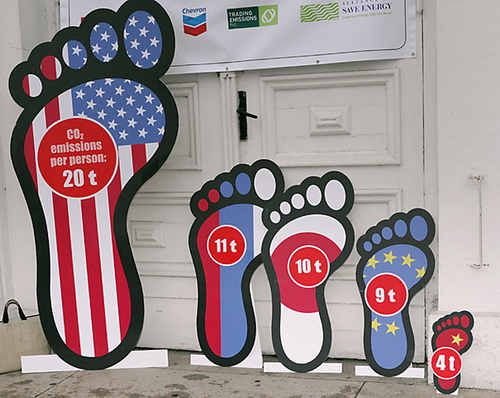
We, the Indigenous Peoples, nations and organizations from all over the world, gathered at the World Peoples’ Conference on Climate Change and the Rights of Mother Earth, from April 19th to 22nd, 2010 in Tiquipaya, Cochabamba, Bolivia, after extensive discussions, express the following:
We Indigenous Peoples are sons and daughters of Mother Earth, or “Pachamama” in Quechua. Mother Earth is a living being in the universe that concentrates energy and life, while giving shelter and life to all without asking anything in return, she is the past, present and future; this is our relationship with Mother Earth. We have lived in coexistence with her for thousands of years, with our wisdom and cosmic spirituality linked to nature. However, the economic models promoted and forced by industrialized countries that promote exploitation and wealth accumulation have radically transformed our relationship with Mother Earth. We must assert that climate change is one of the consequences of this irrational logic of life that we must change.
The aggression towards Mother Earth and the repeated assaults and violations against our soils, air, forests, rivers, lakes, biodiversity, and the cosmos are assaults against us. Before, we used to ask for permission for everything. Now, coming from developed countries, it is presumed that Mother Earth must ask us for permission. Our territories are not respected, particularly those of peoples in voluntary isolation or initial contact, and we suffer the most terrible aggression since colonization only to facilitate the entry of markets and extractive industries.
We recognize that Indigenous Peoples and the rest of the world live in a general age of crises: environmental, energy, food, financial, ethical, among others, as a consequence of policies and attitudes from racist and exclusionary states.
We want to convey that at the Copenhagen Climate Conference, the peoples of the world demanded fair treatment, but were repressed. Meanwhile the states responsible for the climate crisis were able to weaken even more any possible outcome of negotiations and evade signing onto any binding agreement. They limited themselves to simply supporting the Copenhagen Accord, an accord that proposes unacceptable and insufficient goals as far as climate change action and financing to the most affected countries and peoples.
We affirm that international negotiation spaces have systematically excluded the participation of Indigenous Peoples. As a result, we as Indigenous Peoples are making ourselves visible in these spaces, because as Mother Earth has been hurt and plundered, with negative activities taking place on our lands, territories and natural resources, we have also been hurt. This is why as Indigenous Peoples we will not keep silent, but instead we propose to mobilize all our peoples to arrive at COP16 in Mexico and other spaces well prepared and united to defend our proposals, particularly the “living well” and plurinational state proposals. We, Indigenous Peoples, do not want to live “better”, but instead we believe that everyone must live well. This is a proposal to achieve balance and start to construct a new society.
The search for common objectives, as history shows us, will only be completed with the union of Indigenous Peoples of the World. The ancestral and indigenous roots shared by the whole world must be one of the bonds that unite us to achieve one unique objective.
Therefore we propose, require and demand:
1. The recovery, revalidation and strengthening of our civilizations, identities, cultures and cosmovisions based on ancient and ancestral Indigenous knowledge and wisdom for the construction of alternative ways of life to the current “development model”, as a way to confront climate change.
2. To rescue and strengthen the Indigenous proposal of “living well”, while also recognizing Mother Earth as a living being with whom we have an indivisible and interdependent relationship, based on principles and mechanisms that assure the respect, harmony, and balance between people and nature, and supporting a society based on social and environmental justice, which sees life as its purpose. All this must be done to confront the plundering capitalist model and guarantee the protection of life as a whole, through the search for inclusive global agreements.
3. We demand States to recognize, respect and guarantee the application of international standards of human rights and Indigenous Peoples’ rights (i.e., The UN Declaration on the Rights of Indigenous Peoples, ILO Convention 169) in the framework of negotiations, policies, and measures to confront climate change.
4. We demand States to legally recognize the preexistence of our right to the lands, territories, and natural resources that we have traditionally held as Indigenous Peoples and Nations, as well as restitution and restoration of natural goods, water, forests and jungles, lakes, oceans, sacred places, lands, and territories that have been dispossessed and seized. This is needed to strengthen and make possible our traditional way of living while contributing effectively to climate change solutions. Inasmuch, we call for the consolidation of indigenous territories in exercise of our self-determination and autonomy, in conformity with systems of rules and regulations. At the same time we demand that states respect the territorial rights of Indigenous Peoples in voluntary isolation or in initial contact, as an effective way to preserve their integrity and combat the adverse effects of climate change towards those peoples.
5. We call on States not to promote commercial monoculture practices, nor to introduce or promote genetically-modified and exotic crops, because according to our people’s wisdom, these species aggravate the degradation of jungles, forests and soils, contributing to the increase in global warming. Likewise, megaprojects under the search for alternative energy sources that affect Indigenous Peoples’ lands, territories, and natural habitats should not be implemented, including nuclear, bio-engineering, hydroelectric, wind-power and others.
6. We demand changes to forestry and environmental laws, as well as the application of pertinent international instruments to effectively protect forests and jungles, as well as their biological and cultural diversity, guaranteeing Indigenous Peoples’ rights, including their participation and their Free, Prior, and Informed Consent.
7. We propose that, in the framework of climate change mitigation and adaptation measures, states establish a policy that Protected Natural Areas must be managed, administered and controlled directly by Indigenous Peoples, taking into account the demonstrated traditional experience and knowledge towards the sustainable management of the biodiversity in our forests and jungles.
8. We demand a review, or if the case warrants, a moratorium, to every polluting activity that affects Mother Earth, and the withdrawal of multinational corporations and megaprojects from Indigenous territories.
9. We urge that states recognize water as a fundamental human right, avoiding its privatization and commodification.
10. We demand the application of consultations, participation, and the Free, Prior and Informed Consent of Indigenous Peoples and affected populations in the design and implementation of climate change adaptation and mitigation measures and any other intervening actions on Indigenous territories.
11. States must promote mechanisms to guarantee that funding for climate change action arrives directly and effectively to Indigenous Peoples, as part of the compensation for the historical and ecological debt owed. This funding must support and strengthen our own visions and cosmovisions towards “living well”.
12. We call for the recovery, revalidation and strengthening of Indigenous Peoples’ technologies and knowledge, and for their incorporation into the research, design and implementation of climate change policies. This should compliment Western knowledge and technology, ensuring that technology transfer processes do not weaken indigenous knowledge and technologies.
13. We propose the recovery, development and diffusion of indigenous knowledge and technology through the implementation of educational policies and programs, including the modification and incorporation of such knowledge and ancestral wisdom in curricula and teaching methods.
14. We urge States and international bodies that are making decisions about climate change, especially the UNFCCC, to establish formal structures and mechanisms that include the full and effective participation of Indigenous Peoples. They must also include local communities and vulnerable groups, including women, without discrimination, as a key element to obtain a fair and equitable result from climate change negotiations.
15. We join in the demand to create a Climate Justice Tribunal that would be able to pass judgement and establish penalties for non-compliance of agreements, and other environmental crimes by developed countries, which are primarily responsible for climate change. This institution must consider the full and effective participation of Indigenous Peoples, and their principles of justice.
16. We propose the organization and coordination of Indigenous Peoples worldwide, through our local, national, regional, and international governments, organizations, and other mechanisms of legitimate representation, in order to participate in all climate change related processes. With that in mind, we call for an organizational space to be created that will contribute to the global search for effective solutions to climate change, with the special participation of Elders.
17. We propose to fight in all spaces available to defend life and Mother Earth, particularly in COP16, and so we propose a 2nd Peoples’ Conference to strengthen the process of reflection and action.
18. The ratification of the global campaign to organize the World March in defense of Mother Earth and her peoples, against the commodification of life, pollution, and the criminalization of Indigenous and social movements.
 Grand Rapids Institute for Information Democracy