Media Bites – Pepsi: One Tribe
This week’s Media Bites takes a look at a new marketing campaign by Pepsi called the Refresh Project. Pepsi is attempting to position themselves as a company that breaks down barriers and brings people together. The commercial uses a new song by the Black Eyed Peas, One Tribe, to try to make us feel that the company cares about people and the Planet. In the end, the commercial is just another ploy to get us to buy their product and to not think about what harm the company does around the world.
A New Climate Movement in Bolivia
(This article by Naomi Klein is re-posted from ZNet.)
It was 11 am and Evo Morales had turned a football stadium into a giant classroom, marshaling an array of props: paper plates, plastic cups, disposable raincoats, handcrafted gourds, wooden plates and multicolored ponchos. All came into play to make his main point: to fight climate change, “we need to recover the values of the indigenous people.”

Yet wealthy countries have little interest in learning these lessons and are instead pushing through a plan that at its best would raise average global temperatures 2 degrees Celsius. “That would mean the melting of the Andean and Himalayan glaciers,” Morales told the thousands gathered in the stadium, part of the World People’s Conference on Climate Change and the Rights of Mother Earth. What he didn’t have to say is that the Bolivian people, no matter how sustainably they choose to live, have no power to save their glaciers. Bolivia’s climate summit has had moments of joy, levity and absurdity. Yet underneath it all, you can feel the emotion that provoked this gathering: rage against helplessness.
It’s little wonder. Bolivia is in the midst of a dramatic political transformation, one that has nationalized key industries and elevated the voices of indigenous peoples as never before. But when it comes to Bolivia’s most pressing, existential crisis—the fact that its glaciers are melting at an alarming rate, threatening the water supply in two major cities—Bolivians are powerless to do anything to change their fate on their own.
That’s because the actions causing the melting are taking place not in Bolivia but on the highways and in the industrial zones of heavily industrialized countries. In Copenhagen, leaders of endangered nations like Bolivia and Tuvalu argued passionately for the kind of deep emissions cuts that could avert catastrophe. They were politely told that the political will in the North just wasn’t there. More than that, the United States made clear that it didn’t need small countries like Bolivia to be part of a climate solution. It would negotiate a deal with other heavy emitters behind closed doors, and the rest of the world would be informed of the results and invited to sign on, which is precisely what happened with the Copenhagen Accord. When Bolivia and Ecuador refused to rubber-stamp the accord, the US government cut their climate aid by $3 million and $2.5 million, respectively. “It’s not a free-rider process,” explained US climate negotiator Jonathan Pershing. (Anyone wondering why activists from the global South reject the idea of “climate aid” and are instead demanding repayment of “climate debts” has their answer here.) Pershing’s message was chilling: if you are poor, you don’t have the right to prioritize your own survival.
When Morales invited “social movements and Mother Earth’s defenders…scientists, academics, lawyers and governments” to come to Cochabamba for a new kind of climate summit, it was a revolt against this experience of helplessness, an attempt to build a base of power behind the right to survive.
The Bolivian government got the ball rolling by proposing four big ideas: that nature should be granted rights that protect ecosystems from annihilation (a “Universal Declaration of Mother Earth Rights”); that those who violate those rights and other international environmental agreements should face legal consequences (a “Climate Justice Tribunal”); that poor countries should receive various forms of compensation for a crisis they are facing but had little role in creating (“Climate Debt”); and that there should be a mechanism for people around the world to express their views on these topics (“World People’s Referendum on Climate Change”).
The next stage was to invite global civil society to hash out the details. Seventeen working groups were struck, and after weeks of online discussion, they met for a week in Cochabamba with the goal of presenting their final recommendations at the summit’s end. The process is fascinating but far from perfect (for instance, as Jim Shultz of the Democracy Center pointed out, the working group on the referendum apparently spent more time arguing about adding a question on abolishing capitalism than on discussing how in the world you run a global referendum). Yet Bolivia’s enthusiastic commitment to participatory democracy may well prove the summit’s most important contribution.
That’s because, after the Copenhagen debacle, an exceedingly dangerous talking point went viral: the real culprit of the breakdown was democracy itself. The UN process, giving equal votes to 192 countries, was simply too unwieldy—better to find the solutions in small groups. Even trusted environmental voices like James Lovelock fell prey: “I have a feeling that climate change may be an issue as severe as a war,” he told the Guardian recently. “It may be necessary to put democracy on hold for a while.” But in reality, it is such small groupings—like the invitation-only club that rammed through the Copenhagen Accord—that have caused us to lose ground, weakening already inadequate existing agreements. By contrast, the climate change policy brought to Copenhagen by Bolivia was drafted by social movements through a participatory process, and the end result was the most transformative and radical vision so far.
With the Cochabamba summit, Bolivia is trying to take what it has accomplished at the national level and globalize it, inviting the world to participate in drafting a joint climate agenda ahead of the next UN climate gathering, in Cancún. In the words of Bolivia’s ambassador to the UN, Pablo Solón, “The only thing that can save mankind from a tragedy is the exercise of global democracy.” If he is right, the Bolivian process might save not just our warming planet but our failing democracies as well. Not a bad deal at all.
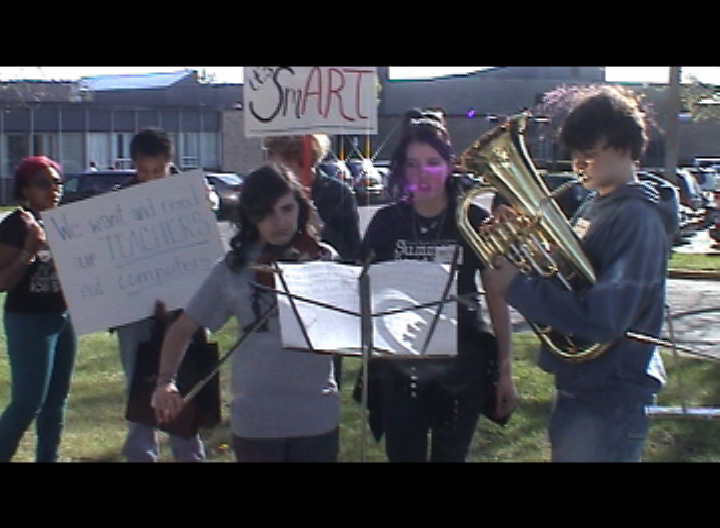
Last night, an estimated 500 people showed up at Ottawa Hills High School to listen and to be heard on a variety of proposals being put forth by the Grand Rapids Public School Board and Superintendent Taylor.
As we have reported before, students and parents are upset with proposals to have more online classes, which would eliminate some teaching positions and budget cuts which would result in art & music programs being reduced.
Upon arriving to Ottawa Hills High School people were greeted by people passing out informational flyers, stickers and students holding signs and playing instruments to draw attention to the proposed cuts to art & music.
When the board meeting finally got under way, the board President right away began defending the direction that the current administration was going in and even referred to the GR Public Schools as a role model for how schools can transition in the current economic climate.
The Agenda
After four area students were recognized for scholarship awards they had won the board dealt with the agenda at hand. First, was the proposal to extend a contract with Dean Transportation, which provides busing services ever since the school board eliminated the busing provided by the school itself. There were two comments on this matter, one in favor and one against. Superintendent Taylor encouraged the board members to vote for the contract extension, but offered up no convincing evidence for why the board should support the contract extension. The measure passed with only one no vote.

Another items on the agenda had to do with grant money that was being offered by the Kellogg Foundation, but was tied to the online learning proposal that was also put forth in recent weeks. Again Taylor encouraged board members to support the Kellogg Foundation grant money, in part, because it could lead to more money from Kelloggs and maybe even the DeVos Foundation.
Taylor then invited 6 of the districts principals to speak to the benefits of the online learning, which was referred to all night as a blended educational system. The school principals all endorsed the proposal and communicated that students, once given proper information were also behind the model.
School Board member Dr. Baker asked how the students were feeling about this blended system and how the principals were able to assess student input. One principal did admit that some of the students do miss the interaction with other students, but they felt that the overall assessment was positive. The board ended up voting 6 – 3 in favor of the Kellogg Foundation grant.
Public Comment
When it came time for public comment, the board first instructed those in attendance that they should be respectful and refrain from having any reaction to comments that were made. This statement was greeted by lots of jeers from the crowd. The school board also reduced public comment from 3 minutes to 2 minutes because there were so many people who had signed up to speak.
In all, 27 people got up to address the school board. Many parents expressed concerns about proposed cuts to music and art programs. On person said that art fosters imagination and that imagination was an important part of education. Another part talked about how music not only increases the capacity for students to learn, “music can make us better people.”
The issue that most people addressed was the online education proposal. Parents, teachers and students all agreed that this was a bad idea. People spoke to the importance of having education being a relational experience, where teachers and students can engage each other. Teachers can identify the needs of each individual student and find ways to reach each student, a quality that no computer can provide. Some parents spoke to how children’s lives are already so technology focused that they did not want online classes to add to the hyper-digital pressures that students already face in a media saturated world.
However, some of the strongest statements and the ones that got the loudest applause came from several students. The students spoke eloquently and passionately about the desire to have teachers in the classroom and to have the opportunity to take art and music classes. One high school student even said that the online classes are not very challenging and are set up in such a way that it makes it easy for students to cheat.
By the end of the night over two dozen people addressed the school board, but it was clear from the applause throughout the night that those in attendance did not support the proposals being put forth by Superintendent Taylor. The overwhelming critical comments from the community seemed to resonate with board members Baker and Hinkle, both of which expressed deep concerns over the online class proposal and the urgent need for the school administration to truly listen to the concerns of the public.
Here is some additional comments by students we spoke with before the School Board meeting.
The Press on Campaign Finance rules for Michigan
Today, the Grand Rapids Press ran as a front-page story about what the new Election Campaign Finance rules will mean in Michigan. The article begins by talking about the history of attacks ads that we have all come to know during the election season.

The Press mentions the Supreme Court decision in October of 2009, which will provide private entities greater opportunities to inject money into the political process. However, the Press does not include any of the details of that Supreme Court decision and what the potential harm it will do to the democratic process.
The article cites several sources, including the Michigan Chamber of Commerce and the state chapter of the AFL-CIO, both of which will no doubt use the opportunity to increase funding for political ads and other campaign financing tactics. Both the Michigan Chamber and unions that are part of the AFL-CIO have been amongst the top donors to Michigan campaigns, as is noted in the 2008 report put out by the Michigan Campaign Finance Network (MCFN).
The Press does cite Rich Robinson with the MCFN, but also Craig Ruff with the Lansing-based Public Sector Consultants. Both Robinson and Ruff express concerns about what Michigan Secretary of State Terry Land will do in regards to how Michigan will adopt the new Campaign Finance ruling, although Ruff seems more optimistic that Land will “will err on the side of disclosure.”
The Press article also does not discuss Land’s history as chairperson for previous election campaign committees, nor the potential conflict of interest as a running mate with gubernatorial candidate Mike Bouchard. Since there are fewer campaign finance restrictions placed on private donors, does Land’s position as a candidate put her in conflict with decisions she has to make about how the State will deal with campaign finance rules? The Press article states that Land will announce her decision within the next week.
Anti-Reform Front Group Wears a Populist Mask
(This article is re-posted from the Center for Media & Democracy.)

A corporate front group with the populist-sounding name “Stop Too Big To Fail” (STBTF) is running a $1.6 million TV advertising campaign designed to appeal to liberal/progressives and get them to advocate against financial reform legislation currently under consideration in Congress.
The ads target Senate Democrats in three states and ask viewers to tell their senators to “vote against this ‘phony financial reform’ ” and “support real reform, stop ‘too big to fail.’ ” STBTF has also put out a blitz of opinion columns on left-leaning Web sites. TPMMuckraker, which researched STBTF, says it has every indication of being an “astroturf operation funded by corporate interests to give the appearance of grassroots opposition to reform.” The group’s president is Robert K. Johnson, a serial astroturf group operator who also heads the corporate front Consumers for Competitive Choice (C4CC).
C4CC was formerly known as “Consumers for Cable Choice,” a front group funded by big telecom companies like Verizon and SBC, which fought to deregulate the cable industry. STBTF also has links to the DCI Group, a well-known Washington, D.C. Republican lobbying and astroturfing business. STBTF sought the support a prominent former chief economist for the International Monetary Fund (IMF), Simon Johnson (no relation to Robert K. Johnson), who now advocates breaking up big banks.
At first Simon Johnson agreed, and STBTF posted a picture of him on their Web site, but when Johnson realized the group was really pushing an anti-reform message, he demanded they stop using his name and likeness, and STBTF was forced to pull all references to S. Johnson from its Web site.
Here is one of the bogus ads the group was using:
Arizona’s Law May Spark Pro-Immigrant Movement
(This article by Valeria Fernández is re-posted from Common Dreams.)
After a week of ongoing protests and acts of civil disobedience, Governor Jan Brewer signed SB 1070 making Arizona the first state in the nation to consider it a crime for a person to be an undocumented immigrant.
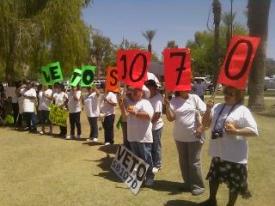
The new law would go into effect 90 days after the end of the legislative session, which is expected to adjourn in the coming weeks.
“I’m disappointed, but not surprised. I believe she’s taken this action for political purposes because she is running for election. It is a poor reason to sign unconstitutional legislation,” said Rep. Kirsten Sinema, D-Phoenix. “The silver lining is that we are going to sue and we are going to win.”
Several legal challenges to keep the legislation from taking effect are in the works by the Mexican American Legal and Educational Fund (MALDEF), the American Civil Liberties Union (ACLU) and the National Day Laborer Organizing Network (NDLON).
“Arizona would have the same place in history as South Africa,” said Salvador Reza, organizer for the PUENTE movement, which advocates for human rights, comparing the new law to apartheid.
But the passage of the Arizona law may also have ignited the pro-immigration reform movement. Rep. Luis Gutiérrez, D-Illinois, is expected to hold a rally in Arizona on Sunday.
“We hope President Obama can join us at the rally to announce swift action the federal government will take to protect the civil rights of its residents,” said Pablo Alvarado, the executive director of NDLON.
President Obama criticized the Arizona bill earlier today, saying it threatens to “undermine basic notions of fairness that we cherish as Americans, as well as the trust between police and our communities that is so crucial to keeping us safe.” He called on Congress to enact immigration reform, saying that without a federal overhaul of immigration laws, “we will continue to see misguided efforts opening up around the country.”

Opponents of the bill are holding ongoing protests and planning economic boycotts of the state convention center.
Since early Friday, thousands of people have gathered outside the state capitol, peacefully protesting the bill with signs reading “Veto SB 1070” and “We are human.” A great majority of them are students between the ages of 14 and 17 who walked out spontaneously from school after news of the protest spread through text-messaging.
Supports of the bill numbered about a dozen.
There has been a strong police presence and some activists are concerned that the governor’s signing of the bill could lead to acts of violence.
Before a crowd of peaceful protesters at the capitol, Phoenix Mayor Phil Gordon spoke passionately against SB 1070 and announced that he would seek approval from the council to seek to stop the bill’s implementation through a lawsuit.
SB 1070, also known as the “Support Our Law Enforcement and Safe Neighborhood Act,” would allow police officers to arrest a person based on “reasonable suspicion ” that he or she is an undocumented immigrant. Police departments could face lawsuits by individuals who believe they are not enforcing the law.
“This bill criminalizes people who appear to be Latino and puts them at risk for racial profiling and prosecution and harassment in the state,” said Sinema.
“There’s no protection in this bill for people who are witnesses or victims of crimes,” she added. “They’ll be less likely to work with police to keep the community safe.”
SB 1070 would also impose penalties for transporting or harboring an undocumented immigrant, which could include family members.
“This is going to break our families apart,” said Estela, an undocumented immigrant who has two children born in the United States. “My older son will want to stay, but we may have to leave.”
The law would have a devastating impact on undocumented students who were brought to the United States when they were very young, said Carmen Cornejo, executive director of CADENA, a group that advocates for passage of the DREAM Act, which would provide a path to citizenship for high school graduates who attend college or serve in the military.
“Even though this is going on, we can’t stop going to school, we can’t stop going to work, we still have a life,” said Dulce, a 25-year-old undocumented immigrant who has an engineering degree. “And we shall not fear.”
Dulce says it has been a difficult week for her family as they waited to hear whether the governor would sign the bill.
“It’s going to be another obstacle,” said the student. “We’ll have to be like we always are, extra careful. They’re not supposed to stop you if you don’t do anything wrong,” said the student. “As an Arizonan and as an undocumented immigrant, I’ll take precautions.”
Dulce planned to attend a protest all day Friday against the bill’s passage.
For immigrant communities, SB 1070 might be the tipping point for action and mobilization after state voters and conservative legislators have passed a series of laws aimed at hardening social conditions in the state to encourage immigrants to leave.
“We’re not going to give up,” said Estela. “We hope that something will be done in the next 90 days.”
Some of the Arizona laws have resulted in U.S.-citizen children going without health care benefits and a number of raids conducted by Maricopa County Sheriff’s deputies that have terrorized immigrant communities.
A coalition of businesses and religious leaders has warned that the impact of the new measure could severely damage the Arizona economy.
“SB 1070 is tearing our state into two. It humiliates us into the eyes of America and threatens our economic recovery,” said Phoenix Mayor Phil Gordon during a speech on Thursday when he urged the governor to veto SB 1070.
Sen. Russell Pearce, R-Mesa, the author of the bill, said the legislation would have the opposite effect. He believes the new legislation will lead immigrants to leave Arizona, causing the state to save money in services it currently provides to the children of undocumented immigrants at schools and hospitals. He has said that states have to take the matter into their own hands in absence of federal enforcement.
The recent death of a rancher on the border connected to violence in the area gave momentum to SB 1070.
Pearce said the legislation would take the handcuffs off law enforcement but allowing them to inquire about a person’s immigration status and would result in a number of immigrants choosing to leave the state.
Ilario and his wife, both undocumented immigrants from Guerrero, Mexico who have lived in the United States for the last 12 years, joined 30 of their neighbors to walk the streets in protest, showing that they refused to remain in the shadows. Ilario knows proponents of the bill want he and his family to leave Arizona, but he is not ready to do that.
“There’s too much at stake for us,” said Ilario in Spanish. “Aquí estamos y no nos vamos.”
US Military tries to cover up civilian deaths in Afghanistan

The anti-war group Rethink Afghanistan has just posted a new video and a petition to expose the deception of the US military in Afghanistan.
“U.S. and allied special forces in Afghanistan killed 2 civilian men, 2 pregnant women and a teenage girl in Gardez, and they then tried to hide their crime. We can’t let them get away with a cover-up.
In this night raid on Feb. 12, special-forces mistakenly attacked a baby shower. Instead of getting immediate medical treatment for the wounded, special forces personnel focused on destroying evidence, digging the bullets out of the bodies.
Gen. McChrystal’s P.R. team fought for weeks to obscure the truth. They lied about finding the women dead when they arrived. They smeared journalists who questioned their story. On April 4, they admitted to killing all of the innocent victims, including the women.
After this outrageous behavior, McChrystal says we should trust his forces to investigate themselves. If you think it is ludicrous for the military to investigate themselves, then please sign on to this petition, invite others to do the same and watch this important video.
Energy companies aren’t green, they give green
A day after celebrating the 40th anniversary of Earth Day it is important to take a look at the efforts by big energy companies and so-called alternative energy companies to influence candidates through campaign donations and lobbying.
The Center for Responsive Politics provides us with good data on both counts. Since 1990, energy companies have contributed half a billion dollars to candidates, with Republicans receiving about twice as much as Democrats. Over $77 million was given to candidates in the 2008 elections and just over $27 million has already reached candidates in the 2010 election cycle.
Here is a list of the top 20 energy companies and their campaign contributions.
| Rank | Organization | Amount |  Dems Dems |
 Repubs Repubs |
Source Indivs Indivs PACs PACs Soft $ Soft $ |
|---|---|---|---|---|---|
| 1 | National Rural Electric Cooperative Assn | $770,650 | 53% | 47% | |
| 2 | Exelon Corp | $566,448 | 66% | 34% | |
| 3 | Koch Industries | $539,900 | 19% | 81% | |
| 4 | Southern Co | $532,169 | 46% | 54% | |
| 5 | American Electric Power | $477,085 | 58% | 42% | |
| 6 | Duke Energy | $468,160 | 52% | 48% | |
| 7 | Exxon Mobil | $436,294 | 14% | 85% | |
| 8 | Dominion Resources | $431,886 | 62% | 37% | |
| 9 | Chevron Corp | $402,159 | 17% | 83% | |
| 10 | EnergySolutions Inc | $361,800 | 29% | 71% | |
| 11 | Energy Future Holdings Corp | $359,866 | 50% | 50% | |
| 12 | FPL Group | $358,096 | 47% | 53% | |
| 13 | Edison International | $356,800 | 64% | 36% | |
| 14 | Valero Energy | $338,800 | 19% | 81% | |
| 15 | Edison Electric Institute | $325,373 | 63% | 37% | |
| 16 | Marathon Oil | $318,670 | 23% | 77% | |
| 17 | Progress Energy | $304,770 | 53% | 47% | |
| 18 | Entergy Corp | $287,365 | 67% | 33% | |
| 19 | Occidental Petroleum | $266,250 | 23% | 77% | |
| 20 | DTE Energy | $250,376 | 65% | 35% |
Some of the major recipients in Congress of the energy companies campaign contributions in 2010 have been Senators Murkowski, Lincoln, Dorgan, and Reid. In the House of Representatives the list includes Boucher, Barton, Edwards, Cantor and Stover.
Michigan Senator Debbie Stabenow has received $71,096 from energy companies so far in 2010 and there is no data for Senator Levin. Congressman Ehlers has received a total of $9,300 this year.

On the lobbying front, big oil leads all energy sectors followed by electric utilities. You can see from the chart the gradual increase in lobby spending by this sector, with figures over $400 million in 2009.
The number of lobbyist for 2009 in the energy sector was 2,302 and has remained over 2,000 since 2002.
Before and After Bagua
(This article is by Paris Conwell – GVSU student)

This past January, I spent a month in the San Martin region of the Peruvian High Amazon as part of a study abroad program through Living Routes. The title of the course was “Community, Ecology, and Indigenous Spirituality in the High Amazon”. While intended to be an anthropology course, what us students found ourselves faced with demanded much more than the passive observation I had usually associated with the field of anthropology.
Within the San Martin department of Peru is the province of Lamas, which is home to the Kichwa-Lamistas, an indigenous society of about 22,500 people. During the program we had the opportunity to meet, interact, and live with some of the members of the Kichwa-Lamistas while we resided in Lamas, and it was during this time that we learned about the Bagua massacres.
On June 5th, 2009, approximately 5,800 Peruvians, mostly natives, were gathered just outside of Bagua, a town only 6 hours car ride from Lamas. They were gathered there for a strike that had begun April 9th, 2009. The strike included a roadblock and the taking of two nearby pumping stations and intended to protest the Free Trade Agreements (FTA) signed between the U.S under the Bush Administration and the government of Alan Garcia in Peru on December 4th 2007. These agreements, and the promulgation of hundreds of legislative decrees by Garcia, have opened indigenous territories to multinational companies without the consent of the indigenous people, and at the expense of their physical, mental, and spiritual well-being. The protests provoked a violent repression on behalf of Garcia’s government, now referred to as the “Bagua massacres” on June 5th this past year. The police attacked at 5:30 am releasing tear gas and firing machine guns at the natives who were armed with lances, stones, and bows and arrows to defend themselves. In the official death toll it was released that 24 police officers and 10 civilians were killed. However, according to various native and social movement communities, there are an estimated 200 to 500 persons involved in the strike who were “disappeared” by being thrown into rivers from the police helicopters and their corpses being burnt.
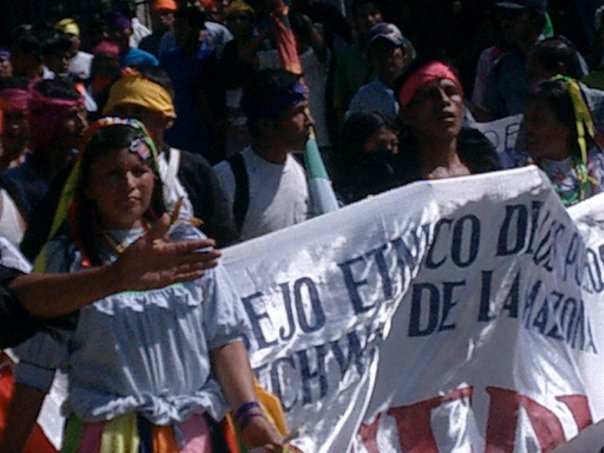
The burning of corpses, in addition to disposing of the bodies by throwing them into the rivers and dumping them from the helicopters, was an effort to greatly decrease the official death toll of native Peruvians and to hide the government’s brutality.
The press was also heavily censored: the government presented a biased account of the events that day and was the sole provider of information for the international media. In a New York Times article written by Simon Romero covering the events that unfolded at the Bagua massacre it reads:
“Initial accounts of the clashes varied. Indigenous leaders here said the killings unfolded early on Friday after the police fired from helicopters on hundreds of protesters who had blocked the highway in the northern Bagua Province, with at least 22 civilians killed. The Chachapoyas Medical Association, in the region where the killings took place, put the number of dead Indians at 25”.
The New York Times article demonstrates the bias and unsound “facts” surrounding the Bagua massacre that is characteristic of the Peruvian government under Garcia as well as the country’s media. It is unfortunate that a major news such as the Times promulgates the racist viewpoints of the Peruvian media and government in their publishing of this article, and that this reflects the tone of the majority if the international coverage of the Bagua massacre. Here is a link to the full article: http://www.nytimes.com/2009/06/06/world/americas/06peru.html?_r=1&scp=1&sq=bagua&st=cse
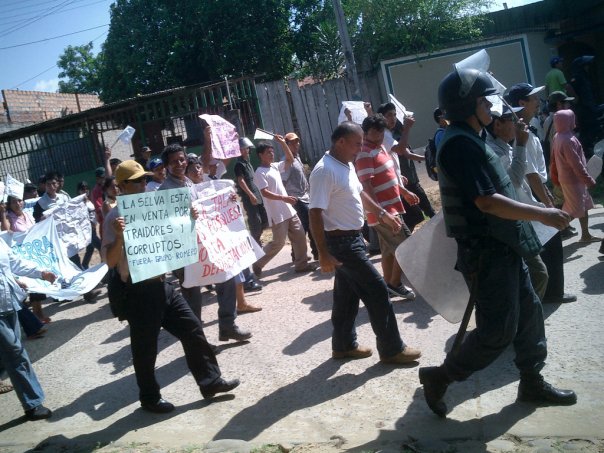
The tone of the reportage on the day of the massacre was biased and racist. Alan Garcia and members of his cabinet as well as the reporters themselves frequently used racist language to describe the native peoples, citing the natives’ efforts to protect their lands as greedy attempts to keep the resources and wealth for themselves because they do not want the land to be privatized or given in concession to transnational companies. Garcia himself called the indigenous people primitive, ignorant savages who stand in the way of progress for all Peruvians.
In the months that preceded Bagua, indigenous leaders sought ways to address the destruction being wrought on behalf of the Free Trade Agreement and Garcia’s marginalizing legislative decrees. In April 2009, leaders of indigenous groups went to Lima to discuss the issue. The leaders returned and discussed the situation with their communities, and it was decided that a strike would be best once it became clear that the Peruvian government was only willing to listen to a few select, elitist and corrupt representatives of indigenous groups who do not properly amplify the voices of the indigenous communities.
The signing of the FTA between the US and Peru has wrought a destructive force comparable to the 16th century conquest of the region, all in the name of “progress” and “development”. It is estimated that 75% of the Peruvian Amazonian territories have either been sold, given in concession, or promised to private enterprise.
Deforestation for a monoculture is a crime. The opening and selling of indigenous territories has led to well documented deforestation, mining, and oil extraction and consequently, environmental disaster and the displacement of people.
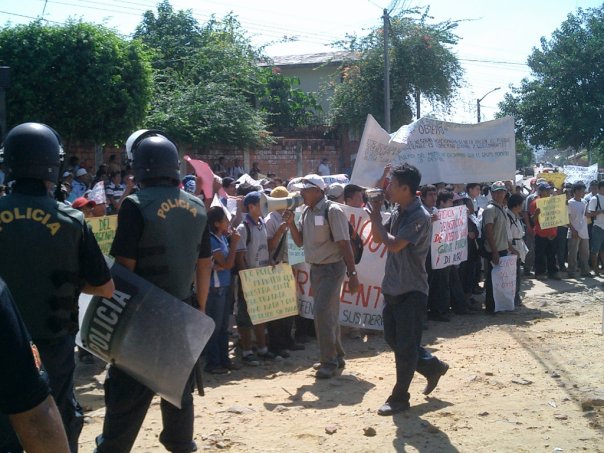
The FTA was ratified in Peru June 2006 and went into affect February 2009. The government of Alan Garcia created a package of 99 reforms to implement the FTA. More than half of these forms have been found to be unconstitutional and directly infringe upon the rights of the indigenous peoples. CEPKA, and indigenous organization representing many of the Kichwa communities, has cited seven specific laws that infringe upon their territorial rights, specifically.
In 1993, Peru ratified the International Labor Organization’s Convention on Indigenous and Tribal Peoples. This convention provides a legal basis for the indigenous people’s struggle against the FTA and the contracting of their land to private companies, particularly part II, Land, articles 13 and 14 in which the government pledges specifically to recognize and respect the lands the indigenous people occupy or otherwise use or traditionally have access to.
In addition to this, on September 13, 2007 the General Assembly of the United Nations adopted the Declaration on Rights of Indigenous Peoples, of which Peru is member. Only 4 nations voted against the declaration— New Zealand, Canada, Australia, and the United States.
As a member of the UN and a signatory of the ILO Convention, Peru is legally obligated to grant certain rights to its native peoples.
Since Bagua, Garcia has apologized and two of the most grievous laws have been amended, however many of the exploitive decrees still remain.
Native communities are devastated by the massacres at Bagua, and now refer to the magnitude of the hardships they face as being “before and after Bagua” as the event marks the pinnacle of violence on behalf of the Peruvian government in regards to the Free Trade Agreements.
The indigenous people of Peru are not against progress. They want to be able to make decisions regarding their territories and to be granted the rights promised to them through the ILO and UN. The forests are their markets, they are a source of subsistence that sustains their livelihood and their cultural identity. Indigenous communities hold a wealth of knowledge about their land. In destroying their lands, the communities are also destroyed and deprived of their wealth. Despite the legal status of these issues, there exists a moral obligation to protect the rights of peoples whose worldview challenges that of the modern west. If we are to ever discuss issues of sustainability, and the physical, mental, and spiritual health of our planet and its inhabitants, we must learn to dialogue with the voices that are often left unheard in their never ceasing challenges to our paradigm of thought.
Towards the end of the study abroad program, all of us students felt the obligation to share what we learned with a western audience. We realized the role our own country plays in the destruction and suffering of the peoples and places we encountered while in the High Amazon, but more importantly, we realized the self-destruction inherent within such practices that ultimately will lead to our planet’s demise, and are responsible for the spiritual deficit we are faced with in the west. Addressing these issues is not a matter of helping “others”; our well-being is bound with those who first feel the damage done. It is just that we are not yet directly and blatantly faced with the affects of our own undoing.
GOP gubernatorial debate coverage
Yesterday, the five Republican candidates running for the Michigan Governor’s seat participated in a debate at MSU, a debate that was organized by the GOP Party.
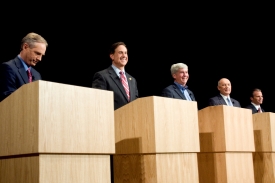
The debate itself was only 1 hour long, which is hardly enough time to do more than provide introductions and engage in sound bite responses to very complex issues. The major West Michigan news agencies all ran stories about the debate, but none of them went beyond reporting some of what was said by each of the candidates.
All of the news agencies spent some time pointing out how the candidates “took a swipe at each other,” but not once did the reporters bother to verify any of the claims made by the candidates. Four of the five GOP candidates are serving in positions of elected office, which would allow reporters to look at their voting records which could shed light on what kind of track record each of them has. This is particularly the case for Hoekstra and George, since they have a voting record as a member of Congress and State Senator.
Another clear omission from the news coverage was the complete absence of any information about candidate platforms. Sure, there were sound bite responses on issues like jobs and taxes, but the reporters could have bothered to take the time and look at details of key platform issues from the candidate’s respective websites.
Instead, TV stations like WZZM 13 decided it was more valuable to have the head of the Michigan Republican Party and the director of Inside Michigan Politics comment on how the debate went. The WXMI 17 story also treated the debate like a sporting event and even included shorter stories with post debate comments from the candidates that provide no value to voters whatsoever. For example, channel 17 has this comment from Mike Bouchard; “I’m in a business where people shoot at ya, so if people want to throw words, that’s fine with me. I’m going to stay focused on jobs because that’s what people at home want to hear about.”
The Grand Rapids Press article was also short on substance, with reporter Peter Luke providing a summary of the sound bites that candidates gave. The article identified issues like taxes, jobs, education and pro-life stances, but no investigation was done by the reporter who thought it was more useful to point out what called the “intramural sniping” the five candidates engaged in.
WOOD TV 8 did pretty much the same kind of coverage as the other news agencies, but they framed the debate in more entertaining ways by using words like fireworks, blows and sniping.
 Grand Rapids Institute for Information Democracy