
MLive announced yesterday that Michigan Senator Carl Levin will be in Grand Rapids on Monday to speak at an event hosted by the World Affairs Council of Western Michigan.
The presentation by Michigan’s senior Senator is based on a recent trip to Afghanistan in which Levin says there has been “significant progress.” Levin returned from a two-day visit to Afghanistan in January and released a statement where he identified the signs of progress as the “regaining of former Taliban strongholds in Helmand and Kandahar” and the increased confidence of the Afghani people in the Coalition forces and the Afghan National Army (ANA).
This “evidence” that Senator Levin provides has been critiqued and challenged from numerous sources. First, the progress or confidence of the Afghan National Army and police forces that the US and Coalition forces have been training has come under question by a major study from the Afghanistan Analysts Network. This study contends that the Afghan security forces often fight against each other, attack civilians and are often infiltrated by Taliban insurgents who gain access to weapons and intelligence.
Senator’s Levin’s suggestion that there is progress being made in Afghanistan is consistent with the position of President Obama who delivered his own assessment of the Afghan campaign at the end of 2010. Foreign Policy analysts Phyllis Bennis and Kevin Martin provided a sharp critique of the President’s claims, pointing out that 2010 saw the largest number of Afghan civilians and US soldier deaths since the 2001 invasion began.

A similar criticism of US policy in Afghanistan was provided by independent journalist Anand Gopal, who spoke in Grand Rapids last year. In an interviewed with GRIID Gopal, who has been reporting from Afghanistan for years, said that the US occupation has only caused more violence and strengthened the Taliban forces.
In recent days there has been further evidence that Levin’s assessment is wishful thinking. The Guardian news reported that there are growing concerns over the Afghan Security Forces. The report states that different security forces have clashed and have even been documented as engaging in illegal drug trafficking. In addition, the United Nations released a report yesterday, which claimed that violence against Afghan children has increased over the past two years. This is further evidence that “the progress” that Senator Levin speaks of is not really benefitting the Afghan people.
GRIID plans to have someone in attendance at the public presentation by Senator Levin and report on his assessment of the 10-year US occupation of Afghanistan. The event will be at noon on the GRCC east campus (former Davenport College) on Fulton Street.
Media Bites – Sobe & Female Objectification

In this week’s Media Bites we look at a new Sobe commercial that was featured on the homepage of YouTube. The commercial uses traditional gender stereotypes where objectification of the female body is not only the norm, but is a male fantasy.
The commercial also uses some of the 2011 Sports Illustrated swimsuit models as a means of cross promotion of both the beverage and the sports magazine, something that appears on YouTube and FaceBook.
We direct people to resources that take a more detailed look at the objectification of the female body in advertising, with both a documentary film and an online resource called About Face.
Media Alert: Congressional vote on funding for public media
(This Media Alert is re-posted from the national media reform group, FreePress.)

Extremists in Congress are pushing for a vote in the House on Thursday to slash all funding for NPR, PBS and other public media.
This is the closest they have ever come to pulling the plug on the news and cultural programming that a vast majority of Americans say they support.
A few brave members of Congress have spoken out against this assault on our media. With your help, we can get more members to take a stand:
Tell Congress: Don’t Take Public Media from the American People
It’s a disgrace to see the extremes to which members of the “People’s House” will go to silence what the public says, in poll after poll, are their most valued sources of news and programming. These outrageous political attacks need to stop. Here’s why:
The proposed bills would zero out the $430 million federal appropriation for the Corporation for Public Broadcasting — a cost that averages a mere $1.39 per person. By comparison, we spent approximately $19.40 per capita to subsidize ethanol production in 2010.
More than 70 percent of that funding goes to local stations around the country, providing the lifeblood for broadcasters in rural or economically hard-hit areas where there are fewer sources of news and programming.
Public media have become a vital resource for Americans at a time when commercial journalism is in decline: U.S. print newsrooms have shrunk by 25 percent in the past three years alone. Local television stations have lost more than 1,500 jobs since 2008. In some parts of the country, public media are the only source of local news and public affairs programs.
A few ultra-partisan members of Congress are pushing an agenda with which the vast majority of Americans disagree. It’s time we came together to stop their plans to kill public media. Here’s how we’re going to do it:
First, sign this letter to your member of Congress.
Once we get enough signatures from your district, we’ll deliver the letter to your representative. After that, we’ll begin a call-in campaign urging your rep to stand with the American people against political efforts to undermine popular programs like PBS NewsHour, Frontline, Point of View and On the Media.
Public pressure works. Last week, Rep. Steve Rothman (D-N.J.) said, “It is critical that Congress continues to support funding for the Corporation for Public Broadcasting… Defunding CPB will significantly hurt National Public Radio news stations in less affluent areas because those communities rely on the vital federal funds set aside for public broadcasting.”
We need to encourage more elected officials to join Rep. Rothman. By signing this letter, you’re putting Congress on notice: Don’t play politics with public media.
Mike Huckabee coming to West Michigan
Evidence that the 2012 Presidential Election is just around the corner was found on MLive today with a short article about GOP candidate Mike Huckabee coming to Holland.

The MLive story tells us that Huckabee will be giving two sermons at a church in Holland and signing copies of his newest book in between. The story also said that Huckabee would be giving a “bible-based” sermon rather than a political speech. In addition the brief article mentioned that Huckabee called Sarah Palin the GOP’s “rock star” last year.
The MLive reporter treated Huckabee’s visit like that of a Hollywood celebrity, only providing readers with minor details and superficial comments about what Huckabee has been up to. However, MLive did provide one hyperlink that was quite instructive to read, a link that said the presidential candidate recently return from a trip to Israel.
The link is to an article from the online DC blog The Hill. In the story we learn that Huckabee was in Israeli to let Israelis know that he is committed to maintaining that country’s security and that he doesn’t believe the Obama administration is doing enough to support Israel.
For instance, Huckabee, “told settlers that Israelis have the right to build anywhere in the land that God gave them.” This comment came in reference to Huckabee’s support of settlement expansion something the Obama administration has voiced concern about. However, voicing concern over settlement expansion is meaningless as long as the US is committed to bankrolling Israel. President Obama in his budget proposal speech yesterday said that he was increasing US aid to Israel to a record-breaking $3.075 billion for fiscal year 2012, according to the group End the Occupation.
The Hill article also says that Huckabee supports the Israeli occupation and control of Jerusalem and the West Bank and he believes that “Palestinian identity is a political construct.” The story ends with a rather interesting comment from Huckabee, who said, “The good news is we ain’t going to Egypt.” Apparently Huckabee doesn’t think much of the Egyptian freedom movement.
It’s too bad that MLive didn’t make these comments part of their story announcing Huckabee’s visit. It would seem to this writer that his position on US foreign policy in the Middle East would be much more relevant than his designation of Sarah Palin as a rock star.
Anti-Mountaintop removal actions: Our Electricity is produced from coal burning too
(This article by Jeff Biggers is re-posted from Common Dreams. This action should be of great interest to folks in Michigan a great deal of the electricity produced in the state is from coal burning, specifically coal from the Appalachians.)
Day 4 of the historic sit-in: Valentine’s Day in the Kentucky governor’s office.

As thousands of protesters descend on the Kentucky capitol in Frankfort today for the “I Love Mountains” march today to end mountaintop removal mining, the 14 sit-in Kentucky Rising protesters inside the governor’s office have electrified the clean energy movement across the nation with an unflinching and inspiring valentine for the country:
This is the year to end mountaintop removal mining.
Talk about “one love.” Across the 48 states that rely on coal-fired electricity, we are all connected to the egregious human rights and environmental crime of mountaintop removal mining.
Every reader can simply go to this website and enter his or her zip code and see their connection to coal-fired electricity supplied by coal strip-mined from mountaintop removal or other strip-mining operations.
Despite limited EPA moves to reduce the damage of mountaintop removal operations to waterways and communities, devastating mountaintop removal mining, which provides less than 5-8 percent of our national coal production, takes place in eastern Kentucky, West Virginia, southwest Virginia and eastern Tennessee. Across the heartland and the Powder River Basin, from Alaska to Alabama, strip-mining operations are at work in 24 states and Native American reservations.
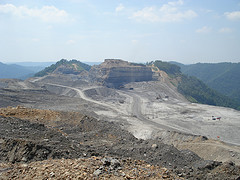
After occupying Gov. Steve Beshear’s office for the weekend, the sit-in protesters have galvanized coalfield residents and clean energy advocates across the nation to revamp the movement to end the 40-year nightmare of mountaintop removal once and for all.
In a joint statement, the Kentucky Rising activists declared: “We find it unacceptable for an elected official to sue a federal agency with taxpayer dollars on behalf of a multi-billion dollar industry that is responsible for poisoning the land, water, and people of Appalachia.”
“It’s disappointing that Gov. Beshear is choosing to play election-year politics with the lives and livelihoods of eastern Kentuckians,” the group said in a joint statement. “Political courage is rare nowadays, and sadly appears to be absent from our Governor’s Mansion. We continue to call on him to engage in a sincere, public dialogue about ending mountaintop removal and beginning a program of economic renewal for our miners and mountain communities.”
The protesters have been staying in the office since talks between them and the governor came to a stalemate on Friday afternoon, when Gov. Beshear finally agreed to meet with them after initially refusing to do so that morning. After repeated requests from group members, he pledged to travel to eastern Kentucky and inspect damage caused by mountaintop removal mining. Despite this, Gov. Beshear continued to express his steadfast support for both mountaintop removal and the coal industry.
A live stream of the sit-in at the governor’s office can be seen here.
Mardi Gras: Made in China screening 2/17
We are a couple of weeks away from Mardi Gras, also known as Fat Tuesday. If you are in New Orleans or right here in West Michigan you are likely to see people wearing bead necklaces.

Like many things we do in our consumer culture, most of us probably don’t know where these beaded necklaces come from and who makes them. This is one of the questions that the directors of Mardi Gras: Made in China are asking. The film does what many documentaries on globalization fail to do…..they get us to think about where the products we consume come from.
Mardi Gras: Made in China presents their case, not in a moralizing way, but in a creative and humanizing fashion. Viewers are first taken to a traditional Mardi Gras scene on the streets of New Orleans. The camera crew films people celebrating and then asks them if they know where the beads they are wearing come from. Everyone says that they don’t and then the film cuts to China, where we meet the young women who work long hours for little pay to thread the necklaces many of us wear.
In addition, the filmmakers show the young Chinese women how the product they are making is used in places like New Orleans. Their reaction is one of astonishment, since these workers had no idea what the Mardi Gras beads were used for.
This is what makes Mardi Gras: Made in China such a powerful film, in that they not only expose the exploitative realities of the globalized economy, they frame it in the context of cultural differences.
The film will be screened this Thursday, February 17, 7pm at the IATSE Labor Hall located at 931 Bridge St. NW in Grand Rapids. The film is hosted by the Grand Rapids branch of the IWW and is free and open to the public. A discussion will follow the film.
Watch the trailer:
Reclaiming Radical Black History
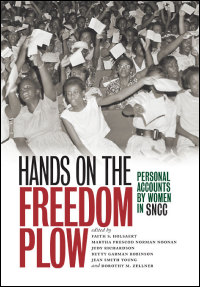
Last month, former SNCC member Judy Richardson, spoke at GVSU about her efforts to keep alive radical Black history.
Richardson who in the past few years has been involved in two projects that seeks to tell stories that have either been forgotten or suppressed. One project was to collect the stories of Black women who were involved in the Student Nonviolent Coordinating Committee. Richardson was one of several women who put these stories into a book entitled Hands on the Freedom Plough: Personal Accounts by Women in SNCC.
A second project Richardson was involved in was the production of the documentary Scarred Justice: The Orangeburg Massacre 1968. This film tells the story about Black student organizing in South Carolina in 1968. Students were confronting some segregationist policies in the community where the university was located. The situation escalated and members of the National Guard and local police opened fire on the crowd of students, killing 3 and wounding another 28.
 When Richardson told this story to the GVSU audience last month, she asked the crowd of several hundred how many people had heard about this incident of state repression. Only a few people raised their hands and several people asked during the Q&A how this story was not more widely known. Richardson said that she believed that much of it has to do with who gets to tell history in this country.
This last point about who gets to tell history was one of the motivating factors for Howard Zinn to write A People’s History of the United States. And the good news is that there are growing efforts to tell and re-tell history that has been suppressed. In fact, later this month former members of the League of Revolutionary Black Workers will be speaking in Grand Rapids.
The IWW, the Bloom Collective and IATSE have all teamed up to host an event on February 25th that will feature the documentary film Finally Got the News, followed by a discussion with some of the former members of the League of Revolutionary Black Workers.
Radical Black Historian Manning Marable says of the League, “Although most histories of the Civil Rights and Black Power movements give greater attention to [other groups]… the League [of Revolutionary Black Workers] was in many respects the most significant expression of black radical thought and activism in the 1960s. The League took the impetus for Black Power and translated it into a fighting program focusing on industrial workers.”
 For more background information on the League, click here.
League of Revolutionary Black Workers Event
Friday, February 25
6pm – 9pm
Kent-Ionia Labor Council
918 Benjamin NE
This event is free and open to the public.
Obama announces wireless plan in Northern Michigan, gives away more of the public commons
Yesterday, US President Barack Obama was in Marquette, Michigan to promote his new plan to “create jobs” by expanding high-speed wireless to more of the country.
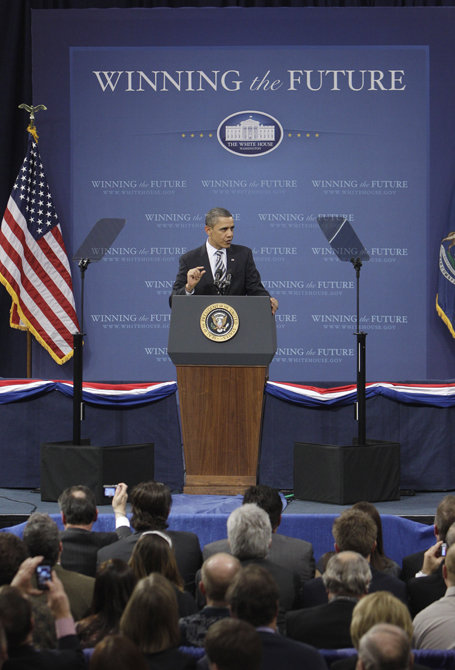 An Associated Press story stated, “Obama’s wireless plan involves nearly doubling the space available on the airwaves for wireless high-speed Internet traffic to keep up with ever-growing demand. This would be accomplished in part by auctioning off space on the radio spectrum to commercial wireless carriers. The White House says this would raise nearly $30 billion over 10 years, and the money could be spent on initiatives that include $10 billion to develop a national broadband network for public safety agencies and $5 billion for infrastructure to help rural areas access high-speed wireless.”
So it seems that the President wants to give away more of the public spectrum to large private media companies who have a long track record of not operating in the public interest. If there is lots of available public spectrum, why not just make that part of the Commons and allow the public to use it?
The national media policy organization Free Press responded to the President’s announcement:
“While we are pleased to see the president focusing on our nation’s broadband challenges, we are concerned that the public interest is being overlooked in this proposal to sell more of our public airwaves to wireless companies like AT&T and Verizon. These industry giants are already building out their networks and expanding coverage, and they don’t need a handout from the federal government to achieve the president’s goals.
Further, the president’s proposal does not contain any policies that would encourage people to adopt broadband. Studies have shown that if you build it, they may not come. According to the FCC’s own data, 98 percent of households in the United States already have access to wireless broadband service, while less than one-third subscribe to it.
If Americans are being asked to give up more of our public airwaves to private industry, we should see a real benefit. Our nation is falling behind the rest of the world in broadband quality and adoption, symptoms of the woeful state of competition in our communications markets. Unfortunately, the president’s plan fails to address these very real problems and offers no policies that would create real competition, spur innovation and help Americans get connected.
If we don’t seriously consider policies that would help Americans get online, we won’t be winning the future. We’ll be selling it short. And we’ll be locking in the uncompetitive wireless market and stranding tens of millions of Americans on the wrong side of the digital divide.”
Just the most recent example of the administration’s subservience to private corporations instead of serving the public interest.
Tanks Used in Egypt Made in the USA
(This article is re-posted from OpenSecrets.)
 Foreign Policy magazine recently revealed how Sen. John McCain (R-Ariz.) and ex-Sen. Russ Feingold (D-Wis.) introduced a resolution last July to press Egyptian President Hosni Mubarak toward more free and fair elections. After a series of meetings between lobbyists representing the government of Egypt and key U.S. senators, the bill was stalled, and then in November, two anonymous Democratic senators placed secret holds on the resolution and ended its chances of moving forward to a vote.
A number of articles have emerged over Egypt’s lobbying efforts in the United States, showing the complexities and ironies of foreign policy. Let’s go through the process.
Egypt pays the lobbying firm PLM $1.1 million a year to secure and enhance the “interests of Egypt in the United States in the political, economic, military and other fields” according to a 2007 contract. PLM consists of Tony Podesta, president of the Podesta Group and brother of former Bill Clinton chief of staff; former representative Bob Livingston (R-La.); and former representative Toby Moffett (D-Conn.).
Every year, the United States sends more than $1 billion to Egypt and much of it comes back in military contracts. For example, the M1A1 battle tanks seen in Tahrir Square are built in America by General Dynamics, a defense contractor that is also Podesta’s lobbying client. According to an NPR interview with Sunlight Foundation‘s Bill Allison, Sen. Roger Wicker (R-Miss.) was active in preventing the aforementioned resolution from moving forward but also benefited from an $800 million deal with Egypt to build four fast missile ships in his state.
In a statement to Politico, Wicker makes it clear that he did not oppose the resolution and was not happy with the process, saying, “[I] wanted to make sure that it was given due diligence, and I made suggestions to improve the resolution.” A Senate Republican aide said the shipbuilding contract never came up in his discussions with Wicker.
New Media We Recommend
Below is a list of new materials that we have read/watched in recent weeks. The comments are not a “review” of the material, instead sort of an endorsement of ideas and investigations that can provide solid analysis and even inspiration in the struggle for change. All these books are available at The Bloom Collective, so check them out and stimulate your mind.

Beyond the Fields: Cesar Chavez, The UFW, and the Struggle for Justice in the 21st Century, by Randy Shaw – Beyond the Fields not only is an excellent investigation into the tactics and strategies of the United Farm Workers (UFW), it provides some interesting analysis on the impact that the farmworker organizing had on other social justice struggles. After Shaw provides readers with an organizational history of the UAW he follows the work of organizers who got their start in farmworker organizing and ended up being involved in other civil rights struggles, electoral campaigns and the current immigration rights movement. The book provides numerous examples of how past movements can influence current movements.

Taking on the Trust: The Epic Battle of Ida Tarbell and John D. Rockefeller, by Steve Weinberg – Taking on the Trust should be required reading for anyone who claims to practice journalism. What Weinberg provides for the reader is a compelling account of how one of the most powerful men every in the history of the US was challenged by a woman who refused to submit to the traditional gender roles of her day. Ida Tarbel practices the kind of journalism we rarely see today, journalism that takes on power. Weinberg also talks about the controlled rage style of journalism that Tarbel practiced. Her writing on the Standard Oil Company led to the federal government’s dismantling of the Rockefeller oil monopoly.
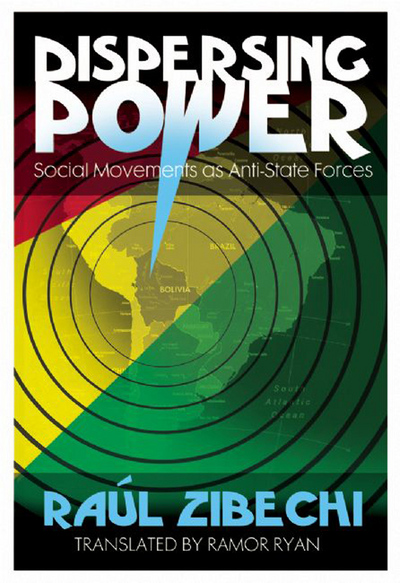
Dispersing Power: Social Movements as Anti-State Forces, by Raul Zibechi – This, Raúl Zibechi’s first book translated into English, is an historical analysis of social struggles in Bolivia and the forms of community power instituted by that country’s indigenous Aymara. Dispersing Power, like the movements it describes, explores new ways of doing politics beyond the state, gracefully mapping the “how” of revolution, offering valuable lessons to activists and new theoretical frameworks for understanding how social movements can and do operate independently of state-centered models for social change. An important book for anyone who wants to explore how social movements outside of the US interact with political parties and electoral politics.

Citizen King (DVD) – The story begins on the steps of the Lincoln Memorial in August 1963, when a 34-year-old preacher galvanized millions with his dream for an America free of racism. It comes to a bloody end almost five years later, on a motel balcony in Memphis, Tennessee. Citizen King pushes past the myths that have obscured King’s story to reclaim the history of a people’s leader. Using the personal recollections, diaries, letters, and eyewitness accounts of friends, family, journalists, law enforcement officers and historians, this film brings fresh insights to King’s difficult journey, his charismatic — if at times flawed — leadership, and his truly remarkable impact.

