Levin and other US Senators targeted with US Military Psy-Ops Effort in Afghanistan
On Monday, we reported on a talk given by Michigan Senator Carl Levin based on his 2-day trip to Afghanistan in January. Levin said that the US military occupation of Afghanistan was showing signs of progress.

Levin did mention in his talk that he met with US military leaders and some Michigan combat troops, but what Levin did not mention and probably did not know is that the US military was engaging on a psychological warfare campaign on him and other visiting US officials who came to Afghanistan for an update on the war.
According to an article by Michael Hastings in Rolling Stone magazine Lt. Gen. William Caldwell, a three-star general in charge of training Afghan troops, was charged with the psy-ops campaign. The Rolling Stone articles states that, “a military cell devoted to what is known as “information operations” at Camp Eggers in Kabul was repeatedly pressured to target visiting senators and other VIPs who met with Caldwell.”
It appears that the US military is becoming more desperate in its attempt to win public opinion on the 10-year US occupation of Afghanistan. Rolling Stone Reporter Michael Hasting notes, “Those singled out in the campaign included senators John McCain, Joe Lieberman, Jack Reed, Al Franken and Carl Levin; Rep. Steve Israel of the House Appropriations Committee; Adm. Mike Mullen of the Joint Chiefs of Staff; the Czech ambassador to Afghanistan; the German interior minister, and a host of influential think-tank analysts.”
This revelation certainly sheds light on the message that Levin delivered to people on Monday at the World Affairs Council hosted event and should give all of us additional cause for concern about what is really happening in the costly and brutal US occupation of Afghanistan.
Private Sector Group Wants to Change Local Government
This morning at the Kent County Commission meeting, the One Kent Coalition presented a proposal to transform the area from a collection of communities into a “powerful metropolitan body.”

These were the words of Nyal Deems, the main spokesperson for the One Kent Coalition. Deems said that the group is made up of private sector individuals who want to foster more economic development and make Kent County more competitive in the global market.
Deems told the County Commissioners, “it is time to update our governmental structure and to foster economic development. We have educational institutions, business leaders, philanthropic support, the medical mile and even Chicago is trying to mimic ArtPrize. But this isn’t enough.”
Deems, a former mayor of East Grand Rapids and a practicing lawyer cited several local elected officials who have suggested that local governments consolidate, officials like County Commissioners Roger Morgan and Sandy Parish, as well as Grand Rapids Mayor George Heartwell. “Corporate leadership is key in helping government leadership act accordingly. If Grand Rapids would merge with EGR, we would move from about 89th to about 25th in the country in terms of city size, which would give us more clout.”
The One Kent Coalition spokesperson then said the group has been working on a draft for proposed legislation that they would like the state legislature to adopt this year, which would allow for a ballot initiative to be put before Kent County residents sometime in 2012.
The responses from the County Commission were mixed, with Roger Morgan first saying that he “is always in favor of enhancing the private sector.” Morgan did say he had concerns about how this is worked out. He thought that consolidation of the core 6 cities is a step in the right direction, but there would need to be an inter-governmental agreement before moving forward.
Commissioner Saalfield raised concerns about drafted legislation and asked who would pay the taxes for the legislation and how will it effect services.
Commissioner Carol Hennessy said she also looked at other communities who have done similar forms of consolidation and cites a study from New York on governmental consolidation that did not work well. Hennessey also expressed concern that the One Kent Coalition folks were using phrases like corporate leadership and entrepreneurship and she wondered if this focus would detract from government delivery of services.

Commissioner Wawee asked where the funds will come from to make this consolidation happen to create a metropolitan government. Deems said they have raised some funds amongst themselves and mentioned that their group had talked to the Governor’s office, which might have money set aside in a pool to help.
This comment from Deems raised other questions and concerns from a few commissioners about the issue of transparency. Commissioner Koorndyk wanted to know who was part of the One Kent Coalition and if Deems could provide them with a list. Deems said that he could do that and this would relieve him from have to list the members at the meeting.
Commissioner Talen also raised the issue of transparency. He asked if there would be complete transparency from here on out, in terms of who is involved with the One Kent Coalition and where the money is coming from that they have raised. Deems said the group is not that formal, doesn’t meet every week and only came up with the drafted proposal near the end of 2010. This is of course did not answer Commissioner Talen’s question about the group’s commitment to transparency.

Grand Rapids Press reporter Jim Harger noted in a story yesterday that, “The West Michigan Policy Forum, a political action committee formed by the Greater Grand Rapids Chamber of Commerce, will be assigned the task of developing the enabling legislation that will lead to One Kent.” Harger also wrote that local lobbyist Jared Rodriguez who has done lobby work for the GR Chamber of Commerce and now works for the West Michigan Policy Forum will be the person who will lobby the state legislature on pushing this proposal forward.
In a story from this morning, Jim Harger with the GR Press does list who is part of the One Kent Coalition:
• Tom Butcher, Grand Valley State University
* Nyal Deems, former East Grand Rapids mayor
• Betsy DeVos, former state GOP chair
• Dick DeVos. former GOP gubernatorial candidate
• Jeanne Englehart, Greater Grand Rapids Chamber of Commerce
• David Frey, Grand Action
• Andy Guy, Wondergem & Associates
• Kurt Kimball, former Grand Rapids City Manager
• David Leonard, Spectrum Health Corp.
• Greg McNeilly, Windquest Corp.
• Marge Potter, former Kent County Commissioner
• Jared Rodriguez, West Michigan Policy Forum
• Milt Rohwer, Frey Foundation
• Peter Secchia, former U.S. ambassador to Italy
• Peter Wege, philanthropist
• Kate Pew Wolters, Steelcase Foundation
• Tim Wondergem, Wondergem & Associates
So, it seems that the same crowd of private business sectors that are part of the Chamber and the West Michigan Policy Forum are behind the One Kent Coalition. This should raise concerns for anyone who doesn’t want to give more power to the private business sector which has made clear that they want to eliminate the Michigan business tax, make Michigan a Right to Work state and make government work in their interests. This doesn’t sound like anything that would enhance democracy, but it does sound like it will benefit private power.
New Media We Recommend
Below is a list of new materials that we have read/watched in recent weeks. The comments are not a “review” of the material, instead sort of an endorsement of ideas and investigations that can provide solid analysis and even inspiration in the struggle for change. All these books are available at The Bloom Collective, so check them out and stimulate your mind.

Exile & Pride: Disability, Queerness and Liberation, by Eli Clare – Eli Clare’s collection of essays was both a refreshing and challenging adventure. Eli forces the reader to come to terms with the limitations of identity around gender, sexual orientation and physical ability. Eli challenges our use of words, our perceptions and our static categorization of how we name people. In addition, the author tackles race, class and environmental degradation in ways that make most attempts at inter-sectionality seem quite sophomoric. Exile & Pride is one of the South End Press Classics that has been revised since its original release in 1999.

Conversations with Terrorists: Middle East Leaders on Politics, Violence, and Empire, by Reese Erlich – Reese Erlich has been doing investigative journalism for several decades now and each of his books reflect that style of writing. This new book is based on interviews with various political leaders in the Middles East over the past few years. With each chapter Erlich attempts to construct vibrant commentary on what leaders of groups like Hamas, the Taliban and Iran’s democracy movement think about not only the struggles in their respective countries, but how they view the US and other regional powers. Erlich also tries to re-frame our understanding of terrorism and what constitutes terrorism. This collection of essays is an important contribution for those wanting to come to terms with US policy in the Middle East.

Guantanamo: Why the Illegal US Base Should Be Returned to Cuba, by Fidel Castro – While many people who voted for Obama are disappointed that he did not keep his promise to discontinue using the US military base in Guantanamo, Cuba as a place of detention and torture for combatants in the “War on Terror,” Fidel Castro argues us that the land that the base inhabits should be returned to the Cuban people. Guantanamo is a well-documented attempt to argue the historical and legal reasons why the US military base that has inhabited that land for over a century should be closed. Castro teaches us a history lesson on how the land known as Guantanamo was appropriated by the US after they undermined the Cuban independence struggle from Spain at the end of the 19th century. The book also includes numerous source documents and short commentary from other Cuban historians.

Colorblind: The Rise of Post-Racial Politics and the Retreat from Racial Equity (DVD) – This is a taped lecture by well-known anti-racist writer/activist Tim Wise from early 2010 and is based on his latest book Colorblind. In this lecture Wise confronts the White Liberal and Progressive community who think that the election of Barack Obama has catapulted us into a post-racial era. Wise, who uses biting humor and well sourced data, exposes the White Supremacist nature of US politics and what it really means for people of color, particularly Blacks and Latinos. This DVD is both challenging and inspiring and should be required viewing for anyone who claims to favor racial justice.
Celebrating a Black Radical – W.E.B. Du Bois

On this day in 1868, William E.B. Du Bois was born in Great Barrington, Massachusetts. The son of a Haitian landowner and a Dutch-African mother, he became an important American sociologist and intellectual leader, one of the first to study and address racism from every possible angle—through scholarship about race’s impact on the American culture, through an examination of the potential of integration, through a rejection of differences between the races, as a political issue, and as a pathway to cultural separatism.
The first Black American to earn a Ph.D. from Harvard University, Du Bois became a professor, founding the Department of Social Work at Atlanta University and also teaching at other colleges, including the New School in Greenwich Village. He was the author of thousands of articles and 22 books, including The Souls of Black Folk, John Brown, Black Reconstruction, and The Negro. His theory that African-American issues and the struggle for racial equality had made an indelible mark on the culture and politics of the United States was initially rejected and mocked. Du Bois fired back, writing, “The problem of the twentieth century is the problem of the color line.”
Also discredited at the time was Du Bois’ visionary exploration of the rise of crime among Blacks in the South, which he connected to their struggle to find a footing in a largely White society. Du Bois wrote, “[The] appearance of crime among the southern Negroes is a symptom of wrong social conditions–of a stress of life greater than a large part of the community can bear…To be a poor man is hard, but to be a poor race in a land of dollars is the very bottom of hardships.”
Part of what made Du Bois a target for heavy criticism among reactionary Whites was his attitude about his race. While Booker T. Washington encouraged Blacks to accept discrimination, be humble, and to take a back seat until Whites were ready to give Blacks a full place in society. Du Bois took the exact opposite view. He felt that Blacks should question Whites on every aspect of their attitudes about race, and continually challenge their actions and their sense of entitlement and authority. Only then could society hope to begin to break down to what Du Bois saw as the institutionalized and entrenched racism in American culture.

In 1900, Du Bois was one of the leaders of the first Pan-African Conference, held in London, and worked on four more conferences through 1927. In 1909, Du Bois became one of the founders of the NAACP and its publications director, although later his political views became too radical for the organization. During this same year he started his crusade against eugenics, declaring there were no inherent difference between people of different races. He embraced Communism and attempted to create a Communist wing of the New York State Legislature.
Du Bois was indicted in 1951 as “an unregistered agent for a foreign power.” A federal judge later ordered his acquittal, but his political views were further used in attempts to discredit him and his work among mainstream scholars. Martin Luther King addressed this hypocrisy head-on in a speech he made about Du Bois just four days before his own assasination:
We cannot talk of Dr. Du Bois without recognizing that he was a radical all of his life. Some people would like to ignore the fact that he was a Communist in his later years…In contemporary life, the English speaking world has no difficulty with the fact that Sean O’Casey was a literary giant of the twentieth century and a Communist, or that Pablo Neruda is generally considered the greatest living poet though he also served in the Chilean Senate as a Communist. It is time to cease muting the fact that Dr. Du Bois was a genius and chose to be a Communist.
In 1961, Du Bois was denied a passport to travel with his wife to Ghana. By this time, he had become completely disillusioned with the United States. Du Bois rejected this act of state repression by openly becoming a member of the Communist Party, claiming Ghanaian citizen, and traveling to Accra. He never returned to the U.S., dying in Accra two years later in 1963.
In his prose-poem “Credo,” Du Bois described his beliefs about racism and equality in these two beautiful passages:
I believe in the Devil and his angels, who wantonly work to narrow the opportunity of struggling human beings, especially if they be black, who spit in the faces of the fallen, strike them that cannot strike again, believe the worst and work to prove it, hating the image which their Maker stamped on a brother’s soul…
I believe in Liberty for all men; the space to stretch their arms and their souls; the right to breathe and the right to vote, the freedom to choose their friends, enjoy the sunshine and ride on the railroads, uncursed by color; thinking, dreaming, working as they will in a kingdom of God and love.
Levin talks up progress in Afghanistan, omits serious US war crimes

Earlier today Michigan Senator Carl Levin spoke on the GRCC campus about the current US policy in Afghanistan at an event organized by the World Affairs Council of Western Michigan. Just over 100 people were in attendance, with the audience being made up of World Affairs Council members, GRCC students and the general community.
Senator Levin only spoke for 20 minutes on the topic of Afghanistan and essentially reiterated the same comments he has posted on his website from a statement he made after a 2-day trip to Afghanistan in January if this year.
Levin’s main point of the short presentation was that there are signs of progress as the “regaining of former Taliban strongholds in Helmand and Kandahar” and the “increased confidence of the Afghani people in the Coalition forces and the Afghan National Army (ANA).”
Levin said he toured an area where some of the heaviest fight happened last year and where the Taliban have been defeated. He also emphasized that these areas are being “secured” by the Afghan security forces, which demonstrates the growing confidence that the Afghani people have in this new army.
However, this “evidence” that Senator Levin provided has been critiqued and challenged from numerous sources. First, the progress or confidence of the Afghan National Army and police forces that the US and Coalition forces have been training has come under question by a major study from the Afghanistan Analysts Network. This study contends that the Afghan security forces often fight against each other, attack civilians and are often infiltrated by Taliban insurgents who gain access to weapons and intelligence.

Another problem with Levin’s presentation of the so-called progress in Afghanistan is that he framed it as a debate between the Afghanis who support the Taliban and the Afghanis who support the US/NATO occupation. This leaves out a whole sector of the population that does not support either side in this war, people who are against both the Taliban and the US/NATO occupation. Groups like the Afghan Women’s Mission and RAWA have been organizing against the Taliban since they took power in the mid-90s and they have been consistent critics of the US/NATO occupation.
Another study, which challenges Senator Levin’s assertion that the US is making “progress” in Afghanistan due to the growth of the Afghan National Army, was released by the Afghanistan NGO Safety Office (ANSO). This study states that, “Foreign military assertions that security in Afghanistan is improving are intended to sway Western public opinion ahead of a troop withdrawal and do not reflect the reality on the ground.”
The ANSO report further states, “militant attacks were up 64 percent last year compared with 2009, and an average of 33 incidents had taken place every day. While violence may have decreased in some areas, it had dramatically increased in others.”
Another point that Levin emphasized was the President’s commitment to reduce US troop levels starting this July. “Afghan people have greater confidence in the Afghan security forces in defeating the Taliban and protecting the people as well as finding roadside bombs and disarming them,” said Levin. However, Levin provided no evidence or sources to support both the claims that the Afghani people have confidence in the Afghan Army or that they are providing security other than antidotal stories of Afghanis having picnics in some parts of the country.
Levin did admit that the central government in Kabul is failing the Afghan people, mostly because of their involvement in corruption. However, Levin did not address the inherent contradiction in this fact with the consistent support of the Karzai government even after the last elections were identified as fraudulent.
After Levin finished his presentation he fielded questions from the audience. The first question that dealt with Afghanistan was around the issue of oversight of US funds going to Afghanistan for reconstruction. Levin said we have to do better with oversight, since a lot of our funds have worked against us and not for us. However, Levin failed to mention the amount of US funding for private security forces and other private contractors and the level of corruption that exists. Levin is very familiar with this reality since the Senate Armed Services Committee released a major report in October 2010 on the funding abuses with private contractors.
One questioner asked if the July 2011 data for US beginning troop withdraw could just allow the Taliban to wait it out. Levin didn’t think this was the case since there will be more Afghan Security forces by then. He went on to say, “the Afghans are fighters, they kicked out Soviets.”

It is true that some Afghanis fought against the Soviet occupation in the 1980s, but the main forces fighting the Soviet Army was the Mujehideen, which was made up of Afghanis as well as people from other countries who embraced a more militant form of Islam. The Mujehideen received billions in US aid, but they were some of the most virulently anti-women sectors of Afghan Society, according to Sonali Kolhatkar’s book Bleeding Afghanistan. This is an important point since Senator Levin stated that the Taliban hate women. It is true that treatment of women under the Taliban was brutal, but it ignores the legacy of the US support of the Mujehideen’s treatment of women and the fact that the Karzai government has also perpetrated serious crimes against Afghani women.
Levin also failed to include in his comments the fact that in 2010 more US troops and more Afghani civilians died than in any previous year since the 2001 US occupation began. He also failed to mention the increased US Drones attacks against civilians in both Afghanistan and Pakistan, the ongoing use of torture at the US military base in Bagram and the increased construction of US military installations throughout Afghanistan.
If one were to take into consideration these factors and weigh them against the comments of Senator Levin one would be hard pressed to find “progress,” at least progress that would benefit the people of Afghanistan.
SB-1405 Crumples Under Public Protest

In its ongoing witch hunt against undocumented workers, the Arizona State Legislature introduced another immigration-related bill this month: SB-1405. This bill would require hospital admissions staff to confirm that any person being admitted for care is a U.S. citizen. If you fail to produce the proper documentation (such as your birth certificate—something you’re sure to have on you when you get hit by a bus—or your U.S. passport, or a certificate of naturalization), then an immigrations officer must be contacted.
If you are undocumented, you can get emergency care under SB-1405, but right after that, you will be arrested and deported. If you tried to get admitted to the hospital for some other reason—such as an operation or outpatient procedure—you proceed directly to jail and the deportation process; medical treatment would be forbidden by the new law.
If the hospital admissions staff or an emergency room doctor or nurse does not get a hold of ICE authorities, he or she will be arrested as well.
In explaining his rationalization for this legislation, Senator President Russell Pearce, father of SB-1040, insisted that he was protecting legal citizens, stating, “I get calls from doctors and nurses every day that work in the emergency room, talking about the abuse, the millions of dollars spent for folks who come in for pregnancy tests, sniffles…they [immigrants] use emergency room services as their primary care. When do we stand up for the taxpayers?…Quit inviting people over the border. We give them free stuff, free medical…enough is enough.”
 This is a fascinating claim, but one that doesn’t stand up to statistics. Although in Russell Pearce’s world, it seems only immigrants go to the emergency room rather than to primary care doctors, the fact is that most poor people, citizens or not, do the same. In a study done in the 1990s, folks using ER care because they had no alternative tended to have annual incomes of $10,000 or less (68 percent) and were usually unemployed (62.6 percent). There was no one predominant racial group that used ER facilities more than the others in this way; the conclusion was “members of racial and ethnic minority groups and those of low socioeconomic status often depend upon ERs as a regular source of care,” and cited Blacks and Latino/as as equally frequent visitors to emergency rooms. Blaming undocumented immigrants for over-stressed ER conditions in this country is ridiculous.
Among those who definitely weren’t amused were Arizona doctors’ and nurses’ associations. Dr. Lucas Restrepo of Phoenix went as far as the prestigious New England Journal of Medicine to publish his colleagues’ concerns. First and foremost, he stated it was unacceptable to criminalize doctors and nurses for practicing in a medially ethical fashion and for honoring the tradition of protecting patients, both from injury and from harm by others. Restrepo wrote, “This legislation, if unchallenged, will force health care providers to choose between the dignity of their profession and the indignity of violating the law.”
Arizona medical professsionals were even more vocal about the fact that driving people away from medical care for fear of deportation would create a health care crisis worse than the one already existing in the state. And hospital administrators objected to the idea of forcing their employees to act as unofficial immigration officers engaged in what amounted to a perpetual sting operation.
 Senator Pearce may have anticipated some backlash from the medical world, but nothing like the chorus of objections that poured into the media as soon as the bill was announced. In addition, there was another, more surprising group that immediately rose up to protest the bill: the Arizona church leaders. Reverend Carmen Guerrero, who last year rallied ministers and priests across the country to protest SB-1070, was already organized to decry SB-1405 as soon as it was launched. “[A law] that prevents a person from seeking medical help in any hospital is cruel, and I will not believe that God is not taking these injustices into account,” she said to the press.
The unified front of medical experts and church leaders, all hitting the media at the same time, worked. Legislators backed down, and a preliminary vote count showed that SB-1405 did not have enough support to pass. The bill slunk back into committee for rewriting, tabling, or eventual rejection.
One can only hope that when a bill like SB-1405 comes to Michigan—as it undoubtedly will—that our community, immigration advocates, and medical professionals put up as strong a protest as the one launched last week in Arizona.
Aquinas College cancels Out Poet/Activist Stacey Ann Chin appearance
Yesterday, GRIID received an anonymous document from someone connected to Aquinas College. The document expresses concerns about a growing pattern of censorship at Aquinas College.

The campus was scheduled to host out poet/activist Stacey Ann Chin on February 24, but her presentation was cancelled. Based on the anonymous letter is appears that Chin was cancelled due to her being an out Lesbian activist. This is consistent with previous speakers who were either from the LGBTQ community or who were going to speak on LGBTQ issues and had their talks cancelled.
In 2008, Dr. John Corvino, an LGBTQ rights activist was scheduled to give a lecture at Aquinas College. The lecture was cancelled and students and community activists found another venue for Corvino to speak.
In March of 2009, Aquinas would not allow the feminist performance of The Vagina Monologues to take place on campus. As a response students and artists organized The Jane Doe Project as a way of challenging silence around violence against women.
This writer contacted the President’s office at Aquinas College, the assistant to the President and the Provost’s office to get a response to why Stacey Ann Chin’s performance was cancelled. None of those people were available and I was forced to leave a voice mail message. I also contact the Women’s Studies Center to see what they might know and was told that I should contact the President’s office.
For people who are concerned about free speech and inclusivity we would encourage you to contact the President’s office at Aquinas by calling 632-2881 or sending an E-mail to sommejan@aquinas.edu. The Anonymous Letter we received can be viewed by clicking here.
There is also a video that the Anonymous Letter included, which is worth looking at.
A New American Workers Movement Has Begun
(This article by Dan La Botz is re-posted from ZNet.)

Thousands of workers demonstrated at the state capital in Madison, Wisconsin on Feb. 15 and 16 to protest plans by that state’s Republican Governor Scott Walker to take away the state workers’ union rights. Walker, cleverly attempted to divide the public workers by excluding police and firefighters from his anti-union law, and the media have worked to divide public employees against private sector workers. Yet, both firemen and private sector workers showed up at the statehouse to join public workers of all sorts in what has been one of the largest workers demonstrations in the United States in decades. Only California has seen demonstrations as large as these in recent years.
Many demonstrators in Madison, taking a clue from the rebellions against authoritarian and anti-worker governments that are sweeping the Middle East, carried signs saying, “Let’s negotiate like they do in Egypt.” While the situation in Wisconsin is hardly comparable to the revolution in the Arab world, what we are witnessing is the beginning of a new American workers movement. Because this movement is so different than what many expected, it may take us by surprise.
Not What We Expected
Many of us, myself included, had for years expected a rank-and-file workers movement to arise out of shop floor struggles in industrial workplaces, out of the fight for union democracy, and out of the process of working class struggle against the employers. While that perspective still has much validity, something different is happening. The new labor movement that is arising does not start in the industrial working class (though it will get there soon enough), it does not focus on shop floor issues (though they will no doubt be taken up shortly), it is not primarily motivated by a desire for unions democracy (though it will have to fight for union democracy to push forward the leaders it needs). And it does not, as so many American labor movements of the past did remain confined to the economic class struggle (though that too will accelerate). It is from the beginning an inherently labor political movement.
The new movement that is arising does not focus on the usual issues of collective bargaining—working conditions, wages, and benefits—but focuses rather on the political and programmatic issues usually take up by political parties: the very right of workers to bargaining collective, the state budget priorities, and the tax system which funds the budget. The new labor movement, because it has begun in the public sector, will not be so much about the process of class struggle as it will be about how class struggle finds a voice through political program. This will have tremendous implications for the traditional relations between the organized labor movement and the Democratic Party, especially since the Democrats, from Barack Obama to state governors like Cuomo, are also demanding that public employees give up wages, benefits, conditions and rights.

Not Your Grandfather’s Working Class
We have for decades in this country thought of the working class as being made up of those workers of railroad, mine and mill whose calloused hands produced the material wealth of this nation over 200 years, that is, since the first factories were opened in the Northeast in the 1790s. Industrial workers though have been declining as a percentage of the population since the 1920s and have diminished at an accelerated rate since the 1950s. Since the 1980s the decline of industrial workers as a proportion of the wage earning class has been dramatic.
In the old days, skilled workers, almost all white men, came as immigrants from the countries of Western and Northern Europe, while the unskilled industrial workers were immigrants from the South and East of Europe, whites from Appalachia, and African Americans from the South’s plantations. While most of those industrial workers were male, millions of women also toiled in textile mills, garment shops, and other workplaces. Those workers created the Knight of Labor in 1869, American Federation of Labor (AFL) in the 1886, the Industrial Workers of the World (IWW) in 1905, and finally in the great labor upsurge of the 1930s won the legal right to organize with the Wagner Act of 1935 and built the Congress of Industrial Unions (CIO).
The Rise of the Public Employees
The post-war period saw the expansion of government as millions found jobs not only in streets and sanitation, the water works, and as teachers, but also as social workers, public health nurses, and college professors. Another labor upsurge in the 1960s and 1970s led to the establishment and rapid growth of public employee unions of all sorts: the American Federation of Teachers (AFT), the National Education Association (NEA), the American Federation of State County and Municipal Employees (AFSCME), and the American Federation of Government Employees (AFGE). These public workers were far more racially diverse than many of the private sector unions, made up white, African American, and Latino workers, of men and many women.
Public employees in the 1960s and 70s won the rights to union recognition, collective bargaining, and the strike through hundreds of strikes, large and small during those two decades. The newspapers front page often carried the photo of some teacher or social worker, nurse or secretary, sanitation worker or park employee being carried off to jail for striking with the union. The most famous of these strikes, perhaps, was the AFSCME Local 1733 strike by African American sanitation workers of Memphis, Tennessee. Dr. Martin Luther King, Jr., the leader of the civil rights movement, was there to help those workers with their strike, when he was assassinated.
The Unions at a Turning Point

Today we in the labor movement are at a turning point. American employers, political parties, and government at all levels have decided that the time has come to move against what is the last bulwark of American unionism: the public employee unions. As of the latest count by the Bureau of Labor Statistics, only 11.9 percent of all workers are in unions, and only 6.9 percent in the private sector. In the public sector, however, public employee unions represent some 36.2 percent of all workers, and the number is even somewhat higher among teachers. America’s political and economic elite are looking for the final solution to the labor problem—and we are not getting on the trains and going to the camps.
Public employees, now finding themselves now on the frontline of the labor movement, are fighting back from one end of the country to the other and nowhere at the moment so dramatically as in Madison, Wisconsin. Just as the Arab revolution spread rapidly from Tunisia to Egypt, so we can expect to see this public worker movement spread from one state to another as it resists Republican and Democratic party governors and local officials who want to strip workers of their rights.
What Sort of a Labor Movement Can We Expect?
What does labor history teach us about labor movements? First, we know that when masses of workers go into motion, as they have now begun to do, political consciousness grows and changes rapidly. Workers who today simply fight to defend their union rights will, if they succeed in resisting the right’s attempt to destroy them, go on to fight to expand not only their rights but to improve their working conditions and standard of living. Most important, workers will fight to expand their power. We are just at the beginning.
Second, when workers discover the strategy and tactics of their movement, those quickly spread to other groups of workers in society. When the rubber workers in Akron, Ohio discovered the sit-down strike in 1936, it quickly spread not only to the auto industry leading to the great strikes of 1937 and 38. Remarkably, the sit-down also spread to such unlikely workers as the “shop girls” of department stores. During the 1950s and early 1960s, African American civil rights activists rediscovered the power of the sit-down, transforming it into the sit-in in lunch counters, bus stations, and other private and public places across the South.
Today public workers in Wisconsin are in such of the strategies and the tactics that can defend their rights, and they are using the mass rally and the camp out at the capital. When the discover or rediscover the strategy and tactics that work, those will spread like wildfire across the country to other public workers—and then jump to the private sector.
The Movement is both Economic and Political
Third, real labor movements ignore the artificial separation between economic and political, taking up either or both as they follow the logic of the struggle. Industrial workers struggles for higher wages in the 1930s became transformed into struggle for the employers’ recognition of the unions and labor legislation granting workers the right to organize. Similarly with public employees in the 1960s whose fight for the right to unions and collective bargaining might flow the other way, to a fight for higher wages. What is today primarily a political fight in Wisconsin, that is to defend the right of public employees to have a labor union, bargain collective and enjoy the right to strike, will inevitably become a struggle for better conditions, higher wages, and health and pension benefits.
Fourth, when a real labor movement arises, that is, a movement not merely of thousands or even tens of thousands, but of millions, it necessarily becomes transformative. Labor union officials who hesitate, who waver, or who knuckle under will soon find themselves challenged by new, younger leaders who will either force those officials to fight or push them aside. Such a movement will change the unions—often by changing the leadership first and sometime by changing the very institutions themselves. Such was the case with the rise of the industrial workers movement in the 1930s which broke the shell of the old AFL to create the new CIO.
A Political Alternative
Fifth, and finally, a new American labor movement of millions will challenge the old political relationship between the unions and the Democratic Party. The unions will fight at first to force the Democratic Party to give up its own conservative budget, tax and labor policies, and failing to do that, will seek another vehicle. Unions may first attempt to change the Democrats by running union candidates in Democratic Party primaries, or they may attempt to take over the state party. Whether the new American labor movement will have the power to put forward a political alternative remains to be seen.
Wisconsin though is famous for its long history of political grouping to the left of the Democratic Party which, from time to time, have shown considerable influence: the Socialist Party held power in Milwaukee into the 1960s, the Farmer-Labor Party was once a power in the state, Progressive Dane (county) thrived a couple of decades ago, and the Wisconsin, Green Party has over a score of elected officials throughout the state. None of these was or is what a workers’ movement needs to achieve real political power, but the presence of such political alternatives is indicative of a more tolerant and experimental attitude in the state. American workers have never in their history succeeded in creating a workers’ party of any power, with the exception of the Socialist Party of the early 20th century.
Today, with the Democrats lowering taxes on the rich, cutting budget, and laying off public employees, we may be in for the kind of confrontation between workers and a pro-business Democratic party that can produce a political alternative. Certainly the struggle over politics and government is built into this contest as it seldom is so directly in the private sector. The task at the moment is to build the fight to defend public services and public employees unions and their rights, but it leads directly to political confrontation.
Corporate Multinationals and Grand Rapids water system

Yesterday, on WGVU radio it was reported that Grand Rapids Mayor George Heartwell is still considering the privatization of the City’s water system.
We have reported in the past that privatization of the City’s water system has been on the table since the fall of 2010 when the Mayor made his first public comment about this issue. The City is still confronted with budgetary issues and continues to consider privatization of the municipal water a way to save money.
In the WGVU radio story Heartwell did clarify where he stands on the matter of privatization by saying, “I have no interest in selling the assets as some other cities have done. I think it’s very important for the city to retain the infrastructure. But I’m very willing to look at privatizing management. If they can manage the costs at a reasonable level and have a profit in doing that, because that’s important for them. I think it’s worth exploring.”
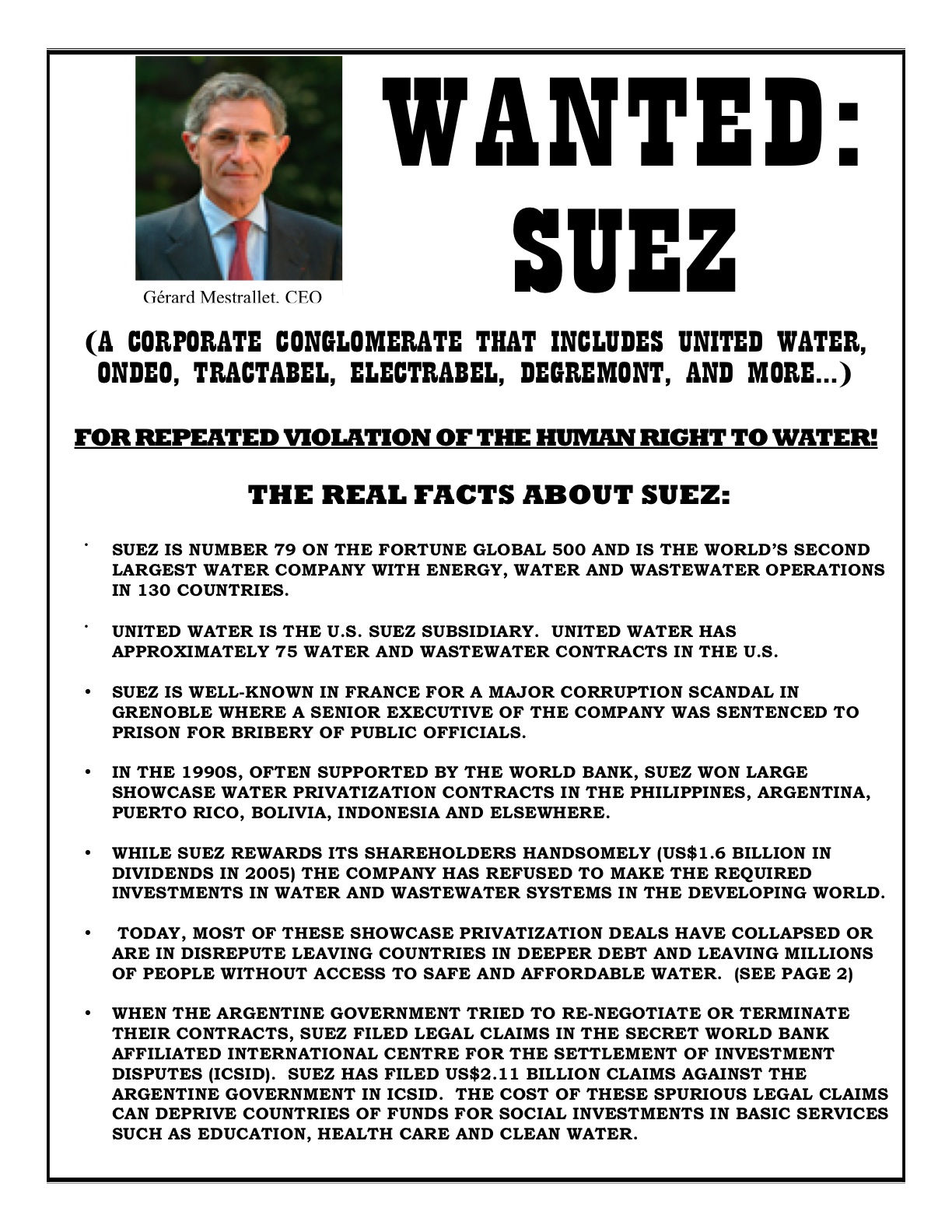
The WGVU reporter also noted that the two companies that the City is negotiating with are United Water (a subsidiary of Suez) and Veolia, two of the largest privatized water corporation in the world.
Suez has a long track record of environmental degradation since they also are involved in coal mining and liquefied natural gas. On the matter of water privatization Suez has been one of the world’s leaders with contracts to run municipal water systems in numerous countries.
According to Food and Water Watch, there is, “A growing international campaign is challenging the policies and practices of Suez, citing the corporation for a range of abusive practices that place profit over the human right to water. These include:
- Refusing to extend services to poor neighborhoods
- Cutting off water if people are unable to pay
- Non-compliance with contractual requirements for maintenance and investment
- Raising rates to unaffordable levels; and
- Threatening legal action when contracts are terminated
For more information on Suez water rights abuses you can download a factsheet.
The other corporation Veolia is the largest water and wastewater company in the world. According to Food and Water Watch they have contracts to operate water and wastewater systems in roughly 650 North American communities. Veolia also operates in 32 US states.
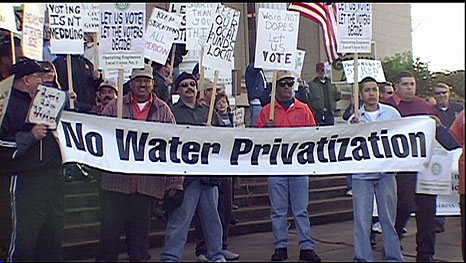
A recent Public Citizen 38-page report on Veolia documents numerous instances of corruption, shutting off people’s water when they can’t pay, diminished services and mistreatment of workers.
In addition to the absurd levels of power that these corporations have over public water systems they also use their wealth to influence legislative policy. According to the Center for Responsive Politics, Veolia spent $115,000 on lobby at the federal level in 2010. Suez has averaged around $130,000 in PAC money they have given to candidates since 2006 which included $2,000 to Michigan Congressman Fred Upton.
Clearly, both of these corporations have a history of influencing public policy and an awful track record of running municipal water systems. Mayor Heartwell claims that if these negotiations move forward with either company that the public will have a chance to comment. However, it would be better for people to voice opposition now and work towards stopping the privatization of Grand Rapids water.
GVSU Students initiate Gender-Neutral Housing campaign
Yesterday, students from Grand Valley State University began a petition campaign to get student, faculty and community support for a campaign to institute gender-neutral housing on campus.

The petition language reads:
The housing proposal would allow any two students, regardless of sex or gender, to live in any GVSU residence building that allows occupants to have their own separate bedroom. The policy would apply only to those who specify on their housing application that they would prefer to utilize this option (blind choices would remain same-sex).
The housing policy seeks to create more options in the room selection process so that ALL students are able to find a compatible roommate and would ease tensions felt by students who struggle to find safe and comfortable living spaces under the current housing requirements, including gay, lesbian, bisexual, transgender, and queer students.
This housing policy change aligns perfectly with Grand Valley’s position found in the “Affirmative Action Statement” which states that our university encourages equal opportunity in the use of its facilities and does not limit access to university activities on the basis of sex/gender, gender identity and expression. It is also consistent to GVSU’s values of inclusiveness and community.

Some of the students involved in the campaign to get gender-neutral housing on campus responded to our request for comment. Fermin Equality Valle stated, “In a university where all voices are heard, I support Gender Neutral Housing because it gives real substance to GVSU’s core values of “inclusiveness” “community” “diversity” and “equity” in the housing arena.”
Joi Dupler said, “Gender-Neutral Housing allows people to choose their most compatible roommate, regardless of gender or sex, because shared living habits, such as cleanliness, is more important in determining a roommate than one’s genitals.”
According to a recent article on Campus Progress, Gender-Neutral Housing now exists on 54 campuses across the country. However, according to the 2010 Campus Equality Index, most of the campuses are located on the east or west coast demonstrating that there is more resistance to the idea of Gender-Neutral Housing in the Midwest.
However, the fact that campuses in the Midwest are lagging behind their counter-parts on the coasts doesn’t mean that students here aren’t committed to making this change happen. Joi Dupler also provided three additional reasons for being involved in this campaign, reasons that are well thought out and articulate the students’ desire for equality and justice on campus.

First, Gender-Neutral Housing (GNH) promotes gender equity by negating gender stereotypes. It is commonly held that men and women can’t co-exist peacefully under the same roof because women are “clean and organized” and men are “messy and irresponsible.” Obviously, such claims are unsubstantiated since research suggests that there is relatively little behavioral difference between genders. Therefore, there isn’t ‘clean’ women or ‘messy’ men, but rather messy people and clean people. If GNH were to be institutionalized, it would break down those gendered assumptions, because students would see functional examples of men and women peacefully living together. This is especially important since anthropological research indicates gender inequality increases as differences between the sexes are socially exaggerated. If we continue to believe men and women are inherently different and can’t co-exist in harmony, we all lose out on an opportunity to develop close friendships.
Second, it serves the unique needs of LGBT students who often struggle to find safe and comfortable housing. Due to the current housing policy, several queer students have often complained of having to deal with the stressful situation of transphobic or homophobic roommates. Some have even been forced to change roommates three to six times in one semester! If a pre-op FtM student would feel more comfortable living with a pre-op MtF student, they should be able to live together–no questions asked. Under the current policy, they cannot because they have different biological sexes, and that’s completely unacceptable! In order to succeed academically, one must first feel safe and comfortable at home; and there’s no way that can be achieved when one’s roommate harasses, ignores, or belittles them based on their gender identity or expression, and sexual orientation.
Lastly, this housing policy change aligns perfectly with Grand Valley’s position found in the “Affirmative Action Statement” which states that our university encourages equal opportunity in the use of its facilities, and does not limit access to university activities on the basis of sex/gender, gender identity and expression. It is also consistent to GVSU’s core values of inclusiveness and community. The university’s best interest is to retain as many students living on-campus as possible. The current housing policy alienates some students that would prefer to live on-campus with a person of a different gender. Therefore, it is suggested that the proper role of the university is not to determine with whom students may or may not live with, but rather empower its students to make healthy decisions, which includes their choice of roommate in their living situation.
GRIID will keep you posted as this effort develops and we encourage people to sign the petition in support of this effort.

