History of US Immigration Policy: Summary of GRIID Class week #2
For anyone who could not join the class tonight or who couldn’t find time to be part of this class, I want to share a summary of what was discussed. I also want to provide links and resources for anyone who wants to do their own investigation on the history of US immigration policy.
As with each of the 8 weeks of this class we will rely on the Popular Education resource I created and update regularly. The Popular Education resource provides an important overview of this history, along with a list of books and online resources that can help us with developing a robust analysis of the history of US immigration policy and how to frame it.
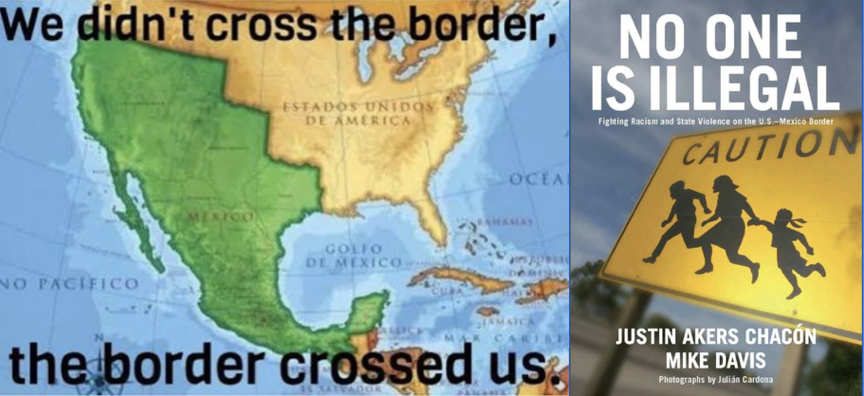
In week #1 we relied heavily on the book, No One is Illegal: Fighting Racism and State Violence on the US/Mexican border, which look at the way that Mexicans, Chinese, Japanese, Jewish and even German immigrants have been treated since the mid-1800s.
In week #2 we the responded to the question about why so many immigrants were coming, especially those who were risking their lives to enter the US/Mexican border at unsanctioned border points. We then talked about the reasons for people taking such risks when crossing the US/Mexican border, along with trying to understand the root causes of why people were leaving their countries and coming to the US. I identified three main reasons, three root causes for why so many people from Mexico and central American were coming to the US especially from the 1970s through to the present.
The first reading assignment was from the book, No One is Illegal: Fighting Racism and State Violence on the US/Mexican border, specifically chapters that provided historical context around US military and economic policy that were two of the major contributing factors for why so many people from Mexico were being displaced and entering the US without documentation.
The second reading focused on the history of immigration detention, using two chapters from Silky Shah’s book, Unbuild Walls: Why Immigrant Justice Needs Abolition.
The author provides us with a clear understanding of the evolution of immigrant detention in the US. One point that is critical to understand was that immigrant detention was an outgrowth of the further criminalization of Black communities after the Civil Rights era. Shah writes in Chapter 1:
“Since the 1980s, a combination of economic restructuring and increasing tough-on-crime policies have produced devastating results: the highest rates of incarceration in the world and the greatest number of deportations in US history.”
 The author notes that immigration detention essentially began during the Reagan Administration in the 1980s. Shah argues that immigrant detention centers were meant as a deterrent for Central Americans that were fleeing by the thousands during the US funding counter-insurgency wars at that time. The detention of undocumented immigrants were mandatory, with the belief that it would minimize the number of undocumented immigrants crossing in to the US at the southern border. While the Immigration Reform and Control Act (IRCA) passed in 1986 and provided amnesty to 3 million undocumented immigrants, new undocumented immigrants were criminalized, with the administration using language that would demonize anyone coming to the US without papers.
The growth of mass immigrant detention continued during the Clinton years, with the adoption of more Neoliberal economic policies, like the end of welfare, which took away basic safety net resources to economically desperate population, including undocumented immigrants. In addition, several states were adopting policies to further criminalize immigrants, like with Prop 187 in California in 1994. The author goes on to say:
“Both the Antiterrorism and Effective Death Penalty Act (AEDPA) and the Illegal Immigration Reform and Immigrant Responsibility Act (IIRAIRA) were passed that year. Together they changed the paradigm on immigration to one that emphasized citizenship rather than residency and laid the legal foundation for the expansion of the deportation machine that emerged following 9/11.”
The George W. Bush administration continued the further criminalization of undocumented immigrants, especially after 9/11 with the creation of the Department of Homeland Security in 2002 and the creation of Immigration Customs and Enforcement (ICE) in 2003. ICE was created with complete bipartisan support.
With the creation of ICE, which a more militarized version of the INS, this increased the number of immigrant detention centers around the country, which fit within the framework of the War on Terrorism. The Obama Administration continued much of the same criminal immigrant framework when he took office in 2009.
According to the author, the Obama Administration made the immigration system bigger and more effective, but not in a good way. His administration created new programs and partnerships and increased family detentions and creating the Secure Communities program, which got county sheriff departments involved in immigration enforcement, like what happened in Kent County in 2012.
The Obama Administration was referred to as the “Deporter in Chief”, since he deported more immigrants (3.5 million) during his tenure, which was the most at that time for any administration.
Lastly, the author makes the point, stating: “the Obama administration expanded and set up a powerful machinery for Trump to exploit by plugging in the detention and deportation system much more closely to criminal law enforcement across the country.”
We also discussed why there hasn’t been as much organized opposition to US immigration policy, especially during the Obama and Biden years. One could argue there has only been organized opposition from affected groups, but most white liberals who are now outraged at what the Trump Administration’s treatment of immigrants did not oppose what recent Democratic Party Administrations have done.


Trackbacks
Comments are closed.