Grand Rapids and Global Warming
Last Saturday during his State of the City address, Grand Rapids Mayor George Heartwell did what some politicians won’t do…..he acknowledged that global warming is a serious problem.

The Mayor states, “The earth’s temperature has already increased and will continue to
rise.” Heartwell went on to raise important questions about the effects of global warming and how the city should respond:
“First, higher temperature means increased evaporation and more rainfall. Here are the questions for the city:
- Can our storm water management systems handle this increased precipitation?
- Are we prepared for increasing accumulations of snow (yes, global warming means greater snow precipitation over a shorter season, counter-intuitive as that may seem)?
- Are there areas of the city that will become more susceptible to flooding and what can we do to protect those neighborhoods?
Second, climate change translates into extreme heat events:
- Who are the vulnerable people in Grand Rapids when temperatures push toward 100 degrees and stay there for a week or more?
- How do we find them to protect them?
- What will the impact be on our power grid when tens of thousands of air conditioning units are sucking up power?
- How will our roads handle the heat?
Third, climate change translates into extreme weather events. More storms, high winds, and tornados:
- Are we equipped to recover from a major storm?
- How quickly can we clear major roads, repair damaged power infrastructure, and respond to emergency medical demands?
- Do we have a rapid response system to re-house people displaced through storm damage?
- How about reaching those isolated and without services?”
Taking these kinds of public positions shows that Heartwell is willing to take some risks, considering the current level of denial that exists in the US around the issue of global warming. Even in this community there have been people who have taken a swipe at the Mayor for his public stance on global warming.
The most recent person to criticize Mayor Heartwell is WOOD TV 8 meteorologist Bill Steffen. Steffen said on a recent blog post, “Global temperature, which was well above average both here in G.R. and globally in 2010 because of the recent El Nino, has now fallen to slightly below average. So, it’s very likely that 2011 will be cooler than 2010 both globally and here in G.R.” This claim by Steffen flies in the face of what many scientists and scientific organizations are saying, such as the National Oceanic and Atmospheric Administration (NOAA), which claim that 2010 has been the hottest year on record for the globe. This is also the conclusion of the Intergovernmental Panel on Climate Change, the international body of scientists, which believe that for humans to survive we need to reduce current carbon emission levels by 80% before 2050.
Grand Rapids Plan for Reducing Carbon Emissions
However, when one reads what the Mayor has proposed to reduce carbon emissions it raises a whole different set of questions. Heartwell stated that he is committed to planting more trees throughout the city, supporting the May 2011 Transit Millage, have energy audits in 1,500 homes in the next year and see investment to reduce energy consumption in the privately owned buildings in downtown Grand Rapids.
 Each of these stated goals are in some ways a step in the right direction and the Mayor should be applauded. However, if we are going to be honest about the need to have global reduction of the current levels of carbon emissions by 80% no later than 2050, these proposals at the local level are woefully inadequate.
First, while improving the mass transit system in this community is always a welcomed action the majority of people still commute to work and transport themselves in cars and trucks at an alarming rate. Grand Rapids, like most US cities, is not designed to facilitate people moving about on foot and it is still a highly dangerous city to be riding bicycle in.
The dependency that most area residents have on cars results in an ongoing battle for more parking space, which contributes to ecological destruction and climate change. It also contributes to air and water pollution and a host of other social costs, such as insurance costs, injuries and deaths from traffic accidents. If we are serious about meeting the goal of 80% carbon reduction then incremental mass transit improvements will not be adequate.
Second, planting more trees throughout the city is extremely important, but the proposed number is not enough in terms of having adequate green space within the city. We need to not only plant more trees, but remove significant amounts of the existing concrete and asphalt which covers the soil. An aggressive and massive shift to urban agriculture would be necessary to not only reduce carbon emissions locally it would provide people with more fresh food, employment opportunities and ways to reduce their budget needs. Massive urban agriculture would especially be of benefit in poor neighborhoods of color, all of which are faced with limited access to healthy and fresh foods where they live.
Third, making buildings more energy efficient is important in that is can reduce our levels of fossil fuels. However, I don’t understand why the Mayor wants to assist the privately owned downtown property owners in reducing energy consumption. Are we always told that the private sector wants the government to stay out of their affairs? More importantly, just saying you want to reduce the energy consumption in the building in downtown Grand Rapids avoid having any discussion about what happens in those buildings and their connection to an economic system that is antithetical to reducing carbon emissions.
Some of those privately owned buildings house large commercial banks, many of which invest in economic practices that contribute to global warming. There are also brokerage firms, PR firms, law offices and a whole host of other business entities that are committed to promoting and expanding Capitalist growth that is in no way committed to reducing carbon emissions. You also have entities like the Acton Institute, a religious organization which has received significant amounts of funding from Exxon/Mobil to deny global warming is a problem.
The Problem is Bigger Than Grand Rapids
However, let’s just say for the sake of argument that Grand Rapids would be able to achieve an 80% reduction of carbon emissions by 2050. It won’t mean much if the rest of the world doesn’t do the same.
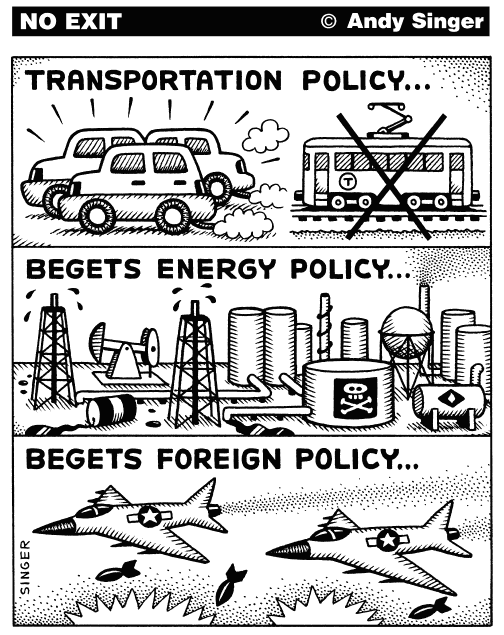 Certainly, we only have immediate control over what happens in our own bioregion, but we cannot not afford to ignore what role the people and institutions of Grand Rapids play in affecting the rest of the world.
One of the largest contributing factors to global warming is global militarism, with the US being the main culprit in producing, selling and tracking in weapons. If we are serious about reducing global carbon emissions, then we must connect our ecological efforts to anti-war and anti-militarism efforts. (See Barry Sander’s book, Green Zone: The Environmental Costs of Militarism.)
As of today, the total amount of money that has left this community to fund the wars in Iraq and Afghanistan is over $602 million dollars according to the National Priorities Project. Imagine if that money stayed in this community and was used for efforts to reduce carbon emissions.
However, an even bigger challenge is the need to radically restructure our economic system in such a way that is truly sustainable. We cannot afford to piece meal the reduction of carbon emissions or apply change in ways that do not seriously address systemic change. This of course means that it will not be easy, but we are talking about the future of humanity and unless we are willing to have serious conversation followed by serious action then I don’t see how we can avoid major catastrophe.
Noam Chomsky: How Climate Change Became a “Liberal Hoax”
(This article & video is re-posted from Znet.)

In this sixth video in the series “Peak Oil and a Changing Climate” from The Nation and On The Earth Productions, linguist, philosopher and political activist Noam Chomsky talks about the Chamber of Commerce, the American Petroleum Institute and other business lobbies enthusiastically carrying out campaigns “to try and convince the population that global warming is a liberal hoax.” According to Chomsky, this massive public relations campaign has succeeded in leading a good portion of the population into doubting the human causes of global warming.
Known for his criticism of the media, Chomsky doesn’t hold back in this clip, laying blame on mainstream media outlets such as the New York Times, which will run frontpage articles on what meteorologists think about global warming. “Meteorologists are pretty faces reading scripts telling you whether it’s going to rain tomorrow,” Chomsky says. “What do they have to say any more than your barber?” All this is part of the media’s pursuit of “fabled objectivity.”
Of particular concern for Chomsky is the atmosphere of anger, fear and hostility that currently reigns in America. The public’s hatred of Democrats, Republicans, big business and banks and the public’s distrust of scientists all lead to general disregard for the findings of “pointy-headed elitists.” The 2010 elections could be interpreted as a “death knell for the species” because most of the new Republicans in Congress are global warming deniers. “If this was happening in some small country,” Chomsky concludes, “it wouldn’t matter much. But when it’s happening in the richest, most powerful country in the world, it’s a danger to the survival of the species.”
Visit http://www.TheNation.com to learn more about “Peak Oil and a Changing Climate,” and to see the other videos in the series.
The Planet Keeps Warming, But U.S. Media Interest Cools
(This article by Miranda Spencer is re-posted from Fairness & Accuracy in Reporting.)
 After the anticlimax of the COP-15 climate-policy negotiations in Copenhagen last year (Extra!, 2/10)—in which the more than 190 UN-member nations walked away with a non-binding statement of intent cobbled together in secret by the U.S. and a few other wealthy nations—public and press expectations for this year’s COP-16 meeting (11/29–12/10/10) in Cancún, Mexico, were low.
At least in part reflecting this pessimism, there has been a “steep slide” in climate reporting this year, Columbia Journalism Review’s science blog (Observatory, 11/24/10) noted. Few major corporate news media outlets even planned to send reporters to Cancún; as Washington Post lead environmental writer Juliet Eilperin told Observatory, “It feels like there is absolutely no momentum…. What will there even be to cover in Cancún in terms of public policy or reader interest?”
Setting aside the oddness of an often-reactive news media predicting the (lack of) news, if a meeting of the world’s nations upon which the fate of the Earth potentially hinges isn’t a story, what is? As Bolivia’s UN ambassador, Pablo Solon, wrote in a Guardian (11/30/10) op-ed,
I wonder whose [low] expectations [the media and negotiators] are talking about. Do they think the 1 million people in the Bolivian city El Alto, who face increasingly chronic water shortages from the disappearance of glaciers, have low expectations? Do they think Pacific Islanders whose homelands will soon disappear beneath the rising sea have low expectations? I believe that the majority of humanity demands and has high expectations that our political leaders should act to stop runaway climate change.
Given those stakes, the press of the world’s second-biggest greenhouse-gas emitter might well be expected to send reporters to Cancún and make the talks and surrounding issues a top ongoing news story.
Unfortunately, that was far from the case. As Democracy Now!’s Amy Goodman (12/6/10) reported as her camera panned over scores of empty chairs, “[last year] the press room was packed…. It’s empty now.”
The only coverage an Extra! search of the Nexis media database from the start of the talks through the day after their conclusion (11/29–12/12/10) found on broadcast network news was a piece on logjams and low expectations on CBS’s 2–6 a.m. newscast (Up to the Minute, 12/9/10) and a three-sentence item on CBS Morning News (12/7/10) about an underwater Greenpeace protest coinciding with the talks, while the PBS NewsHour (11/29/10) had four sentences noting the start of the meetings. USA Today, CNN, MSNBC and Fox News all stayed home and almost entirely ignored the talks. (USA Today found COP-16 such non-news that the only coverage Extra! found on the talks was a mention in the travel section—12/4/10—and a Jay Leno joke—12/3/10.) This record puts these major corporate news media behind the more modestly endowed Christian Science Monitor and California’s Contra Costa Times, both of which sent reporters.
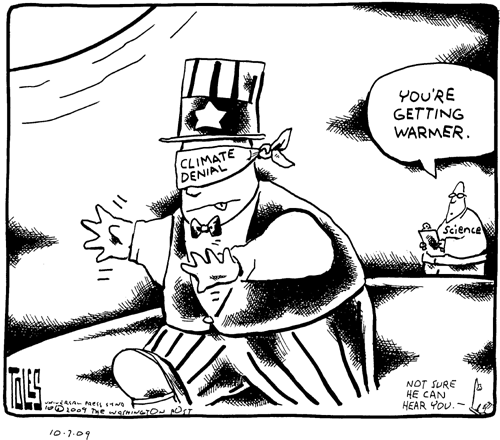 Those who did journey to Mexico—including the New York Times’ John Broder, the L.A. Times’ Margot Roosevelt, and Eilperin of the Post—focused mainly on the “wonkish” UN negotiation process (Washington Post, 12/7/10), often “likened to a zombie” (New York Times, 12/12/10), “where progress is measured in verb tenses and punctuation changes” (New York Times, 11/30/10)—though occasionally they did take a longer view.
Eilperin’s coverage included a page-one story (12/10/10) about efforts of individual nations, states and businesses who are “cobbling together patchwork solutions to preserve forests, produce clean energy and scrub pollution from the air” outside the UN system, and Roosevelt (12/5/10) had a page-one story on the climate struggles of 43 island nations.
The Post (12/8/10, 12/12/10) and the Los Angeles Times (12/10/10) were the only two national outlets during the talks to cover REDD, a proposed formal system for Reducing Emissions from Deforestation and Forest Degradation by paying nations in the global South to preserve forests. The highly contentious market-based mechanism became part of the eventual Cancún Agreement. The articles mainly discussed the business implications of REDD and mentioned indigenous and global South objections only in passing.
But as a successful end to the meeting looked questionable, developing countries—particularly Bolivia, whose outspoken president, Evo Morales, was present—were portrayed as an obstacle to saving the COP process from irrelevance. “Last December, a group of nations led by Bolivia, Venezuela, Cuba and Sudan played the role of spoiler in Copenhagen,” the New York Times reported (12/8/10), and the Post (12/7/10) wrote that efforts to forge North/South cooperation “have not quieted criticism from left-leaning Latin American delegates who have threatened to derail the talks.”
 And while all three papers acknowledged that the agreement would “have scant near-term impact on the warming of the planet” (New York Times, 12/12/10) and that even the most ambitious UN deal proposed this year would have fallen short of the greenhouse-gas reductions scientists say are needed to keep global warming from exceeding 2° Celsius, the ceiling agreed to in the Copenhagen Accord, they generally treated the outcome as overall a “success” (New York Times, 12/12/10) that “salvaged a UN-backed process that was close to failure” (Washington Post, 12/12/10) and “rescued the 20-year climate negotiations from what appeared to be imminent collapse” (L.A. Times, 12/12/10).
Such an assessment was generally not shared by participants in three alternative climate summits that paralleled COP-16 and were far livelier and, arguably, more productive.
Organized and attended by grassroots and other nongovernmental organizations and individuals, they resembled the World Social Forums, but with an environmental justice focus. They featured free public presentations and workshops that involved people from all over the world, particularly from indigenous communities and others in the global South, who collaborated to debate the underlying causes of the climate crisis, offer their own best practices and forge alliances for cooperative actions.
Though distinct, they shared a theme—“Change the system, not the climate”—and all challenged what they called “false solutions” to climate mitigation and the trend toward market-based approaches, such as REDD, that “commodify” nature. Most of all, the alternative summits challenged nations to drastically cut their emissions and bring the less powerful into the solutions process. (For a critique of the Cancún Agreement that reflected the alternative summits’ perspectives, see CounterSpin, 12/17/10).
The three alternative summits, Klima-Forum10, Diálogo Climático, and the Alternative Global Forum for Life and Environmental and Social Justice, brought together thousands of people, but earned nary a mention in U.S. corporate media; the closest they got was a passing Post mention of on-site anti-REDD protests (12/8/10) and a Post acknowledgment (12/7/10) that “indigenous groups will march through Cancún’s streets Tuesday to challenge the idea of allowing private interests to pay to preserve tropical forests.”
 When that march to the official summit was halted by a phalanx of heavily armed guards supported by a Black Hawk helicopter, not a single U.S. media outlet covered it. The L.A. Times’ Roosevelt, who wrote a piece on climate protest movements on the paper’s blog (12/13/10), told Extra! via e-mail:
With limited time and difficult logistics, it was better for reporters to try [to] cover what was actually happening in the negotiations and in the expert seminars (…which also included indigenous people), given that we had access to many of the same people—and the same views—both inside and outside the talks. When you think of what will have an impact on the climate, what was happening inside the venue was more important than the protests outside. One is substantive. The other symbolic.
It’s true that, given the maddening distances between the official venues and the three people’s summits, anyone reporting them would almost have to make a special mission to do so.
But the events’ very existence shows there were still many groups who were either shut out of, felt constrained by or wanted no part of the UN meetings—even as they sought to influence them. This was true even for credentialed attendees: Prominent Indigenous Environmental Network director Tom Goldtooth and Grassroots Solutions for Climate Justice activist Diana Pei Wu found themselves banned from proceedings for criticizing the UN process (Democracy Now!, 12/9/10, 12/13/10). Those TV-news-ready events weren’t covered by the corporate media, nor was the removal of other activists who held a vigil at the talks against what they said was the silencing of civil society, which led to the alleged beating of a Reuters photographer (Democracy Now!, 12/13/10).
And the fact remains that Democracy Now! and other alt/green media, along with Reuters and other wire services following COP-16, did seek out and report on the alternative forums. Not to mention the numerous Latin American and other international media who did.
So are chunks of the largest-audience U.S. media ceding coverage of global climate policy—however unproductive it has been—to these other media? Maybe: The largest press delegation to Cancún, it turns out, was from the Climate Change Media Partnership, which provided fellowships to 35 journalists from 29 developing countries to the UN summit—including 10 U.S. reporters whose outlets’ own budgets couldn’t accommodate the trip. Their print and multimedia stories appeared daily in their home outlets and can be viewed on the website Climate-Partnership.org.
GR City Workers Hold Informational Picket

Yesterday, members of the Grand Rapids Employees Independent Union (GREIU) held an informational picket in from of City Hall to let the public know that they are not happy about the ongoing city efforts to cut benefits, downsize staff and privatize services.
Last Saturday, Grand Rapids Mayor George Heartwell said in his State of the City address, “The current level of benefits received by municipal employees is, I am convinced, unsustainable in the long-haul.” I asked some of the GREIU members what they thought about the Mayor’s statement.
Loran Moyer said that when the local government can afford to increase the salary of the City manager by $6,000 they cannot tell him that he needs to continue to take cuts in benefits. (Although it was announced this morning in the GR Press that the City Manager and other salaried officials want to give back their raises.)
 Joe Casalina agrees and thinks that whenever cuts are being considered by City management it always begins with lower level positions. Joe said that the union recognizes that times are tough and that they always take into consideration the economic climate before negotiating a contract. “We all have families to take care of and to feed, just like everyone else. We aren’t doing this to get rich, but just to make a decent living.”
I also asked the union members what they thought about Mayor Heartwell’s criticism of the current level of benefits that GREIU members have – “This benefit level is not typically found in the private sector and, if we cannot control it, it will break the back of local government.”
GREIU President John Good responded by saying that they are not private sector employees they are public sector workers. Good also stated that their workforce has been cut by 25% and that they have made numerous concessions in recent contracts. The GREIU president also said that they are willing to further negotiate if the city was willing to make some compromises.
Joe Casalina said in response to the comparison of benefits to the private sector that it is a false argument. He said that when the economy is good they never make this comparison, especially when benefits are really high in the private sector. “Now that things are not so good in the private sector they want to make comparisons.”
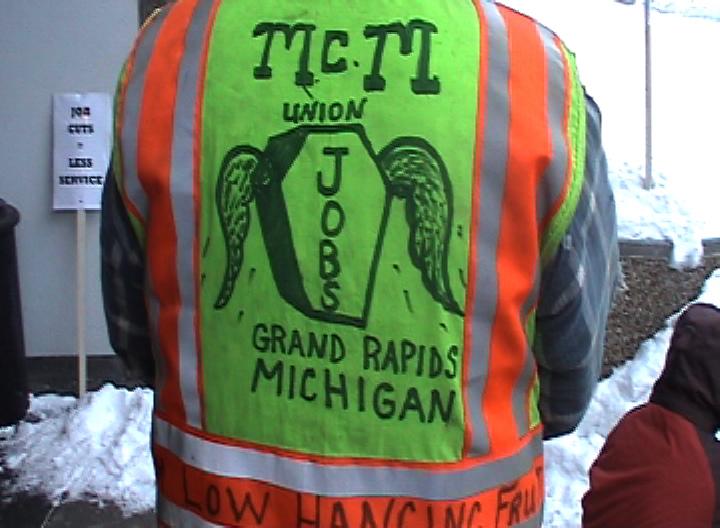 Some of the GREIU members talked about the threat of further job loss because of privatization. The unionized city employees are concerned about the upcoming budget creation and the strong possibility that the city might want to privatize more services in order to “balance the budget.”
One worker, Mike McKay, who has 25 years in as a city employee, said that he was very concerned about talk of privatizing the city’s water & sewage services. “I don’t feel valued as a city employee. Not too long ago Mayor Heartwell referred to us as low hanging fruit, meaning that many of us would be workers who could easily lose our jobs. I wear this vest as a form of protest against that kind of mentality. We deserve to be treated better.”
Time will tell in terms of what the City will do about the labor contracts, but it seems clear that there is a serious conflict between what city management wants to do and what city employees are asking for.
Kids Count in Michigan Report says child poverty has increased
Yesterday, the Kids Count in Michigan Project released its annual report on the state of children in Michigan.
 Some of the indicators were positive, such as a decline in dropout rates for teens across the state. However, there were numerous negative indicators that should cause concern for anyone who cares about the well being of children.
First, “many children, particularly in low-income families, face chronic challenges related to their oral health, mental health, and physical health, including obesity, asthma, and lead poisoning.” Asthma is one of the leading causes of children staying home from school and, according to the Kids Count in Michigan report, 1 out of every 10 students is affected.
However, maybe the most sobering data from the annual report was the substantial increases in the rate of abuse of children over the past decade and the number of children living in poverty.
According to the Kids Count in Michigan report the number of children in Michigan who suffered from abuse or neglect has risen 25% between 2000 and 2009. The report also stated that in 2009 alone, “roughly 30,800 children in Michigan were confirmed as victims of abuse or neglect.” One of the causes for the increase in abuse or neglect is the growing level of children living in poverty.
The Kids Count in Michigan report notes that child poverty grew in the last decade with 27% of young children living in poverty by 2009 and one fifth of all children. This level of childhood poverty led the report producers to state that this negatively impacts the educational climate and opportunities for Michigan’s children.
At the local level, particularly in Kent County, the data is quite sobering. The level of childhood neglect or abuse increased by 66% between 2000 and 2009, according to the Kids Count in Michigan report. On the matter of childhood poverty there has been a 12% increase for children between the ages of 1 – 17.
When you break down what this means along racial lines, there is also a disturbing trend. According to the Kids Count in Michigan report, while 1 in 5 children in Michigan live in poverty, the rate for African American children is 1 in every 2 are living in poverty and 1 in 3 for Hispanic children.
This data and the very harsh reality of what it means for so many of Michigan’s children and families is not the picture that was recently painted by the newly elected Governor Rick Snyder in his State of the State address or the State of the City speech by Grand Rapids Mayor Heartwell.
Media Bites – Budweiser and Product Placement in Films

In this week’s Media Bites we look at a Budweiser commercial that ran during the 2011 Super Bowl. The Budweiser spot is mocking the reality of Product Placement in films with numerous exaggerations.
In many ways the commercial depicts the pervasiveness of product placement in Hollywood Movies and Budweiser regularly buys time in films. We look at some recent examples of Budweiser being used in Hollywood films – Wolverine: X-Men Origins, Friday the 13th and Star Trek. You can track product placement in films by year or brand at the online source BrandChannel.com.
Obama, Inc.
(This article by Jim Hightower is re-posted from the site Otherwords.)
When you dance with the devil, never fool yourself into thinking that you’re leading.
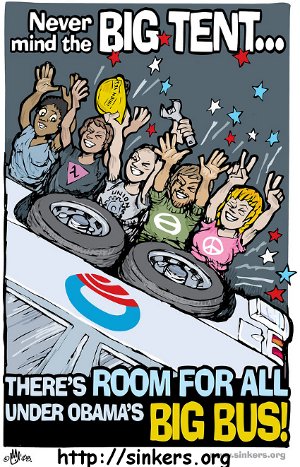
That would be my 50-cents-worth of advice to President Barack Obama as he remakes his presidency into a Clintonesque corporate enterprise. Following last fall’s congressional elections, he immediately began blowing kisses to CEOs and big business lobbyists, and he’s now filled his White House dance card with them.
First came Bill Daley, the Wall Street banker and longtime corporate lobbyist. In early January, Obama brought him to the White House ball to be his chief-of-staff, gatekeeper, and policy coordinator.
Then Obama tapped Jeffery Immelt to lead his Council on Jobs and Competitiveness, which is supposed to “encourage the private sector to hire [Americans] and invest in American competitiveness.” This is a bizarre coupling, for as General Electric’s CEO, Immelt was a leader in shipping American factories and jobs to Asia and elsewhere. Today, fewer than half of GE’s workers are in our country.
As an AFL-CIO official notes, “Highly globalized companies don’t have the same interests as the United States. There is no company more emblematic of this than GE.”
In his recent State of the Union speech, Obama offered only cold comfort to the millions of Americans who are unemployed or barely employed, saying blandly that “The rules have changed.” Well, yes–and who changed them? Self-serving CEOs like Jeffrey Immelt, that’s who.
America’s working families–our endangered middle class–have a right to expect Obama to fight for rules that are fair to them and our country, not meekly accept rules that have been skewed by an elite corporate class to profit them alone. Instead, our president is waltzing with the devil.
He’s rebranding his presidency, all right. It’s becoming Obama, Inc.
Forget Egyptian Freedom, Levin wants Israeli Security

After weeks of protest in Egypt, Chairman of the Senate Armed Services Committee and Michigan Senator Carl Levin finally released a statement on the civilian uprising.
Along with Senators Bob Casey (PA) and Chris Coons (DE), Levin sent out a Media Release on Friday (2/4) that tells us something about what some members of US Senate feel are priorities for the US during Egypt’s uprising.
The statement by Levin and company makes some vague comments about “international obligations:”
“With new freedoms, come new responsibilities for the future leaders and Government of Egypt. During this period of transition, we believe that the U.S. should send a strong message to key Egyptian leaders and members of the opposition, including the Muslim Brotherhood, that Egypt’s international obligations must be respected during a political transition and beyond.”
However, with the next sentence Levin makes it clear where his allegiance lies:
“Specifically, it is imperative that Egypt maintains its historic commitment to peace with Israel, as agreed to in the Camp David Accords, and that the Egyptian military and security forces ensure security on the border with Gaza.”

Levin, Casey and Coons are echoing a long-standing position of the US government as it related to Middle East politics, in that Israeli “security” is the main priority. Their emphasis on Israeli security is interesting considering that recent WikiLeaks documents show that Israel undermined every opportunity at a peaceful settlement with the Palestinians.
It is also interesting that the statement by Senator Levin and his colleagues would emphasize the need for security on the border of Gaza. It has been more than two years since the Israeli assault on Gaza, which resulted in thousands dead and wounded Palestinian civilians. Naomi Klein said in a recent article that despite the international outrage of these war crimes, Israel has not been forced to change its behavior one bit. This is mostly due to the fact that the US continues to bankroll the Israeli occupation of Palestine and allowed the continued expansion of Israeli settlement.
However, there is one additional reason why Levin would be so assertive about Israeli security in the wake of the Egyptian uprising. Michigan Senator Carl Levin has been the second largest recipient of Pro-Israeli PAC money in Congress since 1990. He has received $1,390,594 in campaign contributions from Pro-Israeli groups, according to the Center for Responsive Politics. For more details on Levin’s relationship to these groups, check out an article from 2008 that breaks down the financial backing of Levin from Pro-Israel organizations.
Top 150 PACs raised $48 million in 2010 Election cycle in Michigan
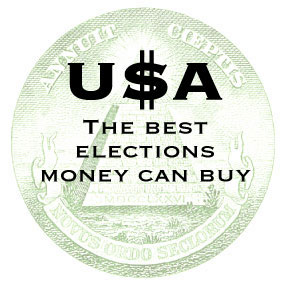
The Michigan Campaign Finance Network MCFN) released its findings of the top 150 PACs (political action committees) for the 2010 Election cycle. Their findings demonstrate that money overwhelmingly influences electoral politics in this state.
According to a Media Release from MCFN, “The top fundraising PAC of the cycle was the RGA Michigan PAC, one of numerous state PACs created by the Republican Governors Association across the country in the 2010 cycle. The RGA Michigan PAC reported $8,429,328 in contributions, a record for a Michigan state PAC. The RGA Michigan PAC gave $5,295,000 to the Michigan Republican Party, $3,000,000 to the campaign committee of Texas Gov. Rick Perry, $130,000 to the Republican Governors Association and it has filed for dissolution.
The Michigan Chamber of Commerce was the top contributor in 2010 to the top PAC’s parent organization, the Republican Governors Association. The Michigan Chamber’s corporate contributions to the RGA totaled $5,372,500. Net of the $3,000,000 contribution to the Texas governor’s campaign, the contributions ascribed to individual donors to RGA Michigan PAC were a near perfect replacement for the Michigan Chamber’s contribution to the RGA. Of the $8.4 million in individual contributions recorded by RGA Michigan PAC, 98 percent came from persons who do not reside in Michigan. The individual contributions that came to the RGA Michigan PAC first passed through the parent organization.”

This kind of financial shell game is just the beginning of how money will influence politics since the 2010 Supreme Court decision that change how campaign donations could be made during electoral campaigns.
The MCFN confirms this influence in their look at 2010 PAC spending in Michigan by corporations. “Corporate PACs made their Michigan debut in 2010, exploiting the opening created by the U.S. Supreme Court’s decision in Citizens United v. Federal Election Commission. In Michigan, corporate funds can be used only for independent expenditures, not contributions to candidates, so organizations that are using corporate funds, so far, are segregating their corporate money in new PACs. The most notable corporate PACs were those of the Michigan Association of Realtors, $450,100, and Business Leaders for Michigan II, at $135,500.”
MCFN executive director Rich Robinson said of the new funding schemes, “The Byzantine transfers into and out of the Republican Governors Association, and the ‘Russian doll’ financing structure in the Realtors’ corporate PAC are clear notice that state PACs have new formulations to defeat transparency. That is not a positive development for democracy in Michigan.”
The list of the top 150 PACs is worth looking at, with several entities on the list from West Michigan, such as Meijer, Progressive Women’s Alliance of West Michigan, Warner, Norcross & Judd and the Grand Rapids Chamber of Commerce.
Film “Scarred Justice” brings forgotten student massacre to light

(Left to right) Henry Smith, Samuel Hammond Jr. and Delano H. Middleton
Dinner and A Movie:
Scarred Justice: The Orangeburg Massacre 1968
Thursday Feb. 10, 6:30 – 8:30 pm
The Bloom Collective
671 Davis NW (Steepletown Center)
Corner of 5th & Davis, Grand Rapids
$3-$5 suggested donation.
The Bloom will serve a light supper with vegan options.
Forty years ago, the Kent State shootings made national headlines. Crosby, Stills, Nash and Young’s song, “Four Dead in Ohio,” made the charts—and is still played frequently today on classic rock radio stations. Last 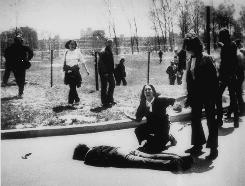 May, on the 40th anniversary, the shootings made headlines again in USA Today, on CBS news, Vanity Fair and other major news outlets.
Did you know that two years before the National Guard gunned down these four white students, the South Carolina Highway Patrol shot dead three African American students, injured 28 others and caused a young pregnant woman to miscarry? All those shot were shot in the back. Why? They were protesting the illegal segregation practiced by the local All Star Bowling Lanes.
The dead included South Carolina State College students, Samuel Hammond and Henry Smith, and high school student, Delano Middleton.
If you are old enough to remember Kent State but can’t remember hearing about the Orangeburg Massacre, don’t blame your bad memory. The story barely made the news, let alone the top forty. But it’s not too late to learn about these brave young folks who stood up for their civil rights and were gunned down by the local police.
The Bloom Collective is screening the documentary film, Scarred Justice: The Orangeburg Massacre 1968 on Thursday. The film’s website tells us, “This film brings to light one of the bloodiest Civil Rights era tragedies after four decades of denial. The killing of four white students at Kent State University in 1970 left an indelible stain on our national consciousness. But most Americans know nothing of the three black students killed at South Carolina State College in Orangeburg two years earlier. It raises disturbing questions about how our country acknowledges its tortured racial past in order to make sense of its challenging present.”
Come out and learn about The Orangeburg Massacre and pay homage to the brave students who died or were injured while standing up for their civil rights in 1968.
View the trailer.

