Some Breaks in the Blackout of Wall Street Protests
This article is re-posted from Fairness & Accuracy in Reporting.
After a FAIR Action Alert (9/23/11) criticized the virtual media blackout of the Occupy Wall Street protests, corporate news coverage has increased–sparked largely by the escalating police brutality at the ongoing demonstration. (See FAIR Blog, 9/23/11, for a sample of the messages sent by FAIR activists to the network nightly news shows.)
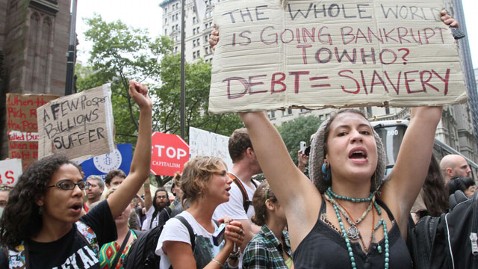
On ABC World News Sunday (9/25/11), anchor David Muir read this short item while playing footage of cops assaulting protesters:
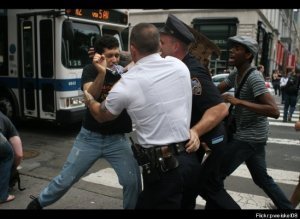
And here in New York, protests continued against the big banks and the bailout that helped the banks, Wall Street, they say, not Main Street. It turned ugly this weekend when protesters marching through Lower Manhattan clashed with police. One man right there brought down forcefully by an officer. About 80 people were arrested, in fact. The protesters posted this video on the Internet.
NBC Nightly News aired a somewhat longer report the next day (9/26/11), with correspondent Ron Allen actually traveling downtown to the protest encampment in Liberty Plaza. His report included this “he said, she said”: “The protesters charge that the police used excessive force. The police say that anyone who resists arrest can expect to encounter some level of force, but nothing excessive.” The following morning’s Today show (9/27/11) briefly aired footage of a police official pepper-spraying nonviolent demonstrators in the face, noting that “the NYPD calls the officer’s actions appropriate.”
Some journalists seemed strikingly reluctant to take videotaped evidence of police violence at face value. CNN anchor Ali Velshi (9/26/11) introduced footage of a police assault by dismissively saying that protesters were “now screaming abuse after they were arrested over the weekend.” After the footage of a cop violently subduing a protester, co-anchor Carol Costello noted, “Of course, what you can’t see is what came before the fight”–a disclaimer that could be made of every single piece of videotape that CNN runs.
A September 27 New York Times piece (FAIR Blog, 9/28/11) seemed to defend the police force’s brutal response, with reporter Joseph Goldstein depicting a police department concerned about “terrorism” and the “destruction and violence” that supposedly accompany “anticapitalist demonstrations.” Such police worries, according to Goldstein, “came up against a perhaps milder reality on Saturday, when their efforts to maintain crowd control suddenly escalated”–an oddly passive way to introduce the use of pepper spray and body slams against nonviolent demonstrators.
“Even as the members of Occupy Wall Street seem unorganized and, at times, uninformed, their continued presence creates a vexing problem for the Police Department,” Goldstein wrote–though his acceptance of media myths about violent demonstrators (Extra!, 1-2/00, 3-4/00; FAIR Action Alert, 7/25/00) makes the reporter seem less informed than the protesters he patronizes.
Similar condescension was on display in another New York Times piece (“Gunning for Wall Street, With Faulty Aim,” 9/25/11), with reporter Ginia Bellafonte deriding the “intellectual vacuum” of the protests, with “its apparent wish to pantomime progressivism rather than practice it.” Bellafante described one protester as a “half-naked woman… with a marked likeness to Joni Mitchell and a seemingly even stronger wish to burrow through the space-time continuum and hunker down in 1968.”
The Times did, however, print a column by Jim Dwyer (9/28/11) that grappled seriously with the police brutality on display in the videos of the march. “If a nightstick were substituted for pepper spray, a conventional weapon instead of an exotic one, the events on 12th Street would bear a strong resemblance to simple assault,” Dwyer noted straightforwardly.
Perhaps the harshest critic of police violence in corporate media was MSNBC‘s Lawrence O’Donnell, who devoted a remarkable segment to the issue on September 26. Pointing to footage of police tackling a person carrying a video camera, O’Donnell noted:
The reason that man is being assaulted by the police is because of what he has in his hand. He’s holding a professional grade video camera. Since the Rodney King beating was caught on an amateur video camera, American police officers have known video cameras are their worst enemy. They will do anything they can to stop you from legally videotaping how they handle their responsibility to serve and protect you.
Another outstanding moment in corporate media coverage was filmmaker Michael Moore’s appearance on CNN (9/26/11). Host Piers Morgan gave Moore a rare opportunity to actually articulate some of the grievances that have prompted the Occupy Wall Street demonstrations in the first place:
The main thing is, number one, is that the rich are getting away with a huge crime. Nobody has been arrested on Wall Street for the crash of 2008. They’re not paying their fair share of the taxes. And now with the Citizens United case of the Supreme Court, they get to buy politicians up out in the open….
It all points to, are we going to live in a democracy that’s run by the majority of the people, or are we going to be living in a kleptocracy, where the kleptomaniacs down on Wall Street, who have stolen people’s pension funds, they’ve wrecked people’s lives, millions have been thrown out of their homes, millions are without health insurance, millions have lost their jobs?
Still, as late as this week, some in the media establishment were continuing to debate whether the Occupy Wall Street protests were worth covering at all. NPR ombud Edward Schumacher-Matos devoted a column (9/26/11) to the network’s decision not to air any reports on the demonstration:
We asked the newsroom to explain their editorial decision. Executive editor for news Dick Meyer came back: “The recent protests on Wall Street did not involve large numbers of people, prominent people, a great disruption or an especially clear objective.”
The next day, the previously unimportant non-news was worth covering after all, as Schumacher-Matos wrote (9/27/11):
The Occupy Wall Street protests have persisted into this week, so the newsroom has decided to include a segment on tonight’s All Things Considered.
FAIR thanks all media activists who wrote to news outlets and helped to change their minds about the newsworthiness of the Occupy Wall Street demonstrations. There’s still a long way to go.
Kellogg’s claims it’s committed to climate change, again
Today, in their Michigan Loves Manufacturing e-blast, MiBiz included what appeared to be a story entitled, “Kellogg Company recognized for commitment to addressing climate change, named to Carbon Disclosure Leadership Index.”

When you click on this headline it doesn’t take you to a MiBiz story. The link takes you to a Kellogg’s Media Release from the company’s PR department.
The media release talks about how the Carbon Disclosure Project gave the Battle Creek Company a high mark in their reporting on carbon emissions. The Media Release also states, “Kellogg is committed to reducing its energy use, greenhouse gas (GHG) emissions and water use by 15 to 20 percent by 2015.”
While this announcement may seem noble in the eyes of some, carbon emissions must be reduced by at least 80% of current levels by 2050 on a planetary scale in order for humanity to avoid a point of no return on global warming. Kellogg’s doesn’t seem to be making a big enough effort for that to happen, which really isn’t their intent.
Kellogg’s, like all corporations are primarily motivated by profit and perpetual growth. One of the tools they use to expand profits and distribution of products is to present themselves as being “Green” or “sustainable.” However, these are just smart marketing tools but don’t carrying any weight in actually making change towards reducing carbon emissions and avoiding climate catastrophe.
The Carbon Disclosure Project (CDP) also plays a role in perpetuating the notions that companies can continue to make huge profits, expand their operations and still be “sustainable.” This was the message of an international business conference that CDP hosted earlier this month, with the message “Forging Sustainable, Profitable Business Growth.”
This kind of deception is rampant within the corporate world and Kellogg has been participating in this kind of deceit for some time. In March we ran a story looking at their claims to sustainable palm oil use, where they we touting their certification from the Roundtable on Sustainable Palm Oil. However, numerous environmental groups such as Friends of the Earth and Rainforest Action Network have challenged this so-called certification process and exposed this business roundtable as fundamentally a front group for agribusiness and their desire to be seen as ecologically responsible.
Kellogg’s claim to be taking action on climate change is just as deceitful and ultimately is a false solution. Does the cereal company really expect us to think that peddling sugar-laden products to kids can ever be sustainable?
Business press reporting is cheerleading for multinational corporation operating in Grand Rapids
Earlier this year we posted a story about the possibility that Grand Rapids might privatize its water system with the French company Veolia. This proposal did not come to fruition, but the energy and water management-company is back in the news in West Michigan.

MiBiz reported last week that Veolia plans to increase its operations in the Great Lakes area, while maintaining Grand Rapids as its “hub of operations.” “We want to create a platform for growth in the Great Lakes,” said Veolia’s Grand Rapids Manager Jim Monterusso. “For anything in the Great Lakes, we want it bolted onto Grand Rapids.”
According to the MiBiz article Veolia has already just opened a landfill gas-to-energy facility in Wisconsin that the company can monitor from their Grand Rapids office. The real goal of course with any for profit entity is growth, which Veolia’s Grand Rapids spokesperson makes clear when he says, “A lot of capacity is available for growth. We can serve a lot more customers than we do. The most sexy for us is the off-pipe projects on industrial or other properties in Grand Rapids and other nearby places, like Holland and Muskegon.”
While management always thinks growth is sexy, the reality is that Veolia is not a friend of local autonomy of human rights.
Veolia is one of the largest water privatization companies in the world and according to a report by Public Citizen, the company has an atrocious environmental record in Europe, Asia, Africa, Latin America and right here in the US.
In addition to energy and water profiteering, Veolia has a division that works on transportation systems. One of those projects is in Israel and is called the Jerusalem Light Rail Project (JLR).
According to the international Boycott, Divestment and Sanctions (BDS) campaign, the JLR project would, “link illegal settlements in East Jerusalem with Israel. Not only do the settlements contravene article 49 of the 4th Geneva Convention forbidding an occupier transferring its own civilians into the territory it occupies, but in most cases the establishment of the Israeli settlements involved war crimes too. The tramway tightens Israel’s hold on occupied East Jerusalem, ties the settlements more firmly into Israel and undermines chances of a just peace for the Palestinian people.” In addition, Veolia operates bus lines for Israeli settlers, running them between illegal settlements and Israel.
The awful environmental practices and the lack of respect for human rights by Veolia are not mentioned in the article by MiBiz. Instead, the local business press seems to be cheerleading for the growth and expansion of a company that has little regard for environmental protection and basic human rights.
New report on Michigan campaign finance spending in 2010
The Michigan Campaign Finance Network has just released a new study of the 2010 election campaign spending for the mitten state.

The new report, 2010 Citizen Guide to Michigan Campaign Finance, is a 98 page report with information on campaign spending for all 2010 candidates and ballot initiatives in Michigan.
According to a Media Release, “Independent spenders overshadowed candidates’ committees in financing Michigan’s most prominent 2010 election campaigns.” The Media Release also highlights some of the areas of campaign finance spending in Michigan, where transparency was limited and where the public can clearly see how the US Supreme Court’s decision Citizens United impacted how money was spent.
“We’ve entered an era when a small group of undisclosed financial backers can drive an election outcome without leaving any fingerprints,” said Rich Robinson of the Michigan Campaign Finance Network. “That is absolutely poisonous for democracy. And anyone who believes that kind of financial support is given for selfless reasons is delusional. Top-tier political donors are investors, and they get a return on their investment.”
Robinson went on to say, “Transparency and accountability gets lip-service in Lansing, but nobody is stepping up to address the deplorable lack transparency and accountability in Michigan political campaigns. Apparently, officeholders and stakeholders are betting that citizen ignorance and apathy is a permanent condition. Unless citizens start acting like citizens, and demand accountability, they can count on being left in the dark for a good long time.”
The Michigan Campaign Finance Network has once again provided the public with important information on how money influences the electoral process in Michigan. In addition, the report underscores why investing lots of energy on the electoral process for making change seems to be a dead end.
The environmental cost of urban development in one Grand Rapids neighborhood
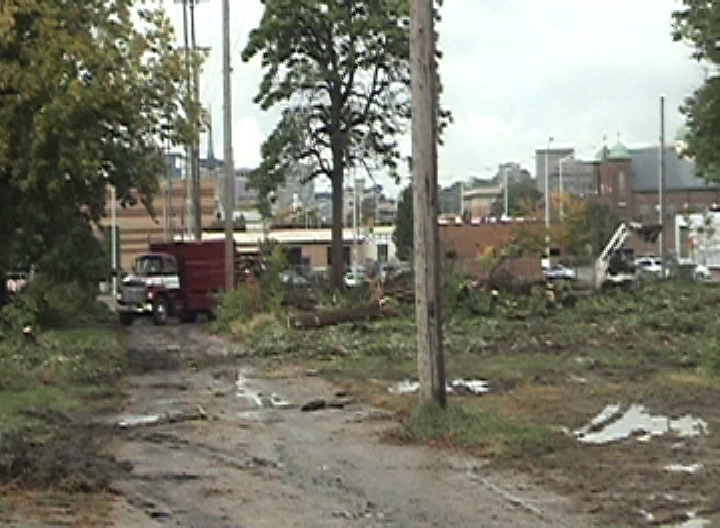
In the interest of full disclosure, the following information is about a development project that is taking place across the street from where I have lived for the past 27 years. The pictures you see here are a progression of the urban deforestation that has taken place in the past 24 hours.

Within the past 24 hours a crew of men have been working on the 400 block of LaGrave Avenue, which is located between Wealthy and Logan Street.
For the past 25 years this block of land has been mostly vacant, with a couple of houses being torn down during that time. Grass and clusters of full-grown trees have occupied most of the space within this city block.

Within these past 24 hours several dozen trees have been cut down and turned into mulch. Granted, there were a few trees that were dead or dying, but the bulk of the trees were healthy and provided a marvelous canopy in an otherwise concrete dominated area.
Over the years I have seen these tree be home to numerous small mammals and a host of birds. Every year there are hundreds of black crows that have used the cluster of trees as a stopping off point on their journey to who knows where. I have seen robins, cardinals, finch, blue jays and sparrows call this urban space home. There have even been times when both peregrine falcons and hawks have landed in this area, quiet possibly because of the large number of fully developed trees.

In addition, I have witnessed years of play that have taken part in this city block, with children climbing trees, neighbors eating berries from the mulberry tree and homeless men and women finding solace under them when seeking a respite from the hot sun.
In the past 24 hours almost every one of these trees have been cut down in preparation for a development project that will include residential and business construction. The development project is being undertaken by the Inner City Christian Federation (ICCF).

Earlier this year, while meeting with the executive director of ICCF, I asked what was going to happen to all the trees in the 400 block of LaGrave SE. He told me that they were all going to be cut down, because they were “ghetto trees.” The non-profit director went on to say that what he meant by this was that they were trees that just came up on their own, meaning they were not planted by humans.
Now, I don’t know about you, but trees don’t need humans. In fact, from an ecological point of view it is the other way around…….humans could not survive without trees.
I’m not against new housing being but across from the house I have lived in for 27 years, but I am not in support of development projects that unnecessarily cut down trees in the process. This is a sad day for Grand Rapids.
Three lessons from the fight to save Troy Davis
This article by by Eugene Puryear is re-posted from BlackAgendaReport.
“The Obama administration is silent on the most egregious violations committed on U.S. soil, aiding and abetting the execution of an innocent man.”
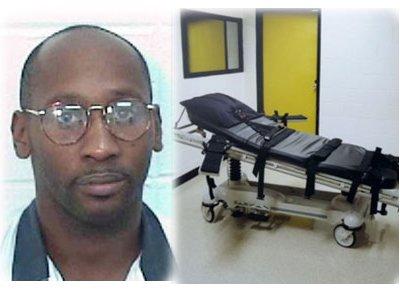
Troy Davis was executed on Sept. 21, pronounced dead at 11:08 p.m. Davis had been falsely convicted of the 1989 killing of a Savannah police officer.
 Since his trial, seven of the nine witnesses who had testified against Davis recanted their testimony. Five witnesses signed affidavits asserting that they were coerced by the police. Three individuals said that another man, Sylvester “Redd” Coles, confessed to them that he committed the crime. The case against Davis lacked any physical evidence—no murder weapon, fingerprints or DNA evidence were ever presented.
None of that stopped the State of Georgia from taking the life of an innocent man.
In the weeks preceding the execution date, over 1 million people signed a petition; many more made phone calls and sent emails to local, state and federal officials demanding that they save the life of Troy Davis.
Students from Howard University in Washington, D.C., held rallies Sept. 16 and Sept. 21—the scheduled execution date. Hundreds of Howard students marched following the Sept. 21 campus rally and gathered at the White House, joined by other Davis’ supporters. Continuing to demand a stay of execution, at least 12 students were arrested.
“In the weeks preceding the execution date, over 1 million people signed a petition.”
When an announcement came minutes before the execution that the Supreme Court had granted a temporary reprieve delaying the execution, the demonstrators militantly marched to the Supreme Court to demand justice, holding a picket until the court’s decision was announced and the execution was carried out. Hundreds remained until after midnight, some of them having been in the streets for 12 hours, speaking out about their experience and plans to continue the struggle.
Despite this determined effort, repeated in cities across the United States and throughout the world, the Supreme Court allowed the execution to go ahead.
While there is much to be said about the case and the implications of the Save Troy Davis struggle, here are three lessons worth highlighting:
1. We are not living in a “post-racial” society
We can finally lay to rest this tiresome phrase.
The case of Troy Davis is at the intersection of race and class in the United States. The cops who coerced witnesses in the Troy Davis trial knew the odds were stacked in their favor. Georgia does not guarantee counsel for death row inmates, making it harder for poor defendants to properly mount appeals. According to the American Bar Association, those convicted of killing white victims in Georgia are 4.5 times more likely to be sentenced to death than those convicted of killing Black victims.
What these cops knew was the true essence of the criminal justice system. The death penalty and other “law and order” methods are political tools. They send a chilling message to the most oppressed sectors of society—primarily Black and Latino working-class communities—meant to discourage any resistance to their own oppression.
2. President Obama won’t save us
President Obama said it was “inappropriate” for him to “weigh in” on the Troy Davis case because it was a “state” issue. Seriously? In 2009, Obama weighed heavily against the trial of a woman in Iran that the United States government claims was innocent. The U.S. president can take a stand against an alleged injustice in another sovereign country, but not against a proven injustice in a U.S. state?
The White House raises the banner of democracy, freedom and human rights as a weapon against those governments it seeks to replace. The Obama administration and U.S. officials are brimming with quotes of condemnation against its targets abroad, yet are silent on the most egregious violations committed on U.S. soil, aiding and abetting the execution of an innocent man.
That is the true role of the U.S. president: the protector, the commander-in-chief of this corrupt system. Obama could have taken a stand for justice, but instead he stood by silently as Troy Davis was killed.
3. The fight-back movement is on
The fight is not over. Troy Davis’ executioners cannot be allowed to escape scot-free. There are many Troy Davises across the country, both in prison and outside. This is the time to escalate the struggle, to take the spirit of the fight to save Troy’s life and turn it into a mass fight-back movement against racism and the system of class oppression that depends on it.
The upsurge to save Troy Davis’ life is part of a rebellious undercurrent. From the massive immigrant rights’ movement in 2006 to the Jena 6 struggle in 2007 to the labor battle in Wisconsin this past winter, the fight to save Davis was a glimpse of potential, a signal of militant rejection of the suffering and oppression afflicting working people in this country.
Moving forward from here, we must turn the fight around Davis’ life into a general struggle against racism, oppression and exploitation. Troy Davis did not die in vain.
Health Insurance Industry Opens Check Books for Mitt Romney, Barack Obama
This article is re-posted from Opensecrets.org.
Research by the Center for Responsive Politics shows that President Barack Obama and his GOP rival Mitt Romney, the former governor of Massachusetts, are the only two presidential candidates to have raised more than $40,000 from the health insurance industry so far this election cycle.

As of June 30, the date of the most recent campaign finance reports, Romney edges out Obama in terms of money raised, $43,750 versus $42,675, the Center’s analysis indicates.
Both men have favored health care policies that include an individual mandate for people to purchase private insurance plans. Romney did so as governor of Massachusetts, and Obama did so as part of the health care reform package he signed into law last year — a package that did not include a public insurance option to compete against private plans, as many liberals hoped it would.
Such mandates are supported by the insurance industry, which stand to benefit from increased customers as well as from government subsidies that help enroll people who could not otherwise afford insurance.
Romney, in fact, has received more than five times as much money from the health insurance industry than any other GOP presidential candidate, according to the Center’s research.
On the campaign trail, Romney has stood behind his Massachusetts policy, while arguing that Obama’s plan is unconstitutional because of the individual mandate from the federal government.
As Romney recently told Fox News host Bill O’Reilly: “States have the right to mandate. That’s why states mandate kids go to school. The federal government can’t do that. States mandate you have to buy auto insurance. The federal government can’t do that.”
Romney has also pledged to repeal Obama’s health care overhaul — which, like many Republicans, he calls “Obamacare” — on his first day in office.
On his first day in office, according to Romney’s campaign website, he will “issue an executive order paving the way for waivers from Obamacare for all 50 states. Subsequently, he will call on Congress to fully repeal Obamacare and advocate reforms that return power to the states.”
As governor of Massachusetts, Romney endorsed a health care policy that mandated insurance coverage for all, targeting specifically the 10 percent without insurance. The 2006 bill was largely a success. A 2010 study (.pdf file here) found that 98.1 percent of Massachusetts residents were insured and 99.8 percent of children had coverage.
Behind Romney, the Center, found that ex-Sen. Rick Santorum (R-Pa.) and former Speaker of the House Newt Gingrich ranked as the No. 2 and No. 3 beneficiaries of health insurance money in the GOP presidential field.
They have raised $8,500 and $8,250, respectively, from health insurers, according to the Center’s analysis.
Before joining the “repeal Obamacare” bandwagon, Gingrich, like Romney, previously supported individual health insurance mandates and subsidies to help low-income Americans afford private insurance.
Santorum, who also wants to “repeal Obamacare,” was also the first 2012 presidential candidate to criticize a June decision by the Sixth Circuit Court of Appeals to uphold Obama’s health care law.
“It is deeply disappointing,” he said, “to force the average American to submit their most personal decisions — their healthcare choices — to the government.”
Back in 1993, Santorum sponsored the Comprehensive Family Health Access and Savings Act with then-Sen. Phil Gramm (R-Texas), which would have provided assistance to low-income Americans to purchase health insurance but did not include an individual mandate — an idea that many Republican lawmakers backed as an alternative to health care reforms championed by the Clinton administration.
Gramm and Santorum’s legislation never made it out of committee.
Notably, Santorum is the only presidential candidate to whom health insurers represent more than 1 percent of the money he has raised.
Meanwhile, Rep. Ron Paul (R-Texas), who proposes a free market-based insurance approach, has raised $2,250 from health insurers, according to the Center’s research. And Rep. Michele Bachmann (R-Minn.), who also claims Obama’s health care reforms are unconstitutional, has so far raised $500 from health insurers.
Here is a table showing how much money each presidential candidate has raised from the health insurance industry as of June 30:
|
Candidate |
Party |
Total |
| Mitt Romney | R |
$43,750 |
| Barack Obama | D |
$42,677 |
| Rick Santorum | R |
$8,500 |
| Newt Gingrich | R |
$8,250 |
| Ron Paul | R |
$2,152 |
| Herman Cain | R |
$1,250 |
| Michele Bachmann | R |
$500 |
Texas Gov. Rick Perry, too, has threatened to wipe out “Obamacare” with an executive order if he is elected president.
But back in 1993, when Perry was the agriculture commissioner in Texas, he showed support of the emerging “HillaryCare” reform bill in a letter to then-First Lady Hillary Clinton. At the time, critics were already calling the Clinton initiative “socialism.”
As governor of Texas, Perry has battled the rising need for Medicaid in his state, where more than a third of the children are dependent on the program. The New York Times reports that Texas state agencies have accepted nearly $20 million in grants authorized by Obama’s health care law.
Moreover, the Texas health industry has a strong donor base that could help Perry. Research by the Center shows that Texas health professionals donated $7.7 million to federal political candidates and committees during the last election cycle.
Perry’s presidential campaign has not yet filed any campaign finance reports with the Federal Election Commission. Third-quarter reports are due to the FEC in mid-October.
For his part, Obama has attempted to brush off criticism of his health care reform overhaul.
“I have no problem with folks saying ‘Obama cares,'” Obama said last month at an event in Minnesota, not far from the renowned Mayo Clinic. “I do care… If the other side wants to be the folks that don’t care, that’s fine with me.”
In addition to requiring individuals to have health insurance plans, Obama’s health care law requires insurance companies to stop discriminating in their coverage based on people’s pre-existing conditions and it prohibits insurance companies from dropping your coverage if you get sick.
Additionally, the law allows children to stay on their parents’ health insurance plans until age 26, closes the Medicare Part D prescription drug “donut hole” and makes preventive care such as physicals and mammograms free, among other changes.
City Commission approves expansion of harm reduction efforts by the Grand Rapids Red Project
This morning the Grand Rapids City Commission approves a request by the Grand Rapids Red Project to expand its harm reduction services in the community. According to request the community-based group will “expand its currently existing syringe exchange program, for the purpose of reducing the spread of HIV / AIDS and other communicable diseases, among individuals who inject drugs by use of needles.”
The Commission approved the request unanimously, in part because the Red Project had substantial support from the community. The Commission had copies of letters from Heartside Ministries, former Mayor John Logie, Cares, the Michigan AIDS Coalition, Network 180, Pub 43, Life Guidance Services, Arbor Circle, the Kent County Health Department, The LGBT Network of Western Michigan and several area churches.
The other major factor in getting the approval is the impressive track record that the Red Project has in reducing and preventing drug overdose in Kent County. In a letter to the City Commission, Director of the Red Project Steve Alsum wrote, “According to the Michigan Department of Community Health, when Clean Works first received permission to operate, approximately 25% of all people with HIV/AIDS living in Kent County had contracted the disease through behavior related to injection drug use. As of April 2011, again according to the MDCH, only 10% of people living with HIV/AIDS in Kent County have contracted the disease through injection drug use.”
The Red Project staff is excited about the support from the City as they have plans to expand their services to areas of the City where injection drug use is prevalent. Alsum believes that they will be even better equipped to reduce the number of people who die from drug overdose, thus fulfilling their mission of harm reduction.
One Kent Proposal reviewed and discussed at GR City Commission meeting
This morning the Grand Rapids City Commission addressed ongoing concerns around the One Kent Coalition proposal to create a new regional government body.
The One Kent Coalition is moving forward in their pursuit to get the proposed legislation introduced in the State House before the New Year, but Grand Rapids Mayor George Heartwell wishes they would change course. “I want to use this public forum today to urge the One Kent group to step back and work with local governments, instead of moving forward with the State legislation.”
Other City Commissioners expressed concerns as well. Second Ward City Commissioner Rosalynn Bliss said she is not convinced that the proposed legislation would be good for the community, “it’s too partisan and it gives to much power to the Executive Officer.” Bliss is referring leadership position in the proposed One Kent legislation, where the new metropolitan government would be run by a CEO. Ruth Kelly echoed these comments by saying it is important to have as much transparency as possible and to avoid a government structure that would great more polarization with partisan influence.
In addition to the commission’s comments, there was a presentation by City staff and two lawyers who agreed to review the One Kent proposal. A 12 – page memorandum was submited that outlines 58 different aspect of the One Kent proposal that the review committee raised questions about. Some of these questions dealt with the executive power that the metropolitan leader would have, the lack of clarity on collective bargaining agreements for government employees, the districting process, the new government’s relationship to the existing city charter, the large number of political appointments and how this proposal would be voted on.
The observations in the review that were presented are both important and relevant for the City to move forward on how they deal with issues of possible consolidation. In addition, the review of the proposed legislation again makes clear that there are numerous undemocratic aspects of the One Kent proposal, which should need to be exposed and debated before any legislation can be adopted.
One side note worth reporting is that the City Commission adopted a resolution to fund a study with Grand Rapids, Kentwood and Wyoming on the possibility of consolidation of police and fire services between these three local governments. The total cost of the study is $265,000, with the City of Grand Rapids contributing $69,000.
More importantly, there are three private entities contributing significantly to the study of local government services consolidation – the Richard & Helen DeVos Foundation ($50,000), the Grand Rapids Community Foundation ($50,000) and the Frey Foundation ($27,000). This should raise flags for anyone paying attention, since both the DeVos and Frey families are members of the One Kent Coalition. The funding that both of these foundations provide should raise the question, is there are conflict of interest with funds coming from families that have a vested interest in seeing local government consolidation happen?
Nobel Peace Prize Winner Wangari Maathai Dies at 71
This is a repost from Our Kitchen Table
 The obituary on Democracy Now reads, “Wangari Maathai, the first African woman to win the Nobel Peace Prize, died Sunday after a long struggle with cancer. She was 71 years old. In 1977, she spearheaded the struggle against state-backed deforestation in Kenya and founded the Green Belt Movement, which has planted some 45 million trees in the country. She has also been an outspoken advocate for women’s rights and democratic development. She won the Right Livelihood Award in 1984. Twenty years later, she won the Nobel Peace Prize.”
This writer posted the following Indy Media story after Maathai’s 2007 visit to Grand Rapids.
Wangari Maathai at Fountain Street Church
“Every one of us needs ten trees to take care of the carbon dioxide we breathe out. We should know where our ten trees are. Or, are you using somebody else’s trees?” Wangari Maathai
2004 Nobel Peace Prize laureate, Wangari Maathai opened her lecture with observations on the biblical creation story as told in the book of Genesis. She noted that every day, after making another aspect of the environment, the creator commented, “It is good,” except for the last day, the day humanity was created. “We have convinced ourselves we are more important than the rest of creation,” Maathai said. “But, we cannot live without trees. They can live without us.”
Maathai believes that because we have higher intelligence, we have a moral responsibility to ensure that other species survive. She applied that belief in Kenya, where as a young biologist she was studying the tic’s role in East Coast Fever, a fatal epidemic killing hybrid cattle. Her fieldwork led her to observe that Kenya’s environment had been degraded. Because of deforestation upstream, fertile topsoil was filling the rivers as silt; rainwaters were washing away into lakes and the ocean instead of returning to groundwater reservoirs; and, rivers were beginning to dry up.
“This was much more dangerous than the tics,” she said.
Then, in 1975, her work with the National Council of Women of Kenya opened her eyes to the serious issues facing Kenya’s women: they did not have enough wood for household energy; they did not have clean drinking water; they did not have nutritious food; they had no ways to generate income. Maathai’s solution “Let us plant trees.”
“We went to the foresters and asked, ‘Can you teach us how to plant trees?’ This is difficult when the people are illiterate and a professional tried to teach you. To cut a long story short, we teach ourselves, use our common sense, our woman sense. Forget the foresters. We started teaching ourselves how to grow trees.”
Much of Kenya had been clear-cut; the British had introduced pines and eucalyptus that drank too much water and dried out the land. “We wanted to restore indigenous vegetation, biodiversity. It’s a campaign we are till carrying out,” she shared.
 Maathai encouraged groups of women to plant trees “whichever way.” The women collected native seeds, planted them in all sorts of cast-off containers and nurtured the seedlings till transplanting them. The women earned money for each seedling planted, generating income for themselves. The new forests help provide wood for energy and stifle the erosion that has robbed farms of topsoil and rivers of clean water. The women taught other women how to be “Foresters without Diplomas.” Today, Kenya has more than 7,000 tree nurseries run by these women.
Though more than 30 million trees have been planted in Kenya, Maathai’s work is not done. When she began in the ’70s, 30% of Kenya was covered by forests. Only 2% is today. However, her work with the women became a catalyst for another change. As the women empowered themselves, and the people found their voices, many spoke out against Kenya’s dictatorial regime.
“If you do not live in a society that is democratic, that allows a minority voice to be heard, it is difficult to protect the environment,” Maathai said. “The freedom of movement. The freedom of assembly. The freedom of expression. The freedom of the press. You have all these freedoms. In a society like yours, you take for granted. When you are at their (the government’s) mercy, they are very pleasant. When you are free, you become troublesome.”
“To cut a long story short,” Kenya became a democracy in 2002; Maathai serves in parliament and as Assistant Minister for the Environment. But, she does not advise people to wait on their governments to take care of the environment.

Read Maathai's inspiring memoir.
“We can plant trees. Anybody can dig a hole. Plant a tree in that hole. Water it. Make sure it survives,” she said. “The government is the custodian of the environment. If the custodian is not doing his job, you fire him during elections.”
Today in Kenya, Maathai has undertaken a campaign to reduce the proliferation of plastic bags and packaging that is polluting Kenya’s cities, impacting its wildlife and creating an untold number of breeding puddles for malaria-infected mosquitoes. She is also working with the United Nations Environment Programme (UNEP) as Goodwill Ambassador for the Congo Basin Forest Ecosystem project–the goal, to plant one billion trees. She invited the audience to visit the Web site and get involved in the project. The Conga Forest, Amazon Forest and the South East Asian Forest are an important defense against the climate change that impacts all of us.
“It is the rich nations who really have to understand that, although the resources look like a lot around you, they are coming from people who are impoverished,” Maathai said. “Sooner or later, there will be conflict and it will affect us.”
 Grand Rapids Institute for Information Democracy