Occupy Harlem Campaign Launched
This article by Donna Lamb is re-posted from Black Agenda Report.
As Occupy Wall Street continues to galvanize America and numerous Occupy movements keep springing up in cities, towns and communities across the nation, it was only a matter of time before Harlem residents and activists took the bull by the horns and brought the initiative uptown.
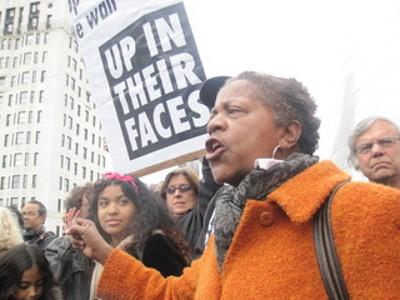
On the evening of October 28, about 150 people, many of them born and raised in Harlem, attended the first Occupy Harlem general assembly, held at St. Philip’s Church in Central Harlem. Nellie Bailey, who is with Harlem Fightback Against War at Home and Abroad as well as a member of the United National Antiwar Coalition, was a co-convener.
There were many proposals dealing with economics and jobs, including a request to endorse “Jobs for ALL,” a massive public works and public service program to create 25 million new jobs at union wages, to be paid for by new taxes on the wealth and income of the rich, on financial transactions, and on corporate profits.
Two political proposals sought endorsement of the Occupy Congress campaign to occupy the local offices of members of Congress unless they sign a pledge to vote down any proposed cuts to working people’s programs and for a congressional hearing in Washington, DC to address the second-class status of independent voters, which make up 41 percent of the electorate.
There were also important proposals regarding issues affecting Continental Africans, such as the Nuba Mountain peoples in southern Sudan, and people of African descent throughout the Diaspora, including Haiti.
“Occupy Harlem can only survive as a people’s movement with the direct involvement of the 99 percent to affect change,” Nellie Bailey said. “We need a radical transformation of the current status quo – the banks financing and controlling the political process, buying out politicians in both parties to protect the economic interest of the one percent. Poor and working class people in Harlem and throughout the country are suffering,” she continued. “We aren’t going to take it anymore. Occupy Wall Street is our blueprint.”
Joining Bailey was Black Agenda Radio commentator Glen Ford. “We can’t just wait for the people downtown in Occupy Wall Street to stand up for us. We must organize for our own economic and political defense,” he said.
Added Larry Adams of the People’s Organization for Progress, “We must take action because the recession in America is a full-blown depression for Black America.”
Focusing attention on one of Harlem’s grave concerns was guest speaker Carl Dix, national spokesperson for the Revolutionary Communist Party. He stressed the urgent need to end the NYPD’s “stop and frisk” policy that is harassing and humiliating countless innocent people.
Dix told of one Black young man who was stopped and frisked on his way to get some chicken. After the police officer found that the young man had no record, instead of just releasing him, the officer told him to do the chicken noodle soup dance and then he would let him go. “I don’t want to live in a country where our Black young men are treated like that,” declared Dix. “It is a burning injustice, and we want to tap into a supportive mood around resisting it and to link in with people who are trying to deal with it on other levels.”
The microphone was opened to all, and attendees eagerly came forward to propose a wide range of issues from the local to the international that they thought should be supported or endorsed by Occupy Harlem.
For instance, at the local level there were proposals to support the continued opposition to the planned 50-year expansion of Columbia University that threatens to take over Harlem; to endorse the struggle against the privatization of Harlem’s public housing; and to fight the closing of the Harlem post office, which will devastate many Harlemites who don’t have bank accounts and must rely on postal money orders to pay their bills. There was also a proposal to support Harlem’s community gardens that provide food, making the community less dependent on outside sources.
Along with the many issues proposed, there was robust discussion regarding procedures and a number of other items. Said Bailey: “As we feel our way in these uncharted waters, we recognize the need of the Harlem community to freely express itself. That is what we tried to do tonight instead of going by a format that others may use in their Occupy movements. As we move forward, we will work these issues out through a democratic and transparent process.”
At its next general assembly Occupy Harlem will begin considering the proposals voiced at this first meeting and organizing working committees, a crucial step forward to sustain and coalesce the movement.
Grand Rapids LGBT History – Businesses, Boycotts and Ordinances
It has been several months since the recent Holland City Commission decision to not include sexual orientation into the City’s anti-discrimination ordinance.
One of the first responses to this Holland decision from the LGBT community and their allies was to call for a boycott of Holland businesses. However, this decision quickly turned into a campaign of finding businesses that supported an LGBT inclusive ordinance and promoting them. According to the group Until Love is Equal, this tactic would send a message, “as non-supportive businesses watched customers going into other stores.”
In Grand Rapids, the campaign to get an LGBT-inclusive ordinance passed played out in a different way. The campaign to pass an ordinance began in 1991 after the Community Relations Commission recommended that the ordinance be updated to include “gender orientation” into the language.
The first time the ordinance was brought before the City Commission it was voted done 4 – 3, with lots of people at the first public hearing expressing their opposition to such an ordinance.
The LGBT community at that time did not call for a boycott of Grand Rapids businesses, nor did they seek out businesses, which supported the ordinance change. Instead, some in the local business community put together a list of those who also opposed the ordinance saying it was “contrary to the values of West Michigan.”

However, what is interesting about the businesses that actively opposed to the ordinance in Grand Rapids in 1991 was the fact that many of those in the original list actually were NOT opposed to the ordinance. The list that was provided to the Grand Rapids City Commission came from Mike Beckett, a man who worked for a local insurance agency. He submitted a list of 140 businesses he claimed were opposed to the ordinance, which members of the LGBT community at the time believed influenced the Commission’s decision.
Members of the LGBT community seemed to think that the list was not accurate and began contacting those listed to verify their stance on this issue. During this process they discovered that many of the businesses on the list did not oppose the ordinance and were never approached by Mr. Beckett about such a campaign against inclusion.
Once Mike Beckett was exposed for his deceit he made a formal apology to the Lesbian and Gay Community Network, which published his apology in their August 1991 newsletter. Once the group had verified the real list of businesses that opposed the ordinance they decided to publish that list in the September issue of the Network newsletter. It is worth noting which businesses and individuals were on that list (included here) from 1991, a list that now included just 59 entities.
After the accurate list was published there was no real push from the broader business community to oppose the ordinance, but there were some area families with significant wealth that made their opposition to equality for the LGBT community known by spending lots of money on campaigns to defeat such efforts. That is an issue we will explore in our next article on the Grand Rapids history of the LGBT community.
Included here is a 1991 archival news story on the first ordinance hearing that was defeated.
Yo Debbie! Listen to your constituents! Take a Stand!
Rally for Fair Farm Rules
Calder Plaza, Grand Rapids, MI
4:10 p.m. Thurs. Nov. 3
On Thursday, Food & Water Watch urges people from Kalamazoo and Grand Rapids to rally at Grand Rapids’ Calder Plaza to ask Senator Debbie Stabenow to support the Fair Farm Rules and Michigan’s small farmers. Stabenow, the Chair of the Senate Agriculture Committee, has so far refused to take a stand on the issue despite the fact that over the past two months, community members in Grand Rapids and Kalamazoo have gathered more than 2,500 postcards urging her to support the Fair Farm Rules.
The Fair Farm Rules prevent meatpackers from giving undue preference to large factory farms, which put small independent producers at an economic disadvantage. The new rules would:
- Stop price premiums and secret preferential contracts granted to cattle and hog factory farms.
- Prevent one buyer from representing multiple meatpackers at an auction. This practice effectively eliminates competitive bidding on livestock, which hurts small-scale producers.
- Prohibit retaliation against poultry growers who speak out about abuses.
- Protects poultry growers who make expensive upgrades and investments and prevents companies from requiring growers to make expensive upgrades to their facilities if they are in working order.
Michigan consumers and the environment lose out as small and midsize farmers are pushed out of business. We are left with fewer options for grass-fed and free range meat and poultry products as well as less access to meat, milk and eggs that are free of antibiotics and artificial hormones.
In addition, factory farming takes a terrible toll on Michigan’s environment and waterways. And, it’s only humane to  agree that animals farmed for our meat, milk and eggs should be allowed to live lives free of the constant pain, darkness and social isolation that is the norm on large factory farms. As small farms disappear, so will humane conditions for a growing majority of our fellow creatures.
The 2008 Farm Bill included new reforms to protect small and midsize livestock farmers, but those reforms are being blocked by a handful of large companies that dominate the meat and poultry industries.
Over the past five years, nearly 27,000 midsize independent family farms have been driven out of business nationally. Those remaining are squeezed by a market that favors big agribusinesses.
In June, Senator Stabenow hosted a public hearing on the Farm Bill in East Lansing that mostly involved Michigan based agri-business and agri-business associations. These entities and the clients they represent have been the recipient of billions in subsidies in the past 15 years as has been well documented by the Environmental Working Group.
Keeping Democrats on the Hook
This article by Alan Nasser is re-posted from CounterPunch.
Occupy Wall Street (OWS) represents a nationwide movement-in-the-making that is independent of the two-Party duopoly. Both the movement’s staying power and its effectiveness depend crucially on this independence. The established powers are fully aware of the dangers implicit in a truly popular democratic, i.e. independent of the two Parties, movement. It is therefore on our agenda to beware of colonization by the powers that be. No one worries about Republican infiltration. It is the Democrats who have the most to lose by OWS. We can be certain that the Party’s operatives will attempt to incorporate the movement into an agenda that does not challenge the legitimacy of the Democratic Party by, for example, underscoring Obama’s whole-hog subservience to Wall Street, and the Party leadership’s acquiescence to the president’s across-the-board betrayal of his once enthusiastic acolytes.
MoveOn has already moved in. An effective Fifth Column can waste no time. The organization responded immediately to OWS’s much publicized presence and broad appeal -polls show most Americans sympathetic to OWS- by forming local groups across the country and never identifying with the already existing OWS, which is at this point no more than the unorganized aggregation of its local assemblages. So far OWS has no clear agenda, no pointed set of demands, nor a clear notion of the sanctions an effective movement would impose if whatever demands are ignored. These are the circumstances we expect a savvy mole to exploit.
MoveOn is a force to be reckoned with. It has developed a sizeable following and an effective communications network. Its principal bad guys are the Republicans; nowhere in its message do we find a statement of preconditions for electoral support of Democratic candidates. The premises implicit in MoveOn’s stance are three: the exclusive objective of big politics is to win elections, no one but a Republican or a Democrat stands a chance of winning a presidential election, and the Republican will always be worse than the Democrat. From these (defective) premises the conclusion does indeed follow that supporting Democrats goes without saying. In fact, it follows that we need not know anything more about a Democratic platform than that the Republican will be worse. MoveOn has bought a subscription to Democratic politics with an obligatory renewal clause.
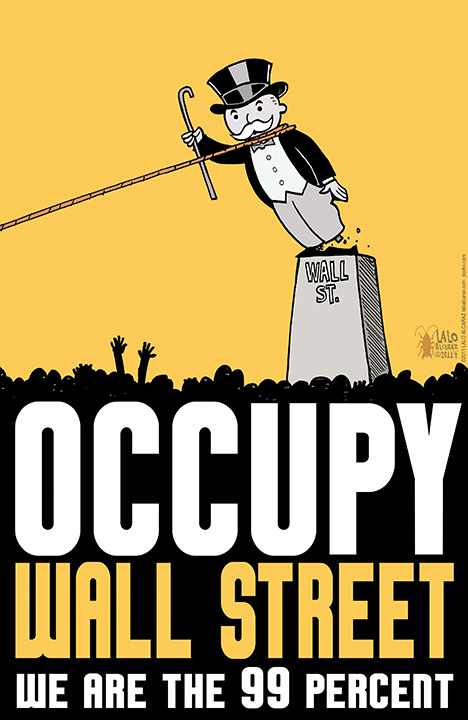
The organization is in effect an arm of the Democratic Party. It creates a political space in which activists who might otherwise be building a Left political alternative to the Democrats can be seduced to remain in the Party. Accomplishing this goal has never been more urgent to the Democrats than it is now. Disaffection with Obama and the Party is rampant in liberal circles. But MoveOn’s meetings will never conclude that the Democrats’ performance demonstrates that working within the Party will not move us away from Uncle Sam’s multiple wars or toward national health care and a reversal of the tendency toward widening inequality.
Is it possible that deindustrialized, financialized American capitalism is incapable of delivering on the New Deal and Great Society promises that define postwar liberalism, much less on the demands of genuine Left egalitarianism? Could it be that the liberal-conservative, Republican-Democrat alternatives are now politically obsolete? Surely the historical moment has arrived when these questions are up for serious consideration. OWS could in principle address these issues by virtue of its independence of the Parties. MoveOn will not touch them.
The Democratic Party will brook no independent political tendencies. It will marshall its forces on whatever scale necessary to discredit and defeat perceived Left challenges. The Howard Dean campaign of 2003-2004 is a paradigm illustration of the lengths to which the Party will go squelch independent tendencies out of step with the Party consensus.
Dean’s initial issues were health care and fiscal responsibility, but disenchanted Democrats siezed upon his opposition to the Iraq war as their principal rallying point around his campaign. Dean quickly appropriated the momentum of growing anti-war sentiment and took it online with great success. “We fell into this by accident,” Dean averred later. “I wish I could tell you we were smart enough to figure this out. But the community taught us. They seized the initiative through Meetup. They built our organization for us before we had an organization.”
An independent grass roots movement-in-the-making had appropriated Dean’s campaign. Its impressive gains were acknowledged by the Washington Post, which reported in 2003 that “His rivals grudgingly concede that Dean … has clearly tapped into something. He is attracting the largest crowds of the nine Democratic contenders… His supporters arguably are the most intense for this early in the process, tens of thousands of them self-organizing in about 300 cities once a month.” By September 2003 Dean was the leading fundraiser among the Democratic aspirants. The organizer of an earlier Republican online effort, the e.GOP Project, admitted that Dean’s base was “ahead in the game. . . . Left of center organizations are showing more energy, innovation and more strength in numbers.”
The effectiveness of Dean’s grass roots base is all the more impressive given his support for NAFTA, Medicare cuts, and his identification with the politics of the reactionary Democratic Leadership Council (DLC), whose operatives set out to defeat the disloyal upstart early in his campaign. Especially threatening to mainstream Democrats were the findings of polls showing most Americans in synch with Dean’s opposition to the war and therefore out of step with the Party leadership, which was solidly in the Clinton, New Democrat camp. Along with fundraisers for the Democratic National Committee, the DLC began running a series of ads attacking front-runner Dean for his position on NAFTA and Medicare, and for his NRA support. There was of course no mention of Clinton’s championing of NAFTA, nor of his pre-Lewinsky plans with Newt Gingrich to initiate the privatization of Social Security.
The major media were happy to jump onto the Democratic establishment’s attacks. They had started going after him the minute he made a campaign issue of breaking up the corporate media monoplies. Their coup de grace was the invention of “the scream”, Dean’s shout of exuberance intended to cheer up his supporters at a post-caucus rally after the Iowa primaries.
For a time after the Iowa caucus the airways were running the scream non-stop, encouraging the perception of Dean as a crazed nutcase. In context Dean’s shout was all of a piece with the crowd’s yelling and hollering. The television crews recorded the event by plugging into an audio source picking up Dean’s microphone, not the sound of the room. The cameras zeroed in on a tight shot of the candidate; the rest of the room was unseen. The media never provided the wide-angle visual-auditory shot until after the desired impression had been foisted upon viewers. As CBS news online put it after the damage had been done, “In a nutshell, you are not seeing that Dean’s speech fit the tone of the room.” Here we see the unsurprising dovetailing of the politics of both the media and the Party.
Equally unsurprising was Dean’s joining forces after his defeat with the very scoundrels who had worked so hard to bring him down. Mission accomplished: Dean was effectively reabsorbed into Democratic business as usual. The Party remained unchallenged from the Left.
OWS is comparable to the independent grass roots movement-in-the-making that put Dean’s campaign on the political map. But it has identified with no mainstream political figure. There is no individual personality to function as a whipping boy to discredit the entire movement. OWS itself will surely be the target of a sustained Party attempt either to discredit it altogether by character assassination or to keep it within the Democrats’ ambit by, for example, incorporating it into MoveOn. The movement will face the choice whether to remain independent of Democratic control or to become either an appendage of MoveOn or a marginalized grouping in the wake of MoveOn’s growing organizational effectiveness. Considerable political acumen is called for. How shall OWS retain its integrity while incorporating into its political program, such as it is, a determination to resist the sirens of MoveOn or any other arm of the Democrats? This is not a rhetorical question; I’m really asking.
I’ve belatedly made myself part of OWS. No one in the movement knows exactly where it is going. How could it be otherwise, given the number of disillusioned, angry and frustrated citizens motivated by a broad range of scandals – foreclosure, bankruptcy, a health care catastrophe, loss of the bulk of retirement savings, unbearable student debt and job loss? OWS does perceive all this as directly related to the economic crisis, the record inequality currently afflicting the citizenry, and the administration’s exclusive concern with protecting the cynical and lawless financial plutocracy. The gaping disconnect between Obama’s promises and his real-world performance has produced a profound sense of betrayal. No wonder that many are impelled to express in concert some form of resistance.
I stumbled onto MoveOn’s organization here in Tacoma when I misread an announcement and ended up not at an OWS meeting but at MoveOn’s initial gathering. The people were seated, much like an audience, in front of a table where the two MoveOn representatives were signing people up. One of the reps was on the staff of Washington Democratic Representative Adam Smith (sic).
The MoveOn representatives were in charge. They announced that the group would be divided into seven smaller discussion groups. The two reps instructed the groups that they had twenty minutes to come up with a brief list of concerns. After this, a representative from each group would state his/her group’s main issues. These would be written out by one of the MoveOn reps and displayed for all to see. From these combined lists the group would select the issues to adopt as its own. It’s worth mentioning that while there were no students present, five of the seven groups listed the student debt burden as among their priorities.
When it came to our group’s list, one of us, a plumber, stated our three concerns: should we adopt an overarching slogan, like Ban Derivatives Trading or Reinstate Glass-Steagall (everyone in my group, composed of retirees, wage earners and small businessmen, knew what Glass-Steagal was), to write down or forgive entirely student debt, and whether our group should maintain its independence of the two Parties. The third concern was not displayed by the rep.
Another member of our group asked why the independence concern was not acknowledged, and by the way, why should we not join the OWS people who were at this moment occupying a park on Tacoma’s main drag. Is there any reason why we should not be united? The rep replied that OWS and “our” group were “two different organizations.” But why, another asked, should that make any difference to an issue on which the two organizations are in accord. “Well,” replied the rep, “there are many different unions aren’t there? It’s the same thing.” “Sure,” I chimed in, “but a company union is not really a union.” End of discussion, the reps decided.
At the time of that meeting, the majority of Democrats on the congressional Joint Select Committee on Deficit Reduction, the “supercommittee” whose principal agenda is to recommend the largest cuts in social spending they think they can get away with, had not yet announced its plan. Their announcement at the end of October turns out to be well to the right of the recommendations of the first incarnation of the deficit reduction committee, the National Commission On Fiscal Responsibility and Reform. Obama appointed as co-chairs of that bipartisan team the fiscal conservatives and privatizers Erskine Bowles, at the time a director of Morgan Stanley, and retired Republican Wyoming senator Alan Simpson. Most of the remaining committee were ideological clones of the co-chairs; the Commission was a stacked deck. The day before his appointment Bowles said to The New York Times “There isn’t a single sitting member of Congress – not one – that doesn’t know exactly where we’re headed.” The same day, Simpson remarked to the Washington Post “How did we get to a point in America where you get to a certain age in life, regardless of net worth or income, and you’re ‘entitled’? The word itself is killing us.” (Feb. 17, 2010)
The Bowles-Simpson proposed cuts in social spending were as expected: $383 billion from Medicare and Medicaid. But the current Joint Select Committee Democratic majority beats that by $92billon; they’d slash a total of $475 billion. And they recommend about $850 billion less in revenue increases than Bowles-Simpson. The current Democratic plan features greater Medicare beneficiary cuts ($200 billion)than B-S and is eight times the level of Medicare beneficiary cuts recommended in Obama’s September 19 budget plan. The Center on Budget and Policy Priorities notes that “Since half of Medicare beneficiaries have incomes below about $21,000, it would be extremely difficult to secure $200 billion in savings from increased Medicare beneficiary charges without requiring significantly larger out-of-pocket payments by beneficiaries with incomes as low as $12,000 or $15,000.”
It is not enough to point out with due indignation that, in the words of an October 31 statement from the AFL-CIO, “Republicans and Democrats on the federal deficit “Super Committee” have called for big cuts to Social Security, Medicare and Medicaid. AFL-CIO President Richard Trumka says the AFL-CIO stands firm against cuts to these essential middle-class programs.” Of course both Republicans and Democrats want a reduction in the social wage, but the significance of the present Democratic stand is its more draconian recommendations relative to the predetermined reactionary position of B-S. Nor are we persuaded by our MoveOn liberals’ rejoinder that the Republicans dismiss the Democrats’ plan and demand even greater cuts. So what? Whatever the Democrats put forward, however poisonous it may be, the Republicans will always, on principle, demand something worse. Piling invective on the Republicans is not unworthy, but in this context it’s a distraction.
Keeping the Democrats on the hook should be implicit in whatever pointed demands OWS might come up with. That won’t happen if MoveOn has its way.
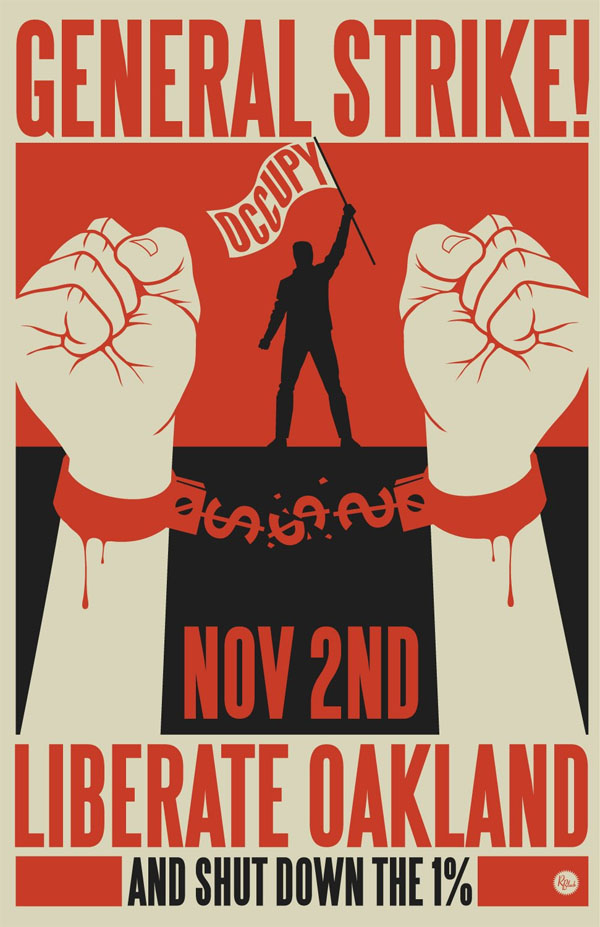
At last night’s general assembly meeting it was decided that Occupy Grand Rapids would have a march/rally in solidarity with the General Strike action being planned in Oakland, CA tomorrow in response to the police brutality against Occupy Oakland.
Here is a statement from Occupy Oakland on the General Strike:
We as fellow occupiers of Oscar Grant Plaza propose that on Wednesday November 2, 2011, we liberate Oakland and shut down the 1%.
We propose a city-wide general strike and we propose we invite all students to walk out of school. Instead of workers going to work and students going to school, the people will converge on downtown Oakland to shut down the city.
All banks and corporations should close down for the day or we will march on them.
While we are calling for a general strike, we are also calling for much more. People who organize out of their neighborhoods, schools, community organizations, affinity groups, workplaces and families are encouraged to self organize in a way that allows them to participate in shutting down the city in whatever manner they are comfortable with and capable of.
The whole world is watching Oakland. Let’s show them what is possible.
Occupy Grand Rapids is inviting people to join them at 4pm on Wednesday, November 2 at the corner of Division & Fulton at Monument Park. The intent is to march to locations in Grand Rapids where police brutality has occurred in this community as an act of solidarity with those who have suffered from police brutality recently in Oakland.
For any updates on this action check out Occupy Grand Rapids page on Facebook. In addition, we would encourage people to read the Seven Myths about the Police.
Angela Davis addresses Occupy Wall Street

Two days ago long time activist, revolutionary and author Angela Davis addressed Occupy Wall Street during a general assembly meeting.
Angela Davis is the author of eight books and has lectured throughout the United States as well as in Europe, Africa, Asia, Australia, and South America. In recent years a persistent theme of her work has been the range of social problems associated with incarceration and the generalized criminalization of those communities that are most affected by poverty and racial discrimination.
She draws upon her own experiences in the early seventies as a person who spent eighteen months in jail and on trial, after being placed on the FBI’s “Ten Most Wanted List.” She has also conducted extensive research on numerous issues related to race, gender and imprisonment. Her most recent books are Abolition Democracy and Are Prisons Obsolete? She is now completing a book on Prisons and American History.
In 1988, the Lesbian and Gay Community Network set out to organize the first Pride Celebration in Grand Rapids.
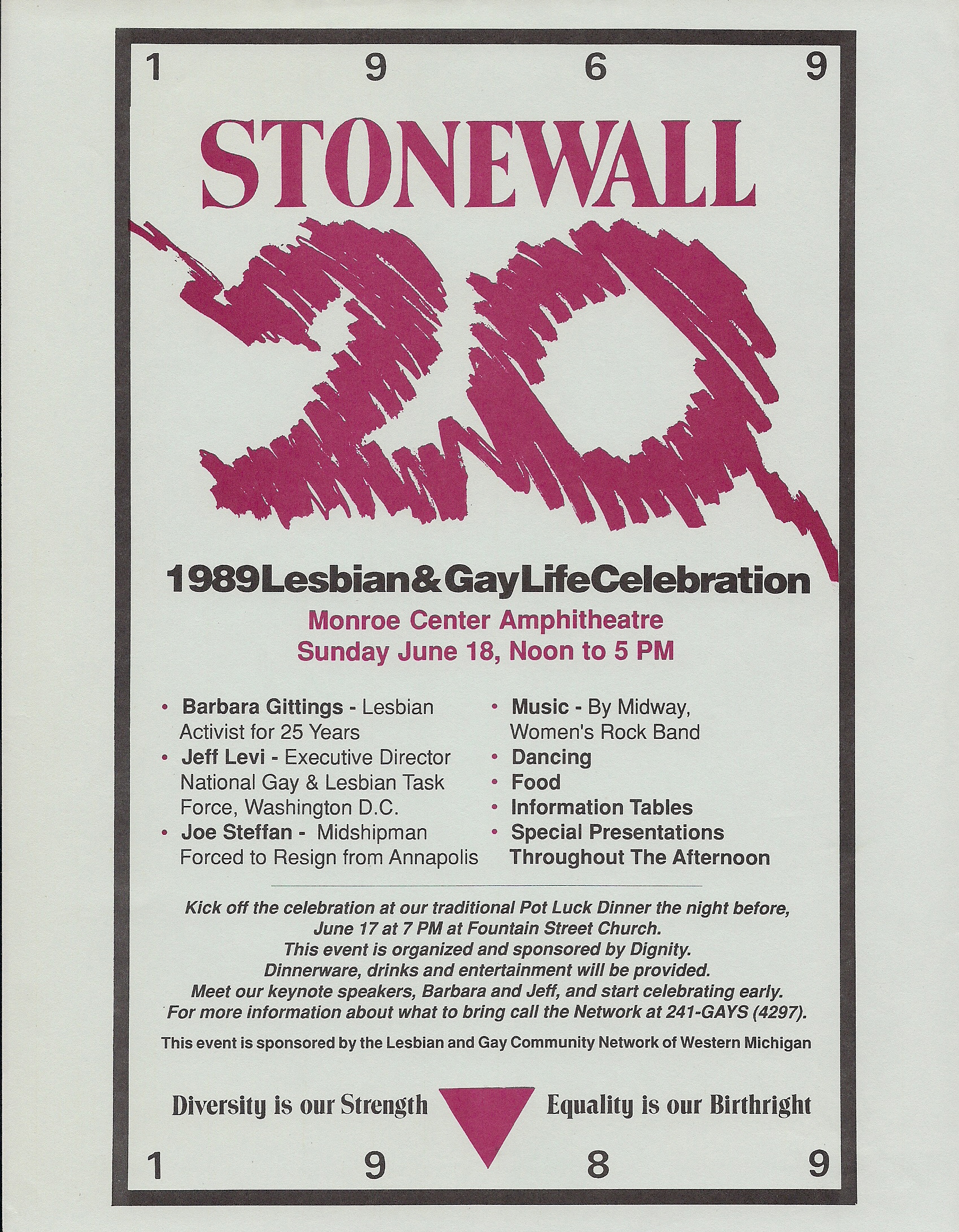
The group sent a request to Grand Rapids Mayor Gerald Helmholt asking that he provide a Mayoral Proclamation in support of the inaugural event. Helmholt denied their request saying it was too controversial for him to endorse.
In 1989, The Network tried again to get a Mayoral Proclamation and again Helmholt denied such a request. Members of The Network attended a City Commission meeting on June 6, 1989 asking for the proclamation. The Network Newsletter documented that event and cited several members who spoke during the commission meeting.
Network members reminded the Mayor that this was the then 20th Anniversary of the Stonewall uprising and that Gay and Lesbians deserved equal rights and recognition. Rev. Bruce Roller responded to Helmholt’s denial for a Mayor Proclamation by saying, “I’m real angry and real tired of having our God’s name to oppress lesbians and gays.”
In that same issue of the Network News the group pointed out that Mayor Helmholt had granted at least 119 proclamations since the group’s first request in 1988. Among the groups/events that Helmholt wrote proclamations for were: Michigan Beverage News Week, Family Sexuality Education Month, Polish Heritage Month, National Roofing Week and Bozo Show Day.
Let us never forget this history!
Join us for the premier screening of A People’s History of the LGBTQ Community in Grand Rapids on Thursday, November 17, 6:30PM at the downtown campus of GVSU. See our Facebook event page for details.
Here is a WOOD TV 8 interview with Mayor Helmholt in 1988 who stated that he denied proclamations to other groups besides Gays and Lesbians, namely Nazis.
Some frightening facts from Washington
This article is re-posted from iwatchnews.org.

If you really want to put a fright into the neighbors this weekend, forget the plastic lawn decorations. Instead, read them this bedtime story about how 40% of Medicare-funded cancer screenings are medically unnecessary . Or this one, about the 876% annual interest rate some “payday” lenders have used. As our treat to you this Halloween weekend, we’ve compiled some of the most scary statistics iWatch News has uncovered this year. Read at your own risk.
Frightful facts
| 1,998 firearms | The Bureau of Alcohol, Tobacco, Firearms and Explosives allowed to pass from weapons dealers to gun runners during a 15-month period. By John Solomon, David Heath and Gordon Witkin |
| 4,300 lives | Could have been saved annually if President Obama had allowed recommendations from the EPA for air quality regulations. By Corbin Hiar |
| 184 bundlers | Number of President Obama’s 2008 fundraisers ($50,000 or more, 556 in total) who were appointed to a key administration position, won a government contract or received similar ‘social’ incentives. By Fred Schulte, John Aloysius Farrell and Jeremy Borden |
| 2,000 lbs. | Amount of mislabeled fish product, previously deemed ready for sale, that was pulled from El Corte Inglés store shelves across Spain. By Mar Cabra, Marcos Garcia Rey and Kate Willson |
| 50 refineries | That continue to use dangerous hydrofluoric acid, putting workers and 16 million Americans who live nearby at risk. By Jim Morris and Chris Hamby |
| $1.5 billion | The Department of Defense’s estimated cost of bringing its accounting practices (for an annual budget of $671 billion) to a ‘reliable’ level. By R. Jeffrey Smith |
| 2.9 million | Number of Americans whose clean drinking water would be affected by the proposed Keystone XL oil pipeline that would stretch across the U.S. By Corbin Hiar |
| 29 doctors | Gathered to set the cost of more than 200 different Medicare-funded medical procedures. By Joe Eaton |
| 1,673% | The markup charged to the U.S. Army by defense contractor Boeing for a helicopter part worth $190 — they paid $3,369.48. By Ben Wieder |
| $2 billion | Portion of the Department of Defense’s budget that is used to fund U.S. involvement in Iraq, each week. By Sandy Johnson |
| 876% | Maximum annual interest rate charged until recently for a high-cost “payday loan” at Mountain America Credit Union. Controversial high-cost payday lending continues at 14 other non-profit credit unions. By Ben Hallman |
| 73% | The increase in usage of limousines for transportation by the Obama administration over the previous Bush administration. By Joe Eaton |
| 40% | Portion of Medicare-funded cancer screenings that are medically unnecessary. By Rochelle Sharpe and Elizabeth Lucas |
Recent Central American History focus of forum at GVSU 11/3

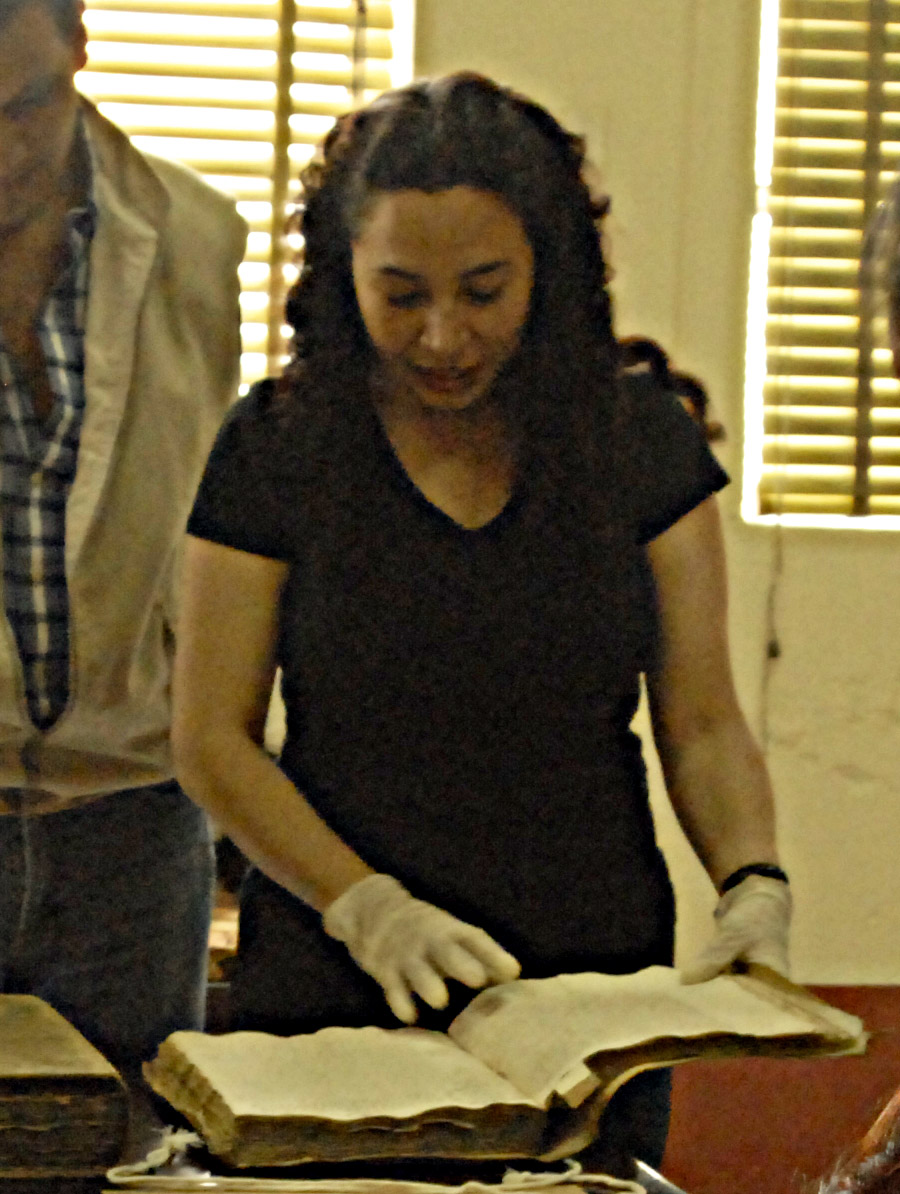
The Latin American Studies department at GVSU is hosting a day-long event this Thursday entitled Power, Justice and Public Memory in Central America.
The one-day colloquium bringing to GVSU two historians and archivists: Prof. Dario Euraque, former Director of the Instituto Hondureño de Antropología e Historia y Lic. Anna Carla Ericastilla, the current Director of theArchivo General de Centroamérica.
Dr. Darío Euraque, a former Director of the Instituto Hondureño de Antropología e Historia and currently Professor of History at Trinity College in Connecticut, is going to talk about his recent work on the “Military Coup 2009”, and “El patrimonio cultural e identidad nacional de Honduras.”
Lic. Anna Carla Ericastilla will talk about the work of the Archivo General de Centroamérica in uncovering and reconstructing the account of US-led medical experiments in Guatemala in 1946-1948.
The schedule for the Thursday, November 3 event is:
9:30 am-10:00 am Welcome (Refreshments served)
10:00 am-11:15 am Session 1: Darío Euraque, a presentation on his recent work on the cultural patrimony and national identity in Honduras in light of the 2009 military coup (http://www.trincoll.edu/~euraque/).
11:15 am – 12:45 pm Break and Lunch
1:00-2:15pm Session 2: Anna Carla Ericastilla, a presentation on how the Guatemalan national archives responded to the revelations of US-conducted medical experiments in Guatemala in 1946-1948.
2:30-3:45 pm Session 3: José Lara, Heidi Fegel, Andrew Schlewitz, Outside Looking In: US researchers reflect on recent experiences in Central America
4:00-5:15 pm Session 4: Anna Carla Ericastilla, Darío Euraque. Inside Looking Out: Central American archivists reflect on how international researchers have used their countries’ public memories.
5:15-5:45 pm Informal Q & A
Location: Kirkhof Center, Room 2215/2216 – Allendale Campus
This event is free and open to the public.
Earlier this week Newsweek announced its 2011 Corporate Green Rankings, with Michigan-based appliance corporation Whirlpool ranked at number 285.

This announcement was plugged on MiBiz’s weekly e-newsletter, which just linked to a Whirlpool Media Release. Whirlpool spokesperson Jeff M. Fettig stated, “For decades Whirlpool Corporation has led the industry in higher appliance efficiency standards, lower greenhouse gas emissions and a smaller carbon footprint. This recognition is a testament to these commitments.”
But what exactly does all this mean in concrete terms? Newsweek has a methodology for determining their Green Ranking, but it is rife with limitations. More importantly, it starts with the premise that corporations are benign and can contribute to environmental sustainability by making certain adjustments. In other words, Newsweek does not question what these companies make nor the political/economic influence they have in the world.
Just look at the graphic for Newsweek’s online Green Ranking to give you an indication of how absurd this all is. You have Ford Motor Company, which has manufactured a product for 100 years that is inherently destructive to the planet. Even if auto companies produce more electric cars, this is not a sustainable solution, but a way for them to continue to make money.
You also have computer/software companies like Dell, IMB and Hewlett Packard, all of which make profits off the mining of minerals for computer components, which means high volume water consumption for manufacturing.
However, one the most offensive of all Green Ranked companies is Bank of America, which is one of the main targets of the Occupy Movement. This just illustrates the limitations, even the absurdity of corporate rankings through such a narrowly defined “green” lens.
We can ill-afford to separate ecology, human rights, treatment of workers, gender justice, racism and LGBTQ rights from how we view institutions. By limiting our lens to just one aspect, we not only make it easy for corporations to fools us into think they can be agents of justice, we make it probable that we will not move in the direction of demanding systemic justice.
The absurdity of Whirlpool’s announcement of being on Newsweek’s Green Ranking is that at the same time they were patting themselves on the back with that award, Whirlpool was eliminating 5,000 jobs. The level of absurdity is amplified when one reads that the company’s “third-quarter net income more than doubled to $177 million, or $2.27 per share, from $79 million, or $1.02 per share.”
 Grand Rapids Institute for Information Democracy