March in Grand Rapids draws attention to current economic conditions

Earlier today, between 250 – 300 people gathered in downtown to march in what was billed as “The Death of the Middle Class.”
The event, organized by We The People, began at Calder Plaza, where led by a New Orleans-style band, people marched in black with coffins and tombstones signaling the death and suffering that working people are currently enduring.
People marched through various streets of downtown Grand Rapids and received honks of support, even though the foot traffic was minimal on this sunny fall day.
The march ended up back at the Calder Plaza where several speakers addressed the audience. Gert Hopson, a member of the UAW and Kent County Democratic Party, was the MC for the event.
The first person to address the crowd was Rev. Jones, a Black minister who was asked to give the “eulogy for the death of the middle class.” Rev. Jones spoke in overtly Christian language and even made the statement that the only way we can be saved from the assault by the rich is to turn to Jesus Christ. Rev. Jones’ comments were followed by a woman singing Amazing Grace.

The next speaker was someone with an unidentified union, who has been unemployed for years and spoke about the need for everyone to fight against all forms of slavery, particularly economic slavery.
Peter Vander Meulen, with the Christian Reformed Church, spoke about how his growing up in the Middle Class was destroyed when his father got cancer and had no insurance to cover the costs. He also mentioned that is was the government safety net which prevented his family from falling into poverty.
Vander Meulen was followed by Eric Foster who said he was with the Grand Rapids branch of the Urban League, the Mayor’s Task Force on Wage Theft and the local Black Caucus. Foster said that the current economic assault “was an attack on the dreams of our children.” Foster and other speakers directed people to the Action Table, where people could sign up for future announcements and register to vote. This lack of concrete action was one aspect of the gathering that was quite disappointing, since voting and getting your name on a listserve has not resulted in a challenge to the power structure that is waging a war against working people.
The last speaker, Azzizi Jasper, said that the crowd needed to figure out a way to harness their anger and direct it towards concrete actions. Azzizi then read a beautiful poem that spoke to the urgency of our collective need to fight for change. He also encouraged people to vote for the Grand Rapids Public School millage this coming Tuesday, November 8.

After the formal program was over, Cole Dorsey, a member of the Grand Rapids branch of the IWW then addressed people with a bullhorn and gave a different message. Dorsey said that there is no middle class in this country, just the ownership class and the working class and that this was something we all needed to acknowledge if we are ever going to make any lasting change. Dorsey berated the reformist approach that the Death of the Middle Class organizers were presenting by suggesting that voting, even if it was the lesser of two evils, would bring about change.
The IWW organizers said that politicians and business unions will never make change and that the only change has to come at the hands of the working class, especially when they organize in their place of work. Dorsey also advocate that working class people organize and implement a General Strike if we are really to put fear into the hearts of the rich and powerful of this country. He invited people to a meeting to learn more about the IWW and radical politics, Sunday night at 8:30pm.
What Would Steve Jobs Do?
This article by Peter Hart is re-posted from Fairness & Accuracy in Reporting.
On the Meet the Press roundtable on Sunday (10/30/11), talk turned to Steve Jobs. And, as one might expect from the avalanche of hero worship that accompanied news of his death, the chatter concerned how we might all one day live up to Jobs’ legacy.
Here’s host David Gregory, speaking to Tom Brokaw:
Tom, it’s interesting, author and journalist Jeff Greenfield tweeted recently about Steve Jobs the following: “Imagine a Steve Jobs in the auto industry, in healthcare, in energy, even in government. We’d have a different country.”
We know from Walter Isaacson‘s biography that Jobs had some pretty strong views about how the government should work–specifically, he wanted to “break” teachers’ unions, and praised the light regulatory burden on corporations doing business in China.
That certainly makes Apple more profitable. But consider this passage from the New York Times‘ review of Mike Daisey’s monologue, “The Agony and the Ecstasy of Steve Jobs,” about one Chinese facility:
While the official Chinese workday is 8 hours, the norm at Foxconn is more like 12 and even longer when the introduction of a product is at hand. One worker died after a 34-hour shift. Some of the workers he meets are as young as 13, and because of the repetitive nature of the labor, their hands often become deformed and useless within a decade, rendering them unemployable.
Back to the NBC panel, where Isaacson was using Jobs’ legacy to underline a point in Tom Brokaw’s new book:
ISAACSON: I think that painting a vision for the future, saying “Here’s where the country really ought to go,” we all know the broad outline, Steve Jobs knew the broad outlines, which is better jobs, skills for those jobs, and a chance for everybody to move up. (CROSSTALK) Well, I think that we all agree that there should be a fairer, flatter taxes…
GREGORY: Mm-hmm.
ISAACSON: …but there should also be a reduction in the inequality in this country.
GREGORY: Right.
We all agree that there should flatter taxes? I don’t think so.
And Apple, for the record, seemed to think it should pay no taxes:
Apple has made money so quickly and so prodigiously that it holds an outrageous $76 billion in cash and investments–an awesome sum thought to be parked in an obscure subsidiary, Braeburn Capital, located across the California border in Reno because the state of Nevada doesn’t have corporate or capital-gains taxes.
If only such a company could dominate every facet of our lives, commercial and political.
IWW hosts event for people interested in radical union organizing
On Sunday, November 6, the Grand Rapids branch of the Industrial Workers of the World (IWW) will be hosting an informal meeting for people who just want to learn about one of the oldest unions in the country.
The text for the event from the IWW states, “Learn about the admired and feared international labor union for ALL workers. See how the Union formed in 1905 evolved into the corporate fightin’, community building Union of today!”
The local IWW has been engaged in organizing campaigns primarily in the service industry, in workplaces such as Starbucks and Jimmy Johns, but has members in a variety of industries. The Grand Rapids branch of the IWW has also been involved in numerous solidarity campaigns and has been hosting an annual May Day celebration for the past 2 years.
Introduction to the IWW
Sunday, November 6
8:30 PM
Bartertown Diner
6 Jefferson SE, Grand Rapids
For more information contact the IWW at grandrapids@iww.org or call 616-881-5263.
Western Mercenaries and Corporations Pouring Into Libya
The story by Glen Ford is re-posted from Black Agenda Report.

Western security firms – a polite term for mercenary outfits – are cramming planes into Libya to make the country safe for an invasion of western capitalists, the real beneficiaries of NATO’s war. So frenzied is the crush of war capitalists and their hired gunmen seeking to cash in on the Libyan catastrophe, the New York Times tell us a $5 cab ride from Tripoli’s airport to downtown hotels now costs $800. The head of the U.S.-Arab Chamber of Commerce calls it a “gold rush,” as officials of the government established by force of NATO airpower lay out the red carpet for the foreign hordes. Libya’s nominal new rulers in the Transitional National Council are in a rush to sell off the nation’s birthright before they’ve even got it in their hands.
The huge influx of big, burley western mercenaries is most ironic, since the so-called rebels’ principal call to arms was that Moammar Gaddafi was maintained in power by paid gunmen from sub-Saharan Africa. They used the false specter of a black mercenary presence to turn the rebellion into a race war that claimed the lives of untold thousands of black Libyans and immigrant workers – an ethnic cleansing that no doubt still unfolds and will forever mark the new regime as racist to its core. That same regime now embraces a real world invasion of Euro-American mercenaries. White and money, indeed, makes right, in the new Libya.
The bodies of the dead had not yet been buried in Sirte, the seaside city virtually leveled by months of NATO bombing – and where all of the citizens’ vehicles were stolen by riotous rebel gunmen – before trade delegations from France and Britain began descending on Tripoli. The French, who were so eager to be first in aggressive, unprovoked war, made sure they were also first in line to get a piece of the spoils. A delegation of businessmen from 80 French companies arrived a whole week before their Libyan hosts’ gunmen butchered Col. Gaddafi and scores of other prisoners. We’re sure the French raised glasses of champagne to mark the occasion.
Of course, foreigners and their money were all over Tripoli before the Europeans and Americans decided that a Shock and Awe assault on Libya would put them in a better position to deal with the uncertainties of the Arab Spring. Foreign investment in Libya increased 25-fold between 2002 and 2010. Gaddafi, by all accounts, had come to an accommodation with foreign capital. European and Asian corporations were transforming the face of Tripoli. Corporate logos on countless construction sites testified to Gaddafi’s determination to “normalize” relations with the imperial powers and the world in general. In recent years, he released from prison hundreds of Islamic fighters, as part of that “normalization.” It would be his undoing.
So, before NATO’s war, there was no question of western access to Libya – and certainly no threat of withholding oil. It is not access, but the terms of access, that makes the difference between war and peace with imperialism. For the Americans, the French and the British, the price of peace is one’s national sovereignty. Oh – and keeping out the Chinese, 30,000 of whom were forced to leave Libya when the bombs started falling. It is doubtful that they will be back in such numbers, until after the current regime is, itself, overthrown
Coverage of Campaign to Target Stabenow on Farm Bill
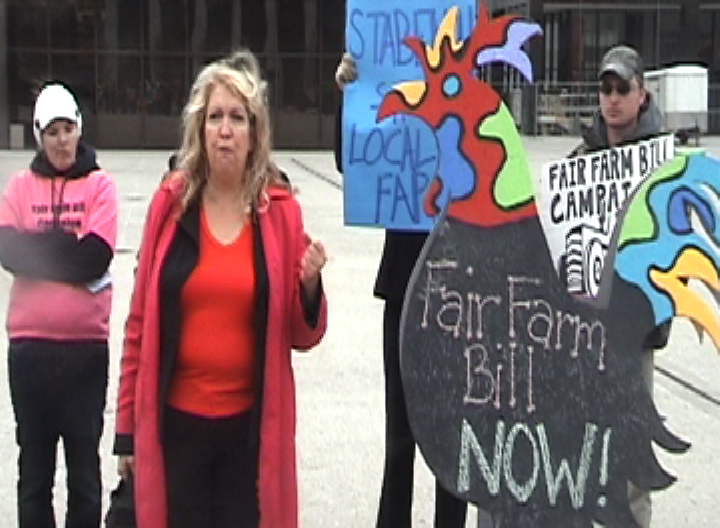
Yesterday, about 25 people gathered at Calder Plaza to stage a media event that they hope will pressure Michigan Senator Debbie Stabenow into supporting a major revision of the Farm Bill, revisions that will support small, family farms.
The event featured a spokesperson with the national advocacy group Food & Water Watch and 3 local speakers. The speakers included a mom, a local organic food market owner and a representative from the Greater Grand Rapids Food Systems Council.
The speakers addressed the need to have more local control of the food we all consume, support for small family farms, which can’t compete with agribusiness, and the need to challenge the current Farm Bill provisions which favor large farming operations.
The Grand Rapids Press cited the Food & Water Watch spokesperson and the organic market owner, but the not the other two speakers. WXMI 17 doesn’t cite any of the speakers, just a local farmer who was in attendance at the media event. This same farmer was also cited in the Grand Rapids Press story.

WXMI 17 went with some of the people who were at Calder to Plaza to deliver the postcards that people have signed to Stabenow urging her to take a stand on this issue. The group delivered nearly 3,000 postcards from West Michigan residents. The Grand Rapids Press sought out a response from one of Stabenow’s local staffers who is quoted as saying, “Family farms are critically important to Michigan’s economy. That’s why Senator Stabenow has led efforts to help small farms succeed throughout her time as a member and now as Chairwoman of the Agriculture Committee.”
Unfortunately for readers the Press never verifies such a claim that the Senator has led efforts to “help small farms succeed.” There is also no mention in any of the news coverage of the public hearing Stabenow held on the Farm Bill earlier this year, which would give readers an indication of who she has heard from on this issue.
Lastly, there was also no coverage of the Michigan farmers who are beneficiaries of the current Farm Bill structure. The Environmental Working Group documents that Michigan farmers have received $4.35 billion since 1995 from government subsidies, with the bulk of that money going to a small number of agribusiness companies/farms. You can search their database to find out which farms/businesses have been the major recipients of government subsidies.
Death of the Middle Class march this Saturday
We the People of Grand Rapids has organized a march this Saturday to protest the current economic conditions in Michigan.
Information from their Facebook event page states:
“Because of Michigan’s inability to create decent jobs,
• $1 Billion in cuts to k-12 education funding,
• cuts to college level funding,
• the new 48 month low-income assistance timeline,
• the taxing of senior’s pensions,
• reduction of the Earned Income Tax Credit,
• introduction of “Right to Work” bill,
• combined with the 86% tax-cuts to corporations
We now have an income-gap between the rich and the poor that has effectively killed the middle class. (US income equality is now 93rd in the world, below Egypt, India, China, Iran.)”
The group is going to have a funeral-style protest and is encouraging people to wear black.
Death of the Middle Class March
Saturday, November 5
11:00AM – The march starts at the corner of Ottawa and Pearl and will end at Calder Plaza with speakers.
Forum on Power, Justice and Public Memory in Central America at GVSU: Archival research on Human Experiments in Guatemala, 1946 – 1948
The second presenter at today’s Latin American Studies forum was Anna Carla Ericastilla, the current Director of the Archivo General de Centroamérica. Anna presented in Spanish, but a translator was provided.

The presenter began with a brief summary about the circumstances centering around the medical experiments conducted by US doctors on Guatemalans without their knowledge or consent.
The three archival centers in Guatemala had no knowledge of this atrocious history, but upon the discovery they began their own investigation. The objective of this investigation was to provide information to the Guatemalan government to take action on behalf of the dignity of their people.
The investigation involved the review of documents from nine different agencies and took 6 months to complete. Part of the framework for the investigation involved determining who were the people whom these experiments were conducted on – prisoners, prostitutes, the mentally ill and soldiers. There were several teams involved in the investigation, some which collected the documents and others that did the quantitative analysis of the information collected. Over 20,000 separate documents were part of this investigation.
In addition to collective the information the research team had to reconstruct the social makeup of Guatemala at the time and what mechanisms allowed for these experiments to take place. This included the role of the Ministry of Health, the military, police and legal system involved that would contribute to the medical experiments taking place. Anna also mentioned that this period was the tail end of a 4 decade dictatorship, where the state was beginning determine new social dynamics.

The researchers found that roughly 2,000 people were subjected to the medical experiments. However, since most of them were infected with STDs they most like infected members of their families or other people they came in contact with.
The group also sought to investigate who all was involved in these experiments, both from the US and within Guatemala that participated in or allowed them to happen. In addition, there was the need to determine everything from who performed the experiments, costs of resources used and other indicators to verify the claims made. One such resource discovered were the use of rabbits to incubate the STDs, which allowed the medical personnel a regular source to infect the people.
One other aspect the researchers found out women who worked as prostitutes were also used as a weapon to infect men. In some cases, the women in prostitution was forced to have sex with a dozen men in an hour in order to infect them. The men used for these experiments were those diagnosed as mentally ill, prisoners and soldiers.
They researchers also discovered that the US doctors admitted that they needed to do these kinds of experiments in Guatemala because they would not be able to conduct them in the United States.
An additional question the researchers wanted to answer was whether or not the Guatemalans used in these experiments were victims of torture. The researchers, according to the presenter, had to divorce themselves from their own personal feelings about this history and make determinations based on the research. However, the research term did conclude that these experiments did constitute a form of torture.
In conclusion, according to the presenter, the final document will include 8 chapters that will cover the social and political context of the experiments, the administrative structure in which the experiments were planned and conducted, reports on the identities of those involved, those responsible for the experiments and the subjects of those experiments.
Anna concluded her comments by stating that this was yet one more chapter of the long legacy of unjust relations between the US and Guatemala that have plague Guatemala for over a century.
Forum on Power, Justice and Public Memory in Central America at GVSU – the cultural impact of the 2009 Honduran Coup
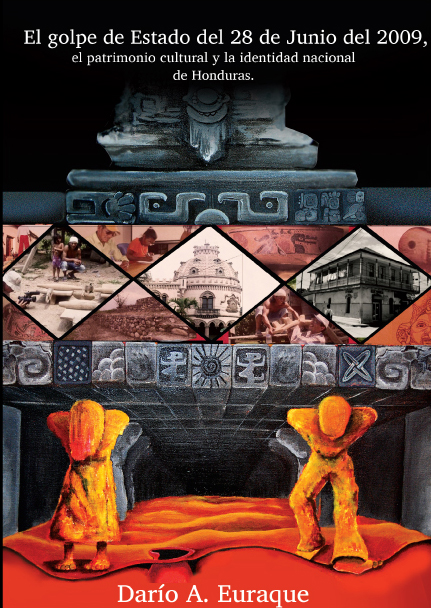
The forum hosted by the Latin American Studies department began today with a presentation by Dario Euraque, a former Director of the Instituto Hondureño de Antropología e Historia and currently Professor of History at Trinity College in Connecticut. His presentation was entitled “The Coup in Honduras in 2009: National Identity, Globalization and the Threat of History, a Personal Account.”
Dr. Euraque began by showing a clip from a documentary that accompanies a book he wrote on the 2009 Coup in Honduras. The clip includes footage, photos and interviews from people who were reflecting on the consequences of the coup. One woman was interviewed, a woman who participated in the initial mobilizations against the coup, who was raped by four soldiers.
The book Dario has written is only available in Spanish, but can be downloaded as a PDF. The 30 – minute documentary that accompanies the book is also online, which is in Spanish, with some English subtitles.
Dr. Euraque said that one of the things that he focuses on is the misinformation about the Mayan roots of Honduras. Many people identify with Mayan roots, but Dario said that this is not only true, this misinformation played a significant role in the propaganda during the 2009 coup.
Between the 1930’s and 1990’s, the government of Honduras engaged in a campaign to solidify the idea that most Hondurans have a Mayan ancestry, when in fact Dr. Euraque says that there are numerous other indigenous groups in Honduras that make up the bulk of the indigenous ancestry for Hondurans.
One of the ways that the government fostered this identity was to construct miniature replicas of Mayan ruins in central parks in communities throughout the country. Another mechanism of enculturation was to promote the nation’s Mayan heritage, particularly in the tourist industry. In the airports, the public parks and many of the hotels designed for tourism are replete with Mayan images and architecture.

In addition, much of the national identity reflects what Dr. Eurague calls the Mayanization of the country. The Honduran currency has Mayan images, the Honduran passport has a Mayan image, the national soccer team includes Mayan imagery, the phone cards and of course so much of the private sector uses Mayan imagery in their advertisements.
What all this has to do with the 2009 coup was the fact that Dr. Euraque, who was working with the Zelaya government at the time, was part of an effort to transform the national identity through de-centering Mayan heritage and promoting the other indigenous identities.

This campaign around transforming Honduran identity was done by presenting and promoting the accurate history of Honduras. Dr. Dario and others began do this by creating a vibrant national archive that was very accessible to the public. After the coup the person in charge of the archive it became under the control of pro-coup forces. Under the new control of pro-coup forces, they transformed the national archive center into a recruiting center for the military/national guard. Dr. Euraque stating that not only was this a bad decision, but it is illegal under international law to have such cultural centers turned into military facilities.
Dr. Euraque objected to this decision and in an act of solidarity, his staff at the archive held a protest in support of his decision. In fact, the national archive even became a center of resistance shortly after the coup. Because of his ongoing resistance to the coup and the misuse of the national archive building, Dr. Euraque was removed from his job in September of 2009. All throughout this presentation, Dr. Euraque showed numerous examples of this process, with photos and documents, since he felt it was extremely important to document this time and in a sense create an personal archive of the consequences of the coup in Honduras.
From Oakland to Grand Rapids: March against Police Brutality
Yesterday about 50 people marched against police brutality, in an action organized by Occupy Grand Rapids.
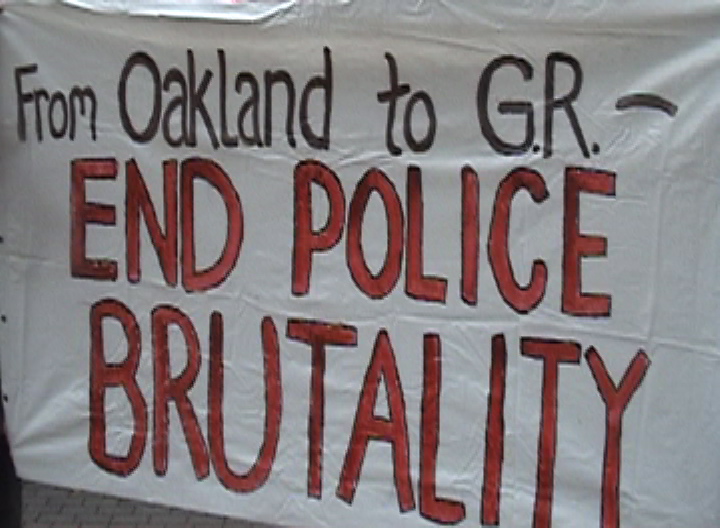
This against was taken to stand in solidarity with the community of Oakland, California, which had called for a General Strike yesterday in response to police brutality. The General Strike in Oakland shut down the ports and the downtown banks.
The Occupy Grand Rapids event was designed to make a statement by marching through downtown Grand Rapids past locations that are directly connected to the systemic violence, which is manifested through police brutality.
People marched down Division, cut through the campus of GRCC, past the courthouse, stopped briefly at Calder Plaza, past the Federal building, down Monroe, up Monroe Center past the police station and back to Monument Park where the march began.
Along the way marchers chanted and some engaged people on the street and in their cars. Most of the feedback was positive even along Division Street where marchers continued to hold signs up until the time the general assembly meeting began.
At one point while marchers were walking up Monroe Center, a few members of the IWW entered the Jimmy Johns to hand out flyers, since there has been a national campaign to organize workers at Jimmy Johns over the past year.
When people gathered back at Monument Park along Division, there was a dispute amongst some present over one sign that said, “the only good cop is a dead cop.” The reporter from the Grand Rapids Press made this the focus of his story without providing any information on the real intent of the march or people’s experiences of police brutality in this community and across the country.
Several people this reporter spoke with had not only a critical view of police, they spoke about their lived experience of suffering at the hands of police brutality, both at other demonstrations and in their daily lives. One useful document that supports this systemic violence is a toolkit put together by the group INCITE on stopping police violence, which provides detailed analysis of police brutality in this country.
While there were clearly differences of opinion about the police at yesterdays march, the Press story was in no way an accurate depiction of the broad experiences of those present at yesterday’s action.
Nov. 4/5 Seminar features noted Black Historian Tony Burroughs
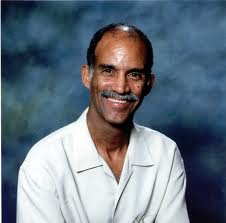
This Friday and Saturday the Western Michigan Genealogical Society will host its annual conference at Calvin College.
The focus of the two-day conference is exploring the roots of African Americans who participated in the US Civil War. Noted historian and genealogist Tony Burroughs is the keynote speaker who has done extensive research on African Americans in the Civil War.
The conference information states, “How often do we hear from Civil War soldiers themselves? Not often. It is especially rare when we hear from African American Civil War soldiers when most were prohibited from reading and writing. African American soldiers did discuss their war experiences. Hear what they said.” This is the topic for Friday.
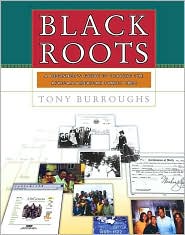
On Saturday, the conference will cover the following themes; The Nature of Genealogy, The Six Phases of African American Genealogy, Did Your Ancestor Serve in the Civil War and how to do successful genealogical research.
Friday, November 4
6:30PM – 9:30PM
Saturday, November 5
8:30AM – 5:15PM
Calvin College Prince Conference Center
1800 East Beltline
This two-day conference is co-sponsored by the Western Michigan Genealogical Society and the Kutsche Office of Local History at GVSU.
 Grand Rapids Institute for Information Democracy