Between 125 – 150 people gathered at the Calder Plaza today in Grand Rapids to support the principles of free enterprise.
According to the event organizer Tommy Brann, owner of the Brann’s Steakhouses, Free Enterprise is what made America the nation it is today. Brann began the event by reading off what he called Ten to Defend, 10 reasons why American Capitalism is so great. Here are the ten reasons:
- Creating jobs is a compassionate thing to do.
- Billions of dollars are paid by Free Enterprise when an entrepreneur owns a commercial building and pays property tax. (This helps local schools, police and Fire.)
- The employer and employee are the backbone of Free Enterprise. Three’s a crowd so Government can sometimes get in the way.
- Anyone with good work ethic and makes an honest effort can participate in Free Enterprise.
- Free Enterprise even provides for the unemployed. Businesses pay 100% of unemployment insurance.
- Michael Jordon, the best basketball player ever, is often applauded because of his skills. Successful business people should be applauded too. We don’t take away from Jordon’s accomplishments, please don’t take away our successful accomplishments.
- Free Enterprise is not free – participants work hard to create jobs and pay by spending long hours away from their families working to be sure they can meet a payroll.
- For every hour a person works in a Free Enterprise business a portion of their Social Security and Medicare taxes are paid by the business owner.
- When Steve Jobs was 24 years old he told his girlfriend he was going to become a millionaire someday. Free Enterprise is for dreamers – don’t take that dream away or America’s future will be a nightmare.
- After Steve Jobs died admirers laid flowers at his home. They respected him as a businessman and a participant in Free Enterprise.
To anyone who gives a few seconds to such a list, one can see that much of it is not true or doesn’t even make sense. Billions of dollars are paid by homeowners and working taxpayers in general. Tommy Brann didn’t say anything about government getting in the way to bail out the banks, to provide billions in corporate subsidies every year or the legislative push over the past 30 years to deregulate industry.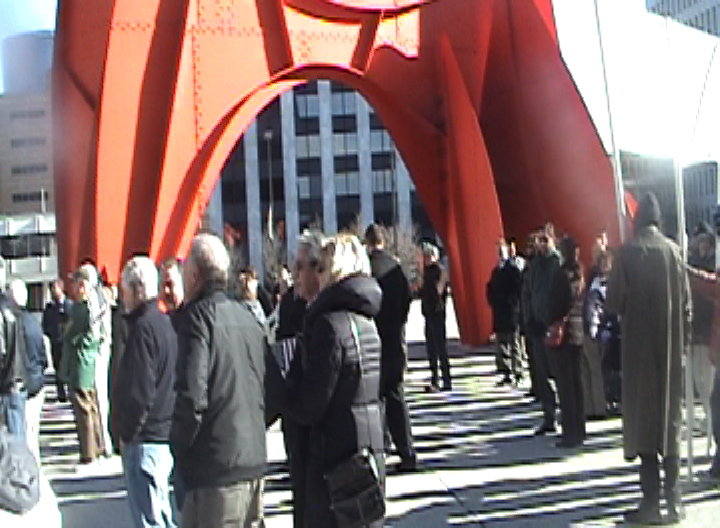
What do Michael Jordan’s skills have to do with business people? What would be more relevant is that Jordon would not take a stand against Nike’s sweatshop practices while he was marketing their shoes around the world. Likewise, businesses don’t want the public to scrutinize their practices, such as worker treatment, health/safety issues and environmental impact.
Also, what is obsession with Steve Jobs? Sure people are elated with Apple products, but we cannot forget that Jobs made millions off the labor of others, often in extremely exploitative conditions.
Brann was followed by four speakers, with a bit of music in between speakers. The first speaker was Tim Doyle, a local businessman who used to work for Tommy Brann and now owns several restaurants and a catering business in the area. Doyle talked about how Grand Rapids is the epicenter of Free Enterprise, with names like DeVos, Van Andel, Meijer and Seechia great visionaries.
The second speaker was Tim Doctor, a local radio talk show host. Doctor made numerous points that were so unsubstantiated. First, he said that no one gets into the 1% by force. Really, apparently Tim didn’t learn about US slavery and how many people and businesses made millions with that kind of force. His comment also ignores the numerous responses from both business and government to workers trying to organize for better pay, a 40 hour work week and workers compensation, which resulted in violent repression from both the private and public sector. One of the best books on this topic is Jeremy Brecher’s book Strike!
The third speaker was former State Representative Fulton Sheen. Sheen said that Free Enterprise built this country. He also said that the US government doesn’t produce anything and that if the US government was VISA they would have gone under years ago. Beyond the anti-government rhetoric, Sheen had nothing substantial to contribute to the rally.
The last speaker was Denny Gillem, another host of a local radio show, one that is hyper-patriotic and pro-US Military. Gillem seems to like speaking at pro-military and pro-Capitalist events, since he was a speaker at the pro-Israel rally this past summer in Grand Rapids.
Gillem said that it is fitting that today was the anniversary of Pearl Harbor, since the US won WWII because of Free Enterprise. He also said the US has a “Cowboy mentality and that is why we get things done.” Gillem ended his comments by saying, “we are here to occupy Grand Rapids for one hour and then get back to work, because that is what we do.”
It should also be mentioned that Grand Rapids City Commissioner Dave Shaffer and Kent County Commissioner Harold Voorhees were also present.
Black America at the Bottom
This article by Margaret Kimberley is re-posted from Black Agenda Report.
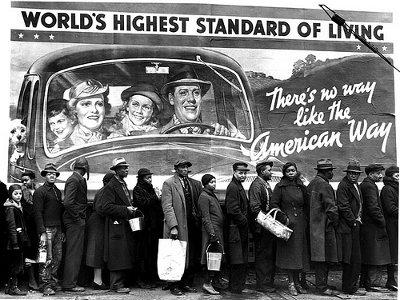 The nation’s economic news is grim indeed, and is the grimmest of all for black Americans. Recently released census data shows that while the median yearly income in this country is $50,000, it is only $32,000 for black people, the lowest of any other racial group in the country. Hispanics had a median income of $37,000, whites $49,000 and Asians $64,000.
Simply put, black Americans are at the absolute bottom of the economic heap in a county still teetering from the effects of a seemingly endless recession. The term recession is something of a misnomer because it does not adequately describe the worldwide crises endemic to capitalism. As western nations take their citizens on a dizzying race to the bottom with various austerity measures, the fate of people already on the bottom grows more precarious by the day.
It is not coincidental that the dismal economic prospects for black people has occurred at the same moment that black politics limps along on life support. Black politics traditionally affirmed a right, indeed an obligation, to speak directly to the needs and aspirations of the masses of people. It has been substituted with feelings of vicarious joy when a black person reaches a high office.
Enter Barack Obama, the beneficiary of both black loyalty and a system which he assessed astutely as being ready for the right black man to come along. He fills the duel roles perfectly, giving good feelings about his presence in the White House but this presence is a result of promising to do nothing that the 1% would find inconvenient.
“The dismal economic prospects for black people has occurred at the same moment that black politics limps along on life support.”
Sadly, the bloom is not yet off of the Obama rose, with a continuation of bizarre poll results indicating that the group doing the worst has the greatest degree of optimism. But the income and other indicators don’t lie and don’t change because most black people still love the president who looks like them but who goes out of his way to ignore them and their needs.
While phony government figures claim that employment numbers are improving, more than 46 million Americans are now receiving food stamps, a record. As the leaders of European countries struggle to keep the crises of Greece, Italy and Spain from spinning out of control, it is tempting to anticipate the post capitalist world. The thought experiment is interesting, but one thing is clear. When the dust eventually settles, black people will be at the bottom of a destroyed system.
If Barack Obama is re-elected, it is likely that black support for him will also continue, and the downward spiral will continue too. What is the future of a group always living on the cusp of disaster when a huge disaster takes place? No one can predict if the world economy will collapse Armageddon-like, or whether it too will limp along, under performing and slowly putting millions of people in ever more dire conditions.
It is difficult to imagine a worse scenario, but imagine it we must. The Obama phenomenon has silenced a people who were once the most likely to speak out against inequality and injustice. The death of movement politics has made black people the perfect victims of the descent of their nation’s and the world’s economies.
“The Obama phenomenon has silenced a people who were once the most likely to speak out against inequality and injustice.”
Barack Obama’s role in exacerbating the crisis goes unnoticed while tangential characters are given needless attention. Every hateful statement from the mouth of Newt Gingrich is dissected and railed against but Gingrich has not been in power in this country for a long time. He played no role in the bank bailout and he did not declare that Social Security would be placed on the budget cutting table. Obama did those things and put an already suffering group further and further behind.
There has been a ray of hope lately provided by the Occupy Wall Street movement.
The group condemned for a lack of focus has focused on neighborhoods with high housing foreclosure rates and acted to put people back into their houses. The Occupy Our Homes actions are doing what movements have always done, forcing the powerful to respond to popular demands.
Black Americans do not have to continue acting like sheep going to the slaughterhouse. They can remember their history of bold action. They do not have to continue being last on the income list, and the political list. If movement politics can be resurrected the group at the bottom now does not have to stay there. There is hope for a different future, if people are unafraid to remember how great changes came about in the past.
7 p.m. Saturday Dec. 10
At The DAAC, 115 S. Division · Heartside , Grand Rapids, MI · 49503
$6 – $10 sliding scale, no one turned away
Sponsored by The Bloom Collective
Fresh from playing Europe and Occupy! cities acorss the US, Ryan Harvey will be hitting up the Midwest in December with his new album Ordinary Heroes, a collaborative album with violinist/journalist/documentarian Michael Fox. The recording, dedicated to historian and activist Howard Zinn, emphasizes and celebrates social movements as a means of overcoming injustice.
Harvey has been writing and performing hard-hitting political folk songs for more than ten years. A part of the Riot-Folk Collective, his music is aimed to support those working for positive change and to educate people about issues of peace and social and economic justice.
When he’s not on the road, Harvey supports Iraq Veterans Against the War through an organization he co-founded, The Civilian-Soldier Alliance that helps members strategize, do outreach events and stay sane in the half-crazed world of trying to fight for justice.
His writings are posted on his blog, Even If Your Voice Shakes, and he also writes for the Baltimore-based Independent Reader, has been published by The Nation, TruthOut, Common Dreams, ZNet and others.
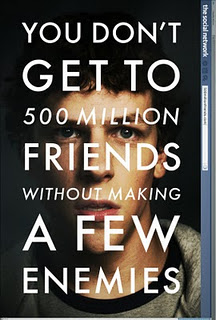
Yesterday afternoon, a packed house attended a luncheon talk at the JW Marriot, by former Facebook advertising guru, Kevin Colleran.
Colleran was hired by Sean Parker and took over for Eduardo Saverin, people whom Colleran referred to sometimes by the actors name, which played these individuals in the Hollywood film The Social Network. In fact, Colleran referenced the film quiet often when speaking about his former employer. Colleran eventually spoke about the evolution of the company in the era of social media.
In 2006, Facebook launched what was called News-feed, which was overwhelmingly opposed by one million members on Facebook. Despite the opposition, Zuckerburg refused to give in to public pressure and kept the new look up, which Colleran says made Facebook even more “popular.”
The next major change was to make Facebook accessible in multiple languages. Colleran shows a video that presents this service as multi-cultural and inclusive, which in some sense it does. However, it ignores the overwhelming market-focused and culturally hegemonic approach to what they do. The beauty of the effort to “translate’ the site was that it was done by members of Facebook, where no one was paid for their labor.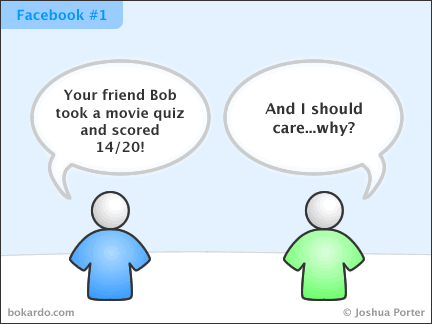
Colleran then talked about the next step in the evolution of Facebook, which was the expansion of applications, such as Farmville. The former Facebook marketer said this created numerous jobs in the US for people who were creating applications, but did not mention how such games have become a huge time-suck for people.
The next point that Colleran presented was that Facebook created forums that created new directions for the company, such as Hackathon. When Hackathon was announced, thousands of people posted video as an application outgrowth from the Hackathon “project.” The guy who led the Hackathon project had actually hacked into Facebook, since it didn’t at the time allow the kind of applications that MySpace did. He was contacted by Facebook and was flown to California, where he was offered a job. The ultimate co-opting of dissident culture, when a hacker goes to work for a corporate behemoth like Facebook.
Colleran then said the next shift with social media was instead of people looking independently at and for content, people now tend to go to content that their “friends” like or recommend. Colleran said the TV/cable industry is working on is to make the TV menu operate like Facebook, where instead of searching the menu it will direct you to shows/channels that your “friends” are watching.
The speaker when on to argue for the social benefits of Facebook, such as how people are creating organ donors on Facebook. He also mentions how Facebook was the mechanism that got Betty White on Saturday Night Live. Colleran showed the SNL clip with Betty White who actually says, “Facebook is a big waste of time.”
Colleran then talked about the use of Facebook in the Arab Spring and showed a video of Egyptians protesting the Mubarak regime. One Egyptian on CNN discussed how social media was one of the mechanisms that allowed people to communicate in the resistance campaign. It is now widely known that social media played a significant role in the Arab Spring uprisings, but what usually omitted from such comments is that it was only effective because people have been organizing for years for revolution and it was their organizing at the grassroots that made the difference.
Facebook and the Profit Motive
The promotional material for Colleran’s talk was centered around the idea of how Facebook and other social media can be used brand your business. Colleran only spent about 10 minutes on this theme.
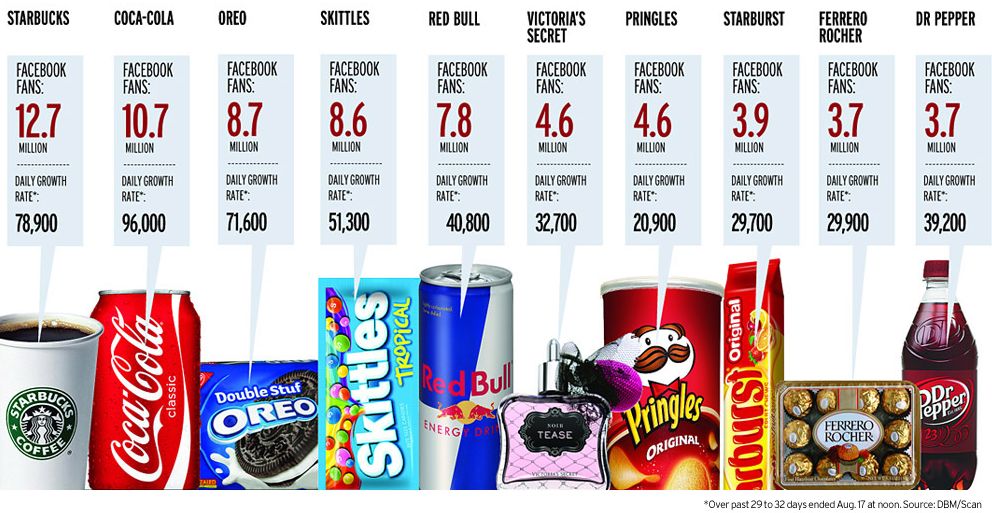
Colleran said that marketing has always been a mix of three kinds of branding – paid, owned and earned. Getting corporations to create fan pages and have people “like” them on Facebook has been huge. Colleran cites Starbucks and Coca Cola as good examples of how the corporate fan page has been successful. “Liking” a fan page gets people to go to sites that some of their friends are “liking.” People utilize this application because they are being marketed to with very sophisticated PR campaigns.
Another way to market your products/brands on Facebook is to publish in the News Feed. Colleran referred to this as the “conversational calendar,” where people post in the News Feed as an additional mechanism to direct people to individual fan pages and engaging consumers on a regular basis to “build relationships” with them. One example was what Coca Cola did every Tuesday, which was tattoo Tuesday. This was a way to communicate with coke consumers that helped to develop brand loyalty, according to Colleran.
The former Facebook marketer speaks from experience on these matters. While at Facebook, Colleran helped guide major corporations—including such Fortune 100 companies as Procter & Gamble, Johnson & Johnson, Walmart, and Coca-Cola—through the process of becoming present and engaged in the online space. In fact, Colleran was one of the main forces behind monetizing the site, which is the primary function of Facebook……to make tons of money.
VIDEO: The High Price of Materialism
This video is re-posted from the Center for the New American Dream.
In this short animation, psychologist Tim Kasser discusses how America’s culture of consumerism undermines our well-being. When people buy into the ever-present marketing messages that “the good life” is “the goods life,” they not only use up Earth’s limited resources, but they are less happy and less inclined toward helping others.
The animation both lays out the problems of excess materialism and points toward solutions that promise a healthier, more just, and more sustainable life.
We Can Stop the Kent County Sheriff Department’s “Bag a Fag” policy action planned for Tuesday, December 13
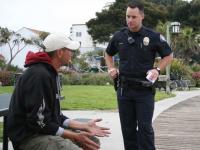
It has been known for the past year that the Kent County Sheriff’s Department has been targeting gay men at public parks in the area and arresting them. The ACLU became involved earlier this year requesting documents from the Sheriff’s Dept. The ACLU has discovered that no formal complaints have been filed against men wanting to meet other men. The Sheriff’s Department had agreed months ago to meet with the ACLU to discuss this matter. However, to date, the Sheriff’s Dept has failed to make themselves available for that meeting.
Therefore, we are asking as many people as possible to join us Tuesday, December 13 at 9:30 am at the Kent County Commission meeting to voice our opposition to this policy of harassing and arresting gay men.
Here is a link to a document that the ACLU sent to the Sheriff’s department, which lays out why their policy of targeting gay men is unjust and a violation of people’s rights.
In addition, there is an excellent report written by Rudy Sera on the history of “Bag a Fag” operations in Michigan, which you can find on the LGBT People’s History Project site.
The Kent County Commission meets in the County building, room 310. Everyone has an opportunity to speak about this issue during public comment, which is at the beginning of the meeting. Please help us spread the word and join us if you can to speak out about this injustice in our community.
We Can Stop the Kent County Sheriff Department’s “Bag a Fag” policy action
Tuesday, December 13
9:30 AM
Kent County Building
Room 310
Downtown Grand Rapids
The two-week UN Climate Conference taking place in Durban is at mid-point and its prospect for success is not looking bright.
The political leaders have started to arrive to confront a range of problematic issues. It is likely that compromises will be worked out and a few successes will be claimed. The reality is that they won’t be enough to tackle the worsening climate situation on the ground.
On the ground over the weekend there were numerous protests held, including one outside the US Embassy in South Africa. At that protest, people confronted the US on its role as the primary polluter and policy maker that is the major obstacle to climate justice.
“We won’t let the U.S. off the hook,” says Ahmina Maxey of the East Michigan Environmental Action Coalition, a lead organization of GGJ. “As members of communities disproportionately affected by U.S. pollution and land grabs, we will be holding dirty U.S. corporations and the State Department accountable for the global mess they have made.”
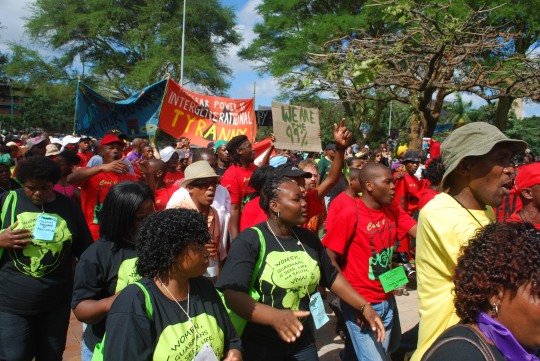
The major protest involved a march of roughly 12,000 people, a march led by the Rural Women’s Assembly. The Rural Women’s Assembly released a statement about rural women in Africa and climate justice that people in the US need to read. The statement says in part, “Women produce 80 per cent of the food consumed by households in Africa. Seventy per cent of Africa’s 600 million people are rural. Financial support for women farmers must be commensurate to their numbers and crucial role.”
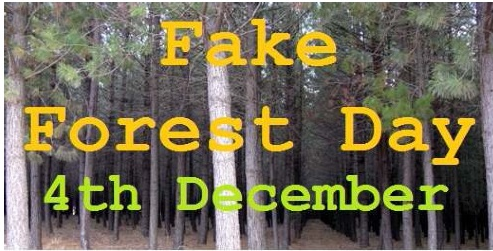
On Sunday, there was an educational forum hosted by TimberWatch. The forum was entitled Fake Forest Day and featured numerous sessions that critiqued both plantation style tree-planting programs and the idea of a green economy, which is the ideological justification for tree plantations and agro-fuels.
Lastly, here is a follow-up interview with the former Bolivian Ambassador to the Un, Pablo Solon with his assessment of the Climate Summit so far.
Drag Show this Saturday is a fundraiser for the LGBT group Tolerance, Equality & Awareness Movement (TEAM)
This Saturday, there is a fundraising event for the Tolerance, Equality & Awareness Movement (TEAM) at the Pyramid Scheme in downtown Grand Rapids.
T.E.A.M. is a human rights organization that seeks to eradicate discrimination against those of different races or sexual orientations. T.E.A.M.’s mission is that a 21st century human rights agenda begins with the creation of environments of diversity, inclusion, and acceptance.
When asked about what the funds will be used for, TEAM founder Chris Surfus responded, “some of the funds will be used for our Diversity and Inclusion program.” Other funds, according to Surfus will be to make TEAM merchandise as a mechanism to generate an ongoing source of funding.
Saturday’s event will feature several bands along with numerous performers, including Britney Storm, Dalylah Desmond, Ariez Iman, and Kaurora Fox who will be performing a drag show for the event.
Saturday, December 9
8:00 PM – 1:30 AM
Pyramid Scheme
68 Commerce SW, Grand Rapids
$5 suggested donation
Grand Rapids LGBTQ History Project: Video of the 1988 Pride Celebration in Grand Rapids
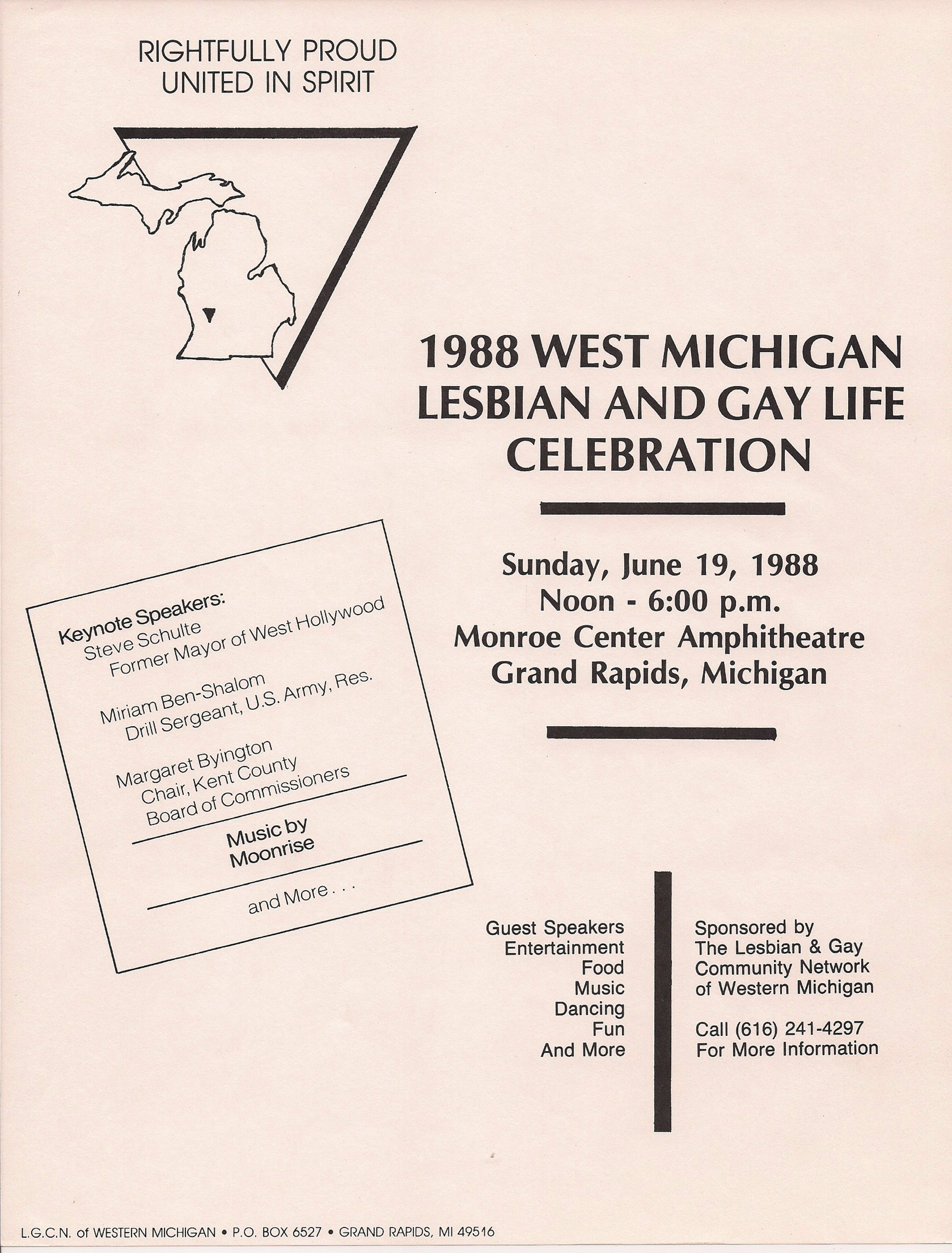
The Lesbian and Gay Community Network of Western Michigan, along with Dignity and Aradia organized the first ever Pride Celebration in Grand Rapids in June of 1988.
The event featured speakers, poetry, music and numerous Lesbian and Gay organizations, which were tabling at the event. The Pride Celebration was held at the old Monroe Amphitheater in downtown Grand Rapids.
In this video you will hear Bryan Ribbons read a proclamation, since the Mayor at that time, Gerry Helmholt, refused to recognize and support the first ever Pride Celebration.
The video also documents that there were a small group of religious extremists, which came to the event to harass and intimidate those who came to celebrate with pride.
This video is archived on the Grand Rapids LGBTQ People’s History Project site and is 90 minutes in length.
What’s Next for the Occupy Movement?
This commentary by Brian Tokar will appear in the winter issue of Broadcast, the newsletter of SEEDS, the Social Ecology Education and Demonstration School, based in Seattle and Vashon, Washington.
Since mid-September, actions inspired by the Occupy Wall Street encampment in New York have awakened the imaginations of people worldwide. Just as the movement approached its two-month anniversary in mid-November, several of the founding Occupations across the US fell victim to apparently highly-coordinated police raids. While the coming of winter was long-predicted to shift the focus of the Occupy movement, the expulsion of iconic tent encampments in New York, Oakland, and other cities has invigorated and intensified discussions about the movement’s next steps and its longer-term strategies.
Inspired in part by the Arab Spring events in Tahrir Square and beyond, the Occupy movement initially focused on the physical occupation of public space. But it’s always been about much more than that. The transcendent quality of the physical occupations was elaborated in a recent commentary by the Cincinnati-based author/activist Dan LaBotz, originally written for the journal New Politics. He described in rich detail how this fall’s Occupations resonate with the long history of popular revolts and occupations of public squares that, since ancient times, were often rooted in the utopian dimensions of the city itself. His outlook strongly resonates with social ecologist Murray Bookchin’s efforts, beginning in the mid-1960s, to reclaim the city’s historic legacy of freedom for today’s revolutionaries.
“We are witnessing something that goes beyond the symbolic,” LaBotz wrote, “something that both threatens the deep foundations of our social structure and, equally important – no, more important – something that touches our deepest spiritual yearnings. The occupation is utopian in the best sense. Whatever its political program, its practice says: ‘We will no longer live in hatred and competition. We will live in love and community.’”
Even the Occupy movement’s oft-criticized resistance to focusing on achievable, short-term “demands” speaks to its long-range, utopian character. Rolling Stone reporter and long-time critic of Wall Street’s excesses, Matt Taibbi describes how, after some initial skepticism, he was soon won over by Occupy Wall Street:
“Occupy Wall Street was always about something much bigger than a movement against big banks and modern finance. It’s about providing a forum for people to show how tired they are not just of Wall Street, but everything. This is a visceral, impassioned, deep-seated rejection of the entire direction of our society, a refusal to take even one more step forward into the shallow commercial abyss of phoniness, short-term calculation, withered idealism and intellectual bankruptcy that American mass society has become… We want something different: a different life, with different values, or at least a chance at different values.”
For some 30 years, the progressive Left in the US has been on the defensive. Against a unified, ideologically-driven assault against all of the social progress of the twentieth century, we’ve learned to fight one battle at a time, to “frame” our issues carefully and often circumspectly, and to try not to rock the boat too much. We have been up against a sometimes frightening confluence of neoliberal economic policies – privatization, deregulation, shredding safety nets, reorienting economies toward global trade – and a fundamentalist “culture war” that has mobilized significant numbers of disenfranchised people in a reactionary crusade to defend “traditional values.” We’ve insisted that “another world is possible,” but often only believed it in the most abstract of terms.
Now, for the first time in decades, the terms of the conversation are shifting. People are fed up, and no longer too timid nor too defeated to speak out loudly against the status quo, and for a different kind of society. We have learned that we can challenge financial elites, defend labor rights, call to overturn capitalism, and our numbers continue to grow. In cities large and small, we experience the exhilaration of direct democracy, of reclaiming public spaces, and of reinventing our future. And we know that we are not going to disappear when elites respond with too many police, or even with small victories.
This movement, with its unbounded creativity, is going to decide its own future. Some trade unionists, Move-On bloggers, and people tied to the Democratic establishment want it to be about the 2012 congressional elections and about reclaiming the long-discredited “American dream.” Some movement participants will, understandably, choose to become involved in the elections. But, for the first time in recent memory, the election may not turn out to be the center of our attention. Instead of a movement narrowing its sites to elect candidates, the candidates may just have to listen to the much farther-reaching demands of this movement. If they don’t – if they instead continue to harp on deficits, budget cuts, and reforms constrained by the demands of Wall Street – they’ll simply make themselves irrelevant.
Occupy Wall Street and its counterparts across the country and around the world have exposed the underside of an economic system that only benefits the wealthiest 1 percent – or less – and begun a new, potentially revolutionary conversation. With the coming of winter, it will evolve in many directions: toward occupying abandoned urban spaces, confronting politicians and CEOs, intervening against foreclosures, organizing university campuses, and more. The movement – and its emerging vision of a different kind of world – will continue to grow and evolve.
In a recent ZNet column, activist scholar Marina Sitrin described what it’s like in Spain today, in the aftermath of their summer 2011 uprising. “[W]hile the indignado movement no longer has encampments, its presence is felt everywhere,” she wrote, most notably in a new flowering of cooperatives in all spheres of life. It has evolved “to the point that in some places in Spain it is almost possible to live without having to depend on the resources hoarded by the 1 percent.” Perhaps not since the anti-nuclear power actions of the 1970s have we seen a movement so dedicated to uniting the oppositional and reconstructive dimensions of radical politics. As snow begins to blanket the North (and the rainy season arrives in the Northwest), we can already feel the anticipation of the Spring awakenings to come.
 Grand Rapids Institute for Information Democracy