We reported on Thursday, that legislation approved by both the House and Senate in Michigan was headed to Governor Rick Snyder, legislation that would eliminate domestic partner benefits for government/public employees.
As of this writing, Snyder has yet to finalize that legislation. Equality Michigan sent out an action alert yesterday stating:
Governor Snyder has said he may sign the ban on domestic partner benefits if certain groups are exempt. Tell Governor Snyder that he can’t pick and choose which of Michigan’s hard working employees to discriminate against.
We need thousands of people to keep the pressure on Governor Snyder to veto these bills. Please ask your friends and family to contact the Governor right away at http://t.co/I25AvJQF.
Equality Michigan also reports that the ACLU is collecting stories from people who currently have domestic partner benefits, but would lose them if Snyder doesn’t veto this legislation. Here is one story from Kent County:
Deb has worked for the Kent County Department of Human Services for 17 years and covers her partner Michelle through her employment with the State. Michelle recently underwent surgery and suffers from diabetes and high blood pressure. If Governor Snyder signs this bill, it will be almost impossible for Michelle and Deb to find an affordable health care plan.
Media Justice and the 99 % Movement
This article by Betty Yu is re-posted from Fairness & Accuracy in Reporting.
It all started with one message posted on a blog on July 13, 2011. The magazine Adbusters, a not-for-profit, reader-supported, 120,000-circulation magazine that combats corporate consumerism, issued a call: “On September 17, we want to see 20,000 people flood into lower Manhattan, set up tents, kitchens, peaceful barricades and occupy Wall Street for a few months. Once there, we shall incessantly repeat one simple demand in a plurality of voices.”

On September 17, a thousand people marched to Wall Street, and then hundreds stayed to occupy Liberty Plaza in New York’s Financial District.
Even after a solid two weeks of this Occupation, corporate media largely blacked it out. What coverage there was depicted protesters as drug-abusing hippies (the Fox News spin—Hannity, 10/10/11), or, in the “liberal” version, as directionless naifs with no message (New York Times, 9/23/11). As the OWS Declaration in New York City put it, the 1 percent “purposefully keep people misinformed and fearful through their control of the media.”
But grassroots, independent media outlets like Democracy Now!, Pacifica Radio, the Indypendent newspapers and public access TV channels, with a combined audience of millions, covered the Occupation from the perspective of the people—the 99 percent. These independent outlets provided a platform for protesters to talk about why they were supporting the Occupation—speaking out about rising unemployment, declining wages, diminishing quality of life, foreclosures, education budget cuts, lack of healthcare and unjust wars, just to name a few.
What elevated the activism to a national and global movement, though, was the sophisticated and widespread use of social media. Independent mediamakers, citizen journalists, everyday people with camera phones were capturing the voices and faces of this burgeoning movement and uploading them to YouTube, Facebook and Twitter, mostly within minutes of being captured. Group text-messaging was used to share information and media quickly.
These tools for instant communication not only helped to mobilize thousands to marches and events, but also captured police brutality toward the protesters. It was only when images were disseminated of a senior New York City police official pepper-spraying peaceful women protesters, temporarily blinding them, that corporate media began paying attention. The pepper-spraying incident was documented by fellow protesters and uploaded to YouTube—where it was viewed more than 2 million times—then posted on Facebook and tweeted to be shared with the world.
In the age of digital media, anyone with an Internet connection can watch OWS’s General Assembly meeting on the livestream of the Occupy website. They can share an Occupy update on Facebook, or tweet it on Twitter—providing an ongoing venue for people to show support and participate virtually in the protests. One Tumblr site houses the stories of thousands of supporters who share why they are a part of the 99 percent, holding up handwritten signs and telling their stories.
Of course, human, face-to-face interaction and relationship building is irreplaceable. Social media have helped get people out of their nests and into the streets of Liberty Plaza and elsewhere, to attend a General Assembly or a working group meeting. In New York, the working groups, many of them self-organized, have grown from 10 to over 70, largely through outreach done on the Internet. People in nearly 900 cities formed MeetUp.com groups, using the OccupyTogether.org website as their central hub.
The democratization of media-making tools, particularly an open and unfettered Internet, has made all this possible. Right now, though, this open access is under threat. Network neutrality is the principle that requires Internet service providers to treat all content equally, guaranteeing a level playing field for all websites and Internet technologies.
Since the invention of the Internet, net neutrality has facilitated democratic participation, allowing social justice organizations, cultural workers, citizen journalists, artists and small businesses to create, share and receive information freely. Right now, the livestream of Occupy Wall Street downloads just as quickly as the website of Goldman Sachs. Without net neutrality, small businesses, nonprofits and individuals who can’t afford high-speed services would have their ability to reach a mass audience online severely limited.
The telecommunications corporations that provide Internet connections, like AT&T, Verizon and Comcast, want to increase their already mammoth profits by controlling websites, video, content and applications. These corporations want their own sites and services to be easily available to the public, while slowing down access to those owned by their competitors—or by independent groups who can’t afford to pay the gatekeepers’ tolls.
In December 2010, the Federal Communications Commission issued new rules on net neutrality that were a devastating blow to media democracy. Labeled “fake net neutrality” by media justice advocates, the new regulations have no real enforcement mechanism. Worse yet, they provide zero protection for wireless devices—the mobile devices that have been so vital in the OWS movement for documenting police misconduct and spreading the word. As Extra! went to press, the Senate was considering a “resolution of disapproval” that would effectively remove all existing protections for Internet users and give unrestricted power to corporations like AT&T, Comcast and Verizon.
The communities that will be most affected by the lack of wireless net neutrality provisions are low-income and people of color. A recent Pew Center study (7/7/10) showed that nearly two-thirds of people of color, mainly Latinos and African-Americans, access the Internet through their phones.
One of the biggest media justice fights now is to break up the emerging duopoly between AT&T and Verizon, potentially controlling 80 percent of the mobile market. In March 2011, AT&T announced plans to acquire T-Mobile USA for $39 billion. The loss of a low-cost wireless carrier like T-Mobile threatens to limit affordable mobile broadband access and stifle competition in the broadband market—making the absence of net neutrality protections for wireless devices even more problematic.
It’s clear how vital the mobile Internet has been to Occupy Wall Street and the flourishing global Occupy movement. But an open Internet is also a basic communication right. In a 21st century digital age, access to jobs, healthcare, housing, government assistance and education require Internet access.
This is not just an isolated issue about media policy—it is a social justice, civil rights and human rights issue. This is about the lives of the 99 percent.
Michigan’s Radical Assault on Public Education Michigan’s Radical Assault on Public Education
This article by Andy Kroll is re-posted from Mother Jones.
The list of initiatives reads like a grand plan to dismantle public education as we know it: Slash education spending. Outsource public teachers. Curb collective-bargaining rights. Kneecap teachers’ unions. Open the floodgates to charter and “cyber” schools.

Welcome to education reform in the state of Michigan, where a Republican-dominated Legislature and a GOP governor are pushing one of the broadest anti-union, pro-privatization agendas in the country. Michigan is grappling with budget shortfalls like other states including Wisconsin, Ohio, and New Jersey—all places where GOP leaders (and occasionally Democrats) are exploiting the economic downturn to launch an ideological assault on teachers’ unions and public school systems. Although some of Michigan’s legislative attempts to overhaul public education have met resistance, state lawmakers have made an unprecedented push toward for-profit schools, dubious online curricula, and budget cuts and anti-union measures that would make the public teaching profession ever more insecure.
Michigan GOPers have gotten help from outside organizations, including Michelle Rhee’s StudentsFirst group (made famous by the documentary Waiting for Superman) and the Mackinac Center for Public Policy, a free-market-centric think tank. So extreme is their agenda that one recent bill even tried to justify bullying in schools on ideological and religious grounds, drawing outrage and national media attention.
Michigan is at the forefront of a badly misguided reform movement sweeping the country, says Diane Ravitch, a preeminent education historian and a former Education Department official under President George H.W. Bush. “They want to save money on education, and the best way for them to do it is by cutting the number of teachers, getting rid of higher-paid teachers—and to do that they must eliminate tenure and seniority,” she says. “The unions are an obstacle to almost everything they want to do, so they have to neutralize them.”
In April, first-term Gov. Rick Snyder unveiled his new vision for public education in Michigan in a 13-page “special message” to state legislators. Snyder called for eliminating the cap on charter schools, heavily weighting student test scores in teacher evaluations, and weakening teacher tenure. Such changes were necessary, Snyder insisted, to turn around an education system that “is not giving our taxpayers, our teachers, or our students the return on investment we deserve.”
Weeks later, the GOP-controlled state House approved a $13.8 billion budget that slashed education funding by $900 million for K-12 and state colleges and universities. Met with howls of protest, Republicans backtracked but ultimately cut funding by $564 million, according to the Michigan Policy Network. The move helped offset $1 billion in lost revenue after Snyder eliminated taxes on all Michigan businesses save for large-shareholder corporations.
Snyder said in April that his planned reforms wouldn’t meddle with the collective-bargaining rights of teachers and other school employees, but GOP lawmakers went ahead and cut them anyway. They passed legislation during the summer banning unions from bargaining over tenure for teachers and teacher placement across school districts—issues once on the table during collective bargaining. The anti-union Mackinac Center praised the changes, and despite his pledge, Snyder signed them into law in July.
Throughout the summer and fall, the GOP’s union-busting continued apace. In September, state House Republicans pushed legislation banning teachers from emailing about union or political activities on school computers. The punishment for lawbreakers: a maximum fine of $1,000 and up to a year in jail. (The bill remains under consideration in the state House.) That same month, Snyder also signed into law a measure forcing public school employees to pay at least 20 percent of the cost of their health care coverage and, in so doing, take cost-sharing out of the bargaining process. (Before, public school employees’ share of their care costs ranged from zero to more than 20 percent.)
In October, GOP state Sens. Randy Richardville, the majority leader, Phil Pavlov, and Arlan Meekhof unveiled right-to-work legislation for most public school teachers. Also known as “right-to-teach,” the bill would let teachers work under union-negotiated contracts without chipping in a dime for the cost of negotiations. (Right now, unions collect dues from all affected teachers—members or not—for bargaining, but can’t make them pay for political activities.) Richardville said right-to-teach legislation would let teachers “keep more of the money they earn.” The Michigan Education Association, the state’s largest teachers’ union, blasted the bill as politically motivated and an effort to diminish the MEA’s clout.
As Mother Jones reported in October, Pavlov had also hatched a plan to let public school districts outsource the teacher hiring process, effectively privatizing their jobs. Doing so would shift pension and health care costs off the books of school districts and so save money, Richardville said. Unions and Michigan Democrats blasted it as an assault on public education itself. “Gov. Snyder and Republicans have made no bones about it: They’re trying to dismantle public education in Michigan,” state Sen. Gretchen Whitmer, the minority leader, said at the time.
In early October, after a small uproar, Pavlov’s privatization measure got yanked out of a package of right-wing education bills compiled by Republicans. Included were bills to eliminate the cap on charter schools in Michigan, which previously stood at 150, and to pave the way for more “cyber” schools in Michigan. Still another bill in the package would allow home-schooled students to take elective classes at any virtual, charter, or public school in their local school district—a move that the MEA decried as a “back-door voucher scheme” that could drive more students to private, nonunionized schools.
Perhaps the most controversial of the GOP’s moves came in November, concerning a new anti-bullying bill. Named “Matt’s Safe School Law,” after a student who committed suicide in the face of incessant bullying, the drafted bill contained an audacious loophole: Teachers or students couldn’t be penalized for bullying so long as they attributed that harassment to a “sincerely held religious belief or moral conviction.” The father of Matt Epling, the bill’s namesake, called the law “government-sanctioned bigotry,” the national media seized upon it, and even satirist Stephen Colbert mocked it on his show. In the end, the exemption was cut from the measure.
Throughout all this, Michigan Republicans had help. Rhee, the former Washington, DC, education chancellor, worked with GOP lawmakers (PDF) to write the legislation that curbed bargaining rights and weakened teacher seniority rules, among other bills. And providing intellectual cover for the assault on unions and public schools was the Mackinac Center for Public Policy, which as Mother Jones reported belongs to a national network of free-market-geared think tanks modeled after the arch-conservative Heritage Foundation in DC. Funded by a slew of right-wing charities, the Mackinac Center has publicly supported many GOP education reforms, battling the MEA all the way. As Jack McHugh, a Mackinac Center policy analyst, put it in a June email to a GOP lawmaker: “Our goal is [to] outlaw government collective bargaining in Michigan, which in practical terms means no more MEA.”
Michigan Republicans say their reforms save money (PDF), empower teachers, and fix a broken, archaic education model. “These reforms are vital in that we’re trying to turn the focus back to the students,” says Ari Adler, press secretary for state House Speaker Jase Bolger. “The speaker feels that people have been fighting to keep the status quo for too long, and we have seen that that does not work.” (Richardville and Pavlov did not respond to requests for comment.)
The Michigan GOP has felt some blowback for its radical education agenda. On November 8, Republican state Rep. Paul Scott, the House education committee chairman, narrowly lost his seat in a recall election partly triggered by his role in the GOP’s education push. The MEA went all-out to unseat Scott, injecting $140,000 into the election, while Rhee’s StudentFirst reportedly spent $70,000 to defend him. Not missing a step, Republicans named state Rep. Tom McMillin to be Scott’s replacement as chairman. McMillin’s anti-union bona fides brought to mind a brutal image from “The Godfather” for one local radio reporter, who called McMillin’s selection “a horse head in the MEA’s bed.”
According to Ravitch, Michigan’s education agenda reflects a nationwide push among conservatives to blame “bad teachers” for the ills afflicting public education. The problem, she says, is that the reductive “bad teacher” paradigm—and the accompanying push for more charter schools, data-based evaluation, virtual learning, and other policies—fails to address the complexity of education reform and isn’t supported by facts. Reams of evidence cast serious doubt on, say, any link between unions and student achievement, the efficacy of charter schools, or the usefulness of test scores in gauging good teaching. As conservative state legislators in Michigan and elsewhere march ahead with their ideas for reform, there is little about their initiatives to suggest that quality education for school children is their top priority.
Earlier today, MLive posted a story about what “West Michigan Leaders” think about the likelihood that Michigan Governor Rick Snyder will sign off on legislation that will ban government employers from offering domestic partner benefits.
The MLive article cites four difference sources as being West Michigan leaders. The first is Matt McLogan, spokesperson for GVSU, who says that Senator Mark Jansen told him this legislation will not effect university employees who currently receive domestic partner benefits, even though the House version of the bill that passed yesterday would include public universities in the ban.
However, McLogan acknowledges that it is ultimately up to what the Governor says about the issue and how he interprets the language of the bill. “We will await the governor’s treatment of the bill and a legal analysis,” said McLogan.
A second source cited is Rockford School Superintendent Mike Shibler, who thinks the issue is a waste of time. “There are too many other important issues that the state legislature should be working on.”
The two remaining voices in the MLive article are a Kent County Commissioner and an Ottawa County administrator, both of whom believe that a ban on domestic partner benefits would be in line with West Michigan values.
Kent County Commissioner Ted Vonk said, “It’s a very conservative area. We’re not going to be cutting edge on any of those liberal ideas.”
While one can debate the notion of who are and who aren’t leaders in West Michigan, it is quite dishonest of MLive to not seek out a single voice that takes the point of view that domestic partners in government/public employee should have the same benefits as people who are legally married.
There are plenty of heterosexual couples that are domestic partners who could be impacted from this legislation, but it is clear that the legislation introduced by Rep. Dave Adgema is targeted at taking away benefits from the LGBT community. This is the irony of the MLive story, which never mentions the LGBT community, despite the fact that it has been primarily the LGBT community that has monitored this issue for sometime and has put out action alerts in the past few days calling on people to pressure Snyder to veto this legislation.
It’s bad enough that the story does not explore how this legislation, if passed, will impact the LGBT community, but to have not one voice from that community is unacceptable. There are plenty of organizations and individuals in the LGBT community that are considered “leaders” in West Michigan, but their voices are effectively muted in this MLive story.
Chomsky lecture on the US and UNESCO

This is a lecture that Chomsky delivered last month at Kutztown University as part of UNESCO’s World Philosophy Day.
UNESCO, according to Chomsky, is one of the best programs of the United Nations. UNESCO promotes peace, multi-culturalism, free speech and independent media. Not surprising the US government has always been critical of UNESCO. Most recently the US discontinued its funding of UNESCO because the UN organization supported and advocated for Palestinian statehood.
The lecture by Chomsky, including Q&A lasts about 1 hour and 40 minutes. But is well worth listening to.
This article by Glen Ford is re-posted from Black Agenda Report.
 The “Occupy” brand is a hit, having embedded its “99%” emblem in the popular consciousness like no other political slogan of the past two generations. And, no wonder. Among the movement’s core non-leaders are the skilled counter-corporate-culturalists of Adbusters magazine, the Canada-based outfit that turns the instruments of mass commercial marketing against their capitalist inventors. Occupy Wall Street flipped the script on the historical subordination of the Many by the Few by symbolically purging the 1% from the righteous community of the rest of us. In hardly the time it takes to “Flick my BIC” – the phenomenally catchy slogan of a classic 1970s ad campaign – Occupy Wall Street has become what some are calling the most significant social movement since the Sixties.
Only time can validate that assessment, and we shall see if there is still magic in the invocation of the “99%” in the spring and summer. One thing is certain: Occupy can only fulfill its promise to build on the contributions of previous movements if it decisively confronts the overarching issue of race, the Great Contradiction at the heart of American life and history that has always thwarted the development of an enduring Left movement.
The ultimate measure of Occupy’s capacity to combat white supremacy and privilege, is the degree to which the movement is seen as relevant to people of color – especially Black America, historically the nation’s most dependably progressive constituency and the group situated at the bottom of the economic heap in the current crisis. Black activists and the general African American public are keenly aware that OWS’s essential whiteness was key to its success in establishing encampments of borderline legality, and to the relatively favorable press coverage the movement has garnered. It is axiomatic that immediate and massive police repression would have been deployed to crush any such initiative by Blacks and browns.
White privilege is, of course, a fundamental fact of life in the United States, and understood as such by virtually every inner city Black child above a certain age, although the beneficiaries of privilege are most often blissfully unaware that they belong to a protected class. In the main, Blacks do not hold the existence of white privilege against Euro-Americans that engage in social struggle – indeed, white activists are often admired for risking their privileges. However, Black people do require that white-dominated movements offer the hope of specific impacts on the African American condition. We have learned through bitter and repetitive experience that campaigns advertised as serving the “common good” are no more to be trusted than the racially flawed slogan, “A rising tide lifts all boats.”
The Occupy movement’s “99%” mantra seems inclusive on its face, but can also subsume the aspirations and grievances of the darker constituencies within the super-majority. Therefore, Blacks are compelled to interrogate the movement’s relevance to their own conditions, including gross racial imbalances in relationships of power. At every juncture of the movement’s development, African Americans must be substantively assured of OWS’s relevance to them.
The vocabulary of Occupy, with its constant references to building “new communities” based on new “values,” can be unsettling to a people whose own, older communities are under siege by gentrification, Wall Street’s quintessential crime against Black population centers. Those of us involved with Occupy Harlem (on Twitter @occupyharlemnow) place the highest priority on ensuring that our people can continue to occupy these historic spaces in northern Manhattan, in numbers sufficient to allow them to shape their own political destinies. The battle against Wall Street is most vicious, and for the highest stakes, in the Harlems of the nation, where finance capital attempts to disperse whole populations to artificially inflate the value of corporate assets in housing and land. If there is any piece of ground where an anti-Wall Street movement should stand and fight, it’s Harlem.
Resistance to inner city gentrification is primarily a battle for renter’s rights. Harlem is overwhelmingly renter-occupied, as are most central city Black communities in the U.S. – virtually all of whom are under gentrifying pressures, or soon will be. As economic and racial targets of Wall Street’s predations, Black city-dwellers are the natural allies of Occupy Wall Street. They need to be convinced, through substantive and ongoing collaboration, that OWS is an ally of theirs.
At three months of age, it is essential that the Occupy movement demonstrate that it is a permanent feature on the political landscape, not a flash in the pan. African Americans are acutely aware that they can never “retire” from the struggle, as relatively privileged social justice activists might have the option of doing. The most rewarding relationship that OWS could forge with Black Harlem and all the Harlems of the United States, is by committing its human and material resources to the struggle to ensure that besieged African American communities are made permanent, viable, self-determining centers in the battle against the rule of money.
The Intersection of Race and Sexual Assault

Earlier today, the Kent County Domestic Violence Community Coordinated Response Team hosted a luncheon presentation by Kristen Moss. Kristen works with Girls Inc., at the YWCA here in Grand Rapids.
Her talk focused on the intersectionality of race and sexual assault, with emphasis on African American women. She began with some basic definitions of sexism and objectification, followed by several ads that underscored her point.
Kristen said, “The media and socialized ideas of gender roles continue to perpetuate the idea that women are merely objects to be used for sexual gratification.” This objectification impacts women of color in significantly different ways in media. African American and Latina women are often portrayed as dominant or sexually promiscuous, tempting and lewd.
Additional stereotypes for women of color in media are Mammy/Patriarch, animalistic, Jezebel, loud/big mouthed, outspoken and seductive. You can see the hyper-animalistic messages these ads portray.
Kristen states that this kind of media and societal representation of women contributes to women of color not wanting to seek assistance in cases of domestic violence and sexual assault. This is reflected at some level based on the most recent statistics from the YWCA on the racial makeup of women who sought assistance in 2009.
69.5% Caucasian
19% African American
5.7% Mixed Race
The presenter then gave numerous reasons why women of color are hesitant to seek treatment.
- negative perceptions about counseling
- financial hardship
- It is seen as white social workers being intrusive or nosy
- Lack of African American counselors
- There are built-in support systems and networks, such as churches, beauty salons, etc.
- Abuse should be kept hidden
- They have to protect the assailant (especially of the same race)
- They will not be believed
- The Superwoman Syndrome
“African Americans have not made addressing sexual assault and abuse a collective priority. Because people have been so ashamed and this is something that has happened to them, that it’s not something that is a pushed idea.” Ruth Sallee-Gresham
In addressing solutions, Kristen identified the following ideas. She stressed that it was important to go into the African American community, since those who work in sexual assault prevention and work with victims can’t expect the Black community to come to them. Second, education is critical in communities of color about the issue and what resources are available for people.
A third solution is to create a task force that involves community members and clergy. Lastly, people who do violence prevention work need to get the word out on the importance of prevention and not just services that are available for victims.
Regarding the role of the Black Churches, Kristen said there are some Black pastors who are willing to speak out on this issue and who genuinely want to support members of their congregation that are experiencing domestic violence and other forms of sexual assault. However, she said it tends to be the younger pastors who have expressed interest in this issue.
Can Snyder Be Stopped as He Targets Workers’ Comp?
Rick Snyder is starting to look like General Sherman, marching through Georgia burning down farms and shooting anything that got in his way. Snyder’s war on the poor and the workers of Michigan has been relentless since the day he took office, and now there’s more news to add to the growing list of his crimes against the citizens of Michigan.

His signing of a law that forbid anyone who owned a car worth $15,000 to collect food stamps (after putting a two-year lifetime cap on welfare payments) had thrown thousands of already food-insufficient families into crisis. Many poor people have cars that they have nursed along for ten or twenty years, and in a state with minimal public transport, those cars are necessary if family members are going to look for work. But if they couldn’t even get food stamps, their choice was between any hope for employment or feeding their kids today or tomorrow. This law was so outrageous that Snyder was forced to partially back down on it as it received national attention.
Snyder’s emergency manager laws are terrorizing people across the state as EFM appointees from Snyder’s cadre of robber barons seize public lands, close schools, fire elected officials, and privatize public utilities. Michigan Forward is currently waging a battle to keep Detroit out of the hands of an EFM—their own current, corrupt mayor has bid for the job and looks like he has the approval of Lansing—but there’s been no recent news from them on their effort to repeal Public Act 4.
And now Snyder is turning his attention toward workers’ compensation. This law protects workers who have been injured on the job—allowing them to collect partial wages and pay for doctors’ bills after being examined by a workers’ compensation doctor and having their case reviewed by the Workers’ Compensation Appellate Commission in the case of disputes.
Snyder’s plan is to eliminate the impartial review in order to achieve an annual savings of $1.2 million. So who will review the cases? Why, Snyder appointees, of course. He has already made some appointments—with all three of his new appointees in the pocket of the insurance industry, and all three right-wing conservatives. 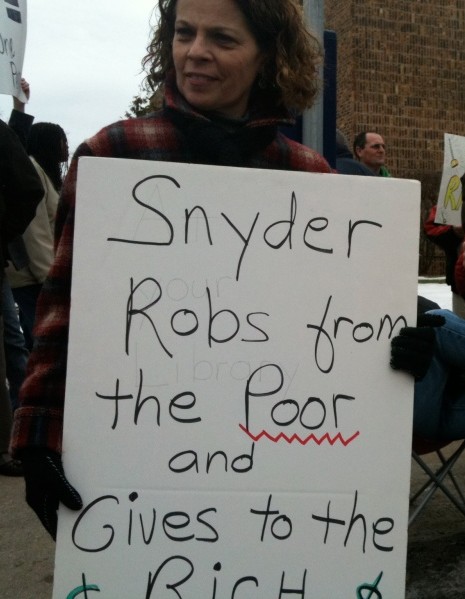
Yesterday, the state senate passed Snyder’s bill, which requires injured workers to return to work before they have completely recovered from their injuries, and puts them at risk of losing all their benefits if they cannot do the job assigned to them. They also have to accept whatever job is assigned, even if the pay is significantly less than their former wage. The law further states that benefits can be docked based on the possibility of wages that the injured employee could be earning at a hypothetical job, even if there is no such job available.
The bill, HB5002, also puts more power into the hands of the review board by requiring workers who want a second opinion or be cared for by their own doctors during their recovery to pay for those expenses themselves. Of course, these changes have been heartily approved by the Michigan Chamber of Commerce for the way they take “employers’ needs” into account—even though the employers are frequently the ones at fault for allowing conditions that caused the injury.
The Senate Minority Leader, Gretchen Whitmer, said, “It seems like every week, Senate Republicans find a new way to attack Michigan workers and roll out another bill to erode their rights and the benefits they depend on to survive.”
And Karla Swift, president of Michigan’s AFL-CIO, commented that the bill “would turn the system on its head by changing the law so that employees would not only lose their workers’ compensation by the wages they earn when they return to work, but by the amount of wages they could possibly earn at a job not even offered to them.”
In other words, it’s business as usual for Czar Snyder as he dismantles every citizen protection he can think of to put more money in the pocket of the capitalists.
And that unemployment rate he promised to improve? Well, it’s improving…because more people are leaving the state permanently rather than suffer any more under this fascist regime. Michigan’s job market improved a whopping 1 percent during Rick’s first year in office…and 1.8 percent of able-bodied workers have left the state or taken early retirement. Doing the math on that one is easy, and accounts for the drop in unemployment claims that Governor Snyder has been singing praises over this holiday season.
But Snyder’s not singing about this: Only 2,000 people this year in Michigan found full-time work at a living wage as Rick continues to transfer bundles of cash, tax cuts, cost eliminations, and state funds to industry leaders.
Protest image from FightBackNews.org
Czar Snyder image used by permission from artist Linda Robinson
Bill to destroy partner health care benefits heads to Snyder’s desk
Yesterday, Equality Michigan sent out a Media Release announcing the Michigan Senate passed House Bills 4770 and 4771 by a vote of 27-9. One Democrat (Sen. Tupac Hunter) joined all 26 Republicans to vote in favor of the measures.

“The bills would eliminate health care benefits for unmarried partners of public employees. HB 4770 originally prohibited any government entity in the state from providing such benefits and HB 4771 prohibits unions from including them in collective bargaining agreements. In a last minute attempt to silence opposition, Senate Republicans passed an amendment that exempts public universities from the legislation.
Anti-gay Republicans Representative Dave Agema (sponsor of the bills) and Attorney General Bill Schuette have been trying to strip away health care benefits for gay and lesbian couples since February of this year.
Equality Michigan Director of Policy Emily Dievendorf added this statement in the Media Release:
“This is yet another step in the wrong direction for Michigan. The only motivation for these bills it to make Michigan a more hostile state for gay and lesbian couples. We call on Governor Snyder to do what’s in the best interest of our state and immediately veto these measures.”
“Tens of thousands of public and private employees in our state have access to health care benefits for unmarried partners. Policies that provide such benefits are used throughout the country to treat employees fairly and retain talented workers. Leaders from Fortune 500 companies, public school districts, and municipal governments across the country know that their workforces are stronger when employees are able to take care of their families.”
“Governor Snyder prides himself on being a pragmatic moderate. We can assume that, like all of us, he has friends he would do real harm to by approving anti-equality initiatives. He also has a personal investment in strengthening Michigan’s business climate. In order to promote both fairness and economic growth in our state, he must allow local governments to offer benefits that help recruit and retain top talent.”
“The State Civil Service Commission has confirmed that costs for other ‘eligible individual benefit programs’ are minuscule, so it’s clear that these bills have moved through the legislature simply because of malice toward gay and lesbian families.”
You can read the language of HB 4770 and HB 4771 to determine how these bills, if adopted by Governor Snyder, will be a defeat for equality in Michigan.
There is a great deal of activity and resistance happening at the United Nations Climate Summit in Durban, South Africa.

A few days ago roughly 1,500 farmers and farmworkers marched in the streets of Durban to draw attention to how small farmers practice agriculture that actually cools the planet, while agribusiness is one of the major contributors to global warming.
Via Campensina was the main organizer of this event, which included the release of a major declaration from the Assembly of the Oppressed. The declaration reads in part as:
For all countries to stop trying to save capitalism and making the people, including small farmers, pay for their economic and financial crisis. We as La Via Campesina, demand the implementation of the people’s global agreement on climate agreed on in Cochabamba. And here in Durban and in a thousand Durbans, we strongly reiterate our solutions to the climate crisis.
– Further global warming must be limited to a rise of 1 degree Celsius only.
– Developed countries must make domestic emission reductions of at least 50% based on 1990 levels, without conditions and excluding carbon markets or other offset mechanisms.
– Developed countries must commit to payment of their climate debt and give funding from at least 6% of their GDP. All funds for this climate finance must be public and be free from the control of the World Bank and private corporations.
– All market mechanisms must be stopped, including REDD, REDD++ and the proposed carbon markets for agriculture.
We reiterate that there will be no solution to climate change and the predatory neo-liberal system that causes it, without the liberation of women, and rural women in particular, from age old patriarchy and sexist discrimination.
We also came across a good analysis article by long time activist and writer Patrick Bond. Bond fully expects that whatever agreement is reached by the international community, it will be imposed on them by the US and its international partners. Bond states:
The biggest problem is obvious: COP17 saboteurs from the US State Department joined by Canada, Russia and Japan, want to bury the legally-binding Kyoto Protocol treaty. Instead of relaxing intellectual property rules on climate technology and providing a fair flow of finance, Washington offers only a non-binding ‘pledge and review’ system.
This is unenforceable and at current pledge rates – with Washington lagging everyone – is certain to raise world temperatures to four degrees centigrade, and in Africa much higher. Estimates of the resulting deaths of Africans this century are now in excess of 150 million. As former Bolivian Ambassador to the UN, Pablo Solon said at last week’s Wolpe Memorial Lecture, “The COP17 will be remembered as a place of premeditated genocide and ecocide.”
 Grand Rapids Institute for Information Democracy