Occupy Grand Rapids produces first zine, continues occupation

Despite the lack of much news coverage, Occupy Grand Rapids still exists and continues to do important work.
Some people are still sleeping outside at Fountain Street Church, while others are having a regular presence at Monument Park on the corner of Fulton & Division. They are having formal rallies every Wednesday (4 – 6pm) and Saturday (2 – 6pm).

Occupy Grand Rapids is also having General Assembly meetings three days a week (Sunday 2pm, Tuesdays and Thursdays 6pm) to provide a forum for discussion and direction that the local occupy will take. General Assemblies are held at the base camp, which is outside of Fountain Street Church near the north side entrance.
In addition, some people involved in Occupy GR have produced a zine called the Occupocalypse, which can be downloaded or obtained at the Occupy GR base camp and gatherings at Monument Park.
The 20-page zine is very visual, with great images and content that speaks to the aspirations and vision of those involved.
Lastly, the Occupy GR wiki site also has a calendar so you can keep up with a new actions planned, follow the General Assembly meeting minutes and find any new resources that are available.
Grand Rapids IWW Film screening of Viva La Causa this Thursday

The Grand Rapids IWW (Industrial Workers of the World) film night for December. Viva La Causa focuses on one of the seminal events in the march for human rights – the grape strike and boycott led by César Chávez and Dolores Huerta in the 1960s.
Viva la Causa will show how thousands of people from across the nation joined in a struggle for justice for the most exploited people in our country – the workers who put food on our tables.
Admission is free. Discussion to follow the film.
Viva La Causa!
Thursday, December 15
7:00PM
IATSE Labor Hall
956 Bridge St. NW, Grand Rapids
New Media We Recommend
Below is a list of new materials that we have read/watched in recent weeks. The comments are not a “review” of the material, instead sort of an endorsement of ideas and investigations that can provide solid analysis and even inspiration in the struggle for change. All these items are available at The Bloom Collective, so check them out and stimulate your mind.

Moments of Excess: Movements, protest and everyday life, by The Free Association – This book is a collection of essays based upon the involvement and analysis of anti-capitalist mass actions from the WTO protest in Seattle through the end of 2010. The writers of this collective have been participants, organizers and critics of such actions that are generally classified as anti-globalization actions. Beyond the important analysis of these actions and “movements,” the essays attempt to expand the notion of movements and movement building. I found their assessment of the big action vs local action/organizing to be insightful and useful for ongoing discussion about how we spend our time and energy organizing and resisting neo-liberal capitalism.

Organizing Cools the Planet: Tools and Reflections to Navigate The Climate Crisis, by Hilary Moore & Joshua Kahn Russell – This 60-page pamphlet sure packs a punch. It not only presents compelling information about climate justice work and movements, it provides very practical organizing tools that people working on any issue could benefit from. The pamphlet includes information on movement building, building community, roles of an organizer, accountability, direct action and developing strategies. The pamphlet is designed with great graphics and lays out useful organizing tools and tactics that would be beneficial to anyone doing organizing work, but particularly for those to climate justice work. There is also a great resource section at the end. Highly readable and highly recommended.

Normal Life: Administrative Violence, Critical Trans Politics, and the Limits of the Law, by Dean Spade – One of the best books I have read on organizing for social justice that emphasizes systemic change. Spade, who has a history of organizing in the LGBT community, provides important analysis on why organizing work needs to move beyond a rights-based approach and move towards for fundamental systemic change. For example, when people are confronted with the issue of an unfair and punitive immigration system the kinds of responses we sometimes see groups advocating for same sex marriage so that international couples can marry. Spade argues that instead we need to organize against the use of immigration policy to criminalize people of color, the exploitation of workers and the maintenance of US global hegemony. Spade also includes a critique of progressive and grassroots groups that have fallen into the non-profit industrial complex, thus abandoning their original, more revolutionary visions.
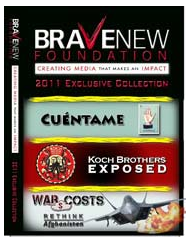
Creating Media That Makes an Impact (Compilation DVD) – This compilation DVD by Brave New Films includes dozens of short films that focus on three broad areas. There are 26 videos by Cuentame, the immigration-rights group that has done amazing work over the past 2 years exposing anti-immigration practices and policies across the country. The second group of videos on this DVD compilation consists of numerous short videos on the US occupation of Afghanistan and related themes like US veterans and military spending. The last group of videos consists of several Brave New Films pieces done on the power and influence of the Koch brothers. An amazing compilation of videos packed onto one DVD that would be a useful resource for any groups working on immigration justice, anti-war organizing and pro-democracy work.
Two West Michigan Pride events to raise funds for those in need
2nd Annual Black and White Masquerade Party and Fashion Show
West Michigan Pride and Matthew Agency proudly present the 2nd Annual Black and White Masquerade Party and Fashion Show on Wednesday, December 14, 9:00pm-2:00am at Eve at The BOB in Grand Rapids
The evening will include a wide array of gifts donated by area merchants for a silent auction to benefit West Michigan Prides LGBT Angel Tree project and Winter Items for Clean Works (hats, gloves/mittens, scarves, coats, socks, blankets). Donations can also be made at www.westmipride.org.
West Michigan Pride Holiday Open House
Monday, December 19 4:00 PM – 8:00 PM
West Michigan Pride Center, 211 Logan St. SW, Grand Rapids
Join us for fun and refreshments to help others:
Taking donations and gift items for LGBT Angel Tree Project and Clean Works winter items collection.
LGBT Angel Tree Project: There are 3 family members and they have been through a very rough time these last 2 years, they lost two siblings and a father. The family is also dealing with the change of their 12-year old daughter, as she is transgender and has just this year started at a new school as a girl. The family is very supportive of her and just wants her to be healthy and happy.
This morning at the Kent County Commission meeting three people addressed the commissioners on an issue that we reported on last week, the targeting of gay men in public parks.
Colette Seguin-Beighley, a member of the Board of Equality Michigan, said, “The Kent County Sheriff’s Department is targeting gay men in public parks. In our deeply conservative western Michigan culture, many gay men are still closeted. The arrests are damaging, both monetarily and socially to these men.”
Seguin-Beighley was basing her comments on both ACLU documents and a statewide report from former Judge Rudy Sera called Bag a Fag Operations in Michigan.
Bill Freeman, a minister in Holland, also addressed the commission. Bill said that it seems that gay men are being arrested for nothing more than being gay. He asked the commission to stop harassing gay men and that they needed to do something immediately to stop such a practice.
Mariam Aukerman, from ACLU West Michigan office, told us that despite the County’s non-cooperation on this issue over the past 6 months, she received a call recently from Kent County saying, “things are moving forward on this issue.” Aukerman believes that the effort to shed light on this matter is producing results and hopes that the County will take action to end these unjust practices.
In the meantime, we are encouraging people to send messages to the 19 Kent County Commissioners and demand that they take action immediately. You can find e-mails for your county commissioner or contact all of them here.
Climate Summit succumbs to climate apartheid
This article is re-posted from Occupy COP 17.
Decisions resulting from the UN COP17 climate summit in Durban constitute a crime against humanity, according to Climate Justice Now! a broad coalition of social movements and civil society. Here in South Africa, where the world was inspired by the liberation struggle of the country’s black majority, the richest nations have cynically created a new regime of climate apartheid.
“Delaying real action until 2020 is a crime of global proportions,” said Nnimmo Bassey, Chair of Friends of the Earth International. “An increase in global temperatures of 4 degrees Celsius, permitted under this plan, is a death sentence for Africa, Small Island States, and the poor and vulnerable worldwide. This summit has amplified climate apartheid, whereby the richest 1% of the world have decided that it is acceptable to sacrifice the 99%.”

According to Pablo Solón, former lead negotiator for the Plurinational State of Bolivia, “It is false to say that a second commitment period of the Kyoto Protocol has been adopted in Durban. The actual decision has merely been postponed to the next COP, with no commitments for emission reductions from rich countries. This means that the Kyoto Protocol will be on life support until it is replaced by a new agreement that will be even weaker.”
The world’s polluters have blocked real action and have once again chosen to bail out investors and banks by expanding the now-crashing carbon markets – which like all financial market activities these days, appear to mainly enrich a select few.
“What some see as inaction is in fact a demonstration of the palpable failure of our current economic system to address economic, social or environmental crises,” said Janet Redman, of the Washington-based Institute for Policy Studies. “Banks that caused the financial crisis are now making bonanza profits speculating on our planet’s future. The financial sector, driven into a corner, is seeking a way out by developing ever newer commodities to prop up a failing system.”
Despite talk of a “roadmap” offered up by the EU, the failure in Durban shows that this is a cul-de-sac, a road to nowhere. Spokespeople for Climate Justice Now! call on the world community to remember that a real climate program, based on planetary needs identified by scientists as well as by a mandate of popular movements, emerged at the World People’s Summit on Climate Change and Mother Earth in Bolivia in 2010. The Cochabamba People’s Agreement, brought before the UN but erased from the negotiating text, offers a just and effective way forward that is desperately needed.
GRIID Classes for Winter 2012
We are excited to offer two new classes for the winter of 2012. Both classes are the result of suggestions from previous class participants and an outgrowth of the Grand Rapids People’s History Project.
On Mondays, beginning January 16, we are offering a class entitled Beyond a Rights-based Model: Radical LGBTQ Politics. Using Dean Spade’s book, Normal Life: Administrative Violence, Critical Trans Politics and the Limits of Law, we will explore the limits of a rights-based approach to change and investigate a more systemic change focused organizing model. The class and book will emphasize contemporary LGBTQ organizing, but the analysis applies to any popular social justice movements. We will also use the analysis to assess what is happening in West Michigan around rights-based organizing.
On Wednesdays, beginning January 18, we are offering the second class entitled, A History of US Policy Towards Native  Americans. We will be using a variety of sources, but the main text for the class is, A Little Matter of Genocide: Holocaust and Denial in the Americas 1492 to the Present. This book by native scholar Ward Churchill, provides well-sourced details of a genocidal policy that began with the European invasion of North America up until today. We will also explore the significance of this policy on a local level and what it means today in West Michigan.
Both classes are 8 – weeks long and cost for each is $20, which doesn’t include the cost of the books. Classes will take place in one of the community rooms at the Steepletown Center located at 671 Davis NW in Grand Rapids.
There are downloadable PDF documents for each class, which we encourage people to share. For more information contact Jeff Smith at jsmith@griid.org.
State of Surveillance
This article by Pratap Chatterjee is re-posted from CorpWatch.
A German tech company is selling the ability to track “political opponents.” An Italian company promises to remotely seize control of smartphones and photograph their owners. A U.S. company allows security services to “see what they [the targets]see.” A South African company can store recordings of billions of phone calls, forever.

Welcome to the new covert world of surveillance contractors. Shining a light on this $5 billion (and growing) industry, Wikileaks today released “Spy Files”: hundreds of secret sales brochures. The companies involved hand this promotional material only to key contacts — often government agencies and police forces — at trade shows that are closed to the public and the press.
“The tools revealed in these brochures demonstrate the previously unfathomable power of mass surveillance. It makes phone-hacking look like a schoolboy’s game,” says Eric King of Privacy International. “Some of the most tyrannical regimes in the world are buying the power to monitor the behavior and communications of every single citizen — and the technology is so effective that they are able to accomplish this with minimal manpower.”
An analysis by the Bureau of Investigative Journalism and Privacy International of the brochures shows that at least 160 companies in 25 countries from Brazil to Switzerland are selling an array of technologies so sophisticated that they often seem to have come of a Hollywood studio.
But what the “Spy Files” reveal is real. The documents add weight to campaigners’ claim that these proliferating technology companies constitute a new, unregulated arms industry. “What we are seeing is the militarization of cyber-space. It’s like having a tank in your front garden,” says Julian Assange, the founder of Wikileaks.
The industry brochures state that they only sell “lawful interception” gear to official authorities: the police, the military and intelligence agencies.
But the sales brochures also boast of vast powers of covert observation using off-the-shelf gear that, activists worry, repressive security forces and corrupt officials can easily abuse.
“Why sample, when you can monitor all network traffic inexpensively?” trumpets a brochure from Endace, a New Zealand-based company. “Total monitoring of all operators to plug any intelligence leakage is critical for government agencies,” offers Indian-based ClearTrail.
China Top Communications, in Beijing, claims to be able to crack passwords of more than 30 email service providers, including Gmail, “in real time by a PASSIVE WAY [sic].” In the obfuscating language of the surveillance industry, “passive” is a euphemism for intercepting data without the targets’ knowledge.
The surveillance technology being offered for sale falls into four broad categories: tracking real-time locations of mobile phones and vehicles, hacking into electronic devices such as computers and phones to monitor every keystroke, recording and storing data traffic of an entire telecommunications network, and analyzing vast streams of data to track individual users.
In recent months, news has filtered out on how repressive governments are using these technologies to crack down on dissent. In October, for example, the Bureau of Investigative Journalism and Privacy International revealed that Syria, despite US export ban, is deploying web filtering equipment from California-based Blue Coat Systems to censor internet traffic. The company later explained the equipment had been diverted from an importer based in the United Arab Emirates.

The Italian company, Area SPA, also aided Syrian government’s repressive policies by installing a surveillance system, an investigation by Bloomberg recently uncovered. The news emerged as Syria was convulsed by mass protests that have left 3,500 dead at the hands of state security forces. Area’s lawyers announced last Monday that the company had cancelled the project. The speed at which this technology is advancing, and the way it is being used raise serious concerns. As technological capacity expands, “the dominant use of surveillance technologies is increasingly the wholesale spying on entire populations, rather than targeted monitoring of a few individuals,” says Dr. Steven Murdoch, professor of security engineering at Cambridge University. “As communication becomes ever more critical to civil society, the abuse of surveillance is a rapidly increasing, and already substantial, threat to democracy, freedom of expression, and human rights in general.”
Phone Tracking
One popular mobile-phone tracking technology is an IMSI catcher. This highly portable device poses as a mini mobile phone tower that can capture all the mobile phones signals in an area, effectively identifying all phone users in a particular place. Today, dozens of companies sell IMSI catchers. Some can fit into a briefcase; others are as small as a mobile phone.
Once up, the IMSI catcher tricks phones into wirelessly sending it data. By setting up several IMSI catchers and measuring the speed of the responses or ‘pings’ from a phone, the surveiller can follow on a computer screen the location and movement of anyone with turned-on mobile, anywhere within the parameters of the IMSI catchers — even when they are not using their phones.
Companies that offer this equipment include Ability in Israel, Rohde & Schwarz in Germany, and Harris Corporation in the US.
The Federal Bureau of Investigation (FBI), which uses these devices to track suspects, claims it can do so without a court order. Many police forces around the world have also bought, or are considering buying, IMSI catchers.
Other companies offer passive surveillance devices that can be installed at phone exchanges, or even stand-alone equipment that can covertly vacuum up all the mobile phone signals in an area.
Specialized gadgets attached to a vehicle can track where it goes. While logistics and trucking companies have long used these devices to ensure on-time delivery of goods, UK-based Cobham sells Orion Guardian covert devices that can be secretly attached to the bottom of a car. Hidden Technology, another British company, sells similar devices.
“For years, there has been a gentleman’s agreement on how these technologies are used,” says Chris Soghoian, a Washington DC-based fellow at the Center for Applied Cybersecurity Research. “The US and the UK know that the Chinese and the Russians are using IMSI catchers — but so are we. Each government believes that the benefit of being able to use it abroad outweighs the risk to their own citizens.
“But today, anyone — a stalker or a private company- – can show up in Chelsea or Tottenham Court Road [London] and listen to everyone else,” adds Soghoian. “It is time to switch to more encrypted systems that keep everyone safe.”
Hacking
Several companies offer “Trojan” software and phone “malware” that allow the user to take control of a target’s computer or phone.
The software can be installed from a USB drive, or delivered remotely by disguising itself as an email attachment or software update. Once in place, a surveiller can riffle through a target’s files, log every keystroke, and even remotely turn on phone and computer microphones and cameras to spy on the target in real-time.

Hacking Team of Italy, Vupen Security in France, Gamma Group in the UK, and SS8 in the US, each offer such products, which they variously claim can hack the Apple iPhone, BlackBerry, Skype, and the Microsoft operating system.
Hacking Team is probably the most public of these companies, advertising on a public website that its “Remote Control System” can “monitor a hundred thousand targets.” SS8 of Milpitas, California, claims that its Intellego product allows security forces to “see what they [the targets] see, in real time” including a “draft-only emails, attached files, pictures and videos.”
These technologies often rely on software vulnerabilities. While major software manufacturers claim to fix these flaws as soon as they are discovered, at least one company, Vupen, boasts dedicated researchers in its “Offensive Solutions” division who are constantly looking to exploit new security holes in popular software.
Hacking systems have recently surfaced in countries with repressive governments. In March when Egyptian democracy activists raided the intelligence headquarters of Hosni Mubarak’s regime, they uncovered contract documents for a hacking program called FinFisher that is marketed by Gamma Group, a UK company. Governments can use this product to “identify an individual’s location, their associates and members of a group, such as political opponents,” according to a brochure from Elaman, a German company with close links to Gamma which also sells FinFisher.
Massive Surveillance
While hacking software targets individuals, other technologies on the market can monitor and censor an entire data or telecommunications network. Massive surveillance works by capturing everyone’s activities — whether they are a suspect or not — and then sifting it for valuable information. For example, US companies Blue Coat Systems and Cisco Systems offer corporate and government buyers technology that can filter web access based on commercial, political, religious or cultural criteria.
Businesses routinely these web-filtering products to catch employees surfing the web when they should be working. But the same technologies can also be used to block social networking websites such as Facebook, multimedia services including Flickr and YouTube, and internet phone services like Skype in countries ranging from China to the United Arab Emirates.
An extension of this technology, “deep packet inspection,” allows the user to scan web and email traffic, and to read through huge volumes of web searches and emails searching for keywords: –Companies including ipoque in Germany and Qosmos in France offer the ability to peer inside email traffic and block specific users such as dissidents. –Datakom, a German company, sells a product called Poseidon that can “’search and reconstruct… web, mail, instant messaging etc.” The company also claims Poseidon “collects, records and analyses VoIP calls,” such as Skype conversations. –Datakom, which offers “monitoring of a complete country,” says it has sold two “large IP monitoring’” systems to unnamed buyers in the Middle East and North Africa region. –South African VASTech sells Zebra, a product that gives governments the ability to compress and store billions of hours of phone calls and petabytes (a billion megabytes) of information for future analysis. In August, the Wall Street Journal reported that VASTech devices had been installed at the country’s international phone exchanges.
Data Analysis
Needless to say, the sheer volume of data form internet traffic, the locations of individuals and their phone conversations could overwhelm. But a parallel analytical technology is providing intelligence agencies, the military, and the police with sophisticated tools that compile and sift information for use in criminal investigations and even in the battlefield.
For example, Speech Technology Center, based in Russia, offers a product called STC Grid ID that it claims provides “reliable identification [of a] nation-wide database of speakers.”
Czech Republic-based Phonexia, with the help of the Czech military, claims to have developed a similar voice-recognition program. Italian-based Loquendo uses ‘voice-prints’ — the unique signature of the human voice — to identify targets and flag up their calls in real-time. And yet another company, Massachusetts-based Intelligent Integration Systems (IISi), sells Geospatial Toolkit, a “location-based analytics’ program.”
But legal documents filed in the US show that these technologies do not always work as promised. Another Massachusetts company, Netezza, allegedly bought a copy of Geospatial Toolkit, reverse-engineered the code, and then sold a hacked version to the CIA for use in remotely piloted drone aircraft. IISi, which says that the software could be wrong by a distance of up to 40 feet, sued Netezza to prevent the use of this software. Company founder Rich Zimmerman stated in court that his “reaction was one of stunned amazement that they (CIA) want to kill people with my software that doesn’t work.”
The two companies settled out of court in November 2010. The CIA has refused to comment.
Digital Past, Dystopian Future
Wikileaks warns that the surveillance contractors revealed in the Spy Files are selling the ability to irrevocably alter our lives with their ability to delve into the digital past.
“We all aware of traditional spy stories of intelligence agencies like MI5 bugging the phone of one or two people,” says Julian Assange. “In the last ten years, something else has happened. We now see mass surveillance, where computer systems of an entire country are infected by surveillance programs, where the entire phone calls of a nation can be and are recorded by a company.”
“Previously we had all thought, why would the government be interested in me, my brother? My business is not interesting, I am not a criminal,” Assange told the Bureau earlier this week. “Now these companies sell to state intelligence agencies the ability to spy on the entire population at once and keep that information permanently. In five or six years’ time, if your brother or someone becomes of interest to that company or the government, they can go back in time and look to see what you said or what you emailed.”

The fifth principle of journalism, according to the Committee of Concerned Journalists, says, “Journalism has an unusual capacity to serve as a watchdog over those whose power and position most affect citizens.”
There is nothing in the basic principles of journalism, which suggests that journalist should give those in power a free pass or act as their lapdogs. However, once again, this is exactly what the Grand Rapids Press did with its feature story on Sunday, December 11. The article offers nothing but praise for the wealthiest families, no critical voices and no critical perspective on the function and role of philanthropy in a capitalist-driven society.
Praise for Hometown Wealth
The article’s headline reads, “Grandchildren of prominent West Michigan donors are shaping the future of local philanthropy.” As is implied in the headline, the article presents what three generations of the wealthiest families in West Michigan have done with their money as fundamentally a benefit to the community as a whole.
The end of the first section of the Press article states, “The generosity of families like Meijer, Loeks, DeVos and Van Andel is a major reason the Grand Rapids-Muskegon-Holland metro area was ranked second most generous in the nation, behind Salt Lake City, by the Chronicle of Philanthropy.”
Another statement by the Press, which demonstrates their unquestioning function of wealthy families in West Michigan, was the text that accompanied a graph, which tracked 2 families and two generations of “giving.” The text reads, “Generosity instilled in children and grandchildren of business giants could result in the West Michigan community reaping rewards long into the future.”
Such comments reflect the Press writer’ acceptance that philanthropy, and in this case the philanthropy of a few wealthy families, is a huge benefit for West Michigan residents as a whole. The families cited are DeVos, Van Andel, Meijer, Frey, Wege and Loeks. Funny thing is, the Press writer never really demonstrates how the community is reaping rewards from these families.
The only sources cited in the article are a Grand Rapids Community Foundation spokesperson, David Van Andel (Van Andel Foundation), philanthropy “expert” with the Dorothy Johnson Center for Philanthropy, the CEO of the Wege Foundation and Ellie Frey (Frey Foundation).
Each of these sources sites of few non-profits that have received funding from one or more of the family foundations cited in the area, non-profits such as UICA, Mel Trotter Ministries and Gilda’s Club to name a few.
The main source cited in the article, Michael Moody, is referred to as a philanthropy expert. Moody is employed by the Dorothy A. Johnson Center for Philanthropy, which is funded by one of the family foundations in the article – The Frey Foundation. Moody speaks highly of Amway, the DeVos family and Rick DeVos’ venture known as ArtPrize. The philanthropy expert also makes comments about generational family philanthropy and what the current generation is likely to do in West Michigan.
Normalizing Systemic Inequity
There is been a great deal of writing and research that takes a very critical and systemic view of the function of foundations and philanthropy in the US. Researchers such as Michael Barker, Adrienne Pine, Joan Roelofs, Daniel Faber and the women of color collective known as INCITE!
Each of these writers has provided us with important analysis on the historical function of foundations, particularly those of the wealthiest families in the country and in each community.
Michael Barker’s 2008 research on how the Ford and Rockefeller Foundations funding influenced the major environmental organizations to abandon grassroots advocacy to become beltway players is a crucial investigation for anyone looking at what has happen to environmental politics in the past 30 years. Barker has also done important work to track the real outcome of the Bill & Melinda Gates Foundation, particularly their foundation’s impact on a global scale. Barker observes that much of what the large foundations do is fund social engineering.
Foundation funding as social engineering is not generally part of the public discourse on philanthropic giving, but within a critical analysis of neoliberal capitalism one can see how the vast amounts of money given by wealthy families is not merely an act of charity.
There are several reasons why wealthy families and individuals create foundations. First, foundations provide a means to protect some of their money from being taxed. This has a double effect, in that foundation money is in itself sort of a tax shelter and the money these foundations give to non-profit sectors is an additional tax write-off.
Second, foundations created by the wealthy have always served as both a public relations tool and a buffer from social movements that have sought to create systemic change. Philanthropists such as Andrew Carnegie gave a small portion of their wealth to create libraries in some communities. This effort by Carnegie both won him praise for funding public access to information, but more importantly it diverted public attention away from the tremendously exploitative wealth he generated off of the backs of steel workers.
The third reason for philanthropic giving, particularly through foundations, is to engage in the social engineering that Barker identifies. This has been the case for the past 100 years in the US, but the biggest growth of foundation funding has developed since the explosion of social movements in the 1960s and 70s. Large foundations realized that the social movements of the 1960s and 70s were a genuine threat to the established order of US society and that using only force was not the best approach to undermining the impact of such movements.
Instead, foundations approached many social movements and offered to fund their work. This funding has resulted in two major outcomes. First, foundation funding has required that the grassroots movements professionalize leadership. People who organically were seen as leaders in social movements were there because of their lived experience of oppression, which gave them insight and passion to organize for change. Secondly, what foundations did was to get movements to create more formal organizations and hire people with specialized educational degrees that would direct the efforts of such groups to call for reformist approaches to change rather than systemic.
Here Dylan Rodriguez notes:
“The structural and political limitation of current grassroots and progressive organizing in the US has become stunningly evident in light of the veritable explosion of private foundations as primary institutions through which to harness and restrict the potentials of US-based progressive activism.”
Stifling political dissent locally
To bring it back to West Michigan, one need only look at how dependent local non-profits are on foundation money in order to survive. It’s not just the social service oriented groups like Mel Trotter Mission that relies on the philanthropy of the areas wealthy families, many of the progressive organizations locally also are dependent on funds from the same families that often have agendas that are contrary to the mission of those non-profits.
In the case of Mel Trotter Mission, it makes complete sense that the Frey family would donate to a homeless shelter, since that organizations doesn’t question any systemic reasons why people are homeless. The same is the case with organization Kids Food Basket, which provides free meals to children in the Grand Rapids area and has received a fair amount of funding from Amway. Not surprising, the director of Kids Food Basket recently said she was not interested in the causes of hunger, just feeding kids.
But local wealthy families are not just funding the obvious entities that in no way will disrupt business as usual politics in West Michigan. Some of the families mentioned in the Grand Rapids Press article even fund groups like Local First. Ellie Frey is listed as donating to Local First, an organization, which encourages people to buy from businesses based in West Michigan. While it might be preferable to drink coffee at a locally owned café instead of a Starbucks, Local First still accepts the basic principles of a free market capitalist system. They don’t question the fundamental principle within free market capitalism of perpetual growth, which is not only unsustainable it undermines localism abroad when Grand Rapids companies sell their products out of state or around the world.
Another entity that seems quite progressive is the Community Media Center (CMC), an entity that got its start as part of the public access TV movement in the 1970s. The original goal of that movement, which was an outgrowth of the social movements of the 1970s, was to provide people whose voices were absent or marginalized in corporate media an opportunity to share their stories and perspectives. The CMC became involved in citizen journalism a few years ago to address some of these media inequities. However, in June of this year the Community Media Center accepted $28,000 from the Amway Corporation to underwrite a segment on their citizen journalism site known as Marketplace. Marketplace features local entrepreneurs, which is the kind of reporting that Amway can support, since it does not address any wealth disparities in West Michigan or question the role of philanthropists like the DeVos family.
The larger benefits for local wealthy families to donate to progressive groups is that it takes attention away from how they acquired their wealth and why we have such inequalities in our society that necessitate philanthropy in the first place. In addition, by funding progressive and charitable causes it makes it hard for people, especially in those organizations, to question the kinds of policies that families like DeVos support.
If your organization is the beneficiary of money from the families listed in the Press article it will be difficult for you to question their funding on anti-LGBT campaigns, anti-Choice campaigns, anti-union campaigns and anti-democracy efforts like the One Kent Coalition and the West Michigan Policy Forum.
Lastly, it makes it difficult for the public as a whole to have a critical discussion about the function of local foundations and philanthropists if the only daily newspaper in town acts as a public relations agent for the wealthy families who use their money to solidify the status quo in Grand Rapids.
Interview with musician/activist Ryan Harvey

On Saturday, musician/activist Ryan Harvey performed in Grand Rapids at an event hosted by the Bloom Collective.
Deirdre Cunningham was able to interview Ryan before his performance, where they talked about his music, his tour, visiting occupy movements around the country, his involvement with the Riot-Folk Collective in Baltimore and his work with US military veterans resisting war.
The first video is the interview, followed by a video of some of Ryan’s performance.
 Grand Rapids Institute for Information Democracy