Hip-Hop Against the World!
This article by Jared Ball is re-posted from Black Agenda Report.
What do empires do whenever they sense trouble? A bunch of things, for sure. But one of them is to use those they most oppress in one location to ease the process of oppressing others somewhere else. Hip-hop is now the latest in a pattern of Black radical creation to be turned against itself and, if left unchecked, will serve as the cultural equivalent of the Buffalo Soldier: a new face and representative of empire or as some form of imperial novocaine. Two recent examples demonstrate this. In one part of the world rappers are sent to cleanse an image that simply defies cleanliness while here they are sent in order to co-opt what still has to prove it cannot be co-opted. But in each case the goal is to mitigate against the multitudes of emcees whose work is to give voice to radical thought and to turn this voice of the people against itself. The goal is to turn hip-hop against the very communities who create it and ultimately to turn it against the world.
In the Arab world the State Department has been sending rappers since 2005 to, as Hilary Clinton recently made clear, “rebuild the image” of the United States. It is as if to say that we hope the lyrical bombs we drop on you will somehow make up for the very literal ones that, by the way, are still coming. But as many will remember, this is part of a legacy of sending Black emissaries overseas to convince others of “a sense of shared suffering, as well as the conviction that equality could be gained under the American political system” that began in the 1950s with jazz musicians. And today, from the U.S. to Syria people are looking for “pro-stability rappers” who will help make capitulation to the West “cool.” Today’s “hip-hop envoys” are, in the words – again – of Hilary Clinton, engaged in a “complex game of ‘multidimensional chess’” which is, in part, meant to challenge the potential support given by hip-hop to revolutionary movements. So artists we never hear on radio or see on television, and even those who are somewhat progressive, are sent to promote a version of this country that simply does not exist. Shared suffering perhaps, but by no means any “equality under an American political system.”
“Artists we never hear on radio or see on television are sent to promote a version of this country that simply does not exist.”
And back here at home, what does an empire do when it clearly has no clothes? It invents them, slaps a cool label on them and tries to sell them as proof of empire being ok. We were impressed a few weeks back when an anonymous super-sister called our former rap mogul, now just regular mogul, Russell Simmons as being part of the problem while he spoke on behalf of the 99% at Occupy Wall Street. As we said then she was right so it was of no surprise to see him hugged up last week to super rapper and businessman Jay-Z sporting his new Occupy All Streets tee-shirt. It was a brief but note-worthy attempt at commercializing an anti-commercial gathering. But within 48 hours Jay-Z’s Rocafella clothing line took down the shirt from its website and apparently got the message that this time the emperor’s clothes would have to stay off, at least for now.
But all of these attempts speak mostly to the extent to which hip-hop and all of us are disorganized. Artists need to eat and live but also need to check and be checked on who is sponsoring them. No one can claim to be representing anything when appointed as a representative by someone else, especially when that someone else is an enemy. Hilary Clinton can only claim that “hip-hop is America” without the more appropriate Malcolm X-like amendment that, “hip-hop is a response to the victimization by America,” because no organized body can stand up and demonstrate her fraudulence. Similarly, it should not take a loose confederacy of Twitter-ites to stop Russell Simmons and Jay-Z from even attempting to embarrass us with such a typical corporatist move. So while we know that hip-hop has long-been used to sell anything from products to myths of Black and Brown “success” we must again acknowledge that there seems to have been a devolution in preparing for worse forms of political abuse.
In the end sponsorship matters. The sponsor is as important as the message itself. And when that sponsor is the State Department or major corporations the message nearly loses all other relevance. And in this case it becomes again a situation where hip-hop is turned against itself and indeed the world.
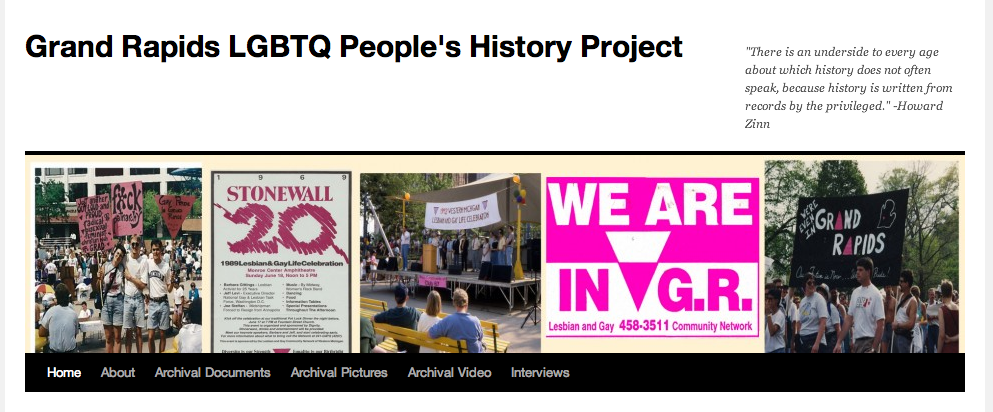
600 turn out for People’s History of the LGBTQ community in Grand Rapids premier screening last night

Last night an estimated 600 filled the Loosemore auditorium and an overflow room in the downtown campus of Grand Valley State University to see A People’s History of the LGBTQ community in Grand Rapids film. An additional 100 people had to be turned away, since we were already at over capacity.
The 1 hour and 45 minute film was the result of 69 interviews, archival photos, video, documents and a research project on how the Grand Rapids Press reported on the LGBTQ community in the 1980s and 90s.
Colette Seguin-Beighley welcomed the overflowing crowd who sat and stood for two hours and took in the rich history of organizing by those who identify as LGBTQ and straight allies.
The project has been amazing on so many levels. As one of the persons heading up the project it was amazing to learn so much about this history and to meet so many fabulous and dedicated people.
James Rider wrote, “I can’t tell you how proud I am after having seen this documentary to have been able to have had a small part in it. You really made a beautiful film showing just how far our community has come in what has really been a very small amount of time. Thank you for making the LGBTQ Community of West Michigan shine and for showing how many beautiful people have helped us to get where we are today!”

Tedi Parsons wrote, “Amazing film with some awesome interviews. Many memories shared and it reminded us all of our past struggles and what more needs to be done. Thank you to everyone involved in this film for bringing our stories to the big screen.”
We heard from dozens of people last night who were moved by the film and wanted to talk about ways to show it in other venues. If people want a copy, they can contact us at jsmith@griid.org.
Online Archive
In addition, we unveiled last night a new wordpress site specifically for A People’s History of the LGBTQ community in Grand Rapids. On that sight you can listen to all 69 interviews that were used in this project. One can also look at archival pictures, documents and video we have collected over the past 10 months. We will be adding more archival video over the coming weeks and eventually adding the film to that site as well. We are also inviting anyone who has any additional archival material they are willing to share for this site to please contact us as well. Lastly, for anyone who wants to tell their story, we invite people to submit a video or audio history of their story or contact us about doing more interviews.
 There will be other chances to see A People’s History of the LGBTQ community in Grand Rapids in public venues and as of this writing the following dates are firm:
Sunday, January 8 at 6pm
Plymouth UCC
4010 Kalamazoo SE, Grand Rapids
Thursday, January 19 at 6pm
GVSU Campus Allendale, Cook-DeWitt
If you would like to do a public screening of the film and would want someone from GRIID to be involved contact us so we can publicize the screening.
The Coming War on the Occupy Movement
This article by George Ciccariello-Maher is re-posted from CounterPunch.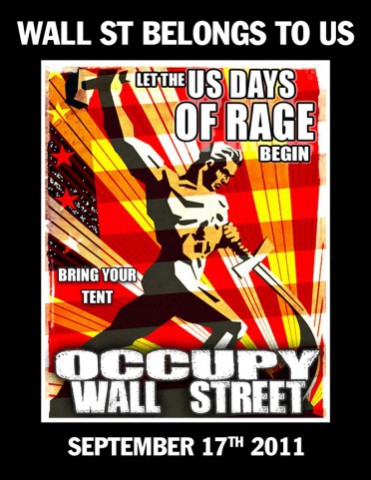
As I begin to write this, Occupy Oakland circulates in a by-now familiar pattern: forced from the camp at the break of day, the occupiers reconvened as they have done before on the steps of the Public Library. Later, they will attempt to close a repeating circuit that stretches a short six blocks along 14th Street between City Hall and the Library.
This circuit, moreover, is one which draws its familiarity not only from recent weeks, but also from the early moments of what is a single cycle of struggle spanning years: it was down 14th Street that Oakland Police pursued us during the first rebellion, on January 7th of 2009, that greeted the murder of Oscar Grant. And it was in front of the same Public Library that I crouched behind a bush as an armored personnel carrier sped past, only to sprint off as heavily-clad militarized police-troops dismounted to chase myself and others on foot.
It has become all too apparent that the Occupy Movement is under attack, and that even my title is wholly insufficient: this war is not “coming,” this war has already begun.
Breaching the Limits of Tolerance
Writing from the perspective of a previous cycle of struggle, the radical Frankfurt School theorist Herbert Marcuse described the phenomenon of “repressive tolerance,” in which an ostensibly liberating concept and practice becomes distorted to suit the powerful and legitimate the status quo. According to the political theorist Wendy Brown, the discourse of tolerance serves to mark the powerful as normal while discrediting the “unruly” as somehow “deviant,” and thereby “legitimates the most illiberal actions of the state.” In other words, the repression that comes is not a distinct and corrupted form of tolerance, as for Marcuse, but instead embedded within the idea itself.
This lesson is of paramount importance to the Occupy Movement, but so is its opposite: even the most repressive of tolerance has its limits in the push-and-pull of forces vying for control, and Marcuse’s arguable pessimism on this point must be countered with the optimism of transgressing those limits.
This war began as most do, in the realm of hegemonic struggle where small shifts signal coming offensives. But walking the fine line of counterintelligence and counterinsurgency, the forces conspiring against the Occupy Movement have been anything but subtle. In a crude and thinly-veiled information war, lies are tossed about like the seeds they are, and the media duly parrots line put forth by police and city alike. This “chatter” (to turn the language of the counterinsurgents against them) begins to spread surreptitiously: that Occupy is unsanitary, now dangerously so, now downright violent.
By the time San Francisco Chronicle was citing “anonymous police sources” about the conditions of the camp (bearing in mind that the police were not even allowed into the camp), it was clear to many that a raid was imminent. For the second raid this morning, the warning was even clearer: another anonymous leak to the Chronicle, and a leaked email to parents at a local school about an “overwhelming use of force.”
The script is strikingly similar across the map, from Oakland to Portland, Atlanta to Philly: a Democratic mayor plays nice, claiming to represent “the 99%” and to support the Occupation’s crusade against big business. But at some point, as the chatter increases, the occupation goes badly wrong, becoming unacceptable and violent, unrecognizable to the Middle America for which it claims to speak. A murder, a suicide, a rape, and an overdose suddenly brim with political opportunity. With the stage set, all that remains is for the guardians of good order to step in to defend the common good.
The Students Step into the Fray
The Bay Area Occupy Movement received an unexpected shot in the arm last Wednesday when students protesting the creeping increase in fees in the UC system pitched a small number of tents on the grassy area in front of Sproul Hall. If Oakland Mayor Jean Quan drastically miscalculated when she unleashed the police in late October, the response by UCPD to this seemingly minor disturbance strays into the realm of the Epic Fail. Deploying overwhelming force, UCPD could be seen on video beating and spearing students with their batons, punching some in the face, and even dragging English Professor Celeste Langan down by her hair. Langan would later write about her experience, and another English Professor, Geoffrey O’Brien, was also injured by police on the day.
Such repressive tactics and blatant disconnect between the second-rate cops of the UCPD and the student body are nothing new. Amid the student upsurge of 2009, the UCPD came under heavy scrutiny for its handling of a wave of building occupations, and at least one lawsuit from a friend of mine whose fingers had been purposely broken by a sadistic officer outside the Wheeler Hall occupation. At the height of the repressive wave, I myself was one of many featured on the UCPD website in an openly McCarthyite attempt to foster a snitch culture on campus (website visitors were encouraged to send tips that would aid in identifying the dangerous student organizers). The website was eventually removed through legal action.
But repression breeds resistance, as we well know. As I write this, the November 15th system-wide student strike is but a few hours away, and the mass participation of students in the Occupy struggle promises, if they can successfully link with their counterparts to the south, to offer a much needed injection of energy and numbers.
The Indestructible Oakland Commune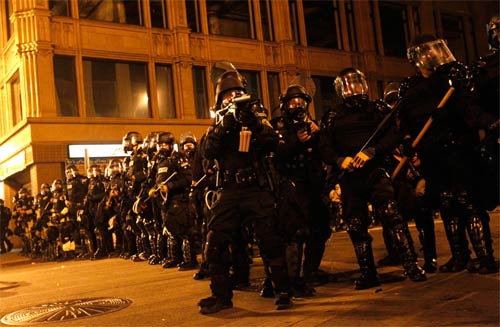
The days following the Oakland General Strike and port shutdown were dominated by a debate that never should have been. Rather than crowing about an unprecedented and unexpected chain of victories, in which Occupiers forced the city to back down and re-took Oscar Grant Plaza only to then embark on a massive if not truly General Strike, which saw up to 25,000 people swarm and shut down the Port of Oakland, some within the metaphorical Occupy camp naively took the bait offered by the city and the police, and amplified by the media. The press talking points went something like this: an otherwise powerful day was sullied by the actions of a small few who broke windows at a bank and assailed the Whole Foods in my old neighborhood.
While this iteration of the “nonviolence” debate was won on many fronts by those promoting nuance and diversity of tactics, this was nevertheless a powerful foothold for those seeking to oust the Occupation once again. Within a matter of days the chatter had increased once again, City Council was almost unanimously urging its removal, and the formerly remorseful Jean Quan, fresh from a visit to Scott Olson’s bedside, was once again urging the Occupiers to vacate. Councilwoman Desley Brooks, whose opportunism apparently knows no bounds, went from sleeping at the occupation (or at least publicly emerging from a tent) to condemning the occupiers in a matter of mere weeks. (Such stage-managed populism is something of a forte: Brooks had previously unleashing her goons on myself and others for apparently undermining her carefully crafted image of sympathy with the people.)
As City Council turned against the Occupiers, and as the City Administrator threatened to go around the Mayor to approve a raid, Quan was apparently disconnected and feigned impotence: as a leaked email from her husband put it, “she does not set policy for the city… council does.” The very same Mayor who had approved the devastatingly brutal raid a week prior finally signed on to allow the same police, under the same police chief, with the same participating agencies, to move in and clear the camp.
This was too much for some within the Quan administration to handle. At 2am, Quan’s chief legal advisor Dan Siegel resigned via a twitter message. Siegel, who I am proud to count as a friend and a comrade, and whose civil rights law firm has tirelessly defended protestors in the past, has been for years fighting the struggle within the Quan administration against all odds. He has chosen to take a principled stand at exactly the right moment.
As Occupiers massed at the Public Library, only to march once again up 14th Street to again seize Oscar Grant Plaza with no resistance from police, the same Plaza the Mayor had just spent hundreds of thousands of dollars to clear, it is clear that she has been defeated once again, and decisively so. One wonders what could possibly be next for Quan.
Occupy Philly’s “Wrong Turn”
On the opposite coast, the same script plays out. After initially expressing support for Occupy Philly, and evidently fooling many Occupiers in the process, Mayor Nutter was re-elected by a wide margin last Tuesday, freeing his hand for a radical change in course. The previous week, the Radical Caucus of Occupy Philly had brought forth a proposal to the General Assembly which simply stated that the Occupy camp would not voluntarily leave in preparation for a scheduled construction project in Dilworth Plaza, and would resist eviction. The proposal seemed to shock many who had been lulled into the false sense of security that liberal tolerance provides, but after extending discussion of a modified proposal for an entire week, a four-hour General Assembly decided almost unanimously (150 to 3) to remain in Dilworth Plaza and make preparations for nonviolent civil disobedience in the event of a raid.
Nutter’s first move came in a Sunday press conference, in which he announced his intentions to the world in so many words. “Occupy Philly has changed,” he insisted, and so to must the city’s relation with it change. Conditions had deteriorated, fire codes had been violated, and communication, according to the Mayor, had been unilaterally severed. The shadowy force behind this subtle and unwelcome change, according to Nutter, was the Radical Caucus, a frightening group that had taken over and is “bent on civil disobedience” (I only wonder why he didn’t follow suit with other cities in referring to “violence”). If the central pretext for eviction in other cities has been murder, suicide, and overdoses, in Philly it is rape: Nutter highlighted a sexual assault at the camp as an indication of just how far the movement had fallen.
If the repetition of this same strategy, discredit then evict, across the country were not enough to doubt the Mayor’s words, Occupy Philly itself was quick to respond. At a counter-press conference yesterday, speaker after speaker dismantled Nutter’s claim, piece by piece. The most shocking revelation came from the Women’s Caucus, which was quick to highlight the opportunism and hypocrisy of focusing in on the sexual assault as a pretext to attack the Occupation. As a representative of the Women’s Caucus told the press, “We asked police for help with the eviction of a sexual predator. The police said, ‘It’s not our problem. Get your men to handle it.’”
If anything, the Mayor’s slander has strengthened the resolve of those who will defend the camp from eviction, and here’s to hoping it will open the eyes of some who have claimed that the Mayor was on the side of the Occupation from day one. (The so-called “Reasonable Solutions Committee,” which had spearheaded efforts to hand the Plaza back to the city, appears to be beyond all limits of reason. Its members are now both circulating a petition to repeal the GA’s decision to remain, deemed a “Petition for the Logical” with characteristic condescension, while simultaneously betraying the Occupation as a whole by unilaterally applying for alternative permits from the city).
The Politics of War
From the messy dialectic of the spreading Occupy Movement emerge some expected developments. Solidarity develops among the occupiers, who draw strength from the successes and rage from the repression of their comrades, learning crucial and radicalizing lessons from both. Police and city administrators similarly close ranks (sometimes together, sometimes against one another) gripped with the fear that their power is splintering, that the movements have become ungovernable, that they are slipping the yoke and refusing the straitjacket. A climate of mutual polarization, radicalization, and warfare sets in.
But other unexpected dynamics surface as well, some of which play into the hands of the Occupiers. As Occupations spread from Oakland to Berkeley, the sheer number of available police becomes a question, as individual forces rely on mutual aid programs for costly, large-scale eviction efforts. Word emerges that Oakland’s efforts to remove the camp were sped-up due to the constraints imposed by the impending student strike tomorrow. Here the fallout from the brutality of the first Oakland eviction blows back on the police forces themselves: citing the excessive force in Oakland, Berkeley City Council voted unanimously to block mutual aid assistance between the Berkeley PD and UCPD.
And even those more than willing to participate in brutality have begun to demand more booty and protection: in the run-up to the second Oakland eviction this morning, the Alameda County Sheriff’s Department demanded not only $1,000 per officer per day, and the City of Alameda also demanded increased legal protection in the case of a repeat of the brutality that left Iraq veteran Scott Olson critically injured at the hands of an ACSD officer. This increasing legal scrutiny, financial strain, and sheer numerical limitations bode well for the future of Bay Area occupations and those across the nation.
I use the language of war consciously, not out of some desire for violent conclusion but out of a recognition that violence is already there. As our Egyptian comrades made clear in a statement in solidarity with Oakland, “It is not our desire to participate in violence, but it is even less our desire to lose.” Despite the asymmetrical nature of the war that confronts us, the implements are the same: few can deny the shocking militarization of police departments in recent years, or that this heavy weaponry has been all but openly deployed against the Occupiers. If Clausewitz famously argued that war is politics by other means, a formulation which Foucault slyly reversed, the practical reality of the Occupy Movement is that the two are much more difficult to disentangle from one another. Every word from the mouth of these Democratic Mayors, every leak whispered from a cop to a reporter is a rubber bullet in potentia.
I use the language of war because we will not back down, and because as a result, the war will be brought to us.
But more importantly, I speak of war because this is not a one-sided affair, and we should not allow our opponents to strip us of our status as equals simply because we do not respond in kind. Our power is nothing to scoff at, although it circulates in a manner largely distinct from that which we oppose. Just two nights ago, Occupy Portland swelled into the thousands to defend Chapman and Lownsdale squares, facing down riot police, forcing their retreat, and winning the night in the most absolute of terms. Last night, the plaza was cleared and campers removed, but traces of such a stunning initial victory remain in the confidence and compromise of the occupiers as they regroup and go once more into the breach.
And as I finish, I receive late word from Oakland that the occupiers have re-taken Oscar Grant Plaza without more than a symbolic police presence, and even later word of a massive crackdown of Zucotti Park in Lower Manhattan. Another skirmish lost, another battle won, but the long war stretches out before us like an interminable horizon.
Local News Media presents various opinions, but not facts during Condoleezza Rice’s visit to Grand Rapids
Last night former Secretary of State Condoleezza Rice spoke at a GOP fundraiser in Grand Rapids. Many local commercial news outlets reported on her visit and a protest by people identified with Occupy Grand Rapids.
The Grand Rapids Press, WZZM 13, WXMI 17 and WOOD TV 8 all reported on Rice’s visit and all four of these news outlets reported on the protest against Rice, except WOOD TV 8. WOOD TV 8 reporter Rick Albin was the person who “interviewed” Condoleezza Rice at the GOP fundraising dinner and will run a long version of the “interview” on their Sunday show To the Point. How could anyone consider channel 8’s role in this GOP event with Rice as anything but objective, when a local TV station plays a major role in a fundraising event for the Kent County Republicans?
However, just because the other media outlets reported on the protest is not necessarily any indication that they fulfilled their role in conducting real journalism of Rice’s visit to Grand Rapids. Certainly one could argue that by presenting both Rice’s point of view and the protestors’ point of view, the GR Press, channel 13 and 17 were being objective in how they reported what happen last night. However, what each of these news outlets, along with channel 8, failed to do was to verify any of the claims made by Rice or the protestors. This is the real role that journalists should be playing, not just recounting what took place last night, but actually investigating the claims made by all parties involved.
That the local news agencies did not question or verify any of the claims made by Condoleeza Rice is not surprising, since in the lead up to the 2003 war and in the first months of the war the local news media acted more as stenographers to power than watchdogs, as is reflected in our 2003 report, Searching for the Smoking Gun: Local News Coverage of the US War in Iraq.
The WZZM 13 story did not include comments from Rice and focused mostly on the protestors. The Fox 17 story does provide comments from Rice and one protestor, but the amount of time is a few seconds to the protestor and nearly a minute of commentary to Rice.
The main claims that Rice makes are that Saddam Hussein took the region to war three times. It is true that Iraq went to war with Iran from 1980 – 1988, but Rice omits the fact that the US was financing Iraq during those years and providing the technology and resources for WMDs, as is substantiated in declassified US government documents. Rice also makes the claim that Saddam Hussein put 400,000 of his own people in graves, a serious accusation, which is not substantiated by the Fox 17 reporter and has no basis in actual human rights records. In addition, Rice claims that Iraq now has a chance to be a real democracy, which is an interesting claim, especially since the US used Paul Bremer to rewrite the Iraqi Constitution that would give Iraqis less say in their future and more access to foreign corporations to take over Iraqi resources.
The WOOD TV 8 story has Condoleezza Rice responding to Rick Albin was comments about 911, Iraq WMDs and the point that right now, “Israel is the only true democracy in the Middle East.” Such a claim that is not verified by channel 8 ignores the fact that Israel has been the largest recipient of US military aid for 3 decades, receiving $3 billion dollars annually while they illegally occupy Palestinian land. This is hardly a shining example of democracy.
The Grand Rapids Press article follows a similar pattern by citing both protestors and Rice, but they have an additional story that is based on a separate interview with Rice. In this interview Rice makes many of the same claims as reflected in the other news coverage. However, in this interview she also makes the claim that the US removal of Saddam Hussein from Iraq is what paved the way for popular uprisings in Tunisia, Egypt and Libya.
“When you start to loosen the pins in a system, a lot of things start to happen. Saddam Hussein was the most authoritarian, dictatorial leader in the region. I do believe that the removal of Saddam Hussein, but more importantly the freedom agenda that President Bush articulated in his second inaugural…put democracy on the agenda in a way it had had not been.”
The Press reporter does not verify such a claim, a claim that ignores the fact that the US has been a supporter of political repression in Tunisia and especially in Egypt, with numerous US administrations providing military and diplomatic support to Mubarak for decades.
The commercial media coverage of Condoleezza Rice’s visit to Grand Rapids provides us with just one more example of how mainstream media acts as stenographers to power. We must not be fooled by the appearance of “balance,” just because protestors are included in the coverage. Instead, we need to recognize the true role of commercial media as nothing more than an extension of the power structure in American society.
Occupy Grand Rapids charges Condoleezza Rice with War Crimes
 Yesterday, about 30 people gathered outside the Grand Rapids Convention Center to protest the presence of former Secretary of State Condoleeza Rice who was in town for the GOP’s Lincoln Day Dinner.
A smaller group of protestors marched from Monument Park with a large puppet of Rice, since those involved in organizing the action were park of Occupy Grand Rapids.
Once at the convention center protestors hung a banner across the street that said, “Condi lied, people died.” The local Food Not Bombs group brought free food for those protesting, which was in contrast to the $100 a plate dinner the GOP was having inside for the opportunity to listen to Rice.
Those protesting Rice also handed out flyers that had a list of accusations against the former Bush administration staffer, accusations, which included war crimes, crimes against humanity, torture and economics crimes of diverting billions of dollars from human need to war.

However, one additional action that people participated in and witnessed, was a mock trial of Condoleezza Rice, that also raised issues and presented facts about what she is guilty of, with an emphasis on her role in creating a war/occupation of Iraq and Afghanistan.
Here is video of that mock trial.
[vimeo 32258454]
They don’t represent you: 50% of Congress are Millionaires
This article is re-posted from OpenSecrets.org.
These days, being a millionaire typically qualifies you as part of the one percent. But in Congress, it only makes you average.

About 47 percent of Congress, or 249 current members of Congress, are millionaires, according to a new study by the Center for Responsive Politics of lawmakers’ personal financial disclosure forms covering calendar year 2010. The Center’s analysis is based on the median values of lawmakers’ disclosed assets and liabilities.
That lofty financial status is enjoyed by only about one percent of Americans.
“The vast majority of members of Congress are quite comfortable, financially, while many of their own constituents suffer from economic hardships,” said Sheila Krumholz, executive director of the Center for Responsive Politics.
“It’s no surprise that so many people grumble about lawmakers being out-of-touch,” Krumholz continued. “Few Americans enjoy the same financial cushion maintained by most members of Congress — or the same access to market-altering information that could yield personal financial gains.”
On the whole, elected officials in the country’s upper chamber enjoy cushier bank accounts and portfolios than their counterparts in the U.S. House of Representatives.
In 2010, the year of the most recently released financial data, the estimated median net worth of a current U.S. senator stood at an average of $2.56 million, according to the Center’s research.
Despite the global economic meltdown in 2008 and sluggish recovery, that’s up about 7.6 percent from an estimated median net worth of about $2.38 million in 2009, according to the Center’s analysis. And it’s up about 13 percent from a median estimated net worth of $2.27 million in 2008.
Economic well-being knows no partisan loyalty.
Fully 36 Senate Democrats and 30 Senate Republicans reported an average net worth in excess of $1 million in 2010, according to the Center’s analysis. The same was true of 110 House Republicans and 73 House Democrats.
The median estimated net worth among Senate Republicans was $2.43 million, and the median net worth among members of the Democratic caucus in the Senate was $2.58 million, by the Center’s tally.
Meanwhile, in the House, the median estimated net worth of a GOP House member was $834,250 in 2010, according to the Center’s research, compared to a median net worth of $635,500 among House Democrats.
The median estimated net worth among House members, overall, stood at $756,765 in 2010. That’s up about 17 percent compared to the median net worth of $645,500 among House members in 2008, but down about 1 percent compared to 2009, when House members posted a median estimated net worth of $765,010, according to the Center’s analysis.
When members of Congress file these annual reports, they are allowed to list of the value of their assets and liabilities in broad ranges. The Center for Responsive Politics determines the minimum and maximum possible values for each asset and liability for every member of Congress and then calculates each lawmaker’s average estimated net worth.
Sometimes hundreds of thousands of dollars — if not millions of dollars — separate a lawmaker’s minimum estimated worth from his or her maximum estimated wealth.
For instance, Rep. Darrell Issa (R-Calif.) ranks as the wealthiest member of the 112th Congress, according to the Center’s analysis of 2010 financial disclosures. Issa’s minimum estimated net worth in 2010 was $195 million, while his maximum estimated net worth was more than $700 million. That gives Issa an average net worth of $448 million.
Meanwhile, Rep. Jared Polis (D-Colo.) ranks as the wealthiest House Democrat. Polis, who has spent about $7 million of his own money on his campaigns since 2007, has an average estimated net worth of $143 million.
That’s not good enough to rank him as the No. 2 wealthiest member of Congress though. In fact, it only ranks him as No. 5 wealthiest current lawmaker.
Rep. Michael McCaul (R-Texas), Sen. John Kerry (D-Mass.) and Sen. Mark Warner (D-Va.) all rank higher.
McCaul’s average estimated net worth in 2010 stood at $380 million, while Kerry’s stood at about $232 million and Warner’s at about $193 million.
Kerry’s sizeable net worth is thanks, largely, to the assets of his wife Teresa Heinz Kerry.
All members of Congress are required to report not only their own holdings but also that of their spouses and any dependents. However, calculating the exact value of many of their investments is impossible.
The top bracket of assets held by senators’ spouses is simply “more than $1 million,” so many lawmakers’ families’ net worth are likely undervalued. For instance, some estimate that Heinz Kerry’s net worth may exceed $1 billion.
Notably, Sen. Bob Corker (R-Tenn.), who places as the No. 12 richest member of Congress with an average estimated net worth of about $60 million, ranks as the wealthiest Senate Republican.
At the other end of the spectrum, a handful of members of Congress are definitely in debt.
No matter how you slice the information on the congressional disclosure forms for Sen. Debbie Stabenow (D-Mich.), for instance, her net worth is below zero. Her maximum net worth is a negative $15,000, while her minimum net worth is a negative $50,000.
A similar predicament afflicts Reps. Mario Diaz-Balart (R-Fla.), John Conyers (D-Mich.), Louis Gohmert (R-Texas), Steve Fincher (R-Tenn.) and Alcee Hastings (D-Fla.).
That said, members of Congress might be more financially well off than we can see. The annual filings do not include the values of government retirement accounts, personal property — such as cars or artwork — that not for investment or any non-income-generating property, such as their primary residences.
Moreover, because of the forms’ broad ranges for assets and liabilities, it’s impossible to know whether some members of Congress are in the black or in the red.
For instance, Sen. Herb Kohl (D-Wis.) could be worth as much as $106 million in debt or as much as $70 million in the black, depending on the exact values of his assets and liabilities.
Kohl, who has in past years ranked among the wealthiest members of Congress, owns the Milwaukee Bucks basketball team and several valuable pieces of land, among other investments. The NBA team is his largest single asset and was valued at $258 million last year. But in 2010, he also reported nine liabilities totaling between $280 million and $425 million.
His average estimated net worth of negative $18 million currently ranks him as the poorest member of Congress. Notably, Kohl chairs the Senate subcommittee that could act as a mediator in the current NBA lockout, should Congress opt to intervene in the dispute.
Download the full list of all current members of Congress and the most popular congressional investments here: http://bit.ly/s1GeBy
Please don’t hesitate to use this information, but please credit the Center for Responsive Politics if you do.
POLITICAL HEAVY WEIGHTS RANK AMONG FAVORITE PICKS
The most popular company in which members of Congress were invested in 2010 was General Electric, a company that spent more than $39 million on federal lobbying that year and ranked as the No. 3 top spender on lobbying.
 Seventy-five different current members of Congress held stock in GE in 2010, according to the Center’s research. Collectively, these holdings were worth at least $3.6 million.
Procter & Gamble and Bank of America ranked No. 2 and No. 3 behind General Electric in terms of the most popular investments, with 62 lawmakers and 57 lawmakers, respectively, holding stocks in each of those companies, according to the Center’s analysis.
Lawmakers’ Procter & Gamble holdings were worth at least $8.7 million, and their Bank of America holdings were worth at least $2.8 million, according to the Center’s research.
Microsoft and Cisco Systems tied for the No. 4 spot, with 56 members of Congress reporting holdings in the two tech companies. And pharmaceutical giant Pfizer ranked next, with 51 members of Congress reporting holdings in 2010.
Lawmakers’ stocks in Microsoft were worth at least $3.2 million, their stocks in Cisco Systems were worth at least $1.3 million and their stocks in Pfizer were worth at least $2 million, by the Center’s tally.
In all, there were 41 separate stocks or investment funds in which at least 20 current members of Congress invested during 2010.
PUSHING FOR GREATER TRANSPARENCY, ACCESS
Federal law requires that all members of Congress annually file personal financial disclosure forms.
Most of these forms are filed in May and made publicly available in June. However, many lawmakers received extensions of up to 90 days. And while the House makes its reports freely available online, one must still trek in-person to the Senate Office of Public Records and purchase copies of these reports — further adding to the difficulty of accessing these them.
As soon as these reports become available, the Center for Responsive Politics gathers — and pays for — these public records. Then, weeks and months of data entry then ensue, turning paper records into the data that get incorporated into the OpenSecrets.org personal financial disclosure database.
The Center for Responsive Politics advocates for the electronic submission of personal financial disclosure reports to provide greater transparency and more meaningful access to this valuable public data.
“More transparency regarding congressional members’ personal assets will help assure constituents that their lawmakers are not attempting to personally benefit from legislative actions,” said Dan Auble, who manages the Center’s database of politicians’ personal financial information.
“It’s time for Congress to make a leap forward into the Internet age,” Auble continued. “This critical information must be made available in a search-able, sort-able, download-able and machine-readable format. Citizens across the country shouldn’t be required to wait and wait and wait.”
Some members of Congress are currently pushing legislation to require that members of Congress and their employees report financial transactions regarding stocks and bonds in excess of $1,000 within 90 days. That bill, known as the Stop Trading on Congressional Knowledge Act, or STOCK Act, would also prohibit members of Congress and their aides from buying or selling investments based on nonpublic information obtained because of their status.
Who is the Biggest Farm Bill Loser video helps reframe the debate about the US food system
The research and advocacy group Food & Water Watch just released a new animated video as part of its campaign to influence the 2012 Farm Bill.

Meant as a spoof of the TV show “The Biggest Loser,” the Food & Water Watch video rightly frames the debate about the poor health of many Americans as a result of the corporate-based food system we have in this country.
“It is often argued that subsidies have lead to the overproduction of commodity crops like corn and soybeans, creating cheap junk food that makes us fat. This seems like a logical argument but it is grossly oversimplified. When you take a closer look, we find that the deregulation of commodity markets — not subsidies — has driven down the price of these commodity crops. Deregulation has made big corporations rich while farmers have struggled to survive. Based on this, can you guess who The Biggest Farm Bill Loser will be?”
Food & Water Watch has a Grand Rapids campaign to make the 2012 Farm Bill respond to the real needs of farmers and the public. You can get information about the local campaign on Facebook.
When elites give money to each other: ArtPrize financials for 2010
We wrote last month a series of articles on ArtPrize, with an emphasis on the political economy of this downtown Grand Rapids spectacle.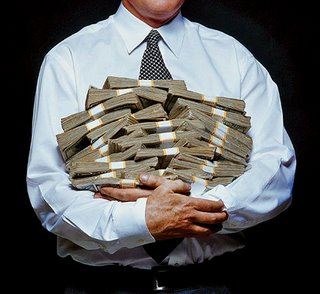
In one article we shared information on the operating budget for the first year of ArtPrize, in 2009. In that first year of operation, the Dick and Betsy DeVos Foundation gave $1,700,000 to Rick DeVos’ desire to see “crazy stuff happen all over Grand Rapids.” We obtained this information by looking at the 990 documents that ArtPrize now has to file since it is a non-profit entity.
Just days ago we were able to obtain the 990 documents for 2010, which reveals even more about who is funding ArtPrize.
Here is a list of financial donors in 2010 that gave $10,000 or more:
Richard & Helen DeVos $100,000
PNC $100,000
Meijer Inc. $50,000
Doug & Maria DeVos $50,000
Dan & Pam DeVos $50,000
Bob & Cheri Vanderweide $50,000
Steelcase $50,000
Amway Corporation $50,000
Haworth $35,000
Dave & Carol Van Andel Foundation $35,000
Huntington National Bank $30,000
Frederick Meijer Gardens $30,000
Rockford Construction Company $25,000
People Design $25,000
KatePew Wolters $25,000
West Side Beer Distributing $25,000
Edgar & Elsa Prince $25,000
Kendall College of Art & Design $20,000
Comcast $20,000
Grand Rapids Downtown Development Authority $15,000
Wolverine Worldwide $15,000
Herman Miller $15,000
Universal Forest Products $15,000
Cascade Engineering $15,000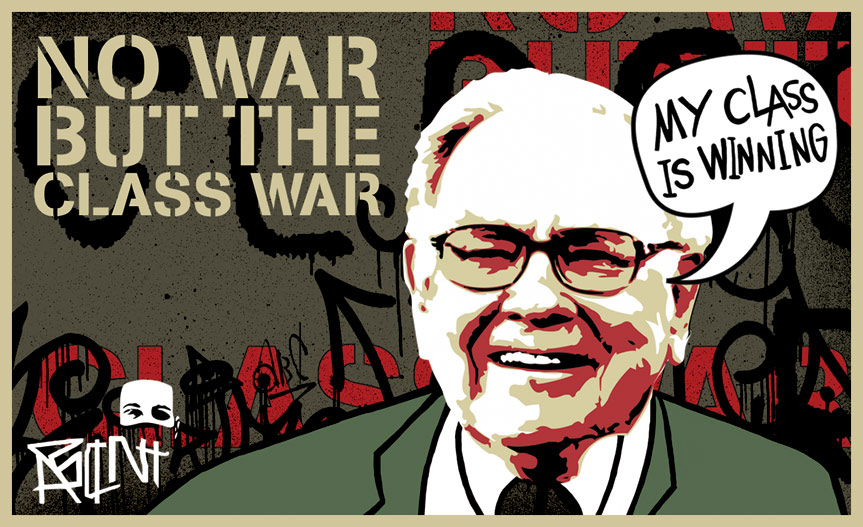
JCT Foundation $15,000
Amway Hotel Corporation $10,000
McGarry Bair $10,000
Pearl St Investment MGMT of Oppenheimer & Co. $10,000
Modern Day Floral $10,000
Fifth Third Bank $10,000
Applause Catering $10,000
Warner, Norcross & Judd LLP $10,000
Spectrum Health Hospital $10,000
J.C. Huizenga Group $10,000
Eastern Floral $10,000
In addition, there were numerous other entities that gave between $5,000 and $7,500 dollars to ArtPrize 2010.
Looking at this list of financial contributors one can easily see that those who were major donors are the political and economic power in this community. It should come as no surprise that they were major donors to ArtPrize, since they are also entities that will benefit financially and politically from the annual downtown art event.
As we have stated before, if you look at who makes up the Grand Rapids Chamber of Commerce, the Econ Club of Grand Rapids, the Downtown Development Authority, Grand Action, the West Michigan Policy Forum and the One Kent Coalition you see many of the same names involved in sponsoring ArtPrize. The Chamber of Commerce and the Econ Club have been supporters of the economic policies implemented by Governor Snyder, which have resulted in the elimination of a business tax, weakening public sector unions and taking away local power through the Emergency Financial Manager system.
The West Michigan Policy Forum wants Michigan to be a Right to Work state and the One Kent Coalition wants to radically alter local government by merging the City of Grand Rapids with the Kent County that will be led by a CEO, according to their own proposed legislation.
In addition to these policy benefits, these entities will make lots of money during ArtPrize, since many of them own or have investments in downtown hotels, bars, restaurants, parking facilities and other services. These entities also benefit, in that all of the donations are tax right offs, since ArtPrize is now a 501c3 non-profit entity.
More importantly, ArtPrize acts as a mechanism to distract us from the political and economic power that the DeVos’ and their friends have in West Michigan or worse, it acts as a form of cultural imperialism by making the public give thanks to the local robber barons for entertaining us for a few weeks every fall. Either way, the public loses while the Grand Rapids version of the 1% laughs all the way to the bank.
In May of 2012, we can get access to the 990s for the 2011 ArtPrize and we promise to give you a breakdown of their finances for the third year of operation.
How to End the Israel-Palestine Conflict
This interview with Norman Finkelstein was conducted by Jamie Stern-Weiner and is re-posted from ZNet.
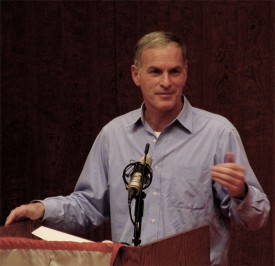
Norman Finkelstein is one of the world’s foremost scholars on the Israel-Palestine conflict. He is the author of, most recently, Beyond Chutzpah, which systematically documents the realities of Israel’s human rights record, and This Time We Went Too Far, an analysis of Israel’s assault on Gaza in 2008-9. His forthcoming book argues that American Jews are distancing from Israel as the dissonance between the latter’s conduct and their liberal values increases. Also, together with Mouin Rabbani, he has written a pamphlet intervening in the Palestinian solidarity movement to make a case for how to resolve the conflict. [Full disclosure: I did research assistance for the pamphlet]. New Left Project met up with him last week to talk about it.
In your forthcoming book you argue that American Jews are distancing themselves from Israel. What is the evidence for that?
There are two kinds of evidence. First, there is a huge amount of polling evidence now showing that, at least in the under-forty generation, there is a significant distancing from Israel. There are some people who still say it’s not true – they claim that in all generations the younger are always more distant, and then as they get older they feel more of a pull towards Israel. That’s called the ‘lifecycle thesis’. But it’s not credible anymore. The best pollsters, like Stephen Cohen, are clear that if you ask questions like, not just ‘how do you feel about Israel?’, but ‘how often do you talk about Israel?’, ‘how closely do you follow events in Israel?’, and so on, if you look at all that polling evidence it’s clear that a distancing is occurring.
Having said that, one qualification. There is serious dispute about what is causing the distancing. So people like Stephen Cohen say it’s intermarriage – Jews are now intermarrying at a rate of about 60% in the United States, and when you intermarry you tend to settle in a less Jewish-centric milieu. And when you’re in a less Jewish-centric milieu, then the tendency to feel a pull towards Israel begins to weaken, because nobody around you is talking about it. It’s not a focus of conversation. So the qualification is: even if you acknowledge that an estrangement from Israel is occurring, there is still the second question of what accounts for it.
Aside from the polling evidence, I think the anecdotal evidence is overwhelming. You see it everywhere, with high-profile defectors like Peter Beinart and David Remnick, and then you read all of these testimonials by Jews talking about how they’re really embarrassed by the way Israel is carrying on. You see this whenever there’s a meeting or convention. There was the Jewish Federations General Assembly recently, and Peter Beinart gave one of his anguished speeches, and then a young woman stood up and she started to avow her anguish… it’s everywhere. This is not sightings of Elvis – this is serious anecdotal evidence that Jews are becoming less and less attached to Israel.
And what’s the significance of that?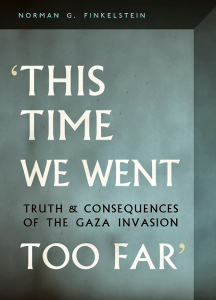
It’s very important if you believe that the Israel lobby has played a critical role in blocking a settlement of the conflict through the pressures it exerts on the U.S. government. If you see the lobby as a series of concentric circles, there’s a ‘core’, and they’re not going to change – they’re paid lobbyists, that’s their job – but it moves out and at some point includes broader Jewish sentiment. Not its core, but moving outwards, it includes for example many Jews who write for newspapers and magazines, and so on. In the conventional sense that’s not a lobby – they’re not paid agents. But if you understand the lobby, and I think it’s a reasonable way to look at it, as a series of concentric circles stretching from a core of paid lobbyists out towards the broader Jewish community, then Jewish opinion plays a big role in the lobby’s effectiveness. Liberal Jewish alienation from Israel means that we’re reaching the point where we can reduce the lobby to its core – which is still a pain, no question about it, and still represents a lot of money, but it means we have a chance of reaching people now.
Why are American Jews becoming disillusioned with Israel?
There is a common misunderstanding here, because everybody just assumes that the one and only factor shaping American Jewish attachment to Israel, and also the inexorable one, is the ‘ethnic’ factor: if you’re Jewish you must be pro-Israel, in fact you must be fanatically pro-Israel. But the historical evidence shows that the relationship in fact depends on three factors.
One factor is ethnicity, for sure, because if you’re Catholic there’s just no particular interest from the get-go in Israel. It might develop, but as a point of departure it’s not there – it has to be created. In the case of Jews, the ethnic factor is the foundational factor. If you’re Jewish, you’re going to have an immediate connection with Israel. How powerful that connection is, that’s a secondary issue, but there will be something. So I’m not going to in any way deny or diminish the ethnic factor, but it has to be contextualized.
For example, there is an ethnic factor after 1948, but it is very seriously weakened by the ‘citizenship’ factor: the fact that Jews enjoy citizenship in the United States. After World War II, Jews were flourishing in the United States, and they didn’t want to jeopardise their standing as American citizens. Jews have always been burdened by the ‘dual loyalty’ bogey and have been historically identified with the Left (not without good reason – the American Communist Party was way disproportionately Jewish; the Bolsheviks were mainly Jewish; etc.). So Jews had to worry about both the historical legacy of the ‘dual loyalty’ charge, compounded by the fact that with the beginning of the Cold War they had to dissociate from the Soviet Union and the whole leftist tradition. Israel, moreover, was at that time seen as leftist – the ruling Mapai party was staunch Second International, and the main opposition party Mapam was staunch Stalinist. American Jews didn’t want much to do with that. And so the citizenship factor seriously diluted the ethnic factor, to the point where there was really no interest in Israel. If you look at the whole record, and I’ve read it carefully, from ’48-’67, there’s nothing on Israel there. You go through the issues of Commentary magazine, Israel would appear in about one issue out of every twenty, around article number thirteen headlined something like, ‘Bar Mitzvah in Israel’. Those were the kind of articles they would run about Israel.
The third factor, which I think is now the salient one, is ideology. American Jews have historically, at least for the past 80 years, been ideologically committed as liberal democrats. I go through all the evidence in the book – no point going through it now, but it’s clear. And I think that’s the factor that is most affecting American Jewish loyalties to Israel now. To put it simply: Israel has become an embarrassment. Its whole way of conducting itself, not to mention the whole mindset of its leadership, is illiberal: in its foreign policy, complete contempt and disregard for international institutions; in its domestic policy now, serious inroads on the most fundamental liberal principle of equality under the law and the rule of law; and in its treatment of the Palestinians and its neighbors, egregious violations of human rights on a systematic and methodical basis.
But those aren’t recent developments.
No, but the big difference is that people now know. That’s new. They now know, first of all because it’s better researched, and secondly because respected and unimpeachable organisations and institutions have now lent their name to the findings. When I was growing up, if you wanted to be critical of Israel’s human rights record you had to rely on what was called the ‘Israeli League for Human and Civil Rights’, which was led by Israel Shahak. Now Shahak was a terrific person, but it’s fair to say – no disrespect to him, he’s now passed away – that he was exceedingly eccentric. He always wanted to develop his own very individual take on things, which sometimes made him come across as kooky. But he was the only one really investigating Israel’s abuses, so you had to rely on him. Nowadays, you can rely on Human Rights Watch and Amnesty International, and everyone understands that. It’s very pleasing to see. I was speaking in Leeds, and they showed me a student article they wrote on political prisoners in Israel. And they cite Amnesty, they cite Human Rights Watch… everyone knows immediately that these are the sources to cite. Now, who can Israel cite, apart from its own press releases and Alan Dershowitz? Really, who can they cite? Well, that makes it very hard for a liberal American Jew to say, ‘oh well, I don’t believe any of the human rights organisations, I believe Israel’.
So if liberalism is shifting American Jews’ attachment to Israel, is American liberal opinion more broadly changing too?
Oh yeah – you see the evidence in people like Jimmy Carter, Bill Moyers, and so on. But on the topic of Israel-Palestine liberals tend to take their cues from liberal Jews. They’ll go out there when they see a large number of Jews do it. It’s the same thing with Human Rights Watch and Amnesty International – Amnesty only began to honestly cover the occupied territories when B’Tselem did. It waited for a Jewish organisation to give it cover.
And this is for good reasons as well as bad – it’s not just for mercenary or cowardly reasons. It’s a kind of feeling, ‘well, Jews have suffered a lot, so I really should defer to the judgement of a liberal Jew on this’. I saw that on the Left too. I was good friends, I loved the guy, with Paul Sweezy, editor of Monthly Review. Sweezy came from a blue-blood patrician family. He was an exceptionally wonderful human being, and he was the leading American Marxist economist. All of his collaborators throughout his life were Jewish – Paul Baran, Harry Magdoff, Leo Huberman… he was that kind of guy, even though his family worked for the House of Morgan. Paul was not afraid of anything, but when it came to Israel and Jewish issues, he always deferred to his Jewish collaborators, out of a kind of respect: ‘I shouldn’t go past where they’re going’. And I respected that – I understood it.
It was the same thing with Amnesty. There were the bad reasons – the money. They were afraid that if they were too critical of Israel they would lose funding, because Jews are liberal, and they put all their money in liberal organisations. But there were also the good reasons – Jews went through the Nazi Holocaust, and so we have to be a bit more cautious with them.
OK, so we’ve discussed why American Jews and liberals more generally are turning from Israel. What do you think follows from this strategically for the Palestinian solidarity movement?
I think that’s the most important question now: where does this all take us politically? In my opinion we’re now at what you might call the ‘Biltmore moment’. As you might know, a turning point in the Zionist movement came in 1942 when Zionist leaders met at the Biltmore Hotel in New York. That’s the first time the Zionist movement goes on record for a Jewish state. Until then the goal was very ambiguous – everybody knew privately that they wanted a Jewish state, but they never declared it publicly. But at the Biltmore meeting, they officially set the goal.
I feel like we’re now at a Biltmore moment. We’re at a point of action. It’s no longer only about debate, or about educating people – educating people remains the priority, but it’s no longer only about that. We’re now at the point where we have to act, and the crucial thing with action is setting a goal that can reach a broad public. I think the only goal that can reach a broad public is the rule of law. That is the dominant language of our epoch, and international law and human rights is also the dominant language of the slice of the public we really want to reach. It’s also the language that liberal Jews understand. The rule of law, equality under the law, international institutions – that’s their language, and so it has to be constantly impressed upon them that what they are supporting is in violation of the law.
There are costs to orientating the movement around the rule of law. For example, the international legal consensus isn’t as firm on the question of the Palestinian refugees as many would like, and international law also says nothing about a single state solution.
I think these are mythical costs. Something can only be a ‘cost’ if it’s within your grasp, and you have to sacrifice it. But if it’s not within your grasp, it’s like saying “the cost is communism”, or “the cost is ‘from each according to his ability, to each according to his need'” – it’s not within our grasp, so how could you use the language of ‘cost’? There is no broad public that is ready to hear the language of a single state.
Let’s take an example. There are homeless people on the streets of New York. If you organise a campaign to get people to give their winter coats to the homeless, you can reach a broad public with that. Most people understand that. If you have an extra winter coat, why not give it? So if some people commit civil disobedience – let’s say they block a boulevard – and say they’re doing it to wake the conscience of people to the fact that there are homeless people, so if you have a winter coat, why not give it. Most people would be receptive to that. But let’s say you go out on the boulevard, and you commit civil disobedience, and you say to people: you have, not extra coats in your houses, but extra space in your houses, so why don’t you take in a homeless person? Well, from a moral point of view there’s a very strong argument for that. And if you asked ‘what would Jesus do?’, I think it’s clear that Jesus would take a person in to his house. But is that likely to reach a broad public? Are people going to say, ‘sure, take my living room’? No. And so from a moral point of view, you could say that there is a ‘cost’ to advocating just the winter coat. But is it practically a ‘cost’? No, because you could never reach people on the room. It’s just a mythical, abstract, speculative cost. It’s not a practical cost.
What about those who say that the time for a two-state settlement has passed – that it is no longer, practically speaking, feasible to implement?
That’s a factual question, and you have to go through it. I have, with detailed maps and so on. There is a practical way to resolve the settlements. The thorniest question of course is the refugees. I’ll admit it’s not an easy one to resolve. I’m presently working on a book with a Palestinian scholar [Mouin Rabbani] whose judgment I completely trust, and according to our division of labour he’s going to handle the refugee question, within our shared framework. I’ll see what he has to say.
I’ve noticed the ascendancy within the American solidarity movement of arguments that focus heavily on the role of the Israel lobby, and on arguments that criticise Israel on the basis that it harms US ‘national interests’. What explains this do you think?
I think we have to start with the basics: it does appear as though the Israel lobby rules American foreign policy! I mean, on the surface, it does give that appearance, because you always have this president who seems so hapless in the face of the lobby, and you have presidents retreating, and handwringing, and they always seem so anguished… so it does give that appearance. But I think the problem is that people generalise from the Israel-Palestine issue to American foreign policy as a whole.
In my view, on the specific issue of Israel-Palestine, it is true that the Israel lobby shapes policy. I don’t see how you can get around that. I mean, look at what happened just now with Dennis Ross. It’s quite interesting. Dennis Ross was fired the other day – he calls it quitting, but he got fired. Why? Because he’s telling the president ‘oh, don’t worry about the Palestinians, they’re never going to do anything, we have them in our pocket’, and then they defy him. They go to the United Nations. Then they think, ‘oh never mind, the British and the French are going to vote with us, don’t worry’. The Palestinians go to UNESCO, and the French vote ‘yes’ and the British abstain. The British didn’t abstain when the US asked them to go into Iraq with it, but now they’re abstaining. Then the Americans start adding up their votes on the Security Council: all the Europeans except Germany are abstaining. The US has only two additional negative votes – Colombia and Germany. The whole policy is falling apart. The US is being isolated, when it doesn’t want to be. In the past it didn’t care – it’s true, every year in the General Assembly there is a vote on the Palestine question and the US stands virtually alone in rejecting it, but it didn’t care. Now it cares. The stakes are high, the issue is salient because the Arab Muslim world is turbulent, and the US doesn’t want to be alone. And the only reason it is alone is Israel. Obama feels trapped: he doesn’t want to lose the lobby, but on the other hand it is doing them damage now. It is hurting their interests. So you give me another explanation apart from the lobby. I just don’t think any other explanation is serious.
But then there is a tendency to generalise from that. Take Iran. The US and Israel are on the same page on Iran. Israel will not do anything without a green light from the US on Iran. Israel knows there are red lines, and that is a red line. Obama, for reasons that utterly perplex me, wants to be re-elected president. He knows that an attack on Iran is a huge gamble. It could set off a devastating chain reaction. And one thing you can say about Obama is that he’s not a gambler. He’s a very cautious politician. He doesn’t go throwing the dice. And so he won’t allow Netanyahu to attack, and if he says ‘no’, it is no.
Which suggests that the lobby is able to be effective on the Israel-Palestine issue because it’s not a ‘red line’ for American elites.
Because it hasn’t been a red line. Now problems are developing for the US, and I think that’s why Dennis Ross is out: because all of his advice proved wrong. He was counting on the past, and now his advice has proven a complete disaster. Things have gotten out of control. Now what the US will do in this situation is very hard to say. Obama doesn’t want to lose the lobby, but on the other hand, national interests are at stake. I won’t say they’re yet first tier interests, but they’re getting up there. I’ll have to wait and see what will happen. The US does not want to be an outlier when it’s in the headlights.
So in this respect have the Arab uprisings had the effect of raising the costs for the US of supporting for Israel?
Yes, definitely. They’ve had a very big effect.
So, to wrap up, you say we’re now in a moment for action. What specifically should activists be calling for?
I don’t see how any person can here find objectionable the demand to ‘enforce the law’. I cannot believe you couldn’t reach 80 percent of the British people on that slogan. Of course Israel’s defenders will say ‘oh, the law is ambiguous’, but we can very easily show that it’s not. The law is very clear. There is no respectable institution or organisation in the world today which says that the settlements are legal. You go from the International Court of Justice to human rights organisations… you can’t name one. The law is not ambiguous. Nor is it ambiguous on the borders: Israel has no right to any of the West Bank, Gaza or East Jerusalem. The only area where you can say there is an element of ambiguity is that the international community mostly uses the formula of a “just resolution” of the refugee question based on the right of return and compensation. With the human rights organisations there’s also an element of ambiguity on this issue: they use the formulation that those who were expelled and the succeeding generations which have preserved or retained “genuine links” with the land are entitled to return. Those are ambiguous words, you have to be honest about that. So there’s room for give and take there, but everywhere else there is no wiggle room: the law is clear.
This doesn’t mean that people can’t still find a way to figure out something reasonable. At that moment, we pull out of our pocket the map proposed by Palestinian negotiators in 2008 and say, ‘this seems to be reasonable’. All of the settlements are illegal, but the Palestinians have presented a map which says you can keep 60% of the settlers. How much more reasonable can you get? And so you can show that there is a way to be both principled and reasonable. What does it mean to be both principled and reasonable? ‘Here it is’ – the map. It’s principled, because the Palestinians want every last inch of land that belongs to them. But it’s also reasonable, because they say ‘here are some land swaps, you can keep a large number of your settlers, and so on’.
That seems to me to be the formula. You show that map, how can a reasonable person say no? I think we have a way now, because for the first time a broad public is listening. They tell me that in the UK, and this sounds right to me, that the attitude of most people is now, ‘yes, there’s a problem there, and yes, Israel bears some responsibility. About 50% of the responsibility is Israel’s, and 50% is the Palestinians’. That’s notaccurate, but it’s also not bad. If they say ’50/50′, then we can show them that it’s actually not 50/50. It’s not such a big battle to win them over to our side. It used to be ‘100/0’ – 100% of the responsibility on the Palestinian side, zero on Israel’s. So with that broad public ready to listen, I think we can do it.
LGBTQ Action Alert – Stop Legislation that undermines local ordinances
Unity Michigan has sent out an action alert encouraging people to get their local communities to pass resolutions against Michigan House Bill 5039, legislation to Amend the Elliot-Larsen civil rights acts, which would essentially eliminate any ordinances that local communities have passed that includes gender identity or sexual orientation in anti-discrimination ordinances.
Grand Rapids passed such an ordinance in 1994 after years of organizing by local LGBT activists.
What Unity Michigan is asking people to do is to get local communities like Grand Rapids to have their city commission adopt a resolution against HB 5039 as an organizing tool to stop the anti-LGBT efforts at the state level from coming to fruition.
The Unity Michigan Action Alert reads as follows:
“City councils across Michigan have already taken a stand against discrimination based on sexual orientation and gender identity. Many have already passed resolutions denouncing House Bill 5039 (McMillin), which would legalize discrimination against lesbian, gay, bisexual, and transgender residents and nullify local anti-discrimination laws.
Tell your city council to pass a resolution opposing House Bill 5039 (McMillin) and urging the state legislature to vote against the bill. Sign this petition and ask the Grand Rapids city council to oppose HB 5039!”
To sign or see the full petition language, click here.
 Grand Rapids Institute for Information Democracy