This Day in Resistance History: Colonists vs Indians 2.0

On November 24, 1656, the colony of Maidstone on Long Island passed some laws concerning the Algonquian Lenape, the natives of the area. No one, the General Council ruled, would be able to rent land to an Indian. Any Indian camping within the outskirts of the village of Maidstone would be charged with a crime. The law went on:
It is alsoe ordered that noe Indian shall travel up and downe or carrie any burdens in or through our Towne on the Sabbath Day. Whoever is found so doing, shall be liable to corporall punishment.
Any person who believed in the Thanksgiving story—an image of neighborly hospitality and harmony, of the generous Puritans inviting their Indian neighbors to a feast of turkey, venison, corn, and other delicacies—might think, “Wow. Things really went downhill between 1621 and 1656.”
That person would be wrong. In point of fact, the Maidstone ordinances were business as usual in 17th Century New England.
As we’ve written in the past, our largely fictitious Thanksgiving story actually runs along both racist and imperialist lines. In this legend, the Pilgrims plan the feast and the Indians are the guests. The Indians are honored to attend and bring their revered leader King Massasoit. The food is provided by the Pilgrims. In actuality, the Wampanoag contingent was a war party. They were responding to the Puritans firing off guns and stealing seed corn from a nearby Indian village. It was the Indians who brought the venison, the turkeys, the other wild fowl, and most of the other food served at the celebration. And of course, they also provided the stewed corn that had been stolen from them. They somehow managed to sit calmly while watching their crops for the next year being devoured by a group of White people who had become the bane of their existence.
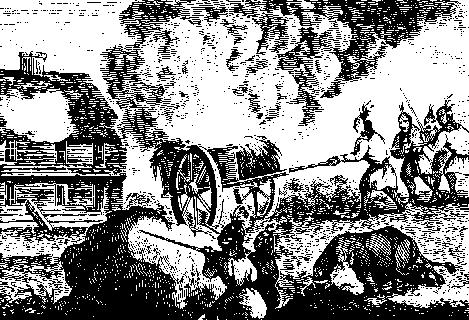
When the first English settlers arrived at Plymouth, they assumed that the land belonged to them, and treated the Indians as encroachers on their infant colony. This attitude of White supremacy can be found in even the earliest of dealings with the Wampanoag. In 1621, for example, the Plymouth colonists drew up a treaty that nine sachems in the immediate area were required to sign, pledging their loyalty to King James. To the colonists, this meant that the Indians were subjects of the king; to the Indians, it meant that they would not wage war against King James’s representatives.
Only two years later, Miles Standish led a party to Wessagussett, asking to parlay with the sachem Obtakiest. Under the pretense of friendship, Standish and his men turned on the Indians, killing several warriors and attempting to murder or capture the sachem.
All of the area tribes then dismantled their camps, disappeared into the forests, and refused to trade furs with the Plymouth colonists. William Bradford wrote, apparently puzzled, “We had much damaged our trade, for there where we had the most skins, the Indians are run away from their habitations.” As for the Indians, they gave a new name to the Pilgrims: Wotawquenange, or “the cutthroats.”
The dealings of the Dutch with the Indians did not go much better. Under Dutch law, settlers were obliged to buy land from the local Indians, not just seize what they wanted. But even these transactions were misunderstood by the invading colonists. The Dutch were under the impression they were buying land with beads and blankets—land that they then would have complete control over.
But the Indians viewed the trade goods as gifts of goodwill. They believed that the settlers were asking their permission to share the land, which they freely did. When the Indians continued to hunt and camp on land that the Dutch had “bought,” the Dutch tried more aggressive methods instead.
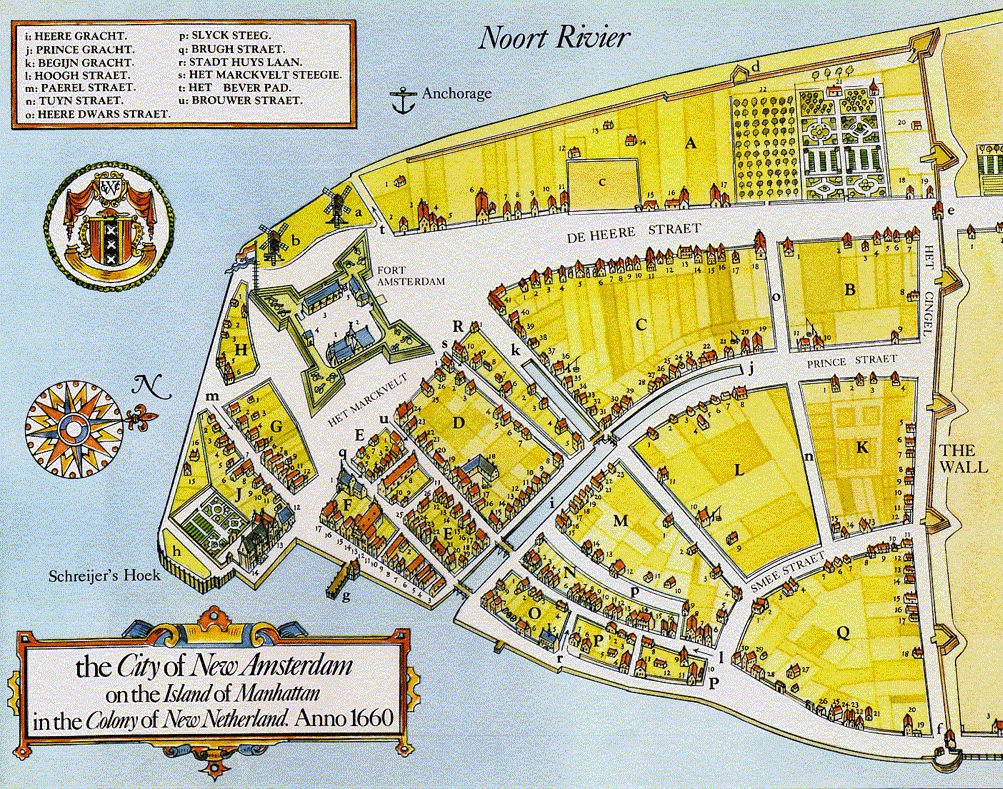
In 1643, as just one example, the then-governor of New Amsterdam, Willem Kieft, attempted to get the Indian “problem” under control by ordering a band of Lenape in the outlying areas of Manhattan off the island. At the time, the Lenape were sheltering on Manhattan after losing a battle with the Mohican and the Mohawk. They refused to return to the mainland, where the enemy’s allied forces were waiting for them.
Enraged, Kieft had 120 of the band killed, including many of the warriors. The Lenape retaliated, forcing the Dutch to flee their farms to their fort at New Amsterdam. One-third of the Indian warriors were killed during the battle. This spurred two years’ worth of raids by the Lenape, and Kieft lost his job.
Petrus (known in our history as Peter) Stuyvesant was sent by the Dutch to replace Kieft. He famously “bought” the entire island of Manhattan from the Indians for what has been described as $24 of trade goods (the actual value was closer to $1,000, still a stunning bargain). But he remained as puzzled as earlier colonists that his purchase did not allow him exclusivity over all of the land he had specified in his purchase.
And so the Dutch and English colonists turned to their courts, creating laws that the Indians found inexplicable—especially since they did not understand the concept of ownership over land to begin with.
The type of laws issued in Maidstone showed the true attitude of the colonists—that they were within their rights to take what they decided was theirs and to mete out punishments to those who attempted originally to share their lands in friendship. They had no vision of themselves as robbers or invaders, no understanding of how their actions might appear to the Indians who had welcomed them as guests in their homeland.
By the 1670s, any pretense of sociability, of shared meals and shared trust, was no longer showing up in colonial reports. King Philip’s War, fought in 1675 and 1676, was the Indians’ long-restrained response to decades of humiliating treatment. The Indian warriors killed 600 of the fighting colonists. Half of the 180 settlements in New England were damaged or destroyed. Their economic losses exceeded the actual value of their property. But the Indians fared much worse.
Already weakened by European diseases that had wiped out whole bands and tribes, the Indians suffered huge human losses in the war. Three thousand allied Indian warriors were killed during King Philip’s War. Many of King Philip’s surviving warriors were sold as slaves to other tribes. Eventually, the remaining Indians were driven from most of their settlements in New England.
Imperialism on the part of settlers ran unchecked through the late 1800s, when Indians across the United States were slaughtered and survivors imprisoned on reservations. Turns out the punitive law passed on Long Island 355 years ago today is a better snapshot of our early attitude toward the natives of North America than any feast of turkey and stolen seed corn can possibly represent.

Here is the film we debuted last week. With some minor corrections and a new ending, you can now watch the entire film. For those who want to purchase a copy of the DVD ($5), contact us at jsmith@griid.org.
The film will permanently be hosted online at http://grandrapidslgbthistory.com/, along with all the archival material, which we are still collecting and posting. Thanks again to everyone who helped make this project a success.
[vimeo 33274790]Grand Rapids LGBTQ History: Video of 1992 Network hosted discussion on the lessons since Stonewall
Below is the most recent archival video we have posted on the Grand Rapids LGBTQ People’s History Project site.
In this 1992 video, we see two presentations, one by Dennis Komac and the other by Holly VanScoy on lessons learned since the 1969 Stonewall uprising. Both of them present very compelling analysis, which is then followed by a lively discussion about the other 20 or so people in the room.
This archival video is another great example of how people were so engaged on these issues in Grand Rapids. It is also a great example of how their analysis informed their actions.
New Report on Religious Groups and Political Lobbying
Yesterday, the Pew Forum on Religion and Public Life released a new study that looks at how there has been an increased in religious groups lobbying Congress and the amount of money they are spending in the process.
“The number of organizations engaged in religious lobbying or religion-related advocacy in Washington, D.C., has increased roughly fivefold in the past four decades, from fewer than 40 in 1970 to more than 200 today. These groups collectively employ at least 1,000 people in the greater Washington area and spend at least $390 million a year on efforts to influence national public policy.
As a whole, religious advocacy organizations work on about 300 policy issues. For most of the past century, religious advocacy groups in Washington focused mainly on domestic affairs. Today, however, roughly as many groups work only on international issues as work only on domestic issues, and nearly two-thirds of the groups work on both. These are among the key findings of a new study by the Pew Research Center’s Forum on Religion & Public Life that examines a total of 212 religion-related advocacy groups operating in the nation’s capital.”
From the graphic below you can see what religious groups are spending the most money to influence domestic and foreign policy.

The American Israel Public Affairs Committee (AIPAC) is significantly ahead of all other religious groups in this report and combined with American Jewish Committee is spending over $100 million on influencing US policy towards Israel and the greater Middle East.
The United States Conference of Catholic Bishops is the second largest source of religious lobbying. The $26 million plus the Catholics spent to lobby Congress has been for a variety of issues, but the top two have been to advocate for anti-abortion laws and anti-marriage equality. In fact, the United States Conference of Catholic Bishops just unveiled a new anti-Gay Marriage website.
The third largest religious lobbying group, according to the Pew study, is the Family Research Council (FRC). The FRC has a long history of promoting far rights policies such as anti-abortion, anti-gay marriage and religion in public life. The FRC, along with Concerned Women for America, the National Right to Life Committee, Home School Legal Defense Association and CitizenLink (an affiliate of Focus on the Family) all are part of the network of religious right groups in the US. Combined these Christian Right groups spent roughly $60 million on influencing national policy in 2009 alone.
This also means that the only liberal or progressive religious group in the top 10 list is Bread for the World. Bread for the World does mostly anti-hunger work around the world with some emphasis on root causes of hunger.
Another important point on the relevance of this new report is that many of the wealthier families in West Michigan, the DeVos, Van Andel and Prince families have all contributed to most of the Christian groups in this top 10 list. However, we could find no evidence of any local news reporting on this connection as of this posting.
Media Literacy: Testing what we know
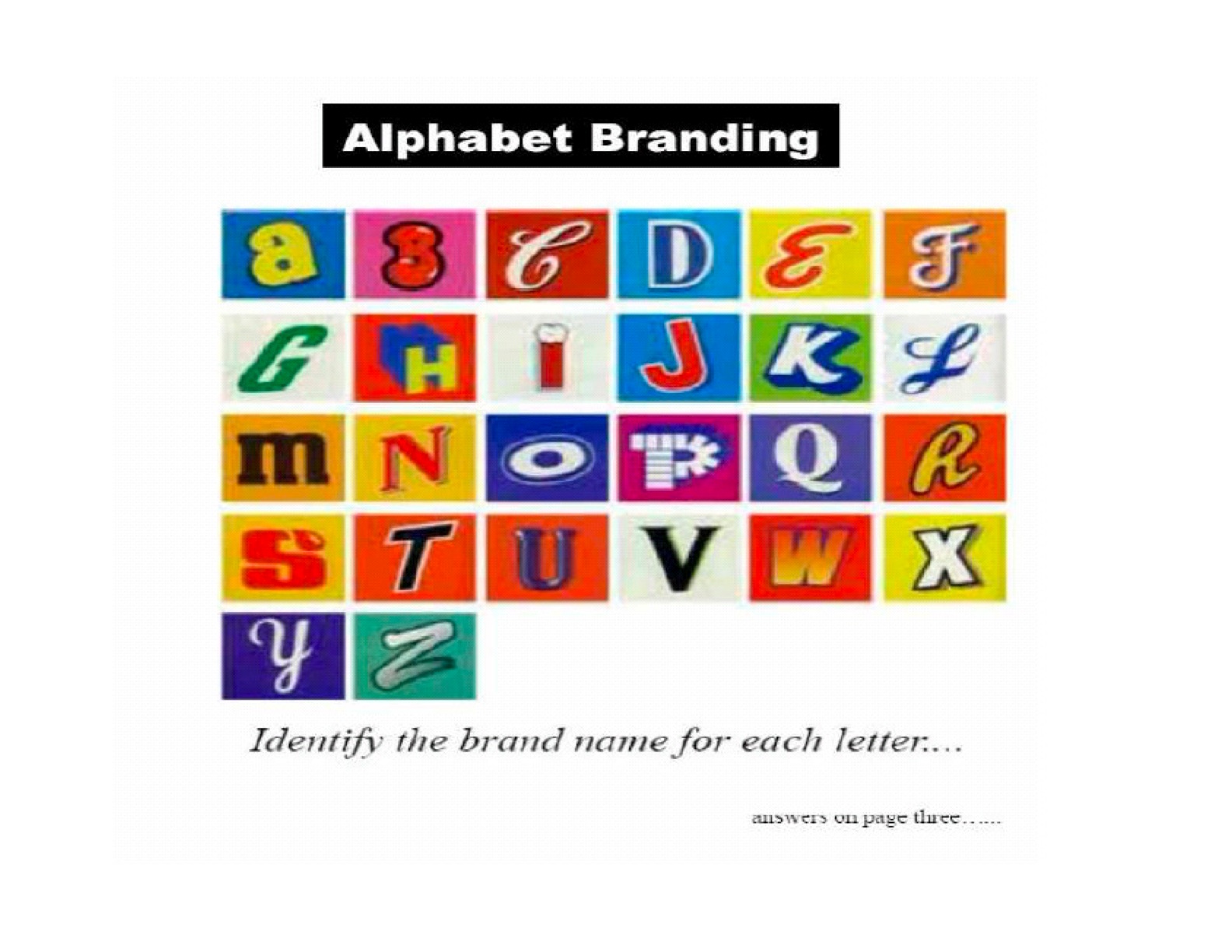
For years we have used a media literacy exercise when doing workshops to illustrate both how media is constructed and how media can determine what we know and what we don’t know.
We used a branded alphabet to see if people could identify products from one letter. Part two of that exercise was to then see if people could identify current high ranking officials in the White House.
Most of the time people could identify products from one letter over people who had tremendous influence on our economy, politics, education, etc.
We have just added a new media literacy exercise, using a new branded alphabet and juxtaposing this with the Kent County Commissioners. Test your knowledge on what you know. What company does the logo represent? What are the names of the 19 Kent County Commissioners? Think about why some things are more known and what that means in terms of an engaged citizenry. Are we primarily citizens or consumers? The answers can be found here. Read more…
Protecting Male Privilege: The Penn State scandal & media coverage
Considering how much media attention has been given to the Penn State sexual assault case, one would be hard pressed to say they didn’t know anything about this.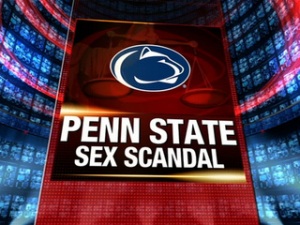
However, the amount of news coverage surrounding this story is a double-edged sword. In one sense the amount of coverage provides an opportunity for greater public awareness and dialogue around sexual assault. On the other hand, the quality of coverage has been fairly weak and in some cases misleading.
According to the Project for Excellence in Journalism, the Penn State sex abuse scandal was one of the two stories that dominated national news coverage the week of Nov. 7 – 13. The other story dealt with sexual harassment charges from several women directed at Presidential candidate Herman Cain. The major difference in the coverage was the fact that the women who charged Cain with sexual harassment were not taken as seriously as the victims in the Penn State sexual assault cases.
Another major difference in these two stories is that in the Penn State case there were numerous high officials on campus that knew of the abuse that was taking place, yet remained silent. It should be stated that those who remained silent were men, which forces us to come to terms with the fact that this was not just about crimes committed, as awful as they are, it is also about how male privilege is protected.
Over the weekend, there was an interesting article on Counter Punch, where the writer is comparing the child sex abuse history of the Catholic Church to that of Penn State. The writer makes the point that in both institutions there was knowledge of the abuses for years, yet the official position was to do nothing. However, the article falls short on one major point, in that they fail to name male privilege as the institutional problem.
This gets us back to the issue of how much coverage there has been of the Penn State sex abuse scandal. Even sports writers have been forced to give some attention to the issue, like the leading online sports entity ESPN, which has reported repeatedly on this issue. However, the coverage has been limited in the area of what happened and why, with more coverage being devoted to what this means to the legacy of Penn State coach Joe Paterno.
Few sports writers have actually asked the hard questions and shed light on the ugly reality of male privilege within institutions like Penn State. Left sports writer Dave Zirin is one of those who has challenged male privilege and called out what really happened.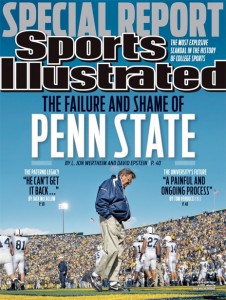
In a recent column Zirin points out that the child sex abuses cases are not the only examples of protecting male privilege at Penn State:
The signs of this malignancy did not emerge overnight. Looking backward, there are moments that speak of the scandals to come. In 2003, less than one year after Paterno was told that Sandusky was raping children, he allowed a player accused of rape to suit up and play in a bowl game. Widespread criticism of this move was ignored. In 2006, Penn State’s Orange Bowl opponent Florida State, sent home linebacker A.J. Nicholson, after accusations of sexual assault. Paterno’s response, in light of recent events, is jaw-dropping. He said, “There’s so many people gravitating to these kids. He may not have even known what he was getting into, Nicholson. They knock on the door; somebody may knock on the door; a cute girl knocks on the door. What do you do? Geez. I hope — thank God they don’t knock on my door because I’d refer them to a couple of other rooms.”
At Penn State there is both a student and community effort to protect Paterno and his coaching legacy, but there are also people who are challenging the institutionalized male privilege. If we want to avoid future sexual assault cases like the ones at Penn State, then we have a to talk about how pervasive male privilege is in this society and we have to confront institutionalized male privilege in all its manifestations. If we don’t, then we are ultimately complicit in these crimes.
100 people gather for Transgender Day of Remembrance
About 100 people gathered at Plymouth United Church of Christ last night to participate in a program for the Transgender Day of Remembrance.
Transgender Day of Remembrance is always celebrated in late November in memory of Rita Hester, a visible member of the Transgender community who was murdered in 1998. The following year, friends of Rita organized a vigil, not only in memory of Rita, but of all people who have been victims of hate crimes targeting the transgender community. Transgender Day of Remembrance has now become an international day of solidarity.
Rev. Doug Van Doren from Plymouth church welcomed people and invited them to collectively mourn the loss of members of the Transgender community over the past year.
At that point the sanctuary became dark and several people with candles began reading the names of members of the Transgender community. After each person read a name(s) they blew out their candle until all the candles were extinguished.
The next part of the event involved members of the Transgender community sharing their personal stories. One person read a poem, while the other two recounted their own journey. One of the most moving comments made was, “An authentic life is the best life to be living.” This comment spoke to how important it is for all of us to be true to who we are.
The featured speaker for the evening was Julie Nemecek, an ordained pastor, professor and member of the Transgender community. Julie began by saying this is a day of honoring and remembering those in the Transgender community, but it is also a day to acknowledge those who have been victims of hate and Transphobia.
Julie then read part of a poem from John Dunne, No Man is an Island. The speaker said the lives we remember and mourn, are our lives. For whom the bell tolls is an important point for what Transgender Day of Remembrance should be. Julie tells the audience about being in England and watching the bell ringers. Bells would toll to signal someone’s death, but what Dunne was saying and what Julie wanted us to hear is that the bell tolls for all of us…..and we should remember.
Julie, then cited the writer Edmund Burke who said, “All that is necessary for evil to triumph is for good people to do nothing.” The speaker then talked about going to a memorial service of a young transgender person who took his own life. At the service for this person, people asked what could they have done to prevent it. Julie said, “Silence is the greatest enabler” and then looked at the audience and said, “I know you are good people. Don’t do nothing!”
The speaker also cited US President Abraham Lincoln and Dr. Martin Luther King Jr. in quoting Lincoln it was in reference to not forgetting the dead at Gettysburg, which translated into the audience not forgetting members of the Transgender community, which have died. The Dr. King quote was for all of us not to be satisfied until justice rolls down from the mountain like a mighty river. Julie wanted us to commit to seeking justice and acknowledge the struggle continues and even recognized those in Holland who were willing to risk arrest for justice.
Julie finished her comments by citing Susan B. Anthony, a woman arrested for voting, who refused to pay the fine and died 13 years before women won the right to vote. Anthony said, “Failure is impossible.” Julie believes this to be true and acknowledged recent changes in our culture and gain made by the LGBT community. Julie ended her comments by repeating the line from Susan B. Anthony, “Failure is impossible!”
Bloom Collective will host Buy Nothing Day event: Really, Really Free Market and screening of What Would Jesus Buy?
The Grand Rapids Infoshop, the Bloom Collective, is hosting an event for the annual Buy Nothing Day, an event in contrast to the hyper-consumption day known as Black Friday on November 25.
Buy Nothing Day began years ago as a response to the hyper-commercialism and market driven culture, which celebrates shopping. Buy Nothing day counter-acts this consumerism by calling on people to not consume, to base our interactions with others through community building and to challenge the mantra of capitalist culture which says you show love for others by buying something for them.
As a way to celebrate Buy Nothing Day, the Bloom Collective is hosting a Really, Really Free Market (rrfm) where people can share basic necessities with others, which can also include skill share and other means of bartering with people. The rrfm will happen from noon til 4pm.
In addition, the Bloom Collective will be screening the documentary, What Would Jesus Buy? What Would Jesus Buy chronicles a campaign by Rev. Billy and the Church of Stop Shopping on a month long tour of the US bringing their message of non-commercialism through street theater.
Really, Really Free Market
12 – 4pm
What Would Jesus Buy?
2:30pm
Bloom Collective
671 Davis NW
Steepletown Community Center
Arundhati Roy addresses the Occupy movement in New York
This video is re-posted from ZNet.
Arundhati Roy, the famous author and activist from India, spoke to a crowd in New York City recently about the Occupy Movement.
Arundhati spoke about the power of this new movement, with its creation of new political imagination and language. She also spoke about how this movement is important in the fight against Empire.
Arundhati Roy is the author of numerous books including, The God of Small Things, An Ordinary Person’s Guide to Empire, War Talk, Power Politics and The Cruise missile and the checkbook.
Listen to these powerful words!
550 media workers are being laid off from Booth News/MLive

It was confirmed today on MLive that 550 layoff notices were sent out to employees of the Booth News chain, as part of the company’s “restructuring plan.” Restructuring is code for eliminating workers in order to increase profits.
The “restructuring plan” involves the creation of two new media companies, MLive Media Group and Advanced Central Services Michigan. While these two new entities are being framed as new companies, they are both still part of the much larger media conglomerate Advance Publications.
In the article MLive Media Group President Dan Gaydou engages in a bit of double speak about how many people will be employed under the new restructuring. However, in a November 2nd Media Release, Gaydou was a bit more honest about his motivations for the restructuring and whose interests he serves.
“Our new company will be dedicated to meeting the needs of audiences, regardless of the platform, and developing solutions for our business partners, based on their needs…….. MLive Media Group will focus on innovation and community engagement, measuring our shared success by that of our employees, advertisers, local communities and business partners alike.” 
It appears to this writer that business interests are what is primary and, in a digital world, that means advertisers and underwriters.
It is impossible to say how many people who work for Booth Newspapers will be without a job once the restructuring takes place in February 2012, but numerous current employees will be unemployed. This is not at all surprising for two reasons. First, since Booth Newspapers have been part of the media conglomerate Advanced Publications, their primary goal has been to make a profit, not to inform the public. This major theme is explored in the most recent issue of the magazine Extra, a publication of Fairness & Accuracy in Reporting, in the cover story, Media Monopoly Revisited.
Second, since Booth Newspapers are not unionized, the ability of workers to resist “restructuring” is very limited. This restructuring has been an ongoing process. We have been aware of the ongoing downsizing of Grand Rapids Press staff, eliminating benefits, using more part time writers and stringers, which definitely affects the quality of journalism that the public deserves.
With the layoff of hundreds of workers, we can expect to see some changes in the quality of information that will be on Mlive. There will no doubt be more information that is culled from other online sources, meaning less on the ground journalism will take place. Another outcome will most likely be an increase in cross-promotional reporting, which will be stories about events that were advertised on MLive.
 Lastly, this ongoing shift in how the corporate media operates, with a total disregard for workers, is all the more reason for the public to support independent media and make our own. As A.J. Liebling once said, “Freedom of the Press is guaranteed only to those who own one.”
 Grand Rapids Institute for Information Democracy