Michigan Passes Anti-Choice Bill
This article by Katie J.M. Baker is re-posted from ZNet.
The Michigan Senate just voted to pass HB 5711 — one of the country’s most extreme and wide-reaching anti-choice measures, which is really saying a lot — by a 27-10 vote, with immediate effect. They added some revisions, which means the bill has to return to the House (which will probably approve it quicker than you can say “transvaginal ultrasound”) before it’s ready for Governor Rick Snyder’s signature.
Remember that time Reps. Lisa Brown and Barb Byrum dared utter the word “vagina” during a debate about vaginas and were thus barred by House leadership? All that hullabaloo was about this 45-page bill, which would, among other restrictions, ban the use of telemedicine abortions — crucial for women who live in rural, under-served areas — and impose a bevy of unnecessary physical plant requirements on abortion providers, including minimum doorway sizes and minimum square footage (because every self-respecting patient cares about the spaciousness of her doctor’s office) that could shut down almost every clinic in the state.
21 out of Michigan’s 83 counties already lack a single OB/GYN, so this bill will make it that more difficult for the state’s women to gain access to healthcare. This could get real bad, real fast.
Last week, the Senate prepared for today’s women-hating entrée with a delectable assortment of anti-choice appetizers/bundle of anti-abortion bills, including SB 0975, a “conscience objection” bill which would give hospitals and other health care centers the right to deny services that aren’t in line with their personal religious beliefs unless the patient/sinner in question is literally dying. The House is debating the bills now.
Opponents came up with various too-real situations where women, gay people, and mixed-race couples could suffer because their doctor didn’t feel like Jesus/the Spaghetti Monster/whomever would OK their treatment. They also referenced the very non-hypothetical death of Savita Halappanavar, who died in an Ireland hospital last month after a miscarriage because doctors waited too long to perform an abortion that could’ve saved her life. Advocates, like Ed Rivet from Right to Life, said during his testimony that these “straw men” scenarios would never actually happen (then why do they need the bill in the first place?) and that “The sky will not and has not fallen.”
Thanks to Michigan’s lame duck legislators, the sky is looking pretty damn close right now.
GRIID Winter 2013 Classes
We are pleased to announce two new classes for Winter 2013.
The first class, Social Movements in Latin America, is designed to investigate the recent history of social movements in Latin America. We will be discussing those movements since the 1994 Zapatista uprising in Mexico to the present.
Some of the movements explored are: the Revolution in Venezuela, Indigenous movements in Bolivia & Chile, Worker movements in Argentina, The Landless People’s Movement in Brazil and Anti-Globalization movements in Central America.
We will be using numerous sources, but the primary text that participants will need to have is Dancing with Dynamite: Social Movements and States in Latin America, by Benjamin Dangl. This class will meet on Mondays from 7 – 9pm beginning on January 21st.

The second class we are offering will be an investigation into the Non-Profit Industrial Complex. Using the book, The Revolution Will Not Be Funded: Beyond the Non-Profit Industrial Complex, we will explore the evolution of the Non-profit, it’s relationship to funders, the state and social movements.
In addition, this class will spend part of the time investigating the Non-Profit Industrial Complex in West Michigan. This class will be held on Wednesdays from 6 – 8pm and begin on January 23rd.
Both classes have a flyer that can be downloaded:
Social Movements in Latin America
Investigating the Non-Profit Industrial Complex
Class size is limited, so sign up early. Classes are $20 each, not including the cost of the book, but no one will be turned away for lack of funds. Contact Jeff Smith jsmith@griid.org to sign up. Location to be determined.
Why Couldn’t Unions Defeat Michigan Anti-Union Bill?
This video is re-posted from The Real News Network.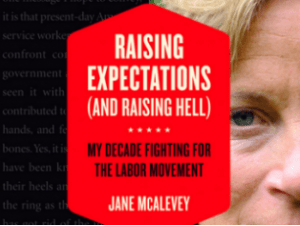
The Real News Network looks at the Right to Work Legislation in Michigan and the attack on unions across the country. They interview Jane Mcalevey, author of the book Raising Expectations (and Raising Hell): My Decade Fighting for the Labor Movement.
In this interview Macalevey addresses the concerted effort to undermine labor unions in recent decades by the Capitalist class. She does acknowledge the failures of the union movement and offers up some suggestions of what they should be doing that might turn the tide against anti-union sentiment and the highly organized campaign to suppress unions.
March planned this Saturday in Grand Rapids to fight GRPS plan
Local people are angry and organized. With the continued dismantling of Grand Rapids Public Schools and the partnerships with the private sector to build places like the Van Andel funded University Prep Academy on Division.
Here is what the Facebook event page says about what is planned this Saturday: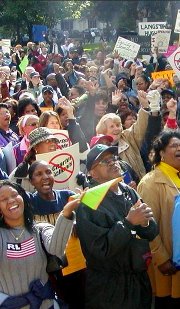
Bring the REAL stakeholders (our children!) to lead us parents as well as teachers and community supporters in a march this Saturday at 12 noon from Rosa Parks Circle to Amway Grand Plaza.
The purpose of our march is to oppose GRPS’s “Transformation Plan” to shutter 10 more of our public schools in the coming year and to bring our complaint to those financially and ideologically responsible for the plan.
The “Cambridge Report”, upon which the GRPS Transformation Plan is based, was paid for with nearly 1/4 $ million from the DeVos family, a family that has been working for over ten years to privatize and dismantle public schools not only in Grand Rapids but also nationwide. As Dick Devos put it in his 2002 speech on the topic to the Heritage Foundation, “Because we know how the government schools perpetuate themselves, we can design a plan to dismantle them”.
Is it any surprise then, that the DeVos family-sponsored study recommended shuttering 10 more of our public schools? It is not a surprise, but it is a surprise that GRPS administrators would simply fall in line!
25 schools have already been shuttered in recent years: closing 10 more leaves our city with a dwindling public education base and just clears the way for more private and charter schools to take their place.
This is one “philanthropic” donation GRPS adminstrators should steadfastly refuse: they should instead be working to expand our public school base, while providing wraparound services and diverse learning opportunities at every school!
Join us and let’s work to save our public school system locally and nationally at the same time. If GRPS won’t do it, we will.
Sponsored by Save Our Schools Grand Rapids (SOSGR)
March of the Stakeholders
Saturday, December 15
Noon – 3PM
Beginning at Rosa Parks Circle in Downtown Grand Rapids
How Private Prisons Profit From the Criminalization of Immigrants
This article by Laura Carlsen is re-posted from CounterPunch.
How a nation uses its power to deny a person’s freedom has always been a critical measure of authoritarian rule. Massive incarceration based on race, ethnic origin or nationality, political beliefs, class, sexual orientation, age or other inherent characteristics is a form of tyranny.
Yet few people realize that this is happening on an enormous scale here, in the United States of America. Immigrants make up the latest market for a booming private prison industry.
The U.S. locks up the highest percentage of its population in the world—730 per 100,000, nearly two and a half million people. Although it has only 5% of the population, 25% of the world’s prison population is behind bars in the U.S.
It wasn’t always like this. This huge growth in the prison population has taken place just over the past two decades, when the imprisonment rate per capita surged by 45%.
It’s not that the U.S. experienced a major crime wave. The opposite is true. Crime and especially violent crime steadily decreased over the same period. Two factors–the lock-up of mostly poor, black or Latino recreational drug users and of immigrants–now account for more than 80% of people behind bars in our country. Draconian drug prohibitionist policies and new laws that criminalize undocumented immigrants have flooded the nation’s prisons.
In other words, while actual behavior in society improved overall, the U.S. government broadened the criteria for depriving people of their most fundamental liberties. This wide net now traps more men, women and children than at any other time in history.
There’s a reason for that.
For-Profit Prisons and the Criminalization of Immigrants
In the mid-eighties, the U.S. government began to outsource jailing people. The first contract, in 1984, went to Corrections Corporation of America (CCA), still the largest for-profit prison company in the country. Private prisons moved into communities left behind by the globalized economy. Heavily subsidized by taxpayer money even before receiving public contracts, they built thousands of cells throughout the country.
Then they had to fill those cells. How do you drum up business if you’re a for-profit prison industry? By making sure there’s a steady stream of prisoners. For every human being sent behind their bars, CCA or the second giant in the industry GEO Group, make approximately $122 a day, per head. CCA reported $1.7 billion in gross revenue last year, nearly half from government contracts.
That’s a powerful incentive to lock people up. In recent years, the most effective strategy for “market expansion” in the private prison industry has been to criminalize immigrants.
Latinos, the New Prison Majority
A series of recent laws have redefined undocumented immigration from an administrative infraction to a felony led to the creation of scores of migrant detention centers, built and run by the private prison industry. Operation Streamline, a policy begun in 2005, mandates that nearly all undocumented immigrants crossing the Southern border in certain areas be prosecuted through the federal criminal justice system.
A Grassroots Leadership report on Operation Streamline shows that federal districts along the Texas-Mexico border have spent more than $1.2 billion on the criminal detention and incarceration of border-crossers since the program began in 2005, with more than 135,000 migrants criminally prosecuted in these two border districts under two sections of the federal code that make unauthorized entry and re-entry a crime. The report found a 2,722% increase in prosecutions for entry, and a 267% increase in prosecutions for re-entry, compared to corresponding data for 2002.
As a result, Latinos now make up the majority of people sent to federal prison for felony crimes, with sentencing for newly defined immigration felonies like illegal border crossing or aiding in border crossing accounting for the increase. While Latinos were 50.3% of those sentenced in 2011, they make up only 16% of the overall population. ICE now sends400,000 immigrants a year to detention centers. Increased sentencing for non-violent immigration and drug offences has also driven the number of women in prison up by 800 percent.
The round-up of immigrants means that half of immigrant detainees spend time in prison compared to just a quarter a decade ago. This human bounty hunting shatters lives and families and costs taxpayers billions of dollars, much of it paid to the private prison industry.
Lobbying for Lock-up
It’s not surprising that for-profit prison companies have lobbied hard in Congress to maintain their cash cows—the drug war and the criminalization of immigrants. The CCA 2010 Annual Report clearly states the need for criminalization to continue by warning its investors:
“The demand for our facilities could be adversely affected by the relaxation of enforcement efforts, leniency in conviction or parole standards and sentencing practices or through the decriminalization of certain activities that are currently proscribed by our criminal laws. For instance, any changes with respect to drugs and controlled substances or illegal immigration could affect the number of persons arrested, convicted and sentenced, thereby potentially reducing demand for correctional facilities to house them.”(p.19)
The report notes that three federal governmental agencies accounted for 43% of total revenues in fiscal year 2010 ($717.8 million)—the Bureau of Prisons (15%), Immigration and Customs Enforcement-ICE (12%) and the US Marshalls Service (16%). It concludes, “We are dependent upon the governmental agencies with which we have contracts to provide inmates for our managed facilities.”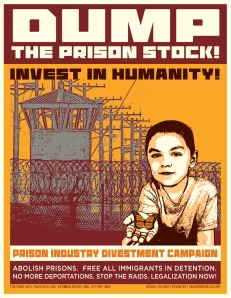
An AP story found that the private prison companies spent more than $45 million in lobbying and campaigns in the last decade. According to a Justice Policy Institute report, CCA spent an average of $900,000 a year on federal lobbying over the past decade. That figure doesn’t count state lobbying, where private prisons participate actively, or campaign contributions.
When Arizona passed SB1070 to increase police power to detain anyone suspected of not having immigration papers, 30 of the bill’s 36 legislative co-sponsors were found to have received significant campaign contributions from private prison companies.
A People’s Movement Against Private Prisons
Peter Cervantes-Gautschi, Director of Enlace, notes, “Of immigrants in the federal prison system, nearly half are in for things not even considered crimes six years ago.” He states that only 5% of immigrants behind bars are there for what would normally be considered a crime.
He adds, “People who are in for re-entry aren’t criminals—these are people coming back to see their children, coming back to visit a sick relative. It’s creating a great deal of human suffering and causing huge problems in our communities and schools. Our families are being broken up by this ridiculous policy.”
Enlace, an organization that works for the rights of low-wage workers, coordinates the National Prison Divestment Campaign. Using a “follow-the-money” strategy for understanding and confronting the influence of the private prison industry, it built a coalition of more than 130 national, state and local organizations “to convince shareholders (individuals, banks, hedge funds, etc.) to divest their funds from the prison industry so that we can make an impact on the prison business and reduce the power of CCA and GEO to lobby for laws that imprison our communities.”
The coalition has already scored some big victories, including cancellation of a for-profit detention center in South Florida, divestment by the hedge fund Pershing Square and by the United Methodist Church, and the divestment of a third of its GEO holdings by Wells Fargo following a campaign against WF Banking on Immigrant Detention. Resident organizations have stopped detention center projects in communities from Georgia to Illinois.
Their message has been simple: “Stop funding incarceration for profit.” The coalition is gearing up for another National Day of Action on Dec. 13. This time the focus will be on members of Congress sitting on the budget committees. Constituents are calling on their representatives to discontinue life support to the for-profit prison industry and direct scarce public funds their communities’ basic needs and services.
Over 10,000 protest Right to Work policies in Lansing

Starting at 6:00am, people came from all over Michigan and surrounding states to take part in a protest against the Michigan legislature’s passing of anti-union legislation, known as Right to Work.
People came from cities like Detroit, Flint, Ann Arbor, Kalamazoo, Grand Rapids and Jackson, as well as small towns like Hastings, Delton, Cedar Springs and Fowlerville.
By 9:00am there was an estimated 10,000 people in and around the state capitol demanding that Governor Snyder veto legislation that was voted on today, making anti-union Right to Work the official policy of the state.
Most of those attended the protest were union members, as was expected, with representation from the UAW, SEIU, electrical workers, steel workers, the MEA, the nurses union, public sector unions and the IWW.
 Many roads were blocked off by the police, who were trying to make it difficult for folks to navigate downtown Lansing, but many unions bused in their members and took over the capitol lawn and the road out front with members holdings signs and inflated rats with Governor Snyder’s name on one and Dick DeVos’ name on another.
There were also over a thousand people inside the capitol, which had a large police presence, some in full riot gear, carry pepper spray and concussion grenades.
In many ways the presence of protestors inside was unorganized and people were just hanging out in the rotunda area, on all three floors. There was good energy, lots of chanting and conversation about what Right to Work policies will mean for Michigan.
There was also a smaller group of folks who informed people before 10:00am that people were going to be sitting down and occupying the 2nd floor of the rotunda while the House was in session and voting on the Right to Work bills.
At this point there were groups standing in sections between the four halls ways that lead off of the rotunda. People continued to chant and sing and every 15 minutes or so we were given updates about what was taking place outside. At one point we were told that pepper spray was used on some of the union members outside and one leader of the UAW was by a cop so hard in the chest that he had to be rushed to the hospital. We were also told that people tore down a Tea Party tent that was outside, news that received a big round of applause from those protesting inside.
Then around 10:45 we were informed that the House had passed the Right to Work legislation and about 100 people who were inside the rotunda moved to the center and sat down. Many of us (this writer participated in the sit down) were given signs that said VETO, even though signs were prohibited inside.
Those of us who sat down, then began to invite others who were inside the capitol as part of the protest. Our numbers grew and we moved out from the center to take over more space. At about 11:30am, we were all greeted by Rev. Jesse Jackson, Lansing Mayor Virg Bernero and Rep. Gretchen Whitmar.
Jackson made some very moving comments (see video below) about the importance of this action and how so many working families have already gone over the “fiscal cliff.” After speaking Jackson sat down with the rest of us, along with Bernero and Whitmar, which brought even more excitement to the action.
However, in less than a minute, Jackson and the local politicians got up and wished us well. Many people took this as an insult and felt that if they really supported this action they would have stayed, considering we live in a society where having people like Jackson and elected officials will generally guarantee more media attention.
The occupation lasted for another hour or so, but it became apparent that not everyone was going to stay, even if it meant risking arrest. We also could not get more people to join us and the police presence continued to grow inside.
Some people who were wearing reflective vests and directing people inside all day, were members of unions, but more often than not acted as an extension of the cops, by constantly telling people to cooperate and getting into arguments with people who were doing civil disobedience.
Around 2:00pm it was clear that there were not enough numbers to maintain an occupation and some organizers decided to tell people to join a protest outside in front of the Romney building across the street.
This writer left, with a contingent of people from Grand Rapids, feeling a sense of defeat since the possibility of occupying the capitol was great and the numbers of protestors could have accomplished what was done in Wisconsin.
While it was refreshing to see thousands of people there, who were passionate about workers rights, it was frustrating that there was no clear plan of action and a lack of support for the autonomous group that did occupy the rotunda for over two hours.
Lessons can certainly be learned from this action, particularly about tactics and strategy and the missed opportunities to use the large gathering of people to shut down business as usual for a Government dominated by people who don’t care about working families and to hold some sort of general assembly to discuss next steps to fight the Right to Work policies in Michigan.
Solidarity Forever!
How Walmart is Taking Over the Food System
 Reposted from Eco-watch
Walmart now captures $1 of every $4 Americans spend on groceries. It’s on track to claim one-third of food sales within five years. Here’s a look at how Walmart has dramatically altered the food system—triggering massive consolidation, driving down prices to farmers and leaving more families struggling to afford healthy food.
Interview with Ecologist and Anti-Fracking Activist Sandra Steingraber
This interview by Maureen Nandini Mitra is re-posted from EcoWatch.
Sandra Steingraber’s gentle voice belies her fierce outrage at the destruction of Earth and human life, a rage that has driven her to devote herself to combating the chemical contaminants that endanger our well-being. An ecologist, cancer survivor, poet, and mother, Steingraber has authored three critically acclaimed books that explore the environmental toxins that permeate our land, air, water and food. In Living Downstream she documented her struggle with bladder cancer at age 20 and supplied a data-driven analysis of the relationship between cancer and industrial and agricultural pollutants. Her second book, Having Faith, explored the ecology of motherhood and the alarming ways environmental hazards threaten infant development. With Raising Elijah, her latest book, she explains how our children face an environment more threatening to their health than any generation in history. Steingraber’s skillful interweaving of personal stories and lucid, almost lyrical explanations of chemical and biological processes has earned her comparisons to Rachel Carson.
Most recently, she has become a vocal opponent of hydraulic fracturing for natural gas, which she believes is prolonging America’s “ruinous dependency on fossil fuels in all their forms.” Steingraber spoke with the Earth Island Journal about her transition from a field biologist to an environmental activist fighting for what she says is the “biggest human rights issue of our time.”
——–
How did the experience of battling cancer and having children affect the way that you work and the kind of work that you do?
Having cancer at 20 derailed my idea about going on to medical school. I was always really good at biology in school and was part of this elite group of biology majors who were being groomed for medical school, and suddenly I was a cancer patient and had no desire to make a hospital my workplace. That was a kind of crisis for me. Then I discovered field biology and went into research. Eventually the women’s cancer movement caught up with me in the late ‘80s. It was a radicalizing movement in which women, especially with breast cancer, and especially lesbian women, were insisting that science address the role of the environment in causing women’s cancers.
As somebody who was very quiet at that point about my cancer but knew that my cancer, namely bladder cancer, is almost always attributable to environmental exposure to carcinogens, I just got very swept up in that movement. It kind of opened my eyes and gave me a voice. I ended up quitting my job as a biology professor. I wanted to build a bridge between what we in the scientific community knew about environment and cancer and what cancer patients are told about that connection. So that became my life’s work.
What’s the connection between the crisis of toxic chemical exposure and climate change?
The environmental crisis we popularly talk about is really two twin crises. One has to do with melting icecaps and rising seas and so forth that come with a destabilizing climate caused by us using the atmosphere as a waste dump for fossil fuel combustion. The other is the crisis of toxic chemicals where we have to worry about pollution, pesticide residues in food linked to learning disabilities in children, about toxic chemicals from oil and gas exploration, especially fracking, some of which are reproductive toxins and can lead to miscarriage risks. Really the toxic crisis and the climate change crisis are two branches of the same tree. They share a common trunk—and that is our ruinous dependency on fossil fuels. When you light [fossil fuels] on fire to make energy, you threaten to destabilize the climate; when you take those hydrocarbons and use them as feedstocks for pesticides, fertilizers, plastics and all kinds of other petrochemicals, then you poison kids, you poison animals and you have a toxic problem.
You talk about this also as a human rights problem.
It is a human rights problem because it’s poisoning and killing people through toxic contamination and it’s also degrading the ecology of the planet on which future generations will depend. We are violating the rights of future generations to have the biological resources that they need. They need pollinators. One-sixth to one-third of all the food we eat is brought to us by insect pollination and those systems are now falling to pieces. We need plankton in the ocean. Plankton provides us half the oxygen we breathe and those plankton stocks are now in trouble because of warming ocean temperatures and ocean acidification. It’s our responsibility as members of this generation to safeguard all these things for our children.
What led you to become concerned about fracking?
As with a lot of people, it arrived at my doorstep. Forty percent of the land in my county is leased to the gas industry, including some fields very near our house. And this is in a state [New York] where our governor has not yet lifted the moratorium on fracking. I don’t know how that battle’s going to turn out, but I’m in the middle of it. I live on top of the Marcellus Shale. The bedrock under my feet is full of bubbles of methane. The biggest industry in the world would like me to move away so that they can have it and turn the land inside out. The industry calls everything between the surface of the earth and their area of economic interest “overburden.” I call it my home, and I’m not going to let them come into my community.
Could you talk a bit about the toxic links between plastics and natural gas?
Natural gas is methane, some of which we burn and some of which is actually a feedstock for making stuff that can include plastic. PVC, or polyvinyl chloride, begins as natural gas, although you just need a source of carbon as a starting point. (In China they use coal to make PVC, but here in the US it’s natural gas.) Natural gas is also the starting point for anhydrous ammonia, which is a synthetic fertilizer that is responsible for the dead zone in the Gulf of Mexico and also a water pollutant that causes miscarriages and reproductive problems for people. In addition, the shale below our feet contains not only natural gas, but also bubbles up other hydrocarbons and those include butane, propane, and ethane. These collectively are called “liquefied petroleum gases” and are feedstocks for all kinds of stuff. Ethane is used to make ethylene, which is a building block for lots and lots of kinds of plastics.
PVC is especially dangerous because it’s full of chlorine and when you burn it you get hydrochloric acid, which can liquefy your lungs. You also get dioxin, which is very toxic. It causes cancer, is an endocrine disrupter, it messes around with our liver and enzymes and it lasts in the body for 35 to 50 years. Plastic in general, whether it’s PVC or not, it just never degrades.
You talk about how people feel helpless in the face of the scale of the environmental crisis. How do you try to move them from this “place of inaction?”
We can’t change the scale of the problem, so that means you have to change the scale of your actions. I don’t tell people what those [actions] should be or what they should do. Everybody has to find their own path. I use autobiography to talk about some of the big things that I’ve done and by doing something big I try to inspire other people to do big things, too.
When I became one of the lucky recipients of the Heinz Awards last year, I chose to donate the cash prize that came with it—$100,000—to the anti-fracking movement. I tell people that the check far exceeded my bank balance. In fact, it exactly equaled the amount of money that I paid for my house. I live in a little $100,000 house. My son shares a bedroom with me because we just don’t have enough space. But I’m not interested in buying a bigger house or a bigger car. (I never owned a car.) None of my plates match. My furniture comes from Goodwill. I’m not interested in acquisition because we are in the middle of a crisis. The people who come after us are going to be inheriting a planet that’s not suitable for life.
I’ve been moved by some of the writings of an environmental attorney, Joseph Guth, who wrote that a functioning biosphere is worth everything we have. So that’s what I’m going to be investing in. I’m investing my love, my money, my future in preserving the abiding ecology of the planet. And I think that’s a hard road, but it’s an inspiring road. I feel really honored at this moment in history to be playing this role. This is the human rights movement of our time. I’m getting on the bus and I want other people on that bus with me.
This article by Peter Hart is re-posted from Fairness & Accuracy in Reporting.
The message could hardly be clearer: According to U.S. intelligence, Syrian government could very well be preparing to use chemical weapons to put down the long and bloody rebellion against ruler Bashar al-Assad. That was the signal from the TV networks and other major media. Should anyone believe they’re right?
“Chemicals so deadly one drop can kill within minutes,” explained ABC World News anchor Diane Sawyer (12/3/12), adding that one question on the table was “whether it means the U.S. may be forced to take action.” Correspondent Martha Raddatz explained:
The latest intelligence is alarming. Officials telling ABC News the U.S. is now seeing specific signs that the Syrian regime may be preparing to use the chemical Sarin against opposition forces.
On CBS Evening News (12/3/12), anchor Scott Pelley explained:
Assad has not used his chemical weapons, including nerve gas, but the possibility that he might threatens to pull the United States into that Middle East conflict.
Pelley added that Pentagon correspondent David Martin “has been talking to his sources,” and indeed he had. Martin explained:
This is a commercial satellite photo of a Syrian chemical weapons base. U.S. monitoring of roughly two dozen bases like this indicates the Assad regime has begun preparing its chemical weapons for use. Orders have been issued to bring together chemical ingredients, which are normally stored separately for safety, but when combined form the deadly nerve agent Sarin.
On the NBC Nightly News (12/5/12), anchor Brian Williams led the newscast:
Chemical weapons in Syria. Suddenly, the world has an urgent situation on its hands. The fear is Syria is preparing to use them against its own people.
NBC Pentagon correspondent Jim Miklaszewski went on:
U.S. officials tell us that the Syrian military is poised tonight to use chemical weapons against its own people. And all it would take is the final order from Syrian President Assad.
He added that “this week, U.S. intelligence detected a flurry of activity at chemical weapons sites…the alarming developments shook the world.”
And on last night’s CBS Evening News (12/6/12), David Martin reported:
Monitoring of Syrian bases like this one has picked up evidence engineers have loaded the chemicals, which combine to form the deadly nerve agent sarin, into bombs that could be dropped from airplanes. Satellites have seen trucks moving among the bunkers where the weapons and agents are believed to be stored. U.S. officials say the evidence is strong but circumstantial, not definitive.
So where did all of this new information come from? Anonymous government officials talking to outlets like the New York Times.
On December 2, Michael Gordon and several others reported in the Times that
Western intelligence officials say they are picking up new signs of activity at sites in Syria that are used to store chemical weapons. The officials are uncertain whether Syrian forces might be preparing to use the weapons in a last-ditch effort to save the government, or simply sending a warning to the West about the implications of providing more help to the Syrian rebels.
“It’s in some ways similar to what they’ve done before,” a senior American official said, speaking on the condition of anonymity to discuss intelligence matters. “But they’re doing some things that suggest they intend to use the weapons. It’s not just moving stuff around. These are different kind of activities.”
That somewhat sketchy take was reiterated the next day in the Times (12/3/12), where readers learned that “what exactly the Syrian forces intend to do with the weapons remains murky, according to officials who have seen the intelligence from Syria.” By December 4, the Times was reporting on Obama’s explicit warning to Syria:
The White House said it had an “increased concern” that the government of President Bashar al-Assad was preparing to use such weapons, effectively confirming earlier reports of activity at chemical weapons sites.
Absent any further details, that would seem to be a strange standard for confirmation: U.S. officials make anonymous claims, and then different officials say on the record that they are concerned about what those anonymous sources are claiming. But the Times aren’t the only ones exercising that kind of judgment; NBC‘s Miklasziewski (12/5/12) reported, “Today, while U.S. officials confirm the precursor chemicals are loaded, they must still be mixed together to create the deadly gas.”
Of course, it is highly unlikely that U.S. officials can “confirm” any such thing.
But the theatrics–satellite images, anonymous sources speaking about weapons of mass destruction and so on–are obviously reminiscent of the lead up to the Iraq War. NBC Nightly News was at least aware of this fact; anchor Brian Williams said this to correspondent Andrea Mitchell:
Andrea, here we go again. The American public, not anxious to hear about any U.S. military involvement anywhere else on the planet, using terms like “weapons of mass destruction,” “chemical weapons.” What is the U.S. to do?
Mitchell acknowledged that “you’ve got a real credibility gap that goes back now more than a decade”–evidently referring to U.S. misinformation on Iraq that led to an invasion and a bloody war.
But she seemed to be stressing that this time it’s different:
But the specific intelligence that Miklasziewski just reported, the movement of Syria’s chemical stockpile, explains exactly why the president and Hillary Clinton warned Bashar al-Assad so forcefully this week not to use the weapons.
But is it really? U.S. officials were confident about a number of things before the invasion of Iraq–most of which were not true. The Syria stories in fact most closely resemble stories in 2003 that alleged that Saddam Hussein had established a “red line” around Baghdad: If U.S. troops were to cross that line, Iraq would deploy chemical weapons.
In fact, some of the same reporters were saying those things then. Jim Miklasziewski told Today show viewers on March 25, 2003:
Top military and intelligence officials tell NBC News that based on information that they’ve received from the Iraqis, the Republican Guards have been instructed that once American ground troops cross a theoretical line, sort of a red line drawn around that southern edge of Baghdad, they have the green light then to release chemical weapons.
And on CBS Evening News (3/24/03), David Martin reported:
U.S. officials say the Iraqis have drawn a red line on the map around Baghdad and once American troops cross it, the Republican Guards are authorized to use chemical weapons.
It is, of course, entirely possible that these fears are very real, and that Syria could be planning a horrific attack in the midst of what is already a horrible situation there. But U.S. officials were pretty confident that they knew what they were talking about last time.

Around the noon hour today, about 100 people marched through downtown Grand Rapids protesting the Right to Work legislation passed last week that Michigan Governor Rick Snyder is expected to sign into law this week.
Some of the protestors had tape over their mouths to make a point about how working people are being silenced on this issue.
At one point the protestors were marching and chanting in front of the Amway Grand Plaza hotel in downtown Grand Rapids. Several GRPD cars showed up and told them that they could not make noise outside of the hotel. Some people argued it was their first amendment right to do so, but police told them it would be a noise ordinance violation and that anyone continuing to make noise outside the DeVos owned building would be arrested.
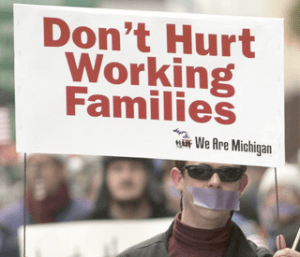
At one point the cops even said to the crowd, “How would you like it if someone came to your house and started chanting?” This is such a ridiculous statement from the cops as it has nothing to do with free speech and it is irrelevant, considering that police do not get to give us their opinion……they are only supposed to “enforce the law.”
The crowd chose the Amway Grand Plaza as a target, because of the role that Dick DeVos has played in promoting anti-union policies such as Right to Work, as we pointed out in a posting entitled, Right to Work: Brought to You in Part by the DeVos family.
People began the march at Calder Plaza and continued through downtown chanting and trying to engage the public about the laws the lame duck session of the state legislators. A large protest is expected tomorrow in Lansing and it will be interesting to see what sort of tactics the protestors use. There are already media reports of police have a significant presence at the Capitol building in Lansing.

