Obama’s War on Syria and its Implications
This article by Shamus Cooke is re-posted from Counter Punch.
The Obama administration has already declared war on Syria, even if it isn’t “official” yet. Consider the facts, all of them acts of war: The U.S. now recognizes a group of Syrian exiles to be the official government of Syria; the U.S. is providing direct support for rebels attacking the government; the U.S. has coordinated with NATO to place advanced missile systems — and 400 U.S. troops — on Syria’s border with Turkey; Obama has drawn a “red line” that, if Syria crosses, would result in U.S. direct military intervention. If any other country made similar moves toward the U.S., there would be no question that war had been declared.
All the strategic steps that led to the Iraq war are being repeated. Obama has assembled a Bush-style international “coalition of the willing” of nations to topple the Syrian government; 130 countries have put their names on paper in support of toppling the Assad government.
In reality, however, the core of the group is the U.S./Europe NATO alliance and the Gulf monarchies. The rest of the “coalition” are economic and political satellites of these main groups, who would sign onto to any military adventure that the rich nations demanded of them, since otherwise the poorer nations would have their military, financial, or political aid frozen.
Europe’s increased lust for blood is a relatively new phenomenon; the European divisions that erupted during the Iraq war and then the Libyan invasion seem to have been smoothed over. Now even Germany aims to directly join the war efforts, intending to send missiles and troops to the Turkish border as well.
But NATO is still a U.S.-dominated military alliance. Any NATO military action is in reality a U.S. led effort, since the European armies are miniscule in comparison, and lack much of the technological sophistication of U.S. weaponry. The advanced Russian missile systems that Syria is equipped with demand a direct U.S. military role to neutralize.
Like Bush, Obama is using his coalition of the willing to distract from the fact that he is circumventing the UN, and thus bringing the post WWII system of international conflict resolution — already on life support — closer to death.
Also like Bush, Obama strategically exploited the UN to weaken Syria with sanctions, and when further UN action was not possible — because of the objections of China and Russia —Obama threw aside the UN and opted for NATO, a U.S./European military alliance built specifically as a deterrent to the now-defunct Soviet Union.
Again like Bush, Obama has crafted a false motive for war. Obama has stolen Bush’s “weapons of mass destruction” but substituted “the use of chemical weapons” as a bogeyman worthy of military intervention. Obama’s bogeyman is as false as Bush’s was. The New York Times reports:
“…the effect of that statement [that Syria was planning to use chemical weapons] was somewhat undercut when France’s foreign minister, Laurent Fabius, asserted during a news conference that such reports were unconfirmed.”
This lack of confirmation hasn’t bothered the U.S. media, who remain content repeating as truth any report issued by U.S. intelligence, no matter the past lies that have cost countless deaths in Iraq and elsewhere.
Of course the U.S. government has zero legitimacy to hand pick a “replacement” government for Syria, since the U.S. is universally hated in the region after the destruction of Iraq, Afghanistan, Libya, and the ongoing drone wars against Pakistan and Yemen. No sane Syrian would invite the U.S. government to “liberate” their country.In fact, a coalition of Syrian opposition groups inside of Syria, the National Coordination Committee (NCC) — virtually ignored by the U.S. media — opposes military intervention, demanding the conflict be addressed through political means.A leader of the NCC is Hassan Abdul Azim, who correctly states:
“We refuse on principle any type of military foreign intervention because it threatens the freedom of our country.”Another prominent ongoing lie repeated by U.S. politicians and media is that the Syrian government is on the verge of collapse. This lie is effective in that it creates an urgency to “take action.” It also paints a picture of the conflict coming to an end that resonates well with Americans.The reality is that the Syrian western-backed rebels have staged daring high-profile attacks that have been largely repulsed by government counter-attacks. But in each instance the U.S. government has used these attacks as an excuse to ratchet up their support to the rebels and now to place U.S. missiles and troops on Syria’s border. Of course if the Syrian government does fall, Obama has absolutely no plan on how to “stabilize” the country, since the most effective rebel fighting force — the Al-Nusra Front — has been labeled a terrorist organization by the U.S. government.
Obama and his NATO and Gulf monarchy allies have created an extremely unstable situation in Syria. They have already torn the Syrian social fabric to shreds with their support of the rebels, but in so doing they’ve pushed many Syrians closer to supporting their government, who they see as a protector against the rebels that have used large scale ethnic-religious cleansing and other war crimes to subdue the population.
Thus, the Syrian government still retains a popular base, ensuring that the already bloody catastrophe will continue with no end in sight, especially since Obama has “regime change” as his goal and is encircling the country with missiles and U.S. and European troops. Iran and Russia will continue to bolster the Syrian government.Under these tense conditions a broader war can break out any moment. The U.S. can claim that the Syrian government is about to employ chemical weapons as an excuse to directly intervene. Or perhaps Turkey — a NATO member — will claim that Syria fired missiles into its territory, and thus Obama will act to “defend” its ally.When war “officially” breaks out, Iran might then increase its direct support for the Syrian government with troops —funneled through Iraq — giving the U.S. another excuse to “defend” itself, and pushing the conflict into Iran. Hezbollah in Lebanon or Israel may intervene too, since both have a direct interest in the outcome of the Syrian conflict. Any number of scenarios could play out that drag other nations into the war, including Russia, who is already supporting the Syrian government. Many of these scenarios have already begun on the proxy level and need only a shove to ensure they explode into a full-scale regional war.
A nation under attack creates a feeding frenzy logic from those countries looking to opportunistically exploit the situation. This proxy war in Syria is on the brink of a much larger disaster, with the potential to annihilate the Middle East through a new round of war and barbarism.
Fighting Back in Michigan Part II: A West Michigan Strategy
In Part I we proposed several tactics that could be used to develop a more radical mass movement capable of overturning the recent set of repressive laws passed in Lansing.
A summary of those tactics are as follows:
- We need to claim our roots, which means we need to rediscover and embrace the radical roots of many of the movements (labor, LGBTQ, women’s, immigrant, etc) most impacted by recent legislative policy.
- We need to redirect financial resources to organizing where we are. If we were not spending the millions we currently are on failed electoral campaigns, we could be spending it to both do more direct organizing in our workplaces, neighborhoods, etc., and engage in more mutual aid with those who do not have access to decent housing, healthy food, health care, etc.
- We need to develop our own independent media. It should be clear that our issues are not honestly or accurately represented in the commercial media, so we need to develop real autonomous and independent media that not only represents our various movements, but also is created by our movements.
- We need to engage in intersectional organizing and solidarity. The point here is that we need to have a more holistic and shared analysis of institutional oppression to better respond to root causes of our problems. We also need to find ways to support each other by engaging in acts of solidarity so that we have each others’ backs at all times.
- We need to stop thinking about elections as the main strategy. Electoral politics is only one tactic to engage in and it is not the most important in the long run. Most of the gains we have made over the past 200 years in the US have been through social movements, not from voting.
- We need to create new and radical ways of living. What we mean here is that in addition to dismantling systems oppression, we need to create new ways of governing ourselves that relies on direct democracy and autonomy.
A West Michigan Strategy
I think it is important to begin by stating that the ideas we just summarized can also be applied to West Michigan. There is not that much that is unique to West Michigan that would warrant an entirely different strategy. However, there are specific tactics and dynamics in West Michigan that we should consider, especially in light of recent legislative attacks coming from Lansing.
First, I think it is important to recognize who makes up the power structure in West Michigan and their role in promoting the recent legislative attacks on various popular sectors.
In September, we posted a story that presented information of what was called A Grand Rapids Power Analysis. We identified individuals and organizations that use their money and political influence to determine government policy. We know that the DeVos family and many others from West Michigan have financed the Mackinac Center for Public Policy, which was the main architect of the recent Right to Work legislation that became law. We also know that the local Chamber of Commerce, places like the Right Place Inc. and the West Michigan Policy Forum have all pushed hard for Right to Work policies for years. These groups, individuals and families have also often attacked and funded campaigns attacking reproduction rights, LGBTQ rights, immigrant rights and even anti-democracy groups like the One Kent Coalition.
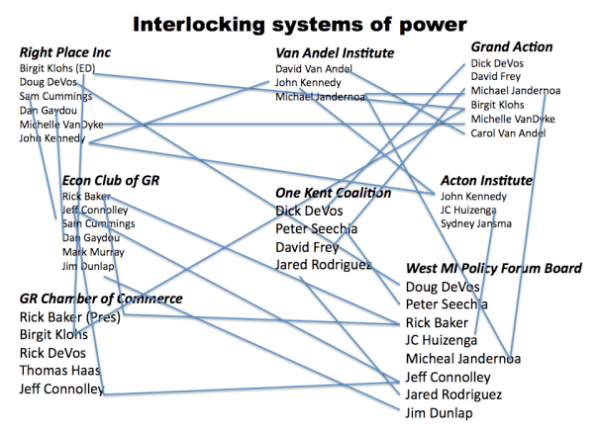
Second, once we have identified those individuals, families and organizations pushing for neoliberal and repressive policies, we need to organize to fight them with whatever tactics necessary. We need to out them in part of our larger public education and independent media work.
Third, we need to confront them with various means of direct action to disrupt their ability to continue imposing their will on the LGBTQ community, working class people, women and immigrants. Here we need to be creative and determined if we are to be effective.
One of the most effective ways would be to put economic pressure on them. This could mean taking action that would cost them money, such as boycotts or other actions that would make it costly for them to continue imposing repressive policies on us.
For example, we could be demanding the dismantling of entities like the DDA, which use public tax dollars but make decisions with a non-elected group of people. We could engage in occupation of buildings and public spaces that have been taken over by the private sector.
We should be using financial and other resources to organize workers in the businesses owned by DeVos, Van Andel, Kennedy and the other businesses identified in our local power analysis.
Another way to fight against the local power elite is to not take their money. Too often, even progressive entities in this community, take money from these rich bastards, which not only gives them more legitimacy, it makes it harder for others to confront them. This would include not allowing them to sit on the boards of local non-profits, which allows them to influence the direction grassroots work might take.
Think of it this way. DeVos family members have funded Right to Work legislation, anti-LGBTQ campaigns and efforts to dismantle public education. We know that they contribute lots of money to redirect local policy and culture. For example, why should we continue to support ArtPrize, which is primarily a project funded by Dick & Betsy DeVos. Labor unions and the LGBTQ community should be boycotting ArtPrize and trying to get their friends and allies to do the same. This doesn’t mean we can’t support local art projects. In fact, we can instead support projects like Avenue for the Arts, ArtPeers and lots of other art projects that do not rely on funding from families and companies that attack workers, the LGBTQ community, etc.
Lastly, we need to create local ways of doing things that do not rely on the existing power structure of West Michigan. We need to create more autonomous entities and movements that can challenge the local power elite and engage in mutual aid and solidarity.
Efforts such as The Really, Really Free Market, Food Not Bombs, Mutual Aid GR, the Grand Rapids chapter of the IWW, the worker run collective Bartertown, the recent movement of undocumented immigrants, the local bike coalition, independent food cooperatives, the groups working on food justice and housing collectives are a good start, but they are not enough to challenge the power of the local elites.
Imagine if more workers were organized and had lots of solidarity to engage in sit-down strikes or wildcat strikes? Imagine if allies of the LGBTQ community would not support any structure that denied that community equal rights and engaged in boycotts or direct action which would not allow them to continue to fund hate? Imagine if people engaged in acts of solidarity with people denied access to basic health rights?
Imagine if we also redirected the money we are no longer spending on supporting systems of oppression and shared it through acts of mutual aid, such as housing, healthy food, health care and education. Imagine if our varying movements and sectors that have been attacked by recent legislation were to building a stronger coalition, not so much to make demands on the rich and powerful, but to dismantle systems of power and create autonomous, self-sustaining communities based on justice and equality?
We cannot hope to move in this direction if we continue to accept, support and allow the current power structure to do what they want. We need a strategy that simultaneously dismantles this power and creates news ways of living with each other and the planet.
Let me end by quoting one of our great spokespersons of liberation, Frederick Douglass:
“Let me give you a word of the philosophy of reform. The whole history of the progress of human liberty shows that all concessions yet made to her august claims have been born of earnest struggle. The conflict has been exciting, agitating, all-absorbing, and for the time being, putting all other tumults to silence. It must do this or it does nothing. If there is no struggle there is no progress. Those who profess to favor freedom and yet deprecate agitation are men who want crops without plowing up the ground; they want rain without thunder and lightning. They want the ocean without the awful roar of its many waters.
This struggle may be a moral one, or it may be a physical one, and it may be both moral and physical, but it must be a struggle. Power concedes nothing without a demand. It never did and it never will. Find out just what any people will quietly submit to and you have found out the exact measure of injustice and wrong, which will be imposed upon them, and these will continue till they are resisted with either words or blows, or with both. The limits of tyrants are prescribed by the endurance of those whom they oppress.”
This article by Making Change at Walmart is re-posted from ZNet.
US Walmart workers were joined by Walmart workers in nine countries on Friday to call for an end to Walmart’s attempts to silence workers for speaking out for changes at the world’s largest employer. As Walmart workers and community supporters marched in front of a Walmart store in Miami, workers in Argentina, Brazil, Chile, Nicaragua, Canada, the United Kingdom, South Africa, Zambia and India held their own rallies, marches, and other actions at Walmart and Walmart subsidiary stores. During the protests, workers cited the negative impacts that the silencing is having on their families, the economy and the company’s bottom-line.
At the protests across the globe, workers held a moment of silence to honor the victims of the factory fire in Bangladesh that tragically claimed the lives of 112 workers. Recent reports show that Walmart “played a leading role in blocking an effort” to improve electrical and fire safety systems in factories in the country.
“Walmart must stop its attempts to silence those who speak out. We are standing up for what is right for our families and the global economy,” said Elaine Rozie, an OUR Walmart member from the Hialeah store in Miami Gardens, Fl. Rozie is a seven-year associate who despite works full-time at Walmart still has to depend on public assistance to make ends meet. “As the largest retailer in the world, Walmart should be setting a standard for good, safe jobs. The benefits of having steady, well-trained workers in stores and along the supply chain will help Walmart improve customer service ratings and its reputation, which is good business.”
“We are inspired by OUR Walmart members who are standing up for a better future for all of our families,” said Louisa Plaatjies, a worker from South Africa. In October, workers from seven countries – where workers all have union representation – launched the UNI Walmart Global Union Alliance to fight for fairness, decent working conditions, and the fundamental human right of freedom of association. ”We are will continue to stand up with our brothers and sisters in the United States until Walmart starts listening to the workers that keep the store running.”
The global protests held today build on the ongoing calls for change at Walmart. In November, community members and Walmart workers held more than 1,000 demonstrations, including strikes in 100 cities, during the Black Friday shopping rush in protest of the company’s illegal attempts to silence workers for speaking out about the company’s manipulation of hours and benefits, efforts to try to keep people from working full-time and its discrimination against women and people of color. The Black Friday strike wave came a little more than a month after OUR Walmart leaders held the first-ever strikes against the mega-retailer. In just one year, OUR Walmart has grown from a group of 100 Walmart workers to an army of thousands of Associates across 43 states.
“The Walmart workers may come from different cultures and continents but they are united in their opposition to Walmart’s cynical and systematic squeezing of its employees to maximize profit, be it the US dollar, the South African rand, the Indian rupee, the Argentine peso or any other currency,” said the International UNI Global Union General Secretary, Philip Jennings. “Walmart has gone too far. US Walmart workers have had enough and they are fighting back as we saw on Black Friday and every day since. The Alliance is standing with them not just in solidarity but in strength and in action.”
Workers like Jesus Vargas, who have been illegally fired, targeted by management or other retaliation for speaking out, are also raising their voices. More than 30 federal charges against Walmart have already been filed, with another 60 allegations against Walmart’s illegal threats currently under investigation.
“Walmart, we will not be silenced,” Vargas said. Vargas, who was unjustly fired for speaking out at his store in California, has filed a federal charge against Walmart. “We are coming together to be heard and to create good jobs that workers in America and across the globe need.”
With so many Americans struggling to make ends meet and Walmart taking in $16 billion in profits and compensating its executives $10 million each, workers and community leaders have been calling on Walmart and Chairman Rob Walton to address the wage gap the company is creating. At the same time frontline Walmart workers are facing financial hardships, the Walton Family – heirs to the Walmart fortune – are the richest family in the country with more wealth than the bottom 42% of American families combined.
Workers’ concerns about wages and staffing have been affirmed by newly uncovered company pay-plans exposed by the Huffington Post, recent poor sales reports and a new study on wage trends in the retail industry. Huffington Post uncovered what reporters call “a rigid pay structure for hourly employees that makes it difficult for most to rise much beyond poverty-level wages.” Meanwhile, last week’s sales reports show that understaffing, which affects workers’ scheduling and take-home pay, is also having an impact on company sales. Last week’s sales report showed that Walmart’s comp store sales are about half what competitors like Target reported in the same quarter, continuing a pattern of underperformance by the world’s largest retailer.
As workers and community supporters call for changes at Walmart, a new report by the national public policy center Demos, shows that better jobs at Walmart and other large retailers would have an impact on our economy. A wage floor equivalent of $25,000 per year for a full-time, year-round employee for retailers with more than 1000 employees would lift 1.5 million retail workers and their families out of poverty or near poverty, add to economic growth, increase retail sales and create more than 100,000 new jobs. The findings in the study prove there is a flaw in the conventional thinking by companies like Walmart that profits, low prices, and decent wages cannot coexist.
Fast-Food Workers Ride Crest of “Simmering Strike Wave” Sweeping Nation
This article by Sarah Jaffe is re-posted from ZNet.
Isaac Ferguson has worked at the McDonald’s on 51st and Broadway for four years. In all that time, he’s gotten exactly one raise of 10 cents an hour; after four years, he makes $7.35. “The price of a MetroCard went up, the price of food went up, they never decided to pay us more,” he said.
Last week, Ferguson and 200 other fast-food workers in New York City went on strike. And while they no doubt have a long road ahead before their bosses give in to their demands of $15 an hour and recognition of their independent union, the Fast Food Workers Committee, things have already changed a little.
“The boss’s attitude has changed,” Marty Davis, who works at the Wendy’s at 425 Fulton Street, explained. “He’s more nice about things, though he still requires the same things as far as effort, going quick, doing the same things.”
And Pamela Flood, whom I met last week leading chants on the picket line outside that same Wendy’s, told me that her boss at Burger King, who used to refer to her by her first name, is back to calling her Miss Flood.
Truvon Shim took the stage with Flood at both the fast-food workers’ rally on strike day, and Thursday’s rally of low-wage workers from across the city. He came to tell his story of losing everything in his Far Rockaway home to Superstorm Sandy, but also had his own victory to share.
Shim had asked his boss at Wendy’s for a few days to deal with the storm’s aftermath, but when he called to be added back to the schedule, was told there were no available hours. However, this week, along with an organizer from New York Communities for Change (NYCC), the group that began the fast-food worker campaign, Shim met with his general manager and was promised he’d get his hours back.
That same Wendy’s where Shim and Davis work saw the most dramatic action when one worker was threatened with firing. According to Jonathan Westin, organizing director at NYCC, community leaders – including City Councilman Jumaane Williams, the Working Families Party’s Dan Cantor, Camille Rivera of United NY and nearly 100 others – held a rally inside and outside of the store until the boss agreed to let her go back to work. Davis added, “That opened a lot of people up in the store, that you cannot fire us for believing in our rights and taking action. It opened up a lot more people’s eyes that weren’t with us, to want to go on strike now.”
Labor Rising
“There seems to be something of a simmering strike wave in the country,” said Frances Fox Piven, professor of sociology and political science at the City University of New York (CUNY) Graduate Center and author of many books, including Poor Peoples’ Movements.
The one-day strikes held by the fast-food workers, like the recent wave of strikes at Walmarts around the country, are something different from a traditional strike (though we’ve seen those in recent months too, most dramatically with the Chicago Teachers Union). The one-day strike, organized to disrupt business but not to shut it down, Piven noted, isn’t about winning. It’s about identifying the group, about respect, about demonstrating to other workers that they can take action, but not exposing the workers to the risk of prolonged loss of the income they have little of already.
“They’re organizing and advocating for low-wage workers in ways that are not in an established New Deal framework,” Ruth Milkman, sociologist of labor at the CUNY Graduate Center, and at the Joseph F. Murphy Institute for Worker Education and Labor Studies, explained. The difficulties of running a traditional National Labor Relations Board election are well-known now.
“That system has become so dysfunctional, increasingly people are looking for alternatives,” Milkman continued. “Structurally it makes sense given the rollback of New Deal reforms that we’ve seen, the growth of inequality, the extreme immiseration.”
Like organizers before the 1935 National Labor Relations Act, the organizers working with low-wage workers these days focus on issues beyond just those of the workplace; it’s worth noting that this campaign began with NYCC organizers working on housing issues. Connecting labor and community issues is a hallmark of NYCC’s work, and campaigns like this one, like the organizing of grocery store workers, child care providers, car wash workers, is the legacy of its founder, Jon Kest, who passed away this week of cancer on the eve of the workers’ rally. Greg Basta of NYCC said, “Seeing this campaign come to fruition was what really was keeping him fighting.”
Piven found it “heartening” that established unions are recognizing and supporting this kind of social movement organizing. In New York, at least, low-wage workers are banding together not just across an industry – as fast-food workers from multiple locations and franchises have come together to create a union – but across the city, supporting one another in solidarity actions and standing together in Times Square, calling for better treatment and government action on workers’ issues.
Combined with recent victories by Domestic Workers United and home health care workers, they’re successfully challenging the country – and the labor movement – to expand its definition of good jobs.
After all, Milkman noted, factories didn’t provide good jobs until the unions that formed the CIO in the 1930s organized them. “It’s appropriate in my view to be nostalgic for the high wages and pensions and health care associated with those jobs, but the jobs themselves were pretty unpleasant; anyone who’s ever done one can tell you that,” she pointed out. “In terms of the high levels of routinization, fast food is similar.”
What’s more, she noted, the usual arguments against unions don’t apply as easily to minimum-wage, no-security jobs. “Nobody can say these are fat and happy workers with pensions,” she said. Instead, they’re workers who are devalued along with their labor by the rest of society. “When you’re making so little money,” Pamela Flood said, “people don’t respect you.”
Even their treatment on the job makes them feel like they don’t matter. In the McDonald’s where he works, Isaac Ferguson explained, there’s an elevator that the bosses get to use, but the workers have to climb stairs. “It’s the kind of job where people look down on you,” he said.
Yet the fast-food workers’ struggle is about more than just them. It’s about whether we’re going to have good jobs in the country at all in the future. “If you look down your nose at these folks, you may find yourself with some of the same problems they have not that far down the line,” said Joshua Freeman, professor of history at CUNY’s Queens College and the Murphy Institute. “In a lot of ways the fast food workers are the wave of the future in terms of our fates, in the downward spiral of the last few decades, as wages and benefits seem to be eroding for most Americans.”
And Milkman noted that nostalgia for manufacturing often doesn’t acknowledge the reality that it is a smaller proportion of all jobs on the planet, because of automation. “It’s never going to be like it was in the past,” she said.
Unemployment is still high in the US (the numbers for November found the unemployment rate at 7.7 percent), which usually presents a problem for organizers, as workers are afraid to lose their already-precarious jobs. Yet paradoxically it can also provide an incentive, as workers are less tempted to quit the job they have when they know there are few out there, and more inclined, perhaps, to stay and fight.
“Economists say that people don’t organize in hard times and there’s some truth to that, but the biggest surge in organizing was in the Great Depression,” Milkman noted.
***
“Hello, fellow low-wage workers!” Prince Jackson called to the crowd stretching down 42nd Street Thursday evening. The rally, led by fast-food workers, airport workers like Jackson, car wash and grocery store workers who have won labor battles in recent months, went on for blocks and spilled off the sidewalk- police barricades weren’t enough to hold back the hard-hatted building trades workers, who cheerily took the street.
The workers were addressed by politicians and clergy, mayoral candidates Bill DeBlasio, Bill Thompson and City Council Speaker Christine Quinn, who refused to answer questions from this reporter as to whether she’d allow a paid sick days bill come up for a vote.
“The overarching picture is a fight for economic fairness,” said Michael Kink of the Strong Economy for All coalition. “In New York City and New York State, the only sector of the economy that is generating more jobs is low-wage work.”
After the rally in Times Square, groups of workers broke out for actions at different targets, including the office of Rep. Peter King, pushing him over “fiscal cliff” negotiations, calling for an end to the Bush tax cuts on the rich, protecting Social Security and Medicare, Medicaid and an investment in jobs.
“The Wendy’s workers who make minimum wage and their checks bounce? Their CEO makes millions and his checks do not bounce. He would be the one getting the huge tax breaks,” Kink said, pointing out that nearly a third of the automatic spending cuts that would be triggered if there’s no deal by January on the so-called fiscal cliff are to state and local governments. That would include cuts to Section 8 housing, emergency housing, food pantries, food stamps and more programs that help low-wage workers and the unemployed.
Now is the time, Kink argued, to push for a good deal that would extend the payroll tax cut for workers and make sure unemployment benefits are still there for those out of work. “Putting the class issues first is a winning strategy.”
“We’re seeing labor being absolutely central to American politics once again,” CUNY’s Freeman said. Debates over the rights of workers, benefits, issues that were pushed off the agenda after World War II are now central once again. “We’re seeing a zillion battles across the country in state capitols, in front of McDonalds, in warehouses, in the port of Los Angeles. Difficult times for working people have put these questions on the forefront. Labor’s on the defensive, but occasionally on the offensive also.”
For Marty Davis, it was simply time to act. “I just felt like it’s now or never; we had to take a stand for something. We might as well take a stand for this – hopefully we can make an impact and get what we want for us, for the future, for everyone that works hard.”
The Racist Roots Of ‘Right To Work’ Laws
This article by Chris Kromm is re-posted from ZNet.
This week, Republican lawmakers in Michigan — birthplace of the United Auto Workers and, more broadly, the U.S. labor movement — shocked the nation by becoming the 24th state to pass “right-to-work” legislation, which allows non-union employees to benefit from union contracts.
While Michigan’s momentous decision has received widespread media attention, little has been said about the origins of “right-to-work” laws, which find their roots in extreme pro-segregationist and anti-communist elements in the 1940s South.
The history of anti-labor “right-to-work” laws starts in Houston. It was there in 1936 that Vance Muse, an oil industry lobbyist, founded the Christian American Association with backing from Southern oil companies and industrialists from the Northeast.
As Dartmouth sociologist Marc Dixon notes in his fascinating history of the period [pdf], “The Christian American Association was the first in the nation to champion the ‘Right-to-Work’ as a full-blown political slogan.”
Muse was a fixture in far-right politics in the South before settling into his anti-labor crusade. In his 1946 book “Southern Exposure,” crusading journalist Stetson Kennedy wrote:
The man Muse is quite a character. He is six foot four, wears a ten-gallon hat, but generally reserves his cowboy boots for trips Nawth. Now over fifty, Muse has been professionally engaged in reactionary enterprises for more than a quarter of a century.
As Kennedy described, these causes included opposing women’s suffrage, child labor laws, integration and growing efforts to change the Southern political order, as represented in the threat of Roosevelt’s New Deal.
Muse’s sister and associate at the Christan American Association, Ida Darden, openly complained about the First Lady’s “Eleanor Clubs” saying they (as related by Kennedy):
…stood for “$15 a week salary for all nigger house help, Sundays off, no washing, and no cleaning upstairs.” As an afterthought, she added, “My nigger maid wouldn’t dare sit down in the same room with me unless she sat on the floor at my feet!”
Allowing herself to go still further, the little lady went on to say, “Christian Americans can’t afford to be anti-Semitic, but we know where we stand on the Jews, all right.
The Association also suspected Catholics — which Dixon notes caused the downfall of their crusades in neighboring Louisiana.
But for far-right conservatives like Muse, as well as industry groups like the Southern States Industrial Council, labor — including black labor — posed an especially dangerous threat in Texas. Thanks to a burgeoning wartime economy, along with labor organizing drives spearheaded by the Congress of Industrial Organizations and, to a lesser extent, the American Federation of Labor, unions were rapidly growing in Texas. After hovering around 10 percent of the workforce during the 1930s, union membership exploded by 225 percent during the next decade.
Muse and the Christian American Association saw danger. Not only were the unions expanding the bargaining power — and therefore improving the wages and working conditions — of working-class Texans, they also constituted a political threat. The CIO in particular opposed Jim Crow and demanded an end to segregation. Unions were an important political ally to FDR and the New Deal. And always lurking in the shadows was the prospect of a Red Menace, stoked by anti-communist hysteria.
Working in concert with segregationists and right-wing business leaders, Muse and the Association swiftly took action. Their first step in 1941 was to push an “anti-violence” bill that placed blanket restrictions on public union picketing at workplaces. The stated goal was to ensure “uninterrupted” industrial production during World War II, although Texas had the fewest number of strikes in the South, and the law applied to all industries, war-related or not.
Their success with the “anti-violence” bill spurred Muse and the Christian American Association to push for — and pass — similar laws throughout the South. Mississippi adopted an anti-violence statute in 1942; Florida, Arkansas, and Alabama passed similar laws in 1943. It also emboldened them to take on a much bigger prize: ending the ability of labor groups to run a “closed shop,” where union benefits extend only to union members.
In 1945, the Christian American Association — along with allies cemented in earlier anti-union legislative battles, including the Fight for Free Enterprise and the vehemently anti-union Texas Lt. Gov. John Lee Smith — introduced a right-to-work bill in Texas. It passed the House by a 60 to 53 margin, but pro-New Deal forces stopped it in the state senate. Two years later, thanks to a well-funded campaign from the Association and industry — and internal divisions between the craft-oriented AFL and the more militant CIO — Texas’ right-to-work bill was signed into law.
While working to pass right-to-work legislation in Texas, Muse and the Association took their efforts to Arkansas and Florida, where a similar message equating union growth with race-mixing and communism led to the passage of the nation’s first right-to-work laws in 1944. In all, 14 states passed such legislation by 1947, when conservatives in Congress successfully passed Section 14(b) of the Taft-Hartly Act, enshrining the right of states to pass laws that allow workers to receive union benefits without joining a union.
Civil rights leaders like Martin Luther King, Jr., who saw an alliance with labor as crucial to advancing civil rights as well as economic justice for all workers, spoke out against right-to-work laws; this 1961 statement by King was widely circulated this week during Michigan’s labor battles:
In our glorious fight for civil rights, we must guard against being fooled by false slogans, such as ‘right to work.’ It is a law to rob us of our civil rights and job rights. Its purpose is to destroy labor unions and the freedom of collective bargaining by which unions have improved wages and working conditions of everyone…Wherever these laws have been passed, wages are lower, job opportunities are fewer and there are no civil rights.
Interestingly, 11 years later, Kansas also passed a right-to-work law, with the support of Texas-born energy businessman Fred Koch, who also viewed unions as vessels for communism and integration. Koch’s sons Charles and David went on to form the Tea Party group Americans for Prosperity, which pushed for the Michigan right-to-work measure, and is now advocating for states that already have such laws, like North Carolina and Virginia, to further enshrine them in their state constitutions.
And what about Muse? According to the Texas State Historical Association:
Muse died on October 15, 1950, at his Houston home, where his efforts with the Christian Americans had originated. At the time of his death he was working on a right-to-work amendment to the federal Constitution.
This article is by Miranda Blue is re-posted from Right Wing Watch.
Former Susan G. Komen executive Karen Handel, the Georgia Republican politician who has been largely credited with the cancer charity’s disastrous decision last year to withdraw its grants to Planned Parenthood, spoke yesterday to the Family Research Council.
Promoting her book about the episode, “Planned Bullyhood,” Handel accused Planned Parenthood of launching an “unprecedented, premeditated, Mafia-style assault” on Komen. Further, she alleges that Planned Parenthood “literally co-opted the color pink” from Komen in a sinister “bait and switch.”
Fighting Back in Michigan Part I: A Statewide Strategy

It has been a tough week in Michigan, as the legislature and the Governor have pushed through repressive bills that will deeply impact working class people, women, racial minorities, the LGBT community and immigrants.
Already, there has been some talk about “going after the GOP in the 2014 elections.” While this is an understandable reaction and one tactic that could be employed, it is a best an inadequate, but more likely a failed strategy.
What we need in order to really fight back is to explore, develop and expand a strategy of resistance and justice. So what follows are just some general ideas on possible directions to go, since the need to organize and fight back has to be a collective effort from the grassroots, particularly the grassroots from the most disaffected sectors. What follows are just some broad ideas that need to be expanded and explored.
First, we need to claim our roots. The labor movement in particular has such a rich history of fighting back in this country, from the early days of the Knights of Labor, to the Wobblies and the CIO. Hell, even the UAW started as a more radical union and did not shy away from engaging in direct action through the wildcat strikes that forced the auto industry to accept their demands, beginning with the 1936-37 Flint factory occupations. We need to utilize the tactics of strikes, walkouts, workplace occupations, boycotts and even a general strike, which are all actions that give us real power.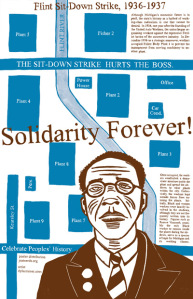
All of the movements negatively impacted by recent Michigan legislation, such as the women’s movement, the LGBTQ movement and immigrant rights movement have strong histories of radical analysis and direct action that must be explored and reintroduced into future organizing.
Second, we need to redirect financial resources toward organizing where we are. For decades the labor movement has been pumping millions of dollars into electoral politics instead of organizing in the workplace and building capacity amongst workers to have the skills to do radical politics.
Think about the $21.9 million dollars that was raised this year to push for Proposal 2. What if that amount of money was spent on paying people to become organizers, to provide resources to those doing organizing campaigns wherever workers wanted to organize? Workplace democracy is one of the strongest forms of democracy and can trump Right to Work laws. If businesses do not have compliant workers, they can’t make money.
Beyond spending the money on organizing, that kind of money could be used for mutual aid, providing resources like food, health care and housing to fellow workers and their families who are struggling to make it in this capitalist economy. Engaging in mutual aid will build solidarity, by demonstrating to people that we care about our working class brothers and sisters.
Third, we need to develop our own independent media. The commercial media in this state doesn’t understand our collective struggles and they won’t because they are dependent on advertising dollars from the very entities that exploit workers. We used to have a lively labor press in the US, but so little of that exists now. We need an independent media that tells the stories of the people whom the commercial media ignores. With an independent media, more people will have access to information that the commercial media marginalizes or represses. I’m not talking about just online media, I’m talking about labor-based press, a newspaper that is run by and for workers. Such a tool and other forms of media are weapons we need in the war of propaganda that the capitalist press is winning.
Fourth, we need to engage in intersectional organizing and solidarity. Each of the groups most negatively impacted from this most recent round repressive legislation cannot afford to remain isolated from each other. Women’s reproductive rights groups, LGBTQ groups, immigrant rights groups, public school educators and workers need to see that our struggles are inter-related and inter-dependent. In order to see this we need a more holistic and institutional analysis of the problem so that we can identify common enemies in this fight – the capitalist class, patriarchy, white supremacy, homophobia and anti-environmental forces.
Once we have a shared analysis, we can develop strategies to work together and engage in acts of solidarity. This doesn’t mean that we all have to go to more meetings, but it does mean that we need to include each other in our organizing work and we need to put our bodies on the line with each other when necessary. If the LGBTQ community is fighting discrimination at a workplace, then organized labor needs to be there. If organized labor is faced with downsizing or factory relocation then the LGBTQ community needs to have their back. Remember, Harvey Milk and the gay community in San Francisco supported the union boycott of Coors beer, which led to union support of the Castro district and Harvey Milk’s election.
We simply cannot afford to organize around single issue politics anymore.
Fifth, we need to stop thinking about elections as the main strategy. Virtually every major struggle we can think of in this country – end of slavery, women’s rights, worker rights, civil rights, environmental justice and LGBTQ rights – did not come about from elections, they came about through direct action and struggle. Elections have to be seen as simply a tactic in the larger strategy and in a radically different way. We know how to turn people out for actions and to vote. Doing so does not require a ton of money, since most election money is spent on electronic advertising.
But before we turn people out to vote, we need to think differently about voting. If we have stronger coalitions of grassroots groups, we should create a collective platform that candidates must endorse before they get our support. This way they can’t get the pro-choice vote without the pro-LGBTQ vote, etc. Think of it this way, we don’t endorse them, they endorse our platform.
This of course does not guarantee they will do what we ask once elected, but it provides a better chance, since the coalition of grassroots sectors can then withhold voting for them in the future if they don’t do what we asked them to do. Of course, elections themselves are ultimately not truly democratic, since the goal would be to create a system of direct democracy instead of representative democracy, which at this point in our history is so corrupt and mostly likely beyond repair.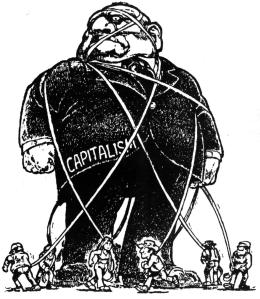
Sixth, we need to create new and radical ways of living. This one might be the hardest for us to think about, since most of us don’t know of any other way of organizing society. However, there are lots of examples from neighborhoods to villages and even cities. These forms of cooperative systems of living can be learned from indigenous communities, worker-run collectives, anarchist struggles and even religious communities like the Quakers and other liberation movements.
This is not just a pipedream, but a real possibility that we need to serious investigate in our struggles for greater justice. These new ways of living with each other also might not be enough, especially considering the urgency we face through climate change. If humanity is to have a future, we have to radically rethink how we are going to both resist the current systems of oppression and how to form new and liberating systems based on justice, cooperation and revolutionary love.
Part II of this will look at strategies for West Michigan.
MLive moralizes behavior in Right to Work onslaught
Yesterday, MLive posted a piece from their editorial board entitled, Right to work in Michigan: Gov. Snyder, unions and lawmakers all disappoint with their behavior this week.
The editorial begins with this comment: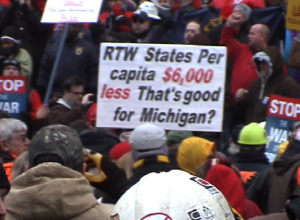
Right-to-work laws may or may not end up helping Michigan, but no one should be pleased with what happened in Lansing this week.
First off, the so-called neutral take on Right to Work by the MLive editorial board is ridiculous and it is bad journalism. Of course the Right to Work law will help Michigan, if by Michigan you mean the corporations and rich like the DeVos family, then yes, it will help. However, if you define Michigan by the majority of those who live here, working class people, then no, it will not help.
Then there is the moralizing comment about how none of us should be pleased this week by what happened in Lansing, which is the essence of the editorial piece.
The article then goes on to make the case that Gov. Snyder, the unions and State Representatives all engaged in behavior that we should be repulsed by.
First, the editorial talks about Snyder and how he said Right to Work wasn’t part of his agenda for the first two years and then, boom, he decides to sign it into law. This is a misreading of Snyder and the policies he has put forth.
From day one Snyder has been implementing neoliberal austerity policies – attacking public sector workers, their benefits & pensions, downsizing the public sector workforce, eliminating business tax, deregulation and the Emergency Management Law. Right to Work completely fits into this neoliberal strategy.
An example of MLive’s misreading of Snyder is a September article by their business reporter, claiming that Right to Work is a thorn in the side of Snyder. We deconstructed this story and pointed out the following:
What I think Gov. Snyder is doing by not taking a strong pro Right to Work stance is buying time. The unions in Michigan have countered the Right to Work possibility by pushing forward a November Ballot Initiative, the Project Our Jobs campaign. If that initiative passes in November, there will be a serious legal battle to overturn it. If it doesn’t pass, Michigan legislators who have aggressively advocated for Michigan to adopt Right to Work legislation will no doubt move forward with proposing such legislation, which means it will then come to Snyder to be signed into law. If Snyder was really against such legislation he would make it clear by stating publicly that he would veto such legislation if it passed in the legislature. He has not done so to date.
Therefore, it is safe to say that Snyder did not behave poorly, he did exactly what he has been doing all along……….making decisions and supporting policy that benefits the capitalist class.
The MLive editorial also goes after State Representatives, because of comments they made, both Republicans and Democrats, which is really quite relevant. Instead, what we should be looking at is how they voted on the Right to Work legislation. MLive doesn’t seem to be interested in publishing that list. I don’t think most people care what elected officials say, they care about what they do and how they vote.
Lastly, Mlive goes after unions members by stating:
If union opponents were hoping to portray organized labor as unruly, they got the images they were hoping for, as an angry group tore down a tent, state police stood in riot gear and Teamsters leader Jimmy Hoffa in a television interview promised “a civil war.” There are ways to passionately debate legislative activity without resorting to actions that cast an unflattering light on union members across the state to a national audience.
Wow. First, there is plenty of information that disputes what happened with the whole “tent destruction incident.” More importantly, the editorial writer doesn’t seem to know much about union history. Union workers have been brutalized, arrested, deported, detained and murdered over the past 150 years in the US when attempting to organize or fight for their rights. During that history, many union members have fought back, often with force, because their rights were being threaten or their lives were being threatened.
This particularly moralizing is just part of the West Michigan ethic of “nice.” In times like these, we don’t need to be nice, we need to be angry and we need to fight back. Personally, I was disappointed that the more union members did not join those of us inside and occupy the state capitol, even if it was by force. The state certainly used force by having hundreds of cops, many in riot gear, to harass, intimidate, beat and pepper spray anyone they thought was not compliant enough.
However, that behavior wasn’t addressed in the MLive editorial. Instead, the public is being preached to by MLive about how we should behave. They want us to be nice and compliant, even while we are being brutalized by policies that will create more poverty in Michigan. When Unions are under attack, we need to fight back!
It has been a brutal week in Michigan for democracy. The Michigan legislature passed bills this week that weaken unions, attacks reproductive rights, Muslims, the LGBT community and now the general public, by passing a new version of the Emergency Financial Manager Law.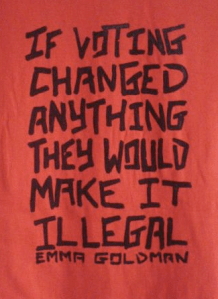
Remember, Michigan voters repealed the existing EFM law that Snyder put in place in early 2011. (He announced the EMF law in Grand Rapids, since GR has followed his austerity model.) Today’s vote pretty much told voters – WE DON’T FUCKING CARE WHAT YOU THINK!
Not only did they pass a new version of the EFM law, they included language that said that this law could not be repealed! Again, SCREW YOU!
Some of the details of this anti-democratic bill are as follows:
- A review team will come to any community they think are financially unstable, hold one public meeting, but are not obligated to have public comment.
- Communities will only have 7 days to make a decision, once the state makes their recommendation.
- Allows the governor to impose “best practices” (undefined), a model charter or model charter provisions (undefined) and management training as a condition to the end of receivership.
- Provides for an “advisory board” that excludes all local participation to continue state intervention as a transition from receivership at the option of the governor.
- Reenacts provisions of PA 4 concerning suspension of collective bargaining rights under receivership.
- Grandparents all existing emergency managers and emergency financial managers.
To see a more detailed analysis of the new Emergency Financial Manager Law can be found at Michigan Forward.
This new law, along with everything else passed this week is reason enough for an uprising. The question is, what will we all do to fight this?
Michigan Republicans propose anti-Sharia law to Discriminate against Muslim Americans
This article by Juan Cole is re-posted from Informed Comment. Editor’s Note: West Michigan legislator Dave Agema has been pushing an anti-sharia bill for over a year, as we have reported on in the past. Agema, has also been rabidly in support of anti-worker legislation, anti-choice, anti-LGBT and anti-immigration legislation. In February and March, local activists confronted Agema on these issues in Grandville.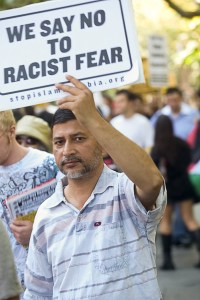
Michigan State legislator David Agema has introduced an anti-sharia bill that attempts to ban the implementation of ‘foreign law’ in the US that would contradict constitutional rights. Agema openly says he wants to target the Muslim-American community of southeast Michigan, falsely alleging that there are terrorist cells among them.
Arab-Americans have emerged as an important swing vote in Michigan, such that Republicans are unwise to complete the job of driving them into the arms of the Democratic Party. (They had earlier been split, but because of Bush administration policies and the rise of the Tea Party, a majority now vote Democratic).
The bill drew a sharp rebuke from the Council on American Islamic Relations (CAIR).
Sharia is the living tradition of Muslim law, analogous to Jewish Halakha or Roman Catholic canon law. Anti-sharia bills are unnecessary since the first amendment forbids the government from establishing any particular religion. Sharia provisions can come into legal judgments (e.g. if a husband and wife have a pre-nup with sharia provisions (dowry?) agreed to by both parties, the judge would obviously have to consider it in a divorce case). The Agema bill could not stop that from happening, and depending on how it is worded, it is ignorant of the tradition of Anglo-American common law or it is just unconstitutional.
Cenk Uygur of the Current TV network treats the proposed law with the derision it deserves:

