Kellogg claims to fight hunger in PR stunt for World Food Day
The online pro-business blog Michigan Loves Manufacturing posted a Media Release from the Battle Creek-based food giant Kellogg yesterday, where the company claims to be fighting global hunger.
The Kellogg Press Release is a typical PR stunt for corporations that want to present themselves as caring in the public eye. Kellogg touts their hunger relief efforts by making donations to food banks across the country, primarily working with Feeding America.
The company also lists the follow activities they are involved in for World Food Day:
- Donating $125,000 in cash and product donations through Kellogg’s Corporate Citizenship Fund to six organizations, mainly food banks, in Latin America. Also, Kellogg employees will volunteer at food bank locations in Mexico, Guatemala and Colombia to provide Kellogg breakfasts.
- Kicking-off the “Help Give a Child a Breakfast” campaign in the U.K. to raise $480,000 to donate to schools most in need to help provide breakfast for children who are going to school hungry.
- Volunteering at community food banks and food distribution sites across the U.S. in the month of October as part of United Way Days of Caring.
Again, more charity work and how convenient that Kellogg workers will be serving their own products around the world to poor children. Nothing like introducing products to new markets in the hopes of gaining new customers.
The Kellogg Media Release also says they are setting up Breakfast Clubs around the world, where the company provides breakfast meals to children in countries that don’t have government assisted programs. Another example of marketing their own products and then writing off the donations for their tax records, which is equivalent to selling the breakfast foods in the first place.
Lastly, Kellogg states that it partners with Walmart in the Fighting Hunger Together campaign, which is another PR stunt designed to manipulate the public into thinking these companies give a shit about fighting hunger by getting communities to compete for money they give away. We have written about this in the past and will say again that these efforts are just well designed PR stunts that do not address the root causes of poverty and hunger.
Companies like Kellogg cannot really address or fight hunger since their very existence is designed to make a profit. Until we change the economic system, hunger and poverty will persist. If we are really serious about making sure everyone has enough healthy food to eat on a daily basis then we will promote Food Justice, not hunger relief. Giving away sugar-laden cereals to poor kids around the global might make for a great photo op, but it does nothing to fight hunger.
This article by Peter Rugh is re-posted from Ecowatch.
A hard rain was falling on Monday night as Occupy the Pipeline activists spread out along New York’s Hudson River Park, in front of the site where workers in orange day-glow vests have been laboring around the clock on the New Jersey-New York Expansion Project. Known colloquially by the name of its builder, Spectra Energy, the Spectra Pipeline will pump fuel hydraulically-fracked from Pennsylvania’s gas fields into New York City.
The very real risk of explosion along the densely populated regions through which the pipeline passes have made local residents want nothing to do with the project, as evidenced by letters submitted to the Federal Energy Regulatory Commission during the pipeline’s approval process. Only 22 of the 5,000 letters were in favor of the project.
The Spectra Pipeline is just one of a new breed of high pressure pipelines being built around the country to expand the gas market to meet the increasing output of U.S. shale production. According to a filing with the Securities and Exchange Commission on Oct. 18, 2011, Spectra Energy entered into a $1.5 billion revolving credit agreement with the likes of JPMorgan Chase, Citibank, Royal Bank of Scotland, Bank of America and Wells Fargo. Through what’s known as a syndicated loan, Wall Street infused Spectra with capital and spread the financial risk around, while leaving the risk of possible explosion for local residents to bear.
On Oct. 15, Occupy the Pipeline activists wrapped themselves in yellow caution tape as they stood in front of the pipeline construction site. They had black-and-white skeleton makeup on their faces—representing, they said, the danger of fossil fuels turning humans into fossils—which was bleeding down their chins because of the rain. The tape woven around the bodies of those on the line served as a symbol of interconnectivity.
“We are all connected through a web of toxic pipelines,” Occupy the Pipeline organizer Monica Hunken cried out through the people’s microphone, “but we are also connected by a vision for safe and sustainable world.”
Seeing their local fight against Spectra as a microcosm of a broader battle, Occupy the Pipeline put out a call several weeks earlier for those opposing America’s fossil fuel beef-up to join them in a day of action. In Texas, activists who have been carrying out direct actions against the Keystone XL didn’t need much prodding. On #O15, as the date has been called, 50 people stood in the way of the pipeline that NASA climate scientist James Hansen has told the New York Times means “game over” in the fight against climate change.
The Keystone XL is designed to bring heavy crude oil from a deforested region in Alberta, Canada, to export markets along America’s Gulf Coast. After more than 1,000 people were arrested sitting-in at the White House against the pipeline in the summer of 2011, and thousands formed a ring around the White House last November, President Barack Obama announced in January he was nixing approval of the pipeline until after the 2012 election. Quietly, however, his administration gave the go-ahead for construction of the XL’s southern portion.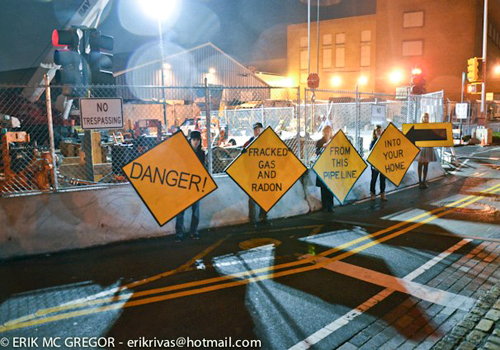
During a stump speech in Cushing, Oklahoma—a town known as the “Pipeline Capital of the World”—Obama disputed claims that he was a softhearted environmentalist. “We’ve built enough pipeline to encircle the earth and then some,” he told the Cushing crowd. Writing at Grist, shortly after Obama’s Department of the Interior issued four coal mining leases for the Powder River Basin in 2011, Glenn Hurowitz summed up the president’s “all of the above” energy policy as “effectively using modest wind and solar investments as cover for a broader embrace of dirty fuels.” It’s a trick straight out of BP or Chevron’s playbook, writes Hurowitz, to “tout modest environmental investments in multi-million dollar PR campaigns, while putting the real money into fossil fuel development.” But these days Obama does not appear to be playing down his enthusiasm for coal, gas and oil.
While the U.S. under Obama’s leadership is deepening its reliance on fossil fuels, greenhouse gas emissions have led the climate and the human race along with it into what Mark Serreze, director of the National Snow and Ice Data Center (NSIDC), calls “uncharted territory.” Data collected by Serreze and fellow researchers in September shows that 1.32 million square miles of arctic ice cover withered away over the summer, more than in any year previously on record. The team had anticipated a record melt, but the scope of this year’s de-icing far exceeded its expectations. “While we’ve long known that as the planet warms up,” reported Serreze, “few of us were prepared for how rapidly the changes would actually occur.”
Fortunately for those concerned about the impact of fossil fuels on the biosphere, opposition to the escalating rate of ecological devastation has entered “uncharted territory” as well. In what has been termed a “Summer of Solidarity,” actions against ecological devastation took place in numerous regions across the U.S.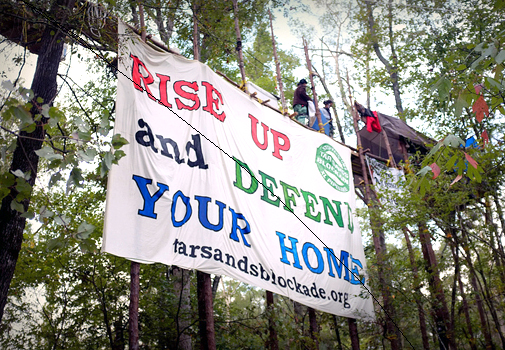
As thousands marched in the first national rally against fracking in Washington, D.C., 50 people walked onto the country’s largest mountaintop removal site in West Virginia and shut it down. Union workers locked out of the Pilgrim nuclear plant in Plymouth, Massachusetts, picketed beside environmentalists. In New York, Occupy the Pipeline challenged Spectra through sit-ins and lockdowns, while Puerto Rican activists battled (and halted) a natural gas pipeline through a campaign in which both islanders and the mainland diaspora took part.
Actions in the U.S. were inspired by bold and brazen acts of ecological defiance globally including the occupation of the massive Bela Monte Dam in Brazil’s rainforest by indigenous tribes amidst the Rio+20 climate conference and a weeklong blockade of the Olympic Dam uranium mine in South Australia. All the while in Texas, lockdowns and tree-sits against Keystone XL took off one after another.
In Massachusetts, where Spectra Energy is attempting to soup up the Algonquin Gas Transmission line, activists with 350.org and the Better Futures Project met the #O15 call with a tree-sit near Boston. They held banners reading, “TransCanada, You Shall Not Win” and “In Unity With @KXLBlockade & @occupy_pipeline.”
“We leave the ‘Summer of Solidarity’ with friends still sitting in tree tops, with the direct actions of thousands still reverberating, and we enter the ‘Autumn of Unity,’” Monica Hunken told the soggy crowd back in New York. As the effects of climate change become more acute Hunken expressed hope that those resisting it will forge stronger ties with one another.
During Occupy Wall Street’s anniversary weekend in New York, I spoke to Sam Rubin, an anti-fracking activist from Ohio who was in town to storm the Stock Exchange. Then, last Sunday, Rubin and comrades blockaded a fracking site in eastern Ohio, ahead of the #O15 day of action. While in New York last month, Rubin told me that he hails from an area outside of Cleveland hit hard by the recession, where U.S. Steel recently reopened a plant for the first time in two years.
“For these guys to be coming back to work is a huge deal for them,” Rubin said. “They are making steal for pipelines to build-up the fracking infrastructure.” Rubin is part of an emerging breed of environmental activists who see their ecological activism as part of a broader movement for social change. As he and other activists draw on the solidarity fermented over the summer, Rubin said it is import to see their ecological struggles within the pervasive framework of global capitalism, “a system based on growth and extraction for profit fundamentally dependent on human exploitation.”
“Otherwise” added Rubin, “I’m just some guy in a bubble who only cares about my little issue.”
New Media We Recommend
Below is a list of new materials that we have read/watched in recent weeks. The comments are not a “review” of the material, instead sort of an endorsement of ideas and investigations that can provide solid analysis and even inspiration in the struggle for change. All these items are available at The Bloom Collective, so check them out and stimulate your mind.
Islamophobia and the Politics of Empire, by Deepa Kumar – On of the more insidious consequences of the US War on Terror has been the demonizing of Islam. For many in the US, Islam is equated with terrorism and that has serious consequences. Deepa Kumar has done us all a great service in her new book Islamophobia. Kumar not only provides readers with a solid analysis of what Islamophobia looks like in the US since 9/11, she provides thorough background into the centuries of anti-Islamic ideology that has permeated much of the west and academia. The analysis presented in this book is not just an intellectual argument, it demonstrates that those who practice Islam have been the targets of harassment, intimidation and violence from both the general public and the state. Islamophobia is an unsettling read, but it is also an important tool in the fight against the so-called war on terror.
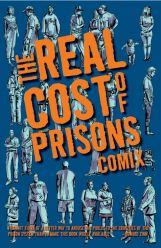 The Real Cost of Prisons Comix, by Lois Ahrens – The Real Cost of Prisons has been a project for more than a decade, where prison abolitionists have looked at the growth of the Prison Industrial Complex. This book is a result of their work and their vision about how to communicate the complexities of incarceration in America through comics. There are three separate comic books with The Real Cost of Prisons Comix. The first deals with how prisons are built and who really pays for them. The second commix is a look at how the War on Drugs has become the largest contributing policy to cause the US prison population to explode. The last commix deals with how prisons impact women and children, both women in the prison industrial complex and those who have loved ones within the system. There are also a few short essays included in the book, but these comics are a fabulous tool that could be used for anyone in high school and older and wants to understand the US prison system.

Blood on the Tracks: The Life and Times of S. Brian Wilson, by S. Brian Wilson – I first met Brian Wilson in 1986 in Washington, DC at a conference for those involved in the Central American Sanctuary Movement. Wilson and other US veterans were fasting against US military aid to the Contras and they addressed the audience in DC. I met Wilson again in 1988 in Guatemala, while working for Peace Brigades International. Wilson was traveling to Nicaragua with a delegation against the US-back war. There was one notable difference the second time seeing Wilson. He had lost his legs. In 1987, Wilson and others were part of a campaign to shut down a munitions rail line on the west coast, munitions that were being sent to Central America. Part of the campaign involved people lying on the tracks and then notifying the company that they would be taking this action to either delay or stop the weapons from being shipped. On one fateful day in the summer of 1987, the train operator wouldn’t stop and Wilson had both of his legs severed. Blood on the Tracks is a powerful autobiography of an amazing person who went from Vietnam Veteran to one of the most committed anti-war activists in this country. A compelling read, highly recommended.
Pink Ribbons Inc (DVD) – Pink Ribbons Inc is an investigation into the insidious cooptation of the breast awareness movement, where corporations use the pink ribbon to not only make money, but to hide their own role in creating a toxic world that leads to breast cancer. Those critical of this reality call the pink ribbons on products – pinkwashing. A powerful film that demonstrates once again how capitalism will co-opt any and all causes, given the chance.
Michigan DEQ spokesperson claims fracking is safe and that they “don’t judge energy sources”
On Thursday, October 18, Representative Pete MacGregor from the 73rd District will host a forum on fracking for people at 6 p.m. at Cannon Township Hall, 6878 Belding Road.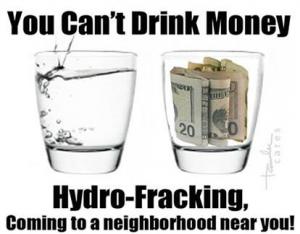
Joining MacGregor will be representatives from the Michigan DNR and DEQ to answer questions about concerns people might have about the method of natural gas extraction, known as hydraulic fracturing or fracking.
In an article last week in the Rockford Squire, DEQ spokesperson Brad Wurfel was the only source cited on the issue, where Wurfel defended the practice of fracking:
Wurful said scare tactics such as the movie Gasland are misleading. A much-promoted graphic of homeowners who are able to light their drinking water on fire has nothing to do with mining or fracking. “I just found a public service flier where the lead graphic was someone lighting their tap water on fire.” He said it happens less often now that more people are hooked to municipal water systems, but homeowners who have well water do have the possibility to have naturally-occurring methane gas contaminate their wells, allowing the alarming possibility of tap water that can burn.
The reporter with the Rockford Squire apparently thinks there is no reason to question a government spokesperson on this critical issue that involves public health, environmental protection and climate change.
There is plenty of recent evidence that there are human health and environmental risks involved with fracking. The US Government Accountability Office (GAO) came out with a recent report confirming the fact the fracking poses serious environmental and human health risks. There are also two new studies done by the US Geological Survey on the contamination of groundwater when fracking occurs.
The fact that Rep. MacGregor did not invite other experts with opinions and facts that differ from the Michigan DEQ means that those who attend are less likely to be aware of the critical perspective on fracking in the US.
Anyone who can attend to share such a perspective would at least provide a more balanced view on this critical issue.
Other up Coming Anti-Fracking Actions and Campaigns
We posted a few weeks back about the big protest coming up on Wednesday, October 24 in Lansing, where the DNR is going to auction off more mineral leasing rights to oil & gas companies on public land.
The DNR auction begins at 9am on the 24th at the Lansing Center, located at 333 East Michigan Ave in Lansing, just east of the Capital building and the river. The protest begins at 8:00AM. For more details there is a facebook event page.
Two days before the protest there is an effort to pressure the Michigan DNR by calling the Executive Director Keith Creagh and telling him to stop the auctioning off of mineral rights on public land to oil & gas companies. People are being encouraged to flood that office with phone calls on Monday, October 22. Call 517-373-2329 for DNR Director Keith Creagh and 517-335-3251 for the Natural Resources Deputy Mary Uptigrove. There is a facebook page for this action with more details and a script if you are looking for ideas of what to say.
Yesterday, we posted a notice about upcoming screenings of the anti-fracking film Gasland that will be shown in West Michigan over the next few weeks.
Obama’s War Record
This article by Jack A. Smith is re-posted from CounterPunch.
When Sen. Barack Obama ran for the presidency in 2008 many wishful-thinking Democratic voters viewed him as a peace candidate because he opposed the Iraq war (but voted yes on the war budgets while in the Senate). Some others assumed his foreign/military policy would be along the lines of Presidents George H. W. Bush (whom Obama admires) or Bill Clinton. Some who identified as progressives actually thought his foreign/military policy might tilt to the left.
Instead, center rightist that he is, Obama’s foreign/military policy amounted to a virtual continuation of George W. Bush’s Global War on Terrorism under a different name. He extended Bush’s wars to Pakistan, Yemen, Somalia, Libya and elsewhere while greatly expanding the war in Afghanistan, hiking the military budget, encouraging the growth of militarism in U.S. society by repeatedly heaping excessive praise on the armed forces, and tightening the military encirclement of China.
Summing up some of his military accomplishments a few months ago, Obama declared: “We’ve succeeded in defending our nation, taking the fight to our enemies, reducing the number of Americans in harm’s way, and we’ve restored America’s global leadership. That makes us safer and it makes us stronger. And that’s an achievement that every American — especially those Americans who are proud to wear the uniform of the United States Armed Forces — should take great pride in.”
Obama actually has little to show for his war policy after nearly four years. Most importantly, Afghanistan — the war he supported with enthusiasm — is predictably blowing up in his face. A symbol of the Bush-Obama 11-year Afghan folly is the recent 2,000th death of an American soldier, not at the hands of the Taliban but a U.S.-trained Afghan police officer, our supposed ally. The truth is that public opinion in Afghanistan has always overwhelmingly opposed the invasion, and rightly so.
Obama hopes to avoid the embarrassment of a takeover by the Taliban or another violent Afghan civil war (as happened in the 1990s) after the bulk of U.S. troops pull out at the end of 2014. He’s made a deal with the Kabul government that allows Washington to keep thousands of American troops — Army, CIA agents with their drones, elite Special Operations forces and pilots — until 2024. There are two reasons for this. One is to keep a U.S.-controlled government in Kabul as long as possible. The other is to station American combatants near Afghanistan’s borders with Iran to the west and China to the east for another 10 years, a verdict hardly appreciated in Tehran and Beijing.
The Middle East is in turmoil. Israel’s still threatening to attack Iran, an act that would transform turmoil into catastrophe. The Syrian regime refuses to fall, much to Washington’s chagrin. Egypt’s new government has just declared partial independence from Washington’s longstanding domination. The plight of the Palestinians has worsened during Obama’s presidency. Relations with China and Russia have declined.
Very few of Obama’s 2008 foreign/military election promises have come to fruition. He said he would initiate a “new beginning” in relations with the international Muslim community which had reached a low point under Bush. America’s popularity jumped after the president’s promising Cairo speech in 2009. But now, after repeatedly attacking Muslim countries with drone assassins, the rating is only 15% positive, lower than when Bush was in command.
Obama had promised to improve relations with Latin America, get diplomatically closer to Iran and Cuba, settle the Israel-Palestine dispute and close Guantanámo prison, among a number of unrealized intentions.
All the foreign developments the Democrats could really brag about at their convention were ending the war in Iraq “with heads held high” as our legions departed an eight-year stalemated conflict that cost Uncle Sam $4 trillion, and assassinating al-Qaeda leader Osama bin-Laden (which drew the most enthusiastic of those jingoist “USA! USA! USA!” chants from Democratic delegates).
Actually, Bush ended the Iraq war by signing an agreement with the Baghdad regime — before the new president took office — to pull out all U.S. troops at the end of 2011. Obama supported the treaty but tried unsuccessfully until the last minute to coerce the Iraqis to keep many thousands of American troops in the country indefinitely. (Antiwar.com reported Oct. 2 that up to 300 U.S. soldiers and security personnel have been training elite Iraqi security forces for months.)
Obama as warrior president discombobulated the Republicans who in past elections always benefited from portraying the Democrats as “weak on defense.” Efforts to do so this year have fallen flat after the president in effect melted down his undeserved Nobel Peace Prize to make more bullets. Obama also obtained a second dividend. He wasn’t besieged by antiwar protests as was his predecessor, because most anti-Bush “peace” Democrats would not publicly oppose Obama’s militarist policies. (This essentially destroyed the mass U.S. antiwar movement, which has been kept going on a much smaller scale by the left and the pacifists.)
Throughout Obama’s election declarations he occasionally speaks of, and exaggerates, increasing threats and hazards confronting the American people that only he can manage. He told the convention that the “new threats and challenges” are facing the country. Romney does the same thing, in spades. Overstating the threats confronting the U.S. is a perennial practice for Democratic and Republican presidents and candidates. George W. Bush brought this dishonest practice to an apogee, at times sounding as though he was reciting a Halloween ghost story to gullible children — but this year’s candidates are no slackers.
Historian and academic Andrew J. Bacevich, an Army colonel in the Vietnam War and now strongly opposed to America’s wars, mentioned fear-mongering in an article published in the January-February issue of The Atlantic magazine. He writes: “This national-security state derived its raison d’être from — and vigorously promoted a belief in — the existence of looming national peril…. What worked during the Cold War [fear of the ‘Communist menace’ and nuclear war] still works today: to get Americans on board with your military policy, scare the hell out of them.”
The main purpose of this practice today is to frighten the public into uncomplainingly investing its tax money into the largest military/national security budget in the world — about $1.4 trillion this year (up to $700 billion for the Pentagon and an equal amount for national security).
This accomplishes two objectives for that elite ruling class that actually determines the course of empire: First, it sustains the most powerful military apparatus in history, without which the U.S. could hardly function as world leader (yes it has the biggest economy, but look at the shape it’s in). Second, it constitutes a huge annual infusion of government cash — a stimulus? — into the economy via the military-industrial complex without the “stigma” of being considered a welfare-like plan to create jobs or benefit the people. (This is wrongly called Military Keynesianism, a notion that was repudiated by the great liberal economist John Maynard Keynes, who helped pull the U.S. out of the Great Depression with his plan to increase government spending to end the crisis.)
The White House and Congress talk about reductions in military spending, and there may be some cuts by eliminating obsolete defense systems — but over the decade the budget will continue to expand. Obama said to the convention, and Romney will pledge the same if elected — “As long as I am Commander-in-Chief we will sustain the strongest military in the world.”
This has been a sine qua non for election to the presidency for decades. It is so familiar and so justified by official scare stories that most Americans don’t think twice about paying an annual national fortune to maintain the most powerful military machine in the world to deal with a few thousand opponents with relatively primitive weapons many thousands of miles away. The U.S. military, of course, has an entirely different purpose: at a time of gradual U.S. decline and the rise several other countries such as Brazil, India and China, among others — Washington’s military power is intended to keep the United States in charge of the world.
GVSU to host screening of Pink Ribbons Inc – October 23rd
Next Tuesday, the Women’s Center at GVSU will host a screening of the recently released documentary film about how breast cancer awareness has become another mechanism for making a profit.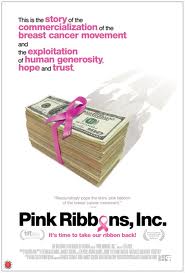
Pink Ribbons Inc is an investigation into the insidious cooptation of the breast awareness movement, where corporations use the pink ribbon to not only make money, but to hide their own role in creating a toxic world that leads to breast cancer. Those critical of this reality call the pink ribbons on products – pinkwashing.
The ubiquitous pink ribbons of breast cancer philanthropy – and the hand-in-hand marketing of brands and products associated with that philanthropy — permeates our culture, providing assurance that we are engaged in a successful battle against this insidious disease. But the campaign obscures the reality and facts of breast cancer – more and more women are diagnosed with breast cancer every year, and face the same treatment options they did 40 years ago. Yet women are also the most influential market group, buying 80 percent of consumer products and making most major household purchasing decisions. So then who really benefits from the pink ribbon campaigns — the cause or the company? And what if the very companies and products that profit from their association have actually contributed to the problem?
In showing the real story of breast cancer and the lives of those who fight it, Pink Ribbons, Inc. reveals the co-opting of what marketing experts have labeled a “dream cause.”
Pink Ribbons Inc
Tuesday, October 23
6:00PM
GVSU Allendale Campus, Kirkhof Center – Grand River Room
A discussion will follow the film. This movie is free and open to all.
Don’t Frack West Michigan events planned
The following information is based on a Media Release from Food & Water Watch.
Over the next month, groups across the region are engaging communities on several occasions to learn about the controversial natural gas drilling process known as hydraulic fracturing or “fracking.” There are three scheduled screenings of the documentary Gasland. Filmed by Josh Fox, Gasland chronicles Fox’s cross-country odyssey to understand the concerns posed by the practice and undercover the truth. 
These screenings come directly before the mineral rights auction being held on October 24th in Lansing, where the Michigan Department of Natural Resources will lease over 175,000 acres of publicly owned mineral rights to oil and natural gas companies. Publicly owned mineral rights in Allegan, Ottawa, Kent and Barry are all being auctioned. See the map here: http://www.michigan.gov/dnr/1,1607,7-153-10371_14793-30912–,00.html
The free public screenings will be held:
Sunday, October 21, 6 pm at Allegan Regent Theater, 211 Trowbridge, Allegan
Monday, October 22, 6 pm at Hopkins Library, 118 East Main St., Hopkins
Tuesday, October 23, 6 pm at Herrick District Library, 300 S. River Ave. Holland
In November, community members will have the opportunity to learn more about the dangers of fracking and what they can do to stop the flood of the fracking industry in to our communities. Michigan Land, Air Water Defense with support from FLOW and Food & Water Watch present an evening with Wenonah Hauter, long time water activist and Executive Director of the consumer advocacy group Food & Water Watch and Jim Olsen, esteemed environmental lawyer on Monday, November 12 at Griswold Auditorium, 401 Hubbard St., Allegan, 6-8:30 p.m.
How Did the Quebec Student Movement Win?
This article/video by subMedia is re-posted from Dissident Voice.
For over 4 months, students and their allies, took over the streets of Montreal every day, to protest a tuition hike imposed by the liberal party in Quebec.
On September 21st, the newly elected Premier of Quebec scrapped the tuition hike and repealed a controversial law, that effectively banned public demonstrations.
While this is being touted as a victory by many in the student movement, one element that made this success possible is already being overshadowed. How the the movement’s militant street politics transformed the student strike from a single issue campaign to an uncompromising social insurrection.
This article is re-posted from EcoWatch.
A new report1 on shale resources and hydraulic fracturing from the Government Accountability Office (GAO)—an independent, nonpartisan agency that works for Congress—concludes that fracking poses serious risks to health and the environment. The report, which reviewed studies from state agencies overseeing fracking as well as scientific reports, found that the extent of the risks has not yet been fully quantified and that there are many unanswered questions and a lack of scientific data.
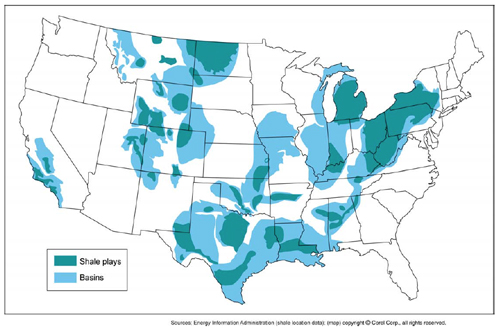
Major reports and studies were also released in Europe the past two months, all of which came to the conclusion that fracking poses serious risks to water, public health, and the environment, and that additional scientific study is necessary. Meanwhile, in NY hundreds2 of doctors, scientists, and medical organizations have renewed calls for an independent, comprehensive health impact assessment and additional scientific research.
“The big-money gas industry is at it again,” said John Armstrong of Frack Action on behalf of New Yorkers Against Fracking, a broad coalition of New Yorkers opposed to fracking. “Rather than allow a comprehensive independent health assessment that can study the dangers fracking poses to our water and health, they just want to frack as quickly as possible and take their profits back to Texas.”
Given the conclusions from the broad NY, U.S., and world-wide scientific and medical community that fracking poses serious public health and environmental risks and needs further scientific study, the gas industry and the Joint Landowners Coalition’s rush to frack is dangerously reckless and irresponsible.
The Government Accountability Office report, which includes review of the New York Department of Conservation’s study of fracking, finds that there is insufficient data and scientific study to determine the extent of risks fracking poses to groundwater and avenues for groundwater contamination, but it does note that such contamination can take place. For example, the report states that, “Underground migration can occur as a result of improper casing and cementing of the well bore as well as the intersection of induced fractures with natural fractures, faults, or improperly plugged dry or abandoned wells. Moreover, there are concerns that induced fractures can grow over time and intersect with drinking water aquifers” (page 46).
The GAO’s concerns about improperly plugged and abandoned wells strike an unnerving note in New York especially, given that the Associated Press recently found3 that Department of Environmental Conservation records, “reveal thousands of unplugged and abandoned wells and other industrial problems that could pose a threat to groundwater, wetlands, air quality and public safety.”
The GAO report also raises many other concerns long held by NY health professionals and scientists, such as the negative impacts that fracking will mean for air quality. The GAO report concludes that, “Construction of the well pad, access road, and other drilling facilities requires substantial truck traffic, which degrades air quality. Air quality may also be degraded as fleets of trucks travelingnewly graded or unpaved roads increase the amount of dust released into the air—which can contribute to the formation of regional haze” (page 33).
GAO goes on to raise concerns that silica sand—commonly used as a proppant in the hyrdaulic fracturing process—may pose a risk to human health. GAO notes that according to a federal researcher from the Department of Health and Human Services, particles from the sand “can lodge in the lungs and potentially cause silicosis” (page 33).
That the gas industry and the Joint Landowners Coalition would push to frack, rather than listen to the science and medical experts and wait for the necessary studies such as an independent, comprehensive health impact assessment4 to be undertaken, is indicative that they are comfortable putting profits before health and are unwilling to participate in a debate based on the science and facts.
On behalf of New Yorkers Against Fracking, Armstrong said, “Fracking proponents continue their reckless and irresponsible push to frack even in the face of an overwhelming body of science showing that fracking poses serious risks to health and the environment and consensus among experts and government agencies that we need more scientific study on fracking. Our water, air and health are priceless.”
The new reports from Europe include a comprehensive report5 from the European Commission’s Environment Directorate-General, a joint report6 from Germany’s Federal Environment Agency and Federal Ministry for the Environment, Nature Conservation and Nuclear Safety, and a year-long German Hydrofracking Risk Assessment7 study from a panel of independent experts.
Among the conclusions8 from the European Commission’s Environment Directorate-General’s comprehensive report5 are that there is “a high risk of surface and groundwater contamination at various stages of the well-pad construction, hydraulic fracturing and gas production processes, and well abandonment, and cumulative developments could further increase this risk.” The report also points to air emissions impacts that pose “potentially significant effect on air quality including ozone levels.”
The conclusions8 from the joint report6 by Germany’s Federal Environment Agency and Federal Ministry for the Environment, Nature Conservation and Nuclear Safety include that fracking can lead to groundwater contamination,that experts advise against large-scale fracking and that there should be a ban in areas that provide drinking water, and that more scientific study is necessary to evaluate environmental risks.
Germany’s year-long Hydrofracking Risk Assessment7 by a panel of independent experts similarly found8 that fracking entails serious risks, that it can do substantial harm to water resources, and pointed to greater concerns about fracking in areas that supply drinking water.
Report Back from What the Frack is going on in Michigan event
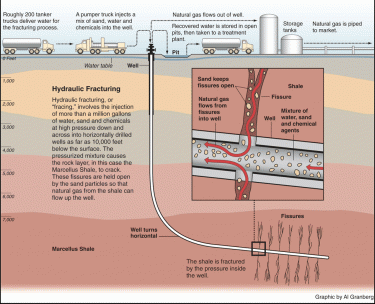
This is a summary of what was presented and discussed at a forum on the impact of hydraulic fracturing in Michigan at the Bloom Collective this past Saturday.
The forum began by talking a bit about the environmental and health effects of fracking. A useful online resource can be found at Earth Works Action, which provides a hydraulic fracturing 101 page that has good information on toxic chemicals used in fracking. Reference was also made to some recent reports by the US Geological Survey, confirming the toxic contamination of groundwater by hydraulic fracturing.
The conversation then shifted to fracking that was specific to Michigan. First, it was pointed out that the oil & gas industry has been active and aggressive in trying to influence policy through money. A report by Common Cause last November shows that there is not only a surge in money going to politicians at the federal level, but in Michigan as well to influence state policy on fracking. The top recipients of money from members of Congress in Michigan are John Dingell, Dave Camp and Fred Upton, each receiving over $150,000 in campaign contributions.
Michigan legislators and candidates for state office have also received a significant amount of money from the oil & gas industry over the last decade. This money has come from a few primary sources with DTE Energy leading the way. It is also important to note that Wolverine Oil & Gas is a Grand Rapids-based company.
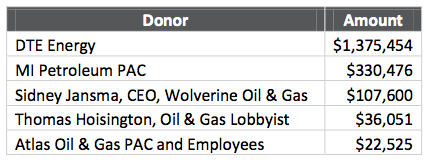
The conversation then shift to where many of the environmental organizations stood on this issue. It was noted that many of the larger groups, such as Clean Water Action, Sierra Club, Food & Water Watch and WMEAC did not support an outright ban on fracking in Michigan. WMEAC, like many of the environmental groups mentioned are instead supporting proposed legislation, which essentially calls for more study on the impact of fracking.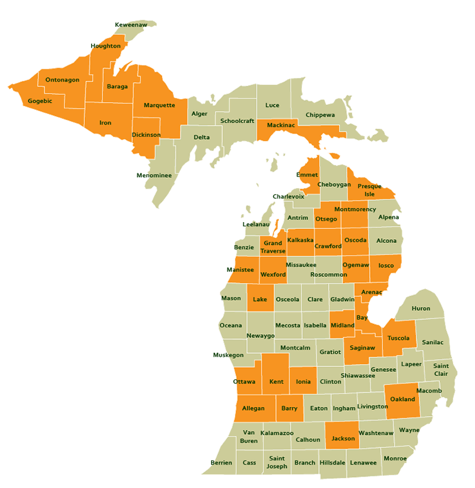
The group Ban Michigan Fracking states:
“The package of bills is a sleight-of-hand, pro-regulatory approach to ensure that fracking for shale gas is labeled ‘safe’ and continues in Michigan,” says LuAnne Kozma of Ban Michigan Fracking. A bill calling for a moratorium is tied to a bill that would initiate a gas industry-funded study and fracking advisory committee, but not the other way around. In other words, the proposed fracking panel and study could go forward even without a moratorium. One of the bills’ key sponsors, state Representative Mark Meadows, revealed shortly after introducing the bills that he is opposed to a ban on fracking.
The recently formed group Ban Michigan Fracking also provides important analysis on each of the three bills introduced that are specific to fracking.
The next thing that was discussed in Michigan is where fracking is taking place across the state and which parcels of land will be auctioned off on October 24 at a DNR meeting in Lansing.
The DNR has a searchable map that allows anyone to look at where in the state the government has listed land as “mineral lease nominations.” The counties in orange are the ones with land up for auction on October 24 and you can see that there are several counties in West Michigan with public land that is up for mineral leasing.
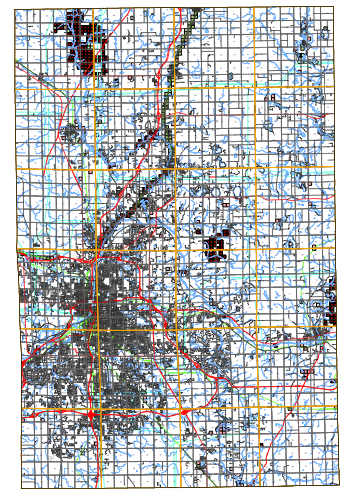
If we looked at a map of Kent County, you can see the proposed sites for mineral leasing that will be auctioned off on October 24 in Lansing. It appears there is a large chunk of public land between Sparta and Cedar Springs. There is also some land near Lowell and along the 131 corridor by Rockford. If you wanted to look at more details of the lands up for auction, the DNR has a detailed document of all the parcels.
It is not likely that residents near these lands that could be leased for mineral rights on October 24 have any idea that hydraulic fracturing could take place near their homes. Such a reality led some at the event to talk about possibly going door to door in those areas to provide information on fracking and organizing informational forums.
The last thing that that was discussed on Saturday was the upcoming DNR land auction in Lansing. People were aware that there is an organized protest for October 24 and they talked about ideas for the protest beyond just having a presence outside the building.
 Grand Rapids Institute for Information Democracy