Fighting Back in Michigan Part I: A Statewide Strategy

It has been a tough week in Michigan, as the legislature and the Governor have pushed through repressive bills that will deeply impact working class people, women, racial minorities, the LGBT community and immigrants.
Already, there has been some talk about “going after the GOP in the 2014 elections.” While this is an understandable reaction and one tactic that could be employed, it is a best an inadequate, but more likely a failed strategy.
What we need in order to really fight back is to explore, develop and expand a strategy of resistance and justice. So what follows are just some general ideas on possible directions to go, since the need to organize and fight back has to be a collective effort from the grassroots, particularly the grassroots from the most disaffected sectors. What follows are just some broad ideas that need to be expanded and explored.
First, we need to claim our roots. The labor movement in particular has such a rich history of fighting back in this country, from the early days of the Knights of Labor, to the Wobblies and the CIO. Hell, even the UAW started as a more radical union and did not shy away from engaging in direct action through the wildcat strikes that forced the auto industry to accept their demands, beginning with the 1936-37 Flint factory occupations. We need to utilize the tactics of strikes, walkouts, workplace occupations, boycotts and even a general strike, which are all actions that give us real power.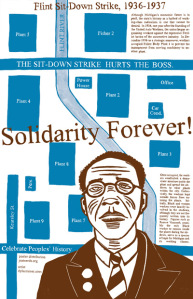
All of the movements negatively impacted by recent Michigan legislation, such as the women’s movement, the LGBTQ movement and immigrant rights movement have strong histories of radical analysis and direct action that must be explored and reintroduced into future organizing.
Second, we need to redirect financial resources toward organizing where we are. For decades the labor movement has been pumping millions of dollars into electoral politics instead of organizing in the workplace and building capacity amongst workers to have the skills to do radical politics.
Think about the $21.9 million dollars that was raised this year to push for Proposal 2. What if that amount of money was spent on paying people to become organizers, to provide resources to those doing organizing campaigns wherever workers wanted to organize? Workplace democracy is one of the strongest forms of democracy and can trump Right to Work laws. If businesses do not have compliant workers, they can’t make money.
Beyond spending the money on organizing, that kind of money could be used for mutual aid, providing resources like food, health care and housing to fellow workers and their families who are struggling to make it in this capitalist economy. Engaging in mutual aid will build solidarity, by demonstrating to people that we care about our working class brothers and sisters.
Third, we need to develop our own independent media. The commercial media in this state doesn’t understand our collective struggles and they won’t because they are dependent on advertising dollars from the very entities that exploit workers. We used to have a lively labor press in the US, but so little of that exists now. We need an independent media that tells the stories of the people whom the commercial media ignores. With an independent media, more people will have access to information that the commercial media marginalizes or represses. I’m not talking about just online media, I’m talking about labor-based press, a newspaper that is run by and for workers. Such a tool and other forms of media are weapons we need in the war of propaganda that the capitalist press is winning.
Fourth, we need to engage in intersectional organizing and solidarity. Each of the groups most negatively impacted from this most recent round repressive legislation cannot afford to remain isolated from each other. Women’s reproductive rights groups, LGBTQ groups, immigrant rights groups, public school educators and workers need to see that our struggles are inter-related and inter-dependent. In order to see this we need a more holistic and institutional analysis of the problem so that we can identify common enemies in this fight – the capitalist class, patriarchy, white supremacy, homophobia and anti-environmental forces.
Once we have a shared analysis, we can develop strategies to work together and engage in acts of solidarity. This doesn’t mean that we all have to go to more meetings, but it does mean that we need to include each other in our organizing work and we need to put our bodies on the line with each other when necessary. If the LGBTQ community is fighting discrimination at a workplace, then organized labor needs to be there. If organized labor is faced with downsizing or factory relocation then the LGBTQ community needs to have their back. Remember, Harvey Milk and the gay community in San Francisco supported the union boycott of Coors beer, which led to union support of the Castro district and Harvey Milk’s election.
We simply cannot afford to organize around single issue politics anymore.
Fifth, we need to stop thinking about elections as the main strategy. Virtually every major struggle we can think of in this country – end of slavery, women’s rights, worker rights, civil rights, environmental justice and LGBTQ rights – did not come about from elections, they came about through direct action and struggle. Elections have to be seen as simply a tactic in the larger strategy and in a radically different way. We know how to turn people out for actions and to vote. Doing so does not require a ton of money, since most election money is spent on electronic advertising.
But before we turn people out to vote, we need to think differently about voting. If we have stronger coalitions of grassroots groups, we should create a collective platform that candidates must endorse before they get our support. This way they can’t get the pro-choice vote without the pro-LGBTQ vote, etc. Think of it this way, we don’t endorse them, they endorse our platform.
This of course does not guarantee they will do what we ask once elected, but it provides a better chance, since the coalition of grassroots sectors can then withhold voting for them in the future if they don’t do what we asked them to do. Of course, elections themselves are ultimately not truly democratic, since the goal would be to create a system of direct democracy instead of representative democracy, which at this point in our history is so corrupt and mostly likely beyond repair.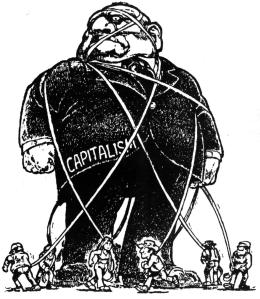
Sixth, we need to create new and radical ways of living. This one might be the hardest for us to think about, since most of us don’t know of any other way of organizing society. However, there are lots of examples from neighborhoods to villages and even cities. These forms of cooperative systems of living can be learned from indigenous communities, worker-run collectives, anarchist struggles and even religious communities like the Quakers and other liberation movements.
This is not just a pipedream, but a real possibility that we need to serious investigate in our struggles for greater justice. These new ways of living with each other also might not be enough, especially considering the urgency we face through climate change. If humanity is to have a future, we have to radically rethink how we are going to both resist the current systems of oppression and how to form new and liberating systems based on justice, cooperation and revolutionary love.
Part II of this will look at strategies for West Michigan.
MLive moralizes behavior in Right to Work onslaught
Yesterday, MLive posted a piece from their editorial board entitled, Right to work in Michigan: Gov. Snyder, unions and lawmakers all disappoint with their behavior this week.
The editorial begins with this comment:
Right-to-work laws may or may not end up helping Michigan, but no one should be pleased with what happened in Lansing this week.
First off, the so-called neutral take on Right to Work by the MLive editorial board is ridiculous and it is bad journalism. Of course the Right to Work law will help Michigan, if by Michigan you mean the corporations and rich like the DeVos family, then yes, it will help. However, if you define Michigan by the majority of those who live here, working class people, then no, it will not help.
Then there is the moralizing comment about how none of us should be pleased this week by what happened in Lansing, which is the essence of the editorial piece.
The article then goes on to make the case that Gov. Snyder, the unions and State Representatives all engaged in behavior that we should be repulsed by.
First, the editorial talks about Snyder and how he said Right to Work wasn’t part of his agenda for the first two years and then, boom, he decides to sign it into law. This is a misreading of Snyder and the policies he has put forth.
From day one Snyder has been implementing neoliberal austerity policies – attacking public sector workers, their benefits & pensions, downsizing the public sector workforce, eliminating business tax, deregulation and the Emergency Management Law. Right to Work completely fits into this neoliberal strategy.
An example of MLive’s misreading of Snyder is a September article by their business reporter, claiming that Right to Work is a thorn in the side of Snyder. We deconstructed this story and pointed out the following:
What I think Gov. Snyder is doing by not taking a strong pro Right to Work stance is buying time. The unions in Michigan have countered the Right to Work possibility by pushing forward a November Ballot Initiative, the Project Our Jobs campaign. If that initiative passes in November, there will be a serious legal battle to overturn it. If it doesn’t pass, Michigan legislators who have aggressively advocated for Michigan to adopt Right to Work legislation will no doubt move forward with proposing such legislation, which means it will then come to Snyder to be signed into law. If Snyder was really against such legislation he would make it clear by stating publicly that he would veto such legislation if it passed in the legislature. He has not done so to date.
Therefore, it is safe to say that Snyder did not behave poorly, he did exactly what he has been doing all along……….making decisions and supporting policy that benefits the capitalist class.
The MLive editorial also goes after State Representatives, because of comments they made, both Republicans and Democrats, which is really quite relevant. Instead, what we should be looking at is how they voted on the Right to Work legislation. MLive doesn’t seem to be interested in publishing that list. I don’t think most people care what elected officials say, they care about what they do and how they vote.
Lastly, Mlive goes after unions members by stating:
If union opponents were hoping to portray organized labor as unruly, they got the images they were hoping for, as an angry group tore down a tent, state police stood in riot gear and Teamsters leader Jimmy Hoffa in a television interview promised “a civil war.” There are ways to passionately debate legislative activity without resorting to actions that cast an unflattering light on union members across the state to a national audience.
Wow. First, there is plenty of information that disputes what happened with the whole “tent destruction incident.” More importantly, the editorial writer doesn’t seem to know much about union history. Union workers have been brutalized, arrested, deported, detained and murdered over the past 150 years in the US when attempting to organize or fight for their rights. During that history, many union members have fought back, often with force, because their rights were being threaten or their lives were being threatened.
This particularly moralizing is just part of the West Michigan ethic of “nice.” In times like these, we don’t need to be nice, we need to be angry and we need to fight back. Personally, I was disappointed that the more union members did not join those of us inside and occupy the state capitol, even if it was by force. The state certainly used force by having hundreds of cops, many in riot gear, to harass, intimidate, beat and pepper spray anyone they thought was not compliant enough.
However, that behavior wasn’t addressed in the MLive editorial. Instead, the public is being preached to by MLive about how we should behave. They want us to be nice and compliant, even while we are being brutalized by policies that will create more poverty in Michigan. When Unions are under attack, we need to fight back!
It has been a brutal week in Michigan for democracy. The Michigan legislature passed bills this week that weaken unions, attacks reproductive rights, Muslims, the LGBT community and now the general public, by passing a new version of the Emergency Financial Manager Law.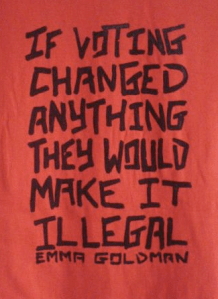
Remember, Michigan voters repealed the existing EFM law that Snyder put in place in early 2011. (He announced the EMF law in Grand Rapids, since GR has followed his austerity model.) Today’s vote pretty much told voters – WE DON’T FUCKING CARE WHAT YOU THINK!
Not only did they pass a new version of the EFM law, they included language that said that this law could not be repealed! Again, SCREW YOU!
Some of the details of this anti-democratic bill are as follows:
- A review team will come to any community they think are financially unstable, hold one public meeting, but are not obligated to have public comment.
- Communities will only have 7 days to make a decision, once the state makes their recommendation.
- Allows the governor to impose “best practices” (undefined), a model charter or model charter provisions (undefined) and management training as a condition to the end of receivership.
- Provides for an “advisory board” that excludes all local participation to continue state intervention as a transition from receivership at the option of the governor.
- Reenacts provisions of PA 4 concerning suspension of collective bargaining rights under receivership.
- Grandparents all existing emergency managers and emergency financial managers.
To see a more detailed analysis of the new Emergency Financial Manager Law can be found at Michigan Forward.
This new law, along with everything else passed this week is reason enough for an uprising. The question is, what will we all do to fight this?
Michigan Republicans propose anti-Sharia law to Discriminate against Muslim Americans
This article by Juan Cole is re-posted from Informed Comment. Editor’s Note: West Michigan legislator Dave Agema has been pushing an anti-sharia bill for over a year, as we have reported on in the past. Agema, has also been rabidly in support of anti-worker legislation, anti-choice, anti-LGBT and anti-immigration legislation. In February and March, local activists confronted Agema on these issues in Grandville.
Michigan State legislator David Agema has introduced an anti-sharia bill that attempts to ban the implementation of ‘foreign law’ in the US that would contradict constitutional rights. Agema openly says he wants to target the Muslim-American community of southeast Michigan, falsely alleging that there are terrorist cells among them.
Arab-Americans have emerged as an important swing vote in Michigan, such that Republicans are unwise to complete the job of driving them into the arms of the Democratic Party. (They had earlier been split, but because of Bush administration policies and the rise of the Tea Party, a majority now vote Democratic).
The bill drew a sharp rebuke from the Council on American Islamic Relations (CAIR).
Sharia is the living tradition of Muslim law, analogous to Jewish Halakha or Roman Catholic canon law. Anti-sharia bills are unnecessary since the first amendment forbids the government from establishing any particular religion. Sharia provisions can come into legal judgments (e.g. if a husband and wife have a pre-nup with sharia provisions (dowry?) agreed to by both parties, the judge would obviously have to consider it in a divorce case). The Agema bill could not stop that from happening, and depending on how it is worded, it is ignorant of the tradition of Anglo-American common law or it is just unconstitutional.
Cenk Uygur of the Current TV network treats the proposed law with the derision it deserves:
Michigan Passes Anti-Choice Bill
This article by Katie J.M. Baker is re-posted from ZNet.
The Michigan Senate just voted to pass HB 5711 — one of the country’s most extreme and wide-reaching anti-choice measures, which is really saying a lot — by a 27-10 vote, with immediate effect. They added some revisions, which means the bill has to return to the House (which will probably approve it quicker than you can say “transvaginal ultrasound”) before it’s ready for Governor Rick Snyder’s signature.
Remember that time Reps. Lisa Brown and Barb Byrum dared utter the word “vagina” during a debate about vaginas and were thus barred by House leadership? All that hullabaloo was about this 45-page bill, which would, among other restrictions, ban the use of telemedicine abortions — crucial for women who live in rural, under-served areas — and impose a bevy of unnecessary physical plant requirements on abortion providers, including minimum doorway sizes and minimum square footage (because every self-respecting patient cares about the spaciousness of her doctor’s office) that could shut down almost every clinic in the state.
21 out of Michigan’s 83 counties already lack a single OB/GYN, so this bill will make it that more difficult for the state’s women to gain access to healthcare. This could get real bad, real fast.
Last week, the Senate prepared for today’s women-hating entrée with a delectable assortment of anti-choice appetizers/bundle of anti-abortion bills, including SB 0975, a “conscience objection” bill which would give hospitals and other health care centers the right to deny services that aren’t in line with their personal religious beliefs unless the patient/sinner in question is literally dying. The House is debating the bills now.
Opponents came up with various too-real situations where women, gay people, and mixed-race couples could suffer because their doctor didn’t feel like Jesus/the Spaghetti Monster/whomever would OK their treatment. They also referenced the very non-hypothetical death of Savita Halappanavar, who died in an Ireland hospital last month after a miscarriage because doctors waited too long to perform an abortion that could’ve saved her life. Advocates, like Ed Rivet from Right to Life, said during his testimony that these “straw men” scenarios would never actually happen (then why do they need the bill in the first place?) and that “The sky will not and has not fallen.”
Thanks to Michigan’s lame duck legislators, the sky is looking pretty damn close right now.
GRIID Winter 2013 Classes
We are pleased to announce two new classes for Winter 2013.
The first class, Social Movements in Latin America, is designed to investigate the recent history of social movements in Latin America. We will be discussing those movements since the 1994 Zapatista uprising in Mexico to the present.
Some of the movements explored are: the Revolution in Venezuela, Indigenous movements in Bolivia & Chile, Worker movements in Argentina, The Landless People’s Movement in Brazil and Anti-Globalization movements in Central America.
We will be using numerous sources, but the primary text that participants will need to have is Dancing with Dynamite: Social Movements and States in Latin America, by Benjamin Dangl. This class will meet on Mondays from 7 – 9pm beginning on January 21st.

The second class we are offering will be an investigation into the Non-Profit Industrial Complex. Using the book, The Revolution Will Not Be Funded: Beyond the Non-Profit Industrial Complex, we will explore the evolution of the Non-profit, it’s relationship to funders, the state and social movements.
In addition, this class will spend part of the time investigating the Non-Profit Industrial Complex in West Michigan. This class will be held on Wednesdays from 6 – 8pm and begin on January 23rd.
Both classes have a flyer that can be downloaded:
Social Movements in Latin America
Investigating the Non-Profit Industrial Complex
Class size is limited, so sign up early. Classes are $20 each, not including the cost of the book, but no one will be turned away for lack of funds. Contact Jeff Smith jsmith@griid.org to sign up. Location to be determined.
Why Couldn’t Unions Defeat Michigan Anti-Union Bill?
This video is re-posted from The Real News Network.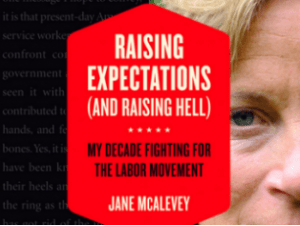
The Real News Network looks at the Right to Work Legislation in Michigan and the attack on unions across the country. They interview Jane Mcalevey, author of the book Raising Expectations (and Raising Hell): My Decade Fighting for the Labor Movement.
In this interview Macalevey addresses the concerted effort to undermine labor unions in recent decades by the Capitalist class. She does acknowledge the failures of the union movement and offers up some suggestions of what they should be doing that might turn the tide against anti-union sentiment and the highly organized campaign to suppress unions.
March planned this Saturday in Grand Rapids to fight GRPS plan
Local people are angry and organized. With the continued dismantling of Grand Rapids Public Schools and the partnerships with the private sector to build places like the Van Andel funded University Prep Academy on Division.
Here is what the Facebook event page says about what is planned this Saturday: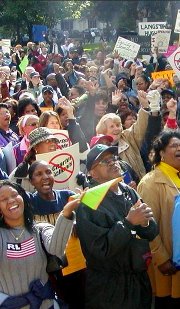
Bring the REAL stakeholders (our children!) to lead us parents as well as teachers and community supporters in a march this Saturday at 12 noon from Rosa Parks Circle to Amway Grand Plaza.
The purpose of our march is to oppose GRPS’s “Transformation Plan” to shutter 10 more of our public schools in the coming year and to bring our complaint to those financially and ideologically responsible for the plan.
The “Cambridge Report”, upon which the GRPS Transformation Plan is based, was paid for with nearly 1/4 $ million from the DeVos family, a family that has been working for over ten years to privatize and dismantle public schools not only in Grand Rapids but also nationwide. As Dick Devos put it in his 2002 speech on the topic to the Heritage Foundation, “Because we know how the government schools perpetuate themselves, we can design a plan to dismantle them”.
Is it any surprise then, that the DeVos family-sponsored study recommended shuttering 10 more of our public schools? It is not a surprise, but it is a surprise that GRPS administrators would simply fall in line!
25 schools have already been shuttered in recent years: closing 10 more leaves our city with a dwindling public education base and just clears the way for more private and charter schools to take their place.
This is one “philanthropic” donation GRPS adminstrators should steadfastly refuse: they should instead be working to expand our public school base, while providing wraparound services and diverse learning opportunities at every school!
Join us and let’s work to save our public school system locally and nationally at the same time. If GRPS won’t do it, we will.
Sponsored by Save Our Schools Grand Rapids (SOSGR)
March of the Stakeholders
Saturday, December 15
Noon – 3PM
Beginning at Rosa Parks Circle in Downtown Grand Rapids
How Private Prisons Profit From the Criminalization of Immigrants
This article by Laura Carlsen is re-posted from CounterPunch.
How a nation uses its power to deny a person’s freedom has always been a critical measure of authoritarian rule. Massive incarceration based on race, ethnic origin or nationality, political beliefs, class, sexual orientation, age or other inherent characteristics is a form of tyranny.
Yet few people realize that this is happening on an enormous scale here, in the United States of America. Immigrants make up the latest market for a booming private prison industry.
The U.S. locks up the highest percentage of its population in the world—730 per 100,000, nearly two and a half million people. Although it has only 5% of the population, 25% of the world’s prison population is behind bars in the U.S.
It wasn’t always like this. This huge growth in the prison population has taken place just over the past two decades, when the imprisonment rate per capita surged by 45%.
It’s not that the U.S. experienced a major crime wave. The opposite is true. Crime and especially violent crime steadily decreased over the same period. Two factors–the lock-up of mostly poor, black or Latino recreational drug users and of immigrants–now account for more than 80% of people behind bars in our country. Draconian drug prohibitionist policies and new laws that criminalize undocumented immigrants have flooded the nation’s prisons.
In other words, while actual behavior in society improved overall, the U.S. government broadened the criteria for depriving people of their most fundamental liberties. This wide net now traps more men, women and children than at any other time in history.
There’s a reason for that.
For-Profit Prisons and the Criminalization of Immigrants
In the mid-eighties, the U.S. government began to outsource jailing people. The first contract, in 1984, went to Corrections Corporation of America (CCA), still the largest for-profit prison company in the country. Private prisons moved into communities left behind by the globalized economy. Heavily subsidized by taxpayer money even before receiving public contracts, they built thousands of cells throughout the country.
Then they had to fill those cells. How do you drum up business if you’re a for-profit prison industry? By making sure there’s a steady stream of prisoners. For every human being sent behind their bars, CCA or the second giant in the industry GEO Group, make approximately $122 a day, per head. CCA reported $1.7 billion in gross revenue last year, nearly half from government contracts.
That’s a powerful incentive to lock people up. In recent years, the most effective strategy for “market expansion” in the private prison industry has been to criminalize immigrants.
Latinos, the New Prison Majority
A series of recent laws have redefined undocumented immigration from an administrative infraction to a felony led to the creation of scores of migrant detention centers, built and run by the private prison industry. Operation Streamline, a policy begun in 2005, mandates that nearly all undocumented immigrants crossing the Southern border in certain areas be prosecuted through the federal criminal justice system.
A Grassroots Leadership report on Operation Streamline shows that federal districts along the Texas-Mexico border have spent more than $1.2 billion on the criminal detention and incarceration of border-crossers since the program began in 2005, with more than 135,000 migrants criminally prosecuted in these two border districts under two sections of the federal code that make unauthorized entry and re-entry a crime. The report found a 2,722% increase in prosecutions for entry, and a 267% increase in prosecutions for re-entry, compared to corresponding data for 2002.
As a result, Latinos now make up the majority of people sent to federal prison for felony crimes, with sentencing for newly defined immigration felonies like illegal border crossing or aiding in border crossing accounting for the increase. While Latinos were 50.3% of those sentenced in 2011, they make up only 16% of the overall population. ICE now sends400,000 immigrants a year to detention centers. Increased sentencing for non-violent immigration and drug offences has also driven the number of women in prison up by 800 percent.
The round-up of immigrants means that half of immigrant detainees spend time in prison compared to just a quarter a decade ago. This human bounty hunting shatters lives and families and costs taxpayers billions of dollars, much of it paid to the private prison industry.
Lobbying for Lock-up
It’s not surprising that for-profit prison companies have lobbied hard in Congress to maintain their cash cows—the drug war and the criminalization of immigrants. The CCA 2010 Annual Report clearly states the need for criminalization to continue by warning its investors:
“The demand for our facilities could be adversely affected by the relaxation of enforcement efforts, leniency in conviction or parole standards and sentencing practices or through the decriminalization of certain activities that are currently proscribed by our criminal laws. For instance, any changes with respect to drugs and controlled substances or illegal immigration could affect the number of persons arrested, convicted and sentenced, thereby potentially reducing demand for correctional facilities to house them.”(p.19)
The report notes that three federal governmental agencies accounted for 43% of total revenues in fiscal year 2010 ($717.8 million)—the Bureau of Prisons (15%), Immigration and Customs Enforcement-ICE (12%) and the US Marshalls Service (16%). It concludes, “We are dependent upon the governmental agencies with which we have contracts to provide inmates for our managed facilities.”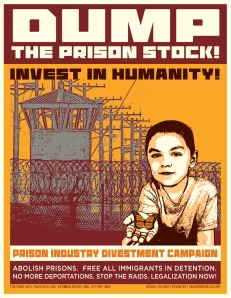
An AP story found that the private prison companies spent more than $45 million in lobbying and campaigns in the last decade. According to a Justice Policy Institute report, CCA spent an average of $900,000 a year on federal lobbying over the past decade. That figure doesn’t count state lobbying, where private prisons participate actively, or campaign contributions.
When Arizona passed SB1070 to increase police power to detain anyone suspected of not having immigration papers, 30 of the bill’s 36 legislative co-sponsors were found to have received significant campaign contributions from private prison companies.
A People’s Movement Against Private Prisons
Peter Cervantes-Gautschi, Director of Enlace, notes, “Of immigrants in the federal prison system, nearly half are in for things not even considered crimes six years ago.” He states that only 5% of immigrants behind bars are there for what would normally be considered a crime.
He adds, “People who are in for re-entry aren’t criminals—these are people coming back to see their children, coming back to visit a sick relative. It’s creating a great deal of human suffering and causing huge problems in our communities and schools. Our families are being broken up by this ridiculous policy.”
Enlace, an organization that works for the rights of low-wage workers, coordinates the National Prison Divestment Campaign. Using a “follow-the-money” strategy for understanding and confronting the influence of the private prison industry, it built a coalition of more than 130 national, state and local organizations “to convince shareholders (individuals, banks, hedge funds, etc.) to divest their funds from the prison industry so that we can make an impact on the prison business and reduce the power of CCA and GEO to lobby for laws that imprison our communities.”
The coalition has already scored some big victories, including cancellation of a for-profit detention center in South Florida, divestment by the hedge fund Pershing Square and by the United Methodist Church, and the divestment of a third of its GEO holdings by Wells Fargo following a campaign against WF Banking on Immigrant Detention. Resident organizations have stopped detention center projects in communities from Georgia to Illinois.
Their message has been simple: “Stop funding incarceration for profit.” The coalition is gearing up for another National Day of Action on Dec. 13. This time the focus will be on members of Congress sitting on the budget committees. Constituents are calling on their representatives to discontinue life support to the for-profit prison industry and direct scarce public funds their communities’ basic needs and services.
Over 10,000 protest Right to Work policies in Lansing

Starting at 6:00am, people came from all over Michigan and surrounding states to take part in a protest against the Michigan legislature’s passing of anti-union legislation, known as Right to Work.
People came from cities like Detroit, Flint, Ann Arbor, Kalamazoo, Grand Rapids and Jackson, as well as small towns like Hastings, Delton, Cedar Springs and Fowlerville.
By 9:00am there was an estimated 10,000 people in and around the state capitol demanding that Governor Snyder veto legislation that was voted on today, making anti-union Right to Work the official policy of the state.
Most of those attended the protest were union members, as was expected, with representation from the UAW, SEIU, electrical workers, steel workers, the MEA, the nurses union, public sector unions and the IWW.
 Many roads were blocked off by the police, who were trying to make it difficult for folks to navigate downtown Lansing, but many unions bused in their members and took over the capitol lawn and the road out front with members holdings signs and inflated rats with Governor Snyder’s name on one and Dick DeVos’ name on another.
There were also over a thousand people inside the capitol, which had a large police presence, some in full riot gear, carry pepper spray and concussion grenades.
In many ways the presence of protestors inside was unorganized and people were just hanging out in the rotunda area, on all three floors. There was good energy, lots of chanting and conversation about what Right to Work policies will mean for Michigan.
There was also a smaller group of folks who informed people before 10:00am that people were going to be sitting down and occupying the 2nd floor of the rotunda while the House was in session and voting on the Right to Work bills.
At this point there were groups standing in sections between the four halls ways that lead off of the rotunda. People continued to chant and sing and every 15 minutes or so we were given updates about what was taking place outside. At one point we were told that pepper spray was used on some of the union members outside and one leader of the UAW was by a cop so hard in the chest that he had to be rushed to the hospital. We were also told that people tore down a Tea Party tent that was outside, news that received a big round of applause from those protesting inside.
Then around 10:45 we were informed that the House had passed the Right to Work legislation and about 100 people who were inside the rotunda moved to the center and sat down. Many of us (this writer participated in the sit down) were given signs that said VETO, even though signs were prohibited inside.
Those of us who sat down, then began to invite others who were inside the capitol as part of the protest. Our numbers grew and we moved out from the center to take over more space. At about 11:30am, we were all greeted by Rev. Jesse Jackson, Lansing Mayor Virg Bernero and Rep. Gretchen Whitmar.
Jackson made some very moving comments (see video below) about the importance of this action and how so many working families have already gone over the “fiscal cliff.” After speaking Jackson sat down with the rest of us, along with Bernero and Whitmar, which brought even more excitement to the action.
However, in less than a minute, Jackson and the local politicians got up and wished us well. Many people took this as an insult and felt that if they really supported this action they would have stayed, considering we live in a society where having people like Jackson and elected officials will generally guarantee more media attention.
The occupation lasted for another hour or so, but it became apparent that not everyone was going to stay, even if it meant risking arrest. We also could not get more people to join us and the police presence continued to grow inside.
Some people who were wearing reflective vests and directing people inside all day, were members of unions, but more often than not acted as an extension of the cops, by constantly telling people to cooperate and getting into arguments with people who were doing civil disobedience.
Around 2:00pm it was clear that there were not enough numbers to maintain an occupation and some organizers decided to tell people to join a protest outside in front of the Romney building across the street.
This writer left, with a contingent of people from Grand Rapids, feeling a sense of defeat since the possibility of occupying the capitol was great and the numbers of protestors could have accomplished what was done in Wisconsin.
While it was refreshing to see thousands of people there, who were passionate about workers rights, it was frustrating that there was no clear plan of action and a lack of support for the autonomous group that did occupy the rotunda for over two hours.
Lessons can certainly be learned from this action, particularly about tactics and strategy and the missed opportunities to use the large gathering of people to shut down business as usual for a Government dominated by people who don’t care about working families and to hold some sort of general assembly to discuss next steps to fight the Right to Work policies in Michigan.
Solidarity Forever!

