One Michigan Undocumented Youth file lawsuit against Secretary of State Ruth Johnson over Driver’s Licenses
The undocumented immigrant movement continues to put pressure on the state government over the issue of having the right to obtain a drivers license in Michigan.
We reported on an action in early November where several hundred immigrants and allies came to Lansing to confront Gov. Snyder on the position that Secretary of State Ruth Johnson has taken and we reported on a packed Grand Rapids City Commission meeting where the immigrant community once again was putting pressure on government officials to support their desire to have access to a Michigan drivers license in early December.
Yesterday, the group One Michigan for Immigrant Rights sent out the following press release with details of a lawsuit filed against Secretary of State Ruth Johnson.
One Michigan for Immigrant Rights will be represented by the American Civil Liberties Union (ACLU) in a lawsuit against Michigan Secretary of State Ruth Johnson challenging the ban on driver’s licenses for recipients of the Deferred Action for Childhood Arrivals (DACA) program.
As an undocumented youth-led organization, members of One Michigan were excited about the doors that DACA opened for them, including the opportunity to work, attend school, and obtain identification. This past summer, in a coordinated effort with other national partners such as the National Immigrant Youth Alliance (NIYA), we were instrumental in pushing for DACA program announced by President Obama on June 15, 2012. On October 8, Johnson announced that the state would deny driver’s licenses and personal identification cards to those authorized to live and work in the United States under DACA, reestablishing many of the barriers placed before undocumented youth in our state. In response to this policy, One Michigan in conjunction with the ACLU and other DACA-eligible individuals filed a lawsuit on December 19, 2012 with the U.S. district court to ensure immigrant youth authorized to work in the U.S. can drive. 
One Michigan member Xochitl Cossyleon, 19, of Detroit, MI was devastated when she found out about Johnson’s policy, and felt like DACA was pointless without being able to drive to work and school. For Xochitl, getting a driver’s license was the main point of applying for DACA.
This policy has been extremely detrimental to the immigrant community in Michigan, because it has discouraged many DACA eligible candidates from applying and becoming productive tax-paying residents of the State of Michigan. This has caused organizations like One Michigan to divert their attention from offering workshops for DACA applicants to organizing to reverse Ruth Johnson’s illegal policy.
It is the hope of One Michigan and their partners in this lawsuit that Ruth Johnson will recognize that allowing DACA recipients to obtain driver’s licenses and identification cards is not only the right thing to do, but her obligation under the law. We will not rest until this policy is reversed, our community is safe, and the undocumented youth of our state are able to work, go to school, and support our families.
The Real And Racist Origins of the Second Amendment
This article by Bruce Dixon is re-posted from Black Agenda Report.
Why does the US Constitution guarantee a right “to keep and bear arms”? Why not the right to vote, the right to a quality education, health care, a clean environment or a job? What was so important in early America about the right of citizens to have guns? And is it even possible to have an honest discussion about gun control without acknowledging the racist origins of the Second Amendment?
The dominant trend among legal scholars, and on the current Supreme Court is that we are bound by the original intent of the Constitution’s authors. Here’s what the second amendment to the Constitution says:
Clearly its authors aimed to guarantee the right to a gun for every free white man in their new country. What’s no longer evident 230 years later, is why. The answer, advanced by historian Edmund Morgan in his classic work, American Slavery, American Freedom, the Ordeal of Colonial Virginia, sheds useful light on the historic and current politics and self-image of our nation.
Colonial America and the early US was a very unequal place. All the good, cleared, level agricultural land with easy access to transport was owned by a very few, very wealthy white men. Many poor whites were brought over as indentured servants, but having completed their periods of forced labor, allowing them to hang around the towns and cities landless and unemployed was dangerous to the social order. So they were given guns and credit, and sent inland to make their own fortunes, encroaching upon the orchards, farms and hunting grounds of Native Americans, who had little or no access to firearms. The law, of course did not penalize white men who robbed, raped or killed Indians. At regular intervals, colonial governors and local US officials would muster the free armed white men as militia, and dispatch them in murderous punitive raids to make the frontier safer for settlers and land speculators.
Slavery remained legal in New England, New York and the mid-Atlantic region till well into the 1800s, and the movements of free blacks and Indians were severely restricted for decades afterward. So colonial and early American militia also prowled the roads and highways demanding the passes of all non-whites, to ensure the enslaved were not escaping or aiding those who were, and that free blacks were not plotting rebellion or traveling for unapproved reasons.
Historically then, the principal activities of the Founding Fathers’ “well regulated militia” were Indian killing, land stealing, slave patrolling and the enforcement of domestic apartheid, all of these, as the Constitutional language declares “being necessary to the security of a free state.” A free state whose fundamental building blocks were the genocide of Native Americans, and the enslavement of Africans.
The Constitutional sanction of universally armed white men against blacks and Indians is at the origin of what has come to be known as America’s “gun culture,” and it neatly explains why that culture remains most deeply rooted in white, rural and small-town America long after the end of slavery and the close of the frontier. With the genocide of Native Americans accomplished and slavery gone, America’s gun culture wrapped itself in new clothing, in self-justifying mythology that construes the Second Amendment as arming the citizenry as final bulwark of freedom against tyranny, invasion or crime. Embracing this fake history of the Second Amendments warps legal scholarship and public debate in clouds of willful ignorance, encouraging us to believe this is a nation founded on just and egalitarian principles rather than one built with stolen labor on stolen land.
Maybe this is how we can tell that we are finally so over all that nasty genocide and racism stuff. We’ve chosen to simply write it out of our history.
A Holiday Message from Rep. Agema

On Monday, MLive invited Rep. Dave Agema an opportunity to write a guest Column to justify his arrogant stance on Right to Work legislation that is now law in Michigan.
In his column, Agema smugly dismissed working class and union concerns about what Right to Work will do to families in Michigan. Agema also uses the column as an opportunity to affirm his recent Facebook remarks, where he took joy in seeing riot cops pepper spray and assault workers during the December 11 anti-Right to Work protest in Lansing.
As we have noted with numerous postings in the past, Agema has been one of the most reactionary politicians in Michigan, introducing legislation that is anti-worker/anti-union, anti-LGBTQ, anti-immigrant and anti-Muslim.
Agema is now term limited, but he will still be heavily involved in Michigan politics in a leadership position within the Republican Party.
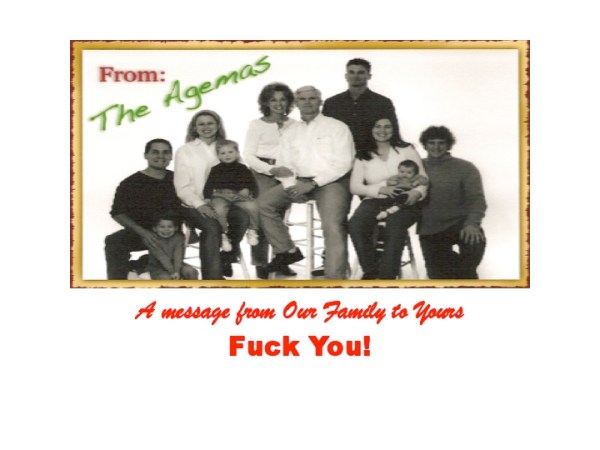
As a gesture in the holiday spirit, we share with you his family’s Christmas Card.
Senator Levin continues to push corporate welfare for the war industry in Michigan
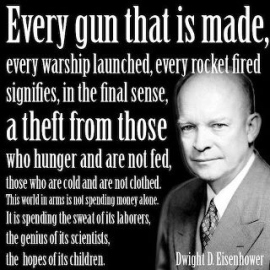
As we have pointed out on previous occasions, Michigan Senator Carl Levin, in his role as Chairmen of the Armed Services Committee, has worked hard to get public tax dollars to fund the military industrial complex.
In a statement he released yesterday on the National Defense Authorization Act (NDAA) for Fiscal Year (FY) 2013, Levin said:
“This bill fulfills our obligations to defend our nation and to provide for our troops and their families, and I’m proud Michigan will make a major contribution to that effort. Our state’s manufacturing, science and engineering strengths have long helped keep our nation safe, and that legacy continues with this bill.”
The bill includes $173.5 million dollars alone for Army combat vehicle research at the TARDEC facility in Warren, Michigan.
The bill also includes a total of $200.0 million for the Department of Defense’s Rapid Innovation Program (RIP). Funding authorized for the RIP could provide significant opportunities for Michigan companies, universities, and other organizations to further research and development efforts with the Department of Defense.
Levin’s statement also said that the bill would bring $2 billion to universities in Michigan to do research for the Department of Defense, although no universities are indentified in the statement.
All of this funding combined is just another example of how much the US economy is dependent on the military industrial complex. It also demonstrates Senator Levin’s continued commitment to being a champion of US imperialism by making sure that the US government outspends every nation in the world for military purposes, in order to maintain the thousands of bases and US troop deployments all over the globe.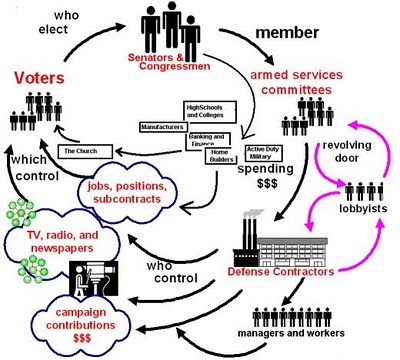
Here is a more detailed list of which Michigan companies get a free ride in the latest Defense Bill:
- $374.3 million for the Family of Medium Tactical Vehicles (FMTV). Meritor of Troy, AAR Mobility of Cadillac, and a number of other Michigan companies are involved in the production of FMTVs.
- $347.7 million for the Army’s Stryker armored vehicle. General Dynamics Land Systems of Sterling Heights is the prime contractor for the Stryker armored vehicle. Many Michigan companies serve as suppliers in support of this program.
- $271.0 million for High Mobility Multipurpose Wheeled Vehicle (HMMWV) recapitalization. Many Michigan companies support the HMMWV program as suppliers.
- $339.5 million for the Abrams Main Battle Tank program, including $136.0 million above the budget request for tank upgrades and to mitigate risk in the armored vehicle industrial base. General Dynamics Land Systems of Sterling Heights is the prime contractor for the Abrams program and more than 200 Michigan companies serve as suppliers.
- $31.7 million for the Lightweight 155mm Howitzer. Howmet Castings of Whitehall is a major contractor for the Lightweight 155mm Howitzer program.
- $54.9 million for the Family of Heavy Tactical Vehicles. Detroit Diesel manufactures and supplies the engine for this program.
- $927.4 million for Mine Resistant Ambush Protected (MRAP) vehicle modifications. Spartan Chassis of Charlotte, Meritor of Troy, and Demmer Corporation of Lansing and many other Michigan companies are involved in this program.
- $288.2 million for Bradley Fighting Vehicle upgrades modifications, including $140.0 million above the budget request to accelerate Bradley modifications included in the approved engineering change proposal and to assist with the mitigation of risk in the armored vehicle industrial base. L-3 of Muskegon is a major contractor for the Bradley program.
- $169.9 million for the M88A2 Improved Recovery Vehicle, including $62.0 million above the budget request. L-3 of Muskegon is a major contractor for the Improved Recovery Vehicle program.
- $1.8 billion for Littoral Combat Ship (LCS) construction, supporting the Navy’s acquisition strategy. Marinette Marine, just across the Michigan border in Wisconsin, is one of two shipyards building LCS and employs several hundred Michigan residents and relies on many Michigan suppliers.
Banks Are “Where the Money Is” In The Drug War
This article by Bill Conroy is re-posted from Narco News.
Citigroup, JP Morgan Chase & Co., Wachovia (acquired by Wells Fargo in 2009), HSBC Holdings, ING Bank, Standard Chartered, American Express Bank International, and not a few others, have a common bond beyond ranking among the largest banks in the world.
All have been accused within the past five years (and several this year) of failing to comply with US anti-money laundering laws — thereby enabling, collectively, hundreds of billions of dollars worth of suspicious transactions to move through the banking system absent adequate monitoring or oversight.
Yet not one these banks, nor any of their top executives, has been hit with criminal sanctions.
All, with the exception of Britain’s HSBC (which is still under investigation), have agreed to pay fines for their alleged transgressions after being served cease-and-desist orders or have entered into so-called deferred-prosecution pacts — under which a lender agrees to pay a fine and to comply with the law going foward in exchange for dismissal of all charges at the end of a specified government monitoring period.
But again, not one bank has been charged with a crime nor have any top executives been forced to do the perp walk, bound by handcuffs, in front of the adoring media throng.
Imagine if you or I were pulled over by the cops while transporting in the trunk of our car even $10,000 in bills that traced back to individuals suspected of being involved in illegal activities, such as narco-trafficking. What are the odds that we would walk away with only a traffic ticket?
That’s essentially what is happening in these cases involving big banks, who, for all practical purposes, are allowing their money transportation systems to be rented, for a fee, by criminals, while the banks’ leadership pleads ignorance: “I didn’t know that money was in the trunk. I’ll have to look into that.”
Now, if you take that same $10,000, or even millions of dollars, and put it inside an armored car under contract to a big bank, suddenly the dirty money gains the presumption of legitimate commerce, and is likely to have a police escort as opposed to being subjected to a police inspection.
“All financial crime has a money laundering component,” says Charles A. Intriago, president of the Miami-based Association of Certified Financial Crime Specialists. “… If you’re an individual, and get caught, you get hammered.
“But if you’re a big bank, and you’re caught moving money for a terrorist or drug dealer, you don’t have to worry. You just fork over a monetary penalty, and then raise your fees to make up for it.
“Until we see bankers walking off in handcuffs to face charges in these cases, nothing is going to change,” Intriago adds. “These monetary penalties are just a cost of doing business to them, like paying for a new corporate jet.”
Broken System
The world’s financial system is incredibly complex and capable of moving trillions of dollars in many directions, across multiple borders, with the push of a button in our digital age, making it difficult for banks to truly know their customers in all cases.
Still, the law demands that they do just that, and have systems in place to assure against money laundering.
From the regulators’ perspective, suspecting that a transaction is dirty is not the same as proving it is so. Financial crimes, by design, are hard to track and involve a considerable expenditure of law enforcement resources to investigate and litigate.
Bryan Hubbard, a spokesman for the US Office of the Comptroller of the Currency (OCC), which regulates national banks, when interviewed by Narco News, stressed that his office is charged with enforcing a wide range of legal and regulatory matters, and has a number of enforcement actions underway at any given time, but it does not have a “special focus” on money laundering — though, he adds, the OCC is committed to enforcing anti-money laundering laws.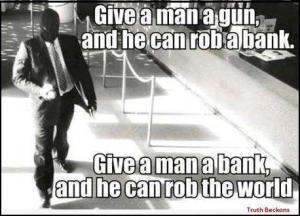
Given the reality of scarce resources, anti-money laundering laws depend, in large measure, on having the banks police themselves — by assuring that suspicious activity reports are filed with regulators when transactions exceed certain monetary thresholds or don’t pass the smell test, or that compliance departments are well-staffed and on top of their systems.
The problem, however, is that there are many holes in that system, due, in large measure, to lax enforcement by overworked or even incompetent regulators — with the added problem that some of those regulators see the lenders they regulate as potential future employers.
For example, there’s the case of HSBC (the subject of a recent US Senate investigation focused on suspected money-laundering activities). One of the former chief compliance officers for the lender’s US subsidiary (called HBUS) served previously as a bank examiner for the OCC, US Senate records show. In addition, two of HBUS’ past Anti-Money Laundering directors worked previously for the US government — one as a federal prosecutor and the other as a US Treasury official.
And, in equal measure, similar power-relationship problems exist within bank compliance departments, whose employees can put at risk millions of dollars in revenue if they aggressively pursue money-laundering suspicions — with another downside being that if they are wrong, they risk angering powerful bank customers as well as their bosses.
It is that cycle of disincentives that makes it far easier for crooks to get in the door in the first place, because the risk of a bank getting caught violating anti-money laundering laws simply doesn’t seem to outweigh the benefits of looking the other way.
This past August, Standard Chartered agreed to pay a $340 million fine to get a New York bank regulator off its back after the British lender was accused of illegally concealing billions of dollars worth of transactions related to Iranian interests, in violation of US laws.
“That fine of $340 million represented only 4.5 percent of Standard Chartered’s profits in 2011,” Intriago points out. “It’s chump change to the bank.”
Repeating History
But Standard Chartered isn’t alone in standing accused of using the US banking system to move money for shady characters. In the 1990s, Raul Salinas de Gortari, the brother of former Mexican President Carlos Salinas, tapped US-based Citibank to help transfer up to $100 million out of Mexico and into Swiss bank accounts. Although US authorities investigated the suspicious money movements, ultimately no charges were brought against Raul Salinas or Citibank — a Citigroup Inc. subsidiary.
Again, in January 2010, Citigroup popped up on banking regulators’ radar, this time in Mexico, when a Mexican judge accused a half dozen casa de cambios (money transmitters) of laundering drug funds through various banks, including Citigroup’s Mexican subsidiary. In that case, Citigroup again was not accused of violating any laws.
However, in April of this year, a US bank regulator, the OCC, issued a cease-and-desist order against Citigroup due to the lender’s “internal control weaknesses, including the incomplete identification of high-risk customers in multiple areas of the bank.”
Again, Citigroup was not charged with any criminal violations and also did not admit or deny any wrongdoing, but promised to institute reforms.
Narco News is well aware of Citigroup’s banking history, particularly in Mexico.
Narco News publisher Al Giordano and Mexican journalist Mario Menendez, publisher of the Mexican daily Por Esto!, stood as defendants in libel litigation filed in 2000 against them by the powerful lender Banco Nacional de Mexico S.A.(Banamex). At the time, Banamex was controlled by banker Roberto Hernandez Ramirez.
At the heart of the litigation, filed in New York state court, was the following claim, spelled out in a Dec. 5, 2001, New York Supreme Court ruling that dismissed the case against Giordano and Menendez in a major victory for Internet publications’ First Amendment rights:
“Plaintiff [Banamex] alleges that defendants [Giordano and Menendez] made accusations that Mr. Hernandez Ramirez is involved in criminal drug trafficking and specifically, the Colombian drug trade.”
While the litigation against Giordano and Menedez was still underway, Citigroup struck a deal, announced in May 2001, to acquire Banamex, then Mexico’s second largest bank, for some $12.5 billion in cash and stock.
To read the entire article, click here.
Misdiagnosing the Culture of Violence
This article by Mike King is re-posted from Counter Punch.
A gunman entering a Newtown, Connecticut school and killing 20 children and six adults after killing his own mother has captured almost everyone’s attention in the U.S. As people try to make sense of this act of mass violence, questions arise with no clear answers: What kind of person does something like this? Why have these types of mass killings become so common? What can be done to prevent horrific acts like this in the future? It is hard enough trying to trace the origins of, and propose viable solutions to, more easily understood problems. With an event like this, that difficulty is compounded. However, it is clear that the “solutions” that have been emerging in the last few days lack both practical understanding of some essential causes of crimes such as this and foresight about problems likely to emerge from these solutions. In our political culture atrocities and crises become exploitable opportunities leading to legislation that usually ends up punitively targeting completely different populations while atrocities like Newtown, Virginia Tech, and Columbine keep happening as we invest unending faith in the government in responding to any matter framed as a “security issue.”
Mass killings have gone from extremely rare (a couple every decade until 1980) to common (a couple every year since 2000). It should not be surprising that at the intersections of guns and the law – against a backdrop of a culture of violence and widespread personal anguish and alienation – all that government agencies and the media can muster are narrow discussions of gun control and mental health care. These discussions are taking place upon an imposed political and historical blank slate that ignores histories of racist gun control and persistent psychiatric abuses of vulnerable populations, and poses solutions to mass killings being prescribed before we determine their causes. These prescribed solutions have predictable “side effects” that many seem more than ready to swallow without reading the label. If we actually care about addressing the symptoms of what is an exponential increase in mass killings over the last thirty years, we will need to shed some light on the blind spots of the gun control debate and peek inside the closet where we have hidden the history of the treatment of the mentally ill. The kids who died last week – for no reason whatsoever – deserve that we have a grown up debate about this.
When G.I. Joe Comes Home to Roost
“War is the health of the State.” – Randolph Bourne (1918)
“Do as I say, not as I do.” – unknown hypocrite
American culture is a violent culture; it has always been a violent culture. There is a smorgasbord of partial explanations for why this is. I will address gun control and mental health below, but the culture of violence in which they are embedded consistently evades serious discussion. A sick society produces sick people. A society in which many forms of violence are valorized will produce many incarnations of violence that are not. This does not excuse the killer’s actions, or rationalize his motivations, but it is an honest assessment of factors which produce such behavior and which legislation and medicalization will not succeed in muffling.
Limiting “violent media” made CNN’s list of 10 solutions, but conspicuously absent was any mention of the violent state. The state educates the society it governs, not merely in a paternalistic or ideological sense, but by example, through its behavior. It is an indicator of our humanity, and not a slight to these 20 dead children, to ask, “Why is it only the unwarranted killing of young and mostly white American children that merits our outrage?” There is a direct connection between what is done to others in our name in other parts of the world (or in many parts of this country) and our tacit complicity with those “other” atrocities , and what happened in Newtown, Connecticut. The massacre in Panjwai, Afghanistan this past March left 7 civilian adults and 9 children dead, killed by the U.S. Army. For an attack that numerous witnesses and press reports indicate involved as many as twenty soldiers, Sergeant Robert Bales, currently awaiting a verdict, was the only person punished or charged. This is but the latest of many war crimes –Haditha and Abu Ghraib in Iraq, and the continued and intensified drone bombings and soldiers killing civilians for fun, collecting their fingers as souvenirs, in Afghanistan and Pakistan.
In a classic study of the relationship between war and violence within war-making societies, Dane Archer uses historical, cross-national data to demonstrate how war making produces significant and consistent elevations in homicide rates among ordinary citizens. The legitimation and sanctioning of murder, atrocities and the targeting of civilians in war causes an increase in murder at home. I am not trying to suggest that the fact that the shooter was dressed in camouflage indicates he was directly emulating Sergeant Bales, but we live in a violent culture that certainly does not begin and end with violent video games and Quentin Tarantino movies. Dehumanization of others (real people who bleed, not computerized images on a screen) creates the ability to do monstrous things like kill twenty kids, whether it is in an Iraqi prison or a Colorado movie theater, in an Afghan village or a Connecticut elementary school. Criminalizing all those labeled as mentally ill or (attempting) to make guns harder to get will not change that basic universal precursor to all atrocious acts – that of seeing other people as not worthy of life.
Gun Control: Profiling the “Angry White Man” or a New Wave of Targeting the “Usual Suspects” (of Color)?
The knee-jerk, liberal reaction for more gun control is plagued by the same inability to understand the fundamental nature of the problem at hand coupled with a perpetual, short-sighted faith in the inherent justness of well-meaning legislation. The state does not solve social crises, the state uses social crises to reinforce a range of social relationships and control certain populations. The history of gun legislation in the last century and a half is one of black criminalization. From the Black Codes that barred freed slaves from owning guns, to the criminalization of open-carry in California targeting the Black Panthers, to more modern mandatory sentences for gun possession and gun enhancements primarily utilized against blacks and Latinos, gun laws (like most criminal law) have a significant and measurable racial bias in application. Blacks are over five times more likely to be arrested for gun possession than whites. In the context of mass shootings, white people commit 77% of all mass murders in the U.S. In keeping with the U.S. commitment to racial profiling and the new federal policing brand “Smart on Crime,” why is there no clarion call for the targeted enforcement of existing gun law on those who commit the overwhelming majority of these crimes, specifically white, middle-class men with ages ranging from young adult to middle-aged?
One might argue that this is a cynical way to view the government, or that the inherent racial bias in the application of criminal law is somehow a side issue when discussing criminal law. A common response in the gun control debate is that “simply getting guns off the street and placing restrictions on legal purchase” will surely help mitigate atrocities like the one that took place last week. That would be all well and good if more than a fraction of guns used in the commission of a crime were bought from legitimate gun sellers. The Bureau of Justice Statistics reports that less than 15% of gun purchases made by people currently convicted of weapons charges were bought from some form of legitimate dealer (i.e. gun show, dealer, store, pawn shop) – the most common place people got guns from was family members. Bearing in mind many of these young, white mass shooters got their guns through their families, what statistical indicators do we have that criminalization in the suburbs (as if that is going to happen) will actually limit the physical availability of guns? The government can’t regulate what they do not currently control. This is not to be brazen about the fact that we live in a society saturated with guns and violence, and ideally things would not be this way. But half-baked solutions to half-understood problems and a populous that gets their marching orders from either FoxNews or CNN does not have a long history of creating logical political policy or just social outcomes.
“We’ve Got a Pill for That:” Medicalization as Social Placebo
The other major node in the discussion of causes and solutions pertaining to the massacre in Newtown is an ill-defined push for “more mental health care.” As with criminal law, psychiatry reform has been a long series of often well-meaning demands that do not address the root of the problem and have no vision of justice let alone a plan to achieve it. In a country that sees an estimated 45,000 people die every year due to lack of healthcare, and in the context of Obama’s meager healthcare bill watered down even further before being signed into law, this call for more mental health care is puzzling. A call for preventative mental health treatments in the context of a major criminal act, and the obvious further pathologizing of those labeled mentally ill in this process, should raise some serious concerns. Psychiatry, like the law, reproduces social inequality (race, gender, sexuality) and is designed to control and manage rather than create just outcomes. Psychiatric abuse did not end when the “Nurse Ratcheds” of the world had to find a new job; ask the hundreds of thousands of kids misdiagnosed with ADHD and pumped full of drugs like Ritalin in the last twenty years. Indeed, poorly tested and easily approved psychiatric medications themselves should be considered as a potential causal factor in mass killings, rather than a solution, as numerous mass killers in the last decade have had psychiatric medications in their system and many of these drugs have poorly studied violent side effects. In trying to formulate tailored solutions to the problem of mass murder, the government’s ability to regulate prescription drugs that contribute to violent behavior far exceeds it ability to control guns. The fact that challenging the damage done to our society by pharmaceutical corporations is an unthinkable thought in this debate, while opening the door to even more widespread over-medication of our youth is common sense, indicates the extent to which we have a very limited vision of what security means.
Looking back to the 1960s, well-meaning reforms in the sphere of psychiatry have a sordid history as well. In the 1950s, at the height of the institutionalization of those determined to be mentally ill, there were over 500,000 people in mental hospitals. Rightfully, people pushed to have almost all of these institutions closed because they were inhumane and, for most patients, unnecessary, remnants of a eugenicist past that should be left behind. Even in the heyday of Keynesianism – in the years right before Nixon would put forward a healthcare bill that would make him look like Hugo Chavez in relation to Barack Obama – the foresight, funds and coordination to ensure successful reentry and social support for the deinstitutionalized was not provided. Those days of (still spotty) social welfare have been replaced by carceral neoliberalism, where the mentally ill are more than likely to be sleeping on the streets or incarcerated. Human Rights Watch estimates that there are 1.25 million people with diagnosed mental illnesses currently incarcerated in U.S. prisons and jails. In this context – where hundreds of thousands of people carrying the label of mentally ill have gone from one abominable institution to another, and the events precipitating this concern with the mentally ill just happen to be mass murders – what exactly are the mental health services we are going to make available to every maladjusted kid that we pathologize into a ticking time-bomb?
From mental institutions to decarceration to homelessness and re-incarceration in jail and prison: this is loosely the arch of government mental health policy. Why exactly are progressive people calling for “mental health care” in this context? People who need and want mental health care should have access to it. But, as with gun control: does that solve the problem? What else might that lead to? Is the issue simply serious mental illness?
Just as more government regulation of firearms makes little sense when the overwhelming majority of guns used in crimes are not legitimately sold, the further profiling, medicalization and criminalization of those diagnosed as severely mentally ill also misses the mark, before even introducing questions of social justice into either discussion. In a statistical study of the predictors of mass killers cited by Psychology Today, the most significant predictor of someone becoming a mass killer is drug and alcohol abuse. Those simply diagnosed with serious mental illnesses, with no serious drug abuse, show no greater likelihood of mass violence than the general population. So are we to intensify gun control, profile more troubled kids as threats to society, and restart prohibition while we are at it so when these types of atrocities keep happening we can say we did all that we could? Admittedly it is hard to solve a problem whose causes most people cannot fathom, but demanding more legislation, surveillance, medicalization and criminalization both creates unjust “side effects” and fails to properly diagnose the problem or seriously evaluate what might be necessary to mitigate it.
Before asking the government or psychiatry to solve this problem with more of their failed policies and practices, we may want to examine an entire population whose healthcare is the purview of the federal government, a population that has higher than normal rates of mental illness, gun ownership, and experiences with violence – U.S. veterans. While veterans have their own particular sets of problems around violence and mental health, the government also has a long history of failing to deal with these mental health issues. (How many decades did it take for veterans to receive recognition of PTSD?). Why should we expect them to fare better with our children, most of whom can only be diagnosed with major mental illnesses because of diagnostic changes in the DSM that emerged in the Ritalin-era? Before we hand our kids over to federally-funded school psychologists we may want to take a look at how the government has fared in its treatment of veterans – a group of scarred, at-risk members of our society almost wholly under government mental health oversight.
In the first six months of this year there was an average of one suicide per day among activity-duty military. Among male veterans aged 17-60, the rate of deaths by suicide is almost three times higher than the general population (20% compared with 7% of the population as a whole). The homicide rate among veterans also went up 89% in the six years after the invasion of Afghanistan when compared with the six years prior. The government perpetuates atrocities all over the world, reproducing a culture of violence that glorifies or rationalizes killing civilians: that, literally, is the textbook definition of a sociopath. Veterans left with trauma from what they have seen and been a part of are met with V.A. psychiatry and medications, with the poor outcomes noted above.
Like taking a second medication solely to counteract the side effects of the original prescription, calls for gun control and medicalization are failing to diagnose the underlying disease behind the symptoms. Our inability to imagine and fight for a healthy, truly secure and just society, and our knee-jerk reaction to expect the government to “solve the problem” – as if there were a simple solution, as if the government would be inclined to solve a problem rather than exploit it, as if they were even capable of solving it if they were so inclined – is the extent to which these types of atrocities continue to happen as we create new state-sponsored atrocities through our good intentions.
Rich Kissed, Working Class Kicked: Obama’s Ugly ‘New Deal’ Aims to Gut Social Security
This article by Jon Queally is re-posted from Common Dreams.
Reports indicate that Obama has willingly affronted public opinion, sound economics, and his political base of supporters by agreeing to make significant cuts to Social Security, health programs, education, and other programs while at the same time making some of the most odious benefits for the nation’s financial elite permanent.
In a new deal—though certainly out of step with “the New Deal”—offered by the White House late Monday, President Obama showed that he’d rather cut health and social service programs for the nation’s poor and elderly than allow tax rates for some of the nation’s wealthiest individuals to go up.
Long holding that tax rates should go back to previous and modestly higher rates for all individuals making $250,000 or more, Obama has now given that popular promise away by offering to make the Bush tax cuts permanent for all those making $400,000 or less in exchange for a deal with Republican Speaker of the House John Boehner.
In addition, reports the Washington Post‘s Ezra Klein in his review of what may be in the final agreement, he says, the payroll tax cut, which middle class workers have enjoyed during the current economic down turn– and what Klein classifies as “one of the most stimulative policies”–will be allowed to lapse. Klein called it “perverse” to do such a thing.
To make up for this loss of revenue, Obama has put cuts to Social Security benefits on the table by changing the way cost-of-living adjustments are calculated. The change, known as the “chained CPI” which would alter the way payments are calculated, is a cynical ploy by the White House, say most critics, because politicians likely feel they can get away by calling it an “adjustment” rather than a “cut.”
But make no mistake, say economists and experts, it’s a cut. And, over the long-term, a significant one. As a recent brief by the Center for Economic and Policy Research explains:
Over time, changing to the Chained CPI would result in significant cuts to Social Security benefits: a cut of roughly 3 percent after 10 years, about 6 percent after 20 years, and close to 9 percent after 30 years. In addition, lower-income retirees would lose much larger proportions of their income than wealthy ones.
Progressives were rightly outraged by Monday’s announced offer.
“Using the debt ceiling to hold the country hostage to exact otherwise unacceptable cuts in education and other vital domestic programs is disreputable policy and politics. Offering to hold off a year before taking the next hostage does not remove the threat,” said Campaign for America’s Future co-directors Robert Borosage and Roger Hickey.
Their clear message to the Obama and other Democrats considering accepting this kind of economic plan: “No deal.”
Alex Lawson, executive director of Social Security Works, which opposes cuts to the program, told the Huffington Post that moving to the chained CPI is terrible and painful policy. “Almost every elected official just spent an entire election season saying they wouldn’t cut the benefits of those 55 and older. The truth is the chained CPI hits everyone’s benefits on day one,” he said. “It hits the oldest of the old and disabled veterans the hardest. If it wasn’t being bandied about as being ‘on the table,’ I would guess that it was created as an office joke to see who could create the most noxious and offensive policy possible.”
And the Social Security cut is just a sample of what else the President included in what will be widely viewed as unnecessary concessions to the Republicans.
As the Huffington Post reports:
Obama’s offer would allow the payroll tax holiday to expire, meaning middle class workers will see smaller paychecks in 2013. Economists have warned that the recovery is too fragile to risk a broad tax hike on workers. It would also gradually reduce Social Security, pension and Medicare benefits seniors are due to receive, taking a small bite up front, but building up to much larger cuts over time.
Obama’s concession to Republicans is opposed by a majority of Americans, according to a HuffPost/YouGov poll. Fifty-two percent of survey respondents said the payroll tax cut should be extended to avoid raising taxes on the middle class, while 22 percent said that it should be allowed to expire to help pay down the debt. Extending the payroll tax cut received bipartisan support: 64 percent of Democrats and 57 percent of Republicans in the survey said they supported the extension.
Despite widespread opposition not only within his base, but among many Republicans and independent voters, a deal along these lines looks very close to being reached.
As the The New York Times reports: “The two sides are now dickering over price, not philosophical differences, and the numbers are very close.”
To economic progressives, like Demos senior fellow Robert Kuttner, the reported offer is what many feared.
As Kuttner wrote just weeks ago, when Obama seemed to taking a firmer negotiating stance:
The budget deal of 2011—the one that created the automatic sequesters—has already taken $1.7 trillion out of domestic spending over a decade. There is almost nothing left to cut on the spending side of the equation, except Social Security and Medicare—which are not the prime drivers of the current deficit and which do not belong in this debate at all.
As Obama points out in his moments of resolve, we just had an election to decide whether to raise taxes on the rich, or to cut Social Security and Medicare. He won. The party that would favor the wealthy and sock the middle class yet again lost.
As the bargaining gets serious, the president has a very strong hand. But he needs to play it a lot better than he has been doing.
In that piece, Kuttner wondered if Obama could be “saved from his own impulses to cave in for the sake of splendid bipartisanship (and needlessly appeasing Wall Street).”
It looks like we have the answer. No.
Low-Wage Workers’ Wildcat Winter Spreads To Chicago
This article by Jake Olzen is re-posted from ZNet.
Hundreds of workers and supporters gathered in Chicago’s Cityfront Plaza on Thursday to speak out against the ways that major retail and fast food corporations are weakening the city’s economy with poverty-level wages. Marching along the Magnificent Mile and its throngs of holiday shoppers, the Workers Organizing Committee of Chicago (WOCC) chanted and passed out leaflets supporting their “Fight for 15” campaign for a $15 per hour wage. Coming in the wake of the Walmart workers struggle for better working conditions, these and other low-wage workers now beginning to organize across the country in retail and restaurant industries are becoming a force to be reckoned with as they gain support from consumers and community organizations.
The newly-minted union in Chicago — representing workers from over 100 employers — launched the Fight for 15 campaign to raise the standard of living for the more than 18,000 workers who keep the city’s busiest shopping areas running.
On November 15, WOCC announced its intention to form a union to represent the interests of retail and restaurant workers in the Loop and the Magnificent Mile. The union has until February 14 to file with the National Labor Relations Board for formal recognition. WOCC’s hope is to be able to negotiate directly with retailers for a minimum $15 per hour contract. In less than a month, over 500 workers have already joined the union. During Thursday’s action, a letter from WOCC was delivered to the Greater North Michigan Avenue Association demanding a response to their campaign for better wages by December 22.
Parthenia Barnes, who is on the WOCC steering committee, says the immediate goals are to increase union membership as well as garner public support for the campaign.
Barnes works full-time at Chicago’s downtown Macy’s, making $8.25 per hour. As a single mother of four — and she recently took temporary custody of her nephew — the long hours and low wages make paying the bills and staying involved in her kids’ lives an endless struggle. But Barnes, along with other retail and restaurant workers in Chicago, have had enough.
On Black Friday, WOCC workers joined with striking Walmart workers to demonstrate at various stores and make the case to employers and the public that retail workers need a just, living wage. Hundreds of workers participated in the November 23 actions along the Magnificent Mile and engaged customers in their push for better wages and working conditions.
In addition to public actions, a high-profile report from Stand Up! Chicago, a coalition of community and labor organizations, and Action Now, a grassroots organization for working families, gives credence to workers’ claims that their employers can afford to give them raises. “A Case for $15: A Low Wage Work Crisis,” the first in a series of reports about the widespread effects of poverty in Chicago, details the crisis of low wages for Chicago’s retail and restaurant workers.
“The idea is to give validity to the point workers are making,” said Victor Perez, one of the authors of the report. “We are proving that the cost of giving workers $15 an hour is relatively small compared to the total revenue that companies bring in and what it would cost them to give their workers a raise.”
Retailers and restaurants in the very profitable, high-end shopping areas targeted by the campaign post annual revenues of over $4 billion. To pay workers $15 an hour would cost between $103 million and $130 million — 2.6 to 4.5 percent of total revenue for corporate retailers. Furthermore, researchers found that executive pay for 50 of the publicly traded companies with operations in downtown Chicago was 407 times greater — or $4,011 an hour more — than a typical workers’ wage of $9.80 an hour. The report also found that increased wages would generate $179 million in economic activity and provide relief for already strained public assistance resources that many employers force low-wage workers to depend on.
Catherine Murrell, communications director of Stand Up! Chicago, notes the key role that clergy and community leaders have in supporting the workers’ cause because of how low wages are hurting neighborhoods. “The Fight for 15 is a matter of where people live, not just where they work,” she said.
High crime accompanies high poverty rates, and many of Chicago’s neighborhoods plagued by violence also see the highest rates of low-wage workers. That is one reason why community organizing groups see the WOCC campaign as part of a larger struggle to better the schools, end poverty and decrease violence. Higher wages for service industry workers — at little cost of real wealth to corporate bottom lines — has profound social and economic benefits for families and communities. To stay the course with poverty-level wages, as recent studies show, runs the risk of further social breakdown for future generations.
According to Murrell, low-wage jobs have accounted for the vast majority of jobs gained since 2008. Wages nationwide are now so low that millions of workers are below the poverty line and qualify for public assistance. Will there be nationwide campaigns for worker justice now that low-wage service workers comprise such a significant sector of workforce growth? In Chicago, for example, the share of employees between the ages of 18 and 64 working in low-wage jobs rose to 31.2 percent last year from 23.8 percent in 2001.
While we’ve yet to see a nationally-coordinated campaign for low-wage workers across industries, the local support for the Fight for 15 campaign — which includes religious organizations, traditional labor groups, neighborhood alliances, Occupy offshoots and students — is part of a broader series of efforts to defend working and poor people from ultra-wealthy corporations and government-imposed austerity. The emerging, but limited, labor uprisings — from fast food workers in New York City and Chicago to the Michigan “right to work for less” union protests — are the birth pangs of a re-invented labor movement that is returning to its roots: fighting for the basic livelihoods of workers.
Earlier today, MLive posted a story that mildly summarizes a New York Times article about the GOP and the DeVos family’s role in getting Right to Work (RTW) legislation rammed through the State and signed into law by Gov. Snyder last week.
The Mlive story doesn’t provide much information from the New York Times piece, but does give DeVos hatchet man Greg McNeilly space to defend his boss Dick DeVos.
The MlIve story is less than 200 words and certainly paints DeVos as a savvy political player instead of the shrewd people of the 1% that uses his family’s wealth to impose repressive policies on the people of Michigan and around the country.
We reported the DeVos family’s role in getting RTW legislation passed in a posting earlier this month, which provided information that MLive rarely does. We pointed out that the DeVos family has been a major financial donor to the Mackinac Center for Public Policy, which was the real architect for the RTW legislation that was pushed by the Republican members of the State and then signed into law by Snyder.
We also pointed out that the West Michigan Policy Forum, which several members of the DeVos family are involved with, has also been pushing for RTW laws in Michigan since their founding in 2008. The 2012 conference held by the West Michigan Policy Forum held in September featured a whole session on RTW, a session led by someone from the Mackinac Center.
The New York Times article doesn’t have a great deal of new information, but it is an affirmation of what some of us have been saying about the prominent role that the DeVos family has played in pushing through this repressive legislation.
The Times piece does state, “A union-backed ballot measure to enshrine collective bargaining rights in the State Constitution was defeated, thanks to an aggressive campaign against it that was financed in part by $2 million of DeVos family money.” Interesting that the MLive story did not include that information.
There was one comment in the MLive story that is relevant in terms of the current “discourse” from those supporting RTW, which claim that this was “retribution” for Prop 2. DeVos spokesperson Greg McNeilly is quoted as say, “It had nothing to do with retribution (for Proposal 2), but (that union-backed ballot proposal) did serve a timeliness factor because it made the issue fresh. It put the issue on the agenda.”
It’s unfortunately, but not surprising that readers of MLive have to find other sources that expose the DeVos family for their tactics of subverting democracy with money.
For readers of this blog, the tepid treatment of the DeVos family role in the RTW fiasco is all the more reason why we need an independent media and why we need to make the DeVos family the target of our collective anger.
Help Stop the Killing of More Than 500 Polar Bears Each Year from International Trade in Fur and Parts
This article By Andrew Wetzler is re-posted from EcoWatch.
Now that the world’s delegates have returned home from climate negotiations in Doha, many ministries are turning their attention to other international environmental agreements—and the consequences of climate change that echo in their implementation. One of those agreements is CITES—the Convention on International Trade in Endangered Species. For the second time in three years, the U.S., now supported by the Russian Federation, has proposed ending the international trade in polar bear fur and parts. This trade, fueled by soaring prices and fed solely by Canada, contributes to the killing of 500 to 600 polar bears every year, provides cover for poaching in Russia and has resulted in an unsustainable hunt for many polar bear populations.
Isn’t the biggest danger to polar bears climate change? Of course it is. In fact, it is because of climate change that we need to give polar bears the best possible chance they have to survive climate change through the end of this century, by which time humanity will hopefully been able to stabilize the atmosphere.
That’s why the U.S. proposal is so important. While climate change is threatening polar bears across the Arctic, we need to adopt policies to keep their populations as robust and healthy as possible. The most obvious way to do this is to address the second biggest threat to polar bears: the fur trade. That means stopping other sources of mortality (like unsustainable hunting) that can drive polar bear populations down.
The fate of the U.S. proposal largely lies in the hands of the European Union. As a block that controls dozens of votes at the rapidly approaching CITES meeting, Europe can swing what animals get protected—and those that are left behind. Our sources tell us that Europe’s position remains in flux with many European countries sitting on the fence.
Will Europe stand up and help the U.S. and Russia end international trafficking in their parts? The next few weeks will decide that question and, with it, the fate of hundreds of polar bears.
Many countries are still upset that the U.S. Congress never ratified the Kyoto Protocols, resentment that Canada is trying to exploit as it defends its polar bear hunt. But that sad fact shouldn’t be used to distract us from what we can do for polar bears today and other animals endangered by climate change. Nor should it distract us from a few other facts: in the last year the U.S. has moved aggressively to regulate the biggest source of global warming, carbon dioxide, through domestic law. Between those regulations and a shift to lower-carbon fuels, the U.S. has substantially reduced it emissions of climate change gasses. In 2011, U.S. emissions of energy-related carbon dioxide were 8.7 percent below 2005 levels. By contrast, since 2005 Canada has walked away from the Kyoto Protocol and invested heavily in polluting tar sands oil fields.
Polar bears need our help.

