On Monday, we posted a critique of an MLive story focusing on the Dick & Betsy DeVos Foundation. The story on Monday from MLive created the narrative that the couple’s election/candidate contributions is “purse change” compared to their Charitable contributions.
We argued that the Dick & Betsy DeVos Foundation’s contributions were also primarily motivated by a political agenda, considering who the recipients on those dollars are. The MLive reporter also claimed that the couple had “lifted the veil” on the foundation’s spending, even though the information they release was minimal and did not reveal much.
Earlier today, MLive ran another article focusing on Dick & Betsy DeVos Foundation contributions, specifically on one recipient of the foundation’s funding, Potter’s House. The headline reads for the MLive article reads, Betsy DeVos’ support of urban school goes beyond writing checks.
First, the headline is a bit misleading. Potter’s House presents itself as not only an urban school, but a Christ-centered school. More specifically, the mission statement reads:
The Potter’s House provides a Christ-centered education to children of all ethnic heritages and income levels, equipping them to serve God and society to their fullest potential.
There is a big difference in calling yourself an urban school, as opposed to a Christ-centered school. Plus, one of the main objections from educators across the country to Betsy DeVos being chosen as Donald Trump’s Secretary of Education, is that she and the DeVos family are primarily interested in promoting religious education, along with blurring the lines between church an state with DeVos funded programs like Believe to Become in the Grand Rapids Public Schools. A source who worked closely on that campaign told me recently that the DeVos family was the primary funder of the Believe to Become project, which was connected to the Grand Rapids Public Schools.
Secondly, the only sources in the article are the Dick & Betsy DeVos and the superintendent of Potter’s House School, John Booy. There are no critical voices in the article and nowhere does the reporter contest or really verify the claims made by those interviewed.
At one point superintendent Booy makes the statement, “They do their research on an organization and when they fund, it’s with no strings attached.”
Third, of course there are strings attached, even if they are not overt and in writing. As we stated in Monday’s critique in Part I those who are recipients of the foundation’s money would never dream of saying anything critical of their politics, even if it had nothing to do with the work of the organization receiving funds from the Dick & Betsy DeVos Foundation. Money, particularly in the amount the the Dicl & Betsy DeVos Foundation gives to Potter’s, always buys silence and complicity.
One other interesting point from the MLive article was this revelation:
For years, Dick DeVos took seniors on an annual insider’s tour of Grand Rapids, explaining the role planning and philanthropy played in revitalizing the city’s downtown.
Who wouldn’t love to sit in on that tour. I can imagine that there would be a great deal to talk about from Dick’s perspective. especially as it relates to the Grand Action projects he has been involved in with the rest of the GR elite, like the arena, the convention center, the civic theater and the downtown market. He also would no doubt talk about the number of hotels he and the rest of his family own downtown, along with all the other kinds of developments that they have a stake in.
However, it is not likely that these students would learn how much public money was funneled into such projects, either outright funding or tax breaks provided, equaling millions of dollars in the downtown alone.
So, once again, MLive has demonstrated that they don’t ask hard questions of those in power, don’t verify claims that are made and don’t offer critical perspectives. They truly are stenographers to power.
Yesterday, MLive ran an interesting piece about the Dick & Betsy DeVos Foundation. I say interesting, because the MLive reporter frames the issue this way:
There’s no question Dick and Betsy DeVos garner lots of attention — and criticism — for their outsized political donations. But those are pocket change compared to their charitable contributions, which add up to nearly $139 million over their lifetimes.
What the MLive reporter has done is to somehow separate the direct political campaign contributions from Dick and Betsy DeVos from the foundation giving, suggesting that their foundation giving is merely charitable and not political. In addition, the MLive reporter then makes the claim that couple gives way more money that is charity-based, unlike the political contributions, which the writer refers to as “pocket change.”
Ultimately, the reporter from MLive, has either failed to understand the nature and function of foundations or they are compromised into protecting power, or maybe both.
As we have noted in previous postings, foundations run by the capitalist class have clear agendas that are often ideologically and politically motivated. We have also written about the nature and function of foundations and their relationship to the Non-Profit Industrial Complex, which is so well articled in the book by the radical women of color organization, The Revolution Will Not Be Funded: Beyond The Non-Profit Industrial Complex.
Limited Transparency
Part of the impetus for the MLive article was the recent posting of a report on the Dick and Betsy DeVos Foundation website. This reported is carefully crafted to convey a message that the Dick & Betsy want to convey, which has little to do with transparency. The “report” does not provide a detailed account of the recipients of their $11.6 million in contributions, just an overview that provides extremely limited information.
The report from the Dick & Betsy DeVos Foundation is only 6 pages long and 2 of those pages are the front and back cover. The report provides some numbers and general categories, like what can be learned from the graphic they use shown above.
The MLive article follows the information provided in the report and then choses to focus on the amount of money the Dick & Betsy DeVos Foundation have directed at education.
In addition, the article sites the power couple, a DeVos spokesperson John Truscott and one of their critics. In fact, the only critic, is Mark Brewer, the former chair of the Democratic Party in Michigan. Brewer falls into the same trap as the MLive reporter and refers to the foundation giving as a “smokescreen” to divert attention away from their electoral contributions, instead of seeing the foundation contributions as equally political.

Looking at Their Track Record
In order to make a more honest assessment of the so-called charitable contributions that the Dick & Betsy DeVos Foundation has made over the years, one can at least look at database provide by Guidestar.
The most recent year available on Guidestar for the Dick & Betsy DeVos Foundation in 2013. In that year here are some of the “charitable” organizations they contributed to:
Acton Institute $250,000
Alliance for School Choice $250,000
Bethany Christian Services $25,000
Endeavor Global Inc $162,500
Foundation for Excellence in Education $100,000
Great Lakes education Foundation $200,000
Mackinac Center for Public Policy $50,000
Northwood University $200,000
Pregnancy Resource Center $20,000
Right to Life Michigan $25,000
Willow Creek Association $1,000,000
Each of these organizations have highly ideological and political agendas, since they attack unions, attack reproductive rights, seek to inject religion into public policy and attempt to undermine public education. Willow Creek Association, which has been the largest recipient in recent years, hosts an annual Global Leadership Summit that weds christianity with global capitalism. Check out the main speakers from the 2016 Summit. 
Buying Silence and Obedience
Lastly, it is important to note that there are plenty of entities that are also recipients of the Dick & Betsy DeVos Foundation money. Whether this money ends up in the hands of entities like GVSU, ArtPrize, Bethany Christian Services or the Inner City Christian Federation, it is money that is given strategically and always with strings attached.
In the case of Bethany Christian Services, the function they play in relation to DeVos funding was demonstrated in 2015, when legislation was passed at the state level to make it so that only heterosexual couples could adopt. Bethany is one of the largest adoption agencies in Michigan and they comply with the anti-LGBT funding coming from the DeVos family foundations.
Other entities, even if they “do good” in the community, play the role of being silent on the political and ideological agenda of the Dick & Betsy DeVos Foundation. Many of these organization may even be opposed in principal to the anti-worker, anti-LGBT, anti-reproductive rights and anti-public education agenda, but they chose to say nothing because they do NOT want to jeopardize future funding.
Therefore, the MLive story not only perpetuates a myth about DeVos foundation giving as charity, they fail to understand the more complex function of foundations that are both highly political, often acting as a way to engage in population management. Once again, MLive demonstrates that they are indeed stenographers to power.
 Hunger is a major problem around the world and it is no less of an issue in West Michigan. Tens of thousands of people receive some form of food assistance in the Greater Grand Rapids area and the number of people living in poverty is embarrassingly high.
In fact, according to a report released earlier this summer by the Economic Policy Institute, Grand Rapids has the largest wealth gap in Michigan. In addition, child poverty has grown in Michigan, according to a 2016 Kids Count report. The report states that:
Child poverty is even higher among minority groups: Forty seven percent of Michigan’s African-American children and 32 of Hispanic children live in poverty.
So how are organizations responding to this issue of poverty and hunger in West Michigan? There are a variety of responses, but most organizations fall under the category of engaging in social services or charity.
One example of the charity model is Feeding America West Michigan. Their website and Facebook page are filled with images and messages about ending hunger, fighting hunger, solving hunger and slashing hunger.
According to the 990 records for the organization, their budget keeps going up and the amount of food they are distributing has increased on an annual basis for more than a decade. When I interviewed the Executive Director of Feeding America West Michigan in 2013, he got excited about how much more food the organization was giving away. I was puzzled by his response in many ways. However, he then went on to tell me that the new freezer they installed was paid for by Wal-Mart. When I asked him if donations from retail giants came with any strings attached he avoided the question. When I asked him if receiving support from Wal-Mart prevented them from having a critical analysis of the retail giant or making statements to challenge the poverty-level wages they pay, he again remained silent.
False Solutions to Ending Hunger
The exchange I had with the Executive Director from Feeding America West Michigan demonstrates is why a charity based model that addresses hunger will never succeed. The charity-based model that claims to fight hunger is too connected to the very food system that is rooted in profit making, which makes it impossible in this model to actually fight hunger. The food charity model is essentially a false solution to ending hunger and what follows are some of the reasons why it is a false solution.
First, it is important to look at who sits on the Board at Feeding America West Michigan. The president of the board is a representative from Amway, which has no commitment to economic justice. Other organizations represented are Francis Marketing, Inc., Spectrum Health Medical Group, Star Truck Rentals, Inc., the law firm of Warner, Norcross & Judd, Chase Bank, Meijer, Calder Investment Advisors, Inclusive Performance Strategies, Sysco Food Services of Grand Rapids and a few representatives from the non-profit sector. The board of Feeding America West Michigan is essentially a corporate board, which like many non-profits, makes it difficult from them to think outside of operating within a Neoliberal Capitalist model.
A second reason why Feeding American West Michigan embraces a false solution has to do with where they get most of their food from. According to the organization’s website, they list the Top Food Donors in 2015, which is made up of the businesses that see food as a commodity for profit, as opposed to food as a fundamental human right.
A third reason why the food charity model is a false solution is that it doesn’t address the root cause of hunger, which is poverty and the existing economic system we live in. It should come as no surprise that those who make minimum wage or near minimum wage are the very same people who rely on some form of food assistance for food charity. If businesses like Wal-Mart were really interested in food justice, their employees would be paid a living wage, so that they could afford to eat healthy, whole foods. However, Wal-Mart is simply just one manifestation of the pathological economic system we live in, which creates the poverty and thus creates hunger.
Too often food charity agencies want to focus on the individuals and the families who are “in need” instead of looking at the food system which is the real culprit in creating hunger. But entities like Feeding America are unable or unwilling to see the problem through this lens, since organizing under a food justice model would be a radically different approach to how we truly end hunger.
A fourth and final reason that food charity is a false solution has to do with who is making the decision(s) on how to “fight hunger.” Those who are disproportionately involved in organizations like Feeding America West Michigan are well-meaning, economically comfortable, white liberals who want to “help people.” Food Charity is often another manifestation of the White Savior politics, where people want to do good, but fail to look at their own privilege and how their comfort and wealth contributes to other people’s poverty.
It is the problem of a great deal of how we respond to social issues in the culture, which is to have those who hold lots of privilege make the decisions about how to address the problem, which more often than not just ends up perpetuating the problem.
What needs to happen is what most food justice organizations around the globe do, which is to practice food sovereignty. Food sovereignty is essentially means that each community should be able to determine the kind of food system they want, which under food sovereignty would mean that it would be local, just, ecologically sustainable and based on food sharing. (See an article we wrote earlier this year that begins to look at what food justice/food sovereignty might look like.)
I know there is an impulse for us to say that at least Feeding America West Michigan is making sure that people are getting food and not going without. This is an understandable tendency, but one that also relies on false solutions. It will be necessary to have safety nets for people who are experiencing hunger and poverty in the interim while we develop and practice more food sovereignty, but only if those same organizations that are acting as a safety net are also committed to changing the food and economic system which currently is designed to keep a certain amount of people hungry and malnourished.

It is hard to go a week in Grand Rapids without one of the news sources celebrating the latest development project around town. The news media are rushing to praise whatever new project that is being proposed, so long as it means more growth.
One recent example is a posting on the site GRNOW.COM, which ran a headline on December 27 that read, The Most Anticipated Projects of 2017.
The piece in GRNOW is not so much a news piece as it is a listing of the development projects expected to come to fruition in 2017. Besides the cheerleading narrative for each project, the article does begin by saying:
After years of planning, Grand Rapids city leaders and developers are gearing up for a big year in Grand Rapids, probably the biggest boom in the city in 10 years; maybe ever. Here are some of the projects that we’ve been keeping an eye on, and what we might expect to see this year.
The list of development/gentrification projects cited in the GRNOW article is fairly long and each of the projects comes with a shiny picture, usually a rendering of what each of the completed projects will look like. We have included our own images that paint a different picture of what these projects really mean. Our images make the case that these projects:
- mostly private projects, use public money,
- make available market rate housing 98% of the time,
- displace working class families,
- promote institutionalized racism
- cater to the professional class and
- promote tourism
- while thousands struggle with poverty

Here is the list of expected 2017 development/gentrification projects:
- the downtown Celebration Cinema, that will include parking, a hotel and market rate housing.
- the Rockford Construction Bridge/Stocking project, which will include a Meijer store and mostly market rate housing, along with the new WMCAT headquarters.
- the new MSU Research facility on Michigan street.
- the new GVSU Health Science facility in the Belknap neighborhood, where numerous houses were torn down last year.
- the Switch Communications facility in the old Steelcase Pyramid.
- Warner Tower on Ionia and Ottawa.

- the new hotel on Fulton and Ionia.
- the new BOB Concert venue.
- the new Embassy Suites/Hilton Garden Hotel on Monroe.
- the new Hotel at 50 Monroe.
- Lyon Square and Riverfront makeovers.
- the 601 Seward/Lake Michigan Dr. apartments
- Diamond Place
- Renovation of the Kingsley Building
- Market rate housing between Benson and Grand off of Michigan
- New Wealthy Street market rate housing
- Founders Brewery expansion.
- and at least 11 more breweries expected to be open in 2017 – because we can never have too many places to drink alcohol.
The GRNOW article ends with talk of more projects, along with an assumption that “most Grand Rapidians will be satisfied with all these projects.
“That would keep most Grand Rapidians satisfied for a while, but we hear there may be other news to bring you this year, including another new hotel and conference center downtown, exciting changes coming to Calder Plaza, and big changes coming to Woodland Mall.”
Grand Rapids in Solidarity with Standing Rock: Stop Funding the Dakota Access Pipeline Action
About 50 people gathered today at the Calder Plaza to participate in an action in solidarity with the resistance by First Nations people at Standing Rock.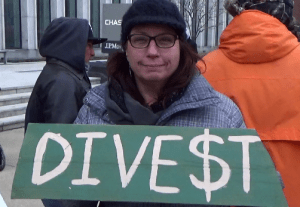
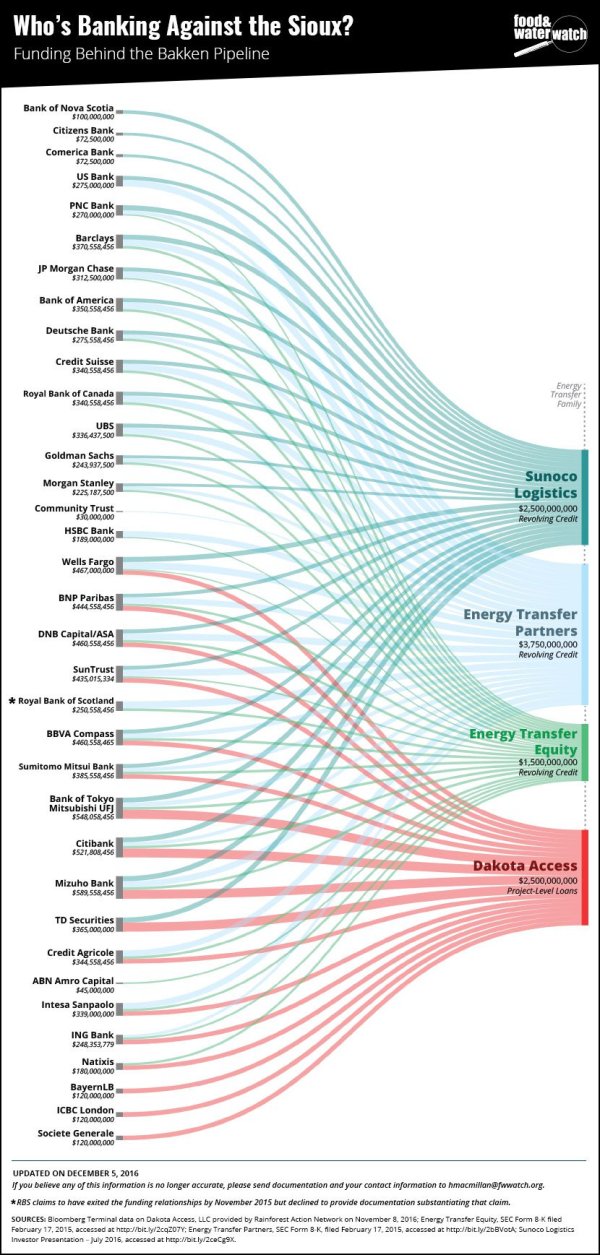
The Stop Funding DAPL event was organized to confront the financial institutions that are currently funding the Dakota Access Pipeline Project, which includes 17 different banks. The action today was directed at JPMorgan Chase bank, which has a branch at 200 Ottawa NW in downtown Grand Rapids.
The action began with drumming and a song that was led by members of the Anishinaabe community. Jonathan Rinehart then spoke about the significance of December 29, which is the anniversary of the US Calvary massacre of unarmed members of the Lakota nation at Wounded Knee in 1890. Reinhart then made the connection to contemporary genocidal policies against First Nations people, like what is happening at Standing Rock.
Nancy Gallardo, who has been at Standing Rock for several months and just returned this morning also spoke about what was happening there and the importance of these kinds of actions that demonstrate solidarity with the struggle in North Dakota.
Another Anishinaabe woman who has also been to Standing Rock spoke and talked about the importance of water in our lives and why it is vital to fight against oil extraction no matter where it takes place.

The flyer pictured above was shared during the action, encouraging people to contact the CEO of JPMorgan Chase Bank.
The intent was to go into the JPMorgan Chase bank on Ottawa, but when we began the action there were already cops there and a private security guard from the bank standing outside the doors. People walked over the the bank anyway but were denied entrance based on what the cop told us was that the bank is “private property.”
By this time there were 8 GRPD cars on the scene and one bicycle cop to protect the bank.

Denied entrance to the bank, people rallied in front of the the bank handing out flyers, chanting and listening to additional comments from the Anishinaabe community.

We founded out the the bank closed to make sure that those who were “protesting” couldn’t get inside, so people stayed for almost another hour to continue to shut the bank down and not allow them to be in the business of funding the pipeline, which is funding death.
Michigan Senators Peters and Stabenow both support the illegal Israeli Settlements in light of recent United Nations Security Council Vote
On the Friday before Christmas, the United Nations Security Council voted 14 – 0 to to condemn Israeli settlements in the occupied West Bank.
The resolution, which passed on December 23rd, demands that Israel “immediately and completely cease all settlement activities in the occupied Palestinian territory, including East Jerusalem, and that it fully respect all of its legal obligations in this regard.”
The United States, a permanent member of the UN Security Council abstained from voting.
Some people saw the US decision to abstain as a criticism against the illegal Israeli settlements, but with the US providing over $3 billion a year in aid to Israel, the decision to abstain was merely for show.
As usual, several members of the UN Security Council were pressured to vote against the resolution, since Israel was threatening to impose sanctions against the two countries that pushed for the resolution, New Zealand and Senegal.
Michigan Senators continue unconditional support for Israel
The two Senators from Michigan, Gary Peters and Debbie Stabenow, both released statements that continue to support Israel and condemn any criticism by the United Nations.
In a statement released just prior to the UN Security Council vote, Senator Peters said:
“I am concerned that one-sided actions against Israel at the United Nations would undermine any future efforts to bring Israelis and Palestinians to the table. We need to focus on achieving a two-state solution that would bring peace and security to Israel and a future Palestinian state. The resolution currently being considered by the United Nations Security Council would mark a significant step backwards with respect to the peace process between Israel and the Palestinian people, and I urge the Administration to do everything to ensure this resolution is not considered or adopted by the Security Council.”
Senator Stabenow waited until after the UN vote had taken place, but was clear in her displeasure with the vote.
“I strongly disagree with the United States’ abstention which allowed a one-sided resolution concerning Israel to be adopted. This resolution is not the way to achieve peace and undermines opportunities for direct negotiations.”
This kind of support from the Michigan Senators should come as no surprise. First, it is rare that any US politician at the federal level will speak out against Israel on any foreign policy matter. Secondly, Senator Peters has been a major recipient of pro-Israeli PAC money, following in the footsteps of former Senator Carl Levin, who was one of Israel’s biggest cheerleaders for decades.
UN Resolution not really a call for justice
Founder and Editor of the online journal, The Electronic Intifada, Ali Abunimah, wrote an important piece about this UN Security Council resolution, where he believes it will be detrimental to Palestinian rights. Unlike, the comments from Michigan Senators Peters and Stabenow, Abunimah makes the point that there have been plenty of previous UN Resolutions that have condemned Israeli settlements. The problem, Abunimah says, is that there is no enforcement mechanism that will actually challenge the Israelis to obey international law. 
Abunimah goes on to say:
What is even more worrying is the rest of the resolution – read in whole, it is a clear attempt to legislate into international law the so-called two-state solution.
In September, I warned that a resolution of this kind would undermine, not support, Palestinian rights.
This draft does not contain a single reference to Palestinian rights, especially the right of return for refugees. It makes no mention of Gaza, which has been under a devastating and illegal Israeli siege for over a decade – a blockade enforced jointly with Egypt, the resolution’s sponsor.
Rather, it expresses “grave concern that continuing Israeli settlement activities are dangerously imperilling the viability of the two-state solution based on the 1967 lines,” as if two states, not restoring Palestinian rights, is an end in itself.
I have explained previously how the tricky phrase “based on the 1967 lines” is designed to allow Israel to annex its vast settlement blocs.
Take the older resolution I mentioned, 465 from 1980. It demands that Israel “dismantle the existing settlements” – all settlements built since the West Bank was occupied in 1967.
The draft now under consideration only calls on Israel to dismantle “all settlement outposts erected since March 2001” – the implication is that most of the existing settlements, particularly the large blocs, will remain forever.
So while being marketed as a move against settlements, this resolution lays the ground to legitimize them, albeit under the framework of a “negotiated” peace agreement.
Lastly, the UN Security Council Resolution is problematic, since it takes away the Palestinian right to resist, by stating:
that Palestinians have a duty effectively to police themselves on behalf of their occupiers by confiscating so-called “illegal weapons” and “dismantling terrorist capabilities” – Israeli-style language that demonizes an occupied people.
Despite the headline, MLive article doesn’t really tell us how the DeVos family influences education policy in Michigan
On Saturday, MLive ran yet another questionable story on the political influence of the DeVos Family, entitled, How the DeVos family has helped shape education policy in Michigan. This story is on the heals of an article that MLive ran last Monday that also demonstrates lazy journalism on the leading Grand Rapids news source.
The article is centered around President-elect Donald Trump’s choice for Secretary of Education, Betsy DeVos. However, the story frames the issue in such a way as to soften, even minimize, the level of influence that the DeVos Family has had on education policy in Michigan.
In the second paragraph, the MLive article states:
“In addition to DeVos’ leadership roles for several education policy organizations, she and her family have used their money and influence as a means to shape major education policy initiatives in Michigan.”
The article never mentions what leadership roles Betsy DeVos plays in organizations that deal with education policy. It would serve the public well to have a better understanding of organizations like American Federation for Children , the Great Lakes Education Project (GLEP) and the Alliance for School Choice. Only GLEP is mentioned in the article.
In addition, the hyper-link provided in the MLive article takes readers to a 9 slide piece that does little to illuminate how the DeVos family has shaped education policy in Michigan. A few slides provide brief commentary on the role of the Great Lakes Education Project on Detroit Public Schools, one on the DeVos-led failed attempt to get a school voucher policy adopted in Michigan in 2000, along with several slides that make it sound as if the DeVos family philanthropy is purely benevolent. (See our article on the political nature of DeVos family philanthropy) 
The December 24 MLive article then talks about three education policy areas in Michigan that the DeVos family has had some influence; Detroit Public Schools, School Choice and Vouchers.
The section on the Detroit Public Schools is the first time in the article that we are informed about the deep involvement of the Great Lakes Education Project (GLEP). The MLive story does offer up some numbers on financial contributions by the DeVos family in regards to influencing the Detroit Public School policy outcome and even links to a Michigan Campaign Finance Network article about the family’s contribution to politicians that influenced the outcome of the Detroit Public Schools policy debate. However, what the MLive article doesn’t tell you is that in the November election, 49 of 53 candidates endorsed by GLEP won in the general election for the Michigan House of Representatives. Here is a list of those endorsed by GLEP that won in November.
• District #17: Rep-Elect Joe Bellino (Monroe)
• District #19: Rep. Laura Cox (Livonia)
• District #20: Rep-Elect Jeff Noble (Plymouth)
• District #24: Rep-Elect Steve Marino (Harrison Township)
• District #30: Rep-Elect Diana Farrington (Utica)
• District #32: Rep-Elect Pamela Hornberger (Chesterfield Township)
• District #33: Rep-Elect Jeff Yaroch (Richmond)
• District #38: Rep. Kathy Crawford (Lyon Township)
• District #39: Rep. Klint Kesto (Commerce Twp)
• District #42: Rep. Lana Theis (Brighton)
• District #44: Rep. Jim Runestad (Milford Township)
• District #45: Rep. Michael Webber (Rochester)
• District #47: Rep. Hank Vaupel (Howell)
• District #51: Rep. Joe Graves (Argentine Township)
• District #56: Rep. Jason Sheppard (Temperance)
• District #57: Rep-Elect Bronna Kahle (Adrian Township)
• District #58: Rep. Eric Leutheuser (Hillsdale)
• District #59: Rep. Aaron Miller (Sturgis)
• District #61: Rep. Brandt Iden (Oshtemo)
• District #63: Rep. David Maturen (Brady Township)
• District #64: Rep-Elect Julie Alexander (Hanover)
• District #66: Rep-Elect Beth Griffin (South Haven)
• District #70: Rep-Elect James Lower (Cedar Lake)
• District #71: Rep. Tom Barrett (Charlotte)
• District #72: Rep-Elect Steve Johnson (Shelbyville)
• District #73: Rep. Chris Afendoulis (Grand Rapids Township)
• District #74: Rep. Rob VerHeulen (Walker)
• District #79: Rep-Elect Kim LaSata (St. Joseph)
• District #80: Rep. Mary Whiteford (Casco Township)
• District #81: Rep. Dan Lauwers (Brockway Township)
• District #83: Rep-Elect Shane Hernandez (Port Huron)
• District #86: Rep-Elect Thomas Albert (Belding)
• District #87: Rep-Elect Julie Calley (Portland)
• District #89: Rep-Elect Jim Lilly (Park Township)
• District #90: Rep. Daniela Garcia (Holland)
• District #91: Rep. Holly Hughes (White River Township)
• District #93: Rep. Tom Leonard (DeWitt Township)
• District #94: Rep. Tim Kelly (Saginaw Township)
• District #97: Rep-Elect Jason Wentworth (Clare)
• District #98: Rep. Gary Glenn (Midland)
• District # 99: Rep-Elect Roger Hauck (Union Township)
• District #100: Rep-Elect Scott VanSingel (Grant)
• District #101: Rep-Elect Curt VanderWall (Ludington)
• District #102: Rep-Elect Michele Hoitenga (Manton)
• District #103: Rep-Elect Daire Rendon (Lake City)
• District #105: Rep. Triston Cole (Mancelona)
• District #106: Rep-Elect Sue Allor (Wolverine)
• District #107: Rep. Lee Chatfield (Levering)
• District #108: Rep-Elect Beau LaFave (Iron Mountain)
Lastly, the MLive information on the Detroit Public School issue doesn’t reflect anywhere near what independent, grassroots media has reported on this. See this powerful article from the Voice of Detroit on how the undermining of public education in Detroit is both an attack on black children and working class families.
School Choice and Vouchers
The remaining two sections of the MLive article are even thinner than the section on the Detroit Public Schools. On the matter of School Choice, the article states, “DeVos and her affiliated groups also supported a 2011 law that lifted Michigan’s cap on charter schools.” Unfortunately, the MLive article provides no specifics in terms of which candidates were provided with funding to promote the increase in the number of charter schools in Michigan.
The section on vouchers merely mentions the failed DeVos-led attempt to get a ballot initiative passed in 2000 that would divert money away from public education to private and religious schools.
While we have come to expect this type of journalism from MLive, it doesn’t mean we have to accept it. Time and time again, MLive makes sure that any reporting having to do with the DeVos family doesn’t ask any serious questions or even attempts to investigate the real power and influence they have on education and so many other aspects of life in Grand Rapids and throughout the state.
MLive, experts and Betsy DeVos as Education Secretary
On Monday, MLive ran another piece looking at President-elect Donald Trump’s choice for Secretary of Education, Betsy DeVos. 
The article on MLive follows a very binary pattern with conservative/liberal voices identified as experts. The story also sets up an overly simplistic framework for the article that does little to flesh out what Betsy DeVos as Education Secretary could actually accomplish.
However, before we look at the experts cited in the article it is important to note that the MLive writer uses words to describe Betsy DeVos that she would use herself in the opening sentence. It reads:
When president-elect Donald Trump nominated renowned philanthropist and school-choice advocate Betsy DeVos for U.S. Secretary of Education, waves of hope and anger swept through education circles nationwide.
The MLive reporter uses the terms “renowned philanthropist” and “school-choice advocate.” These are terms right out of the DeVos family playbook on how to present themselves to the public and demonstrates that more often than not, news media outlets play along with these terms.
People who make billions off the labor of others, rich people, don’t just give their money to organization or causes. Those who are super rich are strategic about who they give money to and that contribution serves very specific purposes. As we noted in an article about the DeVos Family philanthropy, their larger contributions go to institutions that they are politically aligned with. In the case of the Dick & Betsy DeVos Foundation we looked at the most recent 990 filings that foundations are required to submit and this is what we found:
The Dick & Betsy DeVos Foundation also contributes larger sums of money to the organizations that fit within their ideological and class warfare framework. One such entity is the Acton Institute. The Grand Rapids-based think tank, which believes that Capitalism and Christianity make good bed fellows, has received $505,000 from the Dick & Betsy DeVos Foundation according to the 990 reports for 2012 and 2013.
Another Capitalist entity that they have contributed to is Endeavor, which likes to refer to itself as a non-profit for entrepreneurs. The Dick & Betsy DeVos Foundation contributed $162,000 in 2013, according to their 990s, but they also play a significant role in having a staff person from their foundation sit on the regional board of Endeavor in Detroit, Nate Lowery.
However, the major area of philanthropy for Dick and Betsy DeVos is in the area of an attack on public education. They do this through several organizations with their funding. First, there is the DC-based entity called the Alliance for School Choice. In 2013, they contributed $250,000 to this group, which promotes the privatization of public education.
Another anti-public education source for DeVos philanthropy is the Foundation for Excellence in Education ($100,000 in 2013). Betsy DeVos sits on the board of directors, along with Condoleezza Rice and the board president, Jeb Bush.
Lastly, there is the Great Lakes Education Foundation, which has also received substantial funding from the Dick & Betsy DeVos Foundation. ($200,000 alone in 2013) The Great Lakes Education Foundation is a source of funding that supports the Great Lakes Education Project, of which Betsy DeVos is also a board member, along with the DeVos political operative, Greg McNeilly.
The other major effect that foundation giving can often have is to buy silence. The Dick & Betsy DeVos foundation knowns that if they give say $25,000 to a local non-profit, that organization will never say anything critical of the DeVos family. This outcome is equally problematic as contributions that go to groups they are ideologically aligned with, since the overall projects that the DeVos family are committed to – increasing their wealth by supporting neoliberal capitalism, attacking unions & LGBT rights – often are counter to the very efforts that non-profits are trying to counter.
Then there is there is the second label that the MLive article uses to describe Betsy DeVos…….”school-choice advocate.” More than many labels that have been used in recent decades, this one is Orwellian to the core. “School-Choice advocates” are not about choice, they are about promoting their own ideological agenda. This agenda includes taking public money away from public schools, attacking teacher unions, promoting racist and classist education policies and the desire to have religion back in the class room. This is anything but school choice.
Education Experts
The bulk of the MLive article was devoted to getting the opinions of four education policy “experts.” Two of the four experts were overtly in favor of charter schools and school privatization. The first was Michael Petrilli, president of the Thomas B. Fordham Institute. Fordham’s partners are a who’s who of school privatization groups, such as the American Enterprise Institute, the National Alliance for Public Charter Schools, the Foundation for Excellence in Education, the Hoover Institution, the American Federation for Children and the American Legislative Exchange Council (ALEC).
The second overtly pro-charter/private schools expert is Dan Quisenberry, president of the Michigan Association of Public School Academies. DeVos political operative Greg McNeilly, is on the board of directors of this group.
A third expert is Elizabeth Mann, a fellow at the nonpartisan Washington D.C.-based Brown Center on Education Policy at the Brookings Institution. Often viewed as a centrist think tank, the Brookings Institute embraces neoliberal economic policies and the Brown Center on Education Policy has as one of its main experts, former Secretary of Education Arne Duncan. For those thinking Duncan was a staunch defender of the public school system, please see the following links for clarification.
http://www.counterpunch.org/2008/12/18/arne-duncan-s-privatization-agenda/
http://www.counterpunch.org/2009/08/24/obama-and-duncan-s-education-policy-like-bush-s-only-worse/
https://dianeravitch.net/2016/10/28/arne-duncan-supports-privatization-measure-in-massachusetts/
The fourth expert the MLive article cites is Michigan Education Association spokesman Doug Pratt. Pratt is clearly not a support of DeVos as Education Secretary, but he is the only one who frames the qualifications of Betsy DeVos in a more honest way.
Lastly, it should be noted that the MLive article, while seeming to be neutral, actually just promotes the school-choice framework with the imbalance of experts that lean towards DeVos. The other major omission is that this article, like most commercial media sources, are missing the much larger view of why Betsy DeVos is an awful choice for Education Secretary, as noted in our longer article written just after she was named as Trump’s choice.
Facing Foreclosure in Grand Rapids: An Interview with Yvonne Johnson

Yvonne Johnson is facing foreclosure on a home that she has been living in for the past 18 years.
In this interview she talks about how the neighborhood has been transformed over the past ten years, a neighborhood that was once predominantly African American, is now mostly White.
This phenomenon is happening in many neighborhoods in Grand Rapids, where communities of color and working class families are being forced out and displaced from their neighborhoods by the gentrifying effects of development.
Yvonne’s story is the story of racism and White Supremacy.
There is now a fundraising effort for Yvonne. Just go to this link.
MLive, History and the Exclusion of Indigenous Reality
On Wednesday, December 14, MLive thought it would provide a short history lesson on something that took place 180 years ago.
Apparently, people from Ohio and delegates from the territory that would become Michigan met in Ann Arbor to work out a land deal.
Ohio ended up getting what was called the Toledo Strip, while Michigan ended up getting the Upper Peninsula.
This was not in an MLive news stories, but one of those photo galleries with brief captions. This photo gallery consists of 19 slides. In the first 6 slides they share some of this brief history between Ohio and Michigan. However, there was one glaring omission, the MLive piece never mentions that Indigenous people on the land that was “in dispute.”
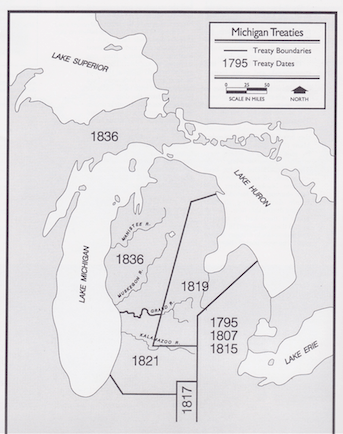
The reality is that thousands of indigenous people lived in what is now called Michigan prior to the European invasion. Most in these native communities experienced displacement by force, religious colonization, the flooding of their communities with alcohol and displacement through legal maneuvers known as treaties. There were numerous treaties that resulted in the takeover of Native land by settler colonialists throughout what is now called Michigan (see map on the right), but settler colonialists have a long history of violation of those treaties. So, to exclude any conversation or historical context about indigenous people is just another way of perpetuating the settler colonial narrative.
There is one mention of Native Americans in frame 16 of this photo gallery. The caption here read: Thanks to the rich history and immigration brought on by the mining boom years, the U.P. is also a cultural melting pot featuring Native Americans, Finns, Swedes, Italians, French Canadians and others.
Such a reference makes it sound like Native Americans just happen to come to the U.P., like all the other ethnic groups mentioned.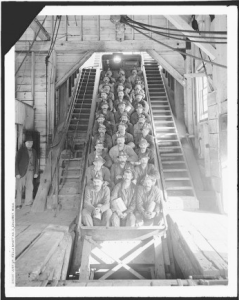
There are also a few other slides in the gallery that are instructive in terms of how it plays into the Settler Colonial narrative.
In frame number 7 we see a group of men who worked in the mines in the U.P. The caption refers to “Michigan striking it rich,” when talking about the level of mining taking place in the U.P. First, of all, Michigan didn’t strike it rich. Those who owned the mine struck it rich. In addition, the mines have contributed and continue to contributed to the contamination of water and soil in the U.P, which has disproportionately impact indigenous communities. (See Al Gedicks book, The New Resource Wars.)
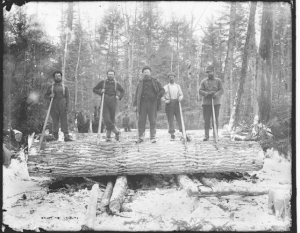 In frame 8 of the photo gallery, there is this picture of men standing on an old growth tree that was cut down. The caption reads: All that supposedly useless wilderness also turned out to be an important source of timber for the logging boom.
First, there wasn’t a logging boom, there were huge profits by logging companies, some of which were owned (in part) by Grand Rapids Furniture Barons who used the wood for furniture.Secondly, the amount of timber that was logged during the 19th century was astronomical, which is why there are essentially no old growth areas left in the U.P.
The rest of the photos in the gallery primarily focus on the majestic beauty of the Upper Peninsula. While the UP is beautiful and often breathtaking, the exclusion of indigenous history is unacceptable. I mean, one of the pictures even includes Tahquamenon Falls. The photo refers to is as a landmark, but fails to mention the name of the falls is Anishinaabe.
This MLive photo gallery that seeks to provide a history lesson, is just one example of how White Supremacy is practiced and why Settler Colonialism continues.

