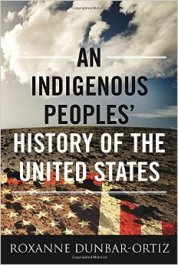
This winter we are offering an 8 week class that looks at the history of US treatment of Indigenous people from the perspective of Indigenous people.
The class will discuss colonialism, settler colonialism and Indigenous resistance. The primary sources we will use for this class are: An Indigenous People’s History of the United States, by Roxanne Dunbar-Ortiz; and a zine entitled Colonization and Decolonization: A Manual for Indigenous Liberation in the 21st Century. You can download the zine by going to this link
https://griid.org/wp-content/uploads/2009/04/colonization-decolonization.pdf.

We chose these two readings because they present US history through an Indigenous lens. We will also have some discussion about settler colonialism in Michigan, particularly West Michigan. The class is also primarily designed to inform and challenge Euro-Americans who are the beneficiaries of settler colonialism.
The class will be held on Wednesday nights from 6:30 – 8:30pm and will be held at Plymouth United Church of Christ, located at 4010 Kalamazoo Ave SE, Grand Rapids, MI 49508. The class will start on Wednesday, February 1 and go through March 22.
We are asking a suggested donation of $25 for the 8 week class, but we will not turn anyone away because of funds. To sign up, just send an e-mail to jsmith@griid.org.
City of Grand Rapids Hosts meeting on being a Sanctuary City
Yesterday, an estimated 30 people took part in a meeting to discuss the issue of Grand Rapids becoming a Sanctuary City. There were representatives from city government, the Mayor, the City Manager, members of the Community Relations Commission and the Chief of Police.
The community was represented by several immigration lawyers, non-profit workers, community organizers and members of the faith community.
The first person to be given the floor to start discussion was the Chief of Police. He started by saying, “we don’t work to enforce national immigration policy.” Rahinsky said that once they arrest someone and process them into the county jail they no longer have jurisdiction over what happens to that person. The Chief of Police inferred that the Sheriff’s Department has say on how much they will cooperate with federal law enforcement and then he made the point that Grand Rapids operates as a Sanctuary City, even though they have never declared themselves as one.
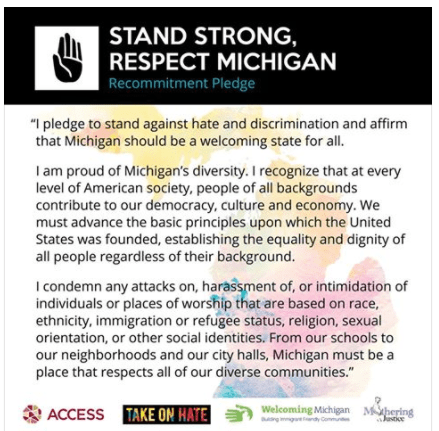
What Grand Rapids has declared themselves as is a Welcoming City. In fact, Grand Rapids is one of ten cities in Michigan that has signed on to what are now called Welcoming Communities. The Welcoming City pledge has lots of positive language and takes a clear stand against hate.
However, there was not a great deal of clarity about what a Welcoming Community means in concrete terms and there is no evidence from the website that becoming a Welcoming Community provides any protections for those who are undocumented.
The impact on undocumented immigrants was the major concern from the members of the community who were in attendance. Several immigration lawyers and an ACLU lawyer made it clear that the current practice of the Grand Rapids Police Department does contribute to undocumented immigrants ending up in detention or face deportation, even for minor non-violent offenses such as traffic violations or a suspended driver’s license.
Several lawyers suggested that the City and the GRPD need to look at developing a policy that would not treat suspended licenses and other minor traffic violation in such a way that does not result in undocumented people going to jail. In fact, a lawyer representing the Western Michigan Branch of the ACLU suggested that the City develop a “menu” of issues that might only result in fines or tickets so that people are not ending up in the County Jail. The ACLU even offered to assist the city in developing such a menu.
The other major issue that was discussed at this meeting was the issue of the potential risks associated with being a Sanctuary City. The specific risk to municipalities was in reference to proposed legislation that would result in the federal government withholding funds from cities that identify as a Sanctuary City. The Stop Dangerous Sanctuary Cities Act (S. 3100) was introduced by Pennsylvania Senator Pat Toomey earlier this year. Some of the federal funding that would be put at risk are identified as Economic Development Administration Grants and Community Development Black Grants, known as CDBG funds. President Elect Trump has also made it clear that he would defund cities that have declared themselves a Sanctuary.
The City Manager, the Mayor and other City staff were pretty clear that they did not want to risk losing federal funding by declaring Grand Rapids to be a Sanctuary City. The City Manager even made the point that much of the federal dollars that come to Grand Rapids benefit the poor.
While some might see the issue of federal funding being at risk if the City becomes a Sanctuary as a legitimate concern, what this really brings to the surface is the very limits of what governments can do.
This is why it is important for us to see the clear difference between Sanctuary Cities and Sanctuary Movements, as we noted in a recent posting. Sanctuary Movements do not have the limits that municipalities have and they also directly impact undocumented individuals and families by providing safety and solidarity in practice. Sanctuary Movements do not offer services, rather then enter into a relationship with those who are at risk of being detained, arrested or deported. Sanctuary Movements enter into this relationship even if it means that those involved in offering sanctuary are at risk of violating the law, because they adhere to values which says that human dignity is more important than laws.
The meeting did raise important questions, but one thing that was glaringly missing from the conversation were those who are most at risk of being arrested, detained or deported. What might the conversation have looked like if the voices of the undocumented were at the table? How might city officials have responded with their voices and their stories front and center? The reality is that those who are undocumented live in fear of the consequences of talking to those who have the power to arrest, detain and deport them. Again, the limits of what government can do are real.
Speaking afterwards with several immigration lawyers, they made it clear that the meeting went better than they expected and at least there was some willingness upon the part of the City of Grand Rapids to continue the conversation about looking at police policy. It was also suggested that a sub-committee be established that can further explore ways the city can adjust policy and procedure that minimizes the risk to those who are undocumented.

The Michigan Legislature is attempting to push through even more punitive bills before the holiday break. Just like the bill that seeks to end Public School teacher pensions and the legislation that seeks to limit picketing and protest in the state, the proposed legislation around ending refugee resettlement could pass before the end of the year.
The resolution, HCR 28, urges the President and Congress of the United States to comply with the Refugee Resettlement Act of 1980 and to halt further refugee placements until the Federal government is “able to comply” with appropriate screening and security checks and consult with local governments in future placements.
As many of you know, security checks already placed on refugees coming to the United States, are the most comprehensive screening process for anyone coming into our country. Secondly, there is already collaboration between the Federal, State, and Local governments regarding resettlement. The resolution would not have any legal effect, but remains of concern because it communicates false and misleading accusations of malfeasance and threat. Given the high level of coordination and security that currently exist, it is difficult to imagine any level of coordination and security that could satisfy the anti-refugee movement leaders promoting this kind of legislation. This legislation was introduced by Republican Mike McCready from the 40th District.
However, there are also several other organizations that have been lobbying for this type of anti-immigration/anti-resettlement legislation. First, there is the group known as Act for American, which, according to Sourcewatch, is one of the largest grassroots groups dedicated to targeting Muslims. Act for America uses hyper-nationalistic language and fear of terrorism as ways to influence public opinion. The Southern Poverty Law Center also lists Act for America as a Hate Group. Act for America has 6 chapters in Michigan.
Another group that has been behind the proposed legislation is the Refugee Resettlement Monitor – Michigan. This organization has ties to Act for America and uses some of the same information sources to update their members. One resource they promote is their Citizen Toolkit, which provides tips on passing local resolutions against refugee resettlement. The Refugee Resettlement Monitor – Michigan is also an anti-Islam group that believes that Muslims are trying to impose Sharia Law on people in the US.
Waterford Township passed an anti-refugee resettlement resolution in October of this year, specifically targeting Syrian refugees.
Whether the legislation becomes law in Michigan remains to be seen, but it is another indication that the far right is organized and attempting to push more anti-immigration policies.
With Grand Rapids Facing a Housing Crisis, Grand Action proposes to spend over $250 million for tourism and entertainment
Let’s be perfectly clear about what the new Grand Rapids Destination Asset Study will mean. It will mean that more public money gets directed at private projects that will result in increasing the wealth of a selected few in Grand Rapids.
In addition, the new study proposes that much of the need to expand certain assets that will primarily be used to attract more visitors/tourists to Grand Rapids. Not all that surprising, this will mean that the hotels, restaurants/bars, property management companies, construction companies, foundations, marketing firms and private parking businesses will be the primary beneficiaries of such projects. All one has to do is look at the list of people/entities that were interviewed in the process of the study and you understand which opinions are valued and which are not (see the last page of the study for list of those interviewed).
This new study was commissioned by the DeVos-created group known as Grand Action. Grand Action’s strategy has always been to use private and public funds for projects that will benefit many of the very same people (and the organizations they represent) that make up Grand Action Committee.
The projects that Grand Action has pushed in previous years have been the Arena, the convention center, the civic theater upgrade, much of the medical mile and most recently the Downtown Market.
Take the Downtown Market for example. This project was promoted from the very beginning with the idea of making Grand Rapids a tourist destination and creating what was referred to as a “Disnyland-like atmosphere.” The Downtown Market has always been about serving the culinary needs of those in the business/professional/ownership class than for working class people. In December of 2011, we reported on the millions of public dollars that would be used for the market, even though the public had little say in the project.
On Monday, MLive reported the Grand Action commissioned study, with the usual glowing remarks. The article even included a short video interview with the consultant who was hired by Grand Action to do the study. 
The Grand Rapids Business Journal and other major commercial media outlets also reported on the Grand Action study and simply restated what each source was saying. The major areas of asset improvement would be expand the convention center, add another new hotel downtown, upgrade transit options for downtown, making the Grand River more of a tourist/outdoor destination, build a professional soccer stadium and add other amateur sports options & destinations.
The expansion of the convention center can be seen in the image here on the right. You can see that the proposed expansion would utilize the space now currently occupied by the downtown post office and where the City & County buildings are located.
Another curious aspect of the Grand Rapids Destination Asset Study is what is referred to as Stressing Authentic: A Diverse and Inclusive Approach. The study says this about the idea of A Diverse and Inclusive Approach:
This initiative could effectively showcase diverse areas of the community, empower residents to participate in destination marketing efforts, and provide content that could potentially be used to inform future destination marketing efforts.
Ultimately it means maybe giving communities of color an opportunity to be involved in the marketing of their neighborhoods. Below is also major bullet points from the study having to do with diversity and inclusion.

My favorite is Minority Hospitality Incubator. Who comes up with this shit?
Lastly, the major issue that this new study raises is the cost. There are some hard figures and then there are some costs that are not as clear. However, based on the known costs, the budget for the proposed destination assets is roughly $278 million dollars.
This amount of money is somewhat staggering when we think about what that kind of money would mean for people who are struggling to make ends meet. Now, I know that some people will say that at least 50% or more will come from private sources and that is probably the case, but what it should say to us is that what those with tremendous wealth are preferring to invest in is making Grand Rapids a destination city. This equals, as we stated in the opening remarks, that those with tremendous wealth will have an opportunity to make even more if this proposal comes to fruition.
Imagine what $278 million could be spent on that would actually serve the needs to of so many. If one was thinking of housing, truly affordable housing, it would not be a stretch to suggest that 2,780 houses at $100,000 each, would mean that 2,780 families could have a healthy place to live.
Imagine if that kind of money was redirected to environmental cleanup and ecological sustainability? Think of how much food justice could be practiced with such a budget, which would result in more people eating better, thus reducing health care costs.
However, this would just be fantastical thinking, because those behind such projects are in no way interested in addressing social inequality or ways that would truly transform Grand Rapids that would make known as the Racial Justice City as opposed to Beer City.
Sanctuary Cities and Sanctuary Movements
There has been a fair amount of discussion at the national and local level about the idea of Sanctuary Cities being a goal, especially since the November 8 election.
This renewed interest is completely understandable, considering what Donald Trump was saying about immigrants and an potential extension on an existing wall along the US/Mexican border.
In September, Trump and his advisors laid out their 10 Point Plan on immigration policy:
1. Build the wall
2. End “catch and release.”
3. Create a deportation task force and focus on criminals in the country illegally
4. Defund sanctuary cities
5. Cancel President Obama’s executive actions
6. Extreme vetting. Block immigration from some nations
7. Force other countries to take back those whom the U.S. wants to deport
8. Get biometric visa tracking system fully in place
9. Strengthen E-Verify, block jobs for the undocumented 10. Limit legal immigration, lower it to “historic norms,” and set new caps
Any number of these ten points would certainly be an attack on the immigrant community and create a climate of fear. However, it is important to note that the Obama administration has deported more people during his 8 years in office than any other president. So, the current discussion around sanctuary cities is not a new one, since millions of immigrants have already been living in fear. What has happened since the November election was really a wake up call to those of us not facing arrest, detention or deportation, about the harsh realities that immigrants face on a daily basis.
Sanctuary Cities
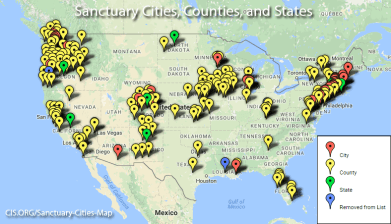
There are currently several dozen cities across the US that have declared themselves Sanctuary Cities. What this means is that those cities will limit the amount of cooperation they will offer to federal authorities when arresting, detaining or deporting immigrants, especially undocumented immigrants. There might be some nuances in some cities engaged in Sanctuary, but we should be clear that becoming a sanctuary city does little more than make a principled stand.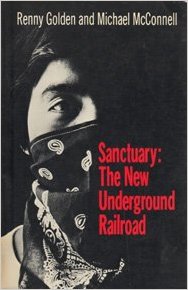
Sanctuary Movements
Sanctuary Movements are a completely different form of action from Sanctuary Cities. Sanctuary Movements are when people collectively work to provide a safe space for those most at risk of deportation and other forms of violence that are committed by the state or groups seeking to do harm to immigrants or those perceived to be immigrants. Sanctuary Movements have a long history in what is now called the United States. Indigenous communities/nations have been sanctuaries for Africans fleeing chattel slavery. An excellent resource that documents this relationship is William Loren Katz’s book, Black Indians: A Hidden Heritage.
Of course the most impactful example of sanctuary in US history was the underground railroad. Blacks that engaged in self-emancipation or were assisted in some way (usually by other blacks) were offered temporary or permanent sanctuary whether it was staying somewhere along the underground railroad for a night or ending up in a community in the northern part of the US or those who decided to go to Canada. Some excellent resources on this topic are The Underground Railroad: Authentic Narratives and First-Hand Accounts and Gateway to Freedom: The Hidden History of the Underground Railroad.
There have been other examples of those practicing sanctuary for people facing deportation and for those refusing to participate in war, but the most widespread example of a contemporary form of sanctuary, was the 1980s Central American Sanctuary Movement.
In the late 1970s and 1980s, US funded counter-insurgency wars were being waged in El Salvador and Guatemala, activists along the US/Mexican border began to see a sharp rise in the number of political refugees entering the country.
As communities began to offer safety to these refugees, they realized that all of them had a similar narrative. Each of the refugees told them that they fled their country because they either witnessed the torture and murder of family members or they themselves were torture survivors.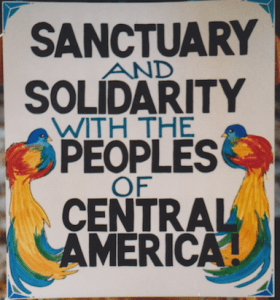
The US financed death squads in El Salvador and Guatemala was the primary source of the displacement of hundreds of thousands of people coming from Central America in the 1980s. US activists began to hear these stories in greater numbers and since the Reagan administration did not acknowledge Salvadoran or Guatemalan refugees as being political refugees, the US Sanctuary Movement was born.
The US Sanctuary Movement was begun by US faith-based communities that believed that they should offer sanitary for their fellow humans who were fleeing violence, even if it meant violating US laws.
Beginning in the Southwestern part of the country, Sanctuaries began popping up, where faith-based groups began to house people fleeing violence and to provide them with a forum to tell their stories.
Soon there were hundreds of places declaring themselves a sanctuary for Central American refugee, with three places declaring in Michigan alone – Detroit, Lansing and Grand Rapids.
The Grand Rapids Sanctuary was run by members of the Koinonia House, a housing collective that had begun in 1984 and did much of their organizing around resisting US Policy in Central America.
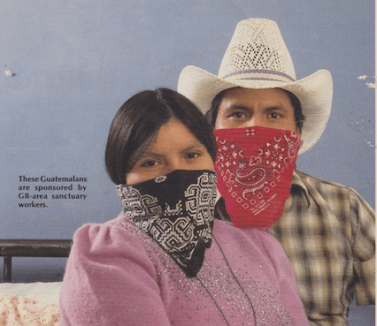
The seven members of the Koinonia House decided in the fall of 1985 to be part of the Central American Sanctuary Movement and traveled to Chicago to meet with the national coordinator of the project, the Chicago Religious Task Force on Central America. The Chicago group acted as a clearly house for groups wanting to declare themselves a sanctuary and to make sure that each group had the capacity to take such a project on.
The Grand Rapids Sanctuary need to get letters of support from organizations and individuals to demonstrate that they had a community of support behind them. Those involved in the sanctuary work also sought out lawyers who would be willing to led legal assistance if the political refugees in sanctuary were in need it. In addition, the Grand Rapids Sanctuary needed to seek out material and financial support for the ongoing needs of those living in sanctuary.
In April of 1987, six adults and one child arrived in Grand Rapids at the Koinonia House. A few days later a press conference was held on the front porch of the Koinonia House (pictured below) and this marked the beginning of several years that the Grand Rapids Sanctuary offered a safe haven for those who were fleeing violence in Central America. 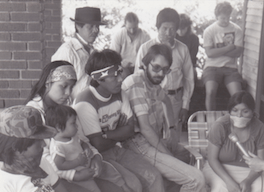
This is the fundamental difference between Sanctuary Cities and Sanctuary Movements. Sanctuary Movements are not symbolic, rather they seeking to offer concrete forms of safety and support, even if it means that those engaged in sanctuary work are at risk of state harassment or repression in the process.
Now, I am not arguing against Grand Rapids becoming a Sanctuary City, but the important work, the necessary work that needs to be done is when households, organizations and faith-based groups are willing to practice being sanctuaries for those at risk from state violence, hate groups and other manifestations of White Supremacy.

Last week we posted an article asking the question of why the Grand Rapids Public Schools Superintendent, Teresa Weatherall Neal, had responded so favorably to Donald Trump’s choice for Secretary of Education, Betsy DeVos.
The article was meant to raise questions and look at the what Superintendent Neal stated were ways in which what the DeVos family was doing in the Grand Rapids School District aligned with Neal’s goals.
I spoke with one GRPS board member on the phone who affirmed the analysis in the article, but two other board members felt that the article was misleading.
Last Tuesday, I sent the following e-mail to every member of the GRPS Board:
As a GRPS School Board Member, I would like to know what your reactions are to 1) the announcement that Betsy DeVos has been named as Secretary of Education, and 2) what impact might that have on GRPS?
If you could respond be the end of the week, that would be great. I plan to post your responses in their entirety on the griid.org blog.
I received two responses via e-mail. Pastor Nathaniel Moody and Monica Randles both replied with the message No Comment.
The remaining 7 members of the Grand Rapids Public School Board – Jen Schottke, Wendy Falb, Maureen Quinn Slade, Dr. Jose Flores, John Matias, Raynard Ross and Tony Baker – did not respond to our questions.
There continues to be a national outcry against Betsy DeVos becoming the Secretary of Education.
Lisa Graves with the Center for Media and Democracy wrote a solid piece on the Trump pick for Secretary of Education, entitled, 5 Things to Know about Billionaire Betsy DeVos, Trump Education Choice.
Democracy Now, also ran an important piece last week about Betsy DeVos, with several guests, but featuring Diane Ravitch, former Education Secretary and author of several books on the privatization of public education in the US.
It is unfortunate that the Grand Rapids School Board members are unwilling to take a position on the choice of Betsy DeVos as Secretary of Education, especially considering that it could mean further efforts to undermine the public school system throughout the country.
AIDS and Activism: A 3-Part Series

In honor of World AIDS Day, we are re-posting our 3-part series on AIDS and Activism that was published four years ago. We do this in memory of all those we have lost to AIDS.
The first posting is the chapter – AIDS in the Gay Community in Grand Rapids – from the film, A People’s History of the LGBTQ Community in Grand Rapids.
AIDS and Activism Part II: Reagan, DeVos and the 1980s crisis
AIDS and Activism Part III – ACT UP and the power of direct action
West Michigan Policy Forum Endorsed Legislation seeks to eliminate Public School Teacher Pensions in Michigan
It is possible that before the end of the year, the Michigan Legislature might push through a bill that will effectively end public school teacher pensions.
We wrote about this issue in September, when the major policy issue that the right-wing West Michigan Policy Forum made ending public sector employee pensions the main issue to get passed in Michigan.
The West Michigan Policy Forum has been instrumental in getting several state policies passed since their inception in 2008, such as making Michigan a Right to Work state, eliminating the business tax and now they are calling for the end of public school teacher pensions.
The proposed legislation, known as HB-5218 in the House and SB 102 in the Senate would eliminate traditional pensions and replace it with 401k-type plans allowing investment firms to make billions managing them. The Michigan Education Association has stated that, “This is a nation-wide attack, led by Enron billionaire Tom Arnold, whose Arnold Foundation is flooding right wing think tanks across the nation with funding to do this work. The Enron meltdown cost public pension funds $1.5 billion in losses.”

In Michigan, the West Michigan Policy Forum and the Mackinac Center for Public Policy has been pushing the same message, which is all in the name of fiscal responsibility. “Fiscal responsibility,” is really just code for austerity measures and ultimately an attempt to break unions.
The recent announcement from the the Trump camp that Betsy DeVos has agreed to be the Secretary of Education in his administration, provides even more momentum, since Betsy DeVos and the DeVos family has made the dismantling of public education a priority for years. Many of the Michigan legislators who have backed both the House and the Senate version of the bill are endorsed by the DeVos run Great Lakes Education Project.
Various organization, particularly unions are attempting to prevent the Michigan Legislature from making this happen. The Michigan AFL-CIO has sent out an action alert, asking people to sign this petition.
However, it will take more than petitions to stop this Neoliberal plan to undermine teacher pensions. The unions and their supporters will need to engage in various forms of direct action if they are to put a stop to ongoing class warfare being wage by the Republicans and their Democratic Party collaborators.
Why is the GRPS Superintendent praising Betsy DeVos as Trump’s choice for Education Secretary?
Last Wednesday, in an article that appeared on MLive about Trump’s choice for Education Secretary, Teresa Weatherall Neal, superintendent of Grand Rapids Public School district, endorsed and even praised Betsy DeVos as Trump’s choice for Education Secretary. Here is part of what that MLive article stated:
Neal says she has worked closely with DeVos since she began her job five years ago. The relationship started with DeVos asking for a meeting.
“She wanted to know what I was going to do, what was my plan for the children in the district,” said Neal. “I appreciated her asking the question. She was part of the transformation that we have done in the district.”
When Neal said she needed the expertise of a superintendent coach, DeVos picked up the tab, and she continues to send notes of encouragement.
The DeVos clan, especially Amway President Doug DeVos and his wife, Maria, have channeled millions from their foundations to programs that align with Neal’s goals.
Neal acknowledges the toll Michigan’s school of choice policy has taken on urban school districts like her own over the past 22 years when the lawmakers set it in motion with school finance reform in 1994.
“It has been hurt by choice (but) we have also become a much stronger district and able to compete,” Neal said.
Over the past two decades, the district has lost 8,000 students, closed 35 buildings, eliminated 1000 positions and cut more than $100 million from the budget, according to the district’s spokesman John Helmholdt.
Under Neal, the district’s graduation rates have climbed and chronic absenteeism have dropped, Helmholdt added, although they’re still below state averages.
Neal thinks DeVos can hold up GRPS as a model of what can be done at other struggling districts.
“I’m really excited for the children across the nation,” Neal said. “She has been a wonderful supporter of GRPS and our transition plan. She knows education. She knows what it is going to take in order for our kids to be helped.”
Some have questioned DeVos family involvement in the district and public education in general since they have educated their children in privately-funded Christian schools.
Neal sees the politically conservative family’s focus on education as their commitment to the “greater social good.”
The praise that Teresa Weatherall Neal gives to Betsy DeVos should should raise red flags for anyone who care about public education in Grand Rapids. There are several statements in the MLive article that should tells us something about the Grand Rapids Public Schools, the role of the DeVos family and the GRPS and the programs that align with GRPS that are supported by the DeVos family and the rest of the local power structure.
However, it is first important to acknowledge that the Grand Rapids Public Schools have been facing tremendous adversity for decades. Some of the main causes of this adversity has been the decades long White Flight, where white families moved out of the district or have chosen to send their kids to other schools. Another cause has been the state-level systematic defunding of local school districts, which the DeVos family has contributed immensely by getting legislators in Lansing that promote their education policies. Lastly, the lack of school funding, coupled with the poverty-level income of many families in the Grand Rapids Public School district has laid the ground work for the privatization of education that Betsy DeVos champions.
There was an acknowledgement in the MLive article that the Doug and Maria DeVos Foundation has contributed directly to the Grand Rapids Public Schools. Based on the 990 documents available, the Doug and Maria DeVos Foundation has contributed money to the GRPS and programs that align with the school district.
The Doug & Maria DeVos Foundation contributed between 2012 – 2014 contributed $1,509,120 directly to the Grand Rapids Public Schools. If you add the money they contributed to the University Prep Academy, located on South Division, the President of Amway and his wife contributed $550,000 during the same 3-year period.
Then there are programs that align with the GRPS, such as the Grand Rapids Student Advancement Foundation, which provides grants to the GRPS. The Doug & Maria DeVos Foundation has contributed $1,496,413 to the Grand Rapids Student Advancement Foundation. Maria DeVos also just happens to sit on the board of this foundation.
The Grand Rapids Initiative for Leadership (GRIL) is a faith-based youth leadership development program that offers trainings through the GRPS at both Union High School and Ottawa Hills High School. This program is really an offshoot of the DeVos Urban Leadership Initiative and is one of the main partners in the GRIL. Doug and Maria DeVos contributed $58,000 between 2012 – 2014 to the Grand Rapids Initiative for Leadership. The Dick and Betsy DeVos Foundation also gave $20,000 between 2012 – 2013.
Another faith-based initiative is the Believe 2 Become program, which works directly with the Grand Rapids Public Schools. There is no direct connection that we could find to the DeVos family, but many of the other programs the DeVos family supports are partners of this project.
A few other projects, which align with the goals of the GRPS, are First Steps Kent and Talent 2025. First Steps Kent provides resources for early childhood efforts in Kent County. The Doug and Maria DeVos Foundation is one of the major funders of this project, contributing $803,000 between 2012 – 2014. Doug DeVos is the Chair Emeritus for First Steps Kent and many of the Commission members make up the local power structure.
Lastly, there is the group Talent 2025. This group is made up of CEO’s who want to create and develop talent for their own interests. The GRPS is also part of this effort, which ultimately wants to prepare students to be part of the workforce. The leadership of this group is also made up of the local power structure, with some DeVos family involvement.
So, you can see why Teresa Weatherall Neal expressed such admiration for Betsy DeVos being chosen as the Secretary of Education. The DeVos family is deeply embedded in the Grand Rapids Public Schools, through their funding and the organizations they have had a hand in creating.
Reflections on the Struggle at Standing Rock
It has been 2 days since I got back from our trip on the invitation by the Lakota nation to be part of the fight for justice at Standing Rock.
There are things that I have been thinking about and wanted to share here.

First, the fight at Standing Rock is first and foremost about White Supremacy and Settler Colonialism. Settler Colonialism, according to Indigenous scholar Roxanne Dunbar-Ortiz, is defined as such:
“Settler colonialism has best been defined as more of an imposed structure than an historical event. This structure is characterized by relationships of domination and subjugation that become woven throughout the fabric of society, and even becomes disguised as paternalistic benevolence. The objective of settler colonialism is always the acquisition of indigenous territories and resources, which means the native must be eliminated. This can be accomplished in overt ways including biological warfare and military domination but also in more subtle ways; for example, through national policies of assimilation.”
What is happening at Standing Rock is also about White Supremacy. However, White Supremacy should not be confused with those who identify as White Supremacists. Instead, we must see White Supremacy as a system of oppression that has always been part of the United States. Chicana scholar and activist Elizabeth Martinez defines White Supremacy as such:
“White Supremacy is an historically based, institutional perpetuated system of exploitation and oppression of continents, nations and peoples of color by white peoples and the European Continent, for the purpose of maintaining and defending a system of wealth, power and privilege.”
The Dakota Access Oil Pipeline is a more current example of White Supremacy and Settler Colonialism. The immediate goal is to stop the pipeline from being constructed, but the longterm goal is to end Settler Colonialism and White Supremacy.
Second, while the Dakota Access Oil Pipeline should be seen as a Climate Justice issue, it should be framed primarily as an Environmental Justice issue. The movement for Environmental Justice grew out of the struggles that communities of color have engaged in and are significantly different that those of white environmentalists. The principles of environmental justice should be read by everyone. There are several that apply to the Standing Rock struggle, particularly the following:
- Environmental Justice must recognize a special legal and natural relationship of Native Peoples to the U.S. government through treaties, agreements, compacts, and covenants affirming sovereignty and self-determination.
- Environmental Justice opposes the destructive operations of multi-national corporations.
- Environmental Justice opposes military occupation, repression and exploitation of lands, peoples and cultures, and other life forms.
Organizations, particularly Environmental groups that do not practice environmental justice and have not made the struggle at Standing Rock part of their work should not get our support.
Third, the repression at Standing Rock is nothing short of a military occupation. The pipeline company, the private security forces they are using, police and the national guard are all being used to monitor, police, attack, arrest and make sure that the pipeline construction will be happen. We saw helicopters constantly monitoring the activities of the water protectors on the ground. In addition, those involved in surveillance are hacking people’s handheld phone and computers, in order to disrupt their signal and attempt to get the word out about what is taking place there.
Then there is the militarized repression we saw within the past few days, where water cannons were being used on people, along with rubber bullets. When people are arrested their legal rights are being violated and sometimes people are being held in dog cages. We also just learned from a report by Jeremy Scahill, that the company being contracted out for doing intelligence gathering is TigerSwan Security, which has ties to Blackwater.
I have spent lots of time in Guatemala, El Salvador and Chiapas and so much of what was happening at Standing Rock felt just like the militarized repression taking place in those countries.
Fourth, the resiliency and courage of the water protectors and all the other people their to support them is amazing. The people I talked to kept saying over and over again how the support and sense of community was simply astounding. There are the water protectors putting their bodies on the line, then there is the legal support people, those doing media, people who are cooking everyday, a health clinic, those hosting cultural and ceremonial activities, the volunteer station, the donations people and those that are providing security for the encampment. What is happening at Standing Rock is a highly organized and welcoming space that were all can learn from in terms of how we want our communities to function.
Fifth, the level of solidarity and support is incredible. People from all over the world are sending supplies, financial support and sometimes representatives to stand with the struggle at Standing Rock. There were flags from all over, representing indigenous people all across the planet, along with other struggles for autonomy and sovereignty, like the connection between the struggle in Palestine and Standing Rock, which we saw reflected in flags, signs and statements around the encampment. This is truly a struggle that has tremendous international support.
Finally, what is taking place at Standing Rock deserves our solidarity. We cannot ignore it, nor can we say that we have a different focus. We all need to support what is happening at Standing Rock in whatever way we can.
They are asking for financial support ton be send at this link http://sacredstonecamp.org/faq/ or if you want to support the Michigan Host Tent site, go to this link https://www.gofundme.com/www-facebook-com-michigan-host-tent-at-standing-rock-9971858.
There are constant updates for what their needs are, so check this link regularly http://sacredstonecamp.org/faq/. People made it very clear that if they welcome anyone who genuinely wants to be part of this struggle. However, if you can’t make the trek, you can support monetarily, you can write letters to people and send care packages. People kept saying it meant the world knowing that people were thinking of them. We can also engage in actions in our own communities that support the struggle in Standing Rock. We can organize a fundraiser, we can host an informational campaign and we can organize actions that make the connections, like confronting the banks and financial institutions that are backing the construction of this oil pipeline. For updates on what is happening in the Grand Rapids area, go to the Grand Rapids DAPL Resistance page https://www.facebook.com/groups/1800659906878257/.

