It is important for people who want to develop a class consciousness to read the business press. While reading the business press might be aggravating, it is important to know what the business community is thinking and how they are influencing public policy.
In a recent “sponsored content” article in MiBiz, the President and CEO of The Right Place Inc, Birgit Klohs, wrote about current proposed legislation in Michigan that would essentially divert more taxpayer money to support business interests.
The legislation that The Right Place Inc CEO was referring to her in article is Senate bills 242, 243 and 244. One of the sponsors of the bill, State Senator Jim Stamas, explains the legislation this way:
Under the bills, business expansions or new locations creating at least 500 qualified new jobs that pay the prosperity region average wage or higher would be eligible to receive up to a five-year, 50 percent abatement on the personal income tax withholdings of the new employees. Companies creating at least 250 qualified new jobs paying wages at 125 percent or more of the prosperity region average wage would be eligible to receive up to a 10-year, 100 percent abatement.
This legislation passed in the Michigan Senate last week and is often referred to as the Good Jobs for Michigan bill. Not so surprising, there is a statewide coalition of businesses and business entities called the Good Jobs for Michigan group.
What is important for the public to understand is that legislation generally isn’t the brainchild of individual legislators, rather legislation is often crafted by those who are part of the capitalist class. And the reason that the capitalist class is in the business of creating policy is because they are always thinking about how they can divert more public money to private interests……..their private interests.
The Good Jobs for Michigan is a slick campaign that essentially is designed to divert public money into the private sector because the private sector claims this is necessary in order for businesses to create jobs. Therefore, businesses and business associations are saying to the government is, “Give us some money so we can create jobs, so we can make a whole bunch of money.”
The Good Jobs for Michigan group is made up of business and trade associations from across the state, including the Grand Rapids Chamber of Commerce and The Right Place Inc. Therefore, the “sponsored” article from Birgit Klohs in MiBiz was nothing more than a pitch to the larger business community to get them to lobby legislators to vote for these bills.
The article from The Right Place Inc CEO appeared on March 19. The Michigan Senate voted on Friday, March 31st to adopt all three bills. This was a bi-partisan supported set of bills, with only 5 Republican Senators voting against the legislation. Even the pro-market Mackinac Center for Public Policy didn’t mince words about what this legislation would do. The pro-market think tank referred to Senate bill 242 as, Transfer state revenue to certain business owners.
The public can ill afford to allow those in the capitalist class to continue to dictate policy that negatively impacts working class people. Just because the word jobs is used in these kinds of campaigns, doesn’t mean it is in the interest of the public.
Betsy DeVos compares School Choice to Uber or Lyft
 Now that Betsy DeVos has bought a seat in the new administration, we thought it might be a good time to begin doing a regular column entitled, Betsy DeVos Watch. These columns will be an opportunity to provide regular analysis of the statements and policies put forth by the Secretary of Education.
On Wednesday, Betsy DeVos delivered a speech at the Brookings Institute. DeVos continued to promote her commitment to the so-called “School of Choice” policy, which is essentially a policy that undermines public education.
It makes complete sense that DeVos would speak at the Brookings Institute on this topic, especially since the organization publishes an annual Education Choice and Competition Index (ECCI). “The intent of the ECCI is to create public awareness of the differences among districts in their support of school choice, provide a framework for efforts to examine the impact of choice and competition, and document changes over time in the policies and practices of school choice.”
There is one major point we want to emphasize from DeVos’ comments delivered at the Brookings Institute. DeVos made the comparison between school choice and transportation. Betsy stated, “Nobody mandates that you take an Uber over a taxi, nor should they. But if you think ridesharing is the best option for you, the government shouldn’t get in your way.”
This comparison is instructive in many ways. The comparison by DeVos essentially seeks to frame education through a market lens, which is no surprise considering that this lens, along with a religious lens, are how she sees the world. As someone who comes from the capitalist class and then married into an even more staunch proponent of the capitalist class, Betsy DeVos whole heartedly believes that the neoliberal market should dictate what we do.
Seeing the world through a market lens is problematic in so many ways. DeVos sees transportation options as choices, but that is because she ignores the history and context of how transportation options have been imposed on us. The very fact that most of us are limited to car transportation is due to the history of the influence of the automobile industry, as is well documented in the documentary film, Taken for a Ride. However, if our transportation system in the US had been designed with the public interest and ecological concerns in mind, we would have a very efficient mass transit system that would benefit everyone. Therefore, the so-called choice model for either transportation or schools is really an illusion. The education system has been determined by those in power who have never had the interest of the masses in mind.
Lastly, it should be stated that Betsy DeVos’ comparison between transportation of choice and school choice is also disingenuous, especially when one realizes that she comes from a family that has used private chauffeurs, owns a $40 million yacht, has had helicopter pads at their homes and utilizes their own private airplanes for their transportation “needs.”

Giving Public Money to Private Developers in Grand Rapids
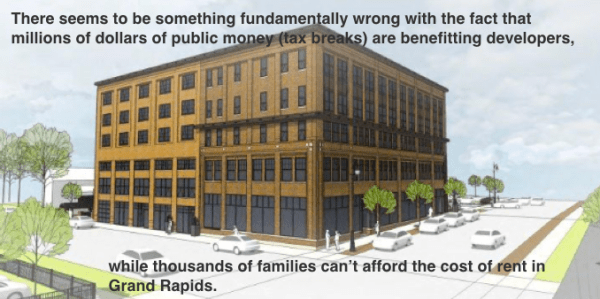
 MLive announced yesterday that Lofts on Wealthy LLC, a division of 616 Development, has been granted a $970,250 in tax breaks to redevelop the former Kregel book publishing site.
The tax breaks were awarded by the Michigan Strategic Fund, which is part of the Michigan Economic Development Corporation. The MEDC is a quasi state entity that claims to market the state of Michigan and attracting business development and investors.
The people who sit on the board of directors of the Michigan Strategic Fund are those who also represent the business community, such as Fifth Third Bank, Greenstone, the Michigan Farm Bureau and Truscott Rossman. There are a few state employees on the board, such as Nick A. Khouri, a former VP with DTE and Shelly Edgerton, a longtime state legislative operative. You can easily see why the Michigan Strategic Fund would want to grant major tax breaks to developers, allowing them to make even larger profits by using public funds.
The 616 Development project on Wealthy plans to include retail on the ground floor, along with 75 apartments that will range from $775 for a micro-unit and up to $1,975 for a three-bedroom. This means 616 Development will on average generate $112,500 a month from rent, not including the money they make from the retail spaces. So lets say that will bump it up to $150,000 a month that the developer will make, which comes to roughly $1.8 million a year.
616 Development claims that they will invest $11.7 million into the building, which means that the project will pay for itself in less than 7 years.
Had the Michigan Strategic Fund not provided the tax breaks totally just under $1 million, this would mean that the company would need another year to pay off their investment.
Imagine what $970,250 could do for providing truly affordable housing in Grand Rapids. Imagine was millions of dollars that are being granted in tax breaks each and every year would amount to in actual construction of affordable homes for families that are currently being displaced from all of the market rate housing projects across Grand Rapids.
There seems to be something fundamentally wrong with the fact that millions of dollars of public money (tax breaks) are benefitting developers, while thousands of families can’t afford the cost of rent in Grand Rapids.
Last Tuesday, the Grand Rapids Press ran a front page news story entitled, Picking Employees: Farmers must make labor decisions now, but future is uncertain. The MLive story has a different headline, but the content of the article is the same.

The article, which is almost an entire page in the print form raises some questions about possible migrant farm labor shortages due to the Trump administration policies that would crack down on undocumented immigrants.
The fact is that even those with documentation are fearful of dealing with Immigration and Customs Enforcement officials, considering that the new executive orders has people in the immigrant community living in fear for family members.
However, the bulk of the article focuses on the potential shortage of migrant workers, which is a major issues, especially in West Michigan, where migrant labor is an essential part of the agribusiness model.
What is both alarming and disturbing about the article is that there is only one source cited. The single source used for the article on migrant labor is Bob Boehm, who is a representative of the Michigan Farm Bureau.
The Michigan Farm Bureau (MFB) is the most powerful agricultural lobby group in the state of Michigan, representing the agribusiness sector. The MFB relies on massive agricultural subsidies that are determined at the federal level through the Farm Bill. You can track by county or by individual farmer, how much money is received. A total of $5.3 billion dollars of taxpayer money has come to Michigan between 1994 – 2014, money that subsidizes the agribusiness sector, which are farms of a certain size, often growing commodity crops.
The Michigan Farm Bureau also lobbies the state around issues related to migrant labor and wants to keep wages for this sector low, which is why they rely on a cheap labor force that is constantly being threatened by immigration policy. A recent opinion piece written for the Michigan Farm Bureau comes from the Mackinac Center for Public Policy, a think tank that defends the interests of the capitalist class.
The fact that the Grand Rapids Press only included the perspective on migrant labor issues from the Michigan Farm Bureau is unacceptable. At a minimum there should have been sources used from the migrant worker community, organization that provide legal defense for migrant workers and immigration lawyers who could help shed light on the topic beyond what the Michigan Farm Bureau representative provided.
The fact that this was a front page story on March 21 indicates that the editors of the Press considered this story to be a priority. However, the question about for whom it is a priority, is another matter. The Grand Rapids Press, once again miserably fails the public by not providing other perspectives on this critical issue, let alone an analysis or at least some context of who the Michigan Farm Bureau is and who they really represent.
 Last week, the city of Grand Rapids was visited by members of the Rose Center for Public Leadership to, “to explore new and innovative ways the city can best utilize public land and finance incentives to support the community’s vision of vibrant neighborhoods with high-quality parks, a riverfront recreation trail, more mobility and housing options and economic opportunity for people from all walks of life.”
This visit resulted in a list of recommendations on how Grand Rapids can be a more equitable city. On Thursday, an MLive article stated:
Calvin Gladney, managing partner of Washington, D.C.-based Mosaic Urban Partners, said equity — creating a city for everyone — helps Grand Rapids compete with other cities for millennials. It also adds to the density needed for a critical mass of people to make certain kinds of initiatives work, Gladney said.
Equity, therefore is viewed primarily through a market lens, since it will help the city compete with other cities for millennials.
In an article published in the Rapidian, the concept of equity through a market lens is expanded by the experts from the Rose Center:
“Why equity? The experts laid out the following reasons why equity is an investment:”
• Prioritizing equity has a big cost, but it also has big benefits.
• Equity improves fiscal health.
• Equity increases city competitiveness.
• Equity improves pro-formas (bottom line)
• Equity (done right) lifts all boats.
• Equity is risk management.
Again, equity is defined through a Neo-liberal capitalist lens, as increasing competitiveness, improving the bottom line and lifting all boats. The throw back to the Kennedy years reference, lifting all boats, is both revealing and disheartening. The notion of lifting all boats is based on the idea that with the right amount of investment in the “disadvantaged” or “the less fortunate,” we can somehow create equity. This neoliberal economic model has been tried for decades and has never resulted in creating real equity, because it is still rooted in the idea that our economy should drive social outcomes.

Recommendations
The report that came out of the Rose Center project for Grand Rapids, can be viewed here.
The 80-page report reads like a bad powerpoint presentation for those in the corporate world, with lots of trendy language. However, the report and its recommendations are ultimately rooted in market-based solutions.

First, the report is partly based on interviewing some 60 stakeholders in the community. This is the first mistake in the attempt to create and practice equity in Grand Rapids. The stakeholders, listed above, are disproportionately made up of people from the business world, along with those representing non-profits and local elected officials. I would argue, that many of these stakeholders are actually engaged in the practice of inequality, since their goals are to amass more wealth, to control more public dollars and to influence public policy that benefits their business.
The stakeholder model also perpetuates the notion that those who are experiencing inequality the most, are unable to articulate what it is that they want. Consider the thousands of people in Grand Rapids who are experiencing inequality and what it might look like if they were actually asked what they think would create equality? Until this happens, it is hard to take seriously and of the recommendations that the experts and stakeholders came up with.
Second, the report solidifies the notion that equity can only be achieved through market principles and the benevolence of those with tremendous economic privilege. On page 27 of the report, one can see how business and philanthropic leaders are elevated. The only point on on page 27 that reflects any real understanding of how to create equity is in the last point about trust. Indeed, the system is fixed in Grand Rapids.

Third, on page 43 of the report, we are provided with a list of five equity implementation ideas:
- Mobility
- Engagement Process
- Incentives
- Workforce Development
- Disposition Process
Again, such ideas are a reflection of a neoliberal mindset, which believes that we only need to create equity by making some minor adjustments to how we do economics. Such ideas completely ignore historical factors, like structural racism and white supremacy, along with class dynamics, which those that have always run the city have made clear they are not willing to give up.
What Would Equity in Grand Rapids Look Like?
The idea of creating and practicing equity in Grand Rapids is not only a difficult notion, it is something that those of us with privilege should have little to no say in. Creating and practicing equity should come from those who are currently NOT experiencing equity.
What we can do is to identify how unequal the city is, which might actually provide a framework for how to achieve equity.
Grand Rapids is a city of haves and have nots. We have 600 millionaires in Kent County, according to data released in 2014. At the same time we have thousands of families and individuals living in poverty. Most of those who live in poverty are employed, but make wages that individuals and families can barely make a living off of.
Grand Rapids is a city that is deeply segregated and a city that disproportionately benefits white people. Those who are struggling financially are disproportionately those in the Black, Latino and Native communities. Achieving any kind of racial equity is impossible unless there is economic equity, but that goal will never be achieved by simply trying to provide more “opportunities” for those living in a deeply white supremacist culture.
Grand Rapids is a city that is currently experiencing a housing crisis. This means that while lots of new housing is being created, most of the new housing is for those with economic privilege. Thousands of families are being priced out of neighborhoods, resulting in displacement. Gentrification is a reality and even though too many people want to deny this fact, we are seeing how several neighborhoods are being drastically transformed to benefit the professional and creative classes, leaving behind working class people. Working class people are necessary to bus tables and to change the sheets, but they are not welcome in the gentrified Grand Rapids.
Inequality also exists in Grand Rapids in our education system. Those who are part of the professional, creative and capitalist class send their kids to schools that most working class and communities of color children can’t access. Such stratification in our education system has been taking place for decades, but it is most recently embodied in the educational philosophy of the current Secretary of Education, Betsy DeVos.
There are several other indicators of inequality in Grand Rapids, such as who makes up the jail population, those who are plagued by poor health, those who experience food insecurity, those struggling with mental health issues, those in the undocumented immigrant community, queer youth, refugees and many, many more.
Until these areas of inequality are addressed, Grand Rapids will never be a city that creates and practices equity, especially when those who own this city are still the ones who make the decisions about what kinds of policies this community will adopt.
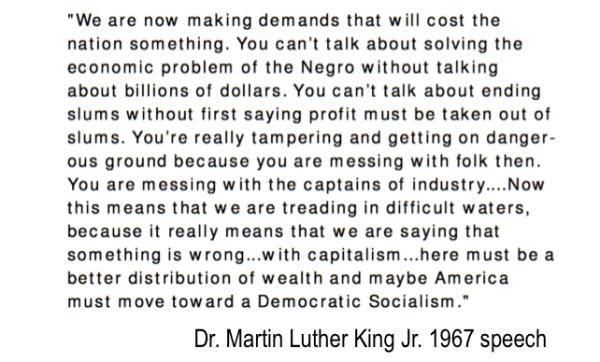
 For years now we have been writing about the West Michigan power structure. What we mean by the West Michigan power structure is the individuals and organizations that have the most power in determining political, economic and social realities in the greater Grand Rapids area.
Too often we have focused on the DeVos family members, in part, because they have the most combined wealth, along with the fact that they have inserted themselves in numerous structures with the goal of influencing the policies and practices of government, education, business, non-profit and cultural realities in Grand Rapids.
However, this focus on the DeVos family has also resulted in limited attention given to other people in the capitalist class that have often flown under the radar.
A recent report by the Michigan Campaign Finance Network (MCFN) on the financial backing of judges in the November 2016 election, illustrates the importance of shinning a light on other members of the West Michigan power structure.
In the MCFN report, they identify four members of the capitalist class in Grand Rapids that made significant financial contributions to the judges that ended up winning the election. Those four individuals cited in the MCFN report are Micheal Jandernoa (42 North Partners), John Kennedy (Autoncam), Peter Secchia (formerly with Universal Forest Products) and Mark Murray (Meijer Corporation).

You can see from the graphic above, the amount of money that these four people contributed to Judges Viviano and Larsen. Jandernoa contributed a total of $13,600, Kennedy $13,600, Secchia $13,600 and Murray $13,600.

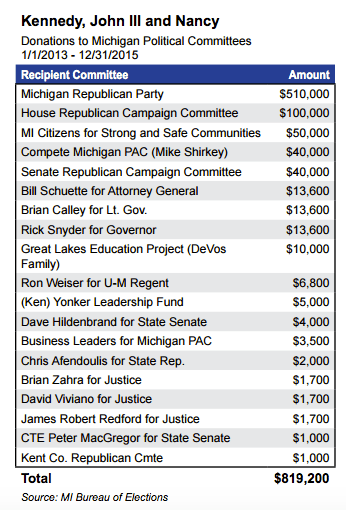 This is not new for these members of the West Michigan power structure, in terms of how much money they use to influence the outcomes of elections. In a report published by the Michigan Campaign Finance Network in 2015, they track those individuals who have contributed the most during the 2013-2014 election cycle. Above is the list of major donors from that report. Both Jandernoa and Kennedy are listed in the chart as some of the largest contributors. To the right, you can just how much and who were the recipients of funds from John and Nancy Kennedy.
Besides using their money to influence electoral outcomes, members of the West Michigan power structure also play other roles in influencing the policies, practices and outcomes in the greater Grand Rapids area. One role they play is to play an active role, often as members of boards of organizations that practice the same values that these men embrace.
For instance, some of these same men sit on the board of directors of the West Michigan Policy Forum, which is one of the most influential policy groups in the area. All four of the men mentioned earlier – Jandernoa, Kennedy, Secchia and Murray – are members of the board of directors. Since the creation of the West Michigan Policy Forum, they have influence state policy on the business tax, making Michigan a Right to Work state, education policy and most recently attempting to get state employee pensions eliminated.
John Kennedy sits on the board of the Right Place Inc, which promotes business interests in West Michigan. John Kennedy also sits of the board of the far right think tank, the Acton Institute. Michael Jandernoa, John Kennedy, Peter Secchia and Mark Murray all sit on the board of the GVSU Foundation. Michael Jandernoa and Peter Secchia sit on the board of directors of the Van Andel Institute.

This is just a sampling of what role some of the members of the West Michigan power structure in the larger community, particularly in positions of power with organizations and entities that have tremendous influence in this community. All of this is to say that there is a interlocking system of power in West Michigan, often made up a small group of people who just happen to be members of the capitalist class.
We hope to continue to shine the light on the West Michigan power structure and its members.
 It’s another year and the richest people in Michigan are getting even richer.
Yesterday, MLive posted a story based on the annual Forbes listing of the wealthiest people on the planet.
The MLive story focuses mostly on the wealthiest people in West Michigan, noting that Doug & Hank Meijer have the most combined wealth at $7.2 billion, followed by Rich DeVos, with estimated wealth at $5.6 billion. Other Michigan billionaires mentioned in the article call Detroit home, Marian Ilitch and Dan Gilbert, worth $6 billion and $5.8 billion respectively.
Towards the end of the article it states:
“The number of billionaires globally climbed 13 percent to a record 2,043 from 1,810 last year, according to Forbes. Their total net worth jumped by 18 percent to $7.67 trillion, another record.”
The number of billionaires and their total net worth are staggering. However, what the MLive article fails to discuss are how the wealthiest people increased their wealth and why there is such a significant wealth gap.
Just telling us that the rich got richer doesn’t really inform us. In fact, regurgitating the Forbes list doesn’t benefit the public at all. What the MLive article actually does is to continue to protect the wealthiest people by implying that these people are wealthy simply because they earned it.
There are plenty of reasons why there is such a huge gap between the wealthiest people in the US and the rest of us. The Urban Institute has 9 charts about Wealth Inequality in America, that are informative and instructive.
One chart, which is interactive, shows how wealth is concentrated at the top.

The Institute for Policy Studies also has some important visuals to help us understand the wealth gap in the US.
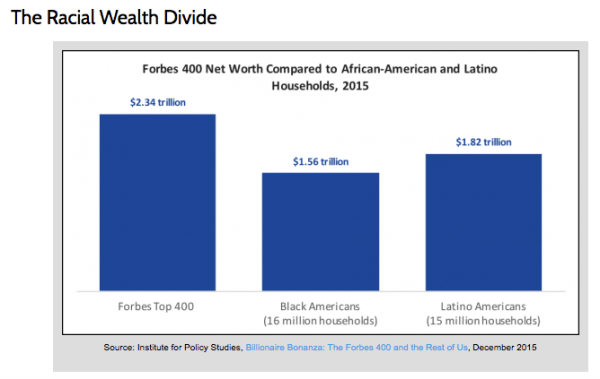
Part of the wealth gap in the US is rooted in White Supremacy, which as a system of oppression, has benefited white people over communities of color. The graphic below illustrates the wealth disparity along racial lines, where the top 400 wealthiest people have more wealth than 16 million Black households or 15 million Latino households.
However, even these charts fail to fully communicate the reasons why there are so few wealthy people, who are increasing their wealth, and so many people experiencing poverty.
United for a Fair Economy publishes an annual report on both economic and racial disparities in the US. The report uses Dr. Martin Luther King Jr.’s notion of The Dream, but quite often is comes across as a nightmare, considering the growing racialized wealth gap in the country.
What is really important in this year’s report, is the deep historical factors that have determined the wealth gap in America. In the graphic below, you can see from the pre-colonial period up to the beginning of the 20th century, ways in which the policy gave a boost to some people, yet blocked so many others.

These historical factors led the report’s authors to conclude in the Strategies Moving Forward section, that reparations for Blacks and indigenous communities as the number one priority. Reparations would indeed be an important first step, but it would only go so far as long as the existing economic and political systems were allowed to remain in the hands of the wealthiest people.
Redefining what is means to be wealthy
Maybe one of our problems is how we talk about and name wealth. Most rich people, like the Meijer and DeVos patriarchs, often refer to themselves as self-made men. The fact is that these men completed relied on the labor of others in order to obtain their wealth. And not only did they rely on the labor of others, they counted on those laborers as being compliant and not rising up to demand the wealth they helped create.
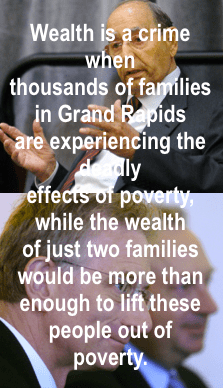
In addition, we might think about referring to those we call wealthy as criminals, especially when considering how many people in Grand Rapids alone are suffering from poverty. Thousands of households in this community are suffering from malnutrition, high stress, fatigue, poor living conditions and limited access to education and health care. The very fact that one in four children live in poverty in Grand Rapids is a crime, while so few have so much.
The Misleading and Unverified claims of Betsy DeVos
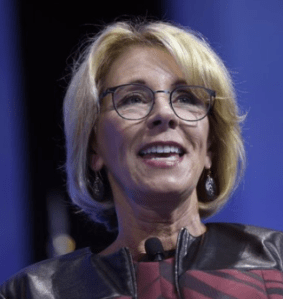 Last Thursday, it was reported that Education Secretary Betsy DeVos was claiming that the administration’s education budget, “places power in the hands of parents and families.”
MLive reported on this story last week, with the announcement that the Trump administration’s budget cuts would take out $9 Billion from the Department of Education.
In a statement released by Betsy DeVos, the Secretary of Education said:
“The budget places power in the hands of parents and families to choose schools that are best for their children by investing an additional $1.4 billion in school choice programs. It continues support for the nation’s most vulnerable populations, such as students with disabilities, while streamlining and simplifying funding for college and continuing to help make college education more affordable.”
The MLive article also includes some additional breakdown of the proposed budget, but beyond that there is no verification of the claims made by Betsy DeVos, nor are there any other voices or perspectives represented in the article.
The lack of verification of claims is pretty standard for stories appearing on Mlive. However, what is even more problematic about the headline and the statement that DeVos made in this story is that it normalizes the position of those who have been pushing for the privatization of public education, expanding the number of charter schools and school vouchers. This is essentially what Betsy DeVos means when she says that the proposed education budget, which increases funding for “school choice,” will do since school choice is code word for privatization, charter schools and school vouchers.
The celebration of increased funding for so-called “school choice,” was celebrated by Education Week, which posted a headline entitled, School Choice a Big Winner in President Trump’s Budget. Education Week also endorses the further privatization of education and a school choice emphasis.
The same can be said for the Michigan-based organization that Betsy DeVos helped to create, the Great Lakes Education Project. GLEP also celebrates the budget and the fact that President Trump, in his first address to Congress, spoke about “school choice.”
A counter to the so-called School Choice narrative can be seen in a recent posting on PRWatch, entitled Trump and DeVos Push ALEC Privatization Scheme as Studies Document Voucher Failures.
The PRWatch article is important for several reasons. First, they point out that the Trump administration education proposals are modeled on the American Legislative Exchange Council (ALEC) bills,which have been adopted in at least 17 states.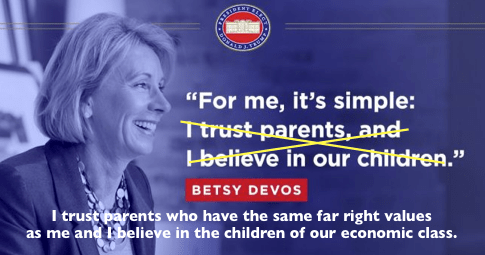
The PRWatch article also points out the push to use taxpayer money to fund the expansion of religious schools, along with the fact that when the public can vote on it, School Voucher Ballot initiatives have failed.
Such a counter narrative is important if people are to have a more complete understanding of education policy and how it continues to shift in the direction that Betsy DeVos and the organizations that she and her husband have been funding for years, such as the American Federation for Children and the Alliance for School Choice.
A great example of a counter narrative, was the recent article in Rolling Stone Magazine entitled, Betsy DeVos’ Holy War.
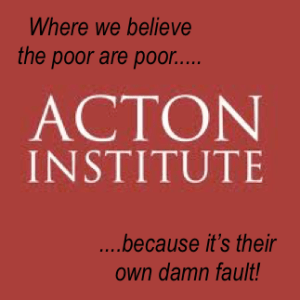 For more than two decades I have been writing about the Grand Rapids-based Acton Institute, an organization that essentially sees christianity and capitalism as compatible.
The DeVos family has been a major donor to the Acton Institute since its founding, along with other members of the Grand Rapids power structure. Several of the DeVos family members have also sat on the board of directors and Betsy DeVos’s mother, Elsa Prince Broekhuizen, is a current member of the board.
The Acton Institute’s founder, Rev. Robert Sirico, has debated against liberation theology on numerous occasions, sometime debated Bishop Thomas Gumbleton from Detroit. The Grand Rapids organization has even funded Exxon/Mobil to the tune of several hundred thousand dollars to deny climate change.
Their positions are often very reactionary and contrary to most justice-based principles, but I found myself particularly disgusted with a recent blog post from the Acton Institute, entitled, 5 Ways the church can help the poor.
I don’t really want to argue theological points or biblical exegesis. There are plenty of people who are more qualified than I who can take on that task. However, what I do think is important to point out in the callousness with which the Acton Institute blogger demonstrates their utter contempt for those who are experiencing poverty.
I want to simply present each of their 5 ways that the church can help the poor and offer up a brief response to each.
The first way the church can help the poor is by teaching “God’s big picture,” which essentially means that the poor should put their faith in the afterlife, since this world is temporal. The Acton writer states, “The poor need to know that poverty is not forever when you’re in Christ.”
Wow, this is the exact same argument that the evangelical community in Guatemala (which was influenced by US-based churches) was making in the 1980s during the years when the army was massacring tens of thousands of indigenous people. People were witnessing the murder of their family members along the disappearance and torture of their neighbors. In the midst of these heinous crimes, the evangelical church was telling those most impacted by the violence to not put much faith in this world, but the next.
The second point the Acton writer makes is that the church should teach the poor about the current job market, with an emphasis on vocational job training, since “Not everyone is going to college.” The poor need to learn their place, by taking jobs that are low paying and in the service sector.
The third way that churches can help the poor is by allowing their buildings to be used by the poor. Doesn’t sound like a bad idea in principle, but then the writer clarifies this point by saying so the poor can fill out job applications, a place for students to do homework or for community development groups to hold meetings. Of the 5 ways the church can help the poor, this is probably the least objectionable, but it still is written from an extremely patronizing place.
The fourth way for the church to help to poor, according to the Acton writer, is to partner with other groups to do personal finance training. Ok, so the problem with the poor is not that many of those experiencing poverty have to work two jobs in order to barely make ends meet or to constantly have to decide whether to pay utility bills or buy groceries. The problem with the poor is they just don’t know how to manage money.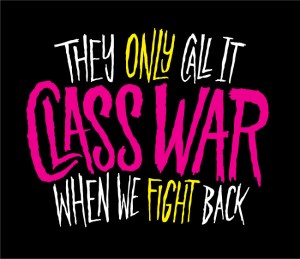
Lastly, the fifth way that the church can help the poor is by using financial resources to help them in “times of crisis.” However, the Acton writer makes it clear that this doesn’t mean “we just hand out benevolence.” Instead, the church should employee people on a temporary basis and become their boss. This, of course, is important because people will just end up being dependent on benevolence and not take any initiative to take care of themselves.
Jesus H Christ, what a load of bullshit. I mean, not only are each of these five suggestions demonstrate nothing but contempt for those experiencing poverty, there is no acknowledgement of the wealth gap in the US or the massive subsidies to the rich in tax breaks and corporate welfare. In fact, there is no mention of the structural violence caused by the economic system of capitalism, since it all comes down to individual behavior.
Not that I was expecting anything different from an organization that is essentially apologists for capitalism, but I was somewhat amazed at the lack of compassion or sense of justice that the Acton writer displayed.
The Corporatization of Rental Properties in Grand Rapids
Over the past decade, Grand Rapids has seen a shift in the housing market as it relates to rental properties.
 First, the cost to rent in Grand Rapids has gone up considerably and in many cases the cost has doubled in the post 10 years. Many tenants we have spoken to have said that they can no longer afford the monthly rental costs, which averages between $800 – $1,000 per month. We are not talking about most of the newer development projects across the city, where rental costs are even higher, we are talking about the cost of rent in neighborhoods that have been around for the past 75 – 100 years. A neighborhood organizer with West Grand Neighborhood, which is on the near westside, said at a Grand Rapids Homes for All event last July that she has seen rent double in the past five years for working class families that can no longer afford to live in that neighborhood.
The second major factor impacting rental properties in Grand Rapids has been the shift in ownership. What has been happening in Grand Rapids, like in many cities across the country, is that larger property management companies are buying up property as investments in the changing housing markets. Just a few decades ago, more of the rental properties in Grand Rapids were owned and operated by local landlords and property management entities. Now we are seeing the emergence of corporate landlords. Companies, often based outside of Michigan, are buying up properties throughout Grand Rapids because of the profitability in the housing market.
For instance, while working on some research for the Grand Rapids Tenant Union, we came across numerous properties in the Garfield Park neighborhood area that are owned by property management companies in Texas, Colorado, California and Illinois. One company in particular, stood out, a company called RDG Fund – 5 LTH LLC.
RDG Fund – 5 LTH LLC, according to the Grand Rapids City parcel map lists the company as based out of Chicago. The business was registered in Illinois by William Rudnick, who has two other businesses registered under his name in Chicago. Rudnick works for DLA Piper, which is a global law firm representing Fortune 500 companies. RDG Fund – 5 LTH LLC owns at least 6 rental properties in the Garfield Park neighborhood area.
Another rental property we came across while doing research, was listed as being owned by People Space LLC. The address for People Space LLC is 838 Cherry St Se in Grand Rapids, which happens to be the address of American Realty. However, unless people knew where to look, People Space LLC seems to be a stand alone small business, when in fact, they are part of a company that manages roughly 250 properties in the greater Grand Rapids area.
These are some of the complex forces that are behind the gentrification of Grand Rapids and these are the obstacles that working class individuals and families are facing when attempting to rent in the area.
Earlier we mentioned that we were doing research for the Grand Rapids Tenant Union, which is part of the group Grand Rapids Homes for All. The Tenant Union has only been around for a few months and is attempting to organize those who rent to fight against the rising cost of rent and the corporatization of the housing market in Grand Rapids.
The Grand Rapids Tenant Union meets monthly and is open to anyone who is a renter in Grand Rapids. They work on promoting renters rights and demonstrating the kind of power tenants can have when they are organized and unified to fight for housing justice in Grand Rapids.
Their next meeting is tomorrow night, Thursday, March 16 at 6pm at the Garfield Park Neighborhood Association. For more information go to this link. If you are unable to attend this meeting, you can contact the Grand Rapids Tenant Union by sending an e-mail to info@grhomesforall.com.

