Calls for a State of Emergency in Grand Rapids elicits no meaningful response from City Officials
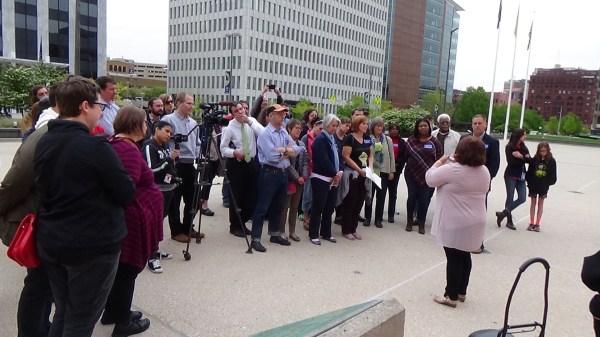
Last night about 40 people gathered outside of city hall for a Prayer Rally for Change. The Micah Center and mothers of the 5 Grand Rapids boys who were held at gunpoint by the GRPD organized the event as a way to respond to the recent examples of oppressive behavior from the police – holding 5 African American boys at gunpoint, the traffic study and the police shooting and killing an African American man.
The who spoke and offered up prayers were from the Black and Latino/a communities and was a moving display of solidarity between the two communities. One of the mothers who’s son was held at gunpoint by the GRPD on March 24, also spoke briefly and expressed disappointment and frustration at the lack of action being taken by city officials.
After the prayer rally, people were invited to attend the Grand Rapids City Commission meeting. The room was full, with only a couple of empty seats when the meeting started. After dealing with items on the agenda, the Public Comment period was opened and dozens of people got up to speak primarily addressing the oppressive incidents and tactics by the GRPD.
Early on, Rev. Jerry Bishop spoke and said that he had invited 100 Black men to a meeting the day before to discuss the level of violence in the community and was calling for a State of Emergency. He invited the men who had met with him the night before to stand up as a demonstration of their solidarity and commitment to the demand for a State of Emergency.
Many of those same African American men got up to speak with common themes. Most of them talked about not feeling safe in the community, specifically not feeling safe when the GRPD was around. Other men fought back tears when talking about how difficult it has been to have conversations with their children about what has been happening in recent weeks and how they fear for their children’s lives.
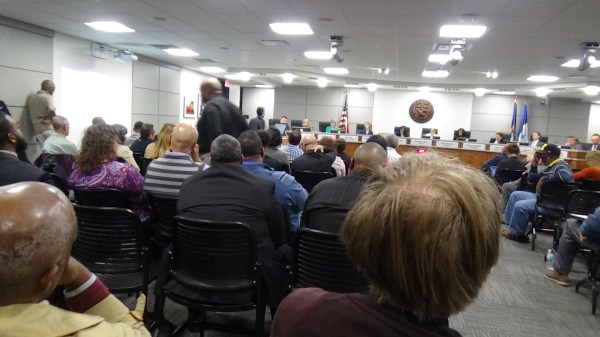
Members of the Latino/a community also spoke about being harassed by the GRPD and that they came to mostly stand in solidarity with their Black brothers and sisters in the struggle.
Other people addressed issues around the lack of response from City officials on these matters and were “shocked” that the city has taken no concrete action based upon the demands the community has made over the past 6 weeks.
Another speaker addressed the fact that the police department consumes a full third of the City’s budget and that instead of allowing the GRPD to use so much of the taxpayers money, it should instead be diverted to providing job opportunities and to fund many of the youth-based programs that many of the African American men who were in attendance, were involved in.
In the end the Mayor said that they heard people’s concerns and thanked them for speaking. However, no verbal commitment was made by city officials last night, which this writer finds unacceptable. How can you hear community member after community member address such crucial issues and collectively call for a State of Emergency and not make some sort of commitment to take action?
One thing that the Micah Center, LINC, the NAACP=GR and MOBB United is doing is hosting meetings to discuss the 12-point plan the city has been working on since the summer of 2015. The first meeting will be held at LINC on Tuesday, May 23 from 5:30 – 8pm in the LINC Gallery, 1167 Madison Ave. SE in Grand Rapids.
 Two weeks ago Michigan Radio ran an investigative story that confirms what many of us in this community have been saying for years about the current housing crisis. Pushed Out: A documentary on housing in Grand Rapids is an important and timely contribution to the current affordable housing crisis in this city. The story makes it clear that the cost of rent and the cost of housing has skyrocketed, along with the fact that more and more companies from outside of the area and outside of the state are buying up properties all across Grand Rapids.
This recent story on Michigan Radio is what makes the recent announcement so difficult to swallow. On Thursday, MLive posted yet another story about developers asking for millions in tax breaks, Tax breaks worth $4.8M urged for 3 urban redevelopment projects.
The article states that there are three development projects asking for $4.8 million in tax breaks. The MLive reporter then states that these projects, “will transform their city neighborhoods.”
The MLive reporter doesn’t ask how they will transform neighborhoods, not do they provide any evidence to support such a claim. These development projects many very well transform the neighborhoods they will be located in, but the question is, who will benefit from these development projects? Again, this is not a question that is asked, rather it is assumed it will benefit everyone in these neighborhoods.
 One project is the develop another downtown hotel, a project that is being led by CWD, a company that owns a great deal of property in downtown Grand Rapids already and is part of the West MI power structure, as we noted in a recent posting. The 130-room hotel will certainly be a benefit to the downtown business and property owners, since it provides even more rooms for those coming to Grand Rapids on business trips or as tourists. The CWD hotel will also be run by the Amway Hotel.
The second development project will re-develop an old auto parts building and include a limousine rental business along Ann Street near US 131. One could easily draw conclusions as to who will be the class of people renting limousines, and it won’t be the working class.
The third development project is a project that will be run by Orion Real Estate Solutions, which has been a major contributor to the gentrification of Grand Rapids, with projects like the Gateway at Belknap. This new project, located at 38 College NE, which will house a four story market rate apartment building.
So yes, these project will transform the neighborhoods they are located in. These development projects will benefit the professional class, those who are upwardly mobile, which means it will disproportionately benefit white people.
In addition, the $4.8 million in tax breaks also means that it is money that does not get directed toward providing truly affordable housing for working class and communities of color. The projects and the tax breaks they receive are announced almost every week. This particular amount of $4.8 million could provide simple homes for 48 working class families, at a cost of $100,000 a piece. Even if the construction cost was $150,000 per home, it would still provide 32 homes for families who are struggling to make a living. With millions of dollars in tax breaks being offered by the state and the city on a regular basis, it could translate into hundreds of affordable housing options.
Let’s say that $5 million in tax breaks is being offered by the city and state each month (which we know to be a low estimate). This would mean there would be $60 million in tax breaks for development projects in each year. Imagine the amount of affordable housing options that could be provided in just one year for people who are currently being displaced or priced out of the neighborhoods that they live in.
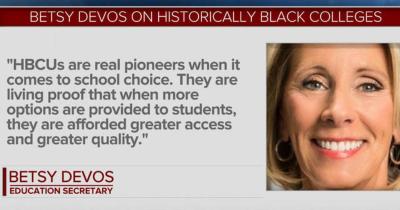 Betsy DeVos is slated to deliver the spring commencement address next Wednesday (May 10) at a private historically black university in Daytona Beach, Bethune-Cookman University.
This announcement has received a tremendous amount of push back, especially after the Secretary of Education stated in February that historically black colleges and universities were “the real pioneers when it comes to school choice” and “living proof that when more options are provided to students, they are afforded greater access and greater quality.”
“Colleges of choice. I mean, we had no other choice but to create HBCUs,” Cynthia Slater, president of the Daytona Beach NAACP Branch, said.
The NAACP, students and residents marched for about a mile on Wednesday from New Mt. Zion Church in Daytona Beach, showing their disapproval of DeVos as BCU’s commencement speaker.
According to the Tampa Bay Times, the Florida chapter of the NAACP called the scheduled speech a “slap in the face to minorities, women and all communities of color.”
Students and Alumni have created a petition to demand that the university dis-invite the Secretary of Education. The petition, in part, reads:
Betsy DeVos doesn’t understand that HBCUs were created because African Americans were excluded from mainstream institutions. Secretary DeVos has no understanding of the importance, contributions, and significance of HBCUs.
Having DeVos speak at the commencement ceremony is an insult to the BCU graduating class, students, alumni, family, friends, and Dr. Mary McLeod Bethune’s legacy.We, the proud alumni of Bethune-Cookman University, do not want Betsy DeVos to have a seat at our table. Please rescind her invitation to speak at the graduation ceremony.
For years the school privatization movement, which has included Betsy DeVos as one of its champions, has attempted to win over the black community and push for “school choice” or school privatization. In a recent article on Black Agenda Report, Glen Ford made the following point:
“Never in history have Black Americans marched, rallied or petitioned for private school vouchers.”
Evelyn Bethune, granddaughter of school founder Mary McLeod Bethune, said a commencement is the wrong forum for DeVos because it should be a “very sacred ceremony.”
“Graduation is a really big deal for our kids and for their families,” said Bethune, who graduated from Bethune-Cookman in 1979 and whose grandson will graduate with a master’s degree next week. “That spotlight should be on them and not on the controversy of the speaker that has been invited.”
Still, Evelyn Bethune takes exception to school administrators comparing the work of her grandmother to what DeVos stands for today. She said her grandmother was a strong proponent of education while being able to relate to common people.
“I don’t see any of that in Ms. DeVos,” said Bethune, who still lives in Daytona Beach and heads up an educational foundation and education consulting firm. “I’ve looked at her history, I’ve looked at the things that she has been connected to and I don’t see any resemblance to anything related to my grandmother.”
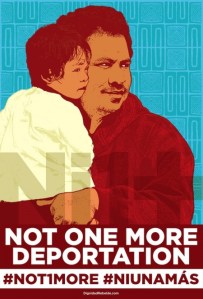 There are an estimated 10 million undocumented immigrants in the United States, immigrants who live in constant fear of harassment, intimidation, arrest, detention and deportation.
During the Obama administration, roughly 2.7 million undocumented immigrants were deported. Under the Trump administration the anti-immigrant discourse has increased and some of the earliest Executive Orders focused on building a wall along the US/Mexican border, hiring more Immigration, Customs & Enforcement officials and deporting more immigrants that are undocumented.
The urgency to take action in response to federal policies has resulted in a growing coalition of organizers and activists that are calling themselves the Grand Rapids Immigrant Solidarity Network. This group of people has been meeting since late last year to discuss ways in which those who hold a whole lot more privilege in this society can stand in solidarity with the immigrant community.
On Monday, there was a large march in Grand Rapids, there have been forums on providing sanctuary to those living in fear, know your rights trainings to inform the immigrant community what their legal rights are and an effort to respond to the repressive practices of Immigration, Customs & Enforcement (ICE) agents.
The campaign is called Rapid Response to ICE and consists of two major components. First, the group is distributing cards in the community that say, What to Do if ICE Shows Up? These cards are in English and in Spanish, provide information on what to do if ICE agents show up and encourage people to call 211 if they live in Kent County.

If people call 211 when ICE agents show up at their homes or places of work, they will be directed to a Rapid Response Team. The Rapid Response Team is made up of nearly 200 people who have been training in a variety of tactics and responses when ICE agents attempt to arrest, detain and deport undocumented immigrants.
There have been several trainings that have taken place in the community for Rapid Response and the next one will be help on Thursday, May 11, beginning at 6:30pm. These trainings are designed for people who want to take action and stand in solidarity with those being targeted by ICE. These trainings are not informational session, rather they are for people who are willing to use their privilege to prevent and respond to any attempted arrests, detentions and deportation of the undocumented community.
For more information on the May 11 training, go to the Facebook event and make sure you follow the instructions on how to register.
2,000 march in Grand Rapids to demand Respect, Dignity and Permanent Protection for All Immigrants
(Just as a matter of transparency. Yesterday, I participated in a march for immigrant justice by providing some security for those marching.)
An estimated 2,000 people turned out yesterday to march for dignity, respect and permanent protection against harassment, arrest and deportation.

Those marching were mostly Latinos, Latinix, and indigenous people from Mexico, Central America and numerous Caribbean nations. Some proudly displayed flags from their country of origin, while other carried signs with demands to stop Separating Families because of the decades-long policy of deporting those without documentation.
The march was organized by Movimiento Cosecha Grand Rapids, which is part of a national movement led by those most impacted by the repressive and unjust immigration policies in the US. The organizers had hoped to match the march that was held in 2006, when 10,000 people marched for immigrant rights, but fell way short of that goal.
However, in 2006, there was no clear long-term strategy and the movement died out in just a few months. Those who organized the march that was held yesterday only see this action as the beginning of a campaign to achieve dignity, respect and permanent protection for all immigrants.
The march began at Garfield Park on Burton and moved west to Division Avenue. People cheered from their porches or came out of the businesses that are along Division, while others decided to join the march.
The march organizers did not obtain a permit, since they felt that it was their right to march for what they were demanding. The GRPD was frantic before the march, calling organizers and others connected to the movement, but no one was giving up any information. The GRPD decided to close down roads on their own to clear a path for the march, but the march organizers were clear in that they were providing enough protection for marchers on their own.

At one point the march made a left onto Franklin St. and was head west towards Grandville Ave.You can see from the photo above that the cops had blocked the entire road and were determined to not let anyone continue west on Franklin. 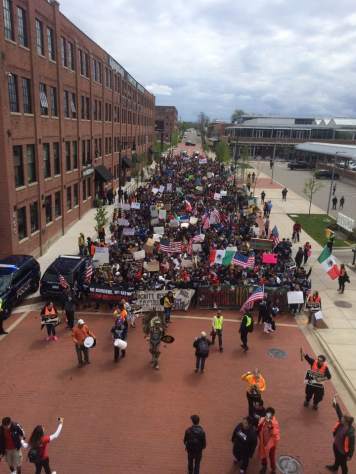
When the marchers arrived at the cop blockade, the GRPD then not only made it clear that people could not continue west on Franklin, but that people would be arrested if they attempted to do so. From that point on, the cops clearly wanted to dictate the march route and make sure they were in control.
Undeterred, the marchers continued along Ionia making noise and marching slower so as to draw as much attention to the march as possible to those working downtown, shopping or living in one of the many development projects that have popped up throughout the downtown in recent years. At one point the march stopped completely to allow one of the marchers to share her story that reflected the difficulty that most immigrants face when coming to the US.
At one point a band joined the march, which elicited a loud response from the marchers. The band accompanied the march until it reached its destination at the Calder Plaza. Once the march arrived, march organizers made a few brief comments about next steps. People were invited to a meeting this Saturday at 9am to talk more about the Movimiento Cosecha and how to get involved.
I have been writing about the Acton Institute for more than 20 years. My first article on the Right Wing Think Tank was published in 1994, was entitled, Lord-ing it over others: Local Think Tank Feels Right at Home. 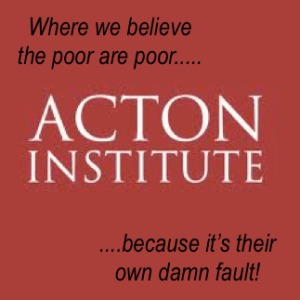
In that article I spoke about Acton’s mission, politics and who sat on their board of directors in the early 1990s. The Acton Institute has grown significantly since then, with dozens of staff members, the publication of books and lots of online media. The founder, Rev. Robert Sirico and many other Acton Institute staff members are regularly invited as guests on national media outlets, like Fox News.
In that 1994 article, I did focus a bit on some of the members of the board of directors, since many of the members then were part of the larger far right network. This still holds true today. Therefore, I would like to spend the rest of this article looking at who makes up the current Board of Directors at the Acton Institute for the Study of Religion and Liberty.
The current board (2017) continues to be made up of people who not only share similar ideological perspectives, they are part of the far right, religious right and neoliberal capitalist class that perpetuates harm done to the most vulnerable in our society.
The Acton board consists of 14 members. Two of those members are part of the Acton Institute’s leadership, with the founder of the Institute, Rev. Robert Sirico and Kris Mauren, who has been one of the longest staff members and is currently the Executive Director. The other 12 board members will be listed in alphabetical order.
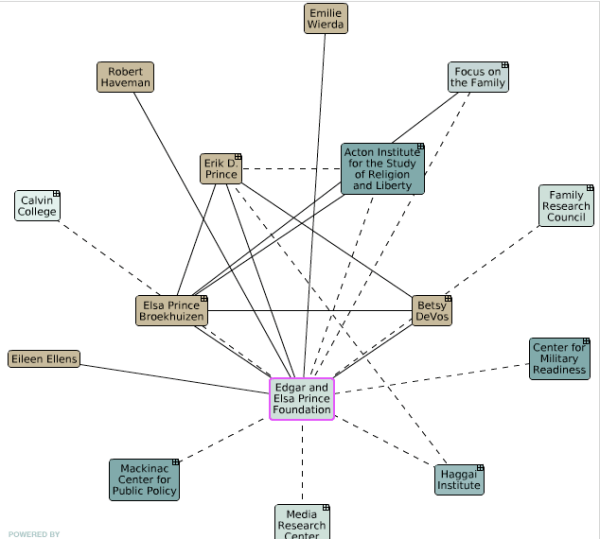
Elsa Prince Broekhuizen
Elsa Prince Broekhuizen is the former wife of Edgar Prince, who made his money from a company he founded in Holland called the Prince Company. As a couple, Edgar and Elsa Prince, were a formidable pair that funded numerous right wing causes and controlled a great deal of the economic, social and cultural dynamics in Holland. Edgar and Elsa Prince are the parents of Erik Prince, the founder of Blackwater, and Betsy Prince, who married into the DeVos family and is the current Secretary of Education.
The Edgar and Elsa Prince Foundation has for years funded efforts to limited LGBT equality around the country. However, the Prince Foundation has primarily funded Christian organizations that promote patriarchal values, groups like Focus on the Family, the Family Research Council, the Promise Keepers and the Rutherford Institute. This foundation also contributes substantial amounts of money to pro-free market think tanks like the Mackinac Center for Public Policy, the Competitive Enterprise Institute and the Acton Institute.
Gaylen Byker
Gaylen Byker was the President of Calvin College from 1995 – 2012. Before becoming Calvin’s President, Byker was an international businessman with ties to the energy sector and international banking.
A 2016 MLive article revealed that Byker lived in a $10 million mansion along Lake Michigan, near Montague. Before leaving his tenure at Calvin College and since then, there has been numerous stories about financial conflicts of interest. While Byker was President of Calvin College, the school accrued some debt, so the college made some investments. Some of those investments were managed by the Fuller Foundation, an entity that included Gaylen Byker as a member of the Board of Directors while he was President of Calvin College.
Byker was also a director at the InterOil Corporation, which now appears to be part of the largest oil conglomerate in the world, ExxonMobile. The connection to big oil makes sense, considering the fact that the Acton Institute took money from Exxon for years in exchange for their commitment to deny climate change.
Alejandro Chafuen
Alejandro Chafuen is the former president of the Atlas Network, “a Washington DC-based non-profit organization that works to support and grow a network of more than 400 think tanks in more than 80 countries promoting individual liberty and free market ideals.” 
Know as the Johnny Appleseed of anti-regulation groups. The Atlas Network also has a history of climate denial and works closely with the State Policy Network, a Koch brothers funded organization that pushes state policy changes like Right to Work, privatization and other austerity measures at the state level.
Chafuen is a serious defender of free market capitalism, and like Acton founder Robert Sirico, believes that Christianity and Capitalism are perfect bedfellows. Chafuen sits on the boards of numerous other far right entities and is a regular columnist for Forbes Magazine.
John P. Crowe
John Crowe is the founder of the John Crowe Company and has a history of being involved in start up companies. Crowe founded JFJ Traders in 1987 and JFJ Real Estate in 1992, which owns and operates commercial buildings around the country. There is not much additional information on Crowe, but it is clear that he is deeply committed to the neoliberal capitalist principles that the Acton Institute was founded on.
David A. Durell
David Durell is connected to the George Edward Durell Foundation, which funds lots of far right organizations and think tanks, like the Acton Institute. Durell was also appointed as a Trustee of the arch-conservative center of higher learning, Hillsdale College.
Hillsdale College is noted for being a hyper-conservative college, with far right ties. Former president of Hillsdale, George Roche sat on the advisory board of the US affiliate of the World Anti-Communist League. This educational institution has hosted forums with speakers such as Manuel Ayau, a member of Guatemala’s Amigos del Pais, a group linked to death squads. Hillsdale also houses the late John Bircher Clarence Manion’s tape collection, with lectures by former Nicaraguan dictator Anastasio Somoza. Hillsdale’s magazine Imprimis provides a forum for anti-minority views. In one issue they gave space to the director of English Only, to condemn advocates of cultural diversity and bilingual education.
Sean M. Fieler
Sean Fieler is a founder of Equinox Partners and former co-founder of the hedge fund group, Mason Hill Advisors. Inside Philanthropy refers to Fieler and the Hedge Funder who promotes conservative values. According to that same Inside Philanthropy article, “Fieler has opposed gay marriage, and once said, according to the New York Times, “the problem with gay marriage… is it promotes a very harmful myth about the gay lifestyle. It suggests that gay relationships lend themselves to monogamy, stability, health and parenting in the same way heterosexual relationships do. That’s not true.”
According to an article in the Huffington Post:
Beyond his electoral spending, Fieler has donated millions to anti-abortion and anti-gay marriage advocacy groups, mostly through his Chiaroscuro Foundation. The nonprofit group, named after a Renaissance painting style favoring high contrast between dark and light, has received more than $19 million from Fieler since 2010.
Most of the foundation’s contributions have gone to Catholic, anti-abortion and anti-birth-control organizations, but some funding has gone to anti-gay groups as well. The foundation has directed at least $220,000 since 2010 to the Catholic Family and Human Rights Institute, a nonprofit that advocates against LGBT rights at the United Nations. C-FAM backed the anti-gay laws in Uganda that have been denounced as criminalizing homosexuality and deployed lawyers to help defend Belize’s anti-gay laws. It voiced support for the anti-gay laws adopted by Russia in 2013 and encouraged the United States to adopt such policies.
Leslie B. Graves
Leslie Graves is the president of the Lucy Burns Institute (LBI), a non-profit based in Madison, Wisconsin that has direct ties to the State Policy Network.
According to SourceWatch:
LBI is an “associate” member of the State Policy Network (SPN), which connects and funds conservative state-based think tanks and receives partial funding from The Claude R. Lambe Foundation. SPN is an ALEC member and “Chairman” level sponsor of its 2011 Annual Meeting, and many of its affiliated think tanks are ALEC members as well.[4] LBI offers free wiki training seminars to SPN members[5] and LBI’s President Leslie Graves and LBI have been featured at SPN events.[6]
Frank J. Hanna III
Frank Hanna III is the CEO of Hanna Capital and has been instrumental in the funding and advocacy of numerous Catholic Institutions around the country.
During the administration of George W. Bush, Frank served as co-chair of a Presidential Commission on Education and oversaw the production and delivery of its report to the President: “From Risk to Opportunity.”
Hanna Capital is also a financial supporter of numerous religious right entities and has consistently provided funding to the Acton Institute.
J C Huizenga
JC Huizenga is founder of Huizenga Group, which operates seven diverse manufacturing companies, a commercial contracting firm, and a consumer products packaging company.
In 1995, Huizenga began (and presently chairs) National Heritage Academies, now serving over 51,000 students in 76 schools across nine states. National Heritage was founded out of Huizenga’s conviction that every child deserves the opportunity to achieve their dreams. National Heritage was listed in Inc. magazine’s “500 Fastest Growing Private Companies” four consecutive years.
Huizenga is a West Michigan native and in addition to sitting on the Acton Institute board,he also sits on the board of the Mackinac Center for Public Policy. Huizenga has been part of the West Michigan power structure for years.
David C. Humphreies
David Humpheries is President and CEO of the Tamko Building Products, based in Joplin, Missouri. Last July is was revealed that Humphries was funding political races in Missouri, specifically to target Republican candidates that did not support Right to Work laws.
John C. Kennedy III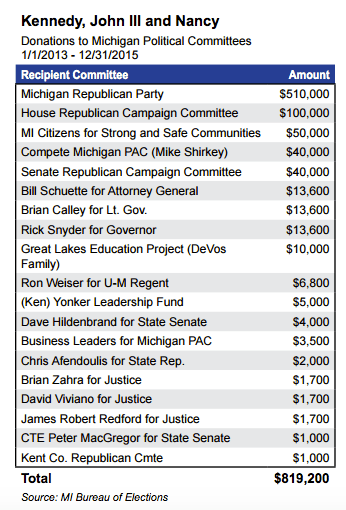
John Kennedy is the CEO of Autocam and part of the West Michigan Power Structure. Kennedy is also a board member of the West Michigan Policy Forum, which pushes for state policy changes that benefit those in the capitalist class.
Kennedy is also on the board of the Right Place Inc, the GVSU Foundation and is currently a trustee of Grand Valley State University.
James C. Rahn
James Rahn is the President of the Kern Family Foundation. The Kern Family Foundation promotes “entrepreneurialism,” meaning they fund neoliberal capitalist entities, like the Acton Institute.
The Kern Family Foundation is also a major player in funding Charter Schools and other “school choice” programs.Kern’s K-12 Education program has clear ideological roots — namely, the idea that choice and competition will improve the quality of education across the country. James C. Rahn serves on the national council of the conservative American Enterprise Institute and is on the board of the Charter School Growth Fund.
Therefore, it seems pretty clear that those who sit on the board of the Acton Institute are free market capitalist proponents, part of the religious right, are anti-union, anti-LGBT, anti-Choice, anti-government regulation, pro-school privatization and are well connected to the vast network of far right organizations and infrastructure all across the country.
Grand Rapids Cosecha Movement holds Press Conference to draw attention to May 1st Day Without Immigrants

Earlier today, three people who were arrested on April 20 for taking action in solidarity with the undocumented community, all plead not guilty to misdemeanor charges at the Kent County Court House.
 Gema Lowe, who is a volunteer with the Grand Rapids Cosecha Movement, spoke first at the press conference, to provide some context for the April 20 action and the upcoming May 1st march themed as Un Dia Sin Immigrantes.
Gema spoke about this movement being about the dignity, respect and permanent protection of immigrants, particularly of undocumented immigrants. “When our families members die in our country of origin, we often can’t go, because we would never be able to get back in the US. This means we often don’t get to pay proper respect to family members who have died.
After Gema, an immigrant shared her story about coming from the Dominican Republic and becoming a foster parent to several refugee children who fled war-torn countries.
The rest of the Press Conference consisted of two of the three people arrested on April 20th, sharing a few words about why they did what they did. In the video below, we hear from Louis DeShane, a member of the Grand Rapids ATU, which is the bus driver’s union in Grand Rapids.
Rockford Construction receives more state and local welfare to expand their control of land on Grand Rapids westside
On Tuesday, it was announced that the Michigan Strategic Fund board approved the Brownfield project receiving a $13.2 million tax break and a $6.3 million low-interest loan, according to an article that appeared on MLive. 
CEO of Rockford Construction, Mike VanGessel said of this news:
“A project of this scale requires a high level of collaboration at the local and state level. We are thankful to the City of Grand Rapids and the State of Michigan for their support in making this vision a reality for our neighborhood. This is a key approval for this transformational project, and it couldn’t move forward without it.”
What VanGessel is really saying is that unless public money is redirected to Rockford Construction for this project, they would not be able to make the kind of profits they want from such an endeavor.
Rockford Construction and other developers would have us all believe that these project, which rely heavily on public money, will benefit the whole community. This just isn’t the case and the trend is that all the development projects in Grand Rapids in recent years benefits the professional class, investors and other business sectors. There is little to no evidence that working class families or communities of color are benefitting to the ongoing gentrification of Grand Rapids.
In looking at the Michigan Strategic Fund packet for April 25th, one gets some interesting insights into the mindset of those making these decisions. Information on the Rockford Construction project begins on page 128.
The Michigan Strategic Fund document states that the project involves the development of the first full service urban grocery store in downtown Grand Rapids. This statement is interesting, considering that within 100 yards of the proposed site of the Meijer store is a Duthlers grocery store on Bridge St. Granted, the Meijer store will be a major upgrade to the Duthler, but this should be viewed as a reflection of the new class of people that the project, along with the growing number of Rockford Construction projects that have emerged on Bridge and Fulton St. in recent years.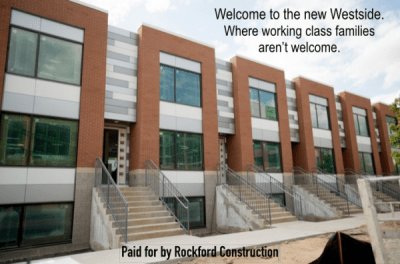
On page 134 of the Michigan Strategic Fund packet is states that the new grocery store will be “offering fresh food within easy access to transit and nearby walkable neighborhoods. The grocery component is expected to service all of the downtown as well as the neighborhoods within a 1 – 2 mile radius.” Let’s be clear that what most contemporary grocery stores offer is not primarily “fresh food,” instead they offer mostly highly process food items that can hardly be identified as fresh.
On the same page, the document further states that the project will, “add at least 130 full-time equivalent jobs for varying skill levels to a neighborhood with a high unemployment rate relative to the rest of the city.” Will these jobs pay a living wage and will they be made available to those who are unemployed or underemployed that live on the near westside? The document does not address these issues, because we are all supposed to be content with the fact that jobs will be created.
However, what the document reveals next provides insight into the larger reason why this development project, along with many others in recent years, are embraced by the planners, decision-makers and investors who are rarely held accountable:
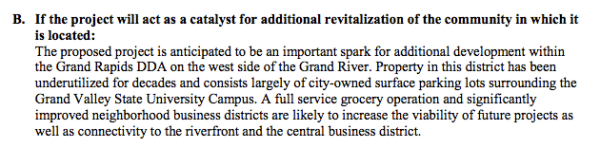
These development projects are all designed to play a major role into the gentrification of areas of Grand Rapids that those in power have been interested in for the past few decades. It’s all about improving business districts and providing greater investment opportunities to companies that, as a recent report from Michigan Radio made clear, are not even based in Grand Rapids. The flip side of all this new development that will benefit the business class and lead to more investment opportunities, is that it will result in the further marginalization of communities of color and working class families, causing more displacement and pricing people out of neighborhoods that have been traditionally working class for decades.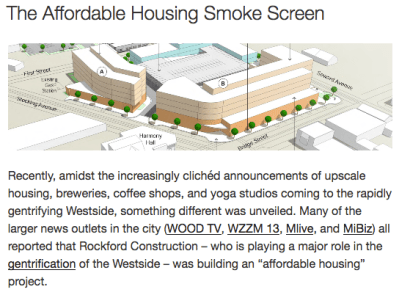
Doesn’t the Affordable Housing component of this project make it all work out?
While it is true that there will be affordable housing units in this new project, this does not reduce the gentrifying effect that Rockford Construction has had on the westside and in other parts of the city. The blog, If the River Swells, aptly entitled an article from last year, The Affordable Housing Smoke Screen. All of the housing units that Rockford Construction has been involved in on West Fulton St, Bridge St and Alabama have all been market rate housing. This means that there is a whole class of people who cannot afford to live in these places.
In addition, Rockford Construction is involved in development projects in the Belknap area, as the lead construction company in the GVSU project, the ICCF project on Wealthy and Division, both of which have displaced working class families of people of color.
Lastly, it is important that we also not leave out the role that Rockford Construction’s CEO, Mike VanGessel plays as part of the West Michigan power structure.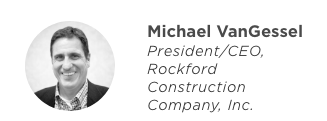
VanGessel sits on the board of directors of the Right Place Inc, along with many of the other members of the West MI power structure. The Rockford Construction CEO also sits on the board of the West Michigan Policy Forum, which has endorsed state policies such as the Right to Work, reducing taxes for businesses and wanting to eliminate public sector employee pensions. VanGessel is also part of the GVSU Foundation board and Rockford Construction is listed as a patron on the Artprize page.
In an MLive article that praised VanGessel and said he wanted to bring “excitement” back to the westside, it states in reference to the earlier Bridge St. development projects:
VanGessel has succeeded in bringing well-heeled investors to the table, such as family members of Amway co-founder Rich DeVos; 42 North, owned by businessman Mike Jandernoa and his family; and SIBSCO, owned by the family of former U.S. Ambassador to Italy Peter Secchia.
Being part of the West Michigan power structure surely has its benefits.
Two weeks ago we wrote about the outcome of the Grand Rapids City Commission meeting that took place shortly after the GRPD, at gun point, falsely accused 5 young African Americans of instigating a fight.
The community once again showed up in numbers at the Grand Rapids City Commission meeting to once again challenge city officials around the recent traffic study, the racism within the GRPD and the lack of affordable housing in the city.
Dozens of people spoke during the public comment period. Some read statements, while others shed tears because of the anger and sadness they feel based on the lack of action from the city. There were several representatives from community-based organizations that spoke, but what was most powerful were the comments from those who have been most impacted by the racist practices of the GRPD and the lack of affordable housing in Grand Rapids.
Despite the input from people throughout the community, the local news media didn’t think that these voices were worthy of being sources to cite in their coverage on Tuesday, April 25. What follows is an analysis of the stories related to the recent practices of the GRPD, its connection to racism and the coverage of the Grand Rapids City Commission meeting on April 25th.
The MLive story was headlined, Commission rejects ‘knee-jerk’ response to Grand Rapids traffic stop study. In the MLive story, the only sources cited were five of the six City Commissioners, City Manager Greg Sundstrom and Police Chief David Rahinsky. To be clear, the MLive article was written at noon on the 25th, after the meeting of the Committee of the Whole, not after the evening meeting where the public comments dominated the meeting.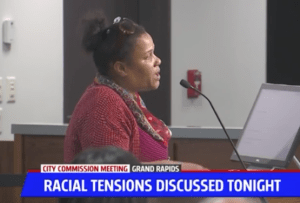
A story on WZZM 13 tended to mimic the MLive article, in that the only voices heard in the story were that of Mayor Bliss and Police Chief Rahinsky.
The WXMI 17 story was an improvement over the WZZM 13 piece, in that the provided brief comments from two African American women, comments that were challenging the city officials. Grand Rapids Mayor Rosalyn Bliss was also cited in the story, a story that was framed as Racial Tensions Discussed at Grand Rapids City Commission meeting.
However, what was problematic about the story was when the two news anchors then brought up children and guns and got the news reporter to talk about recent examples of kids with guns in the Grand Rapids area. This switch to talking about kids and guns diminished the commentary about racism that the story began with. In many ways what the news anchor did was to minimize the issue of racism and to re-frame the story around youth access to guns, even stating that the GRPD follows certain protocol that they will not change with regards to youth and guns.
WOOD TV8 decided to run an interview with Grand Rapids Mayor Bliss, instead of focusing on the community’s reaction at the City Commission meeting. While Mayor Bliss admitted that part of the problem was structural racism, she would not say that the GRPD practices racism when asked by the reporter. In fact, her responses were quite calculated in such a way as to deflect any attention to the recent traffic study and to other GRPD practices, since she felt that every department in the city could “do a better job.” 
It is worth noting that the MLive article and the WZZM 13 story did mention a 2015 report from the City of Grand Rapids called the Safe Alliance for Everyone Anti-Violence Strategy Report & Recommendations. That report offers little in terms of Police and Community relations, as well as any real acknowledgement that the GRPD is an institution that practices systemic racism and White Supremacy.
This is true of the local news coverage within the last 24 hours, where all of the stories are framed in such a way as to make one think that all parties involved are equally responsible for the “racial tensions.” These stories completely avoid what many people from the communities most impacted by these policies and practices of the GRPD, communities of color, have experienced as racism and White Supremacy.
This type of coverage will not likely change, since the commercial media sees police departments as public servants and not as part of a system of oppression.
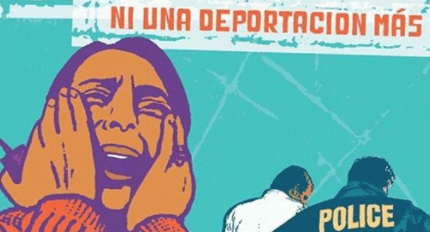 As part of a plan leading up to the May 1st march, A Day Without Immigrants, there was a smaller action today to draw attention to the repressive practices of ICE agents (Immigration Customs and Enforcement).
About 50 people gathered at the Calder Plaza around noon today and then marched over the the ICE office, located on Ottawa, just north of the 196 freeway.
Once the march arrived at the ICE office, the three people who were carrying a banner blocked Ottawa street to further demonstrate their opposition to the targeting of people who are undocumented by ICE agents.
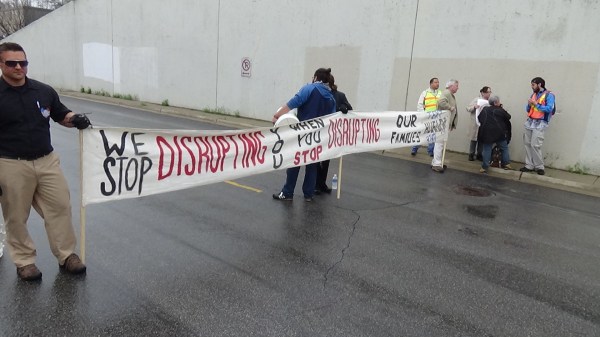
Those from the immigrant community, who organized the action, spoke in Spanish and in English, explaining what the purpose of the action was.
The GRPD arrived shortly after people were blocking the road, but after a brief conversation with the organizers, it was made clear that the police were not going to arrest anyone. Those who organized the action then spent some time discussing amongst themselves what plan of action they would take next. It was then decided that people would walk back towards Michigan St on Ottawa, just beyond where both the eastbound and westbound exits off of 196 are.
you can see from the two pictures below, how traffic was backed up onto the highway from both exits.
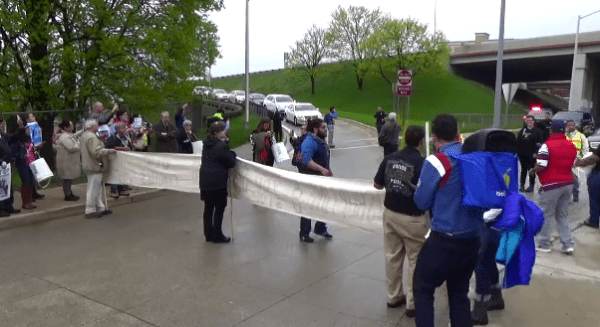
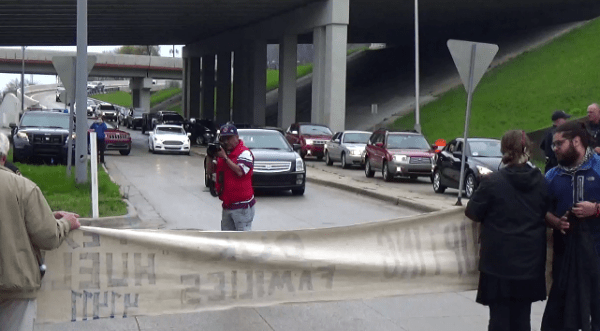
 At this point six GRPD cars converged on the protest march and the arrested the three people who were holding the banner. These three individuals were allies/accomplices who made it clear that this action was not about the, rather it was about the government repression that the undocumented community faces every day. The message was clear from their banner which read, “WE WILL STOP DISRUPTING YOU, WHEN YOU STOP DISRUPTING OUR FAMILIES.

