Writing whatever they say: MLive and Amway
On Monday, MLive ran what I hesitate to call a piece of journalism. The posting on February 12, was entitled, Amway’s 2017 revenues show sales on ‘right track,’ say leaders.
The posting is based on an “interview” that MLive reporter Shandra Martinez did with the Amway co-CEOs Steve Van Andel and Doug DeVos.
A second posting was also done on February 12, entitled, How Amway is appealing to a younger generation.
This second MLive posting, was rather brief and included a 1minute and 31 second interview with the heads of Amway, Steve Van Andel and Doug DeVos, which you can watch below. In fact, the posting essentially regurgitates what Van Andel and DeVos had to say in what MLive refers to as an “interview.”
MLive repeated this process in a posting from February 13, entitled, 50 percent of Amway’s revenues now come from e-commerce.
In fact, MLive will no doubt post 2 additional pieces based on the same “interview” that MLive reporter Shandra Martinez conducted with the second generation Amway CEOs, based on these other videos from the same “interview.”
https://www.youtube.com/watch?v=v9pHYcjbluc
https://www.youtube.com/watch?v=_SjvyuGqX0A
After watching the four videos, it is painfully clear that MLive fundamentally is acting solely as a stenographer, simply writing what the Amway executives have to say. There is only once instance, where the MLive reporter can be heard asking a question, which is a softball question, about what Van Andel and DeVos thought about the new corporate tax breaks.
Imagine what a serious journalist would have asked? Imagine what information or insight would have been gained from a serious, investigative article? Imagine what impact that might have on the public’s view of the the Amway corporation and the DeVos and Van Andel families that are plastered on every other building in downtown Grand Rapids? Well, you will have to keep imagining, since the MLive reporter failed to practice anything that remotely resembled journalism, which we will elaborate on here.
First, it is important to ask ourselves how MLive can claim these postings are anything that resembles journalism. It’s as if the MLive reporter just sat down with the Amway CEOs and said, “what would you like to tell our readers?”
Second, if you are serious about practicing journalism, you don’t interview some of the wealthiest people in West Michigan (who also happen to make it their business to finance political candidates to make sure policies are passed that support their ideological worldview and expand their financial interests), without asking hard, probing questions. The former editor of the GR Press, Mike Lloyd once told me that is was the duty of the Press to, “comfort the afflicted and afflict the comfortable.” This in not practiced at MLive.
Third, based on the commentary from the original article posted early Monday morning, the MLive reporter could have asked some important questions, about why Amway sales have increased in countries like China, South Korea, Japan, Thailand, Taiwan, India, Russia, Malaysia and Hong Kong. More importantly, the MLive reporter could have asked those same question to people who didn’t have the wealth and power that Van Andel and DeVos hold or the reporter could have conducted their own investigation as to why Amway is experiencing these trends.
Fourth, in the video where DeVos and Van Andel talk about the new tax benefits for corporations that the Trump administration passed, any competent reporter would have asked follow up questions, sought out addition sources and even conducted their own analysis of what the recent tax policy of the Trump administration means for the US, who it benefits and who it impacts negatively.
These are not radical notions, this is simply journalism 101. Instead, once again, MLive demonstrates that they rarely practice journalism, especially when it reports on those with wealth and power, like the Amway heirs.
For more on the history of the DeVos Family, check out our 350-page document on the most powerful family in West Michigan, by going to this link.
A Bi-Partisan Betrayal of Dreamers: A Bi-Partisan vote for militarism
 In the very early morning hours of last Friday, Congress passed a two-year budget bill, but completely left Dreamers out of the equation.
In total, 36 Democrats in the Senate and 73 in the House joined the Republican majority in voting for the so-called Bipartisan Budget Act. Among the Democratic Senators to vote against having a Clean Dream Act, were Michigan Senators Gary Peters and Debbie Stabenow.
Those organizing to get a Clean Dream Act passed, have been meeting with Senator Stabenow and her staff in Michigan and in Washington. In addition, the mostly DACA recipients, engaged in a sit-in in Senator Stabenow’s office just a few weeks ago and were given assurances that the Senator would support the Dreamers.
Some people are referring to the Democrats failure to support the Dreamers as an act of betrayal, while others are stating that they “threw the Dreamers under the bus.”
Greisa Martinez Rosas, Advocacy Director for United We Dream, stated:
“Today, the world can legitimately wonder whether an opposition to Trump’s racist agenda exists in Congress. Democrats and moderate Republicans had leverage to protect immigrant youth but instead of protecting us, they used our suffering as a bargaining chip to get more dollars for other projects.
The backstabbing by Chuck Schumer, betrayal by 73 House Democrats and Paul Ryan’s cruel games leave me, my sisters, and millions of immigrant youth at greater risk of being dragged to detention camps and deported. Speeches, crocodile tears and Facebook posts will not save a single life.
Yesterday, over a hundred immigrant youth marched through the halls of Capitol Hill, visiting 240 House Democrats and moderate Republican offices for 14 hours to share our stories and demand permanent protection that does not harm our families and other immigrants.”
However, there is another way to look at the outcome of the vote last Friday, where a Dream Act was not included in the vote. The budget bill that was voted on included a ton of money for the Pentagon and US militarism. One could certainly argue that these are the real constituents of those who occupy seats in Congress. Most Senators and Representatives have military contractors in their districts, which means jobs. Are they really going to piss off those companies and the people they employ?
Here is what Senator Gary Peters tweeted about the budget deal, “The budget deal offers certainty to our military and addresses many outstanding funding priorities.”
Senator Peters sits on the Armed Services Committee and the Homeland Security and Government Affairs Committee. He receives campaign contributions from the military industrial complex and is lobbied directly by the defense industry.
Senator Stabenow, while not directly connected to the Pentagon, has also been a devout supporter of the annual US military budget since taking office in 2000. In addition, Senator Stabenow is up for re-election this year and she doesn’t want to alienate those in the military industrial complex who have contributed to her campaign before.
Remember, this is the so-called Resistance, that those in the Democratic Party like to call themselves these days. Ironically, this is not the only time that Senator Peters and Stabenow have voted with President Trump. You can follow the their votes in The Age of Trump, for both Senator Peters and Senator Stabenow.
Despite the failure of the Democrats to pass a Clean Dream Act, those on the ground who are organizing, the immigrant youth who forced then-President Obama to pass an initial Dream Act, are not giving up and will continue to resist.

Dreamers will be walking from New York to Washington DC, starting February 15 and arriving on March 1st. According to the website for the march, the organizers state:
With the vote count on the Spending bill we have seen once again the lack of courage from Democratic Party members. House Democratic members had the power and leverage to stand up to the hateful anti-immigrant Republican Party leadership to force the Dream Act to be included in the spending bill but decided against standing up for undocumented youth. The Seed Project, along with allies, will be embarking on a walk of hope. The Walk to Stay Home will be starting on February 15, consisting of 11 full time walkers and 15 support members who will be walking from New York City to Washington D.C, where they will be organizing a mass protest when walkers arrive at The Capitol. The Walkers will show members of congress they are not alone and will not accept excuses while being used for achieving higher approval ratings and winning elections. The Walkers demand a clean Dream Act that would grant permanent protection and they demand it now.
La Lucha Sigue!
People from West MI who have contributed the maximum amount to Michigan’s Gubernatorial candidates
 Michigan will be deciding who the next Governor will be this coming November and there has been plenty of money contributed to a variety of candidates running for that office.
According to the Michigan Campaign Finance Network, 318 donors have already given the maximum amount of money allowed under current campaign finance rules.
In addition, there has already been $16 million raised by the eight Gubernatorial candidates, 4 from the GOP and 4 from the Democrats. Of the candidates that have donors who have contributed the maximum amount of $6,800, there are three Republicans and two Democrats.
GOP Candidates who have donors contributing the maximum:
- Bill Schuette has 97 donors who have given the maximum
- Brian Calley has 80 donors who have given the maximum
- Pat Colbeck has 14 donors who have given the maximum
Democratic Candidates who have donors contributing the maximum:
- Abdul El-Sayed has 40 donors who have given the maximum
- Gretchen Whitmer has 80 donors who have given the maximum
West MI Donors who have given the maximum
It is important that we know who the following people are, who have contributed the maximum amount of money to at least one of the candidates for Governor. It’s important because, those who can at the drop of a hat donate $6,800 are part of the capitalist class that too often determines the outcome of elections and influences policy.
It doesn’t matter which candidates they are giving money to, since those who have wealth always want to keep it and increase it. Those who can contribute $6,800 essentially undermine the very notion of democracy and one vote, one person. It is also important to acknowledge that this is how the system of voting is DESIGNED to function. The voting process is not broken, it works quite well for those who have power and want to maintain it.
There is one example you will see below, where someone has donated the maximum amount allowed under current campaign finance laws and given $6,800 to two different candidates. John & Nancy Kennedy have each contributed $6,800 to both Brian Calley and Bill Schuette, thus making sure that they will have access to the two leading Republican candidates.
Bill Schuette Campaign:
- Daniel Bowen DDS $6,800
- William Currie Universal Forrest Products $6,800
- Janice Currie Currie Holdings LLC $6,800
- Mary Ann Keeler $6,800
- John Kennedy AutoCam Medical Corp $6,800
- Nancy Kennedy $6,800
- Joan Secchia $6,800
- Margaret Thompson MSU $6,800
- Jerry Tubergen RDV Corp $6,800
- Marcia Tubergen $6,800
- Lynn White $6,800
Brian Calley Campaign:
- Daniel Bowen Dempsey Ventures $6,800
- Sam Cummings CWD Real Estate $6,800
- Karen DeBlaay Fred Hansen Corp. $6,800
- Dan DeVos DP Fox Ventures $6,800
- Pam DeVos Pamela Roland $6,800
- Sidney Jansma Jr. Wolverine Worldwide $6,800
- John Kennedy AutoCam Inc $6,800
- Nancy Kennedy $6,800
- Dave Killoran ODL Inc $6,800
- Jeffrey Padnos Pandos Corp $6,800
- Richard Riley Grand X-Rays Supply Co. $6,800
- Robert Roth Roman Manufacturing $6,800
- Jim Williams Williams Distributing Co $6,800
Pat Colbeck Campaign:
Todd Van Dyke OVD $6,800
Abdul El-Sayed Campaign:
None from West MI
Gretchen Whitmer Campaign:
- Elizabeth Barton $6,800
- Jim Barton $6,800
- Steve Peska H & H Management $6,800
- Peter Steketee $6,800
- Joan Steketee $6,800
- Kate Wolters Kate Richard Wolters FND $6,800
 During the State of the Union address, President Trump addressed some of his administration’s plans for dealing with immigration. However, like all politicians, we should not take what they say to heart, rather, we need to look more closely at the details of any policy.
The details of the new administration’s immigration policy were released on January 25 and can be found in a document entitled, White House Framework on Immigration Reform & Border Security.
There are four segments within this policy, including Border Security, DACA Legalization, Protecting the Nuclear Family and Eliminate Lottery and Repurpose Visas. The section on Border Security is the longest and is prefaced with the following statement:
The Department of Homeland Security must have the tools to deter illegal immigration; the ability to remove individuals who illegally enter the United States; and the vital authorities necessary to protect national security.
This statement is then followed by these 9 tools:
- $25 billion trust fund for the border wall system, ports of entry/exit, and northern border improvements and enhancements.
- Close crippling personnel deficiencies by appropriating additional funds to hire new DHS personnel, ICE attorneys, immigration judges, prosecutors and other law enforcement professionals.
- Hiring and pay reforms to ensure the recruitment and retention of critically-needed personnel.
- Deter illegal entry by ending dangerous statutorily-imposed catch-and-release and by closing legal loopholes that have eroded our ability to secure the immigration system and protect public safety.
- Ensure the detention and removal of criminal aliens, gang members, violent offenders, and aggravated felons.
- Ensure the prompt removal of illegal border-crossers regardless of country of origin.
- Deter visa overstays with efficient removal.
- Ensure synthetic drugs (fentanyl) are prevented from entering the country.
- Institute immigration court reforms to improve efficiency and prevent fraud and abuse.
Everyone of these tools are designed to not only strengthen border security, they are designed to target undocumented immigrants and to expedite the process of arresting, detaining and deporting undocumented immigrants. In addition, the language used, particularly in points 5 and 8, emphasizes a very negative image of who immigrants are. This language essentially criminalizes immigrants and is part of the government effort to make undocumented immigrants seem as though they are all violent criminals.
 Many of the other points listed in the White House document on immigration talk about adding more immigration judges, more ICE officers and attorneys. These measures are only designed to further target undocumented immigrants and speed up the process of arresting, detaining and deporting people.
The only point that identifies a dollar amount ($25 billion) has to do with the border wall system and ports of entry. Two things are important to note here. First, there already exists roughly 700 miles of border wall and fencing along the US/Mexican border. Much of the existing wall and fencing was built and expanded during the Clinton administration in the 90s. Secondly, walls and barriers of any kind don’t ultimately work as a deterrent to immigration.
The other three areas – DACA Legalization, Protecting the Nuclear Family and Eliminate Lottery and Repurpose Visas – all are framed in a negative way, further criminalizing immigration and making it almost impossible for people to achieve permanent resident status.
What Would Immigration Justice Look Like?
 Immigration Justice can never be achieved unless we acknowledge that immigration justice is intertwined with economic & trade policies, militarism, white supremacy and colonialism. In oder to achieve immigration justice we have to work on dismantling white supremacy, colonialism, militarism and economic/trade policies that are rooted in capitalism.There is the common phrased used by immigrants, particularly Mexican immigrants, that says, “we didn’t cross the border, the border crossed us.”
In fact, the very notion of borders is a nation state creation that is ultimately rooted in imperialist expansion. Mexicans would say that a third of the continental US used to be their land and indigenous communities would argue that is was all their land before the European conquest began more than 500 years ago. Thus, the statement, “we didn’t cross the border, the border crossed us,” is not some facetious notion, it is rooted in the historical reality of US imperialist expansion.
 Immigration justice would acknowledge that people fleeing their home countries often do so out of economic desperation. This economic desperation is connected to the following dynamics; inequality in their country of origin; World Bank and IMF policies that force austerity measures on countries in the global south; capitalist expansion into new markets, which often undermines localized economies; and trade policies that are by their very design, meant to benefit large corporations, often displacing people because they can no longer make a living off the land they once owned. The North American Free Trade Agreement is a good example, which has displaced millions from Mexico.
 Immigration Justice would also require the US to stop providing weapons to countries like Mexico, Guatemala and Honduras that are used to suppress the populations of those countries; stop providing military advisors and training and stop US military intervention. All these forms of militarism contribute to the displacement of people who often end up coming to the US out of fear for their very lives. A great analysis of US militarism in Mexico is explored in Dawn Paley’s marvelous book, Drug War Capitalism.
Immigration Justice also would encompass things like:
- Ending the policy of targeting, detaining and deporting immigrants just because they are undocumented.
- Dismantling the massive detention centers in the US, which are part of the large prison industrial complex.
- The recognition that if the 11 million undocumented immigrants were all detained or deported, that the US economy would collapse.
The Immigration Justice Movement is growing and challenging policy around DACA, TPS (Temporary Protected Status), and the overall unjust and repressive practice of ICE raids and arrests that create tremendous fear in the immigrant community.
 The Immigration Justice Movement is primarily being led by the immigrant community and is no longer asking for reform, but demanding long term solutions. As the Movimiento Cosecha says, “Make no mistake, our movement is stronger than ever. We have structures, strategy, strength, support, and spirit of resilience that it’s rooted in the sentiment of our community so that we will win permanent protection, dignity and respect for ALL immigrants!”
However, this movement also need allies and collaborators – those of us with privilege. We need to stand in solidarity with immigrants, educate ourselves about this struggle, provide support and mutual aid to the immigration justice movement, take risks, offer sanctuary and work to prevent the violence and harm that the state – through the courts, ICE, border patrol, local police, detention centers – does to immigrants.
What is Amplify GR up to these days?
 Is has been 4 months since AmplifyGR made the announcement that they canceled all of the previously scheduled meetings with the community on their development plans for the Boston Square and Cottage Grove neighborhoods.
AmplifyGR staff person Willie Patterson, made a video announcement that was posted on October 12. In that message, AmplifyGR acknowledges that the community has raised several concerns about the process AmplifyGR was engaged in, which led to the cancelation of the meetings. Of the three community Forums that AmplifyGR did host, there was significant pushback from the community and those in attendance.
However, AmplifyGR is merely adjusting their plans for the re-development of parts of southeast Grand Rapids. In an AmplifyGR blog post from August 22, they state, “Still, those of us on the front lines agree: If going slower is the price of getting this right… of NOT repeating the mistakes of the past… it’s worth it. You’re worth it. Our community is worth it. And our commitment and passion to achieving the above priorities has never been greater.”
The above statement is a clear indication that AmplifyGR plans to move forward with their development projects, they just want to get more feedback from the community. In fact, it seems as though, based on some of their Facebook posts, that the DeVos-created entity is meeting with people, just in a less public fashion. In other words, AmplifyGR is moving forward with their development plans for southeast Grand Rapids, outside of the public arena, where they have been challenged on their lack of transparency and intent from the very start. AmplifyGR wants to avoid the kind of pushback they have been experiencing, especially when the community has a chance to speak their mind in a public forum and even interrupt the organization’s plans, as we saw during the last public meeting AmplifyGR held in September.
 I have also looked at the Southtown Corridor Improvement District minutes over the past six months and there is no new evidence that AmplifyGR has been either attending or having input on those meetings. I looked at those minutes, because it was at minutes from January of 2017 that I first learned of the AmplifyGR plans to re-develop parts of southeast Grand Rapids.
In addition, I have looked through the GR Planning Commission documents and meeting minutes and have found no evidence of AmplifyGR activities there.
So, what has the DeVos-created entity, AmplifyGR, been up to is recent months? The last blog post on their website is from August of 2017. However, their Facebook page has been posting information since the announcement of the public meeting cancellations.
AmplifyGR hosted a Coffee with the Cops function, has promoted community turkey give away during the holidays, job fairs and they have posted several announcements about other DeVos Family funded projects, such as Spring GR and the DeVos created entity Start Garden. In fact, Start Garden’s 100 Ideas entrepreneurial project is the now the cover page for AmplifyGR. DeVos money looking out for DeVos money.

Ag Secretary in West MI talks to farmers, says poor people receiving food assistance better not get used to their “lifestyle”
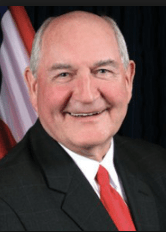 Last Thursday, Secretary of Agriculture Sonny Perdue, visited Robinette Orchards in Grand Rapids Township and spoke with farmers and farm lobbyists, according to an article on MLive.
Perdue had a particular message to people who received federal food assistance:
“For able-bodied adults without dependents who have taken this program as a lifestyle and are not looking for work, we want to send a message to them,”
Perdue was basically saying to a crowd of people who receive massive federal subsidies through the Farm Bill, that people who benefit from federal food assistance programs that they are screwed.
 Such contempt for poor people is not new, since the 2014 Farm Bill cut $8.6 billion for food assistance. However, we can ascertain from the Ag Secretary’s remarks that further cuts to federal food assistance are likely to happen.
The irony of such comments from Perdue, especially considering the US Farm Bill is a nothing short of massive corporate welfare for agri-business (large farmers who generally grow mono-crops). While Governor of Georgia, Sonny Perdue himself made sure that some of the largest Georgia corporate farmers benefited from an earlier version of the Farm Bill.
Also ironic is the fact that Michigan farmers have received over $5 billion in subsidies over the past 20 years, according to the Environmental Working Group data base. Apple growers, like Robinettes, have been the beneficiaries of over $27 million is federal subsidies over the past two decades.
One question that was posed to Perdue, while he was in Grand Rapids Township, had to do with the shortage of migrant farm workers, which those in the agribusiness sector rely on. There is no response from Perdue in the MLive article, to the question about migrant labor, but based on his track record as Governor of Georgia, we could draw some conclusions.
In 2006, Perdue said:
“It is simply unacceptable for people to sneak into this country illegally on Thursday, obtain a government-issued ID on Friday, head for the welfare office on Monday and cast a vote on Tuesday.”
Perdue signed into law several measures that would crackdown on undocumented immigrants, while he was Governor of Georgia.


Synder Front Group runs another Super Bowl Ad extolling the economic comeback of Michigan
This is the third time that Governor Rick Snyder and the 501c4 group, Making Government Accountable, has run an ad during the Super Bowl during the 8 years he has been in office.
The ad, like all political ads, engages in populous and vague rhetoric, like, “Our government is now fiscally responsible” and “Everywhere, a renewed sense of confidence and pride.”
 The video also makes the claim that over 500,000 new jobs have been created in Michigan, but never qualifies what kind of jobs, the wages those jobs pay and whether they are full-time or part time. This is the nature of political ads.
The ad also makes the claim, “Detroit has become the most remarkable comeback city in the country.” Again, no need to substantiate such claims. If you say it, it must be true.
 The images the ad uses about Detroit are those of downtown, with high rise buildings and sports arenas (which were subsidized by taxpayers). What the ad doesn’t show is the growing gap between the wealthy and those in poverty, the gentrification of Detroit or the fact that the city continues to shut off water to thousands of people who are struggling to survive.
The ad doesn’t really talk about the rest of the state, but we know that the ad ran in the Detroit, Flint, Traverse City and Grand Rapids TV markets. According to the Detroit News, the ad ran on WOOD TV8, just prior to the Super Bowl game, at the cost of $12,000.
We found out about the ad from a Facebook post on the West Michigan Policy Forum page. The West Michigan Policy Forum agrees with the ads  message, as the members of the WMPF are amongst the primary beneficiaries of the “economic comeback” of Michigan. What the WMPF members mean by “economic comeback” is more profits for their companies, more government program cuts, taking away public sector union pensions, making Michigan a Right to Work state and eliminating the Michigan Business Tax.
No surprise then that several members of the leadership team at the West Michigan Policy Forum, John Kennedy, Michael Jandernoa, Doug DeVos, Meijer Family, Steve Van Andel, J. C. Huizenga, Matthew Haworth and the companies they represent, have been substantial contributors to Gov. Snyder since he was first elected.
West Michigan Elite amongst the largest contributors to the 2018 Election in the State
 The Michigan Campaign Finance Network is already making it clear that the 2018 Elections in Michigan will be one of the most expensive in state history.
In the 2018 Election we will see contributions from numerous sectors, including Political Action Committees (PACs), Caucus Committees, Super PACs, outside funding and an increase in individual candidate contributions.
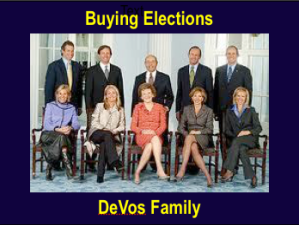
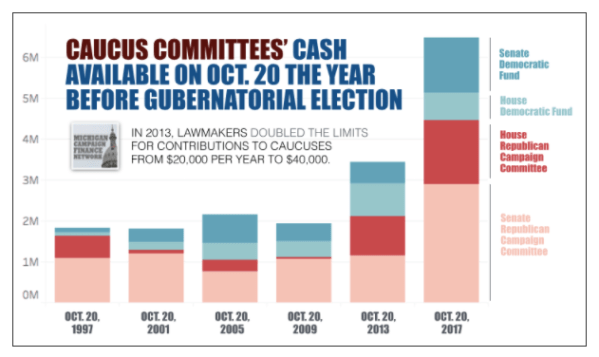
One area, Caucus Committees, not only demonstrates the outrageous amounts of money that have already been raised in Michigan, the data also shows that West Michigan elites are amongst the top contributors to purchasing 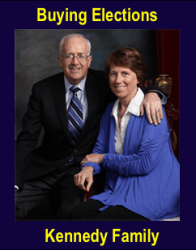 the 2018 elections.
According to the data collected by the Michigan Campaign Finance Network, the top two contributors to the Senate Republican Campaign Committee are listed as:
- DeVos Family, Windquest Group and RDV Corp, $240,000
- Kennedy family, Autocam, $60,000
This amount of money is just what was raised in 2017 and we can expect even higher numbers for 2018.
In the House Republican Campaign Committee, the top three contributors are from West Michigan:
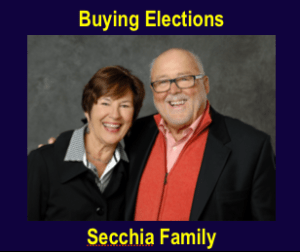 DeVos Family, Windquest Group and RDV Corp, $240,000
- Nancy and John Kennedy, Autocam, $80,000
- Secchia family, Sibsco, $80,000
The Republicans have raised significantly larger amounts than the Democrats to date for the 2018 Election and that typically translates in to the GOP continuing to dominate state politics. You can see from the chart below, that the Michigan Republicans have raised in the House and Senate Caucus Committees more than double what the Democrats have raised.
We don’t have to have a City Manager form of government in Grand Rapids, we didn’t before
 On Tuesday, we posted an article that provided an alternative view of the 8 years that Greg Sundstrom has served as City Manager of Grand Rapids. At the end of that article, we wrote:
we are not asking the question of why we even need a City Manager. The City Manager position in Grand Rapids is a non-elected position, yet this person has more power than anyone else in the City. If the City really wanted community engagement, they would really look at other forms of governance, where all residents had a say, where neighborhoods had more autonomy and where the city budget was determined by the public and not the City Managers office.
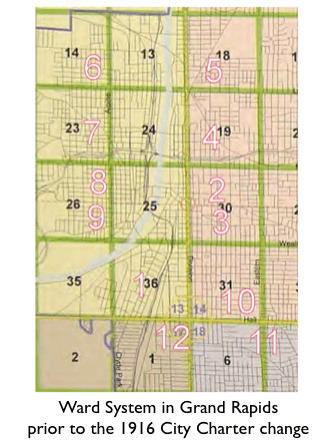
One thing that we did not mention in the Tuesday article, is that Grand Rapids used to have a different form of government. In the early part of the 20th century, Grand Rapids did not have a City Manager, instead the city was led by a strong Mayor, with a 12 ward system.
What this 12 ward system provided, was greater representation from both the working class residents of Grand Rapids and more ethnic diversity, at least diversity in terms of the various Euro-Americans that lived in the City – German, Polish, Dutch, Italian and Lithuanian.
This 12 ward system changed in 1916, when a new City Charter was proposed to reduced the 12 ward system with a 3 ward system and a strong Mayor form of government to a City Manager form of government.
This charter change was an effort put forth by the business community as a direct response to the 1911 furniture workers strike. The furniture workers strike demonstrated to the business community that working people had too much say in local electoral politics.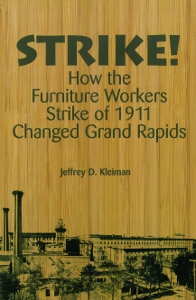
In August of 1916, voters went to the polls to determine the future political structure of Grand Rapids. The new Charter won by a small margin of 7,693 votes in favor to 6,012 votes in opposition. According to Jeffrey Kleiman’s book, Strike: How the Furniture Workers Strike of 1911 Changed Grand Rapids, the wards that voted overwhelmingly in favor of the Charter change were made up of the city’s elite.
The Second, Third and Tenth wards provided enthusiastic support for the proposed changes. Here lived the industrialists, lawyers, and bankers who formed the leadership of the Furniture Manufacturers Association, and the Association of Commerce. These men shared social and business connections through Kent Country Club and the Peninsular Club, and many were members of Fountain Street Baptist Church.
During another period of turmoil in Grand Rapids, there were attempts to change the City Charter back to a larger ward system and eliminate the City Manager for of government. In the later 1960s, just after the July 1967 race riot in Grand Rapids, there were both internal and external efforts to change the form of government.
In October, 1967, just a little over two months after the riot, there was a call for an investigation by Mayor Sonneveldt to look into the possibility of eliminating the City Manager form of government.

The question of shifting to a new form of government, by eliminating the City Manager position, was again debated in the Grand Rapids Press in November of 1967 and again in 1969, with the research commission that Sonneveldt requested 2 years earlier, but this time they were calling for a return to a 12 ward system and limiting the powers of the City Manager.
There have been other times in Grand Rapids history where efforts were put forth to restructure the number of wards the city would have or to eliminate the City Manager form of government.
Therefore, it is not unreasonable to consider such a change right now, especially considering how much power the City Manager has in a non-elected position. And, like in 1967, Grand Rapids is again faced with serious racial and economic disparities. A new form of governance, especially one that truly gave all residents a say what form of government or governance they want. We can certainly learn from the past about what to do in the present that might effect our collective futures.
To view the GR Press articles on the various local governance proposals between 1967 – 1970, click here.

