The GRPD planned for another riot in the wake of no justice for Breonna Taylor action
The Grand Jury did not bring charges against two of the three cops involved in the murder of Breonna Taylor. The third cop was charged with “wanton endangerment” for firing bullets into the apartment building. In the end, the Grand Jury did not charge any of the cops with the murder of Breonna Taylor.
Protests erupted in Louisville and all across the country, once people heard about the court’s decision. One theme that was shared on social media, was that the lack of justice for Breonna Taylor was by design. The legal system, like the prison industrial complex and how policing functions in this country is brutally biased against Black people…….by design. The judicial system isn’t so much corrupt, since they are doing exactly what they were designed to do.

In Grand Rapids, the hometown of Breonna Taylor, family members with the group Justice for Black Lives called for a protest at Rosa Parks Circle. At first, there was a small crowd of maybe 100 people. Breonna’s cousin spoke and expressed a great deal of grief over the court’s decision, but she also expressed a great deal of anger.
Breonna’s cousin said that she was “pissed off” and that she is tired of the businesses in downtown Grand Rapids with Black Lives Matter signs, but when it comes time to demonstrate that sentiment, these same businesses are no where to be seen. “Our family is tired of being fucked with,” said Breonna’s cousin. Her anger permeated her words as she called out numerous institutions and organizations. She then implored people to “take away the money from corporations” and “spend it in the Black community.”
The crowd was then invited to march with the organizers to the Grand Rapids Police headquarters, which had been barricaded once again, just like on May 30th of this year. Large salt trucks blocked the east and west ends of Monroe Center, allowing only a small opening for people to walk through to get to the main entrance of the GRPD.
Again, like on May 30th, GRPD cops were in full riot gear, both in front of the entrance, behind four feet barriers and along Division, preventing people from entering on the east sided along the building.

It was clear that the GRPD were gearing up for another riot, despite the fact that Chief Payne had met and talked with Breonna Taylor’s family earlier in the day. However, the message was clear. The GRPD was saying to the crowd gathered, “we expect you to be disruptive and possibly violent, so we are going to let you know that even before you march to mourn the court’s decision, we will not tolerate any disruptions and we will meet you with force.”
The organizers led chants and then demanded that Chief Payne come out to kneel with them. This was somewhat confusing to many in the crowd, based on their body language and their hesitancy to take a knee. Why would it matter if the Chief of Police took a knee, especially when he had dozens of cops, in full riot gear, ready to arrest protesters at any moment.
After the police chief took a knee, the organizers asked people to move back to Rosa Parks Circle. However, some of the Justice for Black Lives members lingered and were verbally confronting the cops. This was completely understandable, given the legal decision in the Breonna Taylor case. The cops left the northeast corner, where they had been standing while 200 protesters had gathered in front of the police station. The cops moved south on Division, still being followed by some protesters, when all of a sudden the GRPD grabbed one of the protesters and put him in the police cruiser.
People came around the corner to see what was happening and the police then told people that if they got any closer or walked in the street, that they would be arrested. Within minutes another 60 – 70 people who had gone to Rosa Parks Circle, had come back, now standing on the east side of division, right across from where dozens of cops in riot gear were standing.

Emotions were once again high, as people were angered by the arrest. The crowd began chanting loudly, as more and more cops arrived. Suddenly, the cops in riot gear, crossed the road and were standing right in front of those protesting. For about 15 minutes there was a bit of a standoff, when finally organizers of the march asked people to leave to avoid further confrontation.
On the same day, September 23rd, in 1955, the men who were charged in the brutal murder of Emmett Till were found not guilty by an all white jury in Mississippi. Sixty-five years later, a jury once again decided in favor of White Supremacy, with none of the three police officers found guilty of murdering Breonna Taylor. These two cases are linked, not only because of White violence against Black people or the fact that juries let white people get away with murder. The Emmett Till case played a major role as a catalyst in the Civil Rights Movement, just as Breonna Taylor’s murder is now being a catalyst in the Movement for Black Lives.
The Local News Media continues to be a Press Agent for the GRPD
 It is pretty astonishing how the local news continues to serve as Press Agent, a PR front and a stenographer for the GRPD, all at the same time.
This is nothing new. The dominant news sources in West Michigan have always internalized the values of the systems of power and oppression. Therefore, the local news agencies truly believe that the police function to protect and serve all residents in Grand Rapids.
However, the way in which the news media has served as a press agent for the GRPD has been amplified since the May 30th uprising. The news media has not mentioned anything about Defunding the GRPD for over a month, despite the fact that people continue to organize around this issue. In fact, they have been working with the GRPD to attack those speaking out against it. In addition, the dominant news sources in this area are not even talking about broader community concerns over police abuse, particularly within the Black community.
Instead, the dominant story from the local news media has centered around community violence and how busy the GRPD has been to try to stop it. The most recent example of how this plays out can be seen with the most recent Media Advisory from the GRPD, which reads:
The Grand Rapids Police Department (GRPD) is announcing outcomes from its additional enforcement and engagement efforts over the weekend.
The department deployed an additional 110 officers over Friday, Saturday and Sunday between 4 p.m. and 3 a.m. These officers included patrol personnel, Special Response Team, Vice Unit and members of the Detective Unit.
The goals of this effort were to address the recent increase in gun violence, engage community members and increase trust through partnerships and positive interactions with residents.
“By all accounts, we can label this a significant success,” Police Chief Eric Payne said. “My officers worked very hard to address the violence and engage residents in a positive way.”
Over the three evenings, the GRPD fielded the following results:
• 155 positive non-enforcement interactions with residents.
• 40 traffic stops and 13 field interviews
• 18 misdemeanor arrests and 16 felony arrests
• 31 hours on bike patrol and 38 hours on foot patrol
• 10 illegal firearms taken off of the streets
These officers strategically addressed violent crime utilizing intelligence and information provided by crime analysts. They also prioritized non-enforcement interactions with residents.
“This is the policing Grand Rapids can expect as we move forward and implement our new strategic plan,” Payne said. “Through these efforts, we are committed to making sure everyone in Grand Rapids is safe and feels safe at all times.”
This Media Advisory from the GRPD was posted on their FB page on Monday, September 21st. If one looks at the four dominant news sources in Grand Rapids, one can see how each of these news agencies essentially took the GRPD Media Advisory as truth without question. Here are the four news stories that essentially mimic what the GRPD Media Advisory presents:
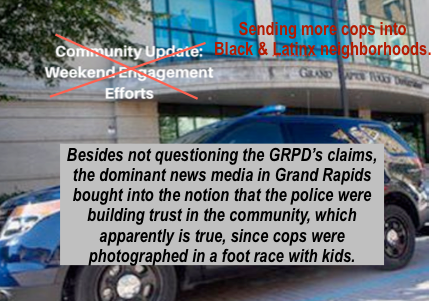
Each of the four news agencies don’t verify the claims of the GRPD, nor do they question the effectiveness of deploying more cops over the weekend. The dominant news sources don’t question the fact that this deployment was primarily in Black and latinx neighborhoods, plus they provide no evidence or additional sources that would question whether or not the GRPD is even able to prevent violence from occurring in the city. Lastly, besides not questioning the GRPD’s claims, the dominant news media in Grand Rapids bought into the notion that the police were building trust in the community, which apparently is true since cops were photographed in a foot race with kids.
In contrast, there are plenty of examples of people pushing back against the GRPD’s claims of building trust in the community. Longtime community advocate, JD Chapman Jr., who has been advocating for the City to adopt the Cure Violence program, had this to say in an FB post after seeing the GRPD weekend deployment:
It’s amazing to me that GRPD Chief Payne boasts about deploying more bodies to the community to clamp down on the recent uptick in violence. This method equates to more of the same all the way back to the Hegarty administration, what better results can this possibly have? This after a $100k study revealed that deploying more bodies does not create a safer or more trusting community.
Another community-based resource, which the group Together We Are Safe, has been distributing, is a document called Before Calling the Police, Ask Yourself. This document provides people with other resources in the community, resources that can actually make a difference. Calling the police generally doesn’t result in violence prevention, and in fact, it often results in violence escalation.
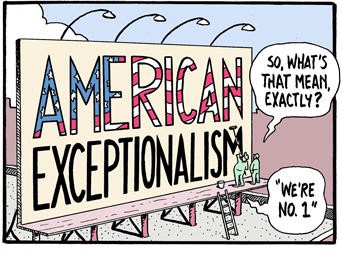 Last Thursday, the Trump Administration held the first ever White House Conference on American History. The President himself, spoke at the conference and shared these opening remarks:
Our mission is to defend the legacy of America’s founding, the virtue of America’s heroes, and the nobility of the American character. We must clear away the twisted web of lies in our schools and classrooms, and teach our children the magnificent truth about our country. We want our sons and daughters to know that they are the citizens of the most exceptional nation in the history of the world.
While many people who identify as progressives, found these comments from Trump to be what they have come to expect from a neo-fascist, they are a reflection of what every US administration has believed about the US. In fact, while speaking at the US Military Academy in 2015, former President Barack Obama stated, “I believe in American exceptionalism with every fiber of my being.”
Now, there are lots of people who found Trump’s comments at the White House Conference on American History to be appalling, especially when he criticized the 1619 Project and the radical historian, Howard Zinn. Trump said of Zinn:
Our children are instructed from propaganda tracts, like those of Howard Zinn, that try to make students ashamed of their own history.
What Trump, those in power and their followers fail to understand is that Zinn was attempting to challenge the official narrative about US exceptionalism. In addition, Zinn did not want students to be ashamed of the history of the US, but to present history from the perspective of people that the official narrative often leaves out or marginalizes. In fact, Zinn’s book, A People’s History of the United States, provides a critical assessment of US exceptionalism, while at the same time presenting US history from the ground up. Howard Zinn’s work doesn’t teach students to be ashamed of US history, it introduces people to the rich history of popular social movements that have been the primary agents of change in US history.
Systems of power and oppression never want us to think critically about history, they only want us to accept the dominant narrative that provides justification for US exceptionalism. Those with power, like Trump, do not want us to acknowledge that the US was founded on the pillars of genocide and slavery. Those with power also don’t want us to know about the transformative nature of social movements, movements that have given us whatever rights and freedoms we enjoy today. Slavery was not ended by a US President, it was ended by the abolitionist movement. Workers did not win better wages, benefits and protections against exploitation because of bosses, but because of organized workers that formed unions. The Civil Rights/Black Freedom Movement did not make gains because of what those in power gave them, they won greater freedoms by fighting systems of White Supremacy. We can look at any example of whatever social progress that has been made, and see that social movements are behind whatever progress we have made.
The US Supreme Court
Within days of Trump’s White House History Conference pronouncements, US Supreme Court Justice Ruth Bader Ginsburg died. Over the past few days there has been an outpouring of grief from people over the loss of Justice Ginsburg, not only because of who she was, but also because of concerns about when to replace her seat on the court.
While the concern of when and who will be nominated to take Ginsburg’s seat is a legitimate an urgent one, it is also important that we grapple with the issue of why the US Supreme Court has the power that it does. Here I will refer again to radical historian Howard Zinn, who wrote an excellent article in The Progressive magazine in 2005, while Congress was fighting over Supreme Court nominations. Zinn wrote:
When the Constitution gets in the way of a war, it is ignored. When the Supreme Court was faced, during Vietnam, with a suit by soldiers refusing to go, claiming that there had been no declaration of war by Congress, as the Constitution required, the soldiers could not get four Supreme Court justices to agree to even hear the case. When, during World War I, Congress ignored the First Amendment’s right to free speech by passing legislation to prohibit criticism of the war, the imprisonment of dissenters under this law was upheld unanimously by the Supreme Court, which included two presumably liberal and learned justices: Oliver Wendell Holmes and Louis Brandeis.
It would be naive to depend on the Supreme Court to defend the rights of poor people, women, people of color, dissenters of all kinds. Those rights only come alive when citizens organize, protest, demonstrate, strike, boycott, rebel, and violate the law in order to uphold justice.
 What Zinn is doing in this article, it to challenge us to think about power, particularly systems of power. Too often we assume that since this is the political system we have, we just have to embrace it. However, Zinn knew all too well that anything is possible as long as people are organized to fight for something better. In that same article from 2005, Zinn went on say:
Still, knowing the nature of the political and judicial system of this country, its inherent bias against the poor, against people of color, against dissidents, we cannot become dependent on the courts, or on our political leadership. Our culture–the media, the educational system–tries to crowd out of our political consciousness everything except who will be elected President and who will be on the Supreme Court, as if these are the most important decisions we make. They are not. They deflect us from the most important job citizens have, which is to bring democracy alive by organizing, protesting, engaging in acts of civil disobedience that shake up the system.
No Supreme Court, liberal or conservative, will stop the war in Iraq, or redistribute the wealth of this country, or establish free medical care for every human being. Such fundamental change will depend, the experience of the past suggests, on the actions of an aroused citizenry, demanding that the promise of the Declaration of Independence–an equal right to life, liberty, and the pursuit of happiness–be fulfilled.
This too, is the legacy of Howard Zinn, to move beyond the liberal/conservative framework and fight for a different kind of world, a world striving for collective liberation!
Non-profit housing leaders put eviction blame on renters, not on Landlords & Property Management Companies
 Last week, the business news source, MiBiz, posted an article headlined, ‘Well-intentioned’ eviction moratoriums will likely cause homelessness bottleneck, nonprofit leaders say.
The article briefly discusses the Centers for Disease Control’s (CDC) call for a halt to housing evictions until the end of the year. The CDC has called for the halt to housing evictions as a means to reduce or minimize the spread of COVID 19.
However, the bulk of the article is based on the responses to this announcement from three are housing assistance organizations; Well House, Mel Trotter Ministries and Degage Ministries. Here is a sample of what each of them had to say:
John Glover – Well House: Eviction moratoriums issued throughout the pandemic have been “well-intentioned,” but they let people get behind on their rent who may already struggle with financial discipline.
Dennis Van Kampen – Mel Trotter Ministries: The rent that they haven’t paid isn’t going away, it’s just accruing, and most people will not be able to have several months of rent in their savings account. They should also start thinking about looking for a place that charges less in rent.
Most landlords we work with want to keep their properties full and people renting them. Now they have the challenge of not having income coming in, so they can’t pay their bills but they also don’t want to evict people.
Marge Palmerlee – Degage Ministries: During a stressful time like this, anxieties rise, but we’re trying to always assure people we’ll be here to walk alongside them.”
What is instructive about the comments from these non-profit housing groups is the fact that they are critical of the CDC’s anti-eviction position, they are empathetic to landlords, and they place blame with tenants and their behavior.
Such comments are in stark contrast to what the housing justice movement is taking, which not only centers the lived experience of tenants, but to also provide a substantial critique of landlords, property management companies and the system that exploits tenants all across the country.
What groups across Michigan, as well as the Grand Rapids Area Tenant Union, are taking can be summed up by the following information they have been sharing with tenants, since the CDC’s announcement.
1) This ban only protects tenants from being evicted for non-payment of rent.
2) Landlords can evict tenants who they believe ‘pose harm to the rental unit or a physical threat to others’, or tenants conducting illegal activity; Therefore,
3) This ban is another demonstration of collusion between property owners and law enforcement against tenants.
4) Local courts may decide to continue accepting filings and holding eviction hearings throughout the ban, so long as landlords do not remove tenants from their units until after Dec. 31st.
5) The ban ends on January 1st, in the middle of winter.
6) The ban is not accompanied by any further financial aid to assist people who have lost income as a result of COVID-19.
7) We are moving into the colder months, and tenants will have to choose between paying some or all of their rent and keeping their heat on.
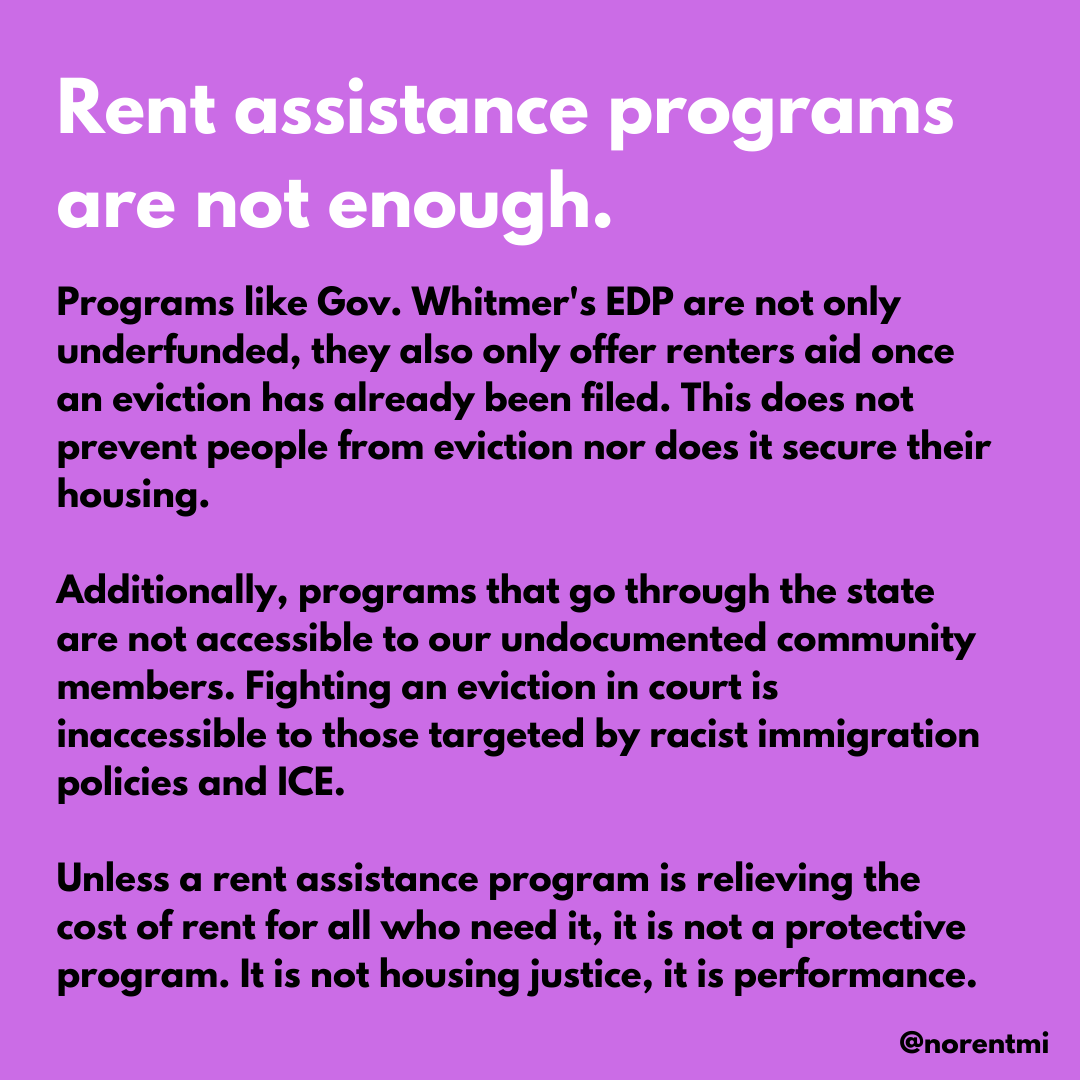 IF YOU HAVE AN EVICTION HEARING SCHEDULED, YOU SHOULD STILL ATTEND AND FIGHT YOUR EVICTION SO IT DOESN’T CATCH UP WITH YOU IN JANUARY.
We understand that the non-profit housing groups are concerned about what will happen come January, when the eviction moratorium ends. However, instead of making demeaning comments about those who are facing housing insecurity, these groups should be acting in solidarity with people facing eviction or at least direct them to groups like the Grand Rapids Area Tenant Union, which centers the lived experience of tenants, since it is primarily made up of those who are tenants.
Check out the Grand Rapids Area Tenant Union, by going to their Facebook page and find out how tenants can support each other and build the kind of political power necessary to challenge the exploitative practices of landlords and property management companies.
West Michigan Far Right Watch for the week of September 13 – 20
 Welcome to the next installment of West Michigan Far Right Watch, where we keep tabs on the far right in this area and provide a summary of what they are up to and what kind of messages they are promoting in this community.
We have 2 examples to share with you this week. The first example comes to us from the West Michigan Policy Forum (WMPF). The West Michigan Policy Forum is made up of representatives of the area’s Capitalist Class and the goal of this group is to influence state policy in Michigan, primarily so it benefits those with economic and political power.
The WMPF posted a link to a video statement from Florida Governor Ron DeSantis, who said that the state would never close again because of COVID 19. This is what the WMPF wrote with that post:
As Michigan businesses continue to show they can safely be open, Florida Governor Ron DeSantis is sharing his thoughts on some of the hidden downsides of lockdowns and how his state moved forward despite calls to lock down this summer. Scroll forward to the 35-minute mark in the video to hear why he says Florida will never be locked down again.
According to the CDC, Florida has one of the highest rates of COVID 19 deaths in the country, with over 13,000 deaths. The WMPF has consistently opposed Gov. Whitmer’s stance on COVID 19, since they are more concerned about business profits than they are about the general well being of the community in West Michigan. Using Florida as an example of state policy that refuses to protect the public, just demonstrates the West Michigan Policy Forum’s belief in profit before people.
Our second example focuses on the group, Voice For the Badge (VFB). VFB has only been around for a couple of years and they began organizing as various social movements have called for greater accountability with the GRPD, as well as defunding of the GRPD. Essentially, the VFB is an apologist of the GRPD and its treatment of Black, Brown and other marginalized communities. The VFB has primarily used social media as a forum to organize, but they now have their own website.
The website for VFB is not very interesting, nor is it very informative. There is one video on the site, which center’s on Johnny Brann’s fight with the City over his banners and flags on his restaurant. What is instructive, is the list of board members that serve on the VFB.
What is instructive about these board members, is not just their defense of the Thin Blue Line and the GRPD, but the larger ideological framework that they embrace. Johnny Brann is on the board, and you can see from the VFB Facebook page that he makes lots of nationalistic and jingoistic comments about the US being the “greatest country on the planet” and his comments after the May 30th uprising are indicative of what he thinks about anyone who questions the cops.
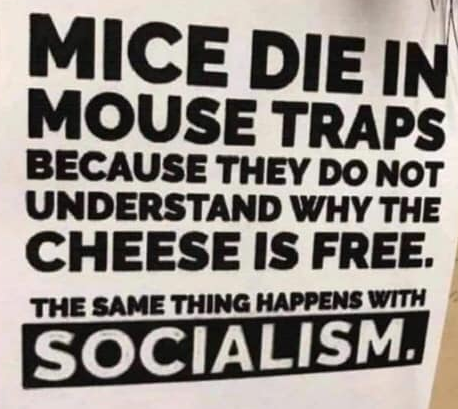 Another VFB boar member is Susan Brubacher. Her Facebook page is also filled with pro-police propaganda, like the one on 9/13, which shows Trump supporters praising cops. Brubacher also makes posts supporting GOP candidates and stupid memes about socialism, like the one here.
Then there is Jack Potes. Besides all of the pro-policing messages on his FB page, he also reposts from a page called All Cop Lives Matter, which, like All Lives Matter, directly dismisses and demeans the Black Lives Matter message. Potes also has anti-LGBT and anti-queer posts on his FB page.
One last example of a VFB board member embracing far right ideology is Susie Damore. Damore doesn’t have an FB profile, but she has been in the news because of her support for Donald Trump. WXMI 17 did a short story about her making pro-Trump cookies in 2015, to sell at a Make America Great Again sale.
What is important to note about the Board members of Voice For the Badge, is that their uncritical view of the police fails to recognize the systemic harm that policing does to the Black community and other communities of color. This means that their defense of the GRPD is also rooted in a racist, White Supremacist ideology. The racist/White Supremacist ideology also informs their nationalism and their general support for systems of power and privilege.
Deconstructing the Jill Biden visit to Grand Rapids: Election Stenography, Food Insecurity and Kids Food Basket
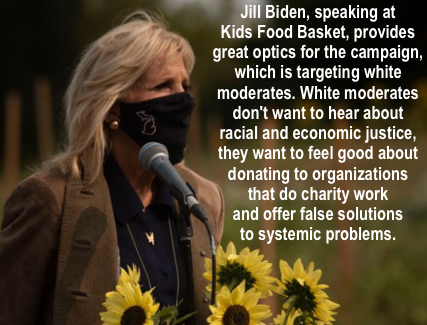 On Tuesday, the wife of Democratic Presidential candidate Joe Biden, Jill Biden was in Grand Rapids. As expected, the dominant news media reported on Biden’s visit, but we’ll limit our critique to what MLive had to say.
There are many things to deconstruct from the MLive article, which is symptomatic of how most journalism is created, where those in power are rarely questioned for the claims they make.Too often, journalism mimics stenography, where reporters just document what was said, but don’t verify claims that are made.
The first section of the MLive article, which is headlined, Jill Biden focuses on veterans issues, food insecurity in West Michigan campaign swing, communicates broad election elements, with little substance. Joining Jill Biden was Hillary Scholten, who is running for the 3rd Congressional District seat against Peter Meijer. MLive states:
Scholten said Joe Biden has dedicated his life to service and is running at a crucial time “to restore, civility, humanity and empathy to our national leadership.” Scholten said her campaign’s internal polls show Biden leading by 5 percentage points in Michigan’s 3rd District.
“I think the main topic of conversation is the disparities that have been broken wide open because of this pandemic,” Scholten said. “People aren’t so much focused on national politics as they are on everyday kitchen table issues. I think the importance of an event really highlights it.”
While is is possible that Scholten provided more details, the comments from the 3rd Congressional Democratic candidate are vague. What disparities have been broken wide open because of the pandemic, an what kitchen table issues is Scholten referring to? These are not idol questions, but deeply relevant to what matters. The pandemic has indeed expose disparities in our society, but what is the candidate proposing as a response to the social and economic disparities that exist?
If we look at Scholten’s platform, we can make some determinations about how or if she will address these disparities. Under Health Care, she does not endorse Medicare for All, rather she plans on defending the Affordable Health Care Act, which is woefully inadequate. In fact, most of the policy positions on Scholten’s campaign page are vague and moderate, with none of them addressing the disparities exposed by the pandemic.
Another instructive component about the MLive article was the fact that Jill Biden visited the non-profit organization known as Kids Food Basket (KFB). Biden was quoted as saying, “A program like this should be national, it should be in every state to help kids learn about food and healthy meals and help all families with food insecurity.”
Food insecurity is indeed a serious issue, but Kids Food Basket does not address food insecurity, an to suggest that their model should be replicated across the country demonstrates that Jill Biden has no idea of what the root causes of food insecurity are.
KFB, in many ways, is a perfect example of what’s wrong with the Non-Profit Industrial Complex:
- KFB has grown exponentially over the years to provide more food aid to children, but they have failed to address the root causes of why there are so many children that are food insecure in West Michigan – poverty, low wage jobs, systemic racism, growing wealth gap, etc.
- KFB has the support of local corporations, such as Amway, Meijer and Spartan Stores, specifically because they do not challenge economic centers of power.
- KFB is the darling of the professional class, which provides countless volunteers to help them make sack lunches, without questioning how this alleviates food insecurity.
 KFB is a charity organization that gets lots of accolades, since the organization does not challenge systems of power and oppression.
- KFB provides a false solution to the issues of hunger and food insecurity.
- KFB provides a great opportunity for those who want to advance in the non-profit world, provided they do not question what is being done.
- KFB is recipient of millions in local philanthropy, precisely because they provide a false solution to a systemic problem in this community.
Over the years, I have been contacted by numerous people who have previously worker for KFB. Those of have contacted me have done so, only if I agree to not share their identities. Several people who have formerly worked for KFB fear that if they speak out publicly, they will ruin any chances of finding work in West Michigan, particularly in the non-profit sector.
The Biden campaign chose to go to KFB because they see it as good optics, particularly to white moderate voters who don ‘t want to be bothered by the movements calling for racial and economic justice. It’s great for an organization like KFB to get such praise from people like Jill Biden, but there are lots of people who are not buying into the idea that KFB actually fights against hunger in West Michigan.
Licenses, not promises: Movimiento Cosecha disrupts and confronts Michigan Legislature
Two years ago, Cosecha Michigan held a rally on the steps of the state capital in Lansing, after a 5 day pilgrimage focusing on Ddriver’s Licenses for All.
Last year, Cosecha Michigan finally got support from a few state legislators to propose legislation that would provide driver’s licenses to people who are undocumented and living in Michigan.

It has been 11 months since legislation was proposed to provide driver’s licenses to those who are undocumented, yet there has been no concrete movement to pass the legislation, like holding public hearings on the matter. This is exactly why more than 100 Cosecha members went to the State Capital in Lansing again, in order to pressure State Legislators to take action by hosting public hearings on the Driver’s Licenses for All legislation.
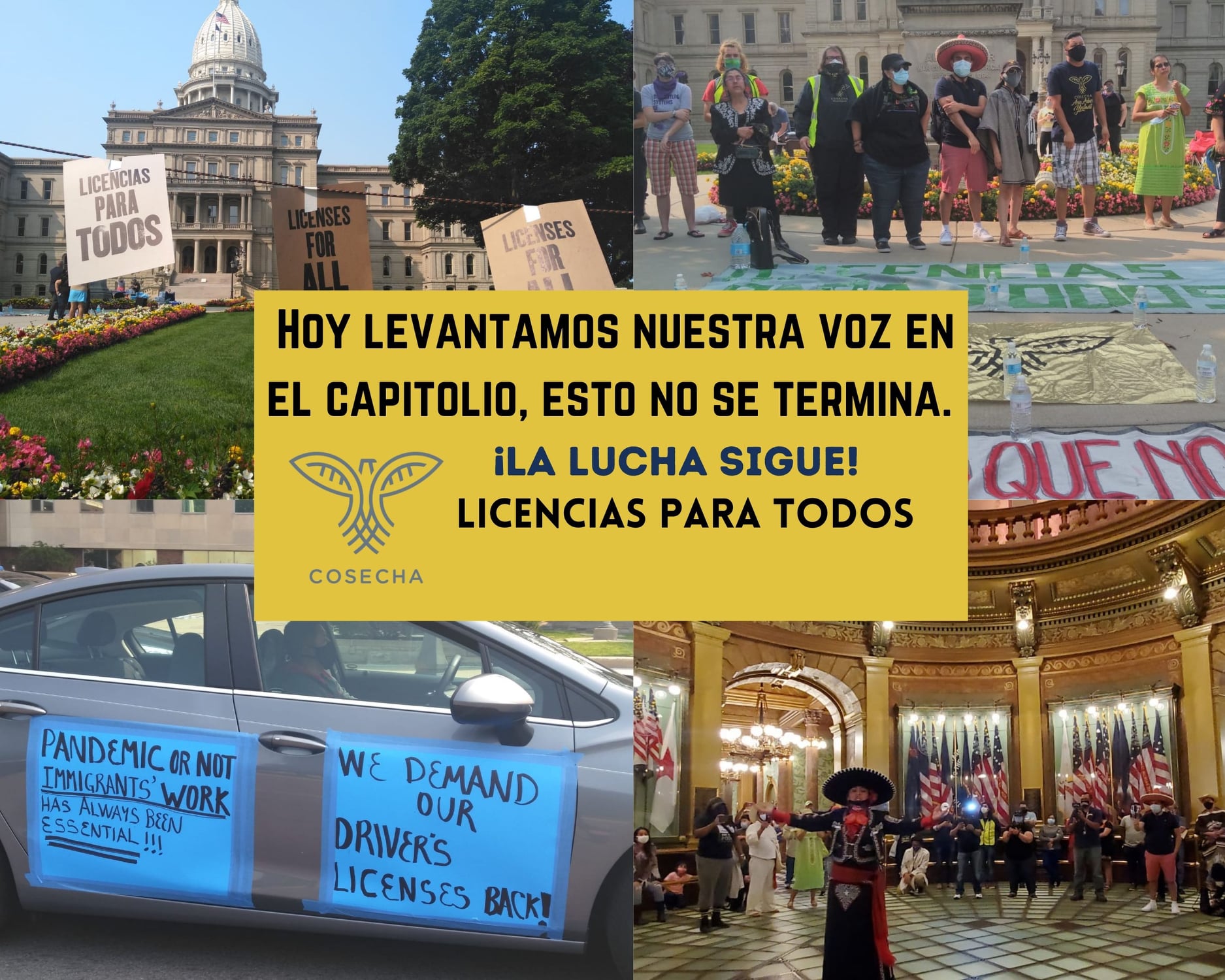
Those involved with Movimiento Cosecha came from all over the state yesterday, to once again demand from state politicians that they pass legislation to allow people who are undocumented the ability to obtain a driver’s license. Those who made the trip to Lansing, first held a car caravan, with vehicles plastered with signs and other messages in support of driver’s licenses, which lasted for about 90 minutes.
People then gathered in front of the State Capital, before going inside the building. Once in the building, Cosecha participants went to the 3rd floor, to make some noise and get the energy of the crowd up. Here is a short video, which reflects the passion of the crowd.
It is always instructive being in this space, a space which is essentially a white space – large paintings of former governors hang on the wall – as well as a nationalistic/jingoistic space – with Michigan and USA flags displayed throughout.
So, here comes a mostly Latinx, mostly immigrant crowd, into the rotunda of the State Capital in Lansing, making noise. There were brief comments from the various Cosecha circles that have sprung up around the state, followed by some music, an lots more chanting.
Eventually, the crowd moved to the area right by the entrance to where the State Legislators gather. Cosecha participants continued to be loud and demanding, in both Spanish and English. Some community-base organizers also spoke, specifically from organizations that were in solidarity with Cosecha’s demand for Driver’s Licenses for All. There was also a representative from the Jewish movement, known as Never Again. The person who spoke said that his parents were arrested by the Nazis. He then told the crowd that after WWII, those who survived the Holocaust made it clear that this kind of thing would never happened again. However, the very fact that Immigration and Customs Enforcement picks up people on a regular basis, detains them, and even put their children in cages, has compelled the Never Again group to speak out in support of immigrant justice and Driver’s Licenses for All!

While Cosecha members were on the 3rd floor making noise and disrupting the legislature, there would be state officials and their aides coming and going from the chamber. It was interesting to see that these people would be escorted by security people through the Cosecha crowd, even though there was no reason for people to fear, as Cosecha is a non-violent movement. However, those in power often view tactics of disruption as disrespectful and threatening. Cosecha uses the tactic of disruption against people with political power because their lives are disrupted on a daily basis. Undocumented immigrants live in constant fear of being arrested, detained and deported. In fact, one of the reasons why Movimiento Cosecha chose to work on a campaign to get driver’s licenses for all, is because the number one reason that undocumented immigrants end up being detained by ICE is because they are stopped by local law enforcement when driving without a license.
After an hour of disrupting business as usual in the State Capital, people left the building and reconvened outside to celebrate the struggle and talk about next steps.
Licenses Yes, Promises No
As was mentioned earlier, it has been 11 months since legislation was introduced on Driver’s Licenses for All, yet, there has been no movement to move the bill forward. As you can see from this link, the last action took place on November 6, 2019, when the bill was sent to the Transportation Committee.
 In six weeks, people throughout Michigan will participate in the 2020 election, which not only includes voting for President, but State Representatives. There were 16 Democrats who co-sponsored this legislation last year. All 16 of these State Representatives are up for re-election, so I thought it would be useful to look at their campaign websites to see if Driver’s Licenses for All was prominently displayed or mentioned. A few of those who co-sponsored the bill are term limited, but in the case of all the other State Representatives running for re-election, NOT ONE of those who co-sponsored the Driver’s Licenses for All legislation has anything about the importance of passing this legislation on their re-election pages.
The lack of urgency from politicians around this issue is not surprising, but it is frustrating. However, Movimiento Cosecha is committed to getting this legislation passed an to fighting for immigrant justice no matter what politicians do. You should contact you local state representative and ask them why they are not fighting for this issue. More importantly, you should support the work of Movimiento Cosecha, with financial support an by leveraging your privilege, especially those who do not live in fear of arrest, detention and deportation from ICE. La Lucha Sigue! Hasta la Huelga!
Interview with Joe Cadreau on the Indigenous People’s Day Action this Saturday in Grand Rapids
 GRIID – What was the motivating factor behind organizing the We Are Still Here action for this Saturday?
Joe – The city has buried this resolution in committee after committee for the last 4-5 years. There has been no communication from the city or the group it claims to be working with, as to where or why this resolution has sat idle.
Also this past summer the city adopted Juneteenth in a matter of 2 days , without any public comments, or committee input etc. Many elders in my community felt shunned because of this and reached out to me.
GRIID – In Grand Rapids, there has been an effort since the late 1980s to replace Columbus Day with Indigenous People’s Day. Why do you think Grand Rapids is so resistant to the idea?
Joe – Grand Rapids would be forced to admit the inequity that they are responsible for creating in my community. We can look through the history of the city and see time after time where they removed us, and forgotten us. Just look at the westside , and the Ford museum.
Grand Rapids is not as diverse as it claims to be , they have done all they can to keep the white power structures in place, from administration to administration, this one is no different.
I don’t think people realize or fully understand the effort and power that the families have in this city. It baffles me why this resolution has taken so long and been buried for so long. I wrote the Indigenous Peoples Day Resolution at GVSU in 2017 and it was passed and adopted by the university. We thought for sure that would have been a catalyst to getting the city to pass the Resolution that have had for years.
GRIID – Have you received any push back since you announced the We Are Still Here action?
Joe – Yes I have both internally and externally. That is why it was important for me to make this event inclusive and a work of allyship.
GRIID – Why is having an Indigenous People’s Day so important for both the anishinnabek community and for everyone else?
Joe – It is the first step in truly creating equity for the indigenous people of this area. Michigan is one of the most populated states with a native presence and population. Columbus is the symbol of colonization and white supremacy.
GRIID – Having an Indigenous People’s Day would be a good first step, but what else needs to change for people to come to terms with Settler Colonialism and do you see this action as a catalyst to make even larger demands?
Joe – There are many things that need to change in relation to the city and its relationship with the anishinnabek community. First thing that needs to change is funding for social programs for indigenous people. We are often forgotten or never mentioned in these social programs that the city develops or implements. The continued purge of dollars and space from the GRPS NAEP needs to end and be fully funded. Those are just a few things , but there are many issues that my community faces in this city on a daily basis.
The city also needs to realize and understand that one organization can not fulfill all the gaps in the anishinnabek community. They need to offer Grant’s to other native led organizations that do important work as well.
Reversing the Missionary Position: Learning Solidarity on Mayan Time – A Film discussion/fundraiser for GR Rapid Response to ICE
 In 2006, I produced a documentary film about my experience of doing accompaniment work in Guatemala and Chiapas, Mexico between 1988 and 2005. I had worked with Peace Brigades International in Guatemala and Enlace Civil in Chiapas on numerous solidarity trips I took in those years.
The film I made, Reversing the Missionary Position: Learning Solidarity on Mayan Time, was really based on my own development and understanding about what solidarity really means. I was not in those countries to tell people what to do, to help them build houses, to preach any message, but to walk with them in their struggle for justice and liberation.
Most of the time I spent doing accompaniment work, meant that I was just present with local organizers, leveraging my privilege as a white male from the United States. As an organizer with Grupo Apoyo de Mutual told me years after my first solidarity trip to Guatemala, “your presence provided us some emotional and physical space to do the work we needed to do. It didn’t eliminate the death threats we faced on a daily basis, but it did provide us with more room to maneuver in the midst of the threats.”
GR Rapid Response is hosting a discussion of the film, Reversing the Missionary Position: Learning Solidarity on Mayan Time, on Monday, September 21st. at 7pm in an online forum. You can watch the film anytime, since it is online here:
Once you have watched the film, GR Rapid Response to ICE is inviting people to be part of a discussion about the content of the documentary and the importance of doing accompaniment work, which is part of work of GR Rapid Response to ICE. To join the discussion go to this link https://us02web.zoom.us/j/87485219485 by 7pm on Monday the 21st.
This event is also a fundraiser for GR Rapid Response to ICE, which provides funds for families impacted by ICE violence, which includes arrest, detention and deportation. You can contribute to GR Rapid Response to ICE b y going to this link bit.ly/RR-mutualaid.
Please help GR Rapid Response to ICE by contributing to their Mutual Aid Fund and by help them to spread the work about this event, which you can find on Facebook at this link.
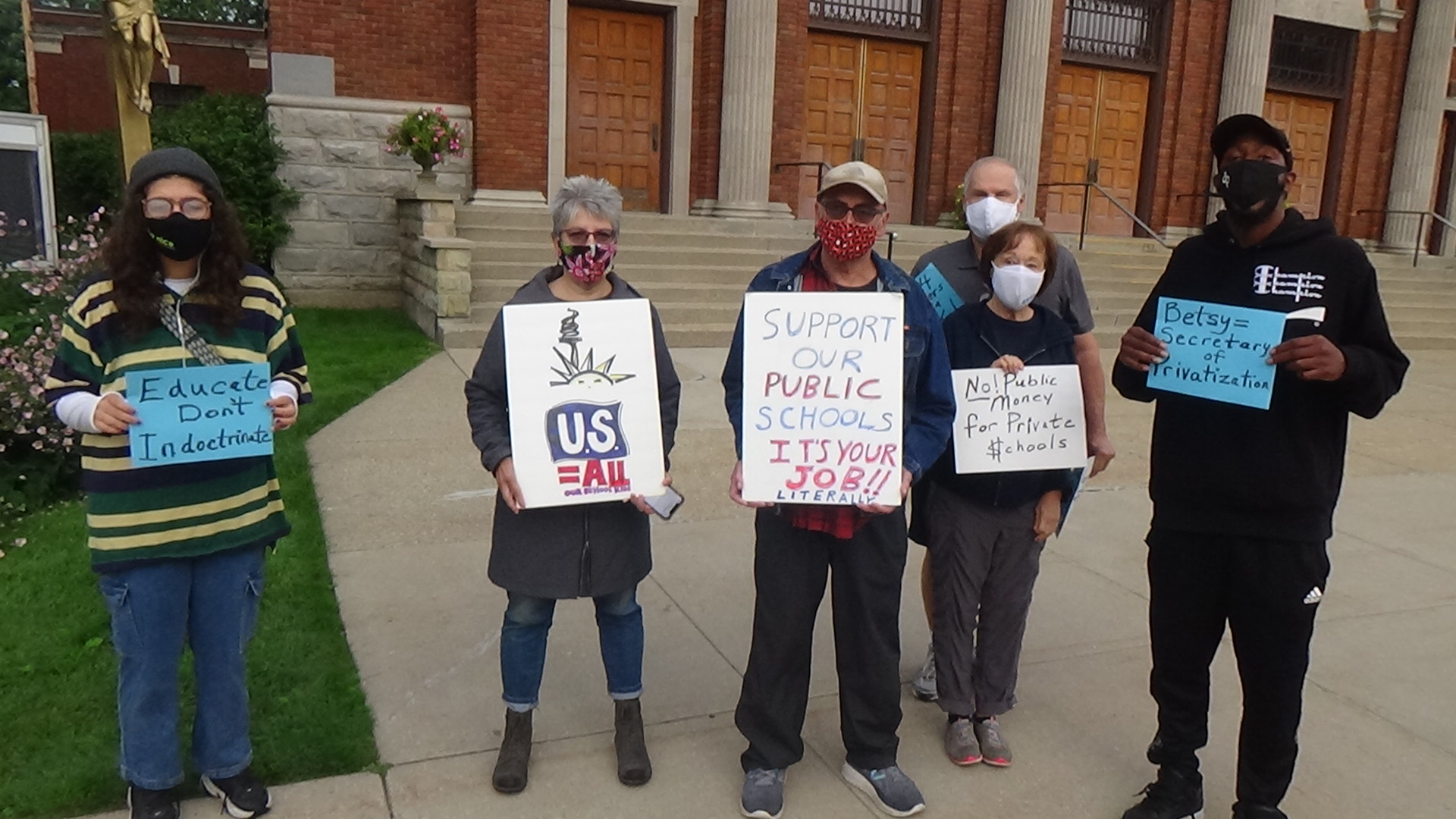
Small group of protesters send a message to Betsy DeVos while leaving the private school she visited today in Grand Rapids
As was mentioned in our previous post, Betsy DeVos was at Sacred Heart Academy this morning to meeting with staff, students and founder of the Acton Institute, Rev. Robert Sirico.
DeVos arrived at the school earlier than MLive had suggested in their article from Saturday, so when protesters arrived there was already GRPD presence and the black SUVs parked next to the school entrance. The black SUVs also included members of the US Secret Service, which have been guarding Betsy DeVos almost since the beginning of her tenure as Secretary of Education, especially since she has been confronted by protests where ever she goes.

In the picture above, Acton Institute founder, Rev. Sirico, is seen talking to DeVos who had already entered the black SUV. Sirico is the shorter of the two priests that can be seen in the above photo.
Several protesters arrived just before 8am to confront DeVos on her policies as Secretary of Education. Jack Prince, with Grand Rapids for Education Justice (GREJ) made the point that DeVos has been pushing her school privatization plan, and that it was an insult to students in the Grand Rapids Public Schools, for DeVos to visit a private Catholic school.
Some of the other talking points that GREJ brought up were:
1. We object to the fact that Secretary DeVos is visiting a private school to see how coping with the pandemic is going, when so many other schools, which are financially struggling should be getting attention.
2. We object to the fact that all throughout the pandemic, Betsy DeVos has been advocating that public money should go to private schools.
3. DeVos chose Sacred Heart Academy, specifically to elevate a private school that is run by the founder of the Acton Institute, Rev. Sirico, who is ideologically aligned with Betsy DeVos on education matters.
4. That Betsy DeVos is coming to a private school during a pandemic and has been pushing for more public money for private education, is consistent with this administration, which has done very little to provide financial relief to working class families, Black families and other families of color, many of which are unemployed and facing eviction, while the wealth of billionaires – like the DeVos family – has increased during the pandemic.