Sister Ardeth Platte: Warrior for Peace
 I first met Sr. Ardeth in the early 1980s in Lansing, when Fr. Dan Berrigan came to speak at an event put on by the group Covenant for Peace. Covenant for Peace organized a multi-year campaign to expose and resist the manufacturing of nuclear weapons systems at Williams International in Walled Lake, MI.
After listening to Berrigan speak that night, I was invited by some of the organizers to meet with Fr. Berrigan and a small group of other activists. Sr. Ardeth was one of those in the small gathering.
(Sr. Ardeth is pictured here in the middle, with the big smile.)
People were having drinks and mingling. I also grabbed a drink and was being introduced to people. At one point I was introduced to Sr. Ardeth, who with a beer in her hand, said she was glad to meet me. I was a bit surprised that a Catholic Sister would be drinking a beer, but then again, I wasn’t raised Catholic and didn’t really know what to expect.
At that first encounter, I found Sr. Ardeth to be a warm and very deliberate with her words when she spoke. I remember feeling relaxed around her, like I could be myself, without having to worry about whether I might offend someone who had taken vows.
After that initial encounter, it would be another two years before I had seen Sr. Ardeth again. By then I had already spent a year in a Catholic Seminary, left and then was part of an intentional community called Koinonia. However, I did receive letters from Sr. Ardeth, while spending 48 days in jail after an action that 13 of us did at Williams International in December of 1984. I didn’t keep those letters, but I remember that her words were filled with encouragement and affirmation of my witness against the indiscriminate destructive power of nuclear weapons.
Beginning in early 1985, I participated in a group study/reflection process with other people of faith in Michigan, all of which were working to resist the nuclear arms race. Sr. Ardeth was part of that group, along with Sr. Carol, her best friend and partner in crime. When I say partner in crime, I literally mean that, since Sr. Ardeth and Sr. Carol were arrested together numerous times over the years, resisting weapons of death.
That same year (1985), Sr. Ardeth and Sr. Carol had organized an action at Wurtsmith Air Force Base in Oscoda, Michigan. The action took place on the anniversary of the US bombing of Hiroshima, which I have written about on the Grand Rapids People’s History site.
I did not take part in another action at Wurtsmith Air Force Base again until 1990, since the intentional community I was part of at the time had become a Sanctuary for Central American refugees fleeing US supported state terrorism.
During the action in 1990, people entered the Wurtsmith Air Force base in small groups, which we called affinity groups. I was with a few other people from Grand Rapids, and as we were waiting our turn to engage in Civil Disobedience, Sr. Ardeth suggested that our group should start closer to the entrance to the military base, since we were doing something very different from other affinity groups. We modeled our action after the Mothers of the Disappeared, with images of people (photo below) either killed by US militarism or people who were negatively impacted because the US puts a higher priority on militarism than they do on people. I had a picture of my brother Steve, who had been going to a day program for adults with disabilities, until the State of Michigan cut funding.
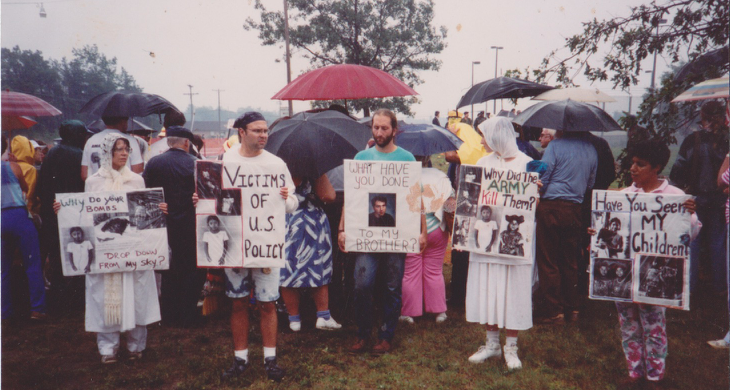
I was arrested that day in 1990 and because I had been arrested before at Wurtsmith Air Force Base, I would likely do months in jail for resisting nuclear weapons. Like the rest of the people who had been arrested more than once at that military base, we all received a letter to appear in court for our hearing, more than a month after the action. I was in communication with Sr. Ardeth and asked her what she thought about me refusing to go to the hearing. Sr. Ardeth was not only in favor of the action, she encouraged me to send a letter to the judge, telling him why I would not be coming. I wrote the letter, and in that I said that since the judge did not acknowledge the validity of International Law as a legal argument for my actions, there was no point in coming, since his court was a mockery of the law.
A few weeks went by and I received another letter, with a new court date. I wrote the judge a second time, using similar arguments, with different wording. A week later federal agents showed up at my door to arrest me. Fortunately, I saw them coming and snuck out the back, while one of my housemates distracted the agents.
For nearly three months I went underground, moving from place to place, always avoiding the federal agents. A friend of mine who did a show on the public access TV station, did an interview with me about the action at Wurtsmith Air Force Base and my reasons for going underground. Here is that video.
I had only seen Sr. Ardeth here and there over the years, sometimes at funerals for other amazing women, who, like Sr. Ardeth, were part of the Dominican Sisters. However, Sr. Ardeth continued her resistance to injustice, to militarism and to war. Years later she had joined the famous community in Baltimore, known as Jonah House, where she continued to value community and resistance.
So you see dear friends, Sr. Ardeth Platte had a tremendous influence on my own formation as an activist and war resister. Her quiet counsel over the years helped me to take a path that I never regretted. From our first meeting over a beer to her encouragement to take bold action, Sr. Ardeth was an inspiration, a kind, gentle person, and someone who took the words of Jesus to heart by being a warrior for peace. Thank you Sr. Ardeth, for welcoming me into your life!!! Rest in Peace.
American Patriot Council says they only support lawful action, but they have created a climate which led to the plot to kidnap Gov. Whitmer
 We have been writing about the American Patriot Council since April, along with one of their leaders, Ryan D. Kelley.
The American Patriot Council released a statement today, already trying to distance themselves from the failed plat to kidnap Michigan Governor Gretchen Whitmer. Here is that brief statement:
The American Patriot Council in no way condones violence as a form of political action. As the public is well aware, any actions taken by the American Patriot Council have been legal and lawful. While we hold the view that many public officials are guilty of a litany of crimes, and it has been our goal to hold these officials criminally responsible, we must do so lawfully.
It has come to our attention that some other groups have allegedly plotted violence and lawlessness, so, we feel it necessary to tell our members, followers, and viewers that The American Patriot Council believes in law and order across the board and that no American citizen should be deprived of their right to due process of law.
We have no affiliation with any other groups, nor will we aid or abet anyone using threats or acts of violence. Please take note that we are on the side of law enforcement. To this point we have not been made aware of any plans of violence and we believe our members and followers to be patriots.
To be clear: The American Patriot Council will report any unlawful activity immediately upon becoming aware.
This statement from the American Patriot Council does NOT condemn the plot to kidnap Gov. Whitmer, instead it uses language to try to distance themselves from the plot, while simultaneously saying, “that many public officials are guilty of a litany of crimes.”
However, there is plenty of evidence that the American Patriot Council has created a climate to nurture actions like the failed kidnapping attempt of Gov. Whitmer.

Members of the American Patriot Council organized the anti-lockdown protest in Lansing on April 30th, which featured lots of armed, white men that day.
They held a rally in Grand Rapids on May 18, with militia types and Proud Boys in attendance.
On the main page of the American Patriot Council, it says, Governor Whitmer Lies About 21 Day Continuance of Her Unconstitutional and Illegal Executive Orders, and if you scroll down a bit more it says, Petition to Arrest Whitmer, Nessel, and Benson.
On the Cases page of the American Patriot Council, it has pictures of Gov. Whitmer, AG Nessel and Sec of State Benson, with the word Felon over each picture. On that same Cases page, Ryan Kelley tells supporter in a video that the FBI needs to arrest Whitmer and company for crimes.

All of these actions have clearly created an anti-Whitmer climate that goes beyond partisan bickering to create a political and ideological climate that fosters hate and violence.
Lastly, the American Patriot Council is coordinating so-called Freedom Marches on October 24th, with several planned in Michigan, with the closest being in Allendale. The possibility of violence, hate and intimidation will be significant at these marches.
With thousands of families struggling with the pandemic economy in Grand Rapids, Grand Action is proposing a downtown Amphitheater
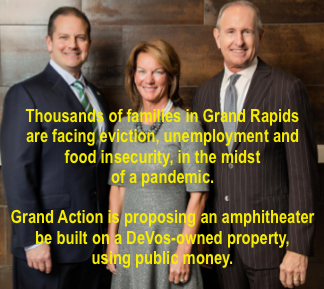 Last Saturday, it was reported by several of the dominant news sources in West Michigan, that the people who run Grand Rapids are still working on adding a large amphitheater and a soccer stadium.
The two primary entities involved in this effort are Grand Action and the Grand Rapids-Kent County Convention/Arena Authority. However, there are several other organizations involved, like the Downtown Grand Rapids Inc., the Right Place Inc. and Experience Grand Rapids. All of these entities are made up of first & second tier members of the Grand Rapids Power Structure.
MLive reported on this story and said that one possibility for where the amphitheater could go would be where Charlie’s Crab sits, including the adjacent parking lot. The MLive article also reported:
The property at 63 Market Ave. is owned by a limited liability company with the same address as RDV Corporation, the DeVos family office. A nearby surface parking lot is owned by the Amway Hotel Corporation.
“It’s too big a parcel and too important to the future of the city to be developed independently,” Frey said of the two pieces of land. “It has a spectacular potential for the next big phase of what this city’s all about.”
Unfortunately, MLive did not contact the RDV Corporation (DeVos-owned) to ask if 63 Market LLC was indeed a DeVos-owned property. I think it is pretty safe to assume that DeVos does own this property, along with the adjacent parking lot. In addition, since Grand Action is involved in this project, that means Dick DeVos will be directly involved.
Equally important is what David Frey (also a member of the GR Power Structure) has to say in the MLive article, specifically that the parcel shouldn’t be “developed independently” and “It has a spectacular potential for the next big phase of what this city’s all about.”
When David Frey says that this development project should happen independently, what he really means is that those of us who run the city will make the decisions about this project, we’ll donate some money, but we’ll get taxpayers to foot the bulk of the costs to make the amphitheater a reality.
When David Frey says this project has a spectacular potential for the next big phase of what this city’s all about, he means that this is what the local power structure wants the city to be about. On the matter of the next big phase, Frey is actually referencing 2016 study that Grand Action had done to look at how to make Grand Rapids a tourism and entertainment destination, something we reported on that year. Unfortunately, MLive failed to mention that the amphitheater and the soccer stadium were not new ideas, but part of a larger plan make more profits for the members of the Grand Rapids Power Structure.
When we reported on the Grand Action tourism and entertainment study in 2016, we made a point about how those plans were happening in the midst of a major housing crisis in Grand Rapids. Today, it would be appropriate to say that the members of Grand Action are planning to get the public to pay for their projects, while thousands in Grand Rapids are still facing eviction, unemployment and food insecurity, all in the midst of the COVID 19 pandemic. This is what we call good old fashioned Class Warfare!
MLive refuses to call Proud Boys a Hate Group, embraces the dominant narrative about policing
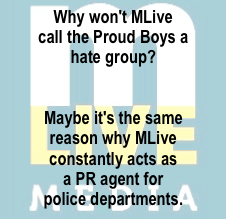 On Friday, MLive ran an article about an anti-lockdown protest in Lansing, which featured Steven Crowder, the far right social commentator who mocks those he doesn’t agree with.
The article also mentioned that there were “a handful of the Proud Boys” in attendance at the anti-lockdown protest. The Proud Boys have been part of every anti-lockdown protest in Lansing, since April, when far right groups began organizing these actions.
However, what is interesting about the MLive article that mentions the Proud Boys, is that they didn’t offer any qualifying comments about the group. The Southern Poverty Law Center identifies the Proud Boys as an “extremist group” and a “far right” group that promotes hate. Political Research Associates also identifies the Proud Boys as a hate group, with their participation in the Charlottesville Unite the Right Rally in 2017.
Unfortunately, MLive (and most other dominant news organizations) don’t always identify the Proud Boys as a hate group or far right group. The day before, on October 1st, MLive ran an editorial about the aftermath of the Proud Boys presence in Kalamazoo.
In that editorial, I was hoping for greater illumination on the Proud Boys role in the protest in Kalamazoo in August, but the editorial did not provide any new information or analysis from the August 15 clash between protesters and the Proud Boys.
However, the editorial did include a link to a podcast between the vice president of content for MLive and Mark Tower, who is one of the news leaders for MLive in Kalamzoo. Again, the MLive staff member working in Kalamazoo was hesitant to call the Proud Boys at Hate Group or White Supremacist group, instead identifying them as a nationalist group.
Also disappointing in this interview between MLive news personnel, was the fact that not only was there limited discussion on the Proud Boys, there was a clear lack of understanding about the current wave of protest groups in the US, and their clear embrace of the dominant narrative surrounding the function of police departments.
It was clear in the podcast that MLive staff have internalized the dominant narrative about policing, especially when one of them said, “you would think that the police would have had a squad car or two there before the Proud Boys showed up at the protest.” Such a statement reflects the belief that the police act to prevent violence in all circumstances and that they are somehow neutral in their dealings with groups which have opposite ways of seeing the world.
Interestingly enough, the MLive staff members did acknowledge that there were police present before the Proud Boys showed up, officers who were doing surveillance on the top of a building. So, the police did have a presence, but were not interested in preventing violence from happening between the Proud Boys and anti-racist activists that day in August.
During the podcast interview, a question was asked about whether or not the Proud Boys would be back to Kalamazoo. The MLive staffer who works in Kalamazoo stated, “I don’t know if they’ll be back, but we did interview someone with the Proud Boys, who is from Michigan.” The MLive staff member from Kalamazoo did not offer anything illuminating about the interview with a Proud Boys member, which leads me to believe that maybe they didn’t ask probing questions.
The MLive editorial and podcast were just one more affirmation for this writer, that the public cannot rely on dominant news sources for critical information about far right and extremists groups like the Proud Boys, nor can we expect these same news sources to investigate and hold accountable police departments or any other system of power and oppression.
After Michigan Supreme Court ruling on COVID 19 policies, legislators, who are bought and paid for, will decide out fate
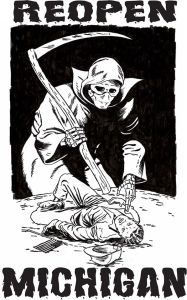 Last Friday, the Michigan Supreme Court ruled that Gov. Whitmer had over-stepped her authority during the COVID 19 crisis.
 In a recent article in Bridge Michigan:
Sen. Shirkey told Bridge he expects a federal court could act on the decision and begin to invalidate Whitmer executive orders as soon as next week. The governor has claimed that cannot happen for at least 21 days under Supreme Court rules.
What this will mean is that the Michigan Legislature will now likely decide on how to deal with the COVID 19 crisis, which should concern anyone who cares about health and well being of people living in Michigan. This is especially the case when it comes to the Senate Majority leader Mike Shirkey and House leader Lee Chatfield. Both of these legislators initiated law suits against Gov. Whitmer in early May.
In April, Shirkey and Chatfield had already been complaining about Gov. Whitmer’s stance on COVID 19. Shirkey was quoted as saying:
We believe business owners will act responsibly and take care within their establishments to clean and disinfect their equipment, protect their workers and customers, and meet strict health and safety standards. We believe parents will protect their children, clergy will make worship services safe for their congregants, and neighbors will look out for their communities.
The data on how many people have died so far and how many have contracted the virus, seems to contradict Shirkey’s comments above.
Then, during the anti-lockdown protests in Lansing, it became clear that the groups involved in organizing those protests were in direct communication with Sen. Mike Shirkey, by their own admission. This is what we wrote on May 12th:
The fact that the anti-lockdown protestors we working in tandem with Sen. Mike Shirkey is confirmed in one of their blog posts, where it states:
“The irony is that the American Patriot Rally was organized with one thing in mind: to encourage the senate to vote no on extending Whitmer’s emergency declaration, which they did. It was a victory. If Sean had taken the time to be a journalist, he’d have known that we got exactly what we came for,” Kelley said.
These comments came from Ryan Kelley, who is with the American Patriot Council. Kelley has also been one of the primary spokespersons defending the Civil War statue in Allendale, Michigan. A week after Kelley confirmed he had been in contact with Sen. Shirkey during the anti-lockdown protests in Lansing, he invited Shirkey to speak at an anti-lockdown protest in Grand Rapids on May 18.
The business community has consistently been behind Shirkey and Chatfield on their COVID 19 position. The Michigan Chamber of Commerce has endorsed allowing businesses to re-open, even pushing this message in April. The West Michigan Policy Forum has also supported this position of profits over people, when they stated in April:
Michigan Chamber of Commerce, Mackinac Center for Public Policy & West MI Policy Forum think 75% of businesses could re-open now throughout the state
The principles offered by Senator Mike Shirkey today smartly allows for a regional and phased approach to safely reopening businesses and protecting employees as they go back to work. We must reject the false choice between work and safety, so these outlined principles rightly empower workers, protect customers and increase economic security. We applaud Senator Shirkey’s welcoming approach to further input by medical experts. We urge the governor, lawmakers and business leaders to further refine the appropriate and sensible proposal by Senator Shirkey to coalesce around one plan to protect both lives and livelihoods and provide a safe pathway to restart our economy.
The endorsement of the West Michigan Policy Forum should not surprise us, especially considering that two of their members, DeVos and Kennedy, have pretty much bankrolled both Sen. Shirkey and Rep. Chatfield, as we noted back in May.
The GOP controlled State Legislature now has the ability to implement opening more and more of Michigan businesses, which will likely lead to more and more people contracting the COVID 19 virus. Profits over people is not just an ideological reference, rather it will become more and more of a reality if the likes of Sen. Shirkey and Rep. Chatfield have their way.
(graphic by Brett Colley)

Welcome to the next installment of West Michigan Far Right Watch, where we keep tabs on the far right in this area and provide a summary of what they are up to and what kind of messages they are promoting in this community.
We have 3 new examples to share with you this week.
First up is Voice For the Badge (VFB), which is now proposing (Oct. 1) that all GR City officials should be require to o 4 ride-alongs with the GRPD every year, plus attend simulation shooting classes twice a year.
VFB leader, Johnny Brann Sr. said, This might wake up city officials to the fact that OUR GRPD go through hell on many of their shifts and the split second decisions they must make. I am willing to bet that most city officials will shoot an innocent citizen or get shot themselves.
Our second example is from the West Michigan Policy Forum, which was recently celebrating on FB the Michigan Supreme Court’s ruling that Gov. Whitmer’s use of the 1945 law was in violation of the state’s constitution. The West Michigan Policy Forum, which is made up of powerful members of the local Capitalist Class, has been lobbying and financing political candidates that will defend business interests, even it is contrary to public health and well being.
Our last example has to do with the Far Right Think Tank, the Acton Institute. Last week, we posted a story about how the Acton Institute publicly endorsed Trump’s Supreme Court nominee, Amy Coney Barrett. We noted in that article, that Barrett is part of a religious right group known as The People of Praise.
In a September 30th blog post, the Acton Institute defended People of Praise, in an article entitled, Amy Coney Barrett: handmaid of the Lord, not the state. The Acton Institute once again demonstrated their far right support for organizations and elected officials that impose monotheism in the public sphere, promote patriarchal values, such a making women subservient to men.
In all three of our examples this week, we see how far right groups are attempting to impose public policy that benefits those in power, attacks marginalized communities in West Michigan, and celebrates profits over people.
Trump, White Supremacy and Fascism: When voting is not enough
 Tuesday nights Presidential debate was, as many have said, a shit show and a mess.
When President Trump was asked by the debate moderator if he would denounce White Supremacy, he refused to and instead told the some of the foot soldiers of White Supremacy, to Stand Back and Stand By.
Many non-state White Supremacist groups were encouraged by this statement and have been public about it. Groups like the Proud Boys, III%, Oathkeepers and Boogaloos are all groups that embrace a White Supremacist ideology. For an excellent assessment of these groups, check out the Activist Field Guide to the Armed Far-Fight, from Political Research Associates.
We all should be concerned about these groups and take them very seriously. However, White Supremacy is much more than groups like these. White Supremacy is a system of power and oppression that permeates all structures and institutions in the US. White Supremacy is not just people believing that White people are superior to every one else, it is more systemic. The best definition I have seen on what White Supremacy is, is what long-time anti-racist organizer Elizabeth Martinez uses, which is in the box above on the right.
An excellent resource for a deeper exploration of what White Supremacy is, is the Bay Area group called Challenging White Supremacy, which has great resources to use for workshops and further education materials.
When we expand our understanding of what White Supremacy is, we see that the state and capitalism are fundamentally rooted in White Supremacy. Mass incarceration, the “Drug War”, poverty, gentrification, are all rooted in White Supremacy and the primarily driven by government bodies, the state. The Proud Boys are not responsible for mass incarceration and the Boogaloos are not responsible for gentrification. These systems of oppression are the direct result of the state and capitalism, often working in tandem.
The Trump administration has created lots of political openings for White Supremacist groups to operate openly, even before he was elected in 2016. Since then, his administration, with little resistance from the Democrats, have adopted a neo-fascist platform. This neo-fascist platform, that the Trump administration has pushed, is now opening working to disenfranchise voters, spread propaganda about voting and is threatening to not concede the election if he does not win the election.
The question for all of us is, what do we do about the electoral threats coming from the Trump administration, in addition to the ongoing state repression that has escalated since the national uprising just after the police lynching of George Floyd? The Democratic Party is frantically trying to get voters to show up on November 3rd, but voting cannot and should not be the only option to confronting and dismantling the ongoing harm that the US government is perpetrating against the public.
Refuse Fascism
There is an interesting call to action coming from a group called Refuse Fascism. This group, which has organized chapters in many major cities across the US, is calling for mass protests to begin on Saturday, October 3rd and to continue through the election if Trump does leave the White House after an electoral defeat. https://refusefascism.org/
Refuse Fascism is following a model that other countries have used to force heads of state to step down, just like what we saw in Puerto Rico last July, where after 12 days of mass protests the Governor was forced to step down.
Here is one of the videos that Refuse Fascism is using to mobilize people to take to the streets and not wait for an electoral outcome.
If people around the country are going to actually escalate protests to call for the Trump administration to step down, the state will use whatever means necessary to repress such protests. This means that local police departments, Sheriff’s offices and state police, along with the National Guard will be use by the state to try and prevent the public from calling for the Trump administration to step down.
It doesn’t matter if mayors or governors in the cities and states that participate in these kinds of mass demonstrations are Democrats or even progressives. All we have to look at is what happened after the police lynching of George Floyd to see what cities and states were actively repressing the uprisings, just like what we saw in Grand Rapids.
What this should tell us is that the systems of power and oppression in this country only want us to believe that elections can solve our problems. Let’s say that Trump refuses to leave the White House if he his defeated in the November election. The Democratic Party will not call for mass demonstrations, they will likely try to rely on the courts or make speeches, but they are not likely to call for massive resistance to oust the Trump administration. This is why we need an independent, autonomous movement(s) to resist fascism in any form, which is what many groups that have been on the ground have been saying for a long time, groups like Black Lives Matter, NoDAPAL, Climate resisters, anti-war resisters, immigrant justice organizers, queer and trans organizers and many others.
Lastly, it is important to note that when the people in Puerto Rico forced the Governor to resign, they made it clear that they would force out any future politician that did not serve the public interest. This is revolutionary politics, and it is something we need to learn here in the US.
Resist White Supremacy!!!
New Kent County Immigration Welcoming Plan elevates business, while ignoring the fear that immigrants face from discrimination and ICE violence
 We know how important a broadly diverse population is for the success of our state. Immigration is key to increasing diversity in our population and boosting our economy. Without immigration growth, the state of Michigan would be poised to lose population for the second census in a row. Perhaps even more impressive, the economic power of Grand Rapids’ immigrant community alone grew by more than $100 million in just one year, and immigrants in Grand Rapids hold nearly $1.5 billion in spending power. At the core of this initiative is the belief that Grand Rapids and Kent County are home to everyone who lives here, and it should feel like it too.
Creating a welcoming and inclusive environment for New Americans in Kent County is not only the right thing to do, it also contributes economically to the area’s wellbeing. We want New Americans to stay in the area; they’ll stay if they feel welcomed, included, and valued.
This is the opening statement from the 36-page plan that Kent County recently published, which provides their strategy for making immigrants feel welcomed. This document is a follow up to the 2018 Gateways for Growth report on how much the immigrant community contributes to Kent County in economic terms. Like the 2018 report, this new document centers business interests over human rights an community safety.
Before discussing the content of the new Kent County plan, it is worth looking at who the Steering Committee and the larger Task Force is made up of. The Steering Committee is made up of people from the business community, one non-profit group (Samaritas) and three government officials.
The Task Force is much larger, as you can see from the entities listed here on the right. The Task Force consists of 36 different groups, with 5 government bodies, 2 law enforcement groups, 6 business entities, 7 non-profit/social service agencies, 4 Cultural entities, 6 Educational groups and a few other entities.
The strong business and economic language of the welcoming plan is a direct result of the business entities like the Chamber of Commerce and the Right Place Inc,, being members of the Task Forces, as well as government bodies, which too often measure success on economic terms, rather than human rights or quality of life.
The Welcoming Plan has lots of images and uses data to celebrate new immigrants, but is limited in terms of a clear and over-arching strategic plan. Sure, the Welcoming Plan wants to make sure that immigrants have access to education and other opportunities, but the recommendations to achieve such goals are vague and short sighted.
On page 16 of the document, the headline reads, Maximize the Potential of New Americans. One goal is to, “Enhance business resources for New American entrepreneurs and business owners,” which is what West Michigan values most……the expansion of entrepreneurs.
However, the fact remains that a large percentage of new immigrants work as migrant labor, in the service sector, landscaping, food industry and construction, with grossly inadequate wages. The Welcoming Plan says nothing about these immigrants and how thousands of them are:
- Subjected to poverty
- Live in substandard housing
- Have little or no health care
- Face linguistic an cultural barriers on a daily basis
Migrant workers are “essential” workers, in terms of West Michigan food production, yet most migrant workers make less than minimum wage and work under difficult and harsh circumstances. Add to this the pandemic and migrant workers are faced with an extremely precarious predicament. So, when the Welcoming Plan emphasizes entrepreneurs, it automatically excludes thousands who literally put food on our tables, yet suffer exploitation at the hands of agribusiness sector.
 Another Welcoming Plan strategy is to provide greater access to people to participate in local civics. While the intent is laudable, the reality is that the Kent County government does not provide simultaneous translation for government meetings, plus the majority of meetings take plus in the morning, making public attendance nearly impossible.
Beginning on page 28, you will find a section that is framed as making Kent County residents feel safe. The usual Neo-liberal tactics are used, such as making law enforcement officers more culturally competent, building relationships between cops and new immigrants and “helping” new immigrants understand the law.
In this section there is no acknowledgement of:
- How thousands of new immigrants live in fear of law enforcement
- How local law enforcement cooperates with Immigration & Customs Enforcement (ICE) to arrest, detain and deport new immigrants
- How thousands of new immigrants are exploited because of their legal status
For immigrant-led groups like Movimiento Cosecha GR, the lack of local government entities to work with them on issues like Driver’s Licenses for All and ICE violence, hasn’t made them feel welcomed or heard when it comes to the critical issues that many new immigrants face.
In the end, it seems that the new Kent County Welcoming Plan; 1) while celebrating economic contributions of immigrants, fails to come to terms with the fact that thousands of new immigrants are being exploited; 2) fails to acknowledge the real fear that new immigrants are experiencing in this community; 3) fails to provide clear and just recommendations on how to deal with ICE violence; and 4) sends the message that new immigrants are welcomed if they operate within the entrepreneurial/assimilationist/White Savior model that can also be described as West Michigan Nice.
Grand Rapids-based Acton Institute endorses Trump’s Supreme Court Nominee who is part of a far right Christian group
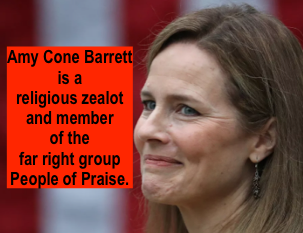 Since the death of Supreme Court Justice Ginsburg, the Trump administration has waste no time in nominating her replacement.
Amy Coney Barrett, who used to clerk for Supreme Court Justice Antonin Scalia, was nominated by President Trump, while some Democrats want to postpone a replacement for Ginsburg until after the election.
The far right think tank, the Acton Institute for the Study of Religion and Liberty, in an article dated September 26th, has essentially endorsed Barrett to become a US Supreme Court Justice.
The Acton Institute article, written by Rev. Ben Johnson, cites several conservative sources, which praise President Trump’s choice in Amy Cone Barrett. The Acton writer cites the First Liberty Institute, a Texas-based legal firm that defends religious rights cases and is endorsed by Ted Cruz.
Then there is The Catholic Association, a far right Catholic group that not only endorses President Trump, but embraces numerous conservative and neo-liberal positions on issues like abortion, education and health care.
Barrett has serve on the U.S. Court of Appeals for the Seventh Circuit since 2017, but has come under tremendous criticism for her conservative religious views. One major omission in the Acton Institute article, is the fact that Barrett is part of the People of Praise group, which is a Catholic Charismatic entity and believes that women should be subservient to men.
The People of Praise movement is also connected to the Sword of the Spirit group, another Catholic Charismatic group based in Ann Arbor, Michigan, with strong ties to the conservative Catholic school in Ohio, Steubenville University.
The National Catholic Reporter has an excellent article about People of Praise and Amy Cone Barrett, and the author of that article was recently interviewed on Democracy Now, for those who want to further explore the cult-like nature of the group People of Praise.
For those of you who are familiar with the politics of the Acton Institute, none of this would come as a surprise. However, the Acton endorsement of Barrett should concern anyone who doesn’t want to see religious zealots making legal decisions on the US Supreme Court.
West Michigan Far Right Watch for the week of September 21 – 27: Police apologists, GR officials and Christians who hate Black Lives Matter
Welcome to the next installment of West Michigan Far Right Watch, where we keep tabs on the far right in this area and provide a summary of what they are up to and what kind of messages they are promoting in this community.
We have 3 examples to share with you this week. The first example comes to us from a group that made our list last week, Voice For the Badge (VFB). VFB is a citizen group in Grand Rapids that acts as an apologist and cheerleader for the GRPD and cops all around the country. Their leader, Johnny Brann Sr., posted this message on Wednesday, September 23rd, after the Grand Jury in Kentucky found that none of the three cops involved in the murder of Breonna Taylor, were guilty of shooting Taylor:
You worthless animals. Attempted assassination of our police in Louisville ?? Pathetic cowards. This will change. Evil cowards will not win. We won’t let them.
PRAYERS FOR OUR OFFICERS
Johnny Brann Sr.
Voice For The Badge
There are no comments about the injustice of the court’s decision or the fact that Breonna Taylor was shot dead by police while in her bedroom. Instead, VFB choses to omit the facts and then distort the context of the threats against police in Louisville. It is completely understandable that people would be pissed off at the cops for getting yet another free pass for killing a Black person in the US. Frankly, the police should be grateful that they are not received more threats, considering they can murder Black people without any damn consequences.
Our second example of a far right action taken in from the City of Grand Rapids. Now, I know that there are lots of people who consider Grand Rapids to be a liberal/progressive bastion, but last week, Grand Rapids once again displayed their contempt for people (mostly Black) who were protesting against the Grand Jury decision in the Breonna Taylor case.
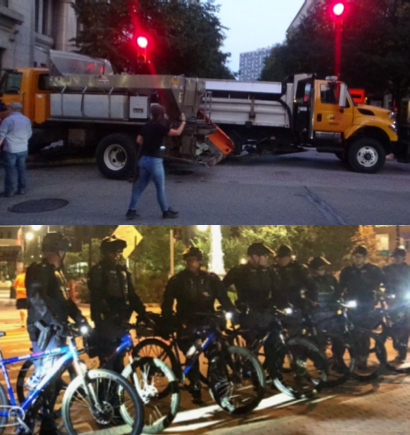 The City of Grand Rapids went out of their way to send a message to people who were protesting against cops getting off in the Breonna Taylor case. The City set up salt trucks to block vehicle access to the GRPD headquarters, put up other physical barriers and stationed cops in full riot gear in front of the police station, when several hundred people were protesting.
What made this display of state violence even more disgusting, was the fact that earlier in the day (Sept. 23rd), the City released a statement on Facebook about how they too were morning the Grand Jury’s decision in the Breonna Taylor Case. In a further display of contempt for public anger in this case, the City also posted information about an event for September 24, hosted by Mental Health Clinicians of Color, inviting people to morning the court’s decision in the Breonna Taylor case. Now, I fully support the purpose of that event, which provided a safe space for people to talk about and process this grave injustice, but for the City of Grand Rapids to promote such an event, while militarizing downtown Grand Rapids in not only hypocritical, it demonstrates that the only acceptable way to mourn or grieve the police murder of Black people is to do it without ever challenging systems of power.
The last example this week is from a Christian Church that displays hatred toward the LGBTQ community, believes that wearing masks during the pandemic is stupid, and refers to Black Lives Matter as a “Marxist cancer.”
The church we are referring to is The Ridge Covenant Church, located at 4453 Fruit Ridge Avenue NW, in Grand Rapids. The church’s pastor, Andy Parker, posts regular videos in their Facebook page, sometimes wear t-shirt that say Socialism Sucks.
The videos they post promote patriarchal values, along with regular condemnations of people that Pastor Andy calls, “homos and Trannies.” The church also celebrates faith communities around the country that have been violating social distancing and mask wearing policies, calling the pandemic a hoax.
In addition, a recent video they hosted (shown below), provides a detailed attack against Black people in general, but specifically the Black Lives Matter movement. It is places like The Ridge Covenant Church, which provides helps to create space for White Supremacist values, which often leads to social indifference and outright support for state violence against Black people, and it can lead to individual acts of violence directed at members of the Black community by people who embrace this ideology.
Finally, while it might be easy for people to scoff at the examples provided here of The Ridge Covenant Church and the Voice For the Badge, it is vitally important that both of these groups are primarily ideological foot soldiers for White Supremacy, whereas the actions of the City of Grand Rapids are a clear example of Structural Violence, which in this case is State Violence.

