The Michigan Oil & Gas industry, Line 5 and why we so desperately need Climate Justice
There was a recent article posted on MiBiz about the Oil & Gas industry in Michigan that was very instructive.
The article, headlined, Michigan’s oil and gas producers weather pandemic amid long-term demand questions, provides an interesting window into the mindset of some in the extraction industry in Michigan.
The story from MiBiz features the voices of Adam Wygant, director of the Department of Environment, Great Lakes and Energy’s Oil, Gas and Minerals Division, along with Jason Geer, president and CEO of the Michigan Oil and Gas Association.
The most instructive comments came from the Michigan Oil and Gas Association CEO, who stated:
“Oil has been pretty cheap, and that has definitely impacted our ability to drill. The pandemic crashed prices into negative territory, and that gives you pause on whether you want to make the investment. The price of oil is starting to go up, and high prices mean more activity for us. We feel pretty good that if the price continues to hover in the $60 range, we’ll probably have a pretty good summer.”
Geer’s statement not only reflects the importance of profitability for the oil and gas industry in Michigan, it reflects a desire to maintain a longterm commitment to a fossil fuel-driven economy.
Later in the article, the focus shifts to the issue of the Enbridge Line 5 that runs through Michigan. The MiBiz article mentions that there are indigenous and environmental groups that are wanting to include Climate Change as a major talking point on why Line 5 should be discontinued. Again, Geer thinks that the Michigan Oil & Gas industry will be fine, since for him it all comes down to the cost of fossil fuels and consumer demand.
The Michigan Oil and Gas Association doesn’t hide its commitment to maintaining Line 5. Their three page “fact sheet” on how Line 5 benefits Michigan, is filled with out of context data and doesn’t factor in the longterm cost of environmental damage from Line 5, nor does it include the impact of maintaining Line 5 in regards to Climate Change.
The Michigan Climate Action Network recently sent out information about including Climate Change in the Line 5 debate, stating:
Within weeks, the Michigan Public Service Commissioners (MPSC) will decide whether or not to consider the impacts of climate change in their review of Enbridge’s proposed Line 5 oil tunnel. MPSC staff is encouraging them to exclude all evidence about climate impacts, even though this project would carry billions of gallons of oil for up to 99 years. It is unconscionable that this could be the case in the time of our climate emergency.
Michigan Climate Action Network is inviting people to add their name to pressure the Michigan Public Service Commission to consider the impacts of Climate Change with regards to the Enbridge Line 5.
Since the COVID 19 pandemic set in over a year ago, we have posted several articles about why we can’t go back to normal once the pandemic is over. What has been normal, is what is killing us, and that is definitely the case with Climate Change. In June we wrote:
Virtually every week there is a new study that comes out about human-caused climate change and the need for radical structural change before it is too late. Unfortunately, most of the white-led environmental groups are still spending most of their energy trying to either get people to change their personal consumption habits or appeal to governments to enact change. We have to stop being fooled by these approaches, start coming to terms with the seriousness of climate change and start learning from Black, indigenous and other communities of color that are rooted the struggle against White Supremacy, Settler Colonialism and Capitalism.
We need to radically imagine a different kind of future. We can no longer afford to think that we can maintain our current levels of consumption and our way of life, by simply using green energy. This is a false solution and it is a lie. We cannot return to normal after the pandemic, since before the pandemic, the systems of White Supremacy, Capitalism, Heterosexism, Ablism and Patriarchy were the norm. If we want a future as human beings, then there needs to be serious, radical and revolutionary goals to work towards. Here is a short list, all of which are connected to Climate Justice, if we are willing to do the intellectual, emotional, social and cultural work to see how these things are connected.
- We need to acknowledge that we are all living on indigenous land.
- We need to ask indigenous communities what they want from us moving forward.
- We need Defund the US military. The US military is one of the largest consumers of fossil fuels and its primary function is to occupy other people’s lands and protect the interests of global capitalists.
- If we Defund the US military ($850 billion for 2020), then if make sure that money goes to Black, indigenous and latinx communities to decide how to use it, imagine how that could radically alter lives in those communities.
- Defund the Police. Again, it would reduce violence against, Black, indigenous and latinx communities and re-direct police budgets to those communities.
- All environmental groups must incorporate into their mission an anti-Settler Colonial, anti-White Supremacy and anti-Capitalist framework.
- Abolish the Prison Industrial Complex.
- Abolish Immigration and Customs Enforcement.
- Abolish the Agri-business system of food and practice Food Justice and Food Sovereignty.
- End all Fossil Fuel Subsidies and demand reparations from the fossil fuel industry for decades of ecological destruction, the murder of countless Black, indigenous and latinx people and the role that the fossil fuel industry has played in deny climate change.
- Make all utilities publicly controlled, and by public I mean community-based control.
- Make public transit free.
- Make housing free for everyone.
- Make health care free for everyone.
- End wage slavery.
- End representative government and move towards direct democracy and local control.
Another World is Possible!!!!

Grand Rapids City Commissioners weigh in on Defunding the GRPD: What the MLive article doesn’t tell you
On Tuesday, MLive posted a story with the headline, GRPD likely won’t face significant ‘defunding’ cuts from city commissioners.
The article begins by saying:
Despite some city commissioner calls for a discussion and a push from some in the community, significant cuts to the Grand Rapids Police Department’s budget are unlikely for the upcoming fiscal year.
“A push from some in the community?” This is not only inaccurate, it minimizes the efforts and all of the hard work that community organizers have put in and continue to put in on the issue of defunding the police. Also, the use of the word some denies the fact that there were over 3,000 individual messages from people in the community calling for defunding the GRPD back to the City Charter mandated 33% of the budget. Three thousand people is not only a substantial number of people, it is one of the highest number of people taking an active role on an issue that we have seen in more than a decade in Grand Rapids. In fact, besides the group Defund the GRPD, here is a list of groups that have been actively involved around a larger GRPD funding conversation – the NAACP, the Urban Core Collective, Equity PAC, Together We Are Safe, the People’s Budget GR, Justice for Black Lives, Movimiento Cosecha GR, the Grand Rapids Area Mutual Aid Network, GR Rapid Response to ICE, the ACLU and the Grand Rapids Area Tenant Union. Again, rarely have we seen this kind of a coalition working on a singular issue in some time.
However, the other thing that is problematic about the MLive article is the singular focus on where Grand Rapids City Commissioners stand on this matter. The article does note that Commissioner’s Reppart and Jones did not respond, but why did MLive exclude City Manager Mark Washington and Police Chief Payne? The reality is that the City Manager has more power than elected officials, and both Payne and Washington have made it clear for months that they do not support any funding reduction for the GRPD.
The more egregious problem with the MLive article is the fact that they do not include community voices in the story, particularly voices from those who have been organizing around Defunding the GRPD since June of 2020. How significantly different would the MLive article look, had they provided commentary from community organizers who have been doing work with Defund the GRPD since last summer.
Equally problematic is the failure of the MLive journalist to provide a clearer and more robust exploration as to what the Defunding the Police movement is all about. Here is a link to one of the many Defund the Police toolkits that have been used by this larger movement for the past year and here is an excellent summary of what the movement is really calling for.
#DefundPolice is a strategy that goes beyond dollars and cents—it is not just about decreasing police budgets, it is about reducing the power, scope, and size of police departments. It is about delegitimizing institutions of surveillance, policing and punishment, and these strategies, no matter who is deploying them, to produce safety. It is a strategy (part of the HOW) to advance a long term vision of abolition of police through divestment from policing as a practice, dismantling policing institutions, and building community-based responses to harm, need, and conflict that do not rely on surveillance, policing and punishment.
This gets to the root of much of the problem is that too many people have reacted in knee-jerk fashion to the phrase defund the police, without taking the time to investigate the larger vision for what defunding the police really means. Of course, the news media has played a significant role in misinforming the public on this critical issue as well.
The bulk of the MLive article, however, is the responses they got from Mayor Bliss and Commissioners O’Connor, Ysasi, Moody and Lenear, which we summarized in the graphic below. What the MLive article doesn’t tell you about some of the responses from commissioners are the following:
Both Mayor Bliss and 1st Ward Commissioner O’Connor have received thousands of dollars from the Grand Rapids Police Officers Association PAC in recent years.
While the MLive article does quote Commissioner Moody about not supporting the defunding of the GRPD, which were comments he made during a City Commission meeting in March, is that he also spoke ill of the group Justice for Black Lives, saying that he hasn’t seen them doing anything positive for the community. His statement is patently false and it was a condescending example of respectability politics.

In Part I, we looked at the recent surge in COVID cases in Michigan, by using a WOODTV8 story as an example of how the local news media is failing us when it comes to exploring the reasons behind the rise in COVID cases.
Today, we want to look at some of the pre-existing structural conditions which are contributing to the recent COVID surge, structural conditions that will continue to cause tremendous harm in a post-COVID world, unless we confront and dismantled them. The three pre-existing structural conditions we will address in this post are White Supremacy, the Wealth Gap and the role that the Non-Profit Industrial Complex plays in supporting the racial and economic injustices in Grand Rapids.
Grand Rapids is an Apartheid City with a White Savior Mentality
Last May, we wrote about the newly created Kent County COVID database that was created by the Health Department. In that post we looked at the Health Department’s data and could easily determining that a disproportionately high number of Black and latinx people were contracting the COVID 19 virus. We determined that this was due to how deeply entrenched White Supremacy is in this city. If one looks at the data from the Health Department today, one could draw the same conclusion.
Let’s be honest. Grand Rapids is a deeply racist city. The data supports this fact, whether we are talking about pre-existing health conditions, poverty, access to education, employment, housing or environmental factors, Black, latinx and indigenous people are disproportionately affected.
We could also talk about how entrenched White Supremacy is in the city through the lens of how the power structure responds. Just within the past few weeks we have heard about how Kent County Commissioners responded to concerns raised by community members over the issue of racism as a public health concern. Then there was the issue of how Grand Rapids City officials responded to how the police are targeting members of Justice for Black Lives. In addition, we could look at the larger response to calls from thousands in the community the Defund the GRPD and how City officials undermined significant public opinion to actually reduce the GRPD’s share of the city budget.
However, there is also the lived experience of Black and latinx people. In recent years, I have been involved in several social movements in this city, the movement for immigrant justice led by Movimiento Cosecha GR and the Defund the GRPD movement, which is led by Black community organizers. I have heard from these leaders repeatedly how they feel threatened, dismissed and exploited. I have also heard these community organizers talk about feeling undervalued, tokenized and unsafe. Lastly, these same leaders have shared their frustrations over and over again with how white-led or white funded organizations and are constantly undermining their work with reformist or white savior politics.
Grand Rapids perpetuates the wealth gap with tactics like entrepreneurial gatekeeping
Based on the most recent data, Grand Rapids has the largest wealth gap of any city in Michigan. There are roughly 600 millionaires in Kent County and a few billionaire families. These 602 families have more combined wealth than the rest of the population in this area. This alone should tell you something about who has power and who doesn’t.
Grand Rapids likes to brag about how they believe in promoting the entrepreneurial spirit, but the fact is that those who have all the wealth are only interested in sharing their tricks of the trade with those who will not challenge their power and excessive wealth. There are only so many start up businesses that can exist in this city, which means they will always need workers to take advantage of. But Grand Rapids hates to call people workers, instead they prefer to call them talent, which is exactly how students in the education system are referred to in this community.
I mean just look at the booming cannabis industry in the city and who is reaping the benefits. Those profiting from the cannabis industry are not the Black people who, until recently, were being criminalized for selling or using cannabis, but non-Black business owners, many of whom are not even based in Grand Rapids and are part of larger chain businesses.
Or look at how the DeVos family strategically provides funding through their foundations to promote wealth creation. Whether we are talking about Start Garden or AmplifyGR, DeVos funding for these projects are designed to allow the right people to gain access to wealth, and by right people I mean those who are either ideologically aligned with the DeVoses or those who will never challenge their hegemonic power. The DeVos family members are the masters at entrepreneurial gatekeeping.
The Grand Rapids Non-Profit Industrial Complex and the buffer zone
In many ways what I just described about the DeVos family is true of the non-profit and social service sector in general in this community. Non-Profit organizations often depend on the wealth of area foundations, which always comes with strings attached. The biggest string, which we could name as a noose, is designed to make sure that in order to gain access to this funding, non-profits can never challenge structural injustice or the very root causes they claim to be addressing. We recently saw how this played out with the group Kids Food Basket, which pushed back against community organizers who were challenge their function as a White Savior entity.
One of the larger benefits to the strings-attached funding dynamics, is that it helps to create what Paul Kivel identifies as a political buffer zone. In his essay, Social Service or Social Change, Kivel names the outcome of foundation funding of non-profits as buffer zones. Buffer zones are political and social spaces created to protect systems of power by creating a dynamic where people are discouraged from asking about why they are poor, especially when the why is directed at those with the most wealth. These buffer zones are self-perpetuating, since they offer individualized opportunities, which often eliminates the opportunities for people to think about the structural barriers to racial justice or any other kind of justice they would benefit from.
Lastly, the buffer zones created by funding conditions within the non-profit sector also leads to the practice of White Saviorism. The charity-based sector does this real well in Grand Rapids, with White money and White-power dynamics determining who gets temporary relief from systems of oppression, which in this community is overwhelmingly Black and Brown people. Why else would White Liberal defend the likes of Kids Food Basket so vehemently?
Thus the pre-existing structural conditions in Grand Rapids – White Supremacy, the Wealth Gap and the Non-Profit Industrial Complex – are the very systems that must be confronted and dismantled, if we ever want to achieve equity and justice in this city. These three pre-existing structural conditions are the holy trinity of systemic oppression in Grand Rapids. So what are we going to do about it?

Living with COVID one year later: Part I – Another surge in cases, but without explanation
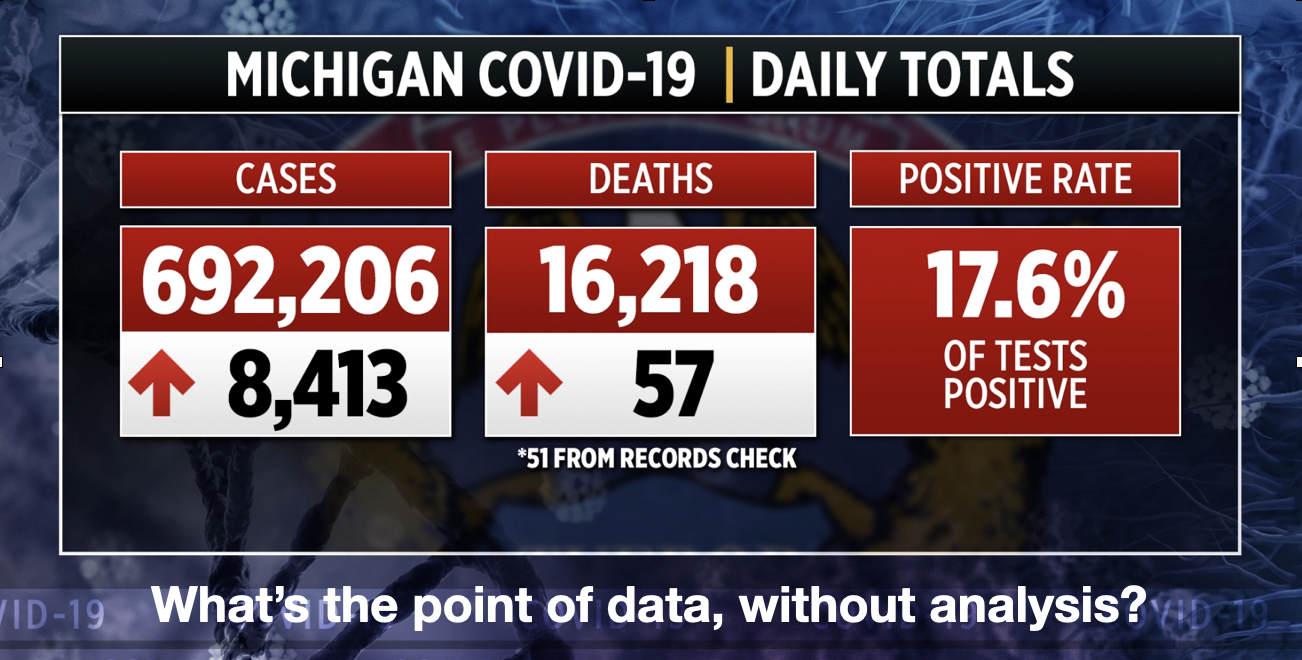
On Saturday, WOOD TV 8 posted a story entitled, About 8,400 new coronavirus cases in MI as test positivity tops fall high.
The story filled with data, both at the state level and data specific to West Michigan. Channel 8 focused on the rising number of people testing positive for COVID, the number of deaths in the last few days, along with maps and even more data.
Later in the story it states:
State officials are now worried about people taking spring break trips, particularly to Florida, which also has a high infection rate right now. They are urging people to get tested before and after travel.
But then channel 8 slips back into making the story about data.
One would think, that after living with COVID for the past year, that local news agencies could do more than give us data, and instead try to get us to think about why some many people are now testing positive for COVID, in what many are calling another surge.
As we mentioned earlier, channel 8 did say that state officials were concerned about people on spring break trips, but this is merely speculation and is not based on fact. So what can we say about why so many people are testing positive for COVID in Michigan right now and what are the contributing factors? How could WOOD TV 8 have made this story about not just the rise in COVID cases, but the reasons for the spike?
As Bridge Magazine as reported, there is a clear correlation between schools shifting back to in person schooling and a spike in cases.
As we have noted in numerous stories over the past year, there has been tremendous pressure from the Chamber of Commerce, from the Mackinac Center, from the West Michigan Policy Forum and from Republican legislators in Michigan to lift any and all restrictions on schools, restaurants and other businesses – as was reflected in this story in the Detroit News in late January, with the headline, Michigan GOP leaders call for reopening schools, restaurant dining.
A third major reason for the surge in COVID cases in Michigan is the fact that there are plenty of people who do not think COVID is a serious issue, plus there are plenty of people that think it is a government hoax. When we reported on the Holland restaurant owner who was put in jail over COVID violations, the amount of coverage that story received was astounding. Even more astounding was the fact that most of the people who came out to protest in support of the restaurant owner were not wearing masks, along with the fact that several GOP politicians and candidates in the 2022 election are running on a platform that includes denial of the COVID pandemic.
Each of these three reasons deserve their own news story(ies) and would benefit the public tremendously, especially if they were explored and analyzed in such a way as to help us make some determinations about what factors are determining the new surge. If news agencies are not doing this, then it is safe to say they are not practicing journalism, but a form of sensationalism, sensationalism that actually does public harm.
In Part II, we will explore some of the larger issues around the COVID pandemic that are specific to the Greater Grand Rapids Area.
Grand Rapids Think Tank promotes more White Supremacy
Over the past decade, GRIID has written dozens of articles that are critical of the Grand Rapids-based far right Think Tank, the Acton Institute for the Study of Religion & Liberty.
In our posts on the Acton Institute, we have dissected their ideological celebration of Capitalism, their support for religious conservatism and their history of climate denial. However, within the past year, a year that has seen the Movement for Black Lives for the people in the United States to confront the glaring realities of White Supremacy, we have noted that the Acton Institute has ramped up their own perpetuation of White Supremacy.
A year ago, when the COVID pandemic hit the US, the Acton Institute promoted xenophobia and anti-Asian hate in a post blaming China for the pandemic. After the police lynching of George Floyd, the Acton Institute began to publicly condemn the Black Lives Matter movement, further demonstrating their perpetuation of White Supremacy.
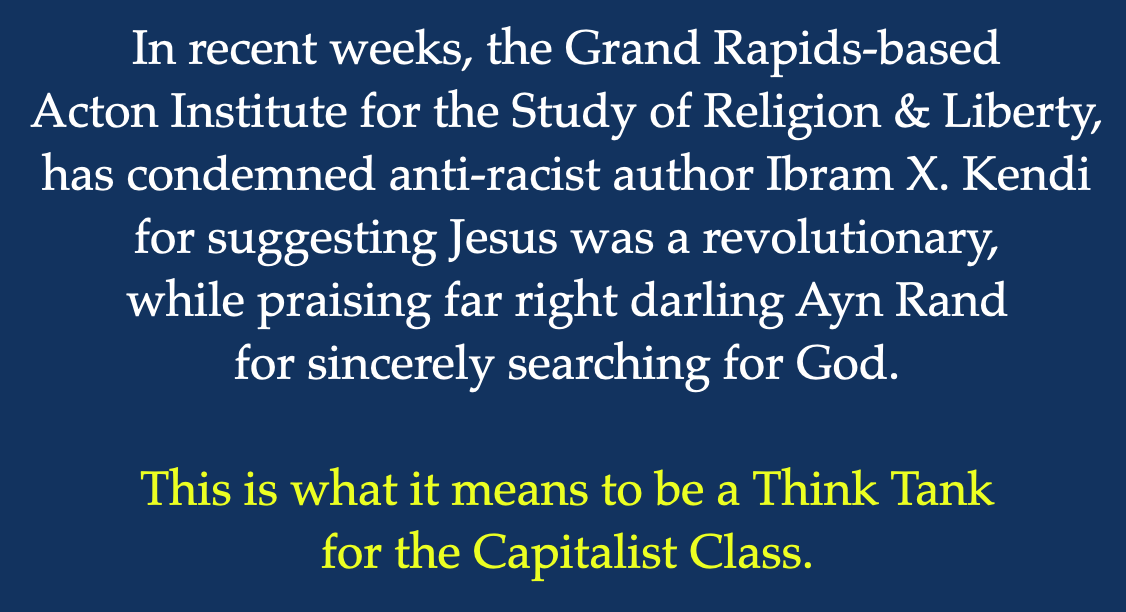
Within the past few weeks, the Acton Institute has gone the extra mile to demonstrate their support for White Supremacy. In an article they posted on March 27, they condemn Black author Ibram X. Kendi, particularly for suggesting that Jesus was a revolutionary. The Acton Institute rant against Kendi also condemns the anti-racist author for being critical of converting people from other cultures and spiritual traditions – missionary work – as well as, blaming him for succumbing to Liberation Theology. Liberation Theology is rooted in the idea that God’s people should liberate themselves for systems of power and oppression. The Acton Institute rejects such a notion, since, 1) they believe that liberation theology is rooted in Marxism, and 2) they believe that Capitalism is the perfect bedfellow of Christianity.
Ironically, just one week before attacking a Black anti-racist author, the same Acton Institute writer praised Ayn Rand for genuinely searching for God. In fact, Acton Institute founder, Rev. Robert Sirico was the one who spoke so highly of Rand.
So, within a one week period, we see the far right Think Tank praise a white author for defending Capitalism, while condemning a Black author for suggestion that Jesus was a revolutionary. Further evidence to underscore exactly why the Acton Institute chose Grand Rapids to be its home base.
Last week, the Institute for Policy Studies published a new report entitled, A Year of Billionaire Pandemic Gains.
The report is full of data and numbers on how much money the billionaire class has profited over the past year, a year that saw over a million die from COVID and millions struggle under the economic, social and health conditions created because of the pandemic.
More importantly, as this new report demonstrates, the pandemic exposed the ugliness, the utter cruelty of the economic system of Capitalism. How is it, that so few could profit so much during the pandemic? But here is the thing, Capitalism will continue to benefit the super rich, even after the pandemic, because that is the nature of Capitalism, particularly in this Neoliberal age of Capitalism.
Here are highlights from the last 12 months of billionaire wealth growth:
- The combined wealth of the nation’s 657 billionaires increased more than $1.3 trillion, or 44.6%, since the pandemic lockdowns began. [Master Table] Over those same 12 months, more than 29 million Americans contracted the virus and more than 535,000 died from it. As billionaire wealth soared over, almost 80 million lost work between March 21, 2020, and 20, 2021, and 18 million were collecting unemployment on Feb. 27, 2021.
- There are 43 newly minted billionaires since the beginning of the pandemic, when there were 614. A number of new billionaires joined the list after initial public offerings (IPOs) of stock in companies such as Airbnb, DoorDash, and Snowflake.
- The increase in the combined wealth of the 15 billionaires with the greatest growth in absolute wealth was $563 billion or 82%. [Table 1] The wealth growth of just these 15 represents over 40% of the wealth growth among all billionaires. Topping the list are Elon Musk ($137.5 billion richer, 559%), Jeff Bezos ($65 billion, 58%) and Mark Zuckerberg ($47 billion, 86%).
According to the data provided in this new report from the Institute for Policy Studies, there are 7 Billionaires living in Michigan. The billionaire in Michigan who profited the most during the pandemic so far is Dan Gilbert. Gilbert is the owner of Quicken Loans, which capitalized on cloistered citizens tapping online financing, plus Gilbert is a major player in the massive gentrification of Detroit. His wealth during the pandemic grew from $6.5 Billion to $41.7 Billion, which was a 642% increase.
We have a few of those 7 Michigan Billionaires right here in West Michigan. The DeVos family is collectively worth billions, but because of the way they hide their wealth it is hard to determine what their total collective wealth is, especially since Richard & Helen DeVos are now deceased.
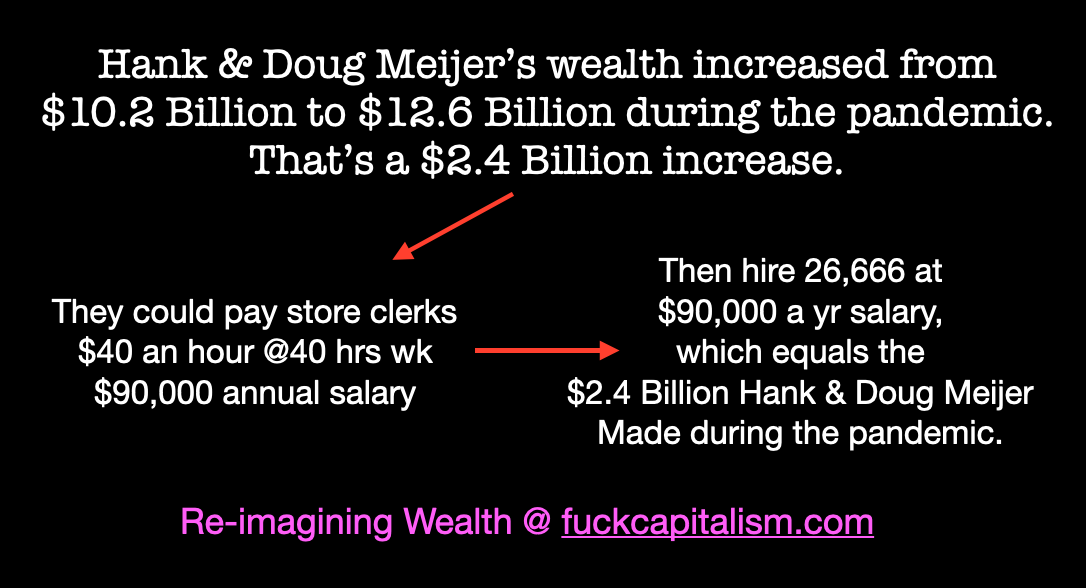
However, we do know how much the Meijer family is worth. According to the data from the Institute for Policy Studies, Hank & Doug Meijer’s wealth went from $10.2 Billion at the beginning of the pandemic to $12.6 Billion today. This means that Hank & Doug Meijer’s wealth increased by 23.5% in just one year.
Now, starting pay for a grocery store clerk is $10 an hour at Meijer and these workers have been considered front line and essential workers in the past 12 months. Do you think that the lives of Hank and Doug Meijer would have been negatively impacted at all if they paid these workers $20 an hour as a starting wage? If a Meijer essential worker was making $20 an hour at 40 hours a week, they would make $45,000 a year. So, if we took the $2.4 billion that the Meijer brothers made during the pandemic and divided it by $45,000, we would get 53,333. This means that Hank & Doug Meijer could have employed 53,333 store workers at $20 an hour/40 hours a week.
Of course, Meijer does not even have 53,333 store employees, so let’s double the salary once again to $40 an hour. This would mean that a Meijer store clerk, which we have been calling an essential worker for the past 12 months, would make $90,000 a year. With the $2.4 billion that Hank & Doug Meijer made during the pandemic, they could pay 26,666 employees earning $40 an hour for 40 hours a week. Again, I doubt that Meijer employees that many store workers, but you get the point. The wealth of people like Hank & Doug Meijer, which has increased by $2.4 Billion during the pandemic, is always about exploitation and it is always about policy. Let’s organize and demand more!
Operation Safe Neighborhoods? The GRPD, Community Policing and the Suppression of Dissent
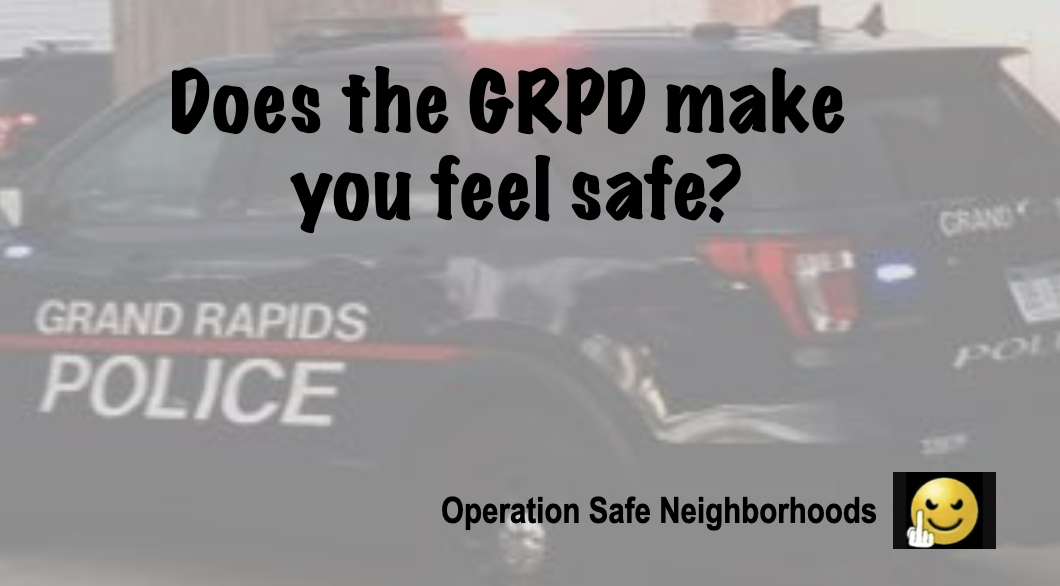
Last weekend, the Grand Rapids Police Department began what they referred to as Operation Safe Neighborhood. This operation involved deploying a “new” community policing program, which also included the use of helicopters.
Like many people, my Facebook newsfeed blew up over the weekend with people complaining about the helicopters flying over the neighborhood, with the general sentiment being that it did not make people feel safe.
In a statement released by the GRPD it states:
Despite the evening’s achievements, Chief Payne appreciates that the operation, including the use of aerial resources, can cause disruption in the community. “No one wants to be sitting in their living room listening to a helicopter flying overhead, including me,” the Chief said. “But I have to weigh what’s happening on our streets with how people may feel. We conducted door to door engagement during the week leading up to this operation, and the residents made it clear that they were glad we were there.” Last night represents another successful implementation of the GRPD strategic plan. “By engaging with the community ahead of time, deploying a diverse team of resources, and using data driven tactics, we made a significant impact on violent crime in the city while partnering with our stakeholders”, the Chief said.
Two things stand out for me in this statement. First, despite his rhetoric, Chief Payne doesn’t care about how people feel, because he has to focus on what is happening in the streets. I take this to mean that Chief Payne is going to do whatever he wants, no matter what the public thinks. The police know what’s best, so if you don’t like what they are doing, then too bad. In recent years this has been the experience of many community organizers that I have spoken with, all of which feel that the GRPD does whatever it wants to do.
Second, Chief Payne suggests that their actions over the weekend were a success, because they made some arrests, etc. However, did Operation Safe Neighborhoods make people feel safer? It may be impossible to know for sure, since we don’t really hear from the public or the so-called “stakeholders” that Chief Payne mentions in his statement.
The local news media did primarily what they always do, which is to rely exclusively on the GRPD’s perspective. In the case of MLive, WZZM 13 and WXMI 17, all they did was to regurgitate what the GRPD said in their statement. The only exception was the channel 8 story, which still featured a GRPD perspective, but it was the only news outlet to actually talk to someone from the community. A local restaurant owner had this to say:
“The shooters, the violators are not being invited to the table,” Libbett said. “They’re not having a conversation with the powers that be or the police.”
Libbett recognizes it’s not an easy task to get both sides to meet.
“If something happens in the streets and there’s a lot of people around and they say, ‘Why don’t they say something?’ Because it’s a code they live by,” Libbett said. “If you got a policeman that’s harassing someone in the community, no other police come forward and say, ‘Hey, stop doing that’ or go to his sergeant and say he used excessive force. When the community sees this is how they are treated, they get defensive, they don’t want to have a conversation.”
Mr. Libbett’s comments are instructive, since he points out what so many people have been saying in recent years, particularly in the Black community, that they do not trust the GRPD and do not want to talk with them, because of how the police treats the community, often using excessive force.
However, the very next day, WOOD TV 8 ran a follow up story about Operation Safe Neighborhoods, in a different neighborhood, speaking with white residents, who said they were “happy with increased GRPD patrols.” It’s almost as if the GRPD leaned on WOOD TV8 after they had a Black man speak the truth about how policing is perceived in his community.
So, despite the use of helicopters and the arrests that were made, how does the community feel about the GRPD? We can never know completely and we certainly are not going to get honest and complete community feedback from the use of tools like FlashVote. We can make some determinations about how the community feels about the GRPD, based on what has happened in recent years.
Here is a list of numerous incidents that communicate that there are plenty of people, particularly in the Black and Brown communities that are highly critical of the GRPD:
The GRPD, White Supremacy and Community Accountability
Calls for a State of Emergency in Grand Rapids elicits no meaningful response from City Officials
Billed as Community-Police relations “listening tour,” the meeting was a highly managed forum
GRPD’s recent detaining of black youth was just following procedure and it was racist
All of these links are between 2016 and 2019, but we know what has happened in 2020 and beyond in terms of the community’s call to defund the GRPD and how the City has responded.
Lastly, it is worth noting that during Operation Safe Neighborhoods, the GRPD arrested several organizers with Justice for Black Lives in downtown Grand Rapids on Saturday. The arrest charges were bogus and demonstrated once against that community members who publicly challenge the authority of the GRPD will be met with repression.
West Michigan Foundation Watch: The Edgar & Elsa Prince Foundation – financing the far right
 This will be our first installment of Foundation Watch for 2021, since West Michigan Foundations are beginning to submit their 2019 990 documents. The 990 documents are legally required to provide some transparency for foundation contributions, but it also provides us with a window into how the area’s largest foundations are spending their money to support far right causes that serve both an ideological and political function.
For those who don’t already know, Edgar and Elsa Prince are the parents of private mercenary profiteer Erik Prince and former Secretary of Education Betsy DeVos. Edgar Prince made his wealth in manufacturing and he and Elsa had been funding the far right for decades. We follow these families and their foundations because we believe it is important for people in West Michigan to know how much the far right is financially supported in West Michigan.
The Edgar & Elsa Prince Foundation 2019 990 documents can be found at GuideStar.org. According to Guide Star, the Edgar and Elsa Prince Foundation has a little over $11 million in assets. This Foundation is governed by Elsa Prince Broekhuizen, Erik Prince, Emilie Wierda, Eileen Ellens, Alan Hoekstra and Renselaer Broekhuizen.
What follows are some of the recipients of funding from the Edgar & Elsa Prince Foundation, the amount they received in 2019 and a brief description of what they do/represent, which we consider to be part of the far right, both the religious right and the political right.
Haggai Institute – $600,000 – The Haggai Institute is a Christian evangelical entity that provides leadership training for people around the world to convert people. The Haggai Institute that only Jesus can bring joy to the world, not governments, education or any other spiritual tradition.
Family Research Council – $25,000 – The Family Research Council is a DC-based entity that was created in 1980 and has played an influential role with numerous administrations, beginning with the Reagan Administration. The Family Research Council advocates a theocracy, which means that religion should be the true ruling power.
Prison Fellowship Ministries – $95,000 – The Prison Fellowship Ministries was founded by former Nixon Administration staff Charles Colson, who was sentenced to jail for his role in the Watergate scandal. The Prison Fellowship Ministries practices far right Christianity and is part of the State Policy Network, which connects far right groups across the country to promote policy changes at the state level, changes which further the far right agenda.
Acton Institute – $30,000 – The Acton Institute is a far right think tank based in Grand Rapids that was founded in 1990 to promote the relationship between Christianity and Capitalism. Elsa Prince has been a former Board member with the Acton Institute.
Freedom Alliance – $30,000 – Freedom Alliance is an entity that was founded by convicted Iran Contra scandal participant Col. Oliver North. The Freedom Alliance promotes US militarism and encourages people to join the US military.
Media Research Center – $25,000 – The Media Research Center is a far right media watchdog, which seeks to counter the leftist press in the United States.
Council for National Policy – $15,000 – The Council for National Policy (CNP) was founded in 1981, with board membership and funding from the Coors, Koch and DeVos families. The CNP is the subject of Anne Nelson’s book, Shadow Network: Media, Money, and the Secret Hub of the Radical Right, and has played a critical role in the anti-lockdown protests across the US since the COVID 19 pandemic began.
Right to Life Michigan – $25,000 – Right to Life Michigan believes that women do not have the right to chose what happens to their bodies, plus they spend money lobbying State Legislators and endorsing far right candidates.
Mackinac Center for Public Policy – $10,000 – The Mackinac Center is a far right think tank based in Midland, Michigan, which has a long history of promoting far right stat policy. The Mackinac Center was instrumental in getting the Right to Work policy adopted in Michigan during the Synder administration and they have been active in the past year opposing COVID 19 policies in the state.
Alliance Defending Freedom – $100,000 – The Alliance for Defending Freedom is a Conservative Christian group of lawyers that defends religious groups around anti-LGBT policies and other religious right issues.
With this list you can see how the Edgar & Elsa Prince Foundation has contributed to the irrational, fanatical and harmful positions that both politicians take, along with what the general population supports. It is with this kind of financial support that fuels the hate towards the queer & trans community, towards immigrants, the Black community, anyone who does not embrace a fundamentalist version of Christianity and those who support feminist principles. If we are to build social movements that are calling for collective liberation, then we need to be aware of the power and influence that the Edgar & Elsa Prince Foundation have. To ignore them or dismiss them would be a strategic mistake.
A new round of pro-GRPD billboards are up: Help us demand transparency for who is paying for these pro-cop messages
 Since last December, there have been several different billboard campaigns that have been seen all over the Grand Rapids area. Some of these billboards have been purchased by the Grand Rapids Police Officer’s Association (GRPOA), as we noted in late December.
Around the same time, there are appeared several billboards that read Oppose Defunding Police, with a tag line at the bottom that read Brothers in Blue GR. I called OutFront Media in early January, asking for information on who was paying for the Oppose Defunding the Police billboards. I got put on hold for a while, then was connected to the General Manager of OutFront Media in Grand Rapids. (OutFront Media is a huge national entity.
I spoke with Brad to inquire as to who or what group was funding the Oppose Defunding Police billboards. Brad told me he would have to contact the sales person who got that particular contract. After a few days, I followed up with Brad to find out if he had information I was looking for. He said that he hadn’t got that information and would have to get back to me.
Well, he never got back to me and now there is a new series of billboards using OutFront Media space, like the one you can see here below.

This new billboard also says Oppose Defunding Police and has the tag line Brothersinbluegr. However, in this new ad campaign they are using the image of Daniel Duyst, who died in 1994, with the message, LAID DOWN HIS LIFE FOR ANOTHER.
According to the pro-cop website Officer Down Memorial Page, Daniel Duyst did not die while on duty, he died when he jumped out of his boat to try to save someone in the water, but both Duyst and the person he tried to save died from electrocution. While we can acknowledge that Mr. Duyst was acting in a noble manner, trying to save someone in Lake Michigan, it had nothing to do with him being part of the GRPD. Lots of people do courageous things all around the world everyday to prevent harm and it has nothing to do with their profession. People work to prevent harm because of their humanity.
Now, we still don’t know who is paying for these billboards that are presenting misinformation. Confronting this misinformation is important, especially since the GRPD has assaulted members of the Black and immigrant communities in recent years, all of which have been documented, plus we are now seeing the GRPD targeting and arresting Black and Brown organizers with Justice for Black Lives.
Therefore, we have a right to know, the community has a right to know, who is financing these pro-GRPD billboards throughout the city. We are asking that everyone who reads this post to call OutFront Media and ask to talk to General Manager Brad Eldridge, and demand that he make public the person, persons or group that is paying for these pro-police billboards.
Call Brad Eldridge
General Manager
OutFront Media
616 – 452 – 3171
Demand Transparency!
Increased rent costs in Grand Rapids, bad media advice and the power of Tenant Unions
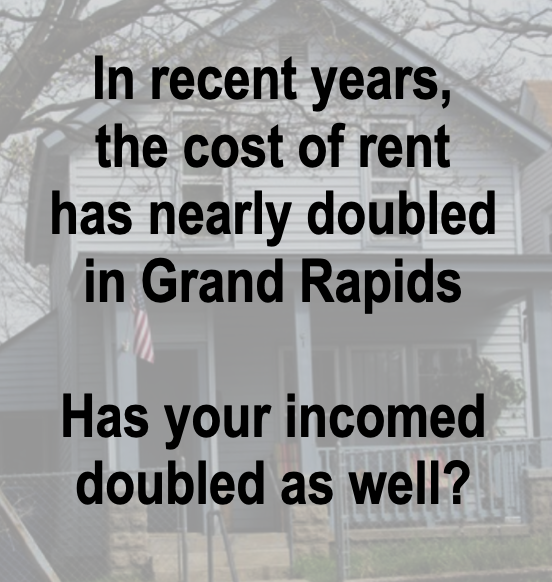 The increase in rent in Grand Rapids is nothing new. People have been feeling the high cost of rent for several years now, often resulting in people leaving Grand Rapids and going to surrounding communities like Wyoming and Kentwood.
On Wednesday, WOOD TV 8 ran a story about the high cost of rent, a story with the headline, “W. MI community members concerned about high rent prices.”
The channel 8 story isn’t very in-depth, but it does offer a poll taken by a WOOD TV 8 reporter, who asked the question, “Has your rent personally gone up?” The informal poll showed that 55.3% of respondents said that rent had gone up for them by more than $100.
The article has one former renter, who left the area because of high rent costs. However, the only other people cited in the story are an investment specialist for NAI Wisinski and who rents out properties in Grand Rapids. Both of the comments from those who benefit from high rent costs DO NOT address the concerns about the high cost of rent, they divert attention to the old argument of market demand.
The fact is, that in recent years, landlords and property management companies have jacked up the price of rental units because Grand Rapids has become more of a destination for those in the professional class, who can afford the increased costs. However, for those who have been living and renting in this community for the past several decades, the increased cost of rent has forced them out of the city.
In 2015, there was a study done by the National Low Income Housing Coalition, which stated that to, “afford an average two-bedroom apartment in Michigan, you would need to make $15.16 an hour.” This was in 2015, so just imagine how much more you would need to earn to afford rent in Grand Rapids right now. Here is some very sobering data from the National Low Income Housing Coalition for Michigan that is from this year.

To make matters worse, the local radio station WFGR took some of the content from the channel 8 story and made it even more ridiculous. The WFGR headline reads, How To Get Your High Rent Price In West Michigan Lowered.
In this awful article, they provide advice on how to get your rent lowered, which is:
- ask for lower rent
- have comparables ready
- offer a longer lease for lower rent
- ask about amenities
- ask for pet increases and parking/garage costs to be removed
- help landlords fill vacancies for a discount or credit
- sell yourself as a model tenant
- be nice!
Their advice is to allow the landlord, the property management company and the “market” to dictate the narrative around rental costs. The thing is, there is another way to get rent costs lowered, which is to join a tenant union. All across the country, tenant unions have been winning rent reductions, rent freezes and rent control. When tenants are organized, they can have a say in rental costs, rental conditions and rental contracts.
If you live in Kent County, you can contact that Grand Rapids Area Tenant Union, either through their Facebook page, or their e-mail gratunion@gmail.com, if you are interested in being part of the tenant union and fighting for housing justice!

