- Get educated. See the list of books, films and online sources below. It is especially critical that we understand the history of US support for Israel, if we want to understand the Palestinian struggle.
- Make sure you center the voices and lived experiences of Palestinians who live in West Michigan. Contact the Arab American Association of West Michigan.
- Protest US Aid to Israel. Do actions at Senator Peters and Senator Stabenow’s offices, since both of them have consistently support Israel. Senator Peters is a major recipient of Pro-Israel PAC money.
- Participated in the International Boycott, Divestment, Sanctions (BDS) Campaign, which is one of the most effective ways to be in solidarity with Palestinians. https://bdsmovement.net/
- In Grand Rapids, target groups like the Right Place Inc, which has lobbied to bring Israeli companies to West Michigan. https://griid.org/2016/04/06/israeli-apartheid-week-targets-the-right-place-inc-in-grand-rapids/
- Understand and Confront Christian Zionism, which is rampant in West Michigan.
Books
Boycott, Divestment, Sanctions: The Global Struggle for Palestinian Rights, by Omar Barghouti
Except for Palestine: The Limits of Progressive Politics, by Marc Lamont Hill and Mitchell Plitnick
Hundred Years’ War on Palestine, Rashid Khalidi
The Ethnic Cleansing of Palestine, by Ilan Pappe
Popular Resistance in Palestine: A History of Hope and Empowerment, by Mazin Qumsiyeh
The Battle for Justice in Palestine, by Ali Abunimah
On Palestine, Noam Chomsky and Ilan Pappe
Against Apartheid: The Case for Boycotting Israeli Universities, Edited by Ashley Dawson and Bill Mullen
Inter/Nationalism: Decolonizing Native America and Palestine, by Steven Salaita
Ten Myths About Israel, by Ilan Pappe
Apartheid Israel: The Politics of an Analogy, by Jon Soske and Sean Jacobs
Israel Lobby and U.S. Foreign Policy, by John Mearsheimer and Stephen Walt
Fateful Triangle: The United States, Israel, and the Palestinians, by Noam Chomsky
Films
Occupation 101
The Occupation of the American Mind: Israel’s Public Relations War in the United States
Peace, Propaganda and the Promised Land: US Media and the Israeli-Palestinian Conflict
Al-Nakba: The Palestinian Catastrophe 1948
Waiting for Armageddon
With God on Our Side
Online Resources
https://electronicintifada.net/
Home
Home

On Thursday, MLive reported that a group of Republican lawmakers in Michigan had presented their police funding plan, which would include $80 million for recruiting and training.
The article cites House Speaker Jason Wentworth and his fellow Republican, Rep. Mike Mueller. While the MLive article mentions some of what the proposed $80 million would go towards, they leave out a whole list of items, such as:
- Tuition assistance for people considering the police academy
- A work study program to give people an opportunity to consider a career
- Incentives for community policing
- Incentives for expanded use of body cameras
- Incentives for de-escalation training
- Access to mental health services for police, corrections workers and other first responders
- A signing bonus for new officers
- State support for secondary road patrols
- State support for recruiting strong candidates into the academies
All of these items listed are meant to convey the message that police are valued and that the government can provide incentives to provide more resources to the police. The financial incentives are offensive, since taxpayers already pay the salaries of police departments across the state.
Then there is the matter of body cameras, while are generally seen as a form of accountability. However, there is plenty of evidence that body cams do not lead to more accountability and they are often a distraction in the much larger issue of what the real function of policing is in the US.
Incentives for community policing is just a a form of branding to suggest that cops will be more integrated into the community, when in fact, as police historian Kristian Williams has documented, community policing is another form of surveillance and tool of counter-insurgency. (See the book, Life During Wartime: Resisting Counterinsurgency)
Lastly, the notion that cops don’t have enough training is just plain not based in fact. Alex Vitale, author of the book, The End of Policing, documents that regardless of the type of training, whether it is racial sensitivity or de-escalation, it has no positive impact on how policing is done throughout the country.
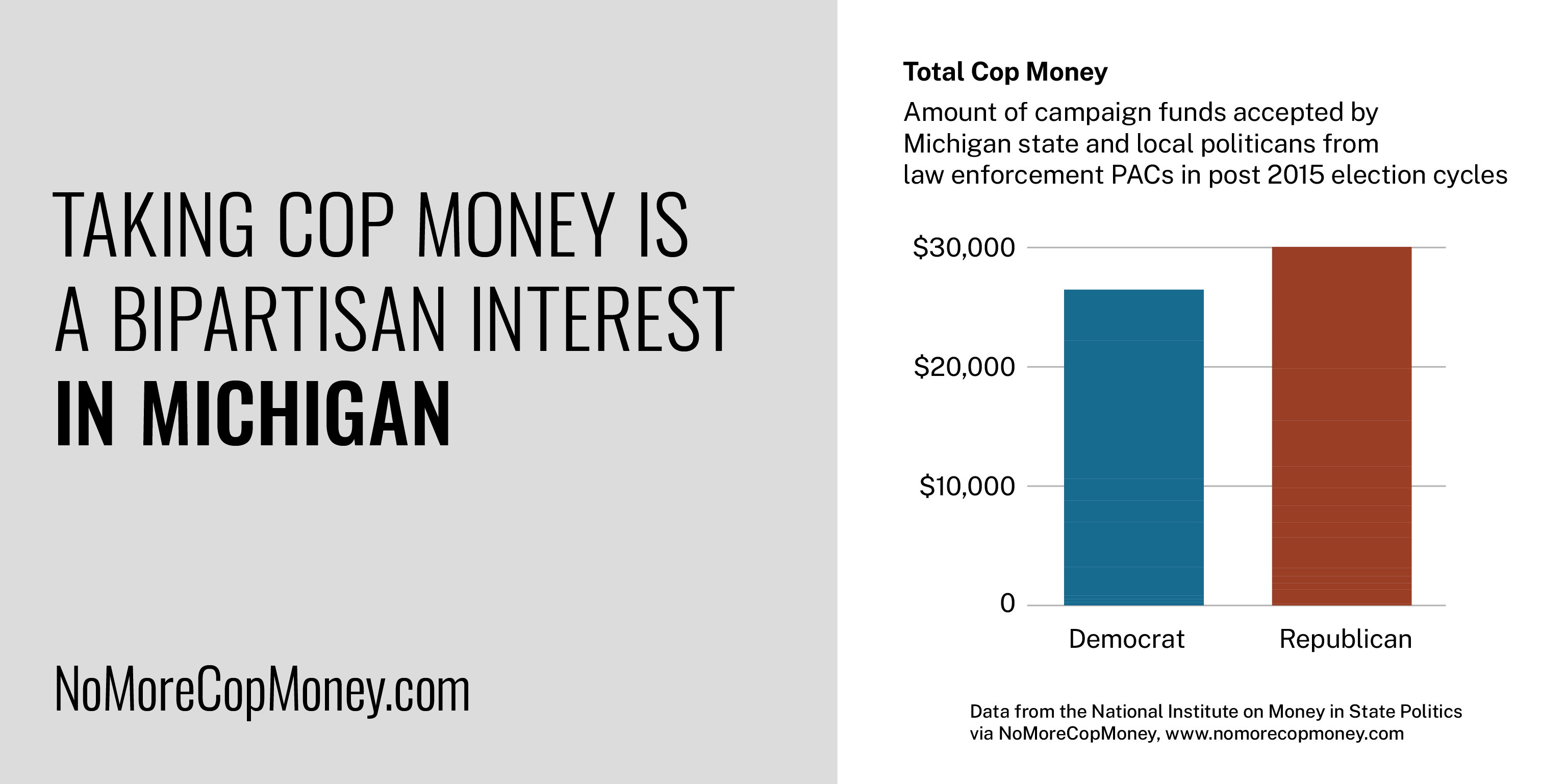
The MLive article also does not tell us that the GOP legislators cited in the article have both received funding from various policing unions in Michigan, with Wentworth receiving $1,250 and Mueller receiving $800, according to the site No More Cop Money.
MLive also wrote:
House Democrats were critical of the plan, noting their caucus’ proposed budget amendments incorporating similar proposals were voted down by House Republicans this week.
However, the MLive article fails to mention that the Michigan Democrat who was arguing about their police funding plan, Rep. Donna Lasinski, has also been the recipient of police union funding, to the tune of $1,500. In fact, No More Cop Money makes it clear that police unions fund both Republicans and Democrats in Michigan. This is just one of the reasons why the Defund the Police movement does not trust that elected officials will easily respond to their demands, especially since they are taking money from police unions and crafting police policy simultaneously.
Last week, water protectors showed up in Lansing and in Mackinaw City to send a strong message to the Enbridge Corporation, that they are now illegally operating Line 5 in Michigan.
In fact, as we reported on May 4th:
Water Protectors, Tribal Citizens and Grassroot Organizations are mobilizing to demonstrate support for Governor Whitmer and DNR Director Eichinger’s termination of the 1953 easement permit. Great Lakes Water Protector’s would like to invite the ALL Sovereign Tribes of the Great Lakes region and ALL State Officials from the Executive Office, Governor’s Office, EGLE, State and Federal Congressional and Senate Delegations. Tell the citizens of this State how OUR REPRESENTATIVES plan to proceed with Enbridge’s unwillingness to uphold the decision of the State.
This resistance to the Enbridge Corporation, which is a fossil fuel fascist, has been growing, with Climate Justice movements, particularly indigenous people leading the way. During the Eviction Party last week in Mackinaw City, there were also Water Protectors who came from Minnesota, people who have been fighting the Enbridge Line 3. Long-time organizer, author and Water Protector, Winona LaDuke, who is one of the main organizers against Line 3, spoke at the Eviction Party, which you can watch here.
Despite all of the growing resistance to Enbridge’s Line 5, on May 12th, the Michigan Senate passed an amendment to Senate Bill 90, which would:
require the state to pay the legal fees of the Line 5 gas pipeline company after Gov. Whitmer revoked the 1953 easement that authorizes its pipeline to cross Mackinac Straits bottomlands, if the company prevails in a lawsuit against the taking.
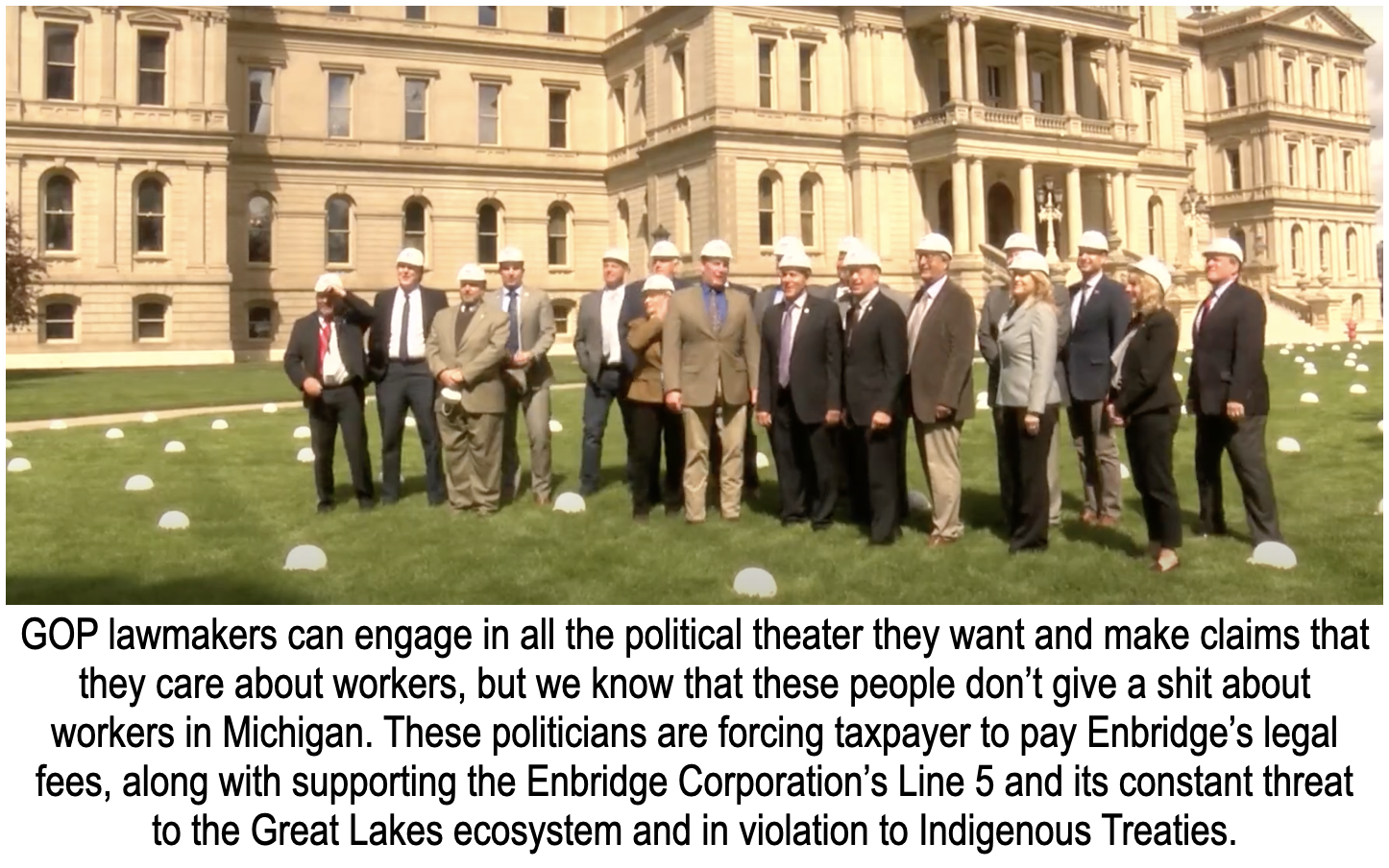
The amendment to pay legal fees to Enbridge passed 20 – 16, completely on partisan lines, with 20 Republicans voting for the amendment and 16 Democrats voting against it. The amendment was proposed by Sen. Ed McBroom, who represents Michigan’s Upper Peninsula. On May 11th, Sen. McBroom joined other members of the GOP on the lawn of the State Capitol for some public theater, claiming that shutting down Line 5 would take away jobs, as can be seen in the video here.
McBroom and other Republican Senators standing on the State Capitol lawn, claiming to care about workers, is both laughable and absurd, considering how often Michigan Republicans attack unions, oppose an increase in minimum wages, and support massive tax breaks to businesses.
What McBroom and his fellow Republicans are doing with this amendment is to use taxpayer money to pay Enbridge’s legal fees while the fossil fuel giant has made billions in profits and constantly threatens the Great Lakes and all of the adjacent water systems.
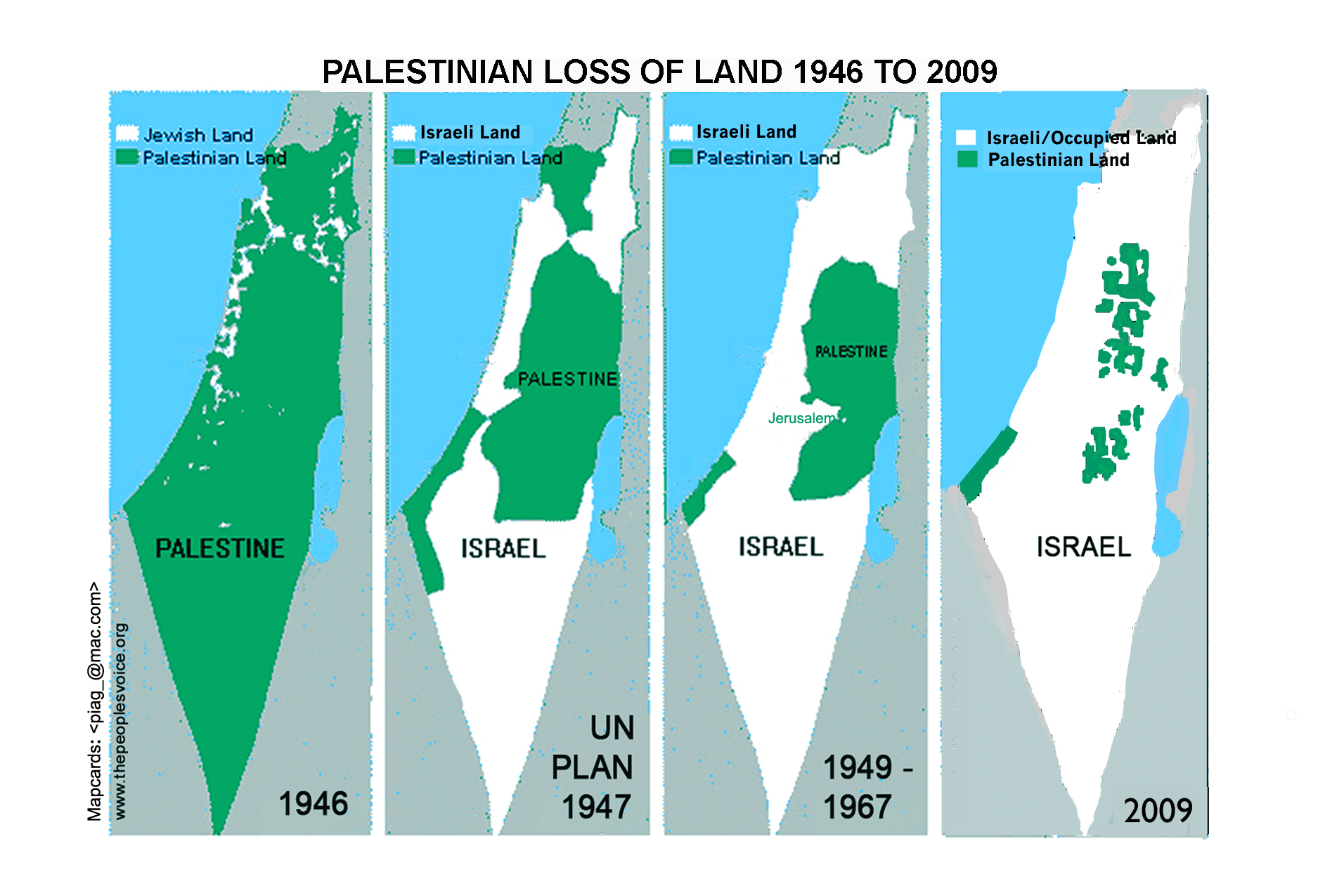
It’s hard to watch recent news reports about the brutality of the Israeli Apartheid State and their treatment of Palestinians.
Some of the best news and analysis of what Israel is doing to the Palestinians can be found on the independent site Electronic Intifada, a site that has been reporting on Israeli policies for the past 20 years.
One issue that has again gained some attention because of the escalation of Israeli brutality, is the level of US funding to Israel. In fact, Israel is the number one recipient of US aid and has been for decades, providing on average about $3 Billion a year. However, we rarely hear about this fact, because every US administration since Nixon has aggressively supported Israel, with almost unanimous support from the US Congress.
Those who question US support of Israel are often branded as anti-semitic. However, being critical of the State of Israel or more specifically of Zionist policies, is not anti-semitism. A great resource on understanding how criticism of Israel is equated with anti-semitism, is the documentary film entitled, The Occupation of the American Mind
Israel’s Public Relations War in the United States, produced by the Media Education Foundation.
Zionism and Palestinian Solidarity in Grand Rapids
Since the 1980s there has been numerous efforts and campaigns in support of the Palestinian people, beginning with the Middle East Education Project, which was a branch of the Institute for Global Education.
In 2001, the local Arab community paid for 15 people to rent a van and travel to Washington, DC, to participate in the massive US Palestinian Solidarity march. Those who went from Grand Rapids, produced a short documentary on the march and the Teach-In that was held over a 3 day period.
In 2002, organizers host a Teach-In on Israel/Palestine at Aquinas College, which featured the founder of the site Electric Intifada. While the Teach-in brought out nearly 150 people, it did not result in greater Palestinian Solidarity, primarily because the US was already making plans to bomb Iraq, which is where people directed their attention.
Beginning in 2009, the Arab American Association of West Michigan was formed as a way for the local Arab community to respond to Israeli attacks on Palestinians, like the rally we reported on in 2010.
However, whenever these campaigns or action are organized, there are often counter-protests coming from the pro-Israeli community, often organized by the Jewish Federation in Grand Rapids.
There are also lots of Christians who defend Israel no matter how often they brutalize Palestinians. For example, a church hosted a speaking tour organized by Stand With Us, which we also reported on in October of 2010. Our story was in sharp contrast to the story that the Grand Rapids Press ran one week later, which we also reported on.
In fact, the local news media often gives lots of attention to pro-Israeli events, like the one that was held in Rosa Parks Circle in the summer of 2011, which featured numerous speakers, including then US Representative Peter Hoekstra.
There are also other pro-Israeli connections in the Greater Grand Rapids area, such as the Right Place Inc. The Right Place Inc has worked to bring Israeli companies to West Michigan and their former CEO was part of a group called the Michigan Israel Business Bridge. In the Spring of 2016, there was an action as part of the international Israeli Apartheid Week in Grand Rapids, where the Right Place Inc was targeted.
Beginning in 2015, the now defunct group Healing Children of Conflict, decided to work on a Boycott, Divestment and Sanctions (BDS) campaign in Grand Rapids. The BDS Campaign is an international campaign organized by Palestinians that is model after the South African Anti-Apartheid Campaign, which the City of Grand Rapids participated in during the early 1980s.
In late 2015, Healing Children of Conflict presented a resolution to the Grand Rapids City Commission to get the City of Divest from any companies benefiting from the Israeli occupation of Palestinian land. George Heartwell was Mayor of Grand Rapids at that time, but he would not take a position on the matter.
The local BDS campaign then met with the incoming Mayor of Grand Rapids, Rosalynn Bliss in early 2016, but Bliss did not want to consider a City resolution to divest from companies profiting off of the Israeli occupation of Palestinian land. The Mayor’s only argument was that she did not want to offend the Jewish community here in Grand Rapids.
Those involved with the BDS campaign decided to then meet with the Community Relations Commission a few months later in 2016. There were productive meetings, which eventually led to a formal draft of a resolution, which read in part:
NOW, THEREFORE BE IT RESOLVED that,
1. The City of Grand Rapids, Michigan, divest itself and/or make no further business dealings or purchases from four companies due to their serious human rights violations in the ongoing illegal Israeli Occupation of Palestinian Lands until those companies have ceased their complicit activities or the Israeli Government has ceased its policy of occupation and practice of apartheid. The four companies are: Caterpillar, Hewlett-Packard, G4S, and Motorola Solutions.
2. Denounces the use of violence as a means to resolving the conflict between the Palestinian people and the state of Israel,
3. Recognizes that the Jewish people and Judaism are not synonymous with the government of Israel or its policies.
You can read the entire 4 page proposed resolution here.
While the Grand Rapids Community Relations Commission was in agreement with the proposed resolution, there was no movement forward with the resolution because members of the Community Relations Commission felt that there were more pressing local issues to deal with, specifically racism in Grand Rapids. However, what people failed to understand is that these issues are connected, which is exactly why the international BDS Campaign has been in solidarity with the Black Lives Matter Movement and the Movement for Black Lives has fully endorsed the BDS Campaign for Palestinian justice.
It is critical for people in Grand Rapids to speak out against the Israeli Apartheid and stand in solidarity with Palestinians, just as people in Grand Rapids have done for decades.
On Monday, the Grand Rapids Police Officer’s Association, the union that represents the GRPD, posted an image on their Facebook page for National Police Week.
National Police Week was first instituted during the Kennedy Administration, with a Congressional resolution that referred to cops as Peace Officers. This should not surprise us, since the system of power in the US has always celebrated the police as an important and necessary component of state power.
However, we know that the police were created in the US as a form of slave patrols, then shifting to policing black bodies under the system of Jim Crow. Police Departments were also heavily relied on to control disgruntled workers and stop worker tactics like strikes, acting as sort of an enforcement tool for the Capitalist class.
During the Civil Rights era, the police were used as enforcement mechanism to defend the structural aspects of White Supremacy, making sure that Black people knew their place in a society constructed on systemic racism.
Today, however, with a growing number of people questioning the very existence of police, the celebration of National Police Week by the Grand Rapids Police Officer’s Association seems like a desperate attempt by the local cop union to legitimize their existence, especially in the face of a growing movement that is calling for the GRPD to be defunded.
The political and media systems in Grand Rapids have done everything they can to defend the GRPD, along with their attempt to co-opt the language of the larger defund/abolish policing movement, a movement that Black scholar Keeanga-Yamahtta Taylor has documented so well in her recent essay entitled, The Emerging Movement for Police and Prison Abolition.
In addition, the resistance upon the part of Grand Rapids officials to even consider a minor reduction in the funding for the Grand Rapids Police Department, has been both instructive and expected. Despite the claims of Grand Rapids City officials, that the City is committed to racial justice and equity, they have demonstrated over the past year that they are deeply committed to maintaining a form of policing that is centered around protecting property and power.
The GRPD and City officials have attempted to use reformist language and to re-brand what the cops do in this city, yet many people are not fooled by their re-branding based on their continued attacks against members of the Black community.
The recent response from City officials to community opposition to the proposed 2022 Budget, especially how much is allocated for the GRPD, has also be interesting to observe. Both City Manager Mark Washington and Mayor Rosalynn Bliss have shown that they are completely unwilling to even entertain a reduction in the GRPD’s funding. Bliss and Washington have both dug their heels in by attempting to present the GRPD as a force for good, along with the claim that police staff is too low for Grand Rapids. All of the rhetoric coming from City officials has made it clear that they do not care that there is a growing opposition to the GRPD in this community, which means they don’t care what their constituents want.
What Grand Rapids City officials are hoping for is that people will “move on” from any talk about defunding the police and eventually get things back to normal. However, this is not likely to happen, since there is growing opposition to the function and existence of the GRPD.
Within the past two months, there have been numerous protests against the GRPD, which has resulted in the cops targeting Black organizers.
The GRPD initiated Operation Safe Neighborhoods, where they used helicopters to harass mostly 3rd Ward residents, resulting in hundreds of messages being sent to the City condemning Operation Safe Neighborhoods.
When the City of Grand Rapids announced their plans for the 2022 City Budget, both Justice for Black Lives and Defund the GRPD organized a series of actions, along with clear demands that not only call for a reduction of police funding, but a rejection of the 2022 City Budget, particularly to allow more time for public input.
In addition, Defund the GRPD has been inviting people to re-imagine how public money could better be spent in this community, by re-directing it from the GRPD to meet urgent community needs. The responses that the community have presented are both thoughtful and amazing.
Lastly, both Justice for Black Lives and Defund the GRPD will be hosting a Defund the GRPD Rally and march this Friday, May 14, starting at 6pm at Calder Plaza.
All of this is to say that this movement will not go away and it will not move on. Those calling for the Defunding of the GRPD are passionate, articulate and committed organizers that the City of Grand Rapids will have to reckon with. This is a historic moment and history will not be kind to those who have sided with power and privilege. As the old organizers song asks, which side are you on my people, which side are you on!

This is our latest installment of The Devil is in the Details, which takes a critical look at Grand Rapids politics and policies, based primarily on the public record, such as committee agendas and minutes. In this installment we look at the proposed 2022 budgets for numerous committee that operate in Grand Rapids, all of which have development as a primary focus.
There has been a great deal of interest generated around the overall 2022 City Budget, primarily because of how much the GRPD continues to receive, but also because of how undemocratic the process for public involvement is in determining how public tax dollars are spent.
The same could be said for all of the upcoming votes on 2022 Budgets for committees that all have Board of Directors, but no elections. The entities we wish to take a look at are the Downtown Development Authority (DDA), the Brownfield Development Authority, the SmartZone Local Finance Development Authority, the Economic Development Corporation, Southtown CIA, Westside CIA, Uptown CIA, Uptown BID, Michigan Street CIA, South Division/Grandville CIA and North Quarter CIA.
Yesterday, during the Committee of the Whole meeting, City officials were discussing the various budgets for the entities listed above, as reflected in the Agenda Packet linked here.
What is clear to this writer is the fact that the bulk of the public money that these committees are using is 1) for development projects, generally to subsidize a private contractor/developer; 2) that all of those who sit on the board of directors of these committees are appointed and not elected; and 3) the overwhelming representation on these boards of directors are from the business sector, often business owners in the city that will likely benefit from the improvement/development projects they will be making decisions on.
Below is the list of the various entities that will be receiving funding from the 2022 Grand Rapids City Budget. Collectively, these groups are asking for $42,826,282 of mostly public money to be used primarily for development projects that many residents are unaware of. Now, there are plenty of people who say that this is how things get done, which is true on one level, but an alternative way of looking at this is how else might nearly $43 million be spent, especially if the public was allowed to have a say crafting these decisions? What would be fundamentally different if the budgeting process was participatory and democratic? How could the public radically imagine that $43 million would be spent in this community? How would participatory budgeting transform not only the process by which decisions are made in this city, think of how differently the funding priorities might be.

The proposed 2022 Budget for the Downtown Development Authority (DDA) is $21,724,900.
DDA Board of Directors
Richard Winn – AHC Hospitality (DeVos-owned)
Mayor Rosalynn Bliss
Luis Avila – Varnum Law
Kayem Dunn – Consultant
Jermale Eddie – Malamiah Juice Bar
Greg McNeilly – Windquest Group (DeVos-owned)
Jim Talen – former Kent County Commissioner
Diana Sieger – Grand Rapids Community Foundation
Jen Schottke – ABC Western Michigan
The proposed 2022 Budget for the Brownfield Development Authority is $15,722,514.
BDA Board of Directors
Guillermo Cisneros – West Michigan Hispanic Chamber of Commerce
Lynn Rabaut – retired
Kristine Bersche – Natura Architectural Consulting LLC
Troy Butler – Thacker Sleight
Nathaniel Moody – City Commissioner
Kim McLaughlin – Wolverine Building Group
Micah Perkins – Retirement Services Officer US Army
John VanFossen – Meijer
Joshua Verhulst – Tech Defenders
Stanley Wisniski –
The proposed 2022 Budget for the SmartZone Local Finance Development Authority is $3,317,800.
SmartZone LFDA Board of Directors
Wayman Britt – Kent County Administrator
Keith Brophy – Emergent Holdings Inc.
Gerald Callahan – Van Andel Institute
Lisa Freiburger – GRCC
Kristian Grant – GRPS
John Helmholt – GRPS
Joe Jones – City Commissioner
Jerry Kooiman – MSU
Mark Holzbach – Tiny World Tours
Therese Thill – The Right Place Inc
Dante Villarreal – GR Chamber of Commerce
The proposed 2022 Budget for the Economic Development Corporation is $122,956.
Economic Development Corporation Board of Directors is the same as the Brownfield Development Authority.
Guillermo Cisneros – West Michigan Hispanic Chamber of Commerce
Lynn Rabaut – retired
Kristine Bersche – Natura Architectural Consulting LLC
Troy Butler – Thacker Sleight
Nathaniel Moody – City Commissioner
Kim McLaughlin – Wolverine Building Group
Micah Perkins – Retirement Services Officer US Army
John VanFossen – Meijer
Joshua Verhulst – Tech Defenders
The proposed 2022 Budget for the Southtown Corridor Improvement Authority is $717.008.
Southtown CIA Board of Directors
Bill DeJonge – PNC Mortgage
Johnathan Farman – JF Consulting
Kristian Grant – GRPS
Helen Harp – Owner Joy Radio
Senita Lenear – City Commissioner
Isaac Norris – Isaac V. Norris & Associates, P.C.
Ruben Ramos – R&R Mechanical Services LLC
Darel Ross – Start Garden and Owner Forty Acres Soul Kitchen
The proposed 2022 Budget for the Westside Corridor Improvement Authority is $282,000.
Westside CIA Board of Directors
Peter Brand – CEO Mindscape
Johnny Brann Jr. – Brann’s Restaurant
Daniel Grinwis – Oasis of Hope Center
Lisa Haynes – GVSU
Michael Lamonaco – HealthBar
Paola Mendivil – Ferris State University
Jon O’Connor – City Commissioner/Owner of Long Road Distillers
Dave Shaffer – CEO Interphase Interiors
Andrew Sisson – Mel Trotter Ministries
The proposed 2022 Budget for the Uptown Corridor Improvement Authority is $329,600.
Uptown CIA Board of Directors
Lynn Happel – owner of Veterinary Clinic
Stephanie Johnson – Urban Exchange LLC
Nathaniel Moody – City Commissioner
Matthew Smith – Open Systems Technologies Inc
Mark Stoddard
Tamara Sytsma – System Wealth Strategies
Peter Vanderwier
The proposed 2022 Budget for the Uptown Business Improvement District is $134,004.
Uptown BID Board of Directors
Stephanie Johnson – Urban Exchange LLC
Nathaniel Moody – City Commissioner
Matthew Smith – Open Systems Technologies Inc
Tamara Sytsma – System Wealth Strategies
Peter Vanderwier
Ted Lott – Lott3Metz Architecture
Jaye Van Lenten – Co-owner of Spirit Dreams
The proposed 2022 Budget for the Michigan Street Corridor Improvement Authority is $285,000.
Michigan Street CIA Board of Directors
Max Benedict – Third Coast Development
Kevin Brant – Developer
Thomas Dann – Real Estate Agent
Joe Jones – City Commissioner
Alexander Lamkin
Jeff Lobdell – Restaurant Partners Inc.
Christopher Swank – GVSU
Joseph Vugteveen – GVSU
The proposed 2022 Budget for the South Division/Grandville Corridor Improvement Authority is $116,500.
South Division/Grandville CIA Board of Directors
Amy Brower – Roosevelt Park Neighborhood Association
Fran Dalton – Garfield Park Neighborhood Association
Mary Dengerink – Green Leaf Consulting
Synia Jordan – Real Estate Agent
Ana Jose – Transformando West Michigan
Henry Pena
Kurt Reppart – City Commissioner
Leonard Van Drunen – Calvin University
Angelica Velasquez – owner of La Casa de la Cobija
The proposed 2022 Budget for the North Quarter Corridor Improvement Authority is $75,000.
North Quarter CIA Board of Directors
Hannah Berry – Lions and Rabbits Center for the Arts
Duane Culver – Culver CPA Group
Brianna Forbes – Urban Massage
Cassandra Oracz – Dwelling Place of Grand Rapids
Rachel Posthumus – Switchback Gear Exchange
Milinda Ysasi – City Commissioner
This is our latest installment of The Devil is in the Details, which takes a critical look at Grand Rapids politics and policies, based primarily on the public record, such as committee agendas and minutes. In this installment we look at recent recreational cannabis operations likely to be approved by the Grand Rapids Planning Commission during their May 13 meeting.
As we have noted in several previous postings, the majority of cannabis businesses in Grand Rapids continue to be owned by companies that are not local, companies that have multiple locations now in the city and companies that are doing little or nothing to address the long-standing harm that has been done during the War on Drugs, particularly against the Black community.
There are three new recreational cannabis operations up for approval by the City Planning Commission, one by Green Skies – Healing Tree LLC (which is known as 3Fifteen) and two by Oak Flint LLC.
Green Skies – Healing Tree LLC, which has 17 dispensary applications submitted, is owned by Leafly and has dispensaries all over Michigan, as well as other states in the US. Leafly is a subsidiary of a much larger company, Privateer Holdings, which owns numerous other businesses within its portfolio.
Oak Flint LLC, which has 3 dispensary applications submitted, also has applications submitted in Lansing. Oak Flint LLC was founded by John McCloed, who used to be a Real Estate Agent and was a special Operations in the Detroit Police Department for 11 years.
Both Green Skies – Healing Tree LLC and Oak Flint LLC are not local, they both already operate cannabis operations in Grand Rapids, and we could find no evidence that either of these business are investing in the work of undoing the harm created by the War on Drugs. In fact, just the opposite is happening.

For example, when people were selling cannabis on the street, before states been legalizing the drug, a disproportionately high number of African Americans were being arrested and sentenced for selling cannabis. Now, white entrepreneurs are doing the exact same thing and making millions, with no legal consequences.
Another reality is that it is very difficult for Black people wanting to get into the Cannabis business, as was reflected in a recent article entitled, Black-Owned Pot Businesses Remain Rare Despite Diversity Efforts. One Black aspiring cannabis business owner states, “A lot of times we’re people who grew up basically on the streets. A lot of us don’t have college educations. We’re not contract-savvy, we don’t have a team of lawyers.”
In an excellent article entitled, The legal cannabis industry must reckon with systemic racism, the writer states:
The legal and medical cannabis industry has long been complicit in the systemic oppression of Black people. As Black Lives Matter protests continue around the country, activists, doctors, and entrepreneurs are calling for those in cannabis to dismantle the systemic racism the industry is built on.
In the wake of the protests against police brutality following the death of George Floyd, a Black man who was killed by a white police officer in Minneapolis, all facets of American culture are forced to rethink its approach to race. The cannabis industry, which has a projected economic impact of $77 billion by 2020, is steadily growing. But the effects of the generations-long war on drugs are still prevalent in marginalized communities, particularly Black ones.
The assessments presented in these articles is a reflection of what is happening in Grand Rapids. When the cannabis businesses that are opening are not local, when they own multiple locations in the city, and when they do virtually nothing to create racial equity or undo the harm of the War on Drugs, then they perpetuate the same kind of long-standing structural racism that has plagued Grand Rapids since the city was founded.

On Friday, MLive ran an article entitled, GRPD training being questioned after Black man forcibly arrested despite police stopping the wrong vehicle.
The article details a recent arrest by the GRPD of a Black man who was on the way to his his mother-in-law’s wake. Several GRPD officers forced the man to the ground, put a knee on him and then cuffed him while he was face down in a parking lot.
However, the man the GRPD physically assaulted and arrested was the wrong person. The GRPD was looking for a Black man in a silver pick up truck and the man they ended up arresting also had a silver truck, but it was the wrong person.
Now, the Black man who was arrested was charged with resisting and obstructing a police officer, because “he was tensing his muscles in his arms.” Apparently, if the police force you on the ground and put their knees in your back, you should just relax, regardless of whether you committed a crime or not. Here is just another instance where the law supports police action, even if those actions seem to any reasonable person to be abusive, violent and just plain bullshit.
The Black man who missed his mother in-law’s wake, because he was arrested and taken to the Kent County Jail has every moral right to fight the GRPD for their wrongful arrest. However, the GRPD has the full force of the law behind them, since most laws are crafted from a pro-police framework and because the police will always be able to argue that they were justified in their actions, especially since the Black man they stopped fit the description of someone they were looking for.
The GRPD’s Internal Affairs is looking at the case, but will most likely side with the officers who falsely arrested this particular Black man, especially since he was tensing his muscles when they were trying to cuff him. The police were just doing their job and this particular Black happened to be in the wrong place at the wrong time, or at least this is what the GRPD would have us believe.
Besides, the GRPD was quoted in the same MLive article, stating:
“The GRPD continues to be dedicated to transparency and accountability regarding police operations, particularly when it comes to using force. When it is appropriate, and allowable under law, we are committed to providing full context to our encounters and answering the community’s questions and concerns.”
This rhetoric sounds nice, but the important point here is to understand what is allowable under law. The GRPD can keep as much information as they want in house and can decide what to share or not share with the news media, with the Office of Oversight and Public Accountability or anyone else for that matter, because the law works in favor of protecting the state and the police are just an enforcement unit for the the state, meaning the government.
Therefore, the Black man who was assaulted by the GRPD, arrested and taken to jail, doesn’t have the force of law behind him. The GRPD charged him with resisting arrest and obstructing a police officer, which by their definition is true. So, do you see how the system works here. Even if you did nothing that was illegal, as defined by the government, you can still get arrested for looking like a suspect. Plus, in the process of being arrested, if you resist, even though you did nothing illegal, you can be charged with a crime because your muscles tightened up while 3 cops forced you face down, on the ground and put their knees on your back.
Now, Kent County Commission Robert Womack is questioning how officers in the GRPD and being trained. What Commissioner Womack fails to understand is that this is exactly how the cops in the GRPD were trained and that the over policing in Black and Brown neighbors is the norm. Alex Vitale, author of the important book, The End of Policing, writes:
Well trained police following proper procedure are still going to be arresting people for mostly low-level offenses, and the burden will continue to fall primarily on communities of color because that us how the system is designed to operate – not because of the biases or misunderstanding of officers.
This is how the system of policing is designed to function. For the GRPD, it doesn’t matter that they stopped the wrong Black man, what matters is that they were doing their job and the wrong Black man still arrest arrested because he tightened his muscles while 3 cops were forcing him to the ground and putting their knees in his back.
Of course, the lesson we should learn from this case is that the system of policing is inherently oppressive, which is exactly why people are calling for defunding and the abolition of the system of policing, because it is a system of oppression. The GRPD and City officials can say that they are committed to re-imagining policing in Grand Rapids, but that is only because they are committed to maintaining the existing systems of power and oppression in this community, despite their well-meaning intentions. If you think that getting the right people elected to the Grand Rapids City Commission will fix this, then you don’t understand how power functions in this city. Only a popular, grassroots social movement that is calling for the defunding of the GRPD, a deep commitment to invest in Black neighborhoods and the abolition of policing will put an end to the GRPD assaulting and arresting more Black people.
Papers not crumbs: Interview with Movimiento Cosecha GR after their action in Washington DC
Last weekend, Movimiento Cosecha GR took two bus loads of people to Washington, DC to make the same demands of the Biden Administration as they did for the Trump Administration.
Movimiento Cosecha is demanding Dignity, Respect and Permanent Protection for all 11 million undocumented immigrants currently in the US.
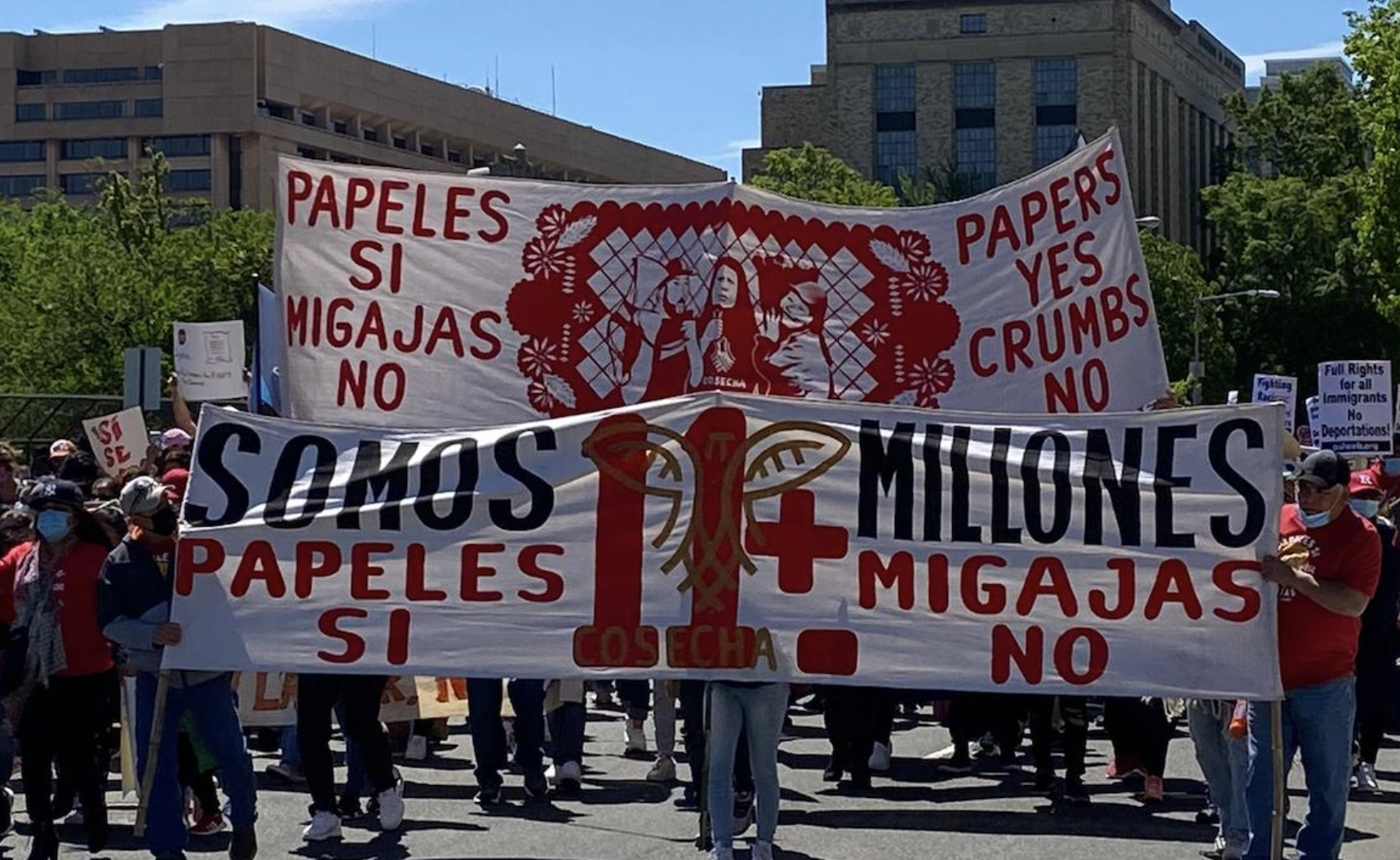
The motivation to go to DC was to make clear that like the previous US Administrations, after the first 100 days in office, the Biden Administration has not looked much different from what immigrants were experiencing under Trump.
We sat down with two of the Cosecha GR organizers, Gema and Idalia, both of who went to DC last weekend. We asked them four questions: 1) What was the main focus of going to Washington DC, since during the past 4 May Days, the actions have been local; 2) What kind of actions did you organize and take part in during the two days in Washington, DC; 3) There has been a clear drop in attention and support by the ally community since the November Election, what message do you have for allies about why it is important to continue supporting the immigrant justice movement; and 4) Those who went to DC were very energized, so how do you maintain that kind of energy and how do you get more people involved for the fight ahead?
During the interview, Gema responded in English and Idalia responded in Spanish, however both of these courageous organizers had powerful things to say. The interview is just under 16 minutes.
Yesterday, the grassroots groups Defund the GRPD and Justice for Black Lives, held a Press Conference at noon, inviting dozens of Grand Rapids-based news agencies.
The Press Conference by two of the groups that came out of the aftermath of the May 30th uprising in Grand Rapids, focused on the 2022 Grand Rapids City Budget proposal, how much the GRPD would receive and the undemocratic budget proposal process.
Unlike previous Press Conferences that Defund the GRPD has organized, both in person and online, yesterday’s Press Conference only had representatives from the Grand Rapids Press, WZZM 13 and WOOD TV 8. It’s always hard to know what drives local news coverage, but one would think that with the second largest city’s 2022 budget being decided upon in a few weeks and a well organized movement calling for defunding of the GRPD, the Press Conference would definitely be news worthy.
A representative with Justice for Black Lives spoke first, followed by someone with Defund the GRPD. Both speakers addressed the violent practices of the GRPD and Defund the GRPD laid out some clear demands (linked here) regarding funding for the GRPD and the City’s budget process.
After the comments made by organizers, there were only three questions asked by the reporters who took part in the Press Conference. The first two question came from a reporter with the Grand Rapids Press, which was followed by a question from WZZM 13. All three questions that were asked were basic questions or questions that still reflected the idea that the GRPD is becoming “more community minded.” For example, the first question asked by the GR Press was, “Does the GRPD Strategic Plan sufficiently re-imagine policing?”
The responses from organizers were solid, but the point here is that the question implies that the GRPD is on the right track. We have seen this over and over again over the years, but especially since the May 30th uprising, where the local news acts either as a PR agent for the GRPD or they act as stenographers, just reporting back what the police said, without questioning or verifying the claims made by the GRPD.
The lack of critical thinking was reflected in the three news stories about the Press Conference that each of the news agency that attended the Press Conference posted yesterday.
In each of the three news stories the stories still utilize City official comments, like the WZZM 13 story, which includes a comment from Mark Washington, recycles previous related story content – as did MLive, or reflects that the news agencies have internalized the values of the systems of power that they report on, like how WOOD TV 8 framed their story. In other words, the dominant commercial media demonstrates a lack of imagination about how reducing the GRPD budget might actually be a huge benefit to the community.
In fact, the dominant commercial media is pretty much incapable of critically examining systems of power and oppression in this community, mostly because they are part of the Grand Rapids Power Structure, as we noted in our ten-part series from 2018. In that article we made the following observation about police and the dominant commercial media:
Another example is how the news media reports on police abuse, or more accurately, mistakes made by a few officers in the police department. The GRPD or any other local law enforcement agency is general presented as serving the public good and when there are issues that arise, it is usually just some aberration, since they are essential to public safety. In other words, the very nature and function of the GRPD is never questioned or investigated, despite the significant levels of mistrust and cynicism that exists in this community about police behavior and how policing impacted particularly Black and Brown residents.
Sitting through yesterday’s press conference only affirms my view that the local dominant commercial news media is incapable of reflecting the aspirations of those working towards dismantling systems of power in this community, particularly since these news agencies are part of that power structure.